About the Report
Base Year 2024New Zealand Emergency Contraceptive Pills Market Overview
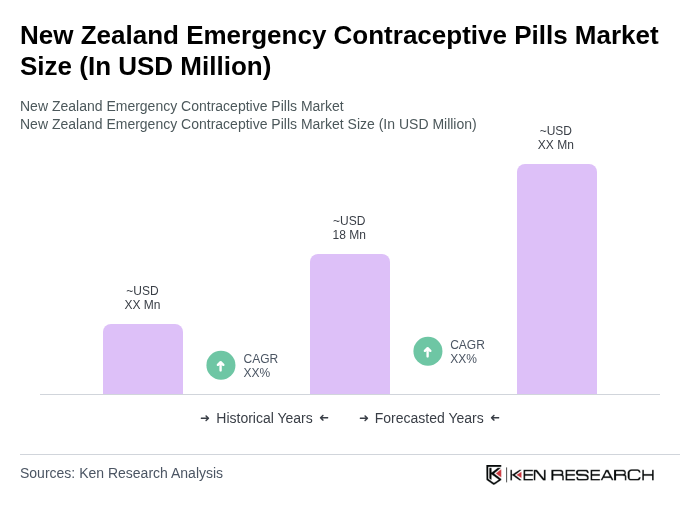
- The New Zealand Emergency Contraceptive Pills market is valued at USD 18 million, based on a five-year historical analysis and the strong penetration of oral emergency contraception in community pharmacy and online pharmacy channels. This growth is primarily driven by increasing awareness of reproductive health, better access to contraceptive options via retail pharmacy chains and telehealth platforms, and the persistently high share of unplanned or mistimed pregnancies within overall pregnancies. The market has seen a steady demand for emergency contraceptive pills, particularly among younger demographics and digitally engaged consumers, reflecting a shift in societal attitudes towards sexual health, privacy, and self-care.
- Auckland and Wellington are the dominant cities in the New Zealand Emergency Contraceptive Pills market due to their larger populations and better access to healthcare services, including high-density community pharmacies and GP clinics. These urban centers have a higher concentration of pharmacies and healthcare providers, facilitating easier access to emergency contraceptive options, and they are often the first to experience and report supply constraints when demand spikes. Additionally, the presence of universities and tertiary institutions in these cities contributes to a more informed consumer base regarding reproductive health and a relatively higher uptake of pharmacy-supplied emergency contraception.
- In New Zealand, regulatory settings allow emergency contraceptive pills containing levonorgestrel to be supplied directly by pharmacists without a prior doctor’s prescription, under pharmacist supply provisions included in the Medicines Act 1981 and the Medicines Regulations 1984 administered by Medsafe and the Ministry of Health. These provisions enable trained pharmacists to dispense specified emergency contraceptive products following a brief consultation, enhancing accessibility for individuals seeking emergency contraception and reducing delays after unprotected intercourse. This framework supports timely access, helps reduce barriers linked to clinic appointments, and promotes responsible reproductive health choices through pharmacist-led counselling at the point of sale.
New Zealand Emergency Contraceptive Pills Market Segmentation
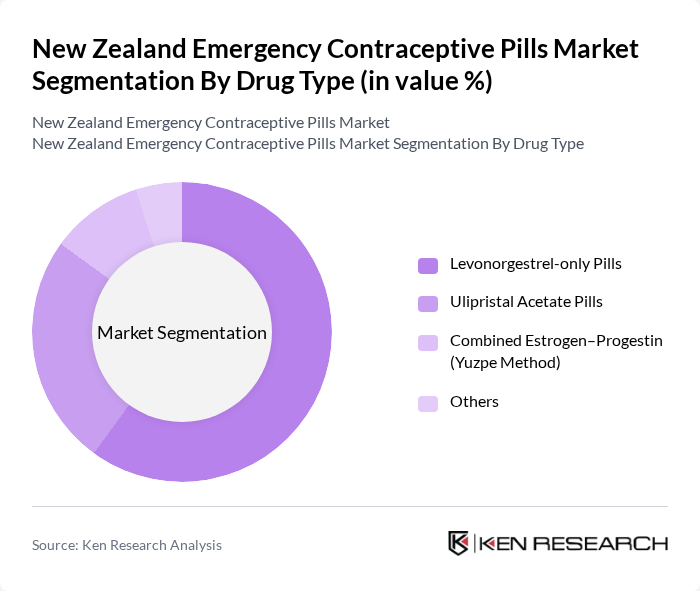
By Drug Type:The market is segmented into Levonorgestrel-only Pills, Ulipristal Acetate Pills, Combined Estrogen–Progestin (Yuzpe Method), and Others. Levonorgestrel-only Pills remain the core of the market, in line with global patterns where levonorgestrel formulations are the most widely used emergency contraceptive due to their well-established safety profile, broad regulatory approvals, and availability through community pharmacies. They are often the first choice for consumers seeking emergency contraception, driven by familiarity, single-dose regimens, and relatively lower cost. Ulipristal Acetate Pills are gaining traction internationally because of their extended window of efficacy up to 120 hours and higher effectiveness closer to ovulation, and in New Zealand they are increasingly considered for women who present later or have higher body weight, where enhanced efficacy is clinically relevant. The Combined Estrogen–Progestin (Yuzpe Method) is less popular as clinical guidance increasingly favours dedicated levonorgestrel or ulipristal products due to better tolerability and efficacy, while the 'Others' category includes less common or clinic-based formulations that are used in specific clinical protocols rather than routine pharmacy supply.
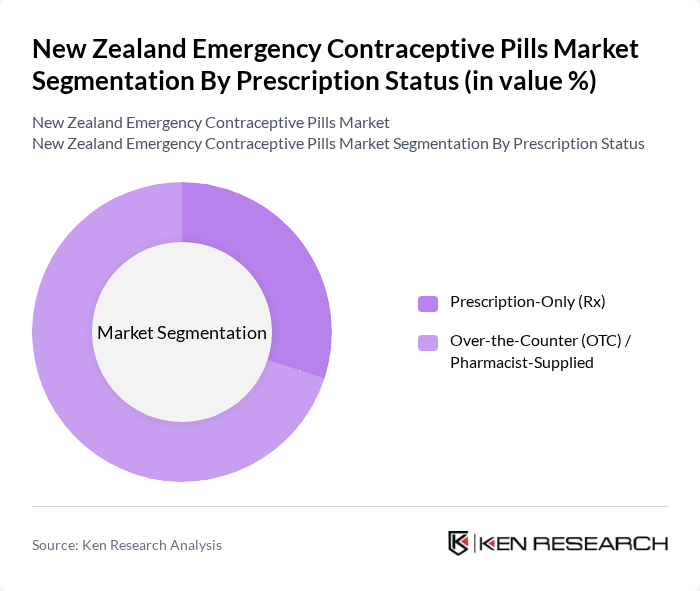
By Prescription Status:The market is divided into Prescription-Only (Rx) and Over-the-Counter (OTC) / Pharmacist-Supplied. The Over-the-Counter / Pharmacist-Supplied segment has seen significant growth in line with international trends where expanded pharmacist and OTC access drives higher utilisation of emergency contraceptive pills and shifts volume away from doctor-prescribed channels. In New Zealand, the ability of pharmacists to supply levonorgestrel emergency contraception without a prior prescription, coupled with extended pharmacy opening hours and increasing use of online pharmacy ordering, has led to increased consumer confidence and a higher volume of sales in pharmacies. The Prescription-Only segment, while still relevant for certain formulations and for patients managed in specialist or hospital settings, is gradually losing share as more consumers prefer the speed, discretion, and convenience of pharmacist-supplied and OTC-style options.
New Zealand Emergency Contraceptive Pills Market Competitive Landscape
The New Zealand Emergency Contraceptive Pills Market is characterized by a dynamic mix of regional and international players. Leading participants such as Bayer New Zealand Limited, HRA Pharma, Viatris (including legacy Mylan portfolio), Pfizer New Zealand Limited, GlaxoSmithKline (GSK) New Zealand, Merck Sharp & Dohme (MSD) New Zealand, AFT Pharmaceuticals Limited, Apotex (New Zealand), Douglas Pharmaceuticals Limited, New Zealand Pharmaceuticals Limited, Chemist Warehouse New Zealand, Countdown Pharmacy, Pharmacy Direct New Zealand, Unichem Pharmacy, Life Pharmacy contribute to innovation, geographic expansion, and service delivery in this space.
New Zealand Emergency Contraceptive Pills Market Industry Analysis
Growth Drivers
- Increased Awareness of Reproductive Health:The New Zealand government has invested NZD 2.5 million in reproductive health education programs, significantly enhancing public awareness. This initiative has led to a 30% increase in inquiries about emergency contraceptive pills (ECPs) over the past year. Furthermore, the rise in social media campaigns has contributed to a more informed population, with 65% of women aged 18-30 now aware of ECP options, compared to just 40% in the past.
- Accessibility of Emergency Contraceptive Pills:The number of pharmacies offering ECPs has increased by 20% since 2021, with over 1,200 locations now providing these services across New Zealand. Additionally, the introduction of telehealth services has allowed for remote consultations, resulting in a 15% rise in ECP prescriptions. This improved accessibility is crucial, especially for women in rural areas, where access to healthcare services is often limited.
- Supportive Government Policies:The New Zealand government has implemented policies that facilitate the distribution of ECPs, including subsidies that reduce costs for consumers. In future, the government allocated NZD 1 million to support initiatives aimed at increasing ECP availability. These policies have led to a 25% increase in ECP usage among women aged 15-24, reflecting a positive shift in reproductive health practices and access to necessary healthcare.
Market Challenges
- Stigma Associated with Emergency Contraceptive Pills:Despite increased awareness, stigma surrounding ECPs remains a significant barrier. A survey indicated that 40% of women feel embarrassed purchasing ECPs, which can deter usage. This stigma is particularly pronounced in conservative communities, where cultural beliefs may discourage open discussions about reproductive health. Addressing this stigma is essential for improving acceptance and usage rates of ECPs in New Zealand.
- Limited Availability in Rural Areas:Approximately 30% of New Zealand's population resides in rural areas, where access to pharmacies is often limited. Many rural communities have only one pharmacy, which may not stock ECPs due to low demand or supply chain issues. This lack of availability can lead to delays in obtaining ECPs, increasing the risk of unplanned pregnancies. Addressing these disparities is crucial for ensuring equitable access to reproductive health services.
New Zealand Emergency Contraceptive Pills Market Future Outlook
The future of the New Zealand emergency contraceptive pills market appears promising, driven by ongoing efforts to enhance accessibility and reduce stigma. With the government’s commitment to reproductive health initiatives and the expansion of telehealth services, more women are likely to seek ECPs. Additionally, the increasing popularity of online pharmacies is expected to further improve access, particularly in underserved areas. These trends indicate a potential for increased usage and acceptance of ECPs in future.
Market Opportunities
- Expansion of Online Pharmacies:The rise of online pharmacies presents a significant opportunity for increasing ECP accessibility. With over 50% of New Zealanders now shopping online, pharmacies can reach a broader audience, particularly in rural areas. This shift can lead to a 20% increase in ECP sales as women feel more comfortable purchasing these products discreetly.
- Educational Campaigns to Promote Usage:Targeted educational campaigns can significantly impact ECP usage rates. By investing NZD 500,000 in awareness programs, organizations can reach an estimated 200,000 women, increasing knowledge about ECPs and reducing stigma. Such initiatives can lead to a projected 30% rise in ECP consultations and prescriptions, ultimately improving reproductive health outcomes.
Scope of the Report
| Segment | Sub-Segments |
|---|---|
| By Drug Type | Levonorgestrel-only Pills Ulipristal Acetate Pills Combined Estrogen–Progestin (Yuzpe Method) Others |
| By Prescription Status | Prescription-Only (Rx) Over-the-Counter (OTC) / Pharmacist-Supplied |
| By Distribution Channel | Community and Chain Pharmacies Online Pharmacies and Telehealth Platforms Public Hospitals and Clinics NGO and Community Health Services |
| By Age Group | –19 Years –29 Years –39 Years Years and Above |
| By Region | North Island – Major Urban Centers (e.g., Auckland, Wellington) North Island – Secondary and Rural Areas South Island – Major Urban Centers (e.g., Christchurch, Dunedin) South Island – Secondary and Rural Areas |
| By Price Band | Subsidized / PHARMAC-Funded Products Mid-Priced Branded and Generic Products Premium-Branded Products |
Key Target Audience
Investors and Venture Capitalist Firms
Government and Regulatory Bodies (e.g., Ministry of Health, Medsafe)
Manufacturers and Producers
Distributors and Retailers
Pharmacies and Healthcare Providers
Non-Governmental Organizations (NGOs) focused on reproductive health
Health Insurance Companies
Public Health Agencies
Players Mentioned in the Report:
Bayer New Zealand Limited
HRA Pharma
Viatris (including legacy Mylan portfolio)
Pfizer New Zealand Limited
GlaxoSmithKline (GSK) New Zealand
Merck Sharp & Dohme (MSD) New Zealand
AFT Pharmaceuticals Limited
Apotex (New Zealand)
Douglas Pharmaceuticals Limited
New Zealand Pharmaceuticals Limited
Chemist Warehouse New Zealand
Countdown Pharmacy
Pharmacy Direct New Zealand
Unichem Pharmacy
Life Pharmacy
Table of Contents
Market Assessment Phase
1. Executive Summary and Approach
2. New Zealand Emergency Contraceptive Pills Market Overview
2.1 Key Insights and Strategic Recommendations
2.2 New Zealand Emergency Contraceptive Pills Market Overview
2.3 Definition and Scope
2.4 Evolution of Market Ecosystem
2.5 Timeline of Key Regulatory Milestones
2.6 Value Chain & Stakeholder Mapping
2.7 Business Cycle Analysis
2.8 Policy & Incentive Landscape
3. New Zealand Emergency Contraceptive Pills Market Analysis
3.1 Growth Drivers
3.1.1 Increased Awareness of Reproductive Health
3.1.2 Accessibility of Emergency Contraceptive Pills
3.1.3 Supportive Government Policies
3.1.4 Rising Incidence of Unplanned Pregnancies
3.2 Market Challenges
3.2.1 Stigma Associated with Emergency Contraceptive Pills
3.2.2 Limited Availability in Rural Areas
3.2.3 Regulatory Hurdles
3.2.4 Competition from Alternative Contraceptive Methods
3.3 Market Opportunities
3.3.1 Expansion of Online Pharmacies
3.3.2 Increasing Demand for Women's Health Products
3.3.3 Collaborations with Healthcare Providers
3.3.4 Educational Campaigns to Promote Usage
3.4 Market Trends
3.4.1 Growth of Telehealth Services
3.4.2 Shift Towards Over-the-Counter Availability
3.4.3 Rising Popularity of Generic Brands
3.4.4 Focus on Sustainable Packaging Solutions
3.5 Government Regulation
3.5.1 Approval Processes for New Products
3.5.2 Guidelines for Advertising and Promotion
3.5.3 Regulations on Distribution Channels
3.5.4 Policies Supporting Women's Health Initiatives
4. SWOT Analysis
5. Stakeholder Analysis
6. Porter's Five Forces Analysis
7. New Zealand Emergency Contraceptive Pills Market Size, 2019-2024
7.1 By Value
7.2 By Volume
7.3 By Average Selling Price
8. New Zealand Emergency Contraceptive Pills Market Segmentation
8.1 By Drug Type
8.1.1 Levonorgestrel-only Pills
8.1.2 Ulipristal Acetate Pills
8.1.3 Combined Estrogen–Progestin (Yuzpe Method)
8.1.4 Others
8.2 By Prescription Status
8.2.1 Prescription-Only (Rx)
8.2.2 Over-the-Counter (OTC) / Pharmacist-Supplied
8.3 By Distribution Channel
8.3.1 Community and Chain Pharmacies
8.3.2 Online Pharmacies and Telehealth Platforms
8.3.3 Public Hospitals and Clinics
8.3.4 NGO and Community Health Services
8.4 By Age Group
8.4.1 15–19 Years
8.4.2 20–29 Years
8.4.3 30–39 Years
8.4.4 40 Years and Above
8.5 By Region
8.5.1 North Island – Major Urban Centers (e.g., Auckland, Wellington)
8.5.2 North Island – Secondary and Rural Areas
8.5.3 South Island – Major Urban Centers (e.g., Christchurch, Dunedin)
8.5.4 South Island – Secondary and Rural Areas
8.6 By Price Band
8.6.1 Subsidized / PHARMAC-Funded Products
8.6.2 Mid-Priced Branded and Generic Products
8.6.3 Premium-Branded Products
9. New Zealand Emergency Contraceptive Pills Market Competitive Analysis
9.1 Market Share of Key Players
9.2 Cross Comparison of Key Players
9.2.1 Company Name
9.2.2 Revenue from Emergency Contraceptive Pills (NZD, Latest Year)
9.2.3 Emergency Contraceptive Pills Volume Sold (Units, Latest Year)
9.2.4 Market Share by Value (%)
9.2.5 Market Share by Volume (%)
9.2.6 3-Year CAGR in ECP Revenue (%)
9.2.7 Average Selling Price per Pack (NZD)
9.2.8 Gross Margin on ECP Portfolio (%)
9.2.9 Share of OTC vs Rx Sales (%)
9.2.10 Geographic Reach within New Zealand (No. of Outlets / Coverage Index)
9.2.11 Share of Online / Telehealth Channel in Total ECP Sales (%)
9.2.12 Marketing & Promotion Spend on ECPs as % of ECP Revenue
9.2.13 New Product / Line Extension Launches in Last 3 Years (Count)
9.2.14 Pharmacovigilance / Safety Incident Rate (Cases per 10,000 Packs)
9.3 SWOT Analysis of Top Players
9.4 Pricing Analysis
9.5 Detailed Profile of Major Companies
9.5.1 Bayer New Zealand Limited
9.5.2 HRA Pharma
9.5.3 Viatris (including legacy Mylan portfolio)
9.5.4 Pfizer New Zealand Limited
9.5.5 GlaxoSmithKline (GSK) New Zealand
9.5.6 Merck Sharp & Dohme (MSD) New Zealand
9.5.7 AFT Pharmaceuticals Limited
9.5.8 Apotex (New Zealand)
9.5.9 Douglas Pharmaceuticals Limited
9.5.10 New Zealand Pharmaceuticals Limited
9.5.11 Chemist Warehouse New Zealand
9.5.12 Countdown Pharmacy
9.5.13 Pharmacy Direct New Zealand
9.5.14 Unichem Pharmacy
9.5.15 Life Pharmacy
10. New Zealand Emergency Contraceptive Pills Market End-User Analysis
10.1 Procurement Behavior of Key Ministries
10.1.1 Budget Allocation for Women's Health
10.1.2 Decision-Making Processes
10.1.3 Supplier Selection Criteria
10.1.4 Contract Management Practices
10.2 Corporate Spend on Infrastructure & Energy
10.2.1 Investment in Health Initiatives
10.2.2 Funding for Educational Campaigns
10.2.3 Partnerships with NGOs
10.2.4 Others
10.3 Pain Point Analysis by End-User Category
10.3.1 Accessibility Issues
10.3.2 Affordability Concerns
10.3.3 Awareness Gaps
10.3.4 Others
10.4 User Readiness for Adoption
10.4.1 Attitudes Towards Emergency Contraceptive Pills
10.4.2 Knowledge of Usage
10.4.3 Availability of Information
10.4.4 Others
10.5 Post-Deployment ROI and Use Case Expansion
10.5.1 Effectiveness of Emergency Contraceptive Pills
10.5.2 User Feedback and Satisfaction
10.5.3 Potential for New Product Development
10.5.4 Others
11. New Zealand Emergency Contraceptive Pills Market Future Size, 2025-2030
11.1 By Value
11.2 By Volume
11.3 By Average Selling Price
Go-To-Market Strategy Phase
1. Whitespace Analysis + Business Model Canvas
1.1 Market Gaps Identification
1.2 Business Model Development
2. Marketing and Positioning Recommendations
2.1 Branding Strategies
2.2 Product USPs
3. Distribution Plan
3.1 Urban Retail Strategies
3.2 Rural NGO Tie-Ups
4. Channel & Pricing Gaps
4.1 Underserved Routes
4.2 Pricing Bands
5. Unmet Demand & Latent Needs
5.1 Category Gaps
5.2 Consumer Segments
6. Customer Relationship
6.1 Loyalty Programs
6.2 After-Sales Service
7. Value Proposition
7.1 Sustainability
7.2 Integrated Supply Chains
8. Key Activities
8.1 Regulatory Compliance
8.2 Branding
8.3 Distribution Setup
9. Entry Strategy Evaluation
9.1 Domestic Market Entry Strategy
9.1.1 Product Mix
9.1.2 Pricing Band
9.1.3 Packaging
9.2 Export Entry Strategy
9.2.1 Target Countries
9.2.2 Compliance Roadmap
10. Entry Mode Assessment
10.1 JV
10.2 Greenfield
10.3 M&A
10.4 Distributor Model
11. Capital and Timeline Estimation
11.1 Capital Requirements
11.2 Timelines
12. Control vs Risk Trade-Off
12.1 Ownership vs Partnerships
13. Profitability Outlook
13.1 Breakeven Analysis
13.2 Long-Term Sustainability
14. Potential Partner List
14.1 Distributors
14.2 JVs
14.3 Acquisition Targets
15. Execution Roadmap
15.1 Phased Plan for Market Entry
15.1.1 Market Setup
15.1.2 Market Entry
15.1.3 Growth Acceleration
15.1.4 Scale & Stabilize
15.2 Key Activities and Milestones
15.2.1 Milestone Planning
Research Methodology
Phase 1: Approach1
Desk Research
- Analysis of national health statistics and reports from the New Zealand Ministry of Health
- Review of academic journals and publications on contraceptive use and trends in New Zealand
- Examination of market reports and white papers from health organizations and NGOs focused on reproductive health
Primary Research
- Interviews with healthcare professionals, including pharmacists and gynecologists, to gather insights on prescribing practices
- Surveys targeting women of reproductive age to understand awareness and usage of emergency contraceptive pills
- Focus group discussions with community health workers to assess barriers to access and education regarding emergency contraception
Validation & Triangulation
- Cross-validation of findings through comparison with international studies on emergency contraceptive usage
- Triangulation of data from healthcare providers, patient surveys, and government health statistics
- Sanity check through expert panel reviews involving reproductive health specialists and market analysts
Phase 2: Market Size Estimation1
Top-down Assessment
- Estimation of total market size based on national contraceptive sales data and population demographics
- Segmentation of the market by age group, urban vs. rural distribution, and socio-economic status
- Incorporation of government health initiatives and funding for reproductive health services
Bottom-up Modeling
- Collection of sales data from pharmacies and clinics offering emergency contraceptive pills
- Estimation of average price points and volume sold per month across different regions
- Analysis of distribution channels, including online sales and direct-to-consumer models
Forecasting & Scenario Analysis
- Multi-factor regression analysis incorporating trends in sexual health education and contraceptive accessibility
- Scenario modeling based on potential changes in legislation and public health campaigns
- Development of baseline, optimistic, and pessimistic forecasts through 2030
Phase 3: CATI Sample Composition1
| Scope Item/Segment | Sample Size | Target Respondent Profiles |
|---|---|---|
| Healthcare Provider Insights | 90 | Pharmacists, Gynecologists, Family Physicians |
| Consumer Awareness Surveys | 140 | Women aged 18-45, Diverse Socio-economic Backgrounds |
| Community Health Worker Feedback | 80 | Community Health Workers, Outreach Coordinators |
| Market Distribution Analysis | 70 | Pharmacy Managers, Retail Health Executives |
| Policy Impact Assessment | 60 | Public Health Officials, Policy Makers |
Frequently Asked Questions
What is the current market value of emergency contraceptive pills in New Zealand?
The New Zealand Emergency Contraceptive Pills market is valued at approximately USD 18 million, reflecting a strong demand driven by increased awareness of reproductive health and improved access through pharmacies and telehealth platforms.
What factors are driving the growth of the emergency contraceptive pills market in New Zealand?
Which cities in New Zealand have the highest demand for emergency contraceptive pills?
What types of emergency contraceptive pills are available in New Zealand?
Other Regional/Country Reports
Other Adjacent Reports
Vietnam Contraceptives Market
Vietnam Birth Control Pills Market
Singapore Condoms Market
Singapore Intrauterine Devices Market
Egypt Pregnancy Test Kits Market
South Korea Fertility Drugs Market
UAE Sexual Health Products Market
Indonesia Womens Health Supplements Market
Philippines Online Pharmacy Market
Bahrain Telehealth Services Market
Why Buy From Us?

What makes us stand out is that our consultants follow Robust, Refine and Result (RRR) methodology. Robust for clear definitions, approaches and sanity checking, Refine for differentiating respondents' facts and opinions, and Result for presenting data with story.

We have set a benchmark in the industry by offering our clients with syndicated and customized market research reports featuring coverage of entire market as well as meticulous research and analyst insights.

While we don't replace traditional research, we flip the method upside down. Our dual approach of Top Bottom & Bottom Top ensures quality deliverable by not just verifying company fundamentals but also looking at the sector and macroeconomic factors.

With one step in the future, our research team constantly tries to show you the bigger picture. We help with some of the tough questions you may encounter along the way: How is the industry positioned? Best marketing channel? KPI's of competitors? By aligning every element, we help maximize success.

Our report gives you instant access to the answers and sources that other companies might choose to hide. We elaborate each steps of research methodology we have used and showcase you the sample size to earn your trust.

If you need any support, we are here! We pride ourselves on universe strength, data quality, and quick, friendly, and professional service.