About the Report
Base Year 2024Australia Motive Lead Acid Battery Market Overview
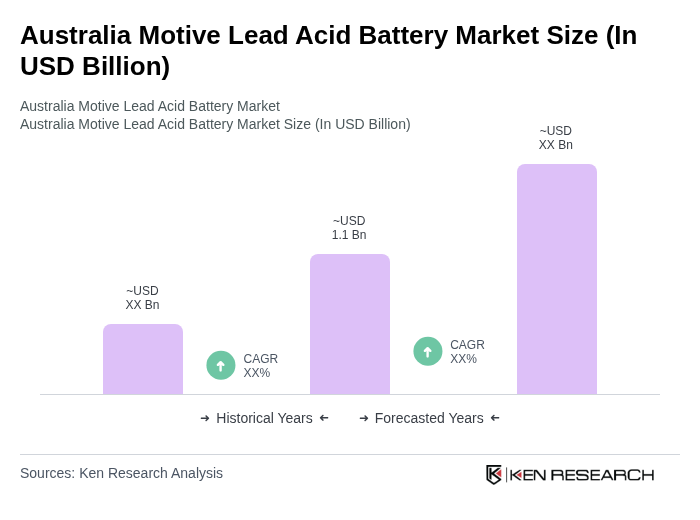
- The Australia Motive Lead Acid Battery Market is valued at USD 1.1 billion, based on a five-year historical analysis of the broader Australian battery and lead-acid segments and their traction/motive share within automotive, industrial, and material-handling applications. This growth is primarily driven by the increasing demand for electric material handling equipment and warehouse automation, as well as the continued use of lead-acid traction batteries in forklifts, reach trucks, and pallet trucks used in logistics and manufacturing. The market is also supported by ongoing improvements in lead-acid technology (including AGM, gel, and enhanced flooded designs), which are improving cycle life, charge acceptance, and maintenance intervals for motive applications, thereby sustaining investment in motive lead-acid battery solutions despite the rise of lithium-ion alternatives.
- Key cities such as Sydney, Melbourne, and Brisbane dominate the market due to their robust industrial bases, container ports, and significant logistics and warehousing operations, which drive high deployment of battery-powered material handling fleets. These urban centers host a large concentration of manufacturing plants, distribution centers, and third?party logistics hubs that rely heavily on motive lead acid batteries to power forklifts, order pickers, and cleaning machines in indoor environments where low emissions and proven reliability are essential. Additionally, the presence of national distribution networks, intermodal freight infrastructure, and major ports in these cities underpins replacement demand for traction batteries in both warehousing and ancillary ground support operations around airports and logistics terminals.
- In 2023, the Australian government released the National Electric Vehicle Strategy, led by the Department of Climate Change, Energy, the Environment and Water (DCCEEW), to accelerate the uptake of electric vehicles and supporting technologies across road transport. The strategy outlines measures such as developing a fuel efficiency standard, improving charging infrastructure, and supporting industry capability, which indirectly stimulates demand for batteries across vehicle and equipment categories, including lead-acid systems used in certain industrial EVs, ground support equipment, and auxiliary power. In parallel, lead-acid batteries used in motive and automotive applications are governed by instruments such as the Product Stewardship (Oil and Batteries) framework and hazardous waste controls under the Hazardous Waste (Regulation of Exports and Imports) Act 1989 administered by the Australian Government, which set requirements for the management, transport, and recycling of lead-containing batteries, influencing compliance, collection, and lifecycle handling obligations for motive lead acid battery suppliers and users.
Australia Motive Lead Acid Battery Market Segmentation
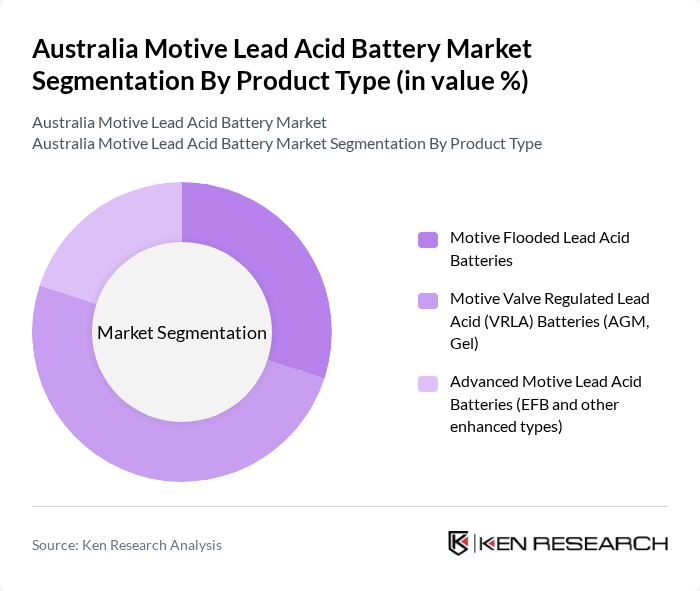
By Product Type:The product type segmentation includes various categories of motive lead acid batteries, each catering to specific applications and consumer needs. The dominant sub-segment is the Motive Valve Regulated Lead Acid (VRLA) Batteries, which are favored for their maintenance-free or low?maintenance operation, spill?proof design, and suitability for indoor use in logistics, warehousing, and cleaning equipment. Motive Flooded Lead Acid Batteries remain significant in cost?sensitive fleets because of their lower upfront price and proven performance in standard traction applications, especially where regular maintenance is feasible. Advanced Motive Lead Acid Batteries, including enhanced flooded batteries (EFB), absorbent glass mat (AGM), and other optimized plate designs, are gaining traction as industries seek higher cycle life, faster recharge capability, and better performance under opportunity charging in intensive multi?shift operations.
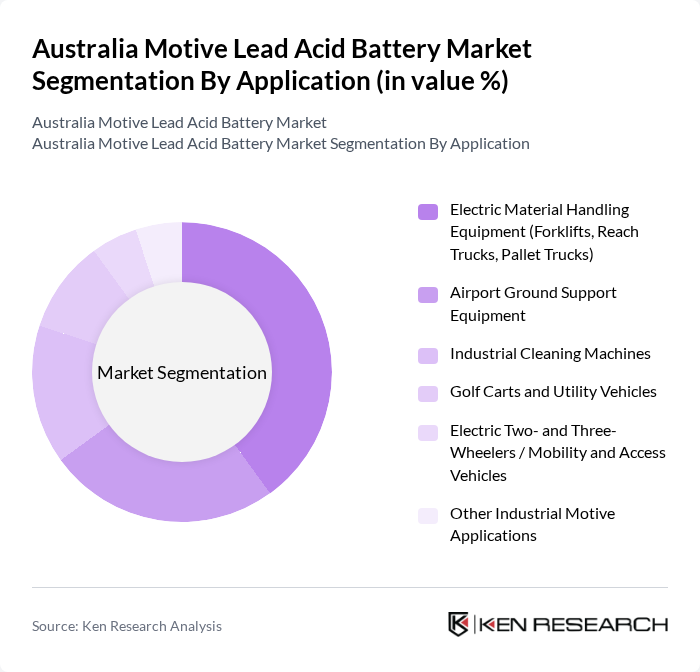
By Application:The application segmentation highlights the various uses of motive lead acid batteries across different sectors. The Electric Material Handling Equipment segment, which includes forklifts and pallet trucks, is the leading application due to the growing demand in warehouses, manufacturing plants, and e?commerce distribution centers where lead-acid traction batteries remain a cost?effective and widely adopted power source. Airport Ground Support Equipment and Industrial Cleaning Machines also represent significant applications, driven by the need for quiet, low?emission, and reliable power sources in airports, commercial buildings, and public facilities, where lead-acid technology offers a balance of cost, safety, and established service infrastructure.
Australia Motive Lead Acid Battery Market Competitive Landscape
The Australia Motive Lead Acid Battery Market is characterized by a dynamic mix of regional and international players. Leading participants such as Century Yuasa Batteries, Exide Technologies, EnerSys, East Penn Manufacturing (Deka), Trojan Battery Company, GS Yuasa Corporation, Panasonic Corporation, Clarios, ACDelco, Robert Bosch GmbH, C&D Technologies, NorthStar Battery Company, Lifeline Batteries, Interstate Batteries, VARTA AG contribute to innovation, geographic expansion, and service delivery in this space.
Australia Motive Lead Acid Battery Market Industry Analysis
Growth Drivers
- Increasing Demand for Electric Vehicles:The Australian electric vehicle (EV) market is projected to reach approximately 1.8 million units in future, driven by government initiatives and consumer interest in sustainable transport. The transition to EVs is expected to increase the demand for motive lead acid batteries, which are essential for various applications, including start-stop systems and energy storage. This shift aligns with Australia's commitment to reducing carbon emissions, further propelling battery demand in the automotive sector.
- Growth in Material Handling Equipment:The material handling equipment sector in Australia is anticipated to grow significantly, with an estimated market value of AUD 3.8 billion in future. This growth is fueled by the expansion of e-commerce and logistics, which require efficient battery solutions for forklifts and pallet jacks. As businesses invest in automation and efficiency, the reliance on motive lead acid batteries for powering these machines will increase, driving market growth.
- Expansion of Renewable Energy Storage Solutions:Australia is experiencing a surge in renewable energy projects, with over 30% of its electricity generated from renewable sources in future. This shift necessitates effective energy storage solutions, where motive lead acid batteries play a crucial role. The integration of these batteries into solar and wind energy systems enhances grid stability and energy management, creating a robust demand for lead acid batteries in the renewable sector.
Market Challenges
- Environmental Regulations on Lead Usage:Stringent environmental regulations in Australia are increasingly limiting the use of lead in battery production. The National Environment Protection Council has set guidelines that restrict lead emissions, impacting manufacturers. Compliance with these regulations requires significant investment in cleaner technologies, which can strain resources and hinder the growth of the motive lead acid battery market, as companies adapt to new standards.
- Competition from Alternative Battery Technologies:The rise of lithium-ion and other advanced battery technologies poses a significant challenge to the motive lead acid battery market. With lithium-ion batteries offering higher energy density and longer life cycles, their adoption in electric vehicles and energy storage systems is increasing. This shift threatens the market share of lead acid batteries, compelling manufacturers to innovate and improve their products to remain competitive.
Australia Motive Lead Acid Battery Market Future Outlook
The future of the Australia motive lead acid battery market appears promising, driven by technological advancements and increasing sustainability efforts. As industries adopt cleaner energy solutions, the demand for efficient battery systems will rise. Additionally, the integration of smart technologies in battery management systems is expected to enhance performance and reliability. Companies that invest in innovation and sustainability will likely capture significant market share, positioning themselves favorably in a rapidly evolving landscape.
Market Opportunities
- Growth in the Logistics and Transportation Sector:The logistics sector in Australia is projected to grow to AUD 110 billion in future, creating substantial opportunities for motive lead acid batteries. As companies seek efficient energy solutions for their fleets, the demand for reliable battery systems will increase, providing a lucrative market for manufacturers.
- Expansion of Battery Recycling Initiatives:With the Australian government promoting battery recycling, the market for recycled lead acid batteries is expected to expand. The introduction of new recycling technologies can reduce environmental impact and lower production costs, creating a sustainable cycle that benefits both manufacturers and consumers, while also addressing regulatory concerns.
Scope of the Report
| Segment | Sub-Segments |
|---|---|
| By Product Type | Motive Flooded Lead Acid Batteries Motive Valve Regulated Lead Acid (VRLA) Batteries (AGM, Gel) Advanced Motive Lead Acid Batteries (EFB and other enhanced types) |
| By Application | Electric Material Handling Equipment (Forklifts, Reach Trucks, Pallet Trucks) Airport Ground Support Equipment Industrial Cleaning Machines Golf Carts and Utility Vehicles Electric Two- and Three-Wheelers / Mobility and Access Vehicles Other Industrial Motive Applications |
| By End-Use Industry | Manufacturing and Warehousing Logistics, Freight and Ta??mac?l?k (Transport & Distribution) Retail, Wholesale and E-commerce Fulfilment Airports, Ports and Public Infrastructure Mining, Construction and Heavy Industries Commercial Facilities, Institutions and Others |
| By Sales Channel | OEM (Factory-Fitted Batteries) Aftermarket / Replacement Leasing and Battery-as-a-Service Providers Distributors and Value-Added Resellers |
| By Capacity Range | Below 100 Ah –300 Ah –600 Ah Above 600 Ah |
| By Voltage Class | V and Below V –48 V Above 48 V |
| By Region | Australian Capital Territory and New South Wales Victoria and Tasmania Queensland Western Australia Northern Territory and South Australia |
Key Target Audience
Investors and Venture Capitalist Firms
Government and Regulatory Bodies (e.g., Australian Competition and Consumer Commission, Department of Industry, Science, Energy and Resources)
Manufacturers and Producers
Distributors and Retailers
Automotive OEMs (Original Equipment Manufacturers)
Battery Recycling Companies
Industry Associations (e.g., Battery Industry Association of Australia)
Financial Institutions
Players Mentioned in the Report:
Century Yuasa Batteries
Exide Technologies
EnerSys
East Penn Manufacturing (Deka)
Trojan Battery Company
GS Yuasa Corporation
Panasonic Corporation
Clarios
ACDelco
Robert Bosch GmbH
C&D Technologies
NorthStar Battery Company
Lifeline Batteries
Interstate Batteries
VARTA AG
Table of Contents
Market Assessment Phase
1. Executive Summary and Approach
2. Australia Motive Lead Acid Battery Market Overview
2.1 Key Insights and Strategic Recommendations
2.2 Australia Motive Lead Acid Battery Market Overview
2.3 Definition and Scope
2.4 Evolution of Market Ecosystem
2.5 Timeline of Key Regulatory Milestones
2.6 Value Chain & Stakeholder Mapping
2.7 Business Cycle Analysis
2.8 Policy & Incentive Landscape
3. Australia Motive Lead Acid Battery Market Analysis
3.1 Growth Drivers
3.1.1 Increasing demand for electric vehicles
3.1.2 Growth in material handling equipment
3.1.3 Expansion of renewable energy storage solutions
3.1.4 Technological advancements in battery efficiency
3.2 Market Challenges
3.2.1 Environmental regulations on lead usage
3.2.2 Competition from alternative battery technologies
3.2.3 Supply chain disruptions
3.2.4 Fluctuating raw material prices
3.3 Market Opportunities
3.3.1 Growth in the logistics and transportation sector
3.3.2 Increasing adoption of automated guided vehicles
3.3.3 Expansion of battery recycling initiatives
3.3.4 Government incentives for clean energy solutions
3.4 Market Trends
3.4.1 Shift towards sustainable battery production
3.4.2 Rising popularity of hybrid electric vehicles
3.4.3 Integration of smart technologies in battery management
3.4.4 Focus on circular economy practices
3.5 Government Regulation
3.5.1 National standards for battery safety
3.5.2 Regulations on lead acid battery disposal
3.5.3 Incentives for renewable energy storage
3.5.4 Compliance requirements for manufacturing
4. SWOT Analysis
5. Stakeholder Analysis
6. Porter's Five Forces Analysis
7. Australia Motive Lead Acid Battery Market Market Size, 2019-2024
7.1 By Value
7.2 By Volume
7.3 By Average Selling Price
8. Australia Motive Lead Acid Battery Market Segmentation
8.1 By Product Type
8.1.1 Motive Flooded Lead Acid Batteries
8.1.2 Motive Valve Regulated Lead Acid (VRLA) Batteries (AGM, Gel)
8.1.3 Advanced Motive Lead Acid Batteries (EFB and other enhanced types)
8.2 By Application
8.2.1 Electric Material Handling Equipment (Forklifts, Reach Trucks, Pallet Trucks)
8.2.2 Airport Ground Support Equipment
8.2.3 Industrial Cleaning Machines
8.2.4 Golf Carts and Utility Vehicles
8.2.5 Electric Two- and Three-Wheelers / Mobility and Access Vehicles
8.2.6 Other Industrial Motive Applications
8.3 By End-Use Industry
8.3.1 Manufacturing and Warehousing
8.3.2 Logistics, Freight and Ta??mac?l?k (Transport & Distribution)
8.3.3 Retail, Wholesale and E-commerce Fulfilment
8.3.4 Airports, Ports and Public Infrastructure
8.3.5 Mining, Construction and Heavy Industries
8.3.6 Commercial Facilities, Institutions and Others
8.4 By Sales Channel
8.4.1 OEM (Factory-Fitted Batteries)
8.4.2 Aftermarket / Replacement
8.4.3 Leasing and Battery-as-a-Service Providers
8.4.4 Distributors and Value-Added Resellers
8.5 By Capacity Range
8.5.1 Below 100 Ah
8.5.2 100–300 Ah
8.5.3 300–600 Ah
8.5.4 Above 600 Ah
8.6 By Voltage Class
8.6.1 12 V and Below
8.6.2 24 V
8.6.3 36–48 V
8.6.4 Above 48 V
8.7 By Region
8.7.1 Australian Capital Territory and New South Wales
8.7.2 Victoria and Tasmania
8.7.3 Queensland
8.7.4 Western Australia
8.7.5 Northern Territory and South Australia
9. Australia Motive Lead Acid Battery Market Competitive Analysis
9.1 Market Share of Key Players
9.2 Cross Comparison of Key Players
9.2.1 Company Name
9.2.2 Group Size (Large, Medium, or Small as per industry convention)
9.2.3 Australia Motive Lead Acid Battery Revenue (USD Million)
9.2.4 Australia Motive Lead Acid Battery Revenue CAGR, 2019–2024 (%)
9.2.5 Australia Motive Lead Acid Battery Market Share, 2024 (%)
9.2.6 EBITDA Margin from Motive Lead Acid Battery Business (%)
9.2.7 Capex Intensity in Motive Lead Acid Operations (% of Sales)
9.2.8 R&D Spend on Motive Lead Acid Technologies (% of Sales)
9.2.9 Average Realized Price per kWh (USD/kWh)
9.2.10 Installed Motive Lead Acid Manufacturing Capacity in Australia (MWh/year)
9.2.11 Utilization Rate of Motive Lead Acid Capacity (%)
9.2.12 Distribution Reach (Number of Dealers / Service Points in Australia)
9.2.13 Key OEM Partnerships and Long-Term Supply Contracts (Count)
9.2.14 After-Sales Service Coverage (Response Time / SLA Tiers)
9.2.15 Innovation Pipeline (New Motive Lead Acid SKUs Launched in Last 3 Years)
9.3 SWOT Analysis of Top Players
9.4 Pricing Analysis
9.5 Detailed Profile of Major Companies
9.5.1 Century Yuasa Batteries
9.5.2 Exide Technologies
9.5.3 EnerSys
9.5.4 East Penn Manufacturing (Deka)
9.5.5 Trojan Battery Company
9.5.6 GS Yuasa Corporation
9.5.7 Panasonic Corporation
9.5.8 Clarios
9.5.9 ACDelco
9.5.10 Robert Bosch GmbH
9.5.11 C&D Technologies
9.5.12 NorthStar Battery Company
9.5.13 Lifeline Batteries
9.5.14 Interstate Batteries
9.5.15 VARTA AG
10. Australia Motive Lead Acid Battery Market End-User Analysis
10.1 Procurement Behavior of Key Ministries
10.1.1 Budget Allocation Trends
10.1.2 Procurement Processes
10.1.3 Supplier Selection Criteria
10.1.4 Contract Management Practices
10.2 Corporate Spend on Infrastructure & Energy
10.2.1 Investment Trends in Energy Storage
10.2.2 Infrastructure Development Projects
10.2.3 Corporate Sustainability Initiatives
10.2.4 Energy Efficiency Programs
10.3 Pain Point Analysis by End-User Category
10.3.1 Cost Management Challenges
10.3.2 Reliability Concerns
10.3.3 Regulatory Compliance Issues
10.3.4 Technological Adaptation Barriers
10.4 User Readiness for Adoption
10.4.1 Awareness Levels
10.4.2 Training and Support Needs
10.4.3 Financial Readiness
10.4.4 Infrastructure Compatibility
10.5 Post-Deployment ROI and Use Case Expansion
10.5.1 Performance Metrics
10.5.2 User Satisfaction Levels
10.5.3 Expansion Opportunities
10.5.4 Long-term Cost Savings
11. Australia Motive Lead Acid Battery Market Future Size, 2025-2030
11.1 By Value
11.2 By Volume
11.3 By Average Selling Price
Go-To-Market Strategy Phase
1. Whitespace Analysis + Business Model Canvas
1.1 Market Gaps Identification
1.2 Business Model Framework
2. Marketing and Positioning Recommendations
2.1 Branding Strategies
2.2 Product USPs
3. Distribution Plan
3.1 Urban Retail vs Rural NGO Tie-ups
4. Channel & Pricing Gaps
4.1 Underserved Routes
4.2 Pricing Bands
5. Unmet Demand & Latent Needs
5.1 Category Gaps
5.2 Consumer Segments
6. Customer Relationship
6.1 Loyalty Programs
6.2 After-sales Service
7. Value Proposition
7.1 Sustainability
7.2 Integrated Supply Chains
8. Key Activities
8.1 Regulatory Compliance
8.2 Branding
8.3 Distribution Setup
9. Entry Strategy Evaluation
9.1 Domestic Market Entry Strategy
9.1.1 Product Mix
9.1.2 Pricing Band
9.1.3 Packaging
9.2 Export Entry Strategy
9.2.1 Target Countries
9.2.2 Compliance Roadmap
10. Entry Mode Assessment
10.1 JV
10.2 Greenfield
10.3 M&A
10.4 Distributor Model
11. Capital and Timeline Estimation
11.1 Capital Requirements
11.2 Timelines
12. Control vs Risk Trade-Off
12.1 Ownership vs Partnerships
13. Profitability Outlook
13.1 Breakeven Analysis
13.2 Long-term Sustainability
14. Potential Partner List
14.1 Distributors
14.2 JVs
14.3 Acquisition Targets
15. Execution Roadmap
15.1 Phased Plan for Market Entry
15.1.1 Market Setup
15.1.2 Market Entry
15.1.3 Growth Acceleration
15.1.4 Scale & Stabilize
15.2 Key Activities and Milestones
15.2.1 Activity Timeline
15.2.2 Milestone Tracking
Research Methodology
Phase 1: Approach1
Desk Research
- Analysis of industry reports from Australian Battery Recycling Association and related organizations
- Review of government publications and energy policies impacting lead-acid battery usage
- Examination of market trends and forecasts from reputable market research databases
Primary Research
- Interviews with industry experts, including battery manufacturers and distributors
- Surveys targeting automotive and industrial sectors utilizing motive lead-acid batteries
- Field interviews with end-users to understand application and performance requirements
Validation & Triangulation
- Cross-validation of findings through multiple data sources, including sales and import/export statistics
- Triangulation of insights from primary interviews with secondary data trends
- Sanity checks conducted through expert panel reviews to ensure data reliability
Phase 2: Market Size Estimation1
Top-down Assessment
- Estimation of total market size based on national energy consumption and battery usage statistics
- Segmentation by application areas such as automotive, marine, and industrial sectors
- Incorporation of regulatory impacts and sustainability initiatives affecting market dynamics
Bottom-up Modeling
- Collection of sales data from leading manufacturers and distributors of motive lead-acid batteries
- Estimation of average selling prices and volume sold across different segments
- Analysis of growth rates based on historical sales data and projected demand trends
Forecasting & Scenario Analysis
- Multi-variable forecasting using economic indicators and technological advancements in battery technology
- Scenario analysis based on potential shifts in consumer preferences and regulatory changes
- Development of baseline, optimistic, and pessimistic market growth projections through 2030
Phase 3: CATI Sample Composition1
| Scope Item/Segment | Sample Size | Target Respondent Profiles |
|---|---|---|
| Automotive Sector Users | 140 | Fleet Managers, Automotive Engineers |
| Industrial Equipment Users | 110 | Operations Managers, Equipment Maintenance Supervisors |
| Marine Applications | 90 | Boat Owners, Marine Equipment Suppliers |
| Battery Recycling Stakeholders | 70 | Recycling Facility Managers, Environmental Compliance Officers |
| Research and Development Professionals | 60 | Battery Technology Researchers, Product Development Engineers |
Frequently Asked Questions
What is the current value of the Australia Motive Lead Acid Battery Market?
The Australia Motive Lead Acid Battery Market is valued at approximately USD 1.1 billion, driven by demand in automotive, industrial, and material-handling applications, particularly in electric material handling equipment and warehouse automation.
What factors are driving the growth of the motive lead acid battery market in Australia?
Which cities are the primary markets for motive lead acid batteries in Australia?
What are the main applications of motive lead acid batteries?
Other Regional/Country Reports
Other Adjacent Reports
Vietnam Renewable Energy Storage Market
North America Electric Vehicle Battery Market Outlook to 2030: Size, Share, Growth and TrendsKSA Airport Ground Support Equipment Market
South Africa Industrial Cleaning Equipment Market
Belgium Logistics Equipment Market
KSA Energy Storage System Market
Why Buy From Us?

What makes us stand out is that our consultants follow Robust, Refine and Result (RRR) methodology. Robust for clear definitions, approaches and sanity checking, Refine for differentiating respondents' facts and opinions, and Result for presenting data with story.

We have set a benchmark in the industry by offering our clients with syndicated and customized market research reports featuring coverage of entire market as well as meticulous research and analyst insights.

While we don't replace traditional research, we flip the method upside down. Our dual approach of Top Bottom & Bottom Top ensures quality deliverable by not just verifying company fundamentals but also looking at the sector and macroeconomic factors.

With one step in the future, our research team constantly tries to show you the bigger picture. We help with some of the tough questions you may encounter along the way: How is the industry positioned? Best marketing channel? KPI's of competitors? By aligning every element, we help maximize success.

Our report gives you instant access to the answers and sources that other companies might choose to hide. We elaborate each steps of research methodology we have used and showcase you the sample size to earn your trust.

If you need any support, we are here! We pride ourselves on universe strength, data quality, and quick, friendly, and professional service.