Ken Research Logo

Australia New Sports Car Market

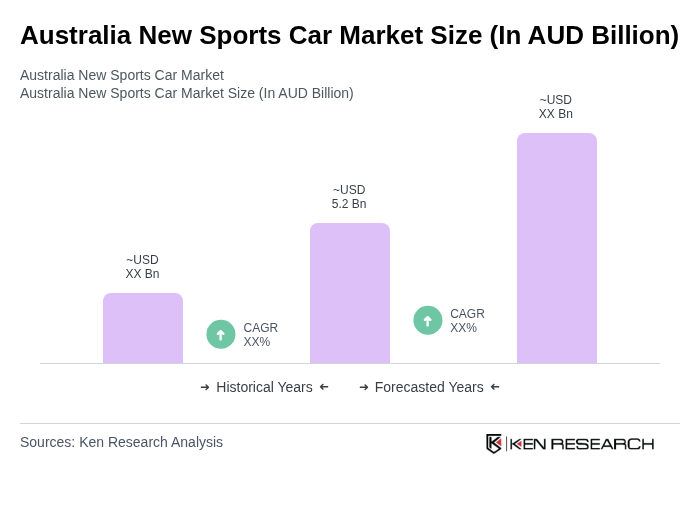
The Australia new sports car market, valued at AUD 5.2 billion, is growing due to rising consumer interest in luxury vehicles, technological innovations, and electric models.

Region:Global

Author(s):Geetanshi

Product Code:KRAE1008

Pages:114

Published On:December 2025
About the Report

Base Year 2024

Australia New Sports Car Market Overview

  • The Australia New Sports Car Market is valued at approximately AUD 5.2 billion, based on a five-year historical analysis. This growth is primarily driven by increasing consumer demand for high-performance vehicles, advancements in automotive technology, and a growing interest in luxury and sports cars among affluent buyers. The market has seen a significant rise in sales, particularly in urban areas where lifestyle preferences favor sporty and stylish vehicles.
  • Key cities such as Sydney, Melbourne, and Brisbane dominate the Australia New Sports Car Market due to their affluent populations and vibrant automotive culture. These cities have a high concentration of luxury car dealerships and a strong presence of automotive events, which further stimulate consumer interest and purchasing behavior. The urban infrastructure also supports the use of high-performance vehicles, making them more appealing to buyers.
  • The Australian government has implemented emissions regulations aimed at reducing carbon footprints from vehicles. These regulations mandate that all new sports cars must meet specific emissions standards, encouraging manufacturers to innovate and produce more environmentally friendly models. The initiative is part of a broader strategy to promote sustainable transportation and reduce the overall environmental impact of the automotive sector.
Australia New Sports Car Market Size

Australia New Sports Car Market Segmentation

By Type:The market is segmented into various types of sports cars, including Coupe, Convertible, Roadster, Sedan Performance, and Others. The Coupe segment is currently leading the market due to its popularity among consumers who prefer a blend of performance and style. Coupes are often seen as the quintessential sports car, appealing to enthusiasts and collectors alike. The Convertible segment also holds a significant share, driven by the desire for open-top driving experiences, especially in Australia's favorable climate. Roadsters and Sedan Performance vehicles cater to niche markets, while the Others category includes unique models that attract specific consumer preferences.
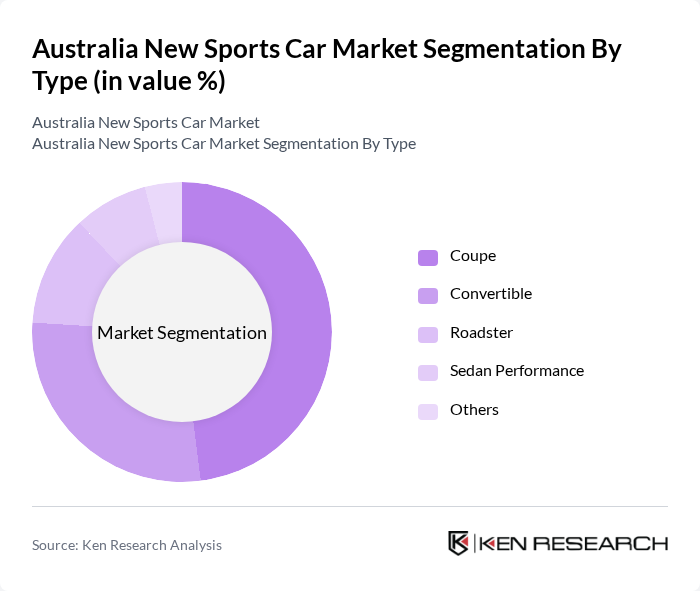
Australia New Sports Car Market segmentation by Type.

By Engine Type:The segmentation by engine type includes Petrol, Diesel, Electric, Hybrid, and Others. The Petrol segment dominates the market, favored for its performance and availability. Diesel engines are less common in the sports car segment but still hold a niche market due to their efficiency. The Electric segment is gaining significant traction as manufacturers introduce high-performance electric sports cars, appealing to environmentally conscious consumers and supported by government incentives for electric vehicle adoption. Hybrid vehicles combine the benefits of both petrol and electric engines, attracting buyers looking for versatility. The Others category includes unique engine configurations that cater to specific consumer preferences.
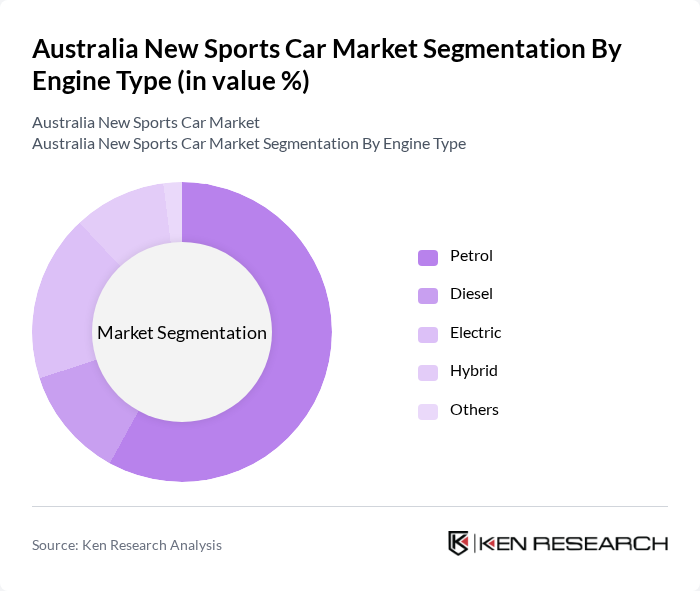
Australia New Sports Car Market segmentation by Engine Type.

Australia New Sports Car Market Competitive Landscape

The Australia New Sports Car Market is characterized by a dynamic mix of regional and international players. Leading participants such as Porsche Australia, BMW Australia, Mercedes-Benz Australia, Audi Australia, Tesla Australia, Subaru Australia, Nissan Australia, Jaguar Land Rover Australia, Aston Martin Australia, Ferrari Australia, Lamborghini Australia, Maserati Australia, Volkswagen Australia, Toyota Australia, Ford Australia contribute to innovation, geographic expansion, and service delivery in this space.

Porsche Australia

1948

Melbourne, Australia

BMW Australia

1928

Melbourne, Australia

Mercedes-Benz Australia

1926

Mulgrave, Australia

Audi Australia

2000

Melbourne, Australia

Tesla Australia

2003

Melbourne, Australia

Company

Establishment Year

Headquarters

Group Size (Large, Medium, or Small as per industry convention)

Year-on-Year Sales Growth Rate (%)

Market Share in Sports Car Segment (%)

Average Selling Price (AUD)

Product Portfolio Breadth (Number of Models)

Electric Vehicle Penetration Rate (%)

Australia New Sports Car Market Industry Analysis

Growth Drivers

  • Increasing Consumer Interest in High-Performance Vehicles:The Australian market has seen a notable increase in high-performance vehicle sales, with a reported 16,500 units sold in the future, reflecting a 10% increase from the previous year. This surge is driven by a growing demographic of enthusiasts aged 25-45, who prioritize speed and performance. Additionally, the Australian Bureau of Statistics reported that 62% of consumers in this age group are willing to invest in premium vehicles, indicating a robust demand for sports cars.
  • Technological Advancements in Automotive Engineering:The integration of cutting-edge technologies in sports cars has significantly enhanced performance and safety. In future, it is estimated that 75% of new sports car models will feature advanced driver-assistance systems (ADAS), improving safety ratings. Furthermore, the Australian automotive industry invested AUD 1.3 billion in research and development in the future, focusing on innovations that enhance vehicle performance, thus attracting tech-savvy consumers seeking the latest advancements.
  • Rising Disposable Income Among Australian Consumers:The average disposable income in Australia is projected to reach AUD 1,300 per week in future, up from AUD 1,200. This increase allows consumers to allocate more funds towards luxury items, including sports cars. Additionally, the Australian Taxation Office reported a 6% rise in personal savings rates, indicating that consumers are more financially secure and willing to invest in high-end vehicles, further driving market growth.

Market Challenges

  • High Competition from Established Brands:The Australian sports car market is highly competitive, with major players like Ford, Toyota, and BMW dominating sales. In future, these brands collectively accounted for over 76% of the market share. New entrants face significant barriers, including brand loyalty and established distribution networks. This intense competition can limit market penetration for emerging brands, making it challenging to capture consumer interest and achieve sustainable growth.
  • Regulatory Compliance and Safety Standards:The Australian automotive industry is subject to stringent safety and environmental regulations. In future, new emission standards will require sports car manufacturers to reduce CO2 emissions to below 90 grams per kilometer. Compliance with these regulations necessitates significant investment in technology and design, which can strain the resources of smaller manufacturers. Failure to meet these standards can result in hefty fines and market exclusion, posing a substantial challenge.

Australia New Sports Car Market Future Outlook

The future of the Australian new sports car market appears promising, driven by evolving consumer preferences and technological advancements. As electric sports cars gain traction, manufacturers are expected to invest heavily in electric vehicle technology, aligning with sustainability trends. Additionally, the rise of online sales channels will facilitate broader market access, allowing consumers to explore and purchase vehicles conveniently. These trends indicate a dynamic shift in the market landscape, fostering innovation and expanding consumer choices in the coming years.

Market Opportunities

  • Growth of Electric Sports Cars:The electric vehicle segment is projected to grow significantly, with sales expected to reach 25,000 units by the end of future. This growth is fueled by increasing consumer awareness of environmental issues and government incentives for electric vehicle purchases. Manufacturers that invest in electric sports cars can tap into this expanding market, appealing to eco-conscious consumers while enhancing their brand image.
  • Increasing Popularity of Motorsports Events:The motorsports industry in Australia is thriving, with attendance at major events like the Bathurst 1000 reaching over 220,000 spectators in future. This growing interest in motorsports creates opportunities for sports car manufacturers to engage with potential customers through sponsorships and promotional events. By aligning their brands with popular motorsports, manufacturers can enhance visibility and attract a dedicated customer base.

Scope of the Report

SegmentSub-Segments
By Type

Coupe

Convertible

Roadster

Sedan Performance

Others

By Engine Type

Petrol

Diesel

Electric

Hybrid

Others

By Price Range

Below AUD 50,000

AUD 50,000 - AUD 100,000

AUD 100,000 - AUD 150,000

Above AUD 150,000

Others

By Brand

Domestic Brands

International Mainstream Brands

Luxury Brands

Ultra-Luxury Performance Brands

Others

By Distribution Channel

Authorized Dealerships

Online Sales Platforms

Direct Manufacturer Sales

Auctions and Secondary Market

Others

By Customer Demographics

Age Group (18-25, 26-35, 36-50, 51+)

Gender

Income Level (High Net Worth Individuals)

Lifestyle Preferences (Enthusiasts, Collectors, Status-Seekers)

Others

By Usage Type

Personal Use

Track/Racing

Leisure and Weekend Driving

Corporate Fleet

Others

Key Target Audience

Investors and Venture Capitalist Firms

Government and Regulatory Bodies (e.g., Australian Competition and Consumer Commission, Department of Infrastructure, Transport, Regional Development and Communications)

Manufacturers and Producers

Distributors and Retailers

Automotive Industry Associations (e.g., Federal Chamber of Automotive Industries)

Financial Institutions

Insurance Companies

Automotive Technology Developers

Players Mentioned in the Report:

Porsche Australia

BMW Australia

Mercedes-Benz Australia

Audi Australia

Tesla Australia

Subaru Australia

Nissan Australia

Jaguar Land Rover Australia

Aston Martin Australia

Ferrari Australia

Lamborghini Australia

Maserati Australia

Volkswagen Australia

Toyota Australia

Ford Australia

Table of Contents

Market Assessment Phase

1. Executive Summary and Approach


2. Australia New Sports Car Market Overview

2.1 Key Insights and Strategic Recommendations

2.2 Australia New Sports Car Market Overview

2.3 Definition and Scope

2.4 Evolution of Market Ecosystem

2.5 Timeline of Key Regulatory Milestones

2.6 Value Chain & Stakeholder Mapping

2.7 Business Cycle Analysis

2.8 Policy & Incentive Landscape


3. Australia New Sports Car Market Analysis

3.1 Growth Drivers

3.1.1 Increasing consumer interest in high-performance vehicles
3.1.2 Technological advancements in automotive engineering
3.1.3 Rising disposable income among Australian consumers
3.1.4 Expansion of sports car offerings by manufacturers

3.2 Market Challenges

3.2.1 High competition from established brands
3.2.2 Regulatory compliance and safety standards
3.2.3 Economic fluctuations affecting consumer spending
3.2.4 Limited availability of high-performance fuel

3.3 Market Opportunities

3.3.1 Growth of electric sports cars
3.3.2 Increasing popularity of motorsports events
3.3.3 Expansion into online sales channels
3.3.4 Collaborations with technology firms for innovation

3.4 Market Trends

3.4.1 Shift towards sustainable and eco-friendly vehicles
3.4.2 Customization and personalization of sports cars
3.4.3 Integration of advanced driver-assistance systems (ADAS)
3.4.4 Growth in car-sharing and subscription models

3.5 Government Regulation

3.5.1 Emission standards and environmental regulations
3.5.2 Safety regulations for high-performance vehicles
3.5.3 Import tariffs and trade agreements
3.5.4 Incentives for electric vehicle adoption

4. SWOT Analysis


5. Stakeholder Analysis


6. Porter's Five Forces Analysis


7. Australia New Sports Car Market Market Size, 2019-2024

7.1 By Value

7.2 By Volume

7.3 By Average Selling Price


8. Australia New Sports Car Market Segmentation

8.1 By Type

8.1.1 Coupe
8.1.2 Convertible
8.1.3 Roadster
8.1.4 Sedan Performance
8.1.5 Others

8.2 By Engine Type

8.2.1 Petrol
8.2.2 Diesel
8.2.3 Electric
8.2.4 Hybrid
8.2.5 Others

8.3 By Price Range

8.3.1 Below AUD 50,000
8.3.2 AUD 50,000 - AUD 100,000
8.3.3 AUD 100,000 - AUD 150,000
8.3.4 Above AUD 150,000
8.3.5 Others

8.4 By Brand

8.4.1 Domestic Brands
8.4.2 International Mainstream Brands
8.4.3 Luxury Brands
8.4.4 Ultra-Luxury Performance Brands
8.4.5 Others

8.5 By Distribution Channel

8.5.1 Authorized Dealerships
8.5.2 Online Sales Platforms
8.5.3 Direct Manufacturer Sales
8.5.4 Auctions and Secondary Market
8.5.5 Others

8.6 By Customer Demographics

8.6.1 Age Group (18-25, 26-35, 36-50, 51+)
8.6.2 Gender
8.6.3 Income Level (High Net Worth Individuals)
8.6.4 Lifestyle Preferences (Enthusiasts, Collectors, Status-Seekers)
8.6.5 Others

8.7 By Usage Type

8.7.1 Personal Use
8.7.2 Track/Racing
8.7.3 Leisure and Weekend Driving
8.7.4 Corporate Fleet
8.7.5 Others

9. Australia New Sports Car Market Competitive Analysis

9.1 Market Share of Key Players

9.2 Cross Comparison of Key Players

9.2.1 Company Name
9.2.2 Group Size (Large, Medium, or Small as per industry convention)
9.2.3 Year-on-Year Sales Growth Rate (%)
9.2.4 Market Share in Sports Car Segment (%)
9.2.5 Average Selling Price (AUD)
9.2.6 Product Portfolio Breadth (Number of Models)
9.2.7 Electric Vehicle Penetration Rate (%)
9.2.8 Distribution Network Density (Dealerships in Australia)
9.2.9 Brand Recognition Index (1-10 Scale)
9.2.10 Customer Satisfaction and Net Promoter Score (NPS)

9.3 SWOT Analysis of Top Players

9.4 Pricing Analysis

9.5 Detailed Profile of Major Companies

9.5.1 Porsche Australia
9.5.2 BMW Australia
9.5.3 Mercedes-Benz Australia
9.5.4 Audi Australia
9.5.5 Tesla Australia
9.5.6 Subaru Australia
9.5.7 Nissan Australia
9.5.8 Jaguar Land Rover Australia
9.5.9 Aston Martin Australia
9.5.10 Ferrari Australia
9.5.11 Lamborghini Australia
9.5.12 Maserati Australia
9.5.13 Volkswagen Australia
9.5.14 Toyota Australia
9.5.15 Ford Australia

10. Australia New Sports Car Market End-User Analysis

10.1 Procurement Behavior of Key Ministries

10.1.1 Government Fleet Purchases
10.1.2 Tender Processes
10.1.3 Budget Allocations
10.1.4 Sustainability Goals
10.1.5 Others

10.2 Corporate Spend on Infrastructure & Energy

10.2.1 Investment in Sports Car Infrastructure
10.2.2 Corporate Sponsorships in Motorsports
10.2.3 Partnerships with Automotive Manufacturers
10.2.4 Research and Development Expenditure
10.2.5 Others

10.3 Pain Point Analysis by End-User Category

10.3.1 High Maintenance Costs
10.3.2 Limited Availability of Parts
10.3.3 Insurance Costs
10.3.4 Fuel Efficiency Concerns
10.3.5 Others

10.4 User Readiness for Adoption

10.4.1 Awareness of New Technologies
10.4.2 Financial Readiness
10.4.3 Interest in Electric Sports Cars
10.4.4 Brand Loyalty
10.4.5 Others

10.5 Post-Deployment ROI and Use Case Expansion

10.5.1 Performance Metrics
10.5.2 Customer Feedback Mechanisms
10.5.3 Expansion into New Markets
10.5.4 Long-term Maintenance Contracts
10.5.5 Others

11. Australia New Sports Car Market Future Size, 2025-2030

11.1 By Value

11.2 By Volume

11.3 By Average Selling Price


Go-To-Market Strategy Phase

1. Whitespace Analysis + Business Model Canvas

1.1 Market Gaps Identification

1.2 Business Model Development


2. Marketing and Positioning Recommendations

2.1 Branding Strategies

2.2 Product USPs


3. Distribution Plan

3.1 Urban Retail vs Rural NGO Tie-ups


4. Channel & Pricing Gaps

4.1 Underserved Routes

4.2 Pricing Bands


5. Unmet Demand & Latent Needs

5.1 Category Gaps

5.2 Consumer Segments


6. Customer Relationship

6.1 Loyalty Programs

6.2 After-sales Service


7. Value Proposition

7.1 Sustainability

7.2 Integrated Supply Chains


8. Key Activities

8.1 Regulatory Compliance

8.2 Branding

8.3 Distribution Setup


9. Entry Strategy Evaluation

9.1 Domestic Market Entry Strategy

9.1.1 Product Mix
9.1.2 Pricing Band
9.1.3 Packaging

9.2 Export Entry Strategy

9.2.1 Target Countries
9.2.2 Compliance Roadmap

10. Entry Mode Assessment

10.1 JV

10.2 Greenfield

10.3 M&A

10.4 Distributor Model


11. Capital and Timeline Estimation

11.1 Capital Requirements

11.2 Timelines


12. Control vs Risk Trade-Off

12.1 Ownership vs Partnerships


13. Profitability Outlook

13.1 Breakeven Analysis

13.2 Long-term Sustainability


14. Potential Partner List

14.1 Distributors

14.2 JVs

14.3 Acquisition Targets


15. Execution Roadmap

15.1 Phased Plan for Market Entry

15.1.1 Market Setup
15.1.2 Market Entry
15.1.3 Growth Acceleration
15.1.4 Scale & Stabilize

15.2 Key Activities and Milestones


Disclaimer</h3


Research Methodology

ApproachModellingSample

Phase 1: Approach1

Desk Research

  • Analysis of industry reports from automotive associations and market research firms
  • Review of government publications on automotive regulations and market trends
  • Examination of sales data from major automotive dealerships and manufacturers in Australia

Primary Research

  • Interviews with automotive industry experts and analysts to gather insights on market dynamics
  • Surveys targeting potential car buyers to understand preferences and purchasing behavior
  • Focus groups with automotive enthusiasts to gauge interest in new sports car models

Validation & Triangulation

  • Cross-validation of findings through comparison with historical sales data and trends
  • Triangulation of insights from expert interviews and consumer surveys
  • Sanity checks through feedback from industry stakeholders and market experts

Phase 2: Market Size Estimation1

Top-down Assessment

  • Estimation of total addressable market based on overall automotive sales in Australia
  • Segmentation of the market by vehicle type, focusing on sports cars
  • Incorporation of macroeconomic factors influencing consumer spending on luxury vehicles

Bottom-up Modeling

  • Collection of sales data from leading sports car manufacturers operating in Australia
  • Estimation of average selling prices and volume of sales for new sports cars
  • Analysis of dealership performance metrics to derive market penetration rates

Forecasting & Scenario Analysis

  • Development of market forecasts based on historical growth rates and economic indicators
  • Scenario analysis considering factors such as changes in consumer preferences and regulatory impacts
  • Creation of multiple projections (baseline, optimistic, and pessimistic) through 2030

Phase 3: CATI Sample Composition1

Scope Item/SegmentSample SizeTarget Respondent Profiles
Potential Sports Car Buyers120Car Enthusiasts, Luxury Vehicle Owners
Automotive Dealership Managers45Sales Managers, General Managers
Automotive Industry Experts30Market Analysts, Automotive Consultants
Current Sports Car Owners65Vehicle Owners, Brand Loyalists
Automotive Enthusiast Groups50Club Members, Event Organizers

Frequently Asked Questions

What is the current value of the Australia New Sports Car Market?

The Australia New Sports Car Market is valued at approximately AUD 5.2 billion, driven by increasing consumer demand for high-performance vehicles and advancements in automotive technology, particularly in urban areas with affluent populations.

Which cities dominate the Australia New Sports Car Market?

What types of sports cars are popular in Australia?

How is the Australia New Sports Car Market affected by emissions regulations?

Other Regional/Country Reports

Indonesia Sports Car Market

Malaysia Sports Car Market

KSA Sports Car Market

APAC Sports Car Market

SEA Sports Car Market

Vietnam Sports Car Market

Other Adjacent Reports

Egypt Luxury Vehicle Market

Thailand Electric Sports Car Market

Indonesia Automotive Aftermarket Market

Germany Motorsports Equipment Market

Japan High-Performance Tire Market

UAE Automotive Financing Market

Mexico Car Customization Market

UAE Vintage Car Market

UAE Hybrid Vehicle Market

Germany Automotive Insurance Market

Why Buy From Us?

Refine Robust Result (RRR) Framework

What makes us stand out is that our consultants follow Robust, Refine and Result (RRR) methodology. Robust for clear definitions, approaches and sanity checking, Refine for differentiating respondents' facts and opinions, and Result for presenting data with story.

Our Reach Is Unmatched

We have set a benchmark in the industry by offering our clients with syndicated and customized market research reports featuring coverage of entire market as well as meticulous research and analyst insights.

Shifting the Research Paradigm

While we don't replace traditional research, we flip the method upside down. Our dual approach of Top Bottom & Bottom Top ensures quality deliverable by not just verifying company fundamentals but also looking at the sector and macroeconomic factors.

More Insights-Better Decisions

With one step in the future, our research team constantly tries to show you the bigger picture. We help with some of the tough questions you may encounter along the way: How is the industry positioned? Best marketing channel? KPI's of competitors? By aligning every element, we help maximize success.

Transparency and Trust

Our report gives you instant access to the answers and sources that other companies might choose to hide. We elaborate each steps of research methodology we have used and showcase you the sample size to earn your trust.

Round the Clock Support

If you need any support, we are here! We pride ourselves on universe strength, data quality, and quick, friendly, and professional service.

Why Clients Choose Us?

400000+
Reports in repository
150+
Consulting projects a year
100+
Analysts
8000+
Client Queries in 2022








