About the Report
Base Year 2024Australia Non GMO Food Market Overview
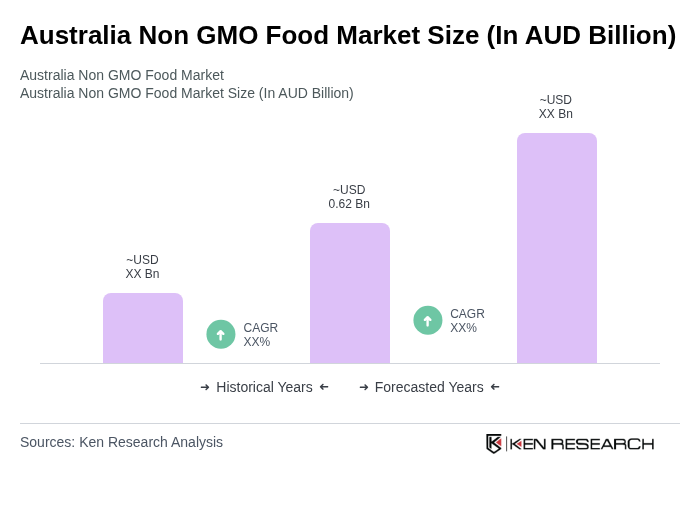
- The Australia Non GMO Food Market is valued at approximately AUD 0.62 billion, based on a five-year historical analysis. This growth is primarily driven by increasing consumer awareness regarding health and wellness, alongside a rising demand for organic and natural food products. The shift towards non-GMO foods is also influenced by concerns over food safety and environmental sustainability, leading to a significant uptick in consumer preference for non-GMO and organically certified products, particularly within fresh produce and plant-based categories.
- Key regions dominating the market include New South Wales, Victoria, and Queensland. These areas are characterized by a higher concentration of health-conscious consumers and a robust retail infrastructure that supports the distribution of non-GMO and organic products through major supermarket chains and specialty health food outlets. The presence of numerous health food stores, independent organic retailers, and extensive supermarket networks such as Coles and Woolworths in these regions further facilitates access to non-GMO options, making them pivotal in the market landscape.
- Food labeling in Australia is governed by the Australia New Zealand Food Standards Code, including Standard 1.5.2 – Food Produced Using Gene Technology, issued by Food Standards Australia New Zealand (FSANZ), which requires mandatory labeling of food produced using gene technology when novel DNA or protein remains present or when the food has altered characteristics (2001, as amended). Under this framework, products making non-GMO or GMO-free claims must ensure that such representations are accurate and not misleading under the Australian Consumer Law, and businesses commonly rely on identity-preserved, tested supply chains and third?party certification to substantiate non-GMO statements. These requirements collectively enhance transparency and consumer trust in food labeling, supporting credible marketing of non-GMO food products in the Australian market.
Australia Non GMO Food Market Segmentation
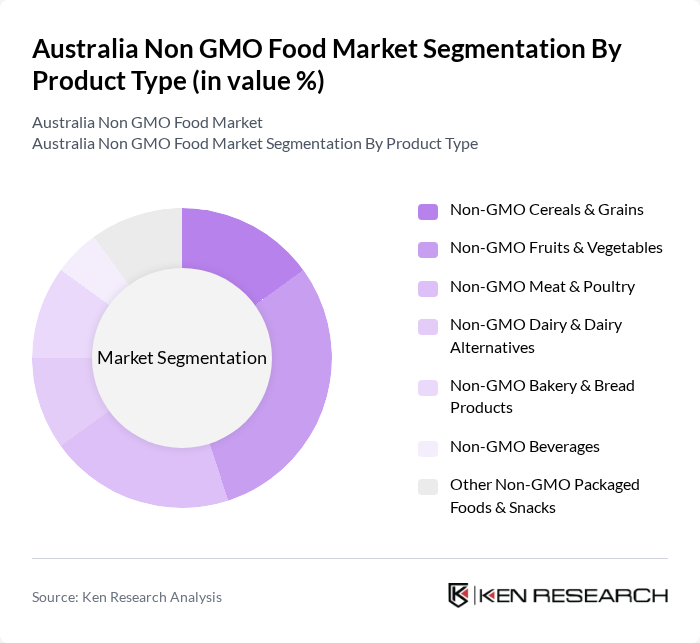
By Product Type:The product type segmentation of the market includes various categories such as Non-GMO Cereals & Grains, Non-GMO Fruits & Vegetables, Non-GMO Meat & Poultry, Non-GMO Dairy & Dairy Alternatives, Non-GMO Bakery & Bread Products, Non-GMO Beverages, and Other Non-GMO Packaged Foods & Snacks. This structure is consistent with how global non-GMO food markets segment by staple foods, animal products, dairy alternatives, and processed/packaged goods. Among these, Non-GMO Fruits & Vegetables are widely recognized as a leading category, supported by strong consumer preference for fresh produce perceived as natural, minimally processed, and free from genetically modified organisms, closely aligned with broader organic produce trends in Australia. This trend is driven by health-conscious consumers who prioritize organic and natural food options, leading to robust demand for non-GMO fruits and vegetables in retail and specialty channels.
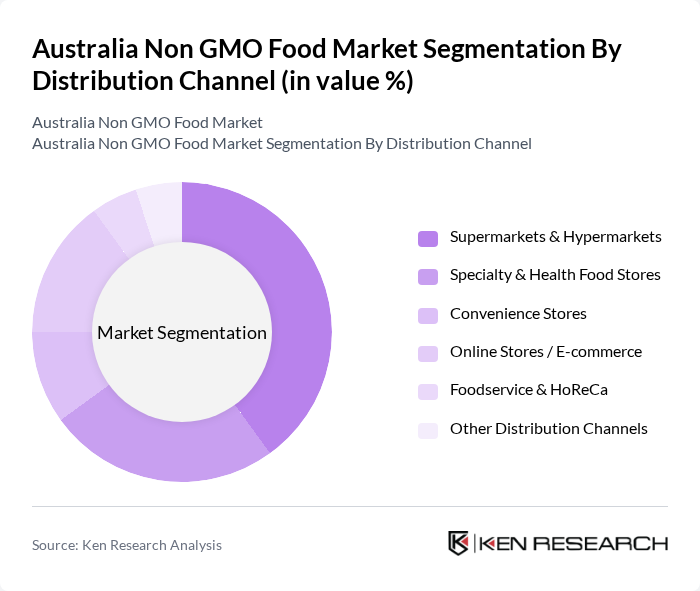
By Distribution Channel:The distribution channel segmentation includes Supermarkets & Hypermarkets, Specialty & Health Food Stores, Convenience Stores, Online Stores / E-commerce, Foodservice & HoReCa, and Other Distribution Channels. This segmentation reflects the primary routes to market for non-GMO and organic food products in Australia, where mainstream retail, specialty health outlets, and online platforms collectively support category growth. Supermarkets & Hypermarkets dominate the market due to their extensive reach, national store networks, and ability to offer a wide variety of non-GMO and organic products under one roof, with major chains increasing shelf space and private-label offerings in better-for-you segments. The convenience and accessibility of these retail formats, complemented by growing online grocery adoption, cater to the rising demand for non-GMO foods, making them the preferred shopping destination for a large share of consumers.
Australia Non GMO Food Market Competitive Landscape
The Australia Non GMO Food Market is characterized by a dynamic mix of regional and international players. Leading participants such as Sanitarium Health Food Company, PureHarvest, Macro Wholefoods Market (Woolworths Group), Australian Organic Limited, Honest to Goodness, The Health Food Company, Ceres Organics Australia, Spiral Foods, Planet Organic, Kialla Pure Foods, Loving Earth, Naturally Good Products, The Source Bulk Foods, Flannerys Organic & Wholefood Market, and other emerging non-GMO and organic brands contribute to innovation, geographic expansion, and service delivery in this space.
Australia Non GMO Food Market Industry Analysis
Growth Drivers
- Increasing Consumer Awareness of Health Benefits:The Australian population is increasingly aware of the health benefits associated with non-GMO foods. According to the Australian Bureau of Statistics, 65% of consumers actively seek non-GMO labels when purchasing food products. This trend is driven by rising health concerns, with 30% of Australians reporting dietary changes to improve health. The demand for transparency in food sourcing is also contributing to this growth, as consumers prioritize health-conscious choices.
- Rising Demand for Organic and Natural Products:The organic food market in Australia reached AUD 2.6 billion, reflecting a 12% increase from the previous year. This surge is indicative of a broader trend where consumers are gravitating towards organic and natural products, with 45% of Australians preferring organic options. The increasing availability of non-GMO certified products in supermarkets and specialty stores is further fueling this demand, as consumers associate these products with higher quality and safety standards.
- Government Support for Non-GMO Initiatives:The Australian government has implemented various initiatives to promote non-GMO agriculture, allocating AUD 50 million for research and development in sustainable farming practices. This support includes grants for farmers transitioning to non-GMO crops, which has led to a 20% increase in non-GMO crop production. Additionally, government campaigns aimed at educating consumers about the benefits of non-GMO foods have further bolstered market growth, enhancing public trust in these products.
Market Challenges
- High Production Costs:The production costs for non-GMO foods in Australia are significantly higher than for conventional foods, with estimates indicating a 30% premium on non-GMO crops. This is primarily due to the stringent farming practices and certification processes required to maintain non-GMO status. As a result, many farmers are hesitant to transition to non-GMO farming, limiting the supply of these products in the market and creating a barrier for wider consumer access.
- Limited Supply Chain Infrastructure:The supply chain for non-GMO foods in Australia faces significant challenges, including inadequate infrastructure for storage and distribution. A report from the Australian Food and Grocery Council indicates that 40% of non-GMO products experience delays in distribution due to logistical issues. This inefficiency not only affects product availability but also increases costs, making it difficult for retailers to maintain competitive pricing for non-GMO offerings.
Australia Non GMO Food Market Future Outlook
The future of the non-GMO food market in Australia appears promising, driven by increasing consumer demand for healthier food options and sustainable practices. As more Australians adopt plant-based diets, the market is likely to see a rise in non-GMO product offerings. Additionally, advancements in e-commerce are expected to enhance accessibility, allowing consumers to easily purchase non-GMO foods online. This shift will likely encourage more brands to enter the market, fostering innovation and competition.
Market Opportunities
- Growth in E-commerce for Food Products:The e-commerce food sector in Australia is projected to reach AUD 5 billion, presenting a significant opportunity for non-GMO brands. With 70% of consumers preferring online shopping for groceries, businesses can leverage this trend to expand their reach and cater to health-conscious consumers seeking non-GMO options conveniently.
- Development of New Non-GMO Product Lines:There is a growing opportunity for companies to innovate and develop new non-GMO product lines, particularly in snacks and beverages. The Australian market has seen a 15% increase in demand for non-GMO snacks, indicating a lucrative niche. Brands that invest in research and development to create appealing non-GMO products can capture this expanding consumer base effectively.
Scope of the Report
| Segment | Sub-Segments |
|---|---|
| By Product Type | Non-GMO Cereals & Grains Non-GMO Fruits & Vegetables Non-GMO Meat & Poultry Non-GMO Dairy & Dairy Alternatives Non-GMO Bakery & Bread Products Non-GMO Beverages Other Non-GMO Packaged Foods & Snacks |
| By Distribution Channel | Supermarkets & Hypermarkets Specialty & Health Food Stores Convenience Stores Online Stores / E-commerce Foodservice & HoReCa Other Distribution Channels |
| By Consumer Segment | Health-Conscious Consumers Families with Children Ethical & Environmentally Conscious Consumers Other Consumer Segments |
| By Packaging Format | Retail Packs Bulk / Foodservice Packs Eco-Friendly / Sustainable Packaging Other Packaging Formats |
| By Certification Type | Non-GMO Certified Organic Certified (Non-GMO) Other Third-Party Certifications Uncertified but Non-GMO Claim |
| By Region | New South Wales & Australian Capital Territory Victoria & Tasmania Queensland Western Australia South Australia & Northern Territory Other Regions |
| By Price Tier | Value / Budget Mid-Range Premium Super-Premium |
Key Target Audience
Investors and Venture Capitalist Firms
Government and Regulatory Bodies (e.g., Food Standards Australia New Zealand, Department of Agriculture, Water and the Environment)
Manufacturers and Producers of Non-GMO Food Products
Distributors and Retailers of Organic and Non-GMO Foods
Food Safety and Quality Assurance Organizations
Industry Associations (e.g., Non-GMO Project, Australian Organic)
Importers and Exporters of Non-GMO Food Products
Health and Wellness Advocacy Groups
Players Mentioned in the Report:
Sanitarium Health Food Company
PureHarvest
Macro Wholefoods Market (Woolworths Group)
Australian Organic Limited
Honest to Goodness
The Health Food Company
Ceres Organics Australia
Spiral Foods
Planet Organic
Kialla Pure Foods
Loving Earth
Naturally Good Products
The Source Bulk Foods
Flannerys Organic & Wholefood Market
Other Emerging Non-GMO & Organic Brands
Table of Contents
Market Assessment Phase
1. Executive Summary and Approach
2. Australia Non GMO Food Market Overview
2.1 Key Insights and Strategic Recommendations
2.2 Australia Non GMO Food Market Overview
2.3 Definition and Scope
2.4 Evolution of Market Ecosystem
2.5 Timeline of Key Regulatory Milestones
2.6 Value Chain & Stakeholder Mapping
2.7 Business Cycle Analysis
2.8 Policy & Incentive Landscape
3. Australia Non GMO Food Market Analysis
3.1 Growth Drivers
3.1.1 Increasing Consumer Awareness of Health Benefits
3.1.2 Rising Demand for Organic and Natural Products
3.1.3 Government Support for Non-GMO Initiatives
3.1.4 Expansion of Retail Channels for Non-GMO Products
3.2 Market Challenges
3.2.1 High Production Costs
3.2.2 Limited Supply Chain Infrastructure
3.2.3 Consumer Misconceptions about Non-GMO
3.2.4 Regulatory Compliance Complexity
3.3 Market Opportunities
3.3.1 Growth in E-commerce for Food Products
3.3.2 Development of New Non-GMO Product Lines
3.3.3 Partnerships with Health and Wellness Brands
3.3.4 Export Potential to International Markets
3.4 Market Trends
3.4.1 Increasing Popularity of Plant-Based Diets
3.4.2 Rise of Clean Label Products
3.4.3 Focus on Sustainable Farming Practices
3.4.4 Growth of Local Sourcing Initiatives
3.5 Government Regulation
3.5.1 Mandatory Labeling of GMO Products
3.5.2 Support for Non-GMO Certification Programs
3.5.3 Restrictions on GMO Crop Cultivation
3.5.4 Incentives for Organic Farming Practices
4. SWOT Analysis
5. Stakeholder Analysis
6. Porter's Five Forces Analysis
7. Australia Non GMO Food Market Market Size, 2019-2024
7.1 By Value
7.2 By Volume
7.3 By Average Selling Price
8. Australia Non GMO Food Market Segmentation
8.1 By Product Type
8.1.1 Non-GMO Cereals & Grains
8.1.2 Non-GMO Fruits & Vegetables
8.1.3 Non-GMO Meat & Poultry
8.1.4 Non-GMO Dairy & Dairy Alternatives
8.1.5 Non-GMO Bakery & Bread Products
8.1.6 Non-GMO Beverages
8.1.7 Other Non-GMO Packaged Foods & Snacks
8.2 By Distribution Channel
8.2.1 Supermarkets & Hypermarkets
8.2.2 Specialty & Health Food Stores
8.2.3 Convenience Stores
8.2.4 Online Stores / E-commerce
8.2.5 Foodservice & HoReCa
8.2.6 Other Distribution Channels
8.3 By Consumer Segment
8.3.1 Health-Conscious Consumers
8.3.2 Families with Children
8.3.3 Ethical & Environmentally Conscious Consumers
8.3.4 Other Consumer Segments
8.4 By Packaging Format
8.4.1 Retail Packs
8.4.2 Bulk / Foodservice Packs
8.4.3 Eco-Friendly / Sustainable Packaging
8.4.4 Other Packaging Formats
8.5 By Certification Type
8.5.1 Non-GMO Certified
8.5.2 Organic Certified (Non-GMO)
8.5.3 Other Third-Party Certifications
8.5.4 Uncertified but Non-GMO Claim
8.6 By Region
8.6.1 New South Wales & Australian Capital Territory
8.6.2 Victoria & Tasmania
8.6.3 Queensland
8.6.4 Western Australia
8.6.5 South Australia & Northern Territory
8.6.6 Other Regions
8.7 By Price Tier
8.7.1 Value / Budget
8.7.2 Mid-Range
8.7.3 Premium
8.7.4 Super-Premium
9. Australia Non GMO Food Market Competitive Analysis
9.1 Market Share of Key Players
9.2 Cross Comparison of Key Players
9.2.1 Company Name
9.2.2 Group Size (Large, Medium, or Small as per industry convention)
9.2.3 Australia Non-GMO Food Revenue (AUD Million)
9.2.4 Australia Non-GMO Food Revenue Growth Rate (% CAGR, 2019-2024)
9.2.5 Market Share in Australia Non-GMO Food Market (%)
9.2.6 EBITDA Margin (%) – Non-GMO Food Portfolio
9.2.7 Average Realized Price per kg / litre (AUD)
9.2.8 Distribution Reach (No. of Outlets / States Covered)
9.2.9 Share of Online Sales in Total Non-GMO Revenue (%)
9.2.10 Product Portfolio Breadth (No. of Non-GMO SKUs)
9.2.11 Marketing & Promotion Spend as % of Non-GMO Revenue
9.2.12 R&D / Innovation Spend as % of Non-GMO Revenue
9.2.13 Certification Coverage (No. of Non-GMO / Organic Certifications)
9.3 SWOT Analysis of Top Players
9.4 Pricing Analysis
9.5 Detailed Profile of Major Companies
9.5.1 Sanitarium Health Food Company
9.5.2 PureHarvest
9.5.3 Macro Wholefoods Market (Woolworths Group)
9.5.4 Australian Organic Limited
9.5.5 Honest to Goodness
9.5.6 The Health Food Company
9.5.7 Ceres Organics Australia
9.5.8 Spiral Foods
9.5.9 Planet Organic
9.5.10 Kialla Pure Foods
9.5.11 Loving Earth
9.5.12 Naturally Good Products
9.5.13 The Source Bulk Foods
9.5.14 Flannerys Organic & Wholefood Market
9.5.15 Other Emerging Non-GMO & Organic Brands
10. Australia Non GMO Food Market End-User Analysis
10.1 Procurement Behavior of Key Ministries
10.1.1 Government Procurement Policies
10.1.2 Budget Allocations for Non-GMO Products
10.1.3 Supplier Selection Criteria
10.1.4 Contract Management Practices
10.2 Corporate Spend on Infrastructure & Energy
10.2.1 Investment in Sustainable Practices
10.2.2 Budgeting for Non-GMO Ingredients
10.2.3 Partnerships with Local Farmers
10.2.4 Others
10.3 Pain Point Analysis by End-User Category
10.3.1 Quality Assurance Issues
10.3.2 Supply Chain Disruptions
10.3.3 Price Sensitivity
10.3.4 Others
10.4 User Readiness for Adoption
10.4.1 Awareness of Non-GMO Benefits
10.4.2 Willingness to Pay Premium
10.4.3 Availability of Non-GMO Options
10.4.4 Others
10.5 Post-Deployment ROI and Use Case Expansion
10.5.1 Measurement of ROI
10.5.2 Case Studies of Successful Adoption
10.5.3 Expansion into New Markets
10.5.4 Others
11. Australia Non GMO Food Market Future Size, 2025-2030
11.1 By Value
11.2 By Volume
11.3 By Average Selling Price
Go-To-Market Strategy Phase
1. Whitespace Analysis + Business Model Canvas
1.1 Market Gaps Identification
1.2 Business Model Development
2. Marketing and Positioning Recommendations
2.1 Branding Strategies
2.2 Product USPs
3. Distribution Plan
3.1 Urban Retail vs Rural NGO Tie-ups
4. Channel & Pricing Gaps
4.1 Underserved Routes
4.2 Pricing Bands
5. Unmet Demand & Latent Needs
5.1 Category Gaps
5.2 Consumer Segments
6. Customer Relationship
6.1 Loyalty Programs
6.2 After-sales Service
7. Value Proposition
7.1 Sustainability
7.2 Integrated Supply Chains
8. Key Activities
8.1 Regulatory Compliance
8.2 Branding
8.3 Distribution Setup
9. Entry Strategy Evaluation
9.1 Domestic Market Entry Strategy
9.1.1 Product Mix
9.1.2 Pricing Band
9.1.3 Packaging
9.2 Export Entry Strategy
9.2.1 Target Countries
9.2.2 Compliance Roadmap
10. Entry Mode Assessment
10.1 JV
10.2 Greenfield
10.3 M&A
10.4 Distributor Model
11. Capital and Timeline Estimation
11.1 Capital Requirements
11.2 Timelines
12. Control vs Risk Trade-Off
12.1 Ownership vs Partnerships
13. Profitability Outlook
13.1 Breakeven Analysis
13.2 Long-term Sustainability
14. Potential Partner List
14.1 Distributors
14.2 JVs
14.3 Acquisition Targets
15. Execution Roadmap
15.1 Phased Plan for Market Entry
15.1.1 Market Setup
15.1.2 Market Entry
15.1.3 Growth Acceleration
15.1.4 Scale & Stabilize
15.2 Key Activities and Milestones
15.2.1 Milestone Planning
15.2.2 Activity Tracking
Research Methodology
Phase 1: Approach1
Desk Research
- Analysis of market reports from Australian food regulatory bodies and agricultural departments
- Review of consumer behavior studies focusing on non-GMO food preferences in Australia
- Examination of industry publications and trade journals related to organic and non-GMO food sectors
Primary Research
- Interviews with key stakeholders in the non-GMO food supply chain, including farmers and distributors
- Surveys targeting consumers to gauge awareness and purchasing behavior regarding non-GMO products
- Focus groups with health and nutrition experts to understand perceptions of non-GMO foods
Validation & Triangulation
- Cross-validation of findings through multiple data sources, including sales data and consumer surveys
- Triangulation of insights from industry experts, market reports, and consumer feedback
- Sanity checks conducted through expert panel reviews to ensure data reliability
Phase 2: Market Size Estimation1
Top-down Assessment
- Estimation of the total market size based on national food consumption statistics and trends
- Segmentation of the market by product categories, including fresh produce, packaged goods, and snacks
- Incorporation of government initiatives promoting non-GMO food production and consumption
Bottom-up Modeling
- Collection of sales data from leading non-GMO food retailers and manufacturers
- Estimation of market penetration rates based on consumer surveys and purchasing patterns
- Volume x price analysis to derive revenue estimates for various non-GMO food segments
Forecasting & Scenario Analysis
- Multi-factor regression analysis incorporating trends in health consciousness and environmental sustainability
- Scenario modeling based on potential regulatory changes and shifts in consumer preferences
- Development of baseline, optimistic, and pessimistic forecasts through 2030
Phase 3: CATI Sample Composition1
| Scope Item/Segment | Sample Size | Target Respondent Profiles |
|---|---|---|
| Consumer Awareness of Non-GMO Foods | 150 | Health-conscious Consumers, Grocery Shoppers |
| Retailer Insights on Non-GMO Product Offerings | 120 | Store Managers, Category Buyers |
| Farmer Perspectives on Non-GMO Crop Production | 90 | Farm Owners, Agricultural Consultants |
| Distributor Feedback on Non-GMO Supply Chain | 70 | Logistics Managers, Supply Chain Coordinators |
| Expert Opinions on Non-GMO Food Trends | 50 | Nutritional Scientists, Food Industry Analysts |
Frequently Asked Questions
What is the current value of the Australia Non-GMO Food Market?
The Australia Non-GMO Food Market is valued at approximately AUD 0.62 billion, reflecting a growing trend towards health and wellness among consumers, alongside increasing demand for organic and natural food products.
What factors are driving the growth of the Non-GMO Food Market in Australia?
Which regions in Australia dominate the Non-GMO Food Market?
What are the main product types in the Australia Non-GMO Food Market?
Other Regional/Country Reports
Other Adjacent Reports
Bahrain Plant-Based Food Market
Bahrain Natural Food Products Market
Malaysia Health and Wellness Food Market
UAE Sustainable Agriculture Market
KSA Clean Label Food Market
Oman Dairy Alternatives Market Report Size, Share, Growth Drivers, Trends, Opportunities & Forecast 2025–2030KSA Fresh Produce Market
Bahrain Packaged Snacks Market
South Korea Food Certification Market
Why Buy From Us?

What makes us stand out is that our consultants follow Robust, Refine and Result (RRR) methodology. Robust for clear definitions, approaches and sanity checking, Refine for differentiating respondents' facts and opinions, and Result for presenting data with story.

We have set a benchmark in the industry by offering our clients with syndicated and customized market research reports featuring coverage of entire market as well as meticulous research and analyst insights.

While we don't replace traditional research, we flip the method upside down. Our dual approach of Top Bottom & Bottom Top ensures quality deliverable by not just verifying company fundamentals but also looking at the sector and macroeconomic factors.

With one step in the future, our research team constantly tries to show you the bigger picture. We help with some of the tough questions you may encounter along the way: How is the industry positioned? Best marketing channel? KPI's of competitors? By aligning every element, we help maximize success.

Our report gives you instant access to the answers and sources that other companies might choose to hide. We elaborate each steps of research methodology we have used and showcase you the sample size to earn your trust.

If you need any support, we are here! We pride ourselves on universe strength, data quality, and quick, friendly, and professional service.