About the Report
Base Year 2024Japan Non GMO Food Market Overview
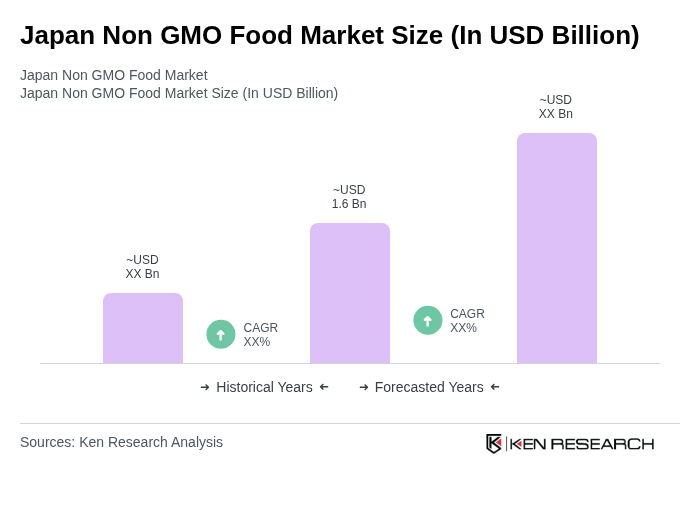
- The Japan Non GMO Food Market is valued at USD 1.6 billion, based on a five-year historical analysis. This growth is primarily driven by increasing consumer awareness regarding health and environmental sustainability, alongside a rising demand for organic and clean-label products. The market has seen a significant shift as consumers prefer non-GMO options, supported by the broader trend toward organic packaged foods and minimally processed products in Japan, leading to a robust expansion in product offerings across various categories.
- Key demand hubs in this market include major metropolitan areas such as Tokyo, Osaka, and Yokohama, which contribute significantly due to their large populations and high consumer spending power. These cities have a well-established retail infrastructure, including supermarkets, department stores, specialty organic shops, and e?commerce channels, and exhibit a strong trend towards health-conscious eating, making them prime locations for non-GMO and organic food products. The urban population's preference for organic, clean-label, and non-GMO foods, together with higher disposable incomes and exposure to global wellness trends, further fuels market growth in these regions.
- Japan regulates genetically modified foods and their labeling under the Food Sanitation Act and the Food Labeling Act, including the “Standards for Labeling of Genetically Modified Foods” issued by the Consumer Affairs Agency and the Ministry of Health, Labour and Welfare. These standards require mandatory labeling for designated processed and fresh foods that contain genetically modified ingredients above specified thresholds, covering key commodities such as soybeans, corn, potatoes, and their derived products, and define how GM and non-GM content must be indicated on packages. The tightening of labeling rules and clearer disclosure obligations enhances consumer transparency and safety, supporting the expansion of the non-GMO food sector as manufacturers increasingly position products with non-GMO or organic attributes to align with consumer health and environmental values.
Japan Non GMO Food Market Segmentation
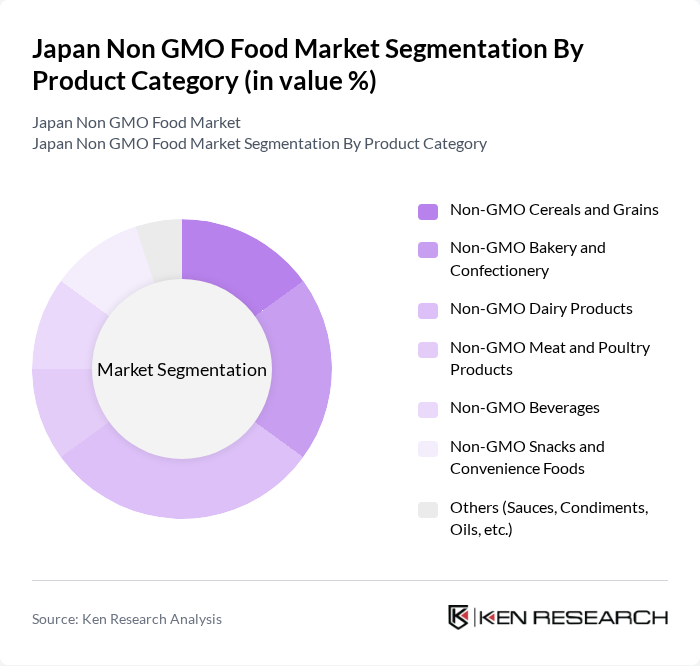
By Product Category:The product category segmentation includes various subsegments such as Non-GMO Cereals and Grains, Non-GMO Bakery and Confectionery, Non-GMO Dairy Products, Non-GMO Meat and Poultry Products, Non-GMO Beverages, Non-GMO Snacks and Convenience Foods, and Others (Sauces, Condiments, Oils, etc.). This structure is consistent with how global and regional non-GMO and organic food markets are commonly segmented across staple foods, packaged categories, beverages, and condiments. Among these, Non-GMO Dairy Products are an important and fast-growing segment, supported by rising demand for healthier dairy options, interest in origin and feed (including non-GMO feed), and the broader shift toward organic and premium dairy in Japan. Consumers are becoming more health-conscious and attentive to clean labels, driving demand for dairy products perceived as free from genetically modified ingredients and aligned with animal welfare and sustainability expectations.
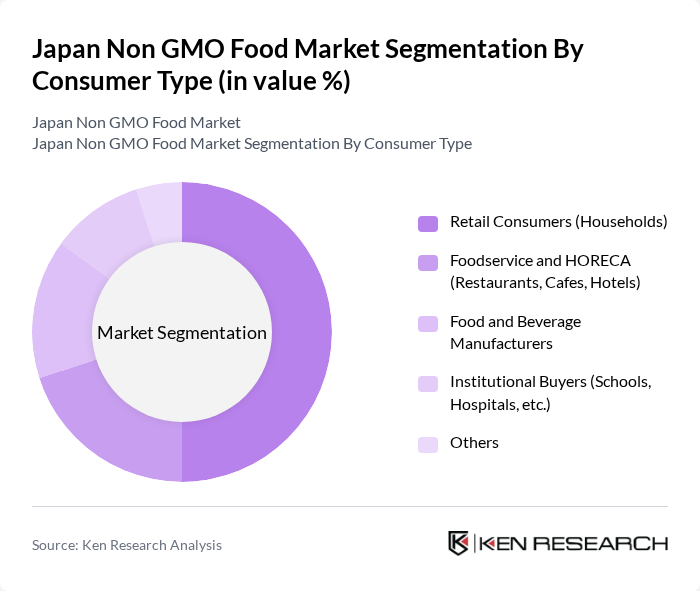
By Consumer Type:The consumer type segmentation includes Retail Consumers (Households), Foodservice and HORECA (Restaurants, Cafes, Hotels), Food and Beverage Manufacturers, Institutional Buyers (Schools, Hospitals, etc.), and Others. This segmentation aligns with the main demand-side groups that purchase non-GMO and organic products through retail, foodservice, and industrial channels. Retail Consumers are the dominant segment, driven by the increasing trend of health-conscious eating, strong interest in natural and organic products, and the growing availability of non-GMO offerings in supermarkets, specialty stores, and online grocery platforms in Japan. The shift towards home cooking, rising scrutiny of ingredient lists, and demand for clean-label products have further propelled this segment's growth.
Japan Non GMO Food Market Competitive Landscape
The Japan Non GMO Food Market is characterized by a dynamic mix of regional and international players. Leading participants such as Aeon Co., Ltd., Marubeni Corporation, Oisix ra daichi Inc., Kagome Co., Ltd., Asahi Group Holdings, Ltd., Itoham Yonekyu Holdings Inc., Sapporo Holdings Limited, Nippon Suisan Kaisha, Ltd. (Nissui), Kikkoman Corporation, Kewpie Corporation, Takara Holdings Inc., House Foods Group Inc., Ito En, Ltd., Meiji Holdings Co., Ltd., Ajinomoto Co., Inc. contribute to innovation, geographic expansion, and service delivery in this space.
Japan Non GMO Food Market Industry Analysis
Growth Drivers
- Increasing Consumer Awareness of Health Benefits:The Japanese population is increasingly aware of the health benefits associated with non-GMO foods. According to a recent survey by the Ministry of Health, Labor and Welfare, 68% of consumers prioritize health when choosing food products. This trend is supported by a report from the Japan Health Promotion Foundation, which indicates that the organic food market is projected to reach ¥1.3 trillion, reflecting a growing preference for healthier, non-GMO options.
- Rising Demand for Organic and Natural Products:The demand for organic and natural products in Japan has surged, with the organic food market growing by ¥250 billion, reaching ¥1.1 trillion. The Japan Organic Agriculture Association reported that over 1.2 million hectares are now dedicated to organic farming, a 10% increase from the previous period. This growth is driven by consumers seeking transparency and sustainability in their food choices, further propelling the non-GMO food sector.
- Government Support for Non-GMO Initiatives:The Japanese government has implemented various initiatives to promote non-GMO agriculture. Recently, the Ministry of Agriculture, Forestry and Fisheries allocated ¥35 billion to support non-GMO crop production and research. Additionally, the government has introduced subsidies for farmers transitioning to non-GMO practices, which has led to a 15% increase in non-GMO crop acreage, fostering a more robust market for non-GMO foods.
Market Challenges
- High Production Costs:The production costs for non-GMO foods in Japan are significantly higher than for conventional foods. A recent report from the Japan Agricultural Cooperatives indicated that non-GMO crops incur an average cost increase of 25% due to stricter farming practices and certification processes. This financial burden can deter farmers from adopting non-GMO methods, limiting supply and increasing prices for consumers.
- Limited Supply Chain Infrastructure:The supply chain for non-GMO foods in Japan faces significant limitations. According to a recent study by the Japan Food Industry Association, only 45% of retailers have established reliable sourcing channels for non-GMO products. This lack of infrastructure results in inconsistent product availability, which can frustrate consumers and hinder market growth, as retailers struggle to meet rising demand.
Japan Non GMO Food Market Future Outlook
The future of the non-GMO food market in Japan appears promising, driven by increasing consumer demand for healthier options and government support for sustainable agriculture. As e-commerce continues to expand, more consumers will have access to non-GMO products, enhancing market penetration. Additionally, innovations in product development will likely attract health-conscious consumers, further solidifying the market's growth trajectory. The emphasis on transparency and local sourcing will also play a crucial role in shaping consumer preferences in the coming years.
Market Opportunities
- Growth in E-commerce for Food Products:The e-commerce sector for food products in Japan is projected to reach ¥3.5 trillion, driven by increased online shopping trends. This growth presents a significant opportunity for non-GMO food brands to expand their reach and cater to a broader audience, particularly among younger consumers who prefer online purchasing.
- Development of Innovative Non-GMO Products:There is a growing opportunity for the development of innovative non-GMO products, particularly in the snack and beverage segments. The Japan Food Research Institute reported that the demand for non-GMO snacks has increased by 30%, indicating a ripe market for new product launches that cater to health-conscious consumers seeking variety and quality.
Scope of the Report
| Segment | Sub-Segments |
|---|---|
| By Product Category | Non-GMO Cereals and Grains Non-GMO Bakery and Confectionery Non-GMO Dairy Products Non-GMO Meat and Poultry Products Non-GMO Beverages Non-GMO Snacks and Convenience Foods Others (Sauces, Condiments, Oils, etc.) |
| By Consumer Type | Retail Consumers (Households) Foodservice and HORECA (Restaurants, Cafes, Hotels) Food and Beverage Manufacturers Institutional Buyers (Schools, Hospitals, etc.) Others |
| By Distribution Channel | Supermarkets and Hypermarkets Convenience Stores Specialty and Health Food Stores Online Retail and E-commerce Foodservice and Direct-to-Business Channels |
| By Certification & Labeling | Non-GMO Verified (Domestic Certification) International Non-GMO Certifications Organic and Non-GMO Dual-Certified Clean Label / Free-from Claims (Gluten-free, Additive-free, etc.) Others |
| By Packaging Type | Retail Packs (?5 kg / ?5 L) Foodservice and Bulk Packs Ready-to-Eat / Ready-to-Cook Formats Sustainable / Eco-Friendly Packaging Others |
| By Price Positioning | Economy / Value Standard / Mid-Range Premium and Super-Premium Private Label vs Branded |
| By Region | Kanto Region Kansai / Kinki Region Chubu / Central Region Hokkaido and Tohoku Region Chugoku and Shikoku Region Kyushu-Okinawa Region |
Key Target Audience
Investors and Venture Capitalist Firms
Government and Regulatory Bodies (e.g., Ministry of Agriculture, Forestry and Fisheries, Food Safety Commission of Japan)
Manufacturers and Producers
Distributors and Retailers
Organic Certification Bodies
Food Importers and Exporters
Industry Associations (e.g., Japan Organic Agriculture Association)
Health and Wellness Organizations
Players Mentioned in the Report:
Aeon Co., Ltd.
Marubeni Corporation
Oisix ra daichi Inc.
Kagome Co., Ltd.
Asahi Group Holdings, Ltd.
Itoham Yonekyu Holdings Inc.
Sapporo Holdings Limited
Nippon Suisan Kaisha, Ltd. (Nissui)
Kikkoman Corporation
Kewpie Corporation
Takara Holdings Inc.
House Foods Group Inc.
Ito En, Ltd.
Meiji Holdings Co., Ltd.
Ajinomoto Co., Inc.
Table of Contents
Market Assessment Phase
1. Executive Summary and Approach
2. Japan Non GMO Food Market Overview
2.1 Key Insights and Strategic Recommendations
2.2 Japan Non GMO Food Market Overview
2.3 Definition and Scope
2.4 Evolution of Market Ecosystem
2.5 Timeline of Key Regulatory Milestones
2.6 Value Chain & Stakeholder Mapping
2.7 Business Cycle Analysis
2.8 Policy & Incentive Landscape
3. Japan Non GMO Food Market Analysis
3.1 Growth Drivers
3.1.1 Increasing Consumer Awareness of Health Benefits
3.1.2 Rising Demand for Organic and Natural Products
3.1.3 Government Support for Non-GMO Initiatives
3.1.4 Expansion of Retail Channels for Non-GMO Products
3.2 Market Challenges
3.2.1 High Production Costs
3.2.2 Limited Supply Chain Infrastructure
3.2.3 Consumer Price Sensitivity
3.2.4 Regulatory Compliance Complexity
3.3 Market Opportunities
3.3.1 Growth in E-commerce for Food Products
3.3.2 Development of Innovative Non-GMO Products
3.3.3 Partnerships with Health and Wellness Brands
3.3.4 Export Potential to Other Markets
3.4 Market Trends
3.4.1 Shift Towards Plant-Based Diets
3.4.2 Increased Transparency in Food Labeling
3.4.3 Rise of Local Sourcing and Production
3.4.4 Growing Popularity of Non-GMO Certifications
3.5 Government Regulation
3.5.1 Stricter Labeling Requirements for GMO Products
3.5.2 Supportive Policies for Organic Farming
3.5.3 Import Regulations on GMO Foods
3.5.4 Incentives for Non-GMO Crop Production
4. SWOT Analysis
5. Stakeholder Analysis
6. Porter's Five Forces Analysis
7. Japan Non GMO Food Market Market Size, 2019-2024
7.1 By Value
7.2 By Volume
7.3 By Average Selling Price
8. Japan Non GMO Food Market Segmentation
8.1 By Product Category
8.1.1 Non-GMO Cereals and Grains
8.1.2 Non-GMO Bakery and Confectionery
8.1.3 Non-GMO Dairy Products
8.1.4 Non-GMO Meat and Poultry Products
8.1.5 Non-GMO Beverages
8.1.6 Non-GMO Snacks and Convenience Foods
8.1.7 Others (Sauces, Condiments, Oils, etc.)
8.2 By Consumer Type
8.2.1 Retail Consumers (Households)
8.2.2 Foodservice and HORECA (Restaurants, Cafes, Hotels)
8.2.3 Food and Beverage Manufacturers
8.2.4 Institutional Buyers (Schools, Hospitals, etc.)
8.2.5 Others
8.3 By Distribution Channel
8.3.1 Supermarkets and Hypermarkets
8.3.2 Convenience Stores
8.3.3 Specialty and Health Food Stores
8.3.4 Online Retail and E-commerce
8.3.5 Foodservice and Direct-to-Business Channels
8.4 By Certification & Labeling
8.4.1 Non-GMO Verified (Domestic Certification)
8.4.2 International Non-GMO Certifications
8.4.3 Organic and Non-GMO Dual-Certified
8.4.4 Clean Label / Free-from Claims (Gluten-free, Additive-free, etc.)
8.4.5 Others
8.5 By Packaging Type
8.5.1 Retail Packs (?5 kg / ?5 L)
8.5.2 Foodservice and Bulk Packs
8.5.3 Ready-to-Eat / Ready-to-Cook Formats
8.5.4 Sustainable / Eco-Friendly Packaging
8.5.5 Others
8.6 By Price Positioning
8.6.1 Economy / Value
8.6.2 Standard / Mid-Range
8.6.3 Premium and Super-Premium
8.6.4 Private Label vs Branded
8.7 By Region
8.7.1 Kanto Region
8.7.2 Kansai / Kinki Region
8.7.3 Chubu / Central Region
8.7.4 Hokkaido and Tohoku Region
8.7.5 Chugoku and Shikoku Region
8.7.6 Kyushu-Okinawa Region
9. Japan Non GMO Food Market Competitive Analysis
9.1 Market Share of Key Players
9.2 Cross Comparison of Key Players
9.2.1 Company Name
9.2.2 Group Size (Large, Medium, or Small as per industry convention)
9.2.3 Japan Non-GMO Food Revenue (Latest FY, JPY Billion)
9.2.4 3-Year Revenue CAGR in Non-GMO / Clean-Label Portfolio (%)
9.2.5 Gross Margin from Non-GMO Food Portfolio (%)
9.2.6 Market Share in Target Categories (%)
9.2.7 Distribution Coverage (No. of Stores / Prefectures Covered)
9.2.8 Share of Online Sales in Total Revenue (%)
9.2.9 Average Price Premium vs Conventional Products (%)
9.2.10 Non-GMO / Clean-Label SKU Count
9.2.11 R&D and Certification Spend on Non-GMO (as % of Sales)
9.2.12 Brand Awareness / Preference Score (Japan, Index)
9.3 SWOT Analysis of Top Players
9.4 Pricing Analysis
9.5 Detailed Profile of Major Companies
9.5.1 Aeon Co., Ltd.
9.5.2 Marubeni Corporation
9.5.3 Oisix ra daichi Inc.
9.5.4 Kagome Co., Ltd.
9.5.5 Asahi Group Holdings, Ltd.
9.5.6 Itoham Yonekyu Holdings Inc.
9.5.7 Sapporo Holdings Limited
9.5.8 Nippon Suisan Kaisha, Ltd. (Nissui)
9.5.9 Kikkoman Corporation
9.5.10 Kewpie Corporation
9.5.11 Takara Holdings Inc.
9.5.12 House Foods Group Inc.
9.5.13 Ito En, Ltd.
9.5.14 Meiji Holdings Co., Ltd.
9.5.15 Ajinomoto Co., Inc.
10. Japan Non GMO Food Market End-User Analysis
10.1 Procurement Behavior of Key Ministries
10.1.1 Ministry of Agriculture, Forestry and Fisheries
10.1.2 Ministry of Health, Labour and Welfare
10.1.3 Ministry of the Environment
10.1.4 Others
10.2 Corporate Spend on Infrastructure & Energy
10.2.1 Food Processing Companies
10.2.2 Retail Chains
10.2.3 Food Service Providers
10.2.4 Others
10.3 Pain Point Analysis by End-User Category
10.3.1 Households
10.3.2 Restaurants
10.3.3 Retailers
10.3.4 Food Manufacturers
10.4 User Readiness for Adoption
10.4.1 Awareness of Non-GMO Products
10.4.2 Willingness to Pay a Premium
10.4.3 Availability of Non-GMO Options
10.4.4 Others
10.5 Post-Deployment ROI and Use Case Expansion
10.5.1 Case Studies of Successful Non-GMO Implementations
10.5.2 Metrics for Measuring ROI
10.5.3 Opportunities for Product Line Expansion
10.5.4 Others
11. Japan Non GMO Food Market Future Size, 2025-2030
11.1 By Value
11.2 By Volume
11.3 By Average Selling Price
Go-To-Market Strategy Phase
1. Whitespace Analysis + Business Model Canvas
1.1 Market Gaps Identification
1.2 Business Model Development
2. Marketing and Positioning Recommendations
2.1 Branding Strategies
2.2 Product USPs
3. Distribution Plan
3.1 Urban Retail Strategies
3.2 Rural NGO Tie-Ups
4. Channel & Pricing Gaps
4.1 Underserved Routes
4.2 Pricing Bands
5. Unmet Demand & Latent Needs
5.1 Category Gaps
5.2 Consumer Segments
6. Customer Relationship
6.1 Loyalty Programs
6.2 After-Sales Service
7. Value Proposition
7.1 Sustainability
7.2 Integrated Supply Chains
8. Key Activities
8.1 Regulatory Compliance
8.2 Branding
8.3 Distribution Setup
9. Entry Strategy Evaluation
9.1 Domestic Market Entry Strategy
9.1.1 Product Mix
9.1.2 Pricing Band
9.1.3 Packaging
9.2 Export Entry Strategy
9.2.1 Target Countries
9.2.2 Compliance Roadmap
10. Entry Mode Assessment
10.1 Joint Ventures
10.2 Greenfield Investments
10.3 Mergers & Acquisitions
10.4 Distributor Model
11. Capital and Timeline Estimation
11.1 Capital Requirements
11.2 Timelines
12. Control vs Risk Trade-Off
12.1 Ownership vs Partnerships
13. Profitability Outlook
13.1 Breakeven Analysis
13.2 Long-Term Sustainability
14. Potential Partner List
14.1 Distributors
14.2 Joint Ventures
14.3 Acquisition Targets
15. Execution Roadmap
15.1 Phased Plan for Market Entry
15.1.1 Market Setup
15.1.2 Market Entry
15.1.3 Growth Acceleration
15.1.4 Scale & Stabilize
15.2 Key Activities and Milestones
15.2.1 Milestone Planning
15.2.2 Activity Tracking
Research Methodology
Phase 1: Approach1
Desk Research
- Analysis of market reports from Japanese agricultural and food industry associations
- Review of government publications on non-GMO regulations and consumer trends
- Examination of academic journals focusing on food safety and consumer preferences in Japan
Primary Research
- Interviews with key stakeholders in the non-GMO food supply chain, including farmers and distributors
- Surveys targeting consumers to gauge awareness and purchasing behavior regarding non-GMO products
- Focus groups with health and nutrition experts to understand perceptions of non-GMO foods
Validation & Triangulation
- Cross-validation of findings with data from international non-GMO certification bodies
- Triangulation of consumer survey results with sales data from major retailers
- Sanity checks through expert panel discussions involving industry analysts and market researchers
Phase 2: Market Size Estimation1
Top-down Assessment
- Estimation of the total market size based on national food consumption statistics
- Segmentation of the market by product categories such as grains, dairy, and processed foods
- Incorporation of growth rates from related sectors, including organic and health food markets
Bottom-up Modeling
- Collection of sales data from leading non-GMO food brands and retailers
- Estimation of average pricing and volume sold across different product categories
- Analysis of distribution channels and their impact on market penetration
Forecasting & Scenario Analysis
- Development of predictive models based on historical sales data and consumer trends
- Scenario analysis considering potential regulatory changes and shifts in consumer preferences
- Projections of market growth under various economic conditions through 2030
Phase 3: CATI Sample Composition1
| Scope Item/Segment | Sample Size | Target Respondent Profiles |
|---|---|---|
| Consumer Awareness of Non-GMO Foods | 150 | Health-conscious Consumers, Grocery Shoppers |
| Retailer Insights on Non-GMO Product Offerings | 120 | Store Managers, Category Buyers |
| Farmer Perspectives on Non-GMO Crop Production | 90 | Organic Farmers, Agricultural Cooperatives |
| Distributor Feedback on Non-GMO Supply Chain | 70 | Logistics Managers, Supply Chain Coordinators |
| Expert Opinions on Non-GMO Market Trends | 50 | Food Scientists, Market Analysts |
Frequently Asked Questions
What is the current value of the Japan Non-GMO Food Market?
The Japan Non-GMO Food Market is valued at approximately USD 1.6 billion, reflecting a significant growth trend driven by increasing consumer awareness of health and environmental sustainability, as well as a rising demand for organic and clean-label products.
What are the main drivers of growth in the Japan Non-GMO Food Market?
Which regions in Japan show the highest demand for non-GMO foods?
What are the main product categories in the Japan Non-GMO Food Market?
Other Regional/Country Reports
Other Adjacent Reports
Philippines Clean Label Food Market
Brazil Natural Food Market
Germany Health Food Market
UAE Functional Food MarketIndonesia Plant-Based Food Market
Mexico Sustainable Agriculture Market
Oman Dairy Alternatives Market Report Size, Share, Growth Drivers, Trends, Opportunities & Forecast 2025–2030Indonesia Beverage Ingredients Market
Global Snack Food Market (2023-2027)Why Buy From Us?

What makes us stand out is that our consultants follow Robust, Refine and Result (RRR) methodology. Robust for clear definitions, approaches and sanity checking, Refine for differentiating respondents' facts and opinions, and Result for presenting data with story.

We have set a benchmark in the industry by offering our clients with syndicated and customized market research reports featuring coverage of entire market as well as meticulous research and analyst insights.

While we don't replace traditional research, we flip the method upside down. Our dual approach of Top Bottom & Bottom Top ensures quality deliverable by not just verifying company fundamentals but also looking at the sector and macroeconomic factors.

With one step in the future, our research team constantly tries to show you the bigger picture. We help with some of the tough questions you may encounter along the way: How is the industry positioned? Best marketing channel? KPI's of competitors? By aligning every element, we help maximize success.

Our report gives you instant access to the answers and sources that other companies might choose to hide. We elaborate each steps of research methodology we have used and showcase you the sample size to earn your trust.

If you need any support, we are here! We pride ourselves on universe strength, data quality, and quick, friendly, and professional service.