About the Report
Base Year 2024Australia Office Real Estate Market Overview
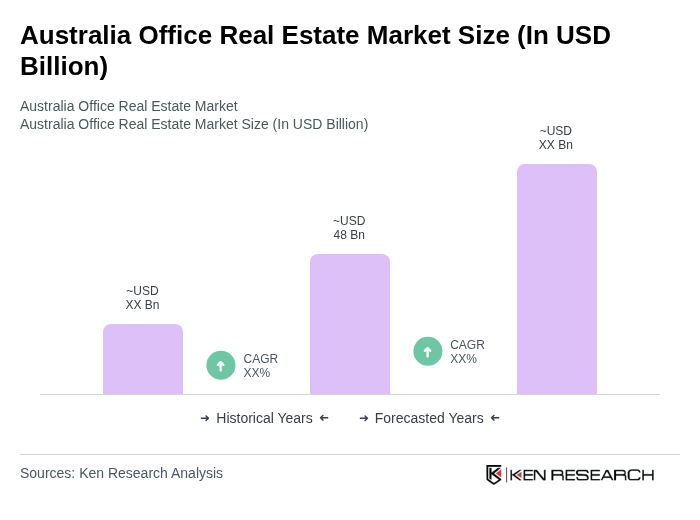
- The Australia Office Real Estate Market is valued at approximately USD 48 billion, based on a five-year historical analysis. This growth is primarily driven by increasing demand for premium office spaces in urban areas, coupled with a rise in remote working trends that have led to a reevaluation of office space requirements favoring high-quality assets with modern amenities and ESG credentials. The market has seen significant investments in infrastructure and technology, enhancing the appeal of office properties, particularly in core CBD precincts of major cities.
- Key cities dominating the market include Sydney, Melbourne, and Brisbane. Sydney stands out due to its status as a financial hub, attracting multinational corporations and startups alike with strong demand in core CBD precincts. Melbourne's vibrant culture and growing tech scene make it a hotspot for creative industries, while Brisbane benefits from a lower cost of living and a burgeoning business environment, making it attractive for both local and international firms with leading rental growth and tightening vacancy.
- The National Construction Code (NCC) 2022, issued by the Australian Building Codes Board (ABCB), governs energy efficiency in commercial buildings including offices. This regulation mandates minimum energy performance standards through NatHERS ratings and Section J requirements for new builds and major refurbishments, requiring compliance verification via energy modeling, on-site testing, and certification before occupancy to promote sustainability and reduce operational energy use by up to 30 percent in compliant buildings.
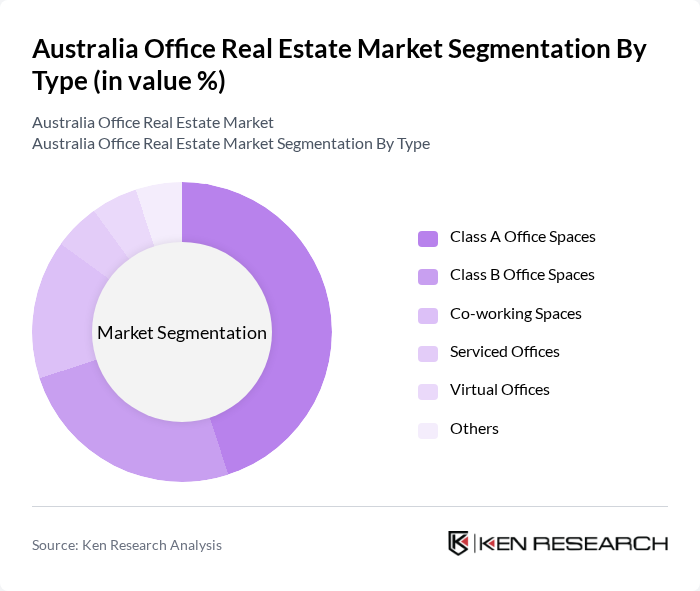
Australia Office Real Estate Market Segmentation
By Type:The office real estate market is segmented into various types, including Class A Office Spaces, Class B Office Spaces, Co-working Spaces, Serviced Offices, Virtual Offices, and Others. Class A office spaces dominate the market due to their prime locations, modern amenities, and higher rental yields. These spaces are preferred by large corporations seeking prestigious addresses with superior ESG features and transport access. Co-working spaces are also gaining traction, especially among startups and freelancers, as they offer flexibility and cost-effectiveness.
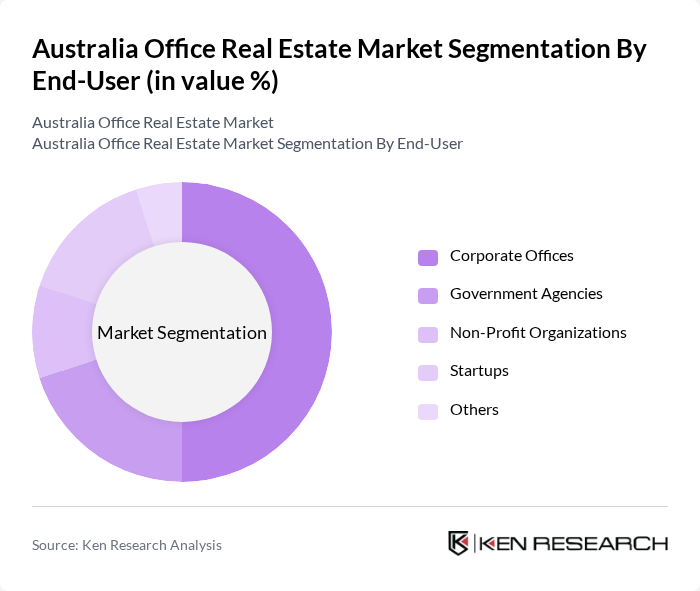
By End-User:The end-user segmentation includes Corporate Offices, Government Agencies, Non-Profit Organizations, Startups, and Others. Corporate offices represent the largest segment, driven by the need for dedicated spaces for large teams and operations in high-quality contiguous floors. Startups are increasingly opting for flexible office solutions, such as co-working spaces, to minimize overhead costs while fostering collaboration and innovation.
Australia Office Real Estate Market Competitive Landscape
The Australia Office Real Estate Market is characterized by a dynamic mix of regional and international players. Leading participants such as Dexus, GPT Group, Stockland, Mirvac, Charter Hall, Lendlease, Frasers Property, Investa, Cromwell Property Group, Abacus Property Group, ISPT, QIC, Centuria Capital, Vicinity Centres, Scentre Group contribute to innovation, geographic expansion, and service delivery in this space.
Australia Office Real Estate Market Industry Analysis
Growth Drivers
- Increasing Demand for Flexible Workspaces:The demand for flexible workspaces in Australia has surged, with over 1,000 co-working spaces operating in major cities in future. This trend is driven by businesses seeking cost-effective solutions, as the average cost per desk in co-working spaces is approximately AUD 650 per month. Additionally, the flexible workspace market is projected to grow by 30% annually, reflecting a shift in corporate real estate strategies towards agility and adaptability in workspace management.
- Urbanization and Population Growth:Australia’s urban population is expected to reach 26 million in future, contributing to increased demand for office space in metropolitan areas. The Australian Bureau of Statistics reports that urbanization rates are projected to rise by 1.6% annually. This growth drives the need for modern office facilities, particularly in cities like Sydney and Melbourne, where the population density is highest, leading to a competitive real estate market and higher occupancy rates.
- Government Infrastructure Investments:The Australian government has committed AUD 120 billion to infrastructure projects over the next decade, significantly impacting the office real estate market. Investments in transport, technology, and urban development are expected to enhance connectivity and accessibility, making office locations more attractive. In future, these developments are anticipated to create over 250,000 jobs, further stimulating demand for office space as businesses expand to accommodate a growing workforce.
Market Challenges
- Economic Fluctuations Impacting Investment:Economic uncertainties, including inflation rates projected at 3.8% in future, pose significant challenges for the office real estate market. Investors are cautious, leading to a slowdown in new developments. The Reserve Bank of Australia indicates that high interest rates, currently at 4.5%, are affecting borrowing costs, which may deter potential investors from entering the market, thereby impacting overall growth and stability.
- High Vacancy Rates in Certain Regions:Certain regions in Australia are experiencing high vacancy rates, particularly in suburban areas, with rates reaching 16% in some markets in future. This oversupply of office space is attributed to changing work patterns and the rise of remote work. As businesses downsize or adopt hybrid models, landlords face challenges in attracting tenants, leading to increased competition and potential declines in rental income.
Australia Office Real Estate Market Future Outlook
The Australia office real estate market is poised for transformation as hybrid work models become the norm, influencing demand for office space. In future, companies are expected to prioritize health and wellness in office design, integrating features that promote employee well-being. Additionally, the adoption of smart building technologies will enhance operational efficiency, while sustainability practices will become essential, driven by both regulatory pressures and tenant preferences for environmentally friendly spaces.
Market Opportunities
- Growth in Co-Working Spaces:The co-working space sector presents a significant opportunity, with an expected increase in demand for shared office environments. In future, the number of co-working spaces is projected to grow by 30%, driven by startups and SMEs seeking flexible leasing options. This trend offers investors a chance to capitalize on the evolving workspace preferences of modern businesses.
- Sustainable Building Practices:There is a growing emphasis on sustainable building practices, with the Australian government aiming for a 50% reduction in carbon emissions by 2030. This creates opportunities for developers to invest in green buildings, which are increasingly sought after by tenants. In future, properties with sustainability certifications are expected to command higher rental rates, making them attractive investments in the office real estate market.
Scope of the Report
| Segment | Sub-Segments |
|---|---|
| By Type | Class A Office Spaces Class B Office Spaces Co-working Spaces Serviced Offices Virtual Offices Others |
| By End-User | Corporate Offices Government Agencies Non-Profit Organizations Startups Others |
| By Region | New South Wales Victoria Queensland Western Australia South Australia |
| By Lease Type | Short-term Leases Long-term Leases Flexible Leases Others |
| By Building Class | High-rise Buildings Mid-rise Buildings Low-rise Buildings Others |
| By Investment Type | Direct Investment Real Estate Investment Trusts (REITs) Joint Ventures Others |
| By Policy Support | Government Grants Tax Incentives Subsidies for Green Buildings Others |
Key Target Audience
Investors and Venture Capitalist Firms
Government and Regulatory Bodies (e.g., Australian Securities and Investments Commission, Department of Infrastructure, Transport, Regional Development and Communications)
Real Estate Investment Trusts (REITs)
Property Developers and Builders
Commercial Real Estate Brokers
Corporate Real Estate Managers
Facility Management Companies
Insurance Companies and Pension Funds
Players Mentioned in the Report:
Dexus
GPT Group
Stockland
Mirvac
Charter Hall
Lendlease
Frasers Property
Investa
Cromwell Property Group
Abacus Property Group
ISPT
QIC
Centuria Capital
Vicinity Centres
Scentre Group
Table of Contents
Market Assessment Phase
1. Executive Summary and Approach
2. Australia Office Real Estate Market Overview
2.1 Key Insights and Strategic Recommendations
2.2 Australia Office Real Estate Market Overview
2.3 Definition and Scope
2.4 Evolution of Market Ecosystem
2.5 Timeline of Key Regulatory Milestones
2.6 Value Chain & Stakeholder Mapping
2.7 Business Cycle Analysis
2.8 Policy & Incentive Landscape
3. Australia Office Real Estate Market Analysis
3.1 Growth Drivers
3.1.1 Increasing demand for flexible workspaces
3.1.2 Urbanization and population growth
3.1.3 Government infrastructure investments
3.1.4 Technological advancements in property management
3.2 Market Challenges
3.2.1 Economic fluctuations impacting investment
3.2.2 Regulatory compliance complexities
3.2.3 High vacancy rates in certain regions
3.2.4 Competition from alternative work arrangements
3.3 Market Opportunities
3.3.1 Growth in co-working spaces
3.3.2 Sustainable building practices
3.3.3 Digital transformation in real estate
3.3.4 Expansion into emerging markets
3.4 Market Trends
3.4.1 Rise of hybrid work models
3.4.2 Increased focus on health and wellness in office design
3.4.3 Adoption of smart building technologies
3.4.4 Shift towards environmentally sustainable practices
3.5 Government Regulation
3.5.1 Zoning laws affecting office space development
3.5.2 Building codes for energy efficiency
3.5.3 Tax incentives for green buildings
3.5.4 Regulations on tenant rights and lease agreements
4. SWOT Analysis
5. Stakeholder Analysis
6. Porter's Five Forces Analysis
7. Australia Office Real Estate Market Market Size, 2019-2024
7.1 By Value
7.2 By Volume
7.3 By Average Selling Price
8. Australia Office Real Estate Market Segmentation
8.1 By Type
8.1.1 Class A Office Spaces
8.1.2 Class B Office Spaces
8.1.3 Co-working Spaces
8.1.4 Serviced Offices
8.1.5 Virtual Offices
8.1.6 Others
8.2 By End-User
8.2.1 Corporate Offices
8.2.2 Government Agencies
8.2.3 Non-Profit Organizations
8.2.4 Startups
8.2.5 Others
8.3 By Region
8.3.1 New South Wales
8.3.2 Victoria
8.3.3 Queensland
8.3.4 Western Australia
8.3.5 South Australia
8.4 By Lease Type
8.4.1 Short-term Leases
8.4.2 Long-term Leases
8.4.3 Flexible Leases
8.4.4 Others
8.5 By Building Class
8.5.1 High-rise Buildings
8.5.2 Mid-rise Buildings
8.5.3 Low-rise Buildings
8.5.4 Others
8.6 By Investment Type
8.6.1 Direct Investment
8.6.2 Real Estate Investment Trusts (REITs)
8.6.3 Joint Ventures
8.6.4 Others
8.7 By Policy Support
8.7.1 Government Grants
8.7.2 Tax Incentives
8.7.3 Subsidies for Green Buildings
8.7.4 Others
9. Australia Office Real Estate Market Competitive Analysis
9.1 Market Share of Key Players
9.2 Cross Comparison of Key Players
9.2.1 Company Name
9.2.2 Group Size (Large, Medium, or Small as per industry convention)
9.2.3 Occupancy Rate
9.2.4 Rental Yield
9.2.5 Pricing Strategy
9.2.6 Tenant Retention Rate
9.2.7 Average Lease Duration
9.2.8 Market Penetration Rate
9.2.9 Revenue Growth Rate
9.2.10 Customer Satisfaction Index
9.3 SWOT Analysis of Top Players
9.4 Pricing Analysis
9.5 Detailed Profile of Major Companies
9.5.1 Dexus
9.5.2 GPT Group
9.5.3 Stockland
9.5.4 Mirvac
9.5.5 Charter Hall
9.5.6 Lendlease
9.5.7 Frasers Property
9.5.8 Investa
9.5.9 Cromwell Property Group
9.5.10 Abacus Property Group
9.5.11 ISPT
9.5.12 QIC
9.5.13 Centuria Capital
9.5.14 Vicinity Centres
9.5.15 Scentre Group
10. Australia Office Real Estate Market End-User Analysis
10.1 Procurement Behavior of Key Ministries
10.1.1 Government Office Space Requirements
10.1.2 Budget Allocation for Office Leasing
10.1.3 Decision-Making Processes
10.1.4 Vendor Selection Criteria
10.2 Corporate Spend on Infrastructure & Energy
10.2.1 Investment in Office Renovations
10.2.2 Expenditure on Energy Efficiency
10.2.3 Budget for Technology Integration
10.2.4 Others
10.3 Pain Point Analysis by End-User Category
10.3.1 Space Utilization Issues
10.3.2 Cost Management Challenges
10.3.3 Compliance with Regulations
10.3.4 Others
10.4 User Readiness for Adoption
10.4.1 Awareness of Market Trends
10.4.2 Willingness to Invest in New Technologies
10.4.3 Training and Support Needs
10.4.4 Others
10.5 Post-Deployment ROI and Use Case Expansion
10.5.1 Measurement of ROI
10.5.2 Expansion of Use Cases
10.5.3 Long-term Sustainability Considerations
10.5.4 Others
11. Australia Office Real Estate Market Future Size, 2025-2030
11.1 By Value
11.2 By Volume
11.3 By Average Selling Price
Go-To-Market Strategy Phase
1. Whitespace Analysis + Business Model Canvas
1.1 Market Gaps Identification
1.2 Business Model Development
2. Marketing and Positioning Recommendations
2.1 Branding Strategies
2.2 Product USPs
3. Distribution Plan
3.1 Urban Retail vs Rural NGO Tie-ups
4. Channel & Pricing Gaps
4.1 Underserved Routes
4.2 Pricing Bands
5. Unmet Demand & Latent Needs
5.1 Category Gaps
5.2 Consumer Segments
6. Customer Relationship
6.1 Loyalty Programs
6.2 After-sales Service
7. Value Proposition
7.1 Sustainability
7.2 Integrated Supply Chains
8. Key Activities
8.1 Regulatory Compliance
8.2 Branding
8.3 Distribution Setup
9. Entry Strategy Evaluation
9.1 Domestic Market Entry Strategy
9.1.1 Product Mix
9.1.2 Pricing Band
9.1.3 Packaging
9.2 Export Entry Strategy
9.2.1 Target Countries
9.2.2 Compliance Roadmap
10. Entry Mode Assessment
10.1 JV
10.2 Greenfield
10.3 M&A
10.4 Distributor Model
11. Capital and Timeline Estimation
11.1 Capital Requirements
11.2 Timelines
12. Control vs Risk Trade-Off
12.1 Ownership vs Partnerships
13. Profitability Outlook
13.1 Breakeven Analysis
13.2 Long-term Sustainability
14. Potential Partner List
14.1 Distributors
14.2 JVs
14.3 Acquisition Targets
15. Execution Roadmap
15.1 Phased Plan for Market Entry
15.1.1 Market Setup
15.1.2 Market Entry
15.1.3 Growth Acceleration
15.1.4 Scale & Stabilize
15.2 Key Activities and Milestones
15.2.1 Milestone Planning
15.2.2 Activity Tracking
Research Methodology
Phase 1: Approach1
Desk Research
- Analysis of national real estate reports from the Australian Bureau of Statistics
- Review of market trends and forecasts from industry publications such as Property Council of Australia
- Examination of economic indicators and demographic data relevant to office space demand
Primary Research
- Interviews with real estate brokers specializing in office properties
- Surveys conducted with corporate real estate managers regarding space utilization
- Focus groups with tenants to understand preferences and future needs
Validation & Triangulation
- Cross-validation of findings with data from commercial real estate databases
- Triangulation of insights from primary interviews with secondary data trends
- Sanity checks through expert panel reviews comprising industry veterans
Phase 2: Market Size Estimation1
Top-down Assessment
- Estimation of total office space based on national commercial property statistics
- Segmentation of market size by major cities and regions in Australia
- Incorporation of macroeconomic factors influencing office space demand
Bottom-up Modeling
- Data collection on average rental rates and occupancy levels from major office markets
- Analysis of lease agreements and terms from leading property management firms
- Volume x rate calculations to derive revenue estimates for office space
Forecasting & Scenario Analysis
- Multi-factor regression analysis incorporating economic growth and employment rates
- Scenario modeling based on potential shifts in remote work trends and urbanization
- Baseline, optimistic, and pessimistic forecasts through 2030
Phase 3: CATI Sample Composition1
| Scope Item/Segment | Sample Size | Target Respondent Profiles |
|---|---|---|
| Corporate Office Space Users | 120 | Real Estate Managers, Facilities Directors |
| Commercial Property Developers | 100 | Project Managers, Development Executives |
| Real Estate Investment Trusts (REITs) | 80 | Investment Analysts, Portfolio Managers |
| Office Space Tenants | 100 | Office Managers, HR Directors |
| Commercial Real Estate Brokers | 90 | Brokerage Agents, Market Analysts |
Frequently Asked Questions
What is the current value of the Australia Office Real Estate Market?
The Australia Office Real Estate Market is valued at approximately USD 48 billion, driven by increasing demand for premium office spaces and investments in infrastructure and technology, particularly in major urban areas like Sydney, Melbourne, and Brisbane.
Which cities are the key players in the Australia Office Real Estate Market?
What types of office spaces are available in Australia?
How is the demand for flexible workspaces changing in Australia?
Other Regional/Country Reports
Indonesia Office Real Estate Market Report
Malaysia Office Real Estate Market Report
KSA Office Real Estate Market Report
APAC Office Real Estate Market Report
SEA Office Real Estate Market Report
Vietnam Office Real Estate Market Report
Other Adjacent Reports
Brazil Retail Real Estate Market
Vietnam Industrial Real Estate Market
New Zealand Residential Real Estate Market Report Size, Share, Growth Drivers, Trends, Opportunities & Forecast 2025–2030UAE Hospitality Real Estate MarketPhilippines Co-Working Space Market
USA Property Management Market Outlook to 2030Kuwait Real Estate Development Market
South Africa Construction Services Market
KSA Sustainable Building Market
South Korea PropTech Market
Why Buy From Us?

What makes us stand out is that our consultants follow Robust, Refine and Result (RRR) methodology. Robust for clear definitions, approaches and sanity checking, Refine for differentiating respondents' facts and opinions, and Result for presenting data with story.

We have set a benchmark in the industry by offering our clients with syndicated and customized market research reports featuring coverage of entire market as well as meticulous research and analyst insights.

While we don't replace traditional research, we flip the method upside down. Our dual approach of Top Bottom & Bottom Top ensures quality deliverable by not just verifying company fundamentals but also looking at the sector and macroeconomic factors.

With one step in the future, our research team constantly tries to show you the bigger picture. We help with some of the tough questions you may encounter along the way: How is the industry positioned? Best marketing channel? KPI's of competitors? By aligning every element, we help maximize success.

Our report gives you instant access to the answers and sources that other companies might choose to hide. We elaborate each steps of research methodology we have used and showcase you the sample size to earn your trust.

If you need any support, we are here! We pride ourselves on universe strength, data quality, and quick, friendly, and professional service.