About the Report
Base Year 2024Bahrain Anti Pollution Nasal Spray Market Overview
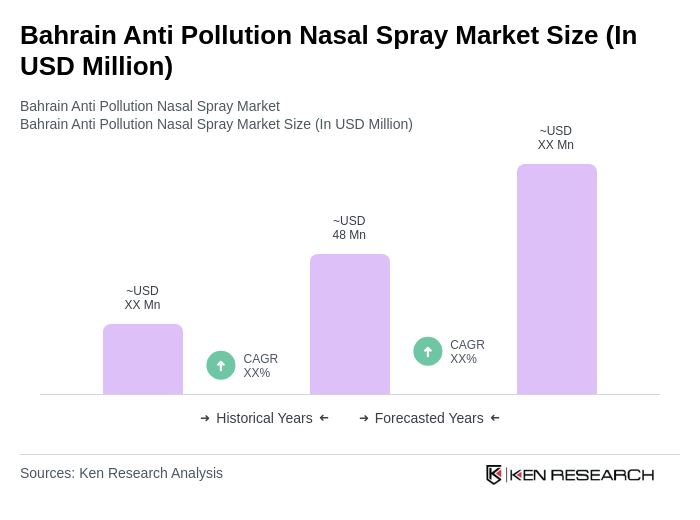
- The Bahrain Anti Pollution Nasal Spray Market is valued at USD 48 million, based on a five-year historical analysis. This growth is primarily driven by increasing air pollution levels, rising health awareness among consumers, and a growing preference for preventive healthcare solutions. The demand for nasal sprays that combat pollution-related health issues has surged, reflecting a shift towards proactive health management. Recent air quality data indicates that Manama has experienced poor air quality conditions throughout 2025, with zero percent of days meeting WHO's safe air quality limits, creating sustained demand for pollution-mitigation products.
- Key players in this market include Manama, Riffa, and Muharraq, which dominate due to their high population density and urbanization levels. These cities have witnessed significant industrial activities and vehicular emissions, leading to increased respiratory issues among residents. Consequently, the demand for anti-pollution nasal sprays has escalated in these urban centers. Manama, in particular, has emerged as a critical market hub, with air quality challenges driving consumer adoption of preventive respiratory health solutions.
- The regulatory framework in Bahrain supports the anti-pollution nasal spray market through established pharmaceutical oversight mechanisms. The Bahrain Pharmaceutical and Medical Device Regulations, administered by the National Health Regulatory Authority (NHRA), mandate that all over-the-counter nasal sprays meet specific safety and efficacy standards. These regulations require manufacturers to include documented anti-pollution or protective ingredients in product formulations, ensuring that products available in the market effectively address pollution-related ailments and promoting consumer safety and confidence in nasal spray products.
Bahrain Anti Pollution Nasal Spray Market Segmentation
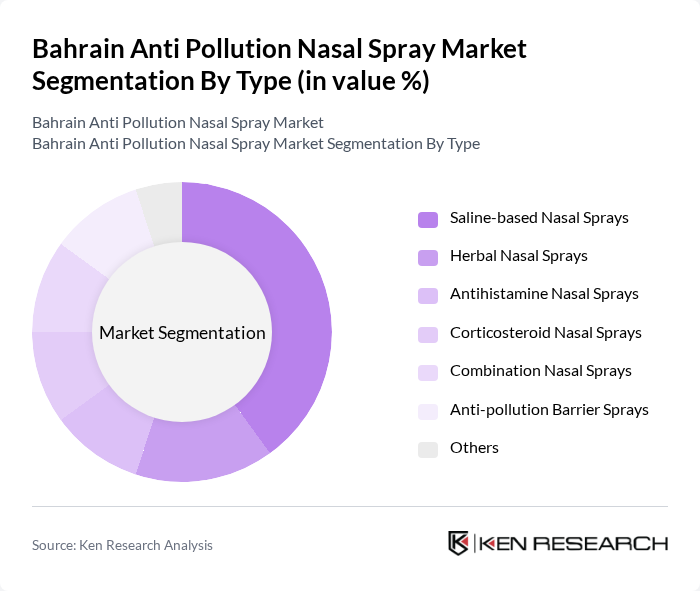
By Type:The market is segmented into various types of nasal sprays, each catering to different consumer needs and preferences. The subsegments include Saline-based Nasal Sprays, Herbal Nasal Sprays, Antihistamine Nasal Sprays, Corticosteroid Nasal Sprays, Combination Nasal Sprays, Anti-pollution Barrier Sprays, and Others. Among these, Saline-based Nasal Sprays are currently leading the market due to their widespread acceptance and effectiveness in alleviating nasal congestion caused by pollution. Consumers prefer these sprays for their natural ingredients and minimal side effects, making them a popular choice for daily use.
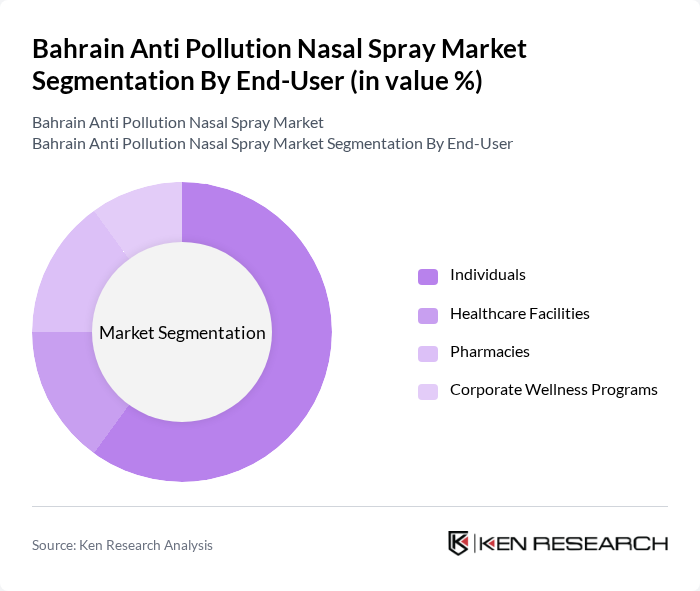
By End-User:The end-user segmentation includes Individuals, Healthcare Facilities, Pharmacies, and Corporate Wellness Programs. Individuals represent the largest segment, driven by increasing health consciousness and the rising prevalence of respiratory issues due to pollution. The growing trend of self-medication among consumers has led to a higher demand for anti-pollution nasal sprays, particularly among urban dwellers who are more exposed to environmental pollutants.
Bahrain Anti Pollution Nasal Spray Market Competitive Landscape
The Bahrain Anti Pollution Nasal Spray Market is characterized by a dynamic mix of regional and international players. Leading participants such as Stérimar (Laboratoire de la Mer), Otrivin (GlaxoSmithKline plc), Nasaleze International Ltd., Cipla Ltd., Bayer AG (maker of ClariSpray), Sandoz (a Novartis division), Johnson & Johnson (maker of Rhinocort), Sanofi (maker of Avamys/Flixonase), Glenmark Pharmaceuticals, Dr. Reddy’s Laboratories, Aptar Pharma, Cipla Gulf FZ LLC, Mundipharma, Reckitt Benckiser Group plc (maker of Durex Nasal Guard), PharmaLinea Ltd. contribute to innovation, geographic expansion, and service delivery in this space.
Bahrain Anti Pollution Nasal Spray Market Industry Analysis
Growth Drivers
- Increasing Air Pollution Levels:In Bahrain, air pollution levels have been rising, with particulate matter (PM10) concentrations reaching 70 µg/m³ in urban areas, significantly above the World Health Organization's recommended limit of 50 µg/m³. This alarming trend has heightened public concern regarding health risks associated with air quality, driving demand for anti-pollution products. The government reported a 15% increase in respiratory-related hospital admissions recently, further emphasizing the need for effective health solutions like nasal sprays.
- Rising Awareness of Health Impacts:The awareness of health impacts from pollution is growing among Bahrain's population, with 62% of residents acknowledging the adverse effects of air quality on their health, according to a recent health survey. This increased awareness has led to a surge in demand for health products, including anti-pollution nasal sprays. The Ministry of Health has also launched educational campaigns, contributing to a 20% rise in sales of health-related products in the last year, indicating a shift towards preventive healthcare.
- Growth in Respiratory Diseases:The prevalence of respiratory diseases in Bahrain has escalated, with the Ministry of Health reporting a 25% increase in asthma cases over the past five years. This rise is attributed to environmental factors, including air pollution. As a result, there is a growing market for products that alleviate symptoms and protect against pollution. The healthcare sector is projected to allocate an additional BHD 5 million in the future for respiratory health initiatives, further supporting the demand for nasal sprays.
Market Challenges
- High Competition from Alternative Products:The Bahrain market for respiratory health products is highly competitive, with numerous alternatives such as air purifiers and traditional medications. Recently, the market saw a 30% increase in air purifier sales, which are often perceived as more effective solutions for air quality issues. This competition poses a significant challenge for anti-pollution nasal sprays, as consumers may opt for these alternatives, impacting market penetration and growth.
- Regulatory Hurdles for New Entrants:New entrants in the Bahrain anti-pollution nasal spray market face stringent regulatory requirements, including extensive testing and approval processes. The Bahrain Food and Drug Authority (BFDA) has increased its scrutiny, leading to an average approval time of 18 months for new products. This regulatory environment can deter potential market players, limiting innovation and slowing the introduction of new products that could meet consumer needs effectively.
Bahrain Anti Pollution Nasal Spray Market Future Outlook
The future of the Bahrain anti-pollution nasal spray market appears promising, driven by increasing health awareness and a growing focus on preventive healthcare. As urban air quality continues to decline, consumers are likely to seek effective solutions to mitigate health risks. Additionally, the rise of e-commerce platforms is expected to enhance product accessibility, allowing consumers to purchase nasal sprays conveniently. Companies that innovate and adapt to consumer preferences will likely thrive in this evolving landscape, fostering a healthier population.
Market Opportunities
- Expansion of Distribution Channels:There is a significant opportunity for expanding distribution channels, particularly through online platforms. E-commerce sales of health products in Bahrain have surged by 40% recently, indicating a shift in consumer purchasing behavior. Companies that leverage this trend can enhance their market reach and improve sales of anti-pollution nasal sprays.
- Development of Innovative Formulations:The demand for innovative formulations, particularly those incorporating natural ingredients, is on the rise. A recent market study revealed that 55% of consumers prefer products with organic components. Companies that invest in research and development to create unique, effective formulations can capture a larger share of the market, appealing to health-conscious consumers.
Scope of the Report
| Segment | Sub-Segments |
|---|---|
| By Type | Saline-based Nasal Sprays Herbal Nasal Sprays Antihistamine Nasal Sprays Corticosteroid Nasal Sprays Combination Nasal Sprays Anti-pollution Barrier Sprays Others |
| By End-User | Individuals Healthcare Facilities Pharmacies Corporate Wellness Programs |
| By Distribution Channel | Online Retail Offline Retail Direct Sales Institutional Sales |
| By Packaging Type | Bottles Sprays Sachets |
| By Price Range | Low Price Mid Price High Price |
| By Consumer Demographics | Age Group (Children, Adults, Seniors) Gender (Male, Female) Income Level (Low, Middle, High) |
| By Product Formulation | Natural Ingredients Synthetic Ingredients Preservative-free Formulations Nanoemulsion-based Formulations |
Key Target Audience
Investors and Venture Capitalist Firms
Government and Regulatory Bodies (e.g., Ministry of Health, Environmental Protection Agency)
Manufacturers and Producers of Nasal Sprays
Distributors and Retailers of Pharmaceutical Products
Healthcare Providers and Clinics
Pharmaceutical Wholesalers
Industry Associations (e.g., Bahrain Pharmaceutical Society)
Financial Institutions and Banks
Players Mentioned in the Report:
Sterimar (Laboratoire de la Mer)
Otrivin (GlaxoSmithKline plc)
Nasaleze International Ltd.
Cipla Ltd.
Bayer AG (maker of ClariSpray)
Sandoz (a Novartis division)
Johnson & Johnson (maker of Rhinocort)
Sanofi (maker of Avamys/Flixonase)
Glenmark Pharmaceuticals
Dr. Reddys Laboratories
Aptar Pharma
Cipla Gulf FZ LLC
Mundipharma
Reckitt Benckiser Group plc (maker of Durex Nasal Guard)
PharmaLinea Ltd.
Table of Contents
Market Assessment Phase
1. Executive Summary and Approach
2. Bahrain Anti Pollution Nasal Spray Market Overview
2.1 Key Insights and Strategic Recommendations
2.2 Bahrain Anti Pollution Nasal Spray Market Overview
2.3 Definition and Scope
2.4 Evolution of Market Ecosystem
2.5 Timeline of Key Regulatory Milestones
2.6 Value Chain & Stakeholder Mapping
2.7 Business Cycle Analysis
2.8 Policy & Incentive Landscape
3. Bahrain Anti Pollution Nasal Spray Market Analysis
3.1 Growth Drivers
3.1.1 Increasing air pollution levels in urban areas
3.1.2 Rising awareness of health impacts from pollution
3.1.3 Growth in respiratory diseases
3.1.4 Government initiatives promoting health products
3.2 Market Challenges
3.2.1 High competition from alternative products
3.2.2 Regulatory hurdles for new entrants
3.2.3 Limited consumer awareness of nasal sprays
3.2.4 Price sensitivity among consumers
3.3 Market Opportunities
3.3.1 Expansion of distribution channels
3.3.2 Development of innovative formulations
3.3.3 Collaborations with healthcare providers
3.3.4 Increasing demand for natural and organic products
3.4 Market Trends
3.4.1 Shift towards preventive healthcare
3.4.2 Growth in e-commerce for health products
3.4.3 Rising popularity of personalized medicine
3.4.4 Increased focus on sustainability in product development
3.5 Government Regulation
3.5.1 Stricter regulations on air quality
3.5.2 Guidelines for health product approvals
3.5.3 Incentives for environmentally friendly products
3.5.4 Public health campaigns promoting nasal sprays
4. SWOT Analysis
5. Stakeholder Analysis
6. Porter's Five Forces Analysis
7. Bahrain Anti Pollution Nasal Spray Market Market Size, 2019-2024
7.1 By Value
7.2 By Volume
7.3 By Average Selling Price
8. Bahrain Anti Pollution Nasal Spray Market Segmentation
8.1 By Type
8.1.1 Saline-based Nasal Sprays
8.1.2 Herbal Nasal Sprays
8.1.3 Antihistamine Nasal Sprays
8.1.4 Corticosteroid Nasal Sprays
8.1.5 Combination Nasal Sprays
8.1.6 Anti-pollution Barrier Sprays
8.1.7 Others
8.2 By End-User
8.2.1 Individuals
8.2.2 Healthcare Facilities
8.2.3 Pharmacies
8.2.4 Corporate Wellness Programs
8.3 By Distribution Channel
8.3.1 Online Retail
8.3.2 Offline Retail
8.3.3 Direct Sales
8.3.4 Institutional Sales
8.4 By Packaging Type
8.4.1 Bottles
8.4.2 Sprays
8.4.3 Sachets
8.5 By Price Range
8.5.1 Low Price
8.5.2 Mid Price
8.5.3 High Price
8.6 By Consumer Demographics
8.6.1 Age Group (Children, Adults, Seniors)
8.6.2 Gender (Male, Female)
8.6.3 Income Level (Low, Middle, High)
8.7 By Product Formulation
8.7.1 Natural Ingredients
8.7.2 Synthetic Ingredients
8.7.3 Preservative-free Formulations
8.7.4 Nanoemulsion-based Formulations
9. Bahrain Anti Pollution Nasal Spray Market Competitive Analysis
9.1 Market Share of Key Players
9.2 Cross Comparison of Key Players
9.2.1 Company Name
9.2.2 Group Size (Large, Medium, or Small as per industry convention)
9.2.3 Revenue Growth Rate (Bahrain and GCC-specific)
9.2.4 Market Penetration Rate (Share of anti-pollution nasal spray sales in Bahrain)
9.2.5 Customer Retention Rate (Repeat purchase ratio in Bahrain)
9.2.6 Product Portfolio Breadth (Number of anti-pollution and related nasal spray SKUs)
9.2.7 Average Selling Price (ASP) in Bahrain
9.2.8 Distribution Network Coverage (Pharmacies, hospitals, online platforms in Bahrain)
9.2.9 Brand Recognition Score (Bahrain market surveys)
9.2.10 Customer Satisfaction Index (Local user ratings, reviews)
9.2.11 Regulatory Compliance Record (MOH approvals, recalls)
9.2.12 Innovation Index (Patents, new launches in anti-pollution segment)
9.3 SWOT Analysis of Top Players
9.4 Pricing Analysis
9.5 Detailed Profile of Major Companies
9.5.1 Stérimar (Laboratoire de la Mer)
9.5.2 Otrivin (GlaxoSmithKline plc)
9.5.3 Nasaleze International Ltd.
9.5.4 Cipla Ltd.
9.5.5 Bayer AG (maker of ClariSpray)
9.5.6 Sandoz (a Novartis division)
9.5.7 Johnson & Johnson (maker of Rhinocort)
9.5.8 Sanofi (maker of Avamys/Flixonase)
9.5.9 Glenmark Pharmaceuticals
9.5.10 Dr. Reddy’s Laboratories
9.5.11 Aptar Pharma
9.5.12 Cipla Gulf FZ LLC
9.5.13 Mundipharma
9.5.14 Reckitt Benckiser Group plc (maker of Durex Nasal Guard)
9.5.15 PharmaLinea Ltd.
10. Bahrain Anti Pollution Nasal Spray Market End-User Analysis
10.1 Procurement Behavior of Key Ministries
10.1.1 Health Ministry Procurement Trends
10.1.2 Environmental Ministry Initiatives
10.1.3 Public Health Campaigns
10.2 Corporate Spend on Infrastructure & Energy
10.2.1 Corporate Health Initiatives
10.2.2 Investment in Employee Wellness
10.3 Pain Point Analysis by End-User Category
10.3.1 Respiratory Issues in Urban Areas
10.3.2 Lack of Awareness about Nasal Sprays
10.4 User Readiness for Adoption
10.4.1 Consumer Education Levels
10.4.2 Accessibility of Products
10.5 Post-Deployment ROI and Use Case Expansion
10.5.1 Effectiveness of Nasal Sprays in Reducing Symptoms
10.5.2 Long-term User Satisfaction
11. Bahrain Anti Pollution Nasal Spray Market Future Size, 2025-2030
11.1 By Value
11.2 By Volume
11.3 By Average Selling Price
Go-To-Market Strategy Phase
1. Whitespace Analysis + Business Model Canvas
1.1 Market Gaps Identification
1.2 Value Proposition Development
1.3 Revenue Streams Analysis
1.4 Key Partnerships
1.5 Customer Segmentation
1.6 Cost Structure
1.7 Channels of Distribution
2. Marketing and Positioning Recommendations
2.1 Branding Strategies
2.2 Product USPs
3. Distribution Plan
3.1 Urban Retail vs Rural NGO Tie-ups
4. Channel & Pricing Gaps
4.1 Underserved Routes
4.2 Pricing Bands
5. Unmet Demand & Latent Needs
5.1 Category Gaps
5.2 Consumer Segments
6. Customer Relationship
6.1 Loyalty Programs
6.2 After-sales Service
7. Value Proposition
7.1 Sustainability
7.2 Integrated Supply Chains
8. Key Activities
8.1 Regulatory Compliance
8.2 Branding
8.3 Distribution Setup
9. Entry Strategy Evaluation
9.1 Domestic Market Entry Strategy
9.1.1 Product Mix
9.1.2 Pricing Band
9.1.3 Packaging
9.2 Export Entry Strategy
9.2.1 Target Countries
9.2.2 Compliance Roadmap
10. Entry Mode Assessment
10.1 JV
10.2 Greenfield
10.3 M&A
10.4 Distributor Model
11. Capital and Timeline Estimation
11.1 Capital Requirements
11.2 Timelines
12. Control vs Risk Trade-Off
12.1 Ownership vs Partnerships
13. Profitability Outlook
13.1 Breakeven Analysis
13.2 Long-term Sustainability
14. Potential Partner List
14.1 Distributors
14.2 JVs
14.3 Acquisition Targets
15. Execution Roadmap
15.1 Phased Plan for Market Entry
15.1.1 Market Setup
15.1.2 Market Entry
15.1.3 Growth Acceleration
15.1.4 Scale & Stabilize
15.2 Key Activities and Milestones
15.2.1 Milestone Planning
15.2.2 Activity Tracking
Research Methodology
Phase 1: Approach1
Desk Research
- Analysis of market reports from health and wellness organizations in Bahrain
- Review of government publications on air quality and pollution statistics
- Examination of academic journals focusing on nasal spray efficacy and consumer health trends
Primary Research
- Interviews with healthcare professionals specializing in respiratory health
- Surveys conducted with consumers regarding their awareness and usage of anti-pollution nasal sprays
- Focus groups with pharmacists to understand product placement and consumer behavior
Validation & Triangulation
- Cross-validation of findings through multiple expert interviews and consumer surveys
- Triangulation of data from health organizations, market reports, and consumer feedback
- Sanity checks through expert panel reviews to ensure data reliability
Phase 2: Market Size Estimation1
Top-down Assessment
- Estimation of market size based on national health expenditure and pollution levels
- Segmentation by demographics, including age and health status of consumers
- Incorporation of government health initiatives promoting anti-pollution products
Bottom-up Modeling
- Volume estimates based on sales data from pharmacies and online retailers
- Cost analysis of production and distribution for anti-pollution nasal sprays
- Consumer purchase frequency and average spend on nasal sprays
Forecasting & Scenario Analysis
- Multi-factor regression analysis considering pollution trends and health awareness
- Scenario planning based on potential regulatory changes and market entry of new products
- Baseline, optimistic, and pessimistic forecasts through 2030
Phase 3: CATI Sample Composition1
| Scope Item/Segment | Sample Size | Target Respondent Profiles |
|---|---|---|
| Healthcare Professionals | 100 | Doctors, Respiratory Therapists |
| Consumers Aware of Air Pollution | 120 | General Public, Health-Conscious Individuals |
| Pharmacists and Retailers | 60 | Pharmacists, Retail Health Advisors |
| Environmental Health Experts | 40 | Researchers, Policy Makers |
| Market Analysts | 40 | Industry Analysts, Market Researchers |
Frequently Asked Questions
What is the current value of the Bahrain Anti Pollution Nasal Spray Market?
The Bahrain Anti Pollution Nasal Spray Market is valued at approximately USD 48 million, reflecting a significant increase driven by rising air pollution levels and growing health awareness among consumers seeking preventive healthcare solutions.
What factors are driving the growth of the anti-pollution nasal spray market in Bahrain?
Which cities in Bahrain are the primary markets for anti-pollution nasal sprays?
What types of nasal sprays are available in the Bahrain market?
Other Regional/Country Reports
Indonesia Anti Pollution Nasal Spray Market
Malaysia Anti Pollution Nasal Spray Market
KSA Anti Pollution Nasal Spray Market
APAC Anti Pollution Nasal Spray Market
SEA Anti Pollution Nasal Spray Market
Vietnam Anti Pollution Nasal Spray Market
Other Adjacent Reports
Singapore Air Purification Devices Market
South Africa Respiratory Medications Market
Oman Allergy Relief Products Market
Belgium Nasal Decongestants Market
Japan Pollution Protection Masks Market
Kuwait Environmental Health Supplements Market
Bahrain Herbal Nasal Remedies Market
Brazil Preventive Respiratory Care Market
UAE Urban Air Quality Solutions Market
KSA Pharmaceutical Inhalers Market
Why Buy From Us?

What makes us stand out is that our consultants follow Robust, Refine and Result (RRR) methodology. Robust for clear definitions, approaches and sanity checking, Refine for differentiating respondents' facts and opinions, and Result for presenting data with story.

We have set a benchmark in the industry by offering our clients with syndicated and customized market research reports featuring coverage of entire market as well as meticulous research and analyst insights.

While we don't replace traditional research, we flip the method upside down. Our dual approach of Top Bottom & Bottom Top ensures quality deliverable by not just verifying company fundamentals but also looking at the sector and macroeconomic factors.

With one step in the future, our research team constantly tries to show you the bigger picture. We help with some of the tough questions you may encounter along the way: How is the industry positioned? Best marketing channel? KPI's of competitors? By aligning every element, we help maximize success.

Our report gives you instant access to the answers and sources that other companies might choose to hide. We elaborate each steps of research methodology we have used and showcase you the sample size to earn your trust.

If you need any support, we are here! We pride ourselves on universe strength, data quality, and quick, friendly, and professional service.