About the Report
Base Year 2024Bahrain Financial Auditing Professional Services Market Overview
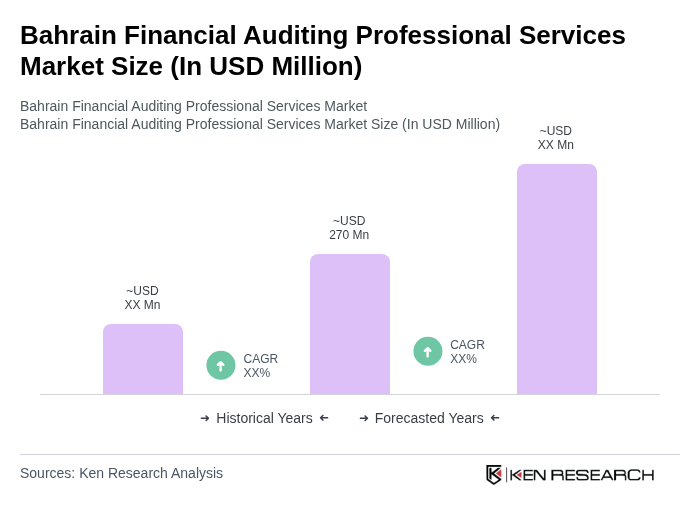
- The Bahrain Financial Auditing Professional Services Market is valued at USD 270 million, based on a five-year historical analysis of sector revenues and regional benchmarks. This growth is primarily driven by the increasing demand for transparency and accountability in financial reporting, the adoption of advanced audit technologies, and the rising complexity of regulatory requirements. The market has seen a surge in the need for professional auditing services as businesses strive to maintain compliance, mitigate financial fraud, and enhance operational efficiency .
- Key players in this market are concentrated in major urban centers such as Manama and Muharraq. These cities dominate due to their status as financial hubs, housing numerous banks, financial institutions, and multinational corporations. The concentration of businesses in these areas creates a robust demand for auditing services, fostering a competitive environment that drives innovation and service quality .
- The Commercial Companies Law (Decree Law No. 21 of 2001, as amended by Law No. 50 of 2014) issued by the Ministry of Industry, Commerce and Tourism, mandates that all public companies in Bahrain must have their financial statements audited annually by certified external auditors. This regulation aims to enhance corporate governance and protect investors by ensuring that financial statements are accurate and reliable, thereby increasing the demand for professional auditing services across the market .
Bahrain Financial Auditing Professional Services Market Segmentation
By Service Type:
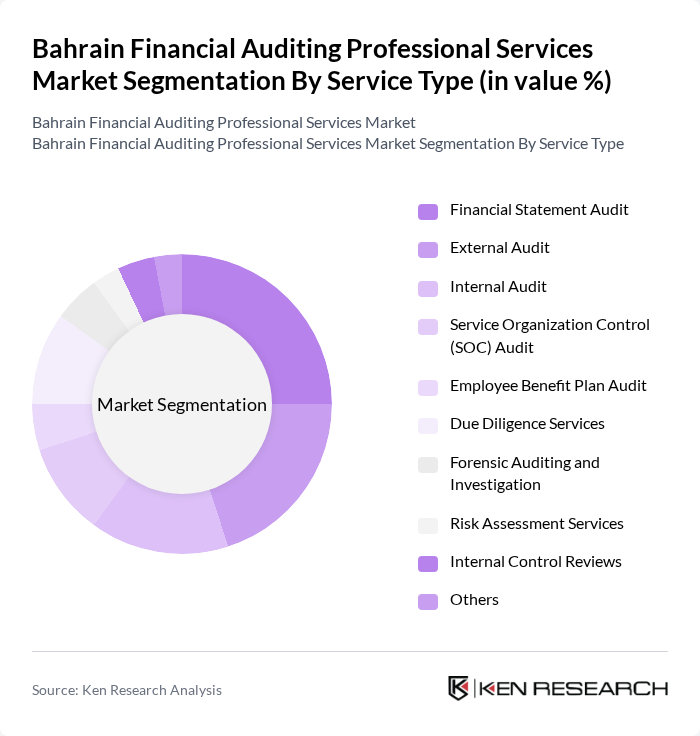
The service type segment is dominated byFinancial Statement Audits, which are essential for businesses to ensure compliance with financial reporting standards. This sub-segment is favored due to the increasing scrutiny from regulatory bodies and stakeholders demanding transparency.External Auditsalso hold a significant share, driven by the need for independent verification of financial statements. The growing complexity of financial regulations, heightened risk of financial fraud, and the need for robust internal controls further bolster the demand forInternal AuditsandRisk Assessment Services.
By End-User Industry:
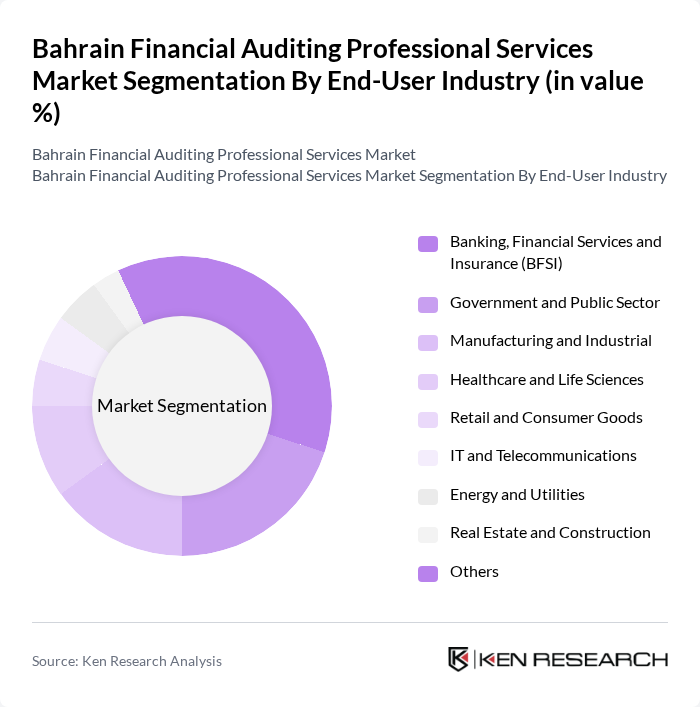
TheBanking, Financial Services, and Insurance (BFSI)sector is the leading end-user industry, accounting for a significant portion of the market. This dominance is attributed to stringent regulatory requirements, the critical need for accurate financial reporting, and the large volume of financial transactions in the sector. TheGovernment and Public Sectoralso represent a substantial share, driven by the need for transparency and accountability in public finances. Other industries, such asManufacturingandHealthcare, are increasingly recognizing the importance of auditing services to enhance operational efficiency, risk management, and compliance with evolving standards .
Bahrain Financial Auditing Professional Services Market Competitive Landscape
The Bahrain Financial Auditing Professional Services Market is characterized by a dynamic mix of regional and international players. Leading participants such as Deloitte Bahrain, PwC Bahrain, KPMG Bahrain, Ernst & Young (EY) Bahrain, BDO Bahrain, Grant Thornton Bahrain, Baker Tilly Bahrain, Crowe Bahrain, RSM Bahrain, Mazars Bahrain, Moore Stephens Bahrain, Nexia Bahrain, Al Ahlia Auditing & Accounting, Al Ameen Auditing & Consulting, A. M. Al-Mohsin & Co. Auditors contribute to innovation, geographic expansion, and service delivery in this space.
Bahrain Financial Auditing Professional Services Market Industry Analysis
Growth Drivers
- Increasing Regulatory Compliance Requirements:The Bahrain financial sector is witnessing a surge in regulatory compliance mandates, with over 200 new regulations introduced recently. This has led to a heightened demand for auditing services, as businesses strive to meet these requirements. The Central Bank of Bahrain reported a 15% increase in compliance-related audits, reflecting the growing need for professional services to navigate complex regulations effectively.
- Growth in Business Establishments:Recently, Bahrain saw a 10% increase in new business registrations, totaling approximately 5,000 new entities. This growth is driven by favorable government policies and economic diversification efforts. As more businesses emerge, the demand for financial auditing services rises, with an estimated 20% increase in audit engagements reported by local firms, indicating a robust market for professional services.
- Rising Demand for Transparency and Accountability:The push for greater transparency in financial reporting has intensified, with 70% of Bahraini companies adopting enhanced reporting standards recently. This trend is fueled by stakeholder expectations and the need for accountability, particularly in publicly listed companies. As a result, the demand for auditing services has surged, with a reported 25% increase in requests for independent audits, highlighting the market's responsiveness to these demands.
Market Challenges
- Intense Competition Among Service Providers:The Bahrain financial auditing market is characterized by fierce competition, with over 50 registered auditing firms vying for market share. This saturation has led to price wars, with some firms reducing fees by up to 15% to attract clients. Consequently, maintaining profitability while delivering quality services has become a significant challenge for many providers in this competitive landscape.
- Shortage of Skilled Professionals:The auditing sector in Bahrain faces a critical shortage of skilled professionals, with an estimated 30% of firms reporting difficulties in hiring qualified auditors. The Bahrain Economic Development Board noted that the demand for certified auditors has outpaced supply, leading to increased salaries and recruitment challenges. This shortage hampers firms' ability to scale operations and meet growing client demands effectively.
Bahrain Financial Auditing Professional Services Market Future Outlook
The future of the Bahrain financial auditing market appears promising, driven by technological advancements and evolving client expectations. The integration of AI and machine learning is expected to enhance auditing efficiency, while the shift towards remote auditing solutions will cater to a broader client base. Additionally, the increasing focus on sustainability reporting will create new avenues for auditors, positioning them as key players in promoting corporate responsibility and transparency in financial practices.
Market Opportunities
- Expansion of Digital Auditing Services:The rise of digital platforms presents a significant opportunity for auditing firms to offer remote services. With a projected 40% increase in demand for digital auditing solutions in the future, firms that invest in technology can enhance service delivery and client engagement, positioning themselves competitively in the market.
- Increasing Demand for Forensic Auditing:The growing complexity of financial crimes has led to a heightened demand for forensic auditing services. Recently, the market for forensic audits in Bahrain expanded by 20%, driven by regulatory scrutiny and corporate governance concerns. Firms that specialize in this area can capitalize on this trend, offering tailored services to meet client needs effectively.
Scope of the Report
| Segment | Sub-Segments |
|---|---|
| By Service Type | Financial Statement Audit External Audit Internal Audit Service Organization Control (SOC) Audit Employee Benefit Plan Audit Due Diligence Services Forensic Auditing and Investigation Risk Assessment Services Internal Control Reviews Others |
| By End-User Industry | Banking, Financial Services and Insurance (BFSI) Government and Public Sector Manufacturing and Industrial Healthcare and Life Sciences Retail and Consumer Goods IT and Telecommunications Energy and Utilities Real Estate and Construction Others |
| By Client Organization Size | Large Enterprises Medium Enterprises Small and Medium Enterprises (SMEs) Others |
| By Service Delivery Model | On-Site Auditing Remote Auditing Hybrid Auditing Others |
| By Geographic Coverage | Manama Muharraq Northern Governorate Southern Governorate Others |
| By Regulatory Compliance Framework | IFRS Compliant Audits Sharia-Compliant Audits AML/CFT Compliance Audits Others |
Key Target Audience
Investors and Venture Capitalist Firms
Government and Regulatory Bodies (e.g., Central Bank of Bahrain, Ministry of Finance)
Publicly Listed Companies
Private Corporations
Non-Governmental Organizations (NGOs)
Financial Institutions
Insurance Companies
Real Estate Developers
Players Mentioned in the Report:
Deloitte Bahrain
PwC Bahrain
KPMG Bahrain
Ernst & Young (EY) Bahrain
BDO Bahrain
Grant Thornton Bahrain
Baker Tilly Bahrain
Crowe Bahrain
RSM Bahrain
Mazars Bahrain
Moore Stephens Bahrain
Nexia Bahrain
Al Ahlia Auditing & Accounting
Al Ameen Auditing & Consulting
A. M. Al-Mohsin & Co. Auditors
Table of Contents
Market Assessment Phase
1. Executive Summary and Approach
2. Bahrain Financial Auditing Professional Services Market Overview
2.1 Key Insights and Strategic Recommendations
2.2 Bahrain Financial Auditing Professional Services Market Overview
2.3 Definition and Scope
2.4 Evolution of Market Ecosystem
2.5 Timeline of Key Regulatory Milestones
2.6 Value Chain & Stakeholder Mapping
2.7 Business Cycle Analysis
2.8 Policy & Incentive Landscape
3. Bahrain Financial Auditing Professional Services Market Analysis
3.1 Growth Drivers
3.1.1 Increasing Regulatory Compliance Requirements
3.1.2 Growth in Business Establishments
3.1.3 Rising Demand for Transparency and Accountability
3.1.4 Technological Advancements in Auditing Processes
3.2 Market Challenges
3.2.1 Intense Competition Among Service Providers
3.2.2 Shortage of Skilled Professionals
3.2.3 Rapidly Changing Regulatory Environment
3.2.4 Economic Fluctuations Impacting Client Budgets
3.3 Market Opportunities
3.3.1 Expansion of Digital Auditing Services
3.3.2 Increasing Demand for Forensic Auditing
3.3.3 Opportunities in Emerging Sectors
3.3.4 Strategic Partnerships with Technology Firms
3.4 Market Trends
3.4.1 Adoption of AI and Machine Learning in Auditing
3.4.2 Shift Towards Remote Auditing Solutions
3.4.3 Growing Focus on Sustainability Reporting
3.4.4 Enhanced Client Engagement through Digital Platforms
3.5 Government Regulation
3.5.1 Implementation of International Financial Reporting Standards (IFRS)
3.5.2 Strengthening of Anti-Money Laundering (AML) Regulations
3.5.3 Introduction of Corporate Governance Codes
3.5.4 Regular Updates to Auditing Standards by Regulatory Bodies
4. SWOT Analysis
5. Stakeholder Analysis
6. Porter's Five Forces Analysis
7. Bahrain Financial Auditing Professional Services Market Market Size, 2019-2024
7.1 By Value
7.2 By Volume
7.3 By Average Selling Price
8. Bahrain Financial Auditing Professional Services Market Segmentation
8.1 By Service Type
8.1.1 Financial Statement Audit
8.1.2 External Audit
8.1.3 Internal Audit
8.1.4 Service Organization Control (SOC) Audit
8.1.5 Employee Benefit Plan Audit
8.1.6 Due Diligence Services
8.1.7 Forensic Auditing and Investigation
8.1.8 Risk Assessment Services
8.1.9 Internal Control Reviews
8.1.10 Others
8.2 By End-User Industry
8.2.1 Banking, Financial Services and Insurance (BFSI)
8.2.2 Government and Public Sector
8.2.3 Manufacturing and Industrial
8.2.4 Healthcare and Life Sciences
8.2.5 Retail and Consumer Goods
8.2.6 IT and Telecommunications
8.2.7 Energy and Utilities
8.2.8 Real Estate and Construction
8.2.9 Others
8.3 By Client Organization Size
8.3.1 Large Enterprises
8.3.2 Medium Enterprises
8.3.3 Small and Medium Enterprises (SMEs)
8.3.4 Others
8.4 By Service Delivery Model
8.4.1 On-Site Auditing
8.4.2 Remote Auditing
8.4.3 Hybrid Auditing
8.4.4 Others
8.5 By Geographic Coverage
8.5.1 Manama
8.5.2 Muharraq
8.5.3 Northern Governorate
8.5.4 Southern Governorate
8.5.5 Others
8.6 By Regulatory Compliance Framework
8.6.1 IFRS Compliant Audits
8.6.2 Sharia-Compliant Audits
8.6.3 AML/CFT Compliance Audits
8.6.4 Others
9. Bahrain Financial Auditing Professional Services Market Competitive Analysis
9.1 Market Share of Key Players
9.2 Cross Comparison of Key Players
9.2.1 Company Name
9.2.2 Firm Classification (Big 4, Mid-Tier, or Local)
9.2.3 Annual Revenue Growth Rate (%)
9.2.4 Client Retention Rate (%)
9.2.5 Average Audit Engagement Value (USD)
9.2.6 Market Penetration Rate in BFSI Sector (%)
9.2.7 Pricing Model (Hourly, Fixed-Fee, Value-Based)
9.2.8 Service Portfolio Breadth (Number of Service Lines)
9.2.9 Client Satisfaction Rating (1-5 Scale)
9.2.10 Regulatory Compliance Certification Level (ISO, IFAC)
9.3 SWOT Analysis of Top Players
9.4 Pricing Analysis
9.5 Detailed Profile of Major Companies
9.5.1 Deloitte Bahrain
9.5.2 PwC Bahrain
9.5.3 KPMG Bahrain
9.5.4 Ernst & Young (EY) Bahrain
9.5.5 BDO Bahrain
9.5.6 Grant Thornton Bahrain
9.5.7 Baker Tilly Bahrain
9.5.8 Crowe Bahrain
9.5.9 RSM Bahrain
9.5.10 Mazars Bahrain
9.5.11 Moore Stephens Bahrain
9.5.12 Nexia Bahrain
9.5.13 Al Ahlia Auditing & Accounting
9.5.14 Al Ameen Auditing & Consulting
9.5.15 A. M. Al-Mohsin & Co. Auditors
10. Bahrain Financial Auditing Professional Services Market End-User Analysis
10.1 Procurement Behavior of Key Ministries
10.1.1 Ministry of Finance
10.1.2 Ministry of Industry, Commerce and Tourism
10.1.3 Ministry of Health
10.1.4 Ministry of Education
10.2 Corporate Spend on Auditing and Compliance
10.2.1 Investment in Financial Systems and Controls
10.2.2 Budget Allocation for External Auditing Services
10.2.3 Expenditure on Compliance and Risk Management
10.2.4 Others
10.3 Pain Point Analysis by End-User Category
10.3.1 Shortage of Qualified Auditors
10.3.2 Rising Costs of Compliance Services
10.3.3 Extended Audit Timelines and Delays
10.3.4 Others
10.4 User Readiness for Adoption
10.4.1 Awareness of Digital and Continuous Auditing Tools
10.4.2 Training and Development Needs
10.4.3 IT Infrastructure Readiness
10.4.4 Others
10.5 Post-Deployment ROI and Use Case Expansion
10.5.1 Measurement of Audit Effectiveness and Compliance Outcomes
10.5.2 Client Feedback and Satisfaction Mechanisms
10.5.3 Opportunities for Service Expansion and Upselling
10.5.4 Others
11. Bahrain Financial Auditing Professional Services Market Future Size, 2025-2030
11.1 By Value
11.2 By Volume
11.3 By Average Selling Price
Go-To-Market Strategy Phase
1. Whitespace Analysis + Business Model Canvas
1.1 Market Gaps Identification
1.2 Value Proposition Development
1.3 Revenue Streams Analysis
1.4 Cost Structure Evaluation
1.5 Key Partnerships Exploration
1.6 Customer Segmentation
1.7 Channels of Distribution
2. Marketing and Positioning Recommendations
2.1 Branding Strategies
2.2 Product USPs
3. Distribution Plan
3.1 Urban Retail vs Rural NGO Tie-Ups
4. Channel & Pricing Gaps
4.1 Underserved Routes
4.2 Pricing Bands
5. Unmet Demand & Latent Needs
5.1 Category Gaps
5.2 Consumer Segments
6. Customer Relationship
6.1 Loyalty Programs
6.2 After-Sales Service
7. Value Proposition
7.1 Sustainability
7.2 Integrated Supply Chains
8. Key Activities
8.1 Regulatory Compliance
8.2 Branding
8.3 Distribution Setup
9. Entry Strategy Evaluation
9.1 Domestic Market Entry Strategy
9.1.1 Product Mix
9.1.2 Pricing Band
9.1.3 Packaging
9.2 Export Entry Strategy
9.2.1 Target Countries
9.2.2 Compliance Roadmap
10. Entry Mode Assessment
10.1 JV
10.2 Greenfield
10.3 M&A
10.4 Distributor Model
11. Capital and Timeline Estimation
11.1 Capital Requirements
11.2 Timelines
12. Control vs Risk Trade-Off
12.1 Ownership vs Partnerships
13. Profitability Outlook
13.1 Breakeven Analysis
13.2 Long-Term Sustainability
14
Research Methodology
Phase 1: Approach1
Desk Research
- Analysis of financial reports from major auditing firms operating in Bahrain
- Review of industry publications and white papers on financial auditing trends
- Examination of regulatory frameworks and compliance guidelines from the Central Bank of Bahrain
Primary Research
- Interviews with senior auditors and partners from leading financial auditing firms
- Surveys targeting CFOs and financial controllers in various sectors
- Focus groups with industry experts and financial consultants to gather insights
Validation & Triangulation
- Cross-validation of findings through multiple data sources including government reports and industry surveys
- Triangulation of qualitative insights from interviews with quantitative data from surveys
- Sanity checks conducted through expert panel reviews to ensure data reliability
Phase 2: Market Size Estimation1
Top-down Assessment
- Estimation of total market size based on GDP contribution from the financial services sector
- Segmentation of the market by service type, including audit, tax, and advisory services
- Incorporation of growth rates from historical data and economic forecasts
Bottom-up Modeling
- Collection of firm-level revenue data from key players in the auditing market
- Estimation of service pricing based on competitive analysis and service offerings
- Volume x pricing model to derive total market revenue for auditing services
Forecasting & Scenario Analysis
- Multi-factor regression analysis incorporating economic indicators and regulatory changes
- Scenario planning based on potential shifts in market demand and client needs
- Development of baseline, optimistic, and pessimistic forecasts through 2030
Phase 3: CATI Sample Composition1
| Scope Item/Segment | Sample Size | Target Respondent Profiles |
|---|---|---|
| Audit Services for Corporates | 100 | Chief Financial Officers, Audit Managers |
| Tax Advisory Services | 70 | Tax Directors, Financial Advisors |
| Regulatory Compliance Audits | 60 | Compliance Officers, Risk Managers |
| Forensic Auditing Services | 40 | Forensic Accountants, Legal Advisors |
| Small Business Audits | 50 | Small Business Owners, Financial Controllers |
Frequently Asked Questions
What is the current value of the Bahrain Financial Auditing Professional Services Market?
The Bahrain Financial Auditing Professional Services Market is valued at approximately USD 270 million, reflecting a robust demand for auditing services driven by regulatory compliance, technological advancements, and the need for transparency in financial reporting.
What are the main drivers of growth in the Bahrain financial auditing market?
Which sectors are the largest consumers of auditing services in Bahrain?
What types of auditing services are most in demand in Bahrain?
Other Regional/Country Reports
Indonesia Financial Auditing Professional Services Market
Malaysia Financial Auditing Professional Services Market
KSA Financial Auditing Professional Services Market
APAC Financial Auditing Professional Services Market
SEA Financial Auditing Professional Services Market
Vietnam Financial Auditing Professional Services Market
Other Adjacent Reports
KSA Accounting Services Market
Vietnam Tax Consulting Market
Oman Compliance Consulting Market
South Africa Forensic Accounting Market
Germany Internal Audit Services Market
Egypt Financial Advisory Market
Vietnam Risk Management Services Market
Oman Corporate Governance Consulting Market
Oman Assurance Services Market
KSA Valuation Services Market
Why Buy From Us?

What makes us stand out is that our consultants follow Robust, Refine and Result (RRR) methodology. Robust for clear definitions, approaches and sanity checking, Refine for differentiating respondents' facts and opinions, and Result for presenting data with story.

We have set a benchmark in the industry by offering our clients with syndicated and customized market research reports featuring coverage of entire market as well as meticulous research and analyst insights.

While we don't replace traditional research, we flip the method upside down. Our dual approach of Top Bottom & Bottom Top ensures quality deliverable by not just verifying company fundamentals but also looking at the sector and macroeconomic factors.

With one step in the future, our research team constantly tries to show you the bigger picture. We help with some of the tough questions you may encounter along the way: How is the industry positioned? Best marketing channel? KPI's of competitors? By aligning every element, we help maximize success.

Our report gives you instant access to the answers and sources that other companies might choose to hide. We elaborate each steps of research methodology we have used and showcase you the sample size to earn your trust.

If you need any support, we are here! We pride ourselves on universe strength, data quality, and quick, friendly, and professional service.