About the Report
Base Year 2024Bahrain Food Allergy Treatment Market Overview
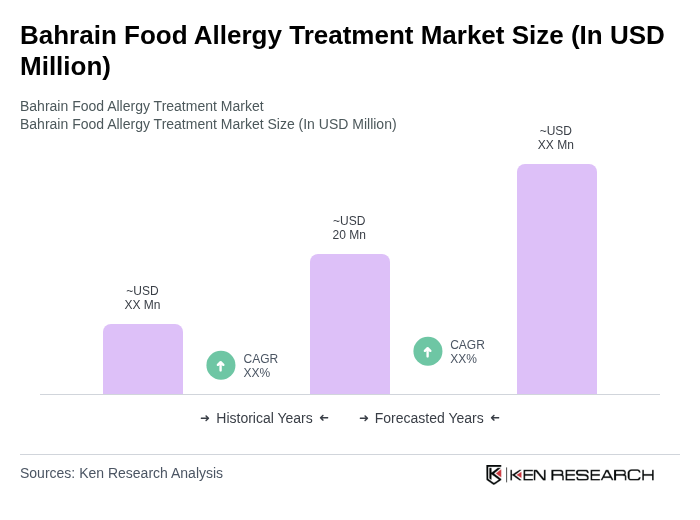
- The Bahrain Food Allergy Treatment Market is valued at USD 20 million, based on a five-year historical analysis and proportional allocation from the Middle East & Africa market size. This growth is primarily driven by the increasing prevalence of food allergies among the population, heightened awareness regarding food safety, and advancements in treatment options. The rising number of diagnosed cases has led to a greater demand for effective treatment solutions, thereby propelling market growth. Recent trends highlight an uptick in demand for both prescription and over-the-counter therapies, including antihistamines and immunotherapies, as well as a growing emphasis on early diagnosis and personalized treatment approaches.
- Key cities such asManamaandMuharraqdominate the market due to their higher population density and better healthcare infrastructure. These urban centers have a greater concentration of healthcare facilities and specialists, which facilitates access to allergy treatments. Additionally, the presence of educational institutions and community awareness programs in these areas contributes to the demand for food allergy treatments.
- In 2023, the Bahrain government implemented theFood Products Allergen Labeling Regulation, 2023issued by theBahrain Ministry of Health. This binding regulation mandates that all food products must clearly label potential allergens, including but not limited to peanuts, tree nuts, milk, eggs, wheat, soy, fish, and shellfish. The regulation requires manufacturers and importers to ensure compliance with standardized allergen labeling formats, periodic audits, and penalties for non-compliance. This initiative aims to enhance consumer safety and awareness, ensuring that individuals with food allergies can make informed choices and is expected to significantly impact the food industry and promote the development of allergy treatment solutions.
Bahrain Food Allergy Treatment Market Segmentation
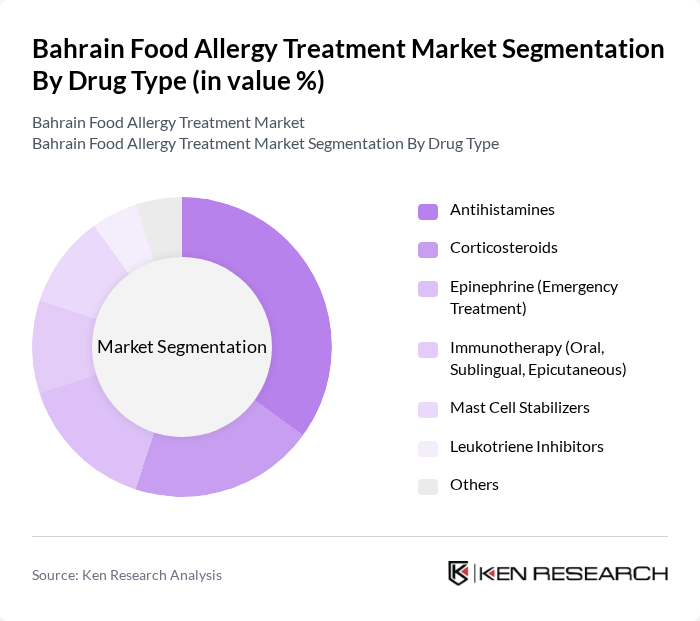
By Drug Type:The drug type segmentation includes various categories such asAntihistamines, Corticosteroids, Epinephrine (Emergency Treatment), Immunotherapy (Oral, Sublingual, Epicutaneous), Mast Cell Stabilizers, Leukotriene Inhibitors, and Others. Among these,Antihistaminesare currently leading the market due to their widespread use in managing allergic reactions. The increasing awareness of food allergies and the availability of over-the-counter antihistamines have contributed to their dominance. Additionally, the growing trend of self-medication has further propelled the demand for these drugs. Recent data indicates that antihistamines account for the largest share of food allergy treatments globally and regionally, reflecting similar trends in Bahrain.
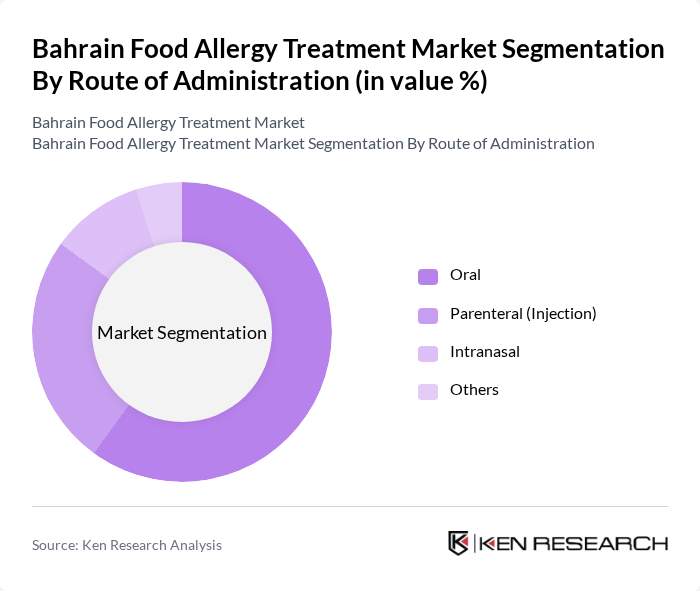
By Route of Administration:The route of administration includesOral, Parenteral (Injection), Intranasal, and Others. TheOralroute is the most preferred method for administering allergy treatments due to its convenience and ease of use. Patients often prefer oral medications as they can be taken at home without the need for professional assistance. This preference is further supported by the availability of various formulations, including tablets and syrups, which cater to different age groups. Global and regional data confirm that oral administration dominates the market, consistent with trends observed in Bahrain.
Bahrain Food Allergy Treatment Market Competitive Landscape
The Bahrain Food Allergy Treatment Market is characterized by a dynamic mix of regional and international players. Leading participants such as Allergy Therapeutics PLC, Aimmune Therapeutics, DBV Technologies, Novartis AG, Sanofi S.A., Merck & Co., Inc., Pfizer Inc., GlaxoSmithKline plc, Regeneron Pharmaceuticals, Inc., Teva Pharmaceutical Industries Ltd., Viatris Inc. (formerly Mylan N.V.), Bayer AG, Amgen Inc., AbbVie Inc., UCB S.A., Church & Dwight Co., Inc., Astellas Pharma Inc., Nestlé S.A., Aravax Pty Ltd, Camallergy Ltd, Immunomic Therapeutics, Inc., Rising Pharmaceuticals, Inc. contribute to innovation, geographic expansion, and service delivery in this space.
**Sources:** - - - -
Bahrain Food Allergy Treatment Market Industry Analysis
Growth Drivers
- Increasing Prevalence of Food Allergies:The prevalence of food allergies in Bahrain has risen significantly, with estimates indicating that approximately 5% of the population is affected. This translates to around 30,000 individuals suffering from food allergies, creating a substantial demand for effective treatment options. The World Allergy Organization reported that the Middle East has seen a 20% increase in food allergies over the past decade, highlighting the urgent need for specialized healthcare services in this area.
- Rising Awareness About Food Allergy Treatments:Awareness campaigns and educational programs have increased public knowledge about food allergies and their management. In future, it is estimated that over 70% of the Bahraini population will recognize the importance of seeking medical advice for food allergies. This growing awareness is supported by initiatives from local health authorities, which have allocated approximately BHD 1 million to promote allergy awareness and treatment options, further driving market growth.
- Advancements in Medical Technology:The Bahrain healthcare sector is witnessing rapid advancements in medical technology, particularly in allergy diagnostics and treatment. In future, investments in innovative allergy testing technologies are projected to reach BHD 500,000, enhancing the accuracy and speed of diagnosis. Additionally, the introduction of new treatment modalities, such as biologics, is expected to improve patient outcomes significantly, thereby increasing the demand for specialized allergy treatments in the region.
Market Challenges
- Limited Access to Specialized Healthcare:Access to specialized healthcare services for food allergies remains a significant challenge in Bahrain. Currently, only 30% of healthcare facilities offer specialized allergy treatment, limiting options for patients. The World Health Organization indicates that Bahrain has a ratio of 1 allergist per 100,000 people, which is below the global average, exacerbating the issue of timely and effective treatment for those affected by food allergies.
- High Cost of Treatment Options:The financial burden of food allergy treatments poses a significant challenge for many patients in Bahrain. The average cost of allergy immunotherapy can exceed BHD 1,200 annually, making it unaffordable for a large segment of the population. Additionally, the lack of comprehensive insurance coverage for allergy treatments further complicates access, as only 40% of insurance plans in Bahrain provide adequate coverage for these essential services.
Bahrain Food Allergy Treatment Market Future Outlook
The future of the Bahrain food allergy treatment market appears promising, driven by increasing healthcare investments and a growing emphasis on preventive care. As the government continues to enhance healthcare infrastructure, the integration of digital health solutions is expected to facilitate better patient management. Furthermore, the rising demand for personalized medicine will likely lead to the development of tailored treatment plans, improving patient outcomes and satisfaction in managing food allergies.
Market Opportunities
- Development of Innovative Treatment Solutions:There is a significant opportunity for the development of innovative treatment solutions, such as oral immunotherapy and biologics. With an estimated BHD 300,000 allocated for research and development in future, local pharmaceutical companies can create effective therapies that cater to the unique needs of Bahraini patients, enhancing treatment accessibility and efficacy.
- Expansion of Telemedicine Services:The expansion of telemedicine services presents a valuable opportunity to improve access to allergy specialists. In future, it is projected that telemedicine consultations will increase by 40%, allowing patients to receive timely advice and treatment from the comfort of their homes. This shift not only enhances patient convenience but also reduces the burden on healthcare facilities, making allergy management more efficient.
Scope of the Report
| Segment | Sub-Segments |
|---|---|
| By Drug Type | Antihistamines Corticosteroids Epinephrine (Emergency Treatment) Immunotherapy (Oral, Sublingual, Epicutaneous) Mast Cell Stabilizers Leukotriene Inhibitors Others |
| By Route of Administration | Oral Parenteral (Injection) Intranasal Others |
| By Allergen Type | Dairy Products Poultry Products Tree Nuts Peanuts Shellfish Wheat Soy Others |
| By End-User | Hospitals Clinics Home Care Settings Retail Pharmacies Others |
| By Age Group | Children Adults Elderly Others |
| By Severity of Allergy | Mild Moderate Severe Others |
| By Treatment Duration | Short-term Long-term Others |
| By Geographic Distribution | Urban Areas Rural Areas Others |
| By Insurance Coverage | Fully Covered Partially Covered Not Covered Others |
Key Target Audience
Investors and Venture Capitalist Firms
Government and Regulatory Bodies (e.g., Bahrain Ministry of Health)
Pharmaceutical Manufacturers
Medical Device Manufacturers
Healthcare Providers and Clinics
Food Safety Authorities (e.g., Bahrain Food Safety Authority)
Allergy and Immunology Specialists
Health Insurance Companies
Players Mentioned in the Report:
Allergy Therapeutics PLC
Aimmune Therapeutics
DBV Technologies
Novartis AG
Sanofi S.A.
Merck & Co., Inc.
Pfizer Inc.
GlaxoSmithKline plc
Regeneron Pharmaceuticals, Inc.
Teva Pharmaceutical Industries Ltd.
Viatris Inc. (formerly Mylan N.V.)
Bayer AG
Amgen Inc.
AbbVie Inc.
UCB S.A.
Church & Dwight Co., Inc.
Astellas Pharma Inc.
Nestle S.A.
Aravax Pty Ltd
Camallergy Ltd
Immunomic Therapeutics, Inc.
Rising Pharmaceuticals, Inc.
Table of Contents
Market Assessment Phase
1. Executive Summary and Approach
2. Bahrain Food Allergy Treatment Market Overview
2.1 Key Insights and Strategic Recommendations
2.2 Bahrain Food Allergy Treatment Market Overview
2.3 Definition and Scope
2.4 Evolution of Market Ecosystem
2.5 Timeline of Key Regulatory Milestones
2.6 Value Chain & Stakeholder Mapping
2.7 Business Cycle Analysis
2.8 Policy & Incentive Landscape
3. Bahrain Food Allergy Treatment Market Analysis
3.1 Growth Drivers
3.1.1 Increasing prevalence of food allergies
3.1.2 Rising awareness about food allergy treatments
3.1.3 Advancements in medical technology
3.1.4 Government initiatives for healthcare improvement
3.2 Market Challenges
3.2.1 Limited access to specialized healthcare
3.2.2 High cost of treatment options
3.2.3 Lack of awareness among the general population
3.2.4 Regulatory hurdles in treatment approval
3.3 Market Opportunities
3.3.1 Development of innovative treatment solutions
3.3.2 Expansion of telemedicine services
3.3.3 Collaborations with international healthcare providers
3.3.4 Growing demand for personalized medicine
3.4 Market Trends
3.4.1 Increasing focus on preventive healthcare
3.4.2 Rise in organic and natural food products
3.4.3 Integration of digital health solutions
3.4.4 Shift towards patient-centric care models
3.5 Government Regulation
3.5.1 Food safety regulations
3.5.2 Healthcare quality standards
3.5.3 Licensing requirements for treatment providers
3.5.4 Insurance coverage policies for allergy treatments
4. SWOT Analysis
5. Stakeholder Analysis
6. Porter's Five Forces Analysis
7. Bahrain Food Allergy Treatment Market Size, 2019-2024
7.1 By Value
7.2 By Volume
7.3 By Average Selling Price
8. Bahrain Food Allergy Treatment Market Segmentation
8.1 By Drug Type
8.1.1 Antihistamines
8.1.2 Corticosteroids
8.1.3 Epinephrine (Emergency Treatment)
8.1.4 Immunotherapy (Oral, Sublingual, Epicutaneous)
8.1.5 Mast Cell Stabilizers
8.1.6 Leukotriene Inhibitors
8.1.7 Others
8.2 By Route of Administration
8.2.1 Oral
8.2.2 Parenteral (Injection)
8.2.3 Intranasal
8.2.4 Others
8.3 By Allergen Type
8.3.1 Dairy Products
8.3.2 Poultry Products
8.3.3 Tree Nuts
8.3.4 Peanuts
8.3.5 Shellfish
8.3.6 Wheat
8.3.7 Soy
8.3.8 Others
8.4 By End-User
8.4.1 Hospitals
8.4.2 Clinics
8.4.3 Home Care Settings
8.4.4 Retail Pharmacies
8.4.5 Others
8.5 By Age Group
8.5.1 Children
8.5.2 Adults
8.5.3 Elderly
8.5.4 Others
8.6 By Severity of Allergy
8.6.1 Mild
8.6.2 Moderate
8.6.3 Severe
8.6.4 Others
8.7 By Treatment Duration
8.7.1 Short-term
8.7.2 Long-term
8.7.3 Others
8.8 By Geographic Distribution
8.8.1 Urban Areas
8.8.2 Rural Areas
8.8.3 Others
8.9 By Insurance Coverage
8.9.1 Fully Covered
8.9.2 Partially Covered
8.9.3 Not Covered
8.9.4 Others
9. Bahrain Food Allergy Treatment Market Competitive Analysis
9.1 Market Share of Key Players
9.2 KPIs for Cross Comparison of Key Players
9.2.1 Company Name
9.2.2 Group Size (Large, Medium, or Small as per industry convention)
9.2.3 Revenue in Bahrain Food Allergy Treatment Segment
9.2.4 Revenue Growth Rate (Bahrain/Middle East)
9.2.5 Market Share in Bahrain Food Allergy Treatment Market
9.2.6 Number of Food Allergy Treatment Products Approved/Marketed
9.2.7 Penetration in Key Distribution Channels (Hospitals, Pharmacies)
9.2.8 R&D Investment as % of Revenue (Allergy Segment)
9.2.9 Local Partnerships/Distribution Agreements
9.2.10 Regulatory Approval Track Record (Bahrain/Middle East)
9.2.11 Customer Satisfaction Index
9.2.12 Innovation Rate (New Product Launches, Pipeline)
9.3 SWOT Analysis of Top Players
9.4 Pricing Analysis
9.5 List of Major Companies
9.5.1 Allergy Therapeutics PLC
9.5.2 Aimmune Therapeutics
9.5.3 DBV Technologies
9.5.4 Novartis AG
9.5.5 Sanofi S.A.
9.5.6 Merck & Co., Inc.
9.5.7 Pfizer Inc.
9.5.8 GlaxoSmithKline plc
9.5.9 Regeneron Pharmaceuticals, Inc.
9.5.10 Teva Pharmaceutical Industries Ltd.
9.5.11 Viatris Inc. (formerly Mylan N.V.)
9.5.12 Bayer AG
9.5.13 Amgen Inc.
9.5.14 AbbVie Inc.
9.5.15 UCB S.A.
9.5.16 Church & Dwight Co., Inc.
9.5.17 Astellas Pharma Inc.
9.5.18 Nestlé S.A.
9.5.19 Aravax Pty Ltd
9.5.20 Camallergy Ltd
9.5.21 Immunomic Therapeutics, Inc.
9.5.22 Rising Pharmaceuticals, Inc.
10. Bahrain Food Allergy Treatment Market End-User Analysis
10.1 Procurement Behavior of Key Ministries
10.1.1 Ministry of Health
10.1.2 Ministry of Education
10.1.3 Ministry of Social Development
10.1.4 Others
10.2 Corporate Spend on Infrastructure & Energy
10.2.1 Healthcare facilities
10.2.2 Research and development
10.2.3 Training and education
10.2.4 Others
10.3 Pain Point Analysis by End-User Category
10.3.1 Patients
10.3.2 Healthcare providers
10.3.3 Insurance companies
10.3.4 Others
10.4 User Readiness for Adoption
10.4.1 Awareness levels
10.4.2 Accessibility of treatments
10.4.3 Financial readiness
10.4.4 Others
10.5 Post-Deployment ROI and Use Case Expansion
10.5.1 Treatment effectiveness
10.5.2 Patient feedback
10.5.3 Cost savings
10.5.4 Others
11. Bahrain Food Allergy Treatment Market Future Size, 2025-2030
11.1 By Value
11.2 By Volume
11.3 By Average Selling Price
Go-To-Market Strategy Phase
1. Whitespace Analysis + Business Model Canvas
1.1 Market Gaps Identification
1.2 Business Model Framework
2. Marketing and Positioning Recommendations
2.1 Branding strategies
2.2 Product USPs
3. Distribution Plan
3.1 Urban retail vs rural NGO tie-ups
4. Channel & Pricing Gaps
4.1 Underserved routes
4.2 Pricing bands
5. Unmet Demand & Latent Needs
5.1 Category gaps
5.2 Consumer segments
6. Customer Relationship
6.1 Loyalty programs
6.2 After-sales service
7. Value Proposition
7.1 Sustainability
7.2 Integrated supply chains
8. Key Activities
8.1 Regulatory compliance
8.2 Branding
8.3 Distribution setup
9. Entry Strategy Evaluation
9.1 Domestic Market Entry Strategy
9.1.1 Product mix
9.1.2 Pricing band
9.1.3 Packaging
9.2 Export Entry Strategy
9.2.1 Target countries
9.2.2 Compliance roadmap
10. Entry Mode Assessment
10.1 JV
10.2 Greenfield
10.3 M&A
10.4 Distributor Model
11. Capital and Timeline Estimation
11.1 Capital requirements
11.2 Timelines
12. Control vs Risk Trade-Off
12.1 Ownership vs Partnerships
13. Profitability Outlook
13.1 Breakeven analysis
13.2 Long-term sustainability
14. Potential Partner List
14.1 Distributors
14.2 JVs
14.3 Acquisition targets
15. Execution Roadmap
15.1 Phased Plan for Market Entry
15.1.1 Market Setup
15.1.2 Market Entry
15.1.3 Growth Acceleration
15.1.4 Scale & Stabilize
15.2 Key Activities and Milestones
15.2.1 Activity Timeline
15.2.2 Milestone Tracking
Research Methodology
Phase 1: Approach1
Desk Research
- Analysis of existing market reports and publications on food allergies in Bahrain
- Review of government health statistics and reports from the Ministry of Health
- Examination of academic journals and articles focusing on food allergy prevalence and treatment options
Primary Research
- Interviews with allergists and healthcare professionals specializing in food allergies
- Surveys conducted with patients and caregivers affected by food allergies
- Focus groups with dietitians and nutritionists to understand dietary management practices
Validation & Triangulation
- Cross-validation of findings through multiple expert interviews and patient surveys
- Triangulation of data from healthcare providers, patient advocacy groups, and academic research
- Sanity checks through feedback from a panel of medical experts in allergy treatment
Phase 2: Market Size Estimation1
Top-down Assessment
- Estimation of the total population affected by food allergies in Bahrain based on health statistics
- Analysis of healthcare expenditure on allergy treatments and related medications
- Incorporation of trends in food allergy awareness and diagnosis rates
Bottom-up Modeling
- Collection of data on the number of allergy clinics and treatment facilities in Bahrain
- Estimation of average treatment costs per patient based on healthcare provider pricing
- Volume estimates based on patient visits and treatment frequency for food allergies
Forecasting & Scenario Analysis
- Multi-factor regression analysis considering population growth and increasing allergy awareness
- Scenario modeling based on potential changes in healthcare policies and insurance coverage
- Baseline, optimistic, and pessimistic projections for market growth through 2030
Phase 3: CATI Sample Composition1
| Scope Item/Segment | Sample Size | Target Respondent Profiles |
|---|---|---|
| Healthcare Providers | 80 | Allergists, General Practitioners |
| Patients with Food Allergies | 120 | Individuals diagnosed with food allergies, Caregivers |
| Dietitians and Nutritionists | 60 | Registered Dietitians, Nutrition Consultants |
| Pharmaceutical Representatives | 40 | Sales Representatives, Product Managers |
| Patient Advocacy Groups | 40 | Leaders of Advocacy Organizations, Community Health Workers |
Frequently Asked Questions
What is the current value of the Bahrain Food Allergy Treatment Market?
The Bahrain Food Allergy Treatment Market is valued at approximately USD 20 million, reflecting a significant demand for effective treatment solutions due to the rising prevalence of food allergies and increased awareness regarding food safety.
What factors are driving the growth of the food allergy treatment market in Bahrain?
Which cities in Bahrain are leading in food allergy treatment demand?
What is the Food Products Allergen Labeling Regulation, 2023?
Other Regional/Country Reports
Indonesia Food Allergy Treatment Market
Malaysia Food Allergy Treatment Market
KSA Food Allergy Treatment Market
APAC Food Allergy Treatment Market
SEA Food Allergy Treatment Market
Vietnam Food Allergy Treatment Market
Other Adjacent Reports
UAE Immunotherapy Market
Qatar Food Safety Testing Market
Japan Epinephrine Auto-Injectors Market
Germany Antihistamines Market
GCC Nutraceuticals MarketBrazil Telemedicine Services Market
Oman biologics market size, share, growth drivers, trends, opportunities & forecast 2025–2030Brazil Pediatric Allergy Treatment Market
Mexico Food Allergen Labeling Market
Why Buy From Us?

What makes us stand out is that our consultants follow Robust, Refine and Result (RRR) methodology. Robust for clear definitions, approaches and sanity checking, Refine for differentiating respondents' facts and opinions, and Result for presenting data with story.

We have set a benchmark in the industry by offering our clients with syndicated and customized market research reports featuring coverage of entire market as well as meticulous research and analyst insights.

While we don't replace traditional research, we flip the method upside down. Our dual approach of Top Bottom & Bottom Top ensures quality deliverable by not just verifying company fundamentals but also looking at the sector and macroeconomic factors.

With one step in the future, our research team constantly tries to show you the bigger picture. We help with some of the tough questions you may encounter along the way: How is the industry positioned? Best marketing channel? KPI's of competitors? By aligning every element, we help maximize success.

Our report gives you instant access to the answers and sources that other companies might choose to hide. We elaborate each steps of research methodology we have used and showcase you the sample size to earn your trust.

If you need any support, we are here! We pride ourselves on universe strength, data quality, and quick, friendly, and professional service.