About the Report
Base Year 2024Listen to the audio summary
Philippines Allergy Diagnostics Market Overview
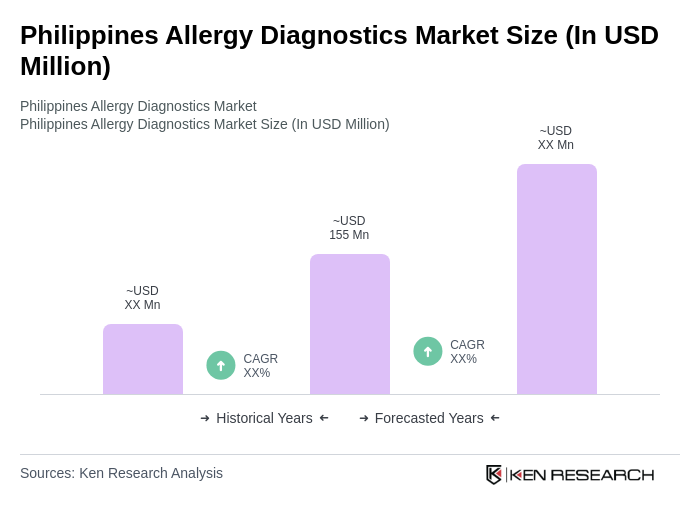
- The Philippines Allergy Diagnostics Market is valued at USD 155 million, based on a five-year historical analysis. This growth is primarily driven by the increasing prevalence of allergic diseases, rising awareness about allergy testing, and advancements in diagnostic technologies. The market is also supported by a growing healthcare infrastructure and the increasing number of healthcare professionals specializing in allergy and immunology. The shift toward molecular diagnostics and component-resolved diagnostics is enabling more precise allergen identification, while automated testing platforms are improving efficiency and scalability across diagnostic facilities.
- Metro Manila, Cebu, and Davao are the dominant cities in the Philippines Allergy Diagnostics Market. Metro Manila, being the capital, has a higher concentration of healthcare facilities and specialists, while Cebu and Davao serve as major healthcare hubs in the Visayas and Mindanao regions, respectively. The urban population in these areas is more aware of allergy-related issues, leading to increased demand for diagnostic services. Rising pollution levels, changing dietary patterns, and increased exposure to environmental allergens in these urban centers are accelerating the need for comprehensive allergy testing.
- The Philippine government implemented the Universal Health Care Act (Republic Act No. 11223) in 2019, which aims to provide equitable access to quality healthcare services, including allergy diagnostics. This landmark legislation mandates that all Filipino citizens and legal residents are automatically enrolled in the National Health Insurance Program, ensuring access to essential health services without financial hardship. The law requires all healthcare facilities to provide a comprehensive package of services covering promotive, preventive, curative, rehabilitative, and palliative care, thereby increasing the demand for allergy testing and diagnostics across the country. The Act establishes mechanisms for contracting healthcare providers, including diagnostic laboratories, and sets standards for quality assurance and accreditation.
Philippines Allergy Diagnostics Market Segmentation
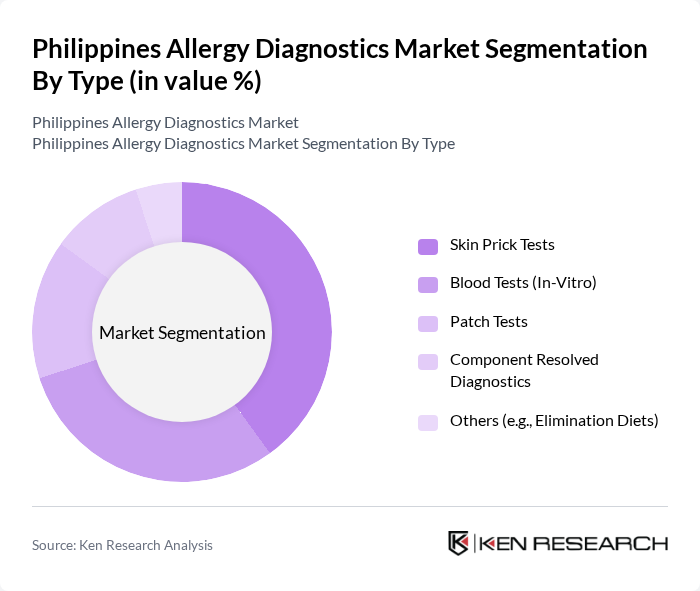
By Type:The market is segmented into various types of allergy diagnostic tests, including Skin Prick Tests, Blood Tests (In-Vitro), Patch Tests, Component Resolved Diagnostics, and Others (e.g., Elimination Diets). Among these, Skin Prick Tests are the most widely used due to their cost-effectiveness and quick results, making them a preferred choice for both healthcare providers and patients. Blood Tests (In-Vitro) are gaining significant traction due to their accuracy, safety profile, and ability to test for multiple allergens simultaneously without direct patient exposure to allergens. In-vitro tests provide standardized and reproducible results, making them particularly suitable for patients with severe allergy risks or those unable to discontinue antihistamine medications.
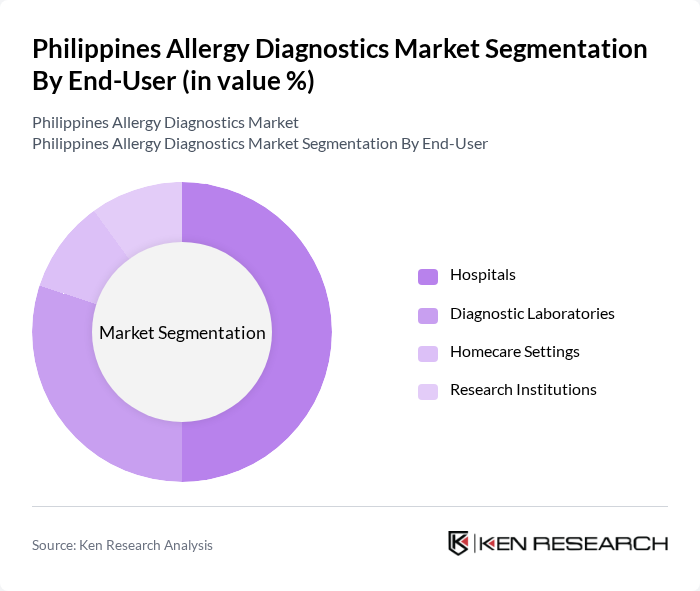
By End-User:The end-user segmentation includes Hospitals, Diagnostic Laboratories, Homecare Settings, and Research Institutions. Hospitals are the leading end-users of allergy diagnostics due to their comprehensive facilities and access to specialized healthcare professionals. Diagnostic Laboratories play a crucial role, providing a wide range of testing services and accounting for a substantial portion of market activity due to their specialized equipment and expertise in handling various allergen testing protocols. The increasing trend of home healthcare and the development of at-home allergy testing kits are contributing to the growth of allergy diagnostics in homecare settings, offering convenience and accessibility to patients.
Philippines Allergy Diagnostics Market Competitive Landscape
The Philippines Allergy Diagnostics Market is characterized by a dynamic mix of regional and international players. Leading participants such as Abbott Laboratories, Thermo Fisher Scientific Inc., Siemens Healthineers, Roche Diagnostics, Merck KGaA, Danaher Corporation, Bio-Rad Laboratories, Inc., Quest Diagnostics Incorporated, LabCorp, Hitachi Chemical Diagnostics, A. Menarini Diagnostics, HYCOR Biomedical, ALK-Abelló A/S, Greer Laboratories, Inc., Stallergenes Greer contribute to innovation, geographic expansion, and service delivery in this space.
Philippines Allergy Diagnostics Market Industry Analysis
Growth Drivers
- Increasing Prevalence of Allergic Diseases:The Philippines has seen a significant rise in allergic diseases, with approximately 31% of the population affected by various allergies, according to the Department of Health. This increase is attributed to urbanization and environmental changes, leading to higher exposure to allergens. The growing burden of allergic conditions necessitates effective diagnostic solutions, driving demand for allergy testing services and products, which are projected to reach a market value of PHP 1.6 billion in future.
- Rising Awareness About Allergy Testing:Public awareness regarding the importance of allergy testing has surged, with campaigns by health organizations reaching over 11 million Filipinos in future. This heightened awareness is crucial as it encourages individuals to seek diagnostic services, thereby increasing the number of tests conducted annually. The Philippine Allergy Society has reported a 26% increase in testing requests, reflecting a growing recognition of the need for accurate diagnosis and management of allergic conditions.
- Advancements in Diagnostic Technologies:The allergy diagnostics sector is benefiting from technological innovations, such as the development of high-throughput screening methods and molecular diagnostics. In future, investments in diagnostic technology reached PHP 600 million, facilitating the introduction of more accurate and faster testing options. These advancements not only improve patient outcomes but also enhance the efficiency of healthcare providers, further propelling market growth as more facilities adopt these technologies.
Market Challenges
- High Cost of Advanced Diagnostic Tests:The cost of advanced allergy diagnostic tests remains a significant barrier, with prices ranging from PHP 3,500 to PHP 11,000 per test. This high cost limits accessibility for many patients, particularly in lower-income demographics. As a result, only about 16% of those with suspected allergies undergo testing, which hampers early diagnosis and treatment, ultimately affecting overall market growth and patient health outcomes.
- Limited Access to Healthcare Facilities in Rural Areas:Approximately 61% of the Philippine population resides in rural areas, where access to healthcare facilities is severely limited. Many regions lack specialized allergy diagnostic services, leading to underdiagnosis and mismanagement of allergic conditions. This disparity creates a significant challenge for the market, as it restricts the potential customer base and limits the overall effectiveness of allergy management strategies across the country.
Philippines Allergy Diagnostics Market Future Outlook
The future of the Philippines allergy diagnostics market appears promising, driven by increasing healthcare investments and technological advancements. The government is expected to enhance healthcare infrastructure, improving access to diagnostic services nationwide. Additionally, the integration of telemedicine is likely to facilitate remote consultations and testing, making allergy diagnostics more accessible. As awareness continues to grow, the market is poised for expansion, with innovative solutions addressing the needs of diverse populations across the country.
Market Opportunities
- Expansion of Telemedicine Services:The rise of telemedicine presents a significant opportunity for allergy diagnostics, allowing patients to consult specialists remotely. In future, telemedicine consultations increased by 41%, indicating a shift in healthcare delivery. This trend can enhance access to allergy testing, particularly in underserved areas, ultimately driving market growth and improving patient outcomes.
- Development of Home Testing Kits:The demand for home testing kits is on the rise, with a projected market value of PHP 210 million in future. These kits offer convenience and privacy, appealing to consumers who prefer self-testing. As manufacturers invest in user-friendly and accurate home testing solutions, this segment is expected to grow, providing a new avenue for market expansion and increased consumer engagement.
Scope of the Report
| Segment | Sub-Segments |
|---|---|
| By Type | Skin Prick Tests Blood Tests (In-Vitro) Patch Tests Component Resolved Diagnostics Others (e.g., Elimination Diets) |
| By End-User | Hospitals Diagnostic Laboratories Homecare Settings Research Institutions |
| By Age Group | Pediatric Adult Geriatric |
| By Allergy Type | Food Allergies Environmental Allergies (Inhaled) Drug Allergies Others (e.g., Insect Stings) |
| By Distribution Channel | Direct Sales Online Sales Retail Pharmacies Others (e.g., Clinics) |
| By Geographic Region | Luzon Visayas Mindanao |
| By Price Range | Low (Basic Tests) Medium (Standard Tests) High (Advanced Tests) |
Key Target Audience
Investors and Venture Capitalist Firms
Government and Regulatory Bodies (e.g., Department of Health, Food and Drug Administration)
Manufacturers and Producers of Allergy Diagnostic Products
Distributors and Retailers of Medical Devices
Healthcare Providers and Clinics Specializing in Allergy Treatments
Pharmaceutical Companies Developing Allergy Medications
Industry Associations (e.g., Philippine Society of Allergy, Asthma, and Immunology)
Health Insurance Companies and Payers
Players Mentioned in the Report:
Abbott Laboratories
Thermo Fisher Scientific Inc.
Siemens Healthineers
Roche Diagnostics
Merck KGaA
Danaher Corporation
Bio-Rad Laboratories, Inc.
Quest Diagnostics Incorporated
LabCorp
Hitachi Chemical Diagnostics
A. Menarini Diagnostics
HYCOR Biomedical
ALK-Abello A/S
Greer Laboratories, Inc.
Stallergenes Greer
Table of Contents
Market Assessment Phase
1. Executive Summary and Approach
2. Philippines Allergy Diagnostics Market Overview
2.1 Key Insights and Strategic Recommendations
2.2 Philippines Allergy Diagnostics Market Overview
2.3 Definition and Scope
2.4 Evolution of Market Ecosystem
2.5 Timeline of Key Regulatory Milestones
2.6 Value Chain & Stakeholder Mapping
2.7 Business Cycle Analysis
2.8 Policy & Incentive Landscape
3. Philippines Allergy Diagnostics Market Analysis
3.1 Growth Drivers
3.1.1 Increasing prevalence of allergic diseases
3.1.2 Rising awareness about allergy testing
3.1.3 Advancements in diagnostic technologies
3.1.4 Government initiatives for healthcare improvement
3.2 Market Challenges
3.2.1 High cost of advanced diagnostic tests
3.2.2 Limited access to healthcare facilities in rural areas
3.2.3 Lack of trained professionals in allergy diagnostics
3.2.4 Regulatory hurdles in product approvals
3.3 Market Opportunities
3.3.1 Expansion of telemedicine services
3.3.2 Development of home testing kits
3.3.3 Collaborations with healthcare providers
3.3.4 Increasing investment in healthcare infrastructure
3.4 Market Trends
3.4.1 Growth of personalized medicine
3.4.2 Integration of AI in diagnostic processes
3.4.3 Shift towards preventive healthcare
3.4.4 Rising demand for point-of-care testing
3.5 Government Regulation
3.5.1 Implementation of stricter quality control measures
3.5.2 Introduction of new healthcare policies
3.5.3 Regulation of medical devices and diagnostics
3.5.4 Support for research and development in diagnostics
4. SWOT Analysis
5. Stakeholder Analysis
6. Porter's Five Forces Analysis
7. Philippines Allergy Diagnostics Market Market Size, 2019-2024
7.1 By Value
7.2 By Volume
7.3 By Average Selling Price
8. Philippines Allergy Diagnostics Market Segmentation
8.1 By Type
8.1.1 Skin Prick Tests
8.1.2 Blood Tests (In-Vitro)
8.1.3 Patch Tests
8.1.4 Component Resolved Diagnostics
8.1.5 Others (e.g., Elimination Diets)
8.2 By End-User
8.2.1 Hospitals
8.2.2 Diagnostic Laboratories
8.2.3 Homecare Settings
8.2.4 Research Institutions
8.3 By Age Group
8.3.1 Pediatric
8.3.2 Adult
8.3.3 Geriatric
8.4 By Allergy Type
8.4.1 Food Allergies
8.4.2 Environmental Allergies (Inhaled)
8.4.3 Drug Allergies
8.4.4 Others (e.g., Insect Stings)
8.5 By Distribution Channel
8.5.1 Direct Sales
8.5.2 Online Sales
8.5.3 Retail Pharmacies
8.5.4 Others (e.g., Clinics)
8.6 By Geographic Region
8.6.1 Luzon
8.6.2 Visayas
8.6.3 Mindanao
8.7 By Price Range
8.7.1 Low (Basic Tests)
8.7.2 Medium (Standard Tests)
8.7.3 High (Advanced Tests)
9. Philippines Allergy Diagnostics Market Competitive Analysis
9.1 Market Share of Key Players
9.2 Cross Comparison of Key Players
9.2.1 Company Name
9.2.2 Group Size (Large, Medium, or Small as per industry convention)
9.2.3 Revenue Growth Rate
9.2.4 Market Penetration Rate
9.2.5 Customer Retention Rate
9.2.6 Pricing Strategy (Premium, Competitive, Discounted)
9.2.7 Product Diversification Index (Range of Allergy Tests Offered)
9.2.8 Operational Efficiency Ratio (Cost per Test)
9.2.9 Brand Recognition Score (Awareness and Preference)
9.2.10 Innovation Index (New Technologies Adopted)
9.3 SWOT Analysis of Top Players
9.4 Pricing Analysis
9.5 Detailed Profile of Major Companies
9.5.1 Abbott Laboratories
9.5.2 Thermo Fisher Scientific Inc.
9.5.3 Siemens Healthineers
9.5.4 Roche Diagnostics
9.5.5 Merck KGaA
9.5.6 Danaher Corporation
9.5.7 Bio-Rad Laboratories, Inc.
9.5.8 Quest Diagnostics Incorporated
9.5.9 LabCorp
9.5.10 Hitachi Chemical Diagnostics
9.5.11 A. Menarini Diagnostics
9.5.12 HYCOR Biomedical
9.5.13 ALK-Abelló A/S
9.5.14 Greer Laboratories, Inc.
9.5.15 Stallergenes Greer
10. Philippines Allergy Diagnostics Market End-User Analysis
10.1 Procurement Behavior of Key Ministries
10.1.1 Ministry of Health
10.1.2 Department of Education
10.1.3 Local Government Units
10.2 Corporate Spend on Infrastructure & Energy
10.2.1 Healthcare Facilities
10.2.2 Diagnostic Centers
10.3 Pain Point Analysis by End-User Category
10.3.1 Hospitals
10.3.2 Clinics
10.3.3 Homecare Providers
10.4 User Readiness for Adoption
10.4.1 Awareness Levels
10.4.2 Training Needs
10.5 Post-Deployment ROI and Use Case Expansion
10.5.1 Cost Savings
10.5.2 Improved Patient Outcomes
11. Philippines Allergy Diagnostics Market Future Size, 2025-2030
11.1 By Value
11.2 By Volume
11.3 By Average Selling Price
Go-To-Market Strategy Phase
1. Whitespace Analysis + Business Model Canvas
1.1 Market Gaps Identification
1.2 Business Model Framework
2. Marketing and Positioning Recommendations
2.1 Branding Strategies
2.2 Product USPs
3. Distribution Plan
3.1 Urban Retail Strategies
3.2 Rural NGO Tie-ups
4. Channel & Pricing Gaps4.1 Underserved Routes4.2 Pricing Bands5. Unmet Demand & Latent Needs5.1 Category Gaps5.2 Consumer Segments6. Customer Relationship6.1 Loyalty Programs6.2 After-sales Service7. Value Proposition7.1 Sustainability Initiatives7.2 Integrated Supply Chains8. Key Activities8.1 Regulatory Compliance8.2 Branding Efforts8.3 Distribution Setup9. Entry Strategy Evaluation9.1 Domestic Market Entry Strategy9.1.1 Product Mix9.1.2 Pricing Band9.1.3 Packaging9.2 Export Entry Strategy9.2.1 Target Countries9.2.2 Compliance Roadmap10. Entry Mode Assessment10.1 Joint Ventures10.2 Greenfield Investments10.3 Mergers & Acquisitions10.4 Distributor Model11. Capital and Timeline Estimation11.1 Capital Requirements11.2 Timelines12. Control vs Risk Trade-Off12.1 Ownership vs Partnerships13. Profitability Outlook13.1 Breakeven Analysis13.2 Long-term Sustainability14. Potential Partner List14.1 Distributors14.2 Joint Ventures14.3 Acquisition Targets15. Execution Roadmap15.1 Phased Plan for Market Entry15.1.1 Market Setup15.1.2 Market Entry15.1.3 Growth Acceleration15.1.4 Scale & Stabilize15.2 Key Activities and Milestones15.2.1 Activity Timeline15.2.2 Milestone TrackingDisclaimerContact Us``` **Key Updates:** 1. **Section 8: Market Segmentation** - **8.1 By Type**: Includes common allergy diagnostic tests like skin prick tests, blood tests (in-vitro), patch tests, and component-resolved diagnostics. - **8.2 By End-User**: Segments include hospitals, diagnostic laboratories, homecare settings, and research institutions. - **8.3 By Age Group**: Pediatric, adult, and geriatric segments are considered. - **8.4 By Allergy Type**: Focuses on food allergies, environmental allergies (inhaled), drug allergies, and others. - **8.5 By Distribution Channel**: Includes direct sales, online sales, retail pharmacies, and others. - **8.6 By Geographic Region**: Covers Luzon, Visayas, and Mindanao. - **8.7 By Price Range**: Low (basic tests), medium (standard tests), and high (advanced tests). 2. **Section 9.2: KPIs for Cross Comparison of Key Players** - **9.2.1 Company Name**: Identifies major players in the Philippines allergy diagnostics market. - **9.2.2 Group Size**: Classifies companies as large, medium, or small. - **9.2.3 Revenue Growth Rate**: Measures the percentage increase in revenue over time. - **9.2.4 Market Penetration Rate**: Indicates the extent of market coverage. - **9.2.5 Customer Retention Rate**: Reflects the ability to maintain customer loyalty. - **9.2.6 Pricing Strategy**: Describes whether pricing is premium, competitive, or discounted. - **9.2.7 Product Diversification Index**: Evaluates the range of allergy tests offered. - **9.2.8 Operational Efficiency Ratio**: Assesses cost per test. - **9.2.9 Brand Recognition Score**: Measures awareness and preference. - **9.2.10 Innovation Index**: Tracks the adoption of new technologies. 3. **Section 9.5: List of Major Companies** - Includes well-known companies like **Abbott Laboratories**, **Thermo Fisher Scientific Inc.**, **Siemens Healthineers**, **Roche Diagnostics**, **Merck KGaA**, **Danaher Corporation**, **Bio-Rad Laboratories, Inc.**, **Quest Diagnostics Incorporated**, **LabCorp**, **Hitachi Chemical Diagnostics**, **A. Menarini Diagnostics**, **HYCOR Biomedical**, **ALK-Abelló A/S**, **Greer Laboratories, Inc.**, and **Stallergenes Greer**. No garbled characters were detected in the company names provided.
Research Methodology
Phase 1: Approach1
Desk Research
- Analysis of existing market reports and publications on allergy diagnostics in the Philippines
- Review of government health statistics and reports from the Department of Health
- Examination of academic journals and articles focusing on allergy prevalence and diagnostic methods
Primary Research
- Interviews with allergists and immunologists practicing in major hospitals
- Surveys conducted with laboratory managers in diagnostic centers
- Focus group discussions with patients diagnosed with allergies to understand their experiences
Validation & Triangulation
- Cross-validation of findings with data from health insurance claims related to allergy treatments
- Triangulation of insights from primary interviews with secondary data trends
- Sanity checks through expert panels comprising healthcare professionals and market analysts
Phase 2: Market Size Estimation1
Top-down Assessment
- Estimation of the total healthcare expenditure in the Philippines allocated to allergy diagnostics
- Segmentation of the market by diagnostic type, including skin tests, blood tests, and other methodologies
- Incorporation of demographic data to assess the prevalence of allergies across different age groups
Bottom-up Modeling
- Collection of data on the number of diagnostic tests performed annually by leading laboratories
- Estimation of average pricing for various allergy tests based on market surveys
- Calculation of market size based on test volume and pricing data
Forecasting & Scenario Analysis
- Utilization of historical growth rates in allergy diagnostics to project future market trends
- Scenario analysis based on potential changes in healthcare policies and public awareness campaigns
- Development of multiple growth scenarios (baseline, optimistic, and pessimistic) through 2030
Phase 3: CATI Sample Composition1
| Scope Item/Segment | Sample Size | Target Respondent Profiles |
|---|---|---|
| Allergy Testing Laboratories | 50 | Laboratory Managers, Technicians |
| Healthcare Providers | 60 | Allergists, General Practitioners |
| Patient Experience Surveys | 100 | Patients with Allergies, Caregivers |
| Pharmaceutical Companies | 40 | Product Managers, Market Analysts |
| Health Insurance Providers | 50 | Claims Analysts, Policy Managers |
Frequently Asked Questions
What is the current value of the Philippines Allergy Diagnostics Market?
The Philippines Allergy Diagnostics Market is valued at approximately USD 155 million, driven by the rising prevalence of allergic diseases, increased awareness about allergy testing, and advancements in diagnostic technologies.
Which cities dominate the Philippines Allergy Diagnostics Market?
What factors are driving growth in the Philippines Allergy Diagnostics Market?
How has the Universal Health Care Act impacted allergy diagnostics in the Philippines?
Other Regional/Country Reports
Indonesia Allergy Diagnostics Market
Malaysia Allergy Diagnostics Market
KSA Allergy Diagnostics Market
APAC Allergy Diagnostics Market
SEA Allergy Diagnostics Market
Vietnam Allergy Diagnostics Market
Other Adjacent Reports
Indonesia Immunology Diagnostics Market
South Africa Respiratory Diagnostics Market
Thailand Dermatology Diagnostics Market
Bahrain Food Intolerance Testing Market
Global In Vitro Diagnostics Market Size, Share & Forecast, By Product Type, Technology & End User, 2026-2031Philippines Molecular Diagnostics Market Size Share Growth Drivers Trends Opportunities & Forecast 2025–2030Thailand Point-of-Care Testing Market
Qatar Immunotherapy Market
Egypt Telemedicine Services Market
Qatar Home Testing Kits Market
Why Buy From Us?

What makes us stand out is that our consultants follow Robust, Refine and Result (RRR) methodology. Robust for clear definitions, approaches and sanity checking, Refine for differentiating respondents' facts and opinions, and Result for presenting data with story.

We have set a benchmark in the industry by offering our clients with syndicated and customized market research reports featuring coverage of entire market as well as meticulous research and analyst insights.

While we don't replace traditional research, we flip the method upside down. Our dual approach of Top Bottom & Bottom Top ensures quality deliverable by not just verifying company fundamentals but also looking at the sector and macroeconomic factors.

With one step in the future, our research team constantly tries to show you the bigger picture. We help with some of the tough questions you may encounter along the way: How is the industry positioned? Best marketing channel? KPI's of competitors? By aligning every element, we help maximize success.

Our report gives you instant access to the answers and sources that other companies might choose to hide. We elaborate each steps of research methodology we have used and showcase you the sample size to earn your trust.

If you need any support, we are here! We pride ourselves on universe strength, data quality, and quick, friendly, and professional service.