About the Report
Base Year 2024Bahrain Government Education Market Overview
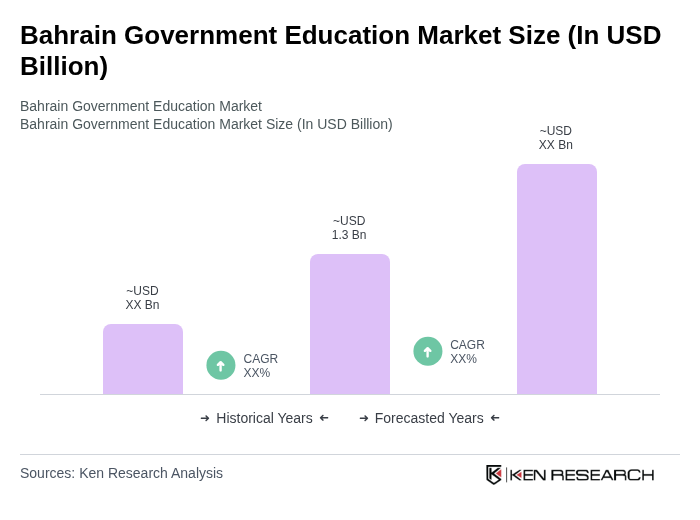
- The Bahrain Government Education Market is valued at USD 1.3 billion, based on a five-year historical analysis and reflecting the sector’s contribution of nearly 4% to national GDP. Growth is primarily driven by increased government spending on education, a rising population, and a growing emphasis on quality education to meet international standards. Recent trends highlight the integration of digital technologies, artificial intelligence, and data-driven personalized learning, as well as a focus on diversity and inclusive teaching methods. The government continues to invest in infrastructure, teacher training, and curriculum development to enhance educational outcomes .
- Key cities such asManamaandMuharraqdominate the market due to their concentration of educational institutions and resources. Manama, as the capital, hosts numerous private and international schools, while Muharraq is recognized for its historical significance in education. Urbanization and economic development in these areas have led to a higher demand for quality education, with Manama also serving as a hub for higher education institutions and international partnerships .
- ThePrivate Educational and Training Institutions Law, 2015(Law No. 25 of 2015), issued by the Kingdom of Bahrain’s Ministry of Education, mandates that all private schools must adhere to national curriculum standards. This regulation ensures uniformity in educational quality across the country and facilitates the integration of students from different backgrounds into the national education system. The law covers licensing, curriculum compliance, teacher qualifications, and periodic inspections .
Bahrain Government Education Market Segmentation
By Education Level:
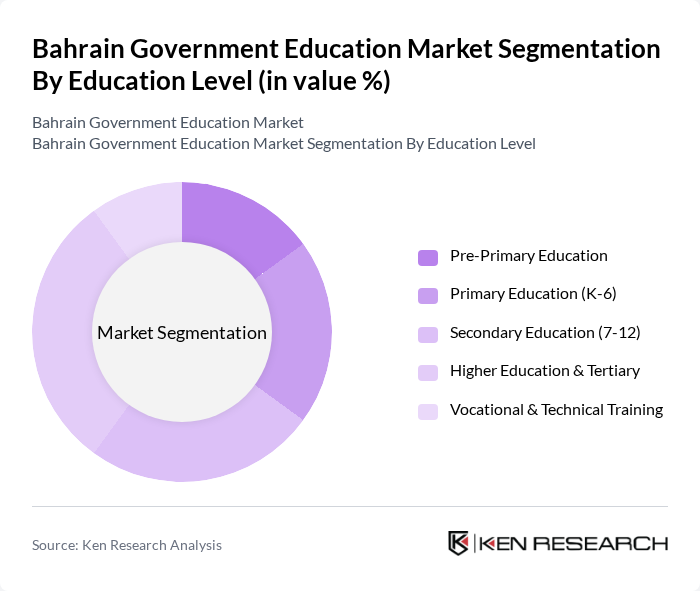
The education level segmentation includes various subsegments: Pre-Primary Education, Primary Education (K-6), Secondary Education (7-12), Higher Education & Tertiary, and Vocational & Technical Training. Among these,Higher Education & Tertiaryis the leading subsegment, driven by a growing demand for skilled professionals in sectors such as healthcare, technology, and business. The increasing number of universities and colleges, along with international partnerships and the expansion of online and blended learning, has made this segment particularly attractive to students seeking advanced education. The trend towards lifelong learning, upskilling, and the adoption of digital and simulation-based training further supports the growth of this subsegment .
By School Type:
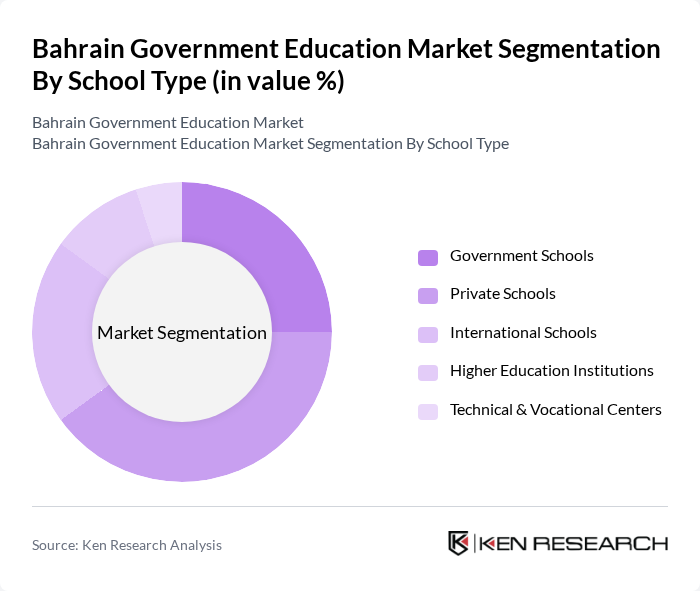
This segmentation includes Government Schools, Private Schools, International Schools, Higher Education Institutions, and Technical & Vocational Centers.Private Schoolsdominate this market segment, as they are preferred by many parents for their perceived higher quality of education, diverse curriculum offerings, and advanced learning environments. The increasing expatriate population in Bahrain has also led to a rise in demand for International Schools, which cater to various nationalities and educational standards. The competition among these school types drives innovation, digital transformation, and continuous improvement in educational services .
Bahrain Government Education Market Competitive Landscape
The Bahrain Government Education Market is characterized by a dynamic mix of regional and international players. Leading participants such as Ministry of Education, Bahrain, Bahrain Polytechnic, University of Bahrain, Royal University for Women, Arabian Gulf University, British School of Bahrain, American School of Bahrain, International School of Choueifat - Bahrain, Bahrain International School, St. Christopher's School, The Indian School, Bahrain, Naseem International School, Al-Hekma International School, Quest International School, Bahrain Teachers College contribute to innovation, geographic expansion, and service delivery in this space.
Bahrain Government Education Market Industry Analysis
Growth Drivers
- Increased Government Funding:The Bahraini government allocated approximately BHD 1.2 billion (USD 3.2 billion) for education in future, reflecting a 10% increase from the previous year. This funding aims to enhance educational infrastructure and resources, ensuring that schools can provide quality education. The government’s commitment to education is evident in its Vision 2030 plan, which emphasizes improving educational outcomes and accessibility, thereby driving growth in the education sector significantly.
- Rising Demand for Quality Education:With a population of around 1.7 million, Bahrain has seen a surge in demand for quality education, particularly in urban areas. The enrollment rate in primary education reached 98% in future, indicating a strong public interest in educational attainment. This demand is further fueled by parents' increasing awareness of the importance of education for future employment opportunities, prompting schools to enhance their offerings and attract more students.
- Technological Advancements in Education:The integration of technology in education has gained momentum, with the government investing BHD 50 million (USD 132 million) in digital learning tools and platforms in future. This investment supports the implementation of e-learning solutions and smart classrooms, which enhance the learning experience. As a result, educational institutions are increasingly adopting innovative teaching methods, making education more accessible and engaging for students across Bahrain.
Market Challenges
- Limited Infrastructure:Despite increased funding, Bahrain's educational infrastructure remains underdeveloped, with only 60% of schools meeting modern standards. Many facilities lack essential resources, such as laboratories and libraries, which hampers the quality of education. The government aims to address this issue, but the current state of infrastructure poses a significant challenge to achieving educational goals and meeting the rising demand for quality education.
- Teacher Shortages:Bahrain faces a critical shortage of qualified teachers, with an estimated deficit of 1,500 educators in future. This shortage is exacerbated by the high turnover rates and the limited availability of training programs. The government is working to attract and retain skilled teachers through incentives, but the current gap in staffing affects the quality of education and student outcomes, presenting a significant challenge for the education sector.
Bahrain Government Education Market Future Outlook
The future of the Bahrain government education market appears promising, driven by ongoing reforms and investments in technology. The government’s commitment to enhancing educational quality and accessibility is expected to yield positive outcomes. As e-learning and vocational training programs gain traction, educational institutions will likely adapt to meet the evolving needs of students. Furthermore, partnerships with international educational organizations may foster innovation and improve curriculum standards, ultimately benefiting the entire education ecosystem in Bahrain.
Market Opportunities
- E-Learning Solutions:The growing acceptance of online education presents a significant opportunity for e-learning providers. With an estimated 70% of students showing interest in digital learning platforms, companies can capitalize on this trend by offering tailored solutions that enhance learning experiences and accessibility, particularly in remote areas.
- Public-Private Partnerships:Collaborations between the government and private sector can drive innovation in education. By leveraging private investment and expertise, Bahrain can improve educational infrastructure and resources, creating a more dynamic learning environment. Such partnerships are essential for addressing current challenges and enhancing the overall quality of education.
Scope of the Report
| Segment | Sub-Segments |
|---|---|
| By Education Level | Pre-Primary Education Primary Education (K-6) Secondary Education (7-12) Higher Education & Tertiary Vocational & Technical Training |
| By School Type | Government Schools Private Schools International Schools Higher Education Institutions Technical & Vocational Centers |
| By Curriculum Type | National Curriculum (Bahraini) British Curriculum American Curriculum CBSE (Indian Curriculum) Arabic/Islamic Curriculum |
| By Delivery Mode | In-Person Learning Online Learning Hybrid Learning Mobile Education |
| By Funding Source | Government Funding Private Tuition Fees International Aid & Grants Public-Private Partnerships |
| By Technology Utilization | Learning Management Systems (LMS) Interactive Digital Tools Virtual Reality & Augmented Reality AI-Powered Educational Platforms |
| By Policy Support | Government Initiatives & Reforms Educational Grants & Scholarships Tax Incentives for Private Schools Digital Literacy Programs |
Key Target Audience
Investors and Venture Capitalist Firms
Government and Regulatory Bodies (e.g., Ministry of Education, Education and Training Quality Authority)
Non-Governmental Organizations (NGOs) focused on education
Technology Providers for Educational Solutions
Publishing Companies for Educational Materials
Corporate Training Providers
International Development Agencies
Local Business Associations related to Education
Players Mentioned in the Report:
Ministry of Education, Bahrain
Bahrain Polytechnic
University of Bahrain
Royal University for Women
Arabian Gulf University
British School of Bahrain
American School of Bahrain
International School of Choueifat - Bahrain
Bahrain International School
St. Christopher's School
The Indian School, Bahrain
Naseem International School
Al-Hekma International School
Quest International School
Bahrain Teachers College
Table of Contents
Market Assessment Phase
1. Executive Summary and Approach
2. Bahrain Government Education Market Overview
2.1 Key Insights and Strategic Recommendations
2.2 Bahrain Government Education Market Overview
2.3 Definition and Scope
2.4 Evolution of Market Ecosystem
2.5 Timeline of Key Regulatory Milestones
2.6 Value Chain & Stakeholder Mapping
2.7 Business Cycle Analysis
2.8 Policy & Incentive Landscape
3. Bahrain Government Education Market Analysis
3.1 Growth Drivers
3.1.1 Increased Government Funding
3.1.2 Rising Demand for Quality Education
3.1.3 Technological Advancements in Education
3.1.4 Focus on Educational Reforms
3.2 Market Challenges
3.2.1 Limited Infrastructure
3.2.2 Teacher Shortages
3.2.3 Budget Constraints
3.2.4 Resistance to Change
3.3 Market Opportunities
3.3.1 E-Learning Solutions
3.3.2 Public-Private Partnerships
3.3.3 Curriculum Development Services
3.3.4 International Collaborations
3.4 Market Trends
3.4.1 Integration of Technology in Classrooms
3.4.2 Emphasis on STEM Education
3.4.3 Growth of Vocational Training Programs
3.4.4 Increased Focus on Student Well-being
3.5 Government Regulation
3.5.1 Education Quality Standards
3.5.2 Teacher Certification Requirements
3.5.3 Curriculum Approval Processes
3.5.4 Funding Allocation Policies
4. SWOT Analysis
5. Stakeholder Analysis
6. Porter's Five Forces Analysis
7. Bahrain Government Education Market Market Size, 2019-2024
7.1 By Value
7.2 By Volume
7.3 By Average Selling Price
8. Bahrain Government Education Market Segmentation
8.1 By Education Level
8.1.1 Pre-Primary Education
8.1.2 Primary Education (K-6)
8.1.3 Secondary Education (7-12)
8.1.4 Higher Education & Tertiary
8.1.5 Vocational & Technical Training
8.2 By School Type
8.2.1 Government Schools
8.2.2 Private Schools
8.2.3 International Schools
8.2.4 Higher Education Institutions
8.2.5 Technical & Vocational Centers
8.3 By Curriculum Type
8.3.1 National Curriculum (Bahraini)
8.3.2 British Curriculum
8.3.3 American Curriculum
8.3.4 CBSE (Indian Curriculum)
8.3.5 Arabic/Islamic Curriculum
8.4 By Delivery Mode
8.4.1 In-Person Learning
8.4.2 Online Learning
8.4.3 Hybrid Learning
8.4.4 Mobile Education
8.5 By Funding Source
8.5.1 Government Funding
8.5.2 Private Tuition Fees
8.5.3 International Aid & Grants
8.5.4 Public-Private Partnerships
8.6 By Technology Utilization
8.6.1 Learning Management Systems (LMS)
8.6.2 Interactive Digital Tools
8.6.3 Virtual Reality & Augmented Reality
8.6.4 AI-Powered Educational Platforms
8.7 By Policy Support
8.7.1 Government Initiatives & Reforms
8.7.2 Educational Grants & Scholarships
8.7.3 Tax Incentives for Private Schools
8.7.4 Digital Literacy Programs
9. Bahrain Government Education Market Competitive Analysis
9.1 Market Share of Key Players
9.2 Cross Comparison of Key Players
9.2.1 Institution Name
9.2.2 Institution Type (Government, Private, International)
9.2.3 Total Student Enrollment
9.2.4 Graduation/Completion Rate
9.2.5 Teacher-to-Student Ratio
9.2.6 Curriculum Offerings & Diversity
9.2.7 Fee Structure & Affordability
9.2.8 Digital Infrastructure & Technology Adoption
9.2.9 Accreditation & Quality Ratings
9.2.10 Market Penetration & Geographic Coverage
9.3 SWOT Analysis of Top Players
9.4 Pricing Analysis
9.5 Detailed Profile of Major Companies
9.5.1 Ministry of Education, Bahrain
9.5.2 Bahrain Polytechnic
9.5.3 University of Bahrain
9.5.4 Royal University for Women
9.5.5 Arabian Gulf University
9.5.6 British School of Bahrain
9.5.7 American School of Bahrain
9.5.8 International School of Choueifat - Bahrain
9.5.9 Bahrain International School
9.5.10 St. Christopher's School
9.5.11 The Indian School, Bahrain
9.5.12 Naseem International School
9.5.13 Al-Hekma International School
9.5.14 Quest International School
9.5.15 Bahrain Teachers College
10. Bahrain Government Education Market End-User Analysis
10.1 Procurement Behavior of Key Ministries
10.1.1 Budget Allocation Processes
10.1.2 Decision-Making Criteria
10.1.3 Supplier Selection Criteria
10.1.4 Contract Management Practices
10.2 Corporate Spend on Infrastructure & Technology
10.2.1 Investment in Educational Facilities
10.2.2 Spending on Technology Integration
10.2.3 Funding for Teacher Training & Development
10.2.4 Budget for Curriculum Development
10.3 Pain Point Analysis by End-User Category
10.3.1 Infrastructure Limitations
10.3.2 Resource Allocation Issues
10.3.3 Quality of Educational Materials
10.3.4 Teacher Retention Challenges
10.4 User Readiness for Adoption
10.4.1 Technology Acceptance Levels
10.4.2 Training Needs Assessment
10.4.3 Stakeholder Engagement Strategies
10.4.4 Change Management Practices
10.5 Post-Deployment ROI and Use Case Expansion
10.5.1 Measurement of Educational Outcomes
10.5.2 Long-term Impact Assessment
10.5.3 Scalability of Solutions
10.5.4 Feedback Mechanisms for Continuous Improvement
11. Bahrain Government Education Market Future Size, 2025-2030
11.1 By Value
11.2 By Volume
11.3 By Average Selling Price
Go-To-Market Strategy Phase
1. Whitespace Analysis + Business Model Canvas
1.1 Market Gaps Identification
1.2 Value Proposition Development
1.3 Revenue Streams Analysis
1.4 Key Partnerships Exploration
1.5 Cost Structure Evaluation
1.6 Customer Segmentation
1.7 Competitive Advantage Assessment
2. Marketing and Positioning Recommendations
2.1 Branding Strategies
2.2 Product USPs
2.3 Target Audience Identification
2.4 Communication Strategy
2.5 Digital Marketing Approaches
2.6 Community Engagement Plans
2.7 Performance Metrics
3. Distribution Plan
3.1 Urban Retail Strategies
3.2 Rural NGO Tie-ups
3.3 Online Distribution Channels
3.4 Partnerships with Educational Institutions
3.5 Logistics and Supply Chain Management
3.6 Distribution Cost Analysis
3.7 Performance Tracking
4. Channel & Pricing Gaps
4.1 Underserved Routes
4.2 Pricing Bands Analysis
4.3 Competitor Pricing Strategies
4.4 Customer Willingness to Pay
4.5 Price Sensitivity Assessment
4.6 Pricing Model Development
4.7 Pricing Strategy Recommendations
5. Unmet Demand & Latent Needs
5.1 Category Gaps Identification
5.2 Consumer Segments Analysis
5.3 Emerging Trends Exploration
5.4 Future Needs Assessment
5.5 Innovation Opportunities
5.6 Market Entry Strategies
5.7 Demand Forecasting
6. Customer Relationship
6.1 Loyalty Programs Development
6.2 After-sales Service Strategies
6.3 Customer Feedback Mechanisms
6.4 Relationship Management Tools
6.5 Customer Retention Strategies
6.6 Engagement Metrics
6.7 Community Building Initiatives
7. Value Proposition
7.1 Sustainability Initiatives
7.2 Integrated Supply Chains
7.3 Unique Selling Points
7.4 Customer-Centric Approaches
7.5 Competitive Differentiation
7.6 Value Delivery Mechanisms
7.7 Performance Metrics
8. Key Activities
8.1 Regulatory Compliance
8.2 Branding Initiatives
8.3 Distribution Setup
8.4 Training and Development
8.5 Marketing Campaigns
8.6 Performance Monitoring
8.7 Stakeholder Engagement
9. Entry Strategy Evaluation
9.1 Domestic Market Entry Strategy
9.1.1 Product Mix Considerations
9.1.2 Pricing Band Analysis
Research Methodology
Phase 1: Approach1
Desk Research
- Analysis of government education policies and strategic plans from the Ministry of Education
- Review of demographic and enrollment statistics from the Bahrain Central Informatics Organization
- Examination of reports from international organizations on educational standards and performance metrics
Primary Research
- Interviews with educational administrators and policymakers in Bahrain's public and private sectors
- Surveys targeting teachers and educators to gather insights on curriculum effectiveness and resource needs
- Focus groups with parents and students to understand perceptions of the education system and areas for improvement
Validation & Triangulation
- Cross-validation of findings through comparison with regional education benchmarks and performance indicators
- Triangulation of qualitative insights from interviews with quantitative data from surveys
- Sanity checks conducted through expert panel reviews involving education specialists and market analysts
Phase 2: Market Size Estimation1
Top-down Assessment
- Estimation of total education expenditure based on national budget allocations for education
- Segmentation of the market by educational levels (primary, secondary, tertiary) and types (public vs. private)
- Incorporation of trends in digital learning and technology adoption in educational institutions
Bottom-up Modeling
- Collection of enrollment data from schools and universities to establish a baseline for market size
- Analysis of average spending per student across different educational levels and institutions
- Estimation of growth rates based on historical enrollment trends and demographic projections
Forecasting & Scenario Analysis
- Multi-factor regression analysis incorporating economic growth, population changes, and educational reforms
- Scenario modeling based on potential shifts in government policy and funding for education
- Development of baseline, optimistic, and pessimistic forecasts through 2030
Phase 3: CATI Sample Composition1
| Scope Item/Segment | Sample Size | Target Respondent Profiles |
|---|---|---|
| Public School Administrators | 60 | Principals, Vice Principals, Education Coordinators |
| Private School Stakeholders | 50 | School Owners, Heads of Curriculum, Financial Officers |
| Higher Education Institutions | 60 | University Deans, Program Directors, Admissions Officers |
| Educational Technology Providers | 40 | Product Managers, Sales Directors, Implementation Specialists |
| Parents of School-Aged Children | 70 | Parents, Guardians, Community Leaders |
Frequently Asked Questions
What is the current value of the Bahrain Government Education Market?
The Bahrain Government Education Market is valued at approximately USD 1.3 billion, contributing nearly 4% to the national GDP. This valuation reflects a five-year historical analysis and indicates significant growth driven by increased government spending and a rising population.
What are the key growth drivers in the Bahrain education sector?
Which cities dominate the Bahrain education market?
What types of schools are prevalent in Bahrain?
Other Regional/Country Reports
Indonesia Government Education Market
Malaysia Government Education Market
KSA Government Education Market
APAC Government Education Market
SEA Government Education Market
Vietnam Government Education Market
Other Adjacent Reports
UAE Private Education Market
Japan E-Learning Solutions Market
Bahrain Vocational Training Market
Philippines Higher Education Institutions Market
Vietnam Educational Technology Market
Oman Teacher Training Market
KSA International Schools Market
Egypt Curriculum Development Market
South Africa Educational Infrastructure Market
South Africa Student Assessment Services Market
Why Buy From Us?

What makes us stand out is that our consultants follow Robust, Refine and Result (RRR) methodology. Robust for clear definitions, approaches and sanity checking, Refine for differentiating respondents' facts and opinions, and Result for presenting data with story.

We have set a benchmark in the industry by offering our clients with syndicated and customized market research reports featuring coverage of entire market as well as meticulous research and analyst insights.

While we don't replace traditional research, we flip the method upside down. Our dual approach of Top Bottom & Bottom Top ensures quality deliverable by not just verifying company fundamentals but also looking at the sector and macroeconomic factors.

With one step in the future, our research team constantly tries to show you the bigger picture. We help with some of the tough questions you may encounter along the way: How is the industry positioned? Best marketing channel? KPI's of competitors? By aligning every element, we help maximize success.

Our report gives you instant access to the answers and sources that other companies might choose to hide. We elaborate each steps of research methodology we have used and showcase you the sample size to earn your trust.

If you need any support, we are here! We pride ourselves on universe strength, data quality, and quick, friendly, and professional service.