Ken Research Logo

Bahrain Inhaled Intranasal Products Contract Service Providers Market

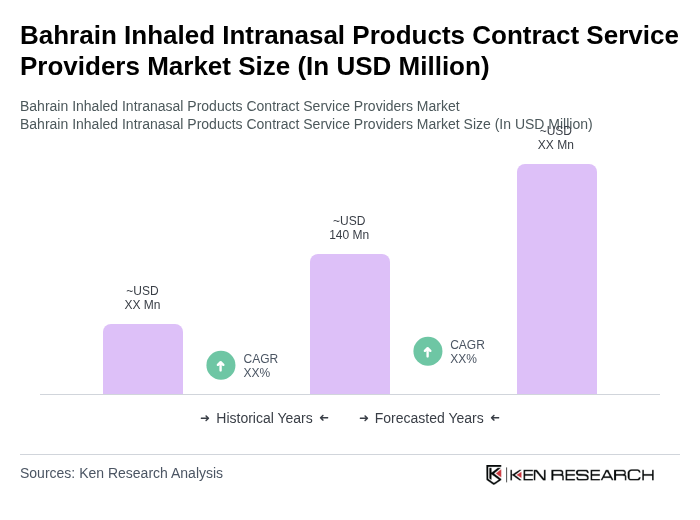
Bahrain Inhaled Intranasal Products Contract Service Providers Market is worth USD 140 million, fueled by rising respiratory issues and innovative inhalation technologies.

Region:Middle East

Author(s):Dev

Product Code:KRAD5117

Pages:96

Published On:December 2025
About the Report

Base Year 2024

Bahrain Inhaled Intranasal Products Contract Service Providers Market Overview

  • The Bahrain Inhaled Intranasal Products Contract Service Providers Market is valued at USD 140 million, based on a five-year historical analysis and benchmarked against Bahrain’s pharmaceuticals sector size and the Middle East and Africa inhalation and nasal spray generics market. This growth is primarily driven by the increasing prevalence of respiratory and allergic diseases, rising consumer awareness regarding the benefits of intranasal and inhaled delivery systems, and ongoing advancements in drug formulation and device technologies. The market is also supported by the growing demand for personalized and patient-centric therapies, greater focus on self?administration and home-care delivery formats, and the continuous expansion and digitalization of healthcare infrastructure in the Gulf region.
  • Key players influencing this market include Bahrain, Saudi Arabia, and the United Arab Emirates, which act as principal hubs for pharmaceutical manufacturing, import, and contract development and manufacturing services in the Gulf. These countries benefit from robust healthcare systems, higher per?capita health expenditure, and sustained investments in pharmaceutical research, biologics, inhalation technologies, and specialty generics, alongside a growing population with increasing chronic respiratory and allergy burden. The presence of regional distribution hubs, local subsidiaries of multinational pharma companies, and global contract service providers serving GCC clients further strengthens their role in shaping Bahrain?linked inhaled and intranasal outsourcing flows.
  • In 2023, Bahrain's government reinforced quality and safety oversight of medicines, including inhaled and intranasal products, through the National Health Regulatory Authority (NHRA) framework, which requires that all pharmaceutical products placed on the market comply with Good Manufacturing Practice and recognized international standards for quality, safety, and efficacy. Under the NHRA’s “Regulation for the Registration of Pharmaceutical Products” issued by the National Health Regulatory Authority, Kingdom of Bahrain, marketing authorization holders must submit quality, non?clinical, and clinical data in line with Gulf Central Committee for Drug Registration and international reference guidelines, and imported or locally manufactured inhaled and intranasal products are subject to batch control, GMP?compliant production, and post?marketing surveillance. This regulatory architecture aims to ensure consistent product performance, bolster consumer and prescriber confidence, and support the growth of Bahrain’s pharmaceutical and contract services ecosystem serving both domestic patients and GCC demand.
Bahrain Inhaled Intranasal Products Contract Service Providers Market Size

Bahrain Inhaled Intranasal Products Contract Service Providers Market Segmentation

By Service Type:The service type segmentation includes various categories that cater to the diverse needs of the inhaled intranasal products market. The dominant sub-segment is contract clinical and commercial manufacturing, which is crucial for the scalable development, filling, and packaging of metered-dose inhalers, dry powder inhalers, and nasal sprays for both generic and branded products. This segment benefits from the increasing number of regional and global clinical trials involving inhaled routes, the need for specialized device?drug combination capabilities, and the outsourcing of sterile and complex dosage manufacturing to experienced contract development and manufacturing organizations. Other significant segments include contract development and analytical testing, as well as regulatory and quality consulting services, which support formulation optimization, device engineering, bioequivalence studies, and compliance with NHRA, GCC, EMA, and FDA requirements, thereby underpinning overall market growth.
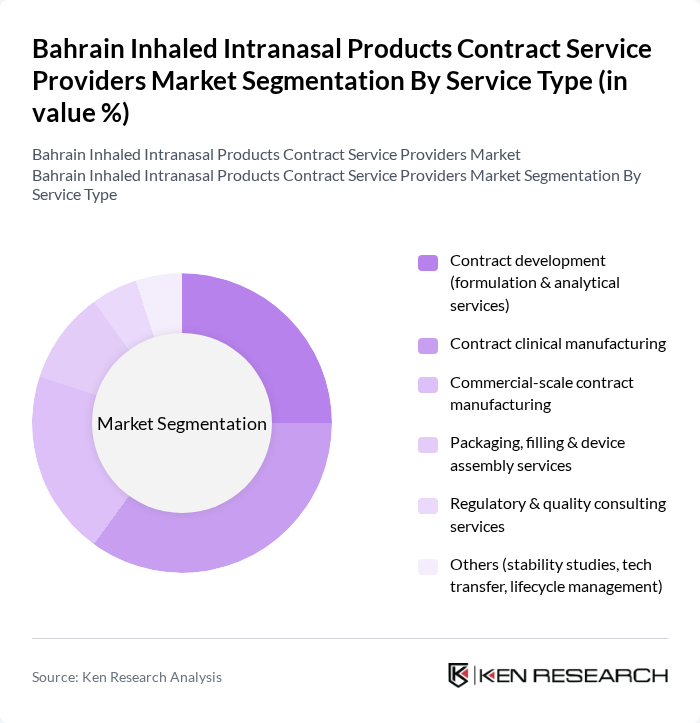
Bahrain Inhaled Intranasal Products Contract Service Providers Market segmentation by Service Type.

By Dosage / Delivery Type:The dosage and delivery type segmentation encompasses various forms of inhaled products, with metered-dose inhalers (MDI) and dry powder inhalers (DPI) together accounting for a substantial share of inhalation therapy, in line with regional and global usage patterns for asthma and chronic obstructive pulmonary disease treatment. The popularity of MDIs is attributed to their ease of use, familiarity among clinicians and patients, and effectiveness in delivering bronchodilators and corticosteroids directly to the lungs, while DPIs are gaining ground due to propellant?free operation and improved portability. Other notable segments include nebulized solutions and suspensions for hospital and pediatric use, and nasal sprays, powders, and gels, which are increasingly adopted for allergic rhinitis, sinusitis, anti?pollution protection, and emerging systemic indications using intranasal drug delivery platforms.

Bahrain Inhaled Intranasal Products Contract Service Providers Market segmentation by Dosage / Delivery Type.

Bahrain Inhaled Intranasal Products Contract Service Providers Market Competitive Landscape

The Bahrain Inhaled Intranasal Products Contract Service Providers Market is characterized by a dynamic mix of regional and international players. Leading participants such as Lonza Group Ltd., Catalent Inc., Kindeva Drug Delivery, Recipharm AB, Hovione, Aenova Group, Aptar Pharma, Vectura Group plc, Aetos Pharma Private Limited, Cipla Gulf FZ LLC, Glenmark Pharmaceuticals Ltd., Nasaleze International Ltd., Stérimar (Laboratoire de la Mer), Sandoz (a Novartis division), Bayer AG contribute to innovation, geographic expansion, and service delivery in this space.

Lonza Group Ltd.

1897

Basel, Switzerland

Catalent Inc.

2007

Somerset, New Jersey, USA

Kindeva Drug Delivery

2020

Minneapolis, Minnesota, USA

Recipharm AB

1995

Stockholm, Sweden

Hovione

1959

Lisbon, Portugal

Company

Establishment Year

Headquarters

Service portfolio breadth (number of inhaled / intranasal service categories offered)

Bahrain & GCC revenue share from inhaled / intranasal contracts

Number of active inhaled / intranasal projects for Bahrain clients

cGMP and regulatory accreditation status (NHRA, GCC, EMA, FDA, WHO, etc.)

On-time project delivery rate

Average development-to-commercialization timeline

Bahrain Inhaled Intranasal Products Contract Service Providers Market Industry Analysis

Growth Drivers

  • Increasing Prevalence of Respiratory Diseases:The World Health Organization reported that respiratory diseases affect approximately 235 million people globally, with a significant portion residing in the Middle East. In Bahrain, the prevalence of asthma and chronic obstructive pulmonary disease (COPD) is rising, with an estimated 8% of the population affected. This growing patient base drives demand for inhaled intranasal products, as healthcare providers seek effective treatment options to manage these conditions.
  • Rising Demand for Non-Invasive Drug Delivery Systems:The global market for non-invasive drug delivery systems is projected to reach $210 billion in future, reflecting a shift in patient preferences towards less invasive treatment options. In Bahrain, healthcare professionals are increasingly adopting intranasal delivery methods due to their ease of use and rapid onset of action. This trend is further supported by the increasing number of patients seeking alternatives to injections and oral medications, enhancing market growth.
  • Technological Advancements in Inhalation Devices:The inhalation device market is experiencing rapid innovation, with investments in smart inhalers and digital health technologies. In Bahrain, the Ministry of Health has allocated $55 million for healthcare technology upgrades in future, promoting the adoption of advanced inhalation devices. These innovations improve drug delivery efficiency and patient adherence, driving the demand for inhaled intranasal products and enhancing treatment outcomes for respiratory diseases.

Market Challenges

  • Stringent Regulatory Requirements:The Bahrain National Health Regulatory Authority enforces strict regulations on inhaled products, requiring extensive clinical trials and safety assessments. In future, the average time for product approval is estimated at 16 months, which can delay market entry for new products. These regulatory hurdles pose significant challenges for contract service providers, impacting their ability to respond swiftly to market demands and innovate effectively.
  • High Development Costs:The development of inhaled intranasal products involves substantial financial investment, often exceeding $1.2 million per product. This high cost is attributed to research, development, and compliance with regulatory standards. In Bahrain, where healthcare budgets are constrained, the financial burden on contract service providers can limit their capacity to invest in new product development, hindering market growth and innovation.

Bahrain Inhaled Intranasal Products Contract Service Providers Market Future Outlook

The future of the inhaled intranasal products market in Bahrain appears promising, driven by increasing healthcare investments and a growing focus on patient-centric solutions. As the healthcare infrastructure expands, more patients will gain access to innovative inhalation therapies. Additionally, the integration of digital health technologies is expected to enhance patient engagement and adherence, further propelling market growth. The collaboration between contract service providers and pharmaceutical companies will also play a crucial role in advancing product development and market penetration.

Market Opportunities

  • Expansion of Healthcare Infrastructure in Bahrain:The Bahraini government is investing $220 million in healthcare infrastructure improvements in future. This investment will enhance access to inhaled intranasal products, creating opportunities for contract service providers to expand their market presence and improve patient outcomes through better distribution channels and facilities.
  • Collaborations with Pharmaceutical Companies:Strategic partnerships with pharmaceutical companies can enhance product development and market reach. In future, collaborations are expected to increase by 35%, allowing contract service providers to leverage shared resources and expertise, ultimately leading to the introduction of innovative inhaled products tailored to local market needs.

Scope of the Report

SegmentSub-Segments
By Service Type

Contract development (formulation & analytical services)

Contract clinical manufacturing

Commercial-scale contract manufacturing

Packaging, filling & device assembly services

Regulatory & quality consulting services

Others (stability studies, tech transfer, lifecycle management)

By Dosage / Delivery Type

Metered-dose inhalers (MDI)

Dry powder inhalers (DPI)

Nebulized solutions & suspensions

Nasal sprays (aqueous and suspension)

Nasal powders & gels

Others (soft-mist, novel inhalation devices)

By Therapeutic Application

Asthma and COPD

Allergic rhinitis & sinusitis

Anti-infectives and vaccines (respiratory)

CNS and pain management via intranasal route

Anti-pollution and saline-based nasal products

Others

By Client Type

Global innovator pharma & biotech

Generic pharmaceutical companies

Regional / GCC-based pharma companies

OTC and consumer health companies

Others (start-ups, research institutes)

By Engagement Model

Full-service CDMO (end-to-end)

Project-based outsourcing

Long-term strategic manufacturing partnerships

Technology transfer & licensing-based engagements

By Target Market (Demand Origin)

Bahrain domestic market

GCC export markets

Wider MENA export markets

Rest of world

By Facility Location

Bahrain-based facilities

GCC-based facilities serving Bahrain

Europe-based facilities serving Bahrain

Asia-based facilities serving Bahrain

Key Target Audience

Investors and Venture Capitalist Firms

Government and Regulatory Bodies (e.g., Bahrain Ministry of Health, Bahrain Food and Drug Authority)

Pharmaceutical Manufacturers

Contract Research Organizations (CROs)

Logistics and Supply Chain Providers

Healthcare Providers and Hospitals

Pharmacy Chains and Retail Pharmacies

Biotechnology Firms

Players Mentioned in the Report:

Lonza Group Ltd.

Catalent Inc.

Kindeva Drug Delivery

Recipharm AB

Hovione

Aenova Group

Aptar Pharma

Vectura Group plc

Aetos Pharma Private Limited

Cipla Gulf FZ LLC

Glenmark Pharmaceuticals Ltd.

Nasaleze International Ltd.

Sterimar (Laboratoire de la Mer)

Sandoz (a Novartis division)

Bayer AG

Table of Contents

Market Assessment Phase

1. Executive Summary and Approach


2. Bahrain Inhaled Intranasal Products Contract Service Providers Market Overview

2.1 Key Insights and Strategic Recommendations

2.2 Bahrain Inhaled Intranasal Products Contract Service Providers Market Overview

2.3 Definition and Scope

2.4 Evolution of Market Ecosystem

2.5 Timeline of Key Regulatory Milestones

2.6 Value Chain & Stakeholder Mapping

2.7 Business Cycle Analysis

2.8 Policy & Incentive Landscape


3. Bahrain Inhaled Intranasal Products Contract Service Providers Market Analysis

3.1 Growth Drivers

3.1.1 Increasing prevalence of respiratory diseases
3.1.2 Rising demand for non-invasive drug delivery systems
3.1.3 Technological advancements in inhalation devices
3.1.4 Growing focus on personalized medicine

3.2 Market Challenges

3.2.1 Stringent regulatory requirements
3.2.2 High development costs
3.2.3 Limited awareness among healthcare providers
3.2.4 Competition from alternative drug delivery methods

3.3 Market Opportunities

3.3.1 Expansion of healthcare infrastructure in Bahrain
3.3.2 Collaborations with pharmaceutical companies
3.3.3 Increasing investment in R&D for inhaled products
3.3.4 Potential for export to neighboring markets

3.4 Market Trends

3.4.1 Shift towards digital health solutions
3.4.2 Growing interest in biodegradable inhalation devices
3.4.3 Rise of telemedicine and remote patient monitoring
3.4.4 Increased focus on patient-centric product development

3.5 Government Regulation

3.5.1 Compliance with Gulf Cooperation Council (GCC) standards
3.5.2 Approval processes by the Bahrain National Health Regulatory Authority
3.5.3 Guidelines for clinical trials and product testing
3.5.4 Regulations on marketing and advertising of inhaled products

4. SWOT Analysis


5. Stakeholder Analysis


6. Porter's Five Forces Analysis


7. Bahrain Inhaled Intranasal Products Contract Service Providers Market Size, 2019-2024

7.1 By Value

7.2 By Volume

7.3 By Average Selling Price


8. Bahrain Inhaled Intranasal Products Contract Service Providers Market Segmentation

8.1 By Service Type

8.1.1 Contract development (formulation & analytical services)
8.1.2 Contract clinical manufacturing
8.1.3 Commercial-scale contract manufacturing
8.1.4 Packaging, filling & device assembly services
8.1.5 Regulatory & quality consulting services
8.1.6 Others (stability studies, tech transfer, lifecycle management)

8.2 By Dosage / Delivery Type

8.2.1 Metered-dose inhalers (MDI)
8.2.2 Dry powder inhalers (DPI)
8.2.3 Nebulized solutions & suspensions
8.2.4 Nasal sprays (aqueous and suspension)
8.2.5 Nasal powders & gels
8.2.6 Others (soft-mist, novel inhalation devices)

8.3 By Therapeutic Application

8.3.1 Asthma and COPD
8.3.2 Allergic rhinitis & sinusitis
8.3.3 Anti-infectives and vaccines (respiratory)
8.3.4 CNS and pain management via intranasal route
8.3.5 Anti-pollution and saline-based nasal products
8.3.6 Others

8.4 By Client Type

8.4.1 Global innovator pharma & biotech
8.4.2 Generic pharmaceutical companies
8.4.3 Regional / GCC-based pharma companies
8.4.4 OTC and consumer health companies
8.4.5 Others (start-ups, research institutes)

8.5 By Engagement Model

8.5.1 Full-service CDMO (end-to-end)
8.5.2 Project-based outsourcing
8.5.3 Long-term strategic manufacturing partnerships
8.5.4 Technology transfer & licensing-based engagements

8.6 By Target Market (Demand Origin)

8.6.1 Bahrain domestic market
8.6.2 GCC export markets
8.6.3 Wider MENA export markets
8.6.4 Rest of world

8.7 By Facility Location

8.7.1 Bahrain-based facilities
8.7.2 GCC-based facilities serving Bahrain
8.7.3 Europe-based facilities serving Bahrain
8.7.4 Asia-based facilities serving Bahrain

9. Bahrain Inhaled Intranasal Products Contract Service Providers Market Competitive Analysis

9.1 Market Share of Key Players

9.2 Cross Comparison of Key Players

9.2.1 Company name
9.2.2 Service portfolio breadth (number of inhaled / intranasal service categories offered)
9.2.3 Bahrain & GCC revenue share from inhaled / intranasal contracts
9.2.4 Number of active inhaled / intranasal projects for Bahrain clients
9.2.5 cGMP and regulatory accreditation status (NHRA, GCC, EMA, FDA, WHO, etc.)
9.2.6 On-time project delivery rate
9.2.7 Average development-to-commercialization timeline
9.2.8 Fill–finish and device assembly capacity utilization
9.2.9 Quality metrics (batch failure / deviation rate)
9.2.10 Client retention rate for Bahrain and GCC contracts
9.2.11 Pricing position (premium / mid / value) in Bahrain contracts
9.2.12 R&D intensity (share of revenue reinvested in inhalation / intranasal capabilities)

9.3 SWOT Analysis of Top Players

9.4 Pricing Analysis

9.5 Detailed Profile of Major Companies

9.5.1 Lonza Group Ltd.
9.5.2 Catalent Inc.
9.5.3 Kindeva Drug Delivery
9.5.4 Recipharm AB
9.5.5 Hovione
9.5.6 Aenova Group
9.5.7 Aptar Pharma
9.5.8 Vectura Group plc
9.5.9 Aetos Pharma Private Limited
9.5.10 Cipla Gulf FZ LLC
9.5.11 Glenmark Pharmaceuticals Ltd.
9.5.12 Nasaleze International Ltd.
9.5.13 Stérimar (Laboratoire de la Mer)
9.5.14 Sandoz (a Novartis division)
9.5.15 Bayer AG

10. Bahrain Inhaled Intranasal Products Contract Service Providers Market End-User Analysis

10.1 Procurement Behavior of Key Ministries

10.1.1 Budget allocation for healthcare
10.1.2 Decision-making processes
10.1.3 Preferred suppliers and contracts
10.1.4 Evaluation criteria for procurement

10.2 Corporate Spend on Infrastructure & Energy

10.2.1 Investment in healthcare facilities
10.2.2 Spending on medical equipment
10.2.3 Budget for research and development
10.2.4 Partnerships with private sector

10.3 Pain Point Analysis by End-User Category

10.3.1 Challenges faced by hospitals
10.3.2 Issues in clinics
10.3.3 Barriers for home care settings
10.3.4 Concerns of pharmacies

10.4 User Readiness for Adoption

10.4.1 Awareness of inhaled products
10.4.2 Training needs for healthcare providers
10.4.3 Patient education requirements
10.4.4 Infrastructure readiness

10.5 Post-Deployment ROI and Use Case Expansion

10.5.1 Measurement of treatment outcomes
10.5.2 Cost-effectiveness analysis
10.5.3 Opportunities for product line expansion
10.5.4 Feedback mechanisms for continuous improvement

11. Bahrain Inhaled Intranasal Products Contract Service Providers Market Future Size, 2025-2030

11.1 By Value

11.2 By Volume

11.3 By Average Selling Price


Go-To-Market Strategy Phase

1. Whitespace Analysis + Business Model Canvas

1.1 Market gaps identification

1.2 Value proposition development

1.3 Revenue model exploration

1.4 Key partnerships and resources

1.5 Customer segments analysis

1.6 Cost structure evaluation

1.7 Competitive landscape overview


2. Marketing and Positioning Recommendations

2.1 Branding strategies

2.2 Product USPs

2.3 Target audience identification

2.4 Communication channels

2.5 Promotional tactics

2.6 Market positioning

2.7 Customer engagement strategies


3. Distribution Plan

3.1 Urban retail strategies

3.2 Rural NGO tie-ups

3.3 Online distribution channels

3.4 Partnerships with healthcare providers

3.5 Logistics and supply chain management

3.6 Inventory management practices

3.7 Distribution network optimization


4. Channel & Pricing Gaps

4.1 Underserved routes

4.2 Pricing bands analysis

4.3 Competitor pricing strategies

4.4 Customer willingness to pay

4.5 Value-based pricing models

4.6 Discount and promotion strategies

4.7 Price elasticity considerations


5. Unmet Demand & Latent Needs

5.1 Category gaps identification

5.2 Consumer segments analysis

5.3 Emerging trends and needs

5.4 Product development opportunities

5.5 Market entry barriers

5.6 Customer feedback integration

5.7 Future demand forecasting


6. Customer Relationship

6.1 Loyalty programs

6.2 After-sales service

6.3 Customer support strategies

6.4 Feedback collection mechanisms

6.5 Relationship management tools

6.6 Community engagement initiatives

6.7 Customer education programs


7. Value Proposition

7.1 Sustainability initiatives

7.2 Integrated supply chains

7.3 Unique selling points

7.4 Customer-centric approach

7.5 Competitive advantages

7.6 Long-term value creation

7.7 Brand loyalty enhancement


8. Key Activities

8.1 Regulatory compliance

8.2 Branding efforts

8.3 Distribution setup

8.4 Market research and analysis

8.5 Training and development

8.6 Stakeholder engagement

8.7 Performance monitoring


9. Entry Strategy Evaluation

9.1 Domestic Market Entry Strategy

9.1.1 Product mix considerations
9.1.2 Pricing band analysis
9.1.3 Packaging strategies

9.2 Export Entry Strategy

9.2.1 Target countries identification
9.2.2 Compliance roadmap development

10. Entry Mode Assessment

10.1 Joint Ventures

10.2 Greenfield investments

10.3 Mergers & Acquisitions

10.4 Distributor Model

10.5 Risk assessment

10.6 Strategic fit evaluation

10.7 Long-term partnership considerations


11. Capital and Timeline Estimation

11.1 Capital requirements

11.2 Timelines for market entry

11.3 Funding sources

11.4 Financial projections

11.5 Investment return expectations

11.6 Budget allocation strategies

11.7 Risk management plans


12. Control vs Risk Trade-Off

12.1 Ownership considerations

12.2 Partnership dynamics

12.3 Risk mitigation strategies

12.4 Control mechanisms

12.5 Long-term sustainability

12.6 Exit strategies

12.7 Performance evaluation criteria


13. Profitability Outlook

13.1 Breakeven analysis

13.2 Long-term sustainability

13.3 Profit margin expectations

13.4 Revenue growth projections

13.5 Cost management strategies

13.6 Financial health indicators

13.7 Market share growth potential


14. Potential Partner List


Research Methodology

ApproachModellingSample

Phase 1: Approach1

Desk Research

  • Analysis of market reports from health authorities in Bahrain
  • Review of published studies on intranasal product efficacy and market trends
  • Examination of regulatory frameworks and guidelines from the Bahrain Ministry of Health

Primary Research

  • Interviews with key opinion leaders in the pharmaceutical and healthcare sectors
  • Surveys targeting healthcare professionals involved in prescribing intranasal products
  • Focus groups with patients using inhaled intranasal therapies

Validation & Triangulation

  • Cross-validation of findings through multiple data sources including sales data and expert insights
  • Triangulation of market size estimates with industry growth rates and demographic data
  • Sanity checks conducted through expert panel discussions and feedback loops

Phase 2: Market Size Estimation1

Top-down Assessment

  • Estimation of total healthcare expenditure in Bahrain as a baseline for market size
  • Segmentation of the market by therapeutic areas and product types
  • Incorporation of demographic trends and disease prevalence rates affecting intranasal product demand

Bottom-up Modeling

  • Collection of sales data from leading contract service providers in the region
  • Estimation of production capacities and service offerings of local manufacturers
  • Volume and pricing analysis based on historical sales data and market entry costs

Forecasting & Scenario Analysis

  • Development of predictive models based on historical growth patterns and market drivers
  • Scenario planning considering potential regulatory changes and market disruptions
  • Creation of baseline, optimistic, and pessimistic forecasts through 2028

Phase 3: CATI Sample Composition1

Scope Item/SegmentSample SizeTarget Respondent Profiles
Pharmaceutical Manufacturers45Product Managers, R&D Directors
Healthcare Providers80Physicians, Pharmacists
Regulatory Bodies40Regulatory Affairs Specialists, Compliance Officers
Market Research Analysts50Market Analysts, Business Development Managers
Patient Advocacy Groups45Patient Representatives, Health Educators

Frequently Asked Questions

What is the current value of the Bahrain Inhaled Intranasal Products Contract Service Providers Market?

The Bahrain Inhaled Intranasal Products Contract Service Providers Market is valued at approximately USD 140 million, reflecting a robust growth trajectory influenced by rising respiratory disease prevalence and advancements in drug delivery technologies.

What factors are driving the growth of the inhaled intranasal products market in Bahrain?

Who are the major players in the Bahrain inhaled intranasal products market?

What are the regulatory requirements for inhaled products in Bahrain?

Other Regional/Country Reports

Indonesia Inhaled Intranasal Products Contract Service Providers Market

Malaysia Inhaled Intranasal Products Contract Service Providers Market

KSA Inhaled Intranasal Products Contract Service Providers Market

APAC Inhaled Intranasal Products Contract Service Providers Market

SEA Inhaled Intranasal Products Contract Service Providers Market

Vietnam Inhaled Intranasal Products Contract Service Providers Market

Other Adjacent Reports

Qatar Inhaled Drug Delivery Systems Market

South Korea Intranasal Drug Delivery Devices Market

Japan Pharmaceutical Contract Manufacturing Market

Egypt Respiratory Therapeutics Market

Indonesia Nasal Spray Generics Market

Thailand Asthma Treatment Market

Vietnam COPD Management Market

Malaysia Drug Formulation Services Market

Thailand Regulatory Consulting Services Market

Thailand Analytical Testing Services Market

Why Buy From Us?

Refine Robust Result (RRR) Framework

What makes us stand out is that our consultants follow Robust, Refine and Result (RRR) methodology. Robust for clear definitions, approaches and sanity checking, Refine for differentiating respondents' facts and opinions, and Result for presenting data with story.

Our Reach Is Unmatched

We have set a benchmark in the industry by offering our clients with syndicated and customized market research reports featuring coverage of entire market as well as meticulous research and analyst insights.

Shifting the Research Paradigm

While we don't replace traditional research, we flip the method upside down. Our dual approach of Top Bottom & Bottom Top ensures quality deliverable by not just verifying company fundamentals but also looking at the sector and macroeconomic factors.

More Insights-Better Decisions

With one step in the future, our research team constantly tries to show you the bigger picture. We help with some of the tough questions you may encounter along the way: How is the industry positioned? Best marketing channel? KPI's of competitors? By aligning every element, we help maximize success.

Transparency and Trust

Our report gives you instant access to the answers and sources that other companies might choose to hide. We elaborate each steps of research methodology we have used and showcase you the sample size to earn your trust.

Round the Clock Support

If you need any support, we are here! We pride ourselves on universe strength, data quality, and quick, friendly, and professional service.

Why Clients Choose Us?

400000+
Reports in repository
150+
Consulting projects a year
100+
Analysts
8000+
Client Queries in 2022








