Bahrain Residential Solar PV Panels Market Report Size Share Growth Drivers Trends Opportunities & Forecast 2025–2030

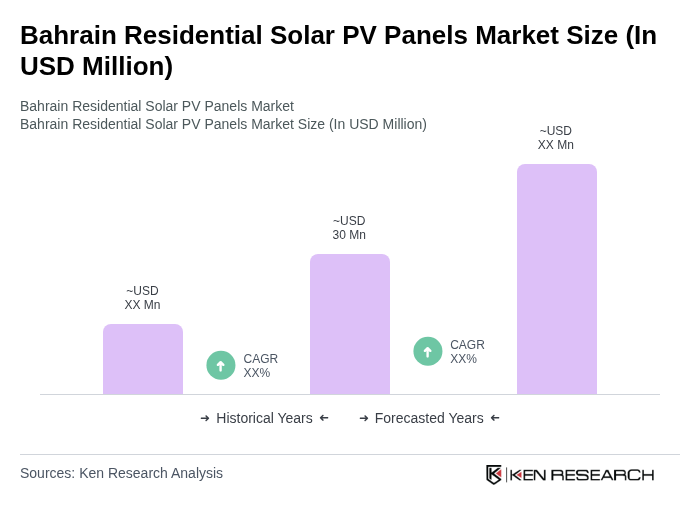
The Bahrain residential solar PV panels market, worth USD 30 million, grows via national renewable plans, rooftop installations, and cost savings, focusing on grid-connected systems.

Region:Middle East

Author(s):Dev

Product Code:KRAB1955

Pages:92

Published On:January 2026
About the Report

Base Year 2024

Bahrain Residential Solar PV Panels Market Overview

  • The Bahrain Residential Solar PV Panels Market is valued at USD 30 million, based on a five-year historical analysis of national solar deployment and rooftop activity within the wider renewable and rooftop solar programs in the Kingdom. This growth is primarily driven by the increasing demand for renewable energy sources under Bahrain’s National Renewable Energy Action Plan, the rollout of distributed rooftop projects, and rising consumer awareness regarding environmental sustainability and electricity cost optimisation. The market has seen a notable uptick in installations supported by favorable climatic conditions (high solar irradiation) and the declining global cost of solar modules, inverters, and balance-of-system components.
  • Key regional demand centers in this market include the Capital Governorate, which leads due to its higher urbanization, electricity consumption, and concentration of rooftop structures suitable for PV, followed by the Northern Governorate, where government-supported distributed solar and efficiency initiatives have spurred new rooftop projects. The Southern Governorate is also emerging as a significant area for solar deployment, supported by utility-scale projects such as the 100 megawatt Al Dur solar PV plant and other planned developments that enhance grid readiness and awareness for solar solutions among households in new residential communities.
  • Residential solar development in Bahrain is guided by the Net Metering Regulations issued by the Electricity and Water Authority (EWA) under the National Renewable Energy Action Plan, which enable customers to install grid?tied rooftop PV systems and offset consumption by exporting surplus electricity to the grid. These regulations set technical and interconnection requirements for small?scale systems, define metering and billing arrangements, and provide a structured approval process for rooftop PV on homes, thereby supporting energy efficiency, emissions reduction, and the Kingdom’s renewable energy and Net Zero 2060 targets.
Bahrain Residential Solar PV Panels Market Size

Bahrain Residential Solar PV Panels Market Segmentation

By Panel Type:

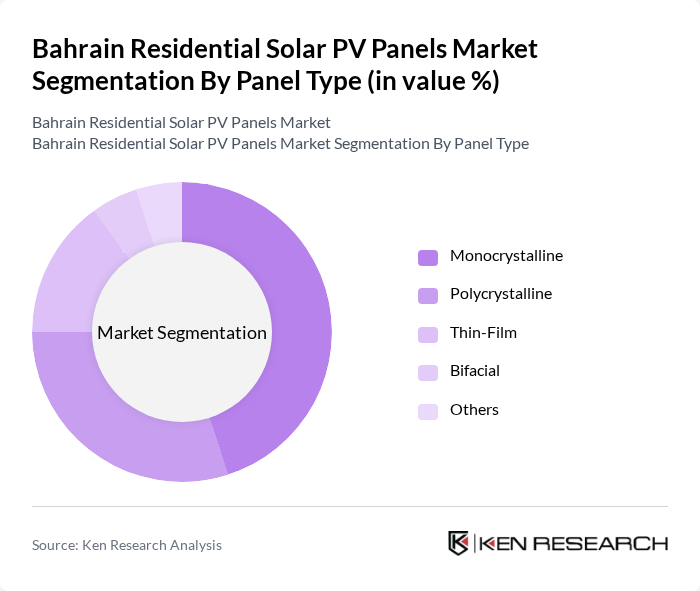
Bahrain Residential Solar PV Panels Market segmentation by Panel Type.

The panel type segmentation includes Monocrystalline, Polycrystalline, Thin-Film, Bifacial, and Others. Monocrystalline panels currently account for the largest share of residential installations in Bahrain, reflecting global trends where higher module efficiencies and better performance in high?irradiance conditions are preferred on space?constrained rooftops. Polycrystalline panels remain a widely adopted, cost?effective alternative for price?sensitive homeowners, albeit with slightly lower conversion efficiency than monocrystalline modules. The demand for Thin?Film and Bifacial panels is growing from niche use cases where design flexibility, lower weight, or specific aesthetic requirements are prioritized, particularly in architect?driven residential projects and carport structures. Overall, consumer preference for high?efficiency, warranty?backed, Tier?1 modules under Bahrain’s high solar irradiation continues to underpin the leadership of the Monocrystalline segment in the residential sector.

By System Type:
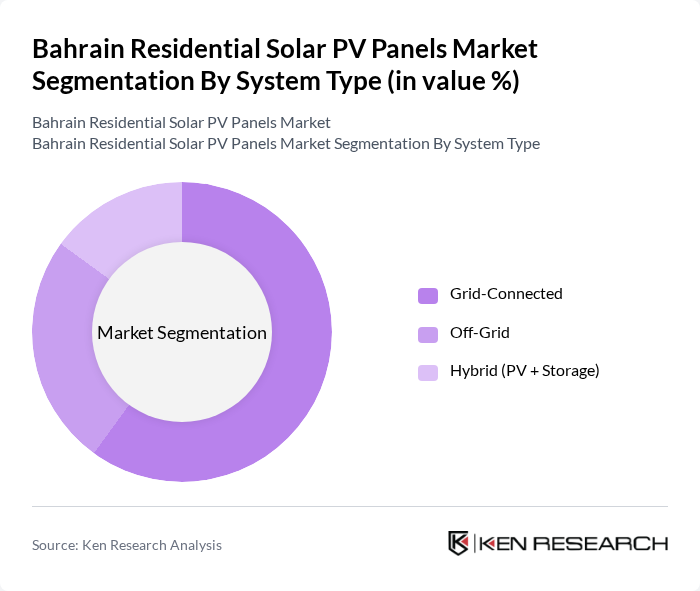
Bahrain Residential Solar PV Panels Market segmentation by System Type.

This segmentation includes Grid-Connected, Off-Grid, and Hybrid (PV + Storage) systems. Grid?Connected systems dominate the residential market in Bahrain, supported by the EWA net metering framework that allows households to interconnect rooftop PV with the distribution grid and receive credit for exported surplus energy, improving the payback profile of investments. Off?Grid systems are mainly adopted in locations where grid access or reliability is constrained, or where homeowners seek fully independent supply for specific loads such as farms, remote villas, or auxiliary buildings. Hybrid (PV + Storage) systems are gaining traction as battery prices gradually decline globally and as consumers prioritize resilience against outages, self?consumption maximization, and time?of?use optimization, following broader residential solar?plus?storage trends observed in international markets. The increasing focus on energy security, bill reduction, and decarbonization is supporting growing interest in hybrid configurations among early?adopter households.

Bahrain Residential Solar PV Panels Market Competitive Landscape

The Bahrain Residential Solar PV Panels Market is characterized by a dynamic mix of regional and international players. Leading participants such as First Solar, SunPower Corporation, Canadian Solar, JinkoSolar, Trina Solar, Hanwha Q CELLS, LONGi Solar, JA Solar Technology, SMA Solar Technology, Enphase Energy, ABB Ltd., Schneider Electric, Risen Energy, REC Group, Solaria Energía y Medio Ambiente contribute to innovation, geographic expansion, and service delivery in this space, supplying modules, inverters, and balance?of?system components used by local EPC and rooftop installers.

First Solar

1999

Tempe, Arizona, USA

SunPower Corporation

1985

San Jose, California, USA

Canadian Solar

2001

Guelph, Ontario, Canada

JinkoSolar

2006

Shanghai, China

Trina Solar

1997

Changzhou, China

Company

Establishment Year

Headquarters

Group Size (Large, Medium, or Small as per industry convention)

Bahrain Residential Solar PV Revenue (Latest Year)

3-Year Revenue CAGR (Residential Solar PV in Bahrain)

Installed Residential Capacity in Bahrain (kW / MW)

Number of Residential Installations in Bahrain

Market Share in Bahrain Residential Segment (by Capacity / Installations)

Bahrain Residential Solar PV Panels Market Industry Analysis

Growth Drivers

  • Increasing Energy Demand:Bahrain's energy consumption has surged, with a reported increase of 4.8% annually, reaching approximately 15,600 GWh in future. This rising demand is driven by population growth, urbanization, and economic expansion, necessitating alternative energy sources. The government aims to diversify energy sources, targeting 10% of total energy generation from renewables by 2030, which directly supports the adoption of residential solar PV panels as a viable solution to meet this growing energy need.
  • Government Incentives for Renewable Energy:The Bahraini government has implemented various incentives to promote renewable energy, including a 20% subsidy on solar PV installations. In future, the government allocated $60 million to support renewable energy projects, enhancing affordability for consumers. These initiatives are designed to encourage residential adoption of solar technologies, aligning with Bahrain's National Renewable Energy Action Plan, which aims to increase the share of renewables in the energy mix significantly by 2030.
  • Rising Electricity Costs:Electricity prices in Bahrain have increased by 16% over the past two years, prompting consumers to seek cost-effective alternatives. The average residential electricity bill reached approximately $115 per month in future. As consumers face higher utility costs, the financial appeal of solar PV systems becomes more pronounced, leading to increased interest in residential solar installations as a means to mitigate rising energy expenses and achieve long-term savings.

Market Challenges

  • High Initial Installation Costs:The upfront cost of installing solar PV systems in Bahrain can range from $11,000 to $16,000 for an average residential setup. This significant financial barrier often deters potential customers, especially in a market where many households prioritize immediate expenses over long-term savings. Despite government incentives, the initial investment remains a critical challenge that needs addressing to enhance market penetration of solar technologies.
  • Limited Consumer Awareness:A substantial portion of the Bahraini population lacks awareness regarding the benefits and functionalities of solar PV systems. Surveys indicate that only 32% of residents are informed about available incentives and technologies. This knowledge gap hinders market growth, as potential customers may not recognize the long-term savings and environmental benefits associated with solar energy, necessitating targeted educational campaigns to boost adoption rates.

Bahrain Residential Solar PV Panels Market Future Outlook

The future of the Bahrain residential solar PV panels market appears promising, driven by increasing energy demands and supportive government policies. As technological advancements continue to lower costs and improve efficiency, more households are likely to adopt solar solutions. Additionally, the integration of smart home technologies and energy storage systems will enhance the appeal of solar PV, making it a more attractive option for consumers seeking energy independence and sustainability in their homes.

Market Opportunities

  • Technological Advancements in Solar PV:Innovations in solar technology, such as bifacial panels and improved inverter systems, are expected to enhance efficiency and reduce costs. These advancements can lead to a more attractive return on investment for homeowners, potentially increasing adoption rates significantly in the coming years as technology becomes more accessible and affordable.
  • Expansion of Financing Options:The introduction of flexible financing solutions, such as pay-as-you-go models and solar leasing, can make solar PV systems more accessible to a broader audience. By reducing the financial burden of upfront costs, these options can encourage more homeowners to invest in solar energy, thereby accelerating market growth and adoption rates in Bahrain.

Scope of the Report

SegmentSub-Segments
By Panel Type

Monocrystalline

Polycrystalline

Thin-Film

Bifacial

Others

By System Type

Grid-Connected

Off-Grid

Hybrid (PV + Storage)

By Installation Type

Rooftop Mounted

Building-Integrated PV (BIPV)

Ground-Mounted (Residential Compounds / Farms)

By Consumer Segment (Residential)

Villas and Independent Houses

Apartments and Residential Buildings

Gated Communities / Compounds

By Sales / Business Model

Direct Purchase (Capex Model)

Lease / Rental Model

Power Purchase Agreement (PPA)

ESCO / Energy-as-a-Service

By Region

Northern Governorate

Southern Governorate

Capital Governorate

Muharraq Governorate

Key Target Audience

Investors and Venture Capitalist Firms

Government and Regulatory Bodies (e.g., Electricity and Water Authority, Sustainable Energy Authority)

Manufacturers and Producers of Solar PV Panels

Distributors and Retailers of Renewable Energy Products

Solar Installation Companies

Energy Service Companies (ESCOs)

Industry Associations (e.g., Bahrain Renewable Energy Association)

Financial Institutions and Banks Offering Green Financing

Players Mentioned in the Report:

First Solar

SunPower Corporation

Canadian Solar

JinkoSolar

Trina Solar

Hanwha Q CELLS

LONGi Solar

JA Solar Technology

SMA Solar Technology

Enphase Energy

ABB Ltd.

Schneider Electric

Risen Energy

REC Group

Solaria Energia y Medio Ambiente

Table of Contents

Market Assessment Phase

1. Executive Summary and Approach


2. Bahrain Residential Solar PV Panels Market Overview

2.1 Key Insights and Strategic Recommendations

2.2 Bahrain Residential Solar PV Panels Market Overview

2.3 Definition and Scope

2.4 Evolution of Market Ecosystem

2.5 Timeline of Key Regulatory Milestones

2.6 Value Chain & Stakeholder Mapping

2.7 Business Cycle Analysis

2.8 Policy & Incentive Landscape


3. Bahrain Residential Solar PV Panels Market Analysis

3.1 Growth Drivers

3.1.1 Increasing energy demand
3.1.2 Government incentives for renewable energy
3.1.3 Rising electricity costs
3.1.4 Environmental awareness and sustainability trends

3.2 Market Challenges

3.2.1 High initial installation costs
3.2.2 Limited consumer awareness
3.2.3 Regulatory hurdles
3.2.4 Competition from traditional energy sources

3.3 Market Opportunities

3.3.1 Technological advancements in solar PV
3.3.2 Expansion of financing options
3.3.3 Growth in energy storage solutions
3.3.4 Increasing demand for energy independence

3.4 Market Trends

3.4.1 Shift towards smart home technologies
3.4.2 Integration of solar PV with electric vehicles
3.4.3 Rise of community solar projects
3.4.4 Focus on sustainability and carbon neutrality

3.5 Government Regulation

3.5.1 Renewable Energy Law
3.5.2 Feed-in Tariff policies
3.5.3 Net metering regulations
3.5.4 Building codes and standards for solar installations

4. SWOT Analysis


5. Stakeholder Analysis


6. Porter's Five Forces Analysis


7. Bahrain Residential Solar PV Panels Market Size, 2019-2024

7.1 By Value

7.2 By Volume

7.3 By Average Selling Price


8. Bahrain Residential Solar PV Panels Market Segmentation

8.1 By Panel Type

8.1.1 Monocrystalline
8.1.2 Polycrystalline
8.1.3 Thin-Film
8.1.4 Bifacial
8.1.5 Others

8.2 By System Type

8.2.1 Grid-Connected
8.2.2 Off-Grid
8.2.3 Hybrid (PV + Storage)

8.3 By Installation Type

8.3.1 Rooftop Mounted
8.3.2 Building-Integrated PV (BIPV)
8.3.3 Ground-Mounted (Residential Compounds / Farms)

8.4 By Consumer Segment (Residential)

8.4.1 Villas and Independent Houses
8.4.2 Apartments and Residential Buildings
8.4.3 Gated Communities / Compounds

8.5 By Sales / Business Model

8.5.1 Direct Purchase (Capex Model)
8.5.2 Lease / Rental Model
8.5.3 Power Purchase Agreement (PPA)
8.5.4 ESCO / Energy-as-a-Service

8.6 By Region

8.6.1 Northern Governorate
8.6.2 Southern Governorate
8.6.3 Capital Governorate
8.6.4 Muharraq Governorate

9. Bahrain Residential Solar PV Panels Market Competitive Analysis

9.1 Market Share of Key Players

9.2 Cross Comparison of Key Players

9.2.1 Company Name
9.2.2 Group Size (Large, Medium, or Small as per industry convention)
9.2.3 Bahrain Residential Solar PV Revenue (Latest Year)
9.2.4 3-Year Revenue CAGR (Residential Solar PV in Bahrain)
9.2.5 Installed Residential Capacity in Bahrain (kW / MW)
9.2.6 Number of Residential Installations in Bahrain
9.2.7 Market Share in Bahrain Residential Segment (by Capacity / Installations)
9.2.8 Average System Selling Price (USD/Watt)
9.2.9 Gross Margin (%) on Residential Projects
9.2.10 Average Installation Time per System (days)
9.2.11 Customer Acquisition Cost per System (USD)
9.2.12 Customer Retention / Repeat Business Rate (%)
9.2.13 Service & Maintenance Contract Penetration (%)
9.2.14 Net Promoter Score (NPS) / Customer Satisfaction Score
9.2.15 Average Payback Period for End-Users (years)

9.3 SWOT Analysis of Top Players

9.4 Pricing Analysis

9.5 Detailed Profile of Major Companies

9.5.1 First Solar
9.5.2 SunPower Corporation
9.5.3 Canadian Solar
9.5.4 JinkoSolar
9.5.5 Trina Solar
9.5.6 Hanwha Q CELLS
9.5.7 LONGi Solar
9.5.8 JA Solar Technology
9.5.9 SMA Solar Technology
9.5.10 Enphase Energy
9.5.11 ABB Ltd.
9.5.12 Schneider Electric
9.5.13 Risen Energy
9.5.14 REC Group
9.5.15 Solaria Energía y Medio Ambiente

10. Bahrain Residential Solar PV Panels Market End-User Analysis

10.1 Procurement Behavior of Key Ministries

10.1.1 Ministry of Electricity and Water Affairs
10.1.2 Ministry of Housing
10.1.3 Ministry of Works, Municipalities Affairs and Urban Planning
10.1.4 Others

10.2 Corporate Spend on Infrastructure & Energy

10.2.1 Investment in Renewable Energy Projects
10.2.2 Budget Allocation for Energy Efficiency
10.2.3 Corporate Sustainability Initiatives
10.2.4 Others

10.3 Pain Point Analysis by End-User Category

10.3.1 Residential Users
10.3.2 Commercial Users
10.3.3 Industrial Users
10.3.4 Government Entities

10.4 User Readiness for Adoption

10.4.1 Awareness Levels
10.4.2 Financial Readiness
10.4.3 Technical Knowledge
10.4.4 Others

10.5 Post-Deployment ROI and Use Case Expansion

10.5.1 Performance Monitoring
10.5.2 Maintenance Costs
10.5.3 Energy Savings Analysis
10.5.4 Others

11. Bahrain Residential Solar PV Panels Market Future Size, 2025-2030

11.1 By Value

11.2 By Volume

11.3 By Average Selling Price


Go-To-Market Strategy Phase

1. Whitespace Analysis + Business Model Canvas

1.1 Market Gaps Identification

1.2 Business Model Development


2. Marketing and Positioning Recommendations

2.1 Branding Strategies

2.2 Product USPs


3. Distribution Plan

3.1 Urban Retail vs Rural NGO Tie-ups


4. Channel & Pricing Gaps

4.1 Underserved Routes

4.2 Pricing Bands


5. Unmet Demand & Latent Needs

5.1 Category Gaps

5.2 Consumer Segments


6. Customer Relationship

6.1 Loyalty Programs

6.2 After-sales Service


7. Value Proposition

7.1 Sustainability

7.2 Integrated Supply Chains


8. Key Activities

8.1 Regulatory Compliance

8.2 Branding

8.3 Distribution Setup


9. Entry Strategy Evaluation

9.1 Domestic Market Entry Strategy

9.1.1 Product Mix
9.1.2 Pricing Band
9.1.3 Packaging

9.2 Export Entry Strategy

9.2.1 Target Countries
9.2.2 Compliance Roadmap

10. Entry Mode Assessment

10.1 Joint Ventures

10.2 Greenfield Investments

10.3 Mergers & Acquisitions

10.4 Distributor Model


11. Capital and Timeline Estimation

11.1 Capital Requirements

11.2 Timelines


12. Control vs Risk Trade-Off

12.1 Ownership vs Partnerships


13. Profitability Outlook

13.1 Breakeven Analysis

13.2 Long-term Sustainability


14. Potential Partner List

14.1 Distributors

14.2 Joint Ventures

14.3 Acquisition Targets


15. Execution Roadmap

15.1 Phased Plan for Market Entry

15.1.1 Market Setup
15.1.2 Market Entry
15.1.3 Growth Acceleration
15.1.4 Scale & Stabilize

15.2 Key Activities and Milestones

15.2.1 Milestone Planning
15.2.2 Activity Tracking

Research Methodology

ApproachModellingSample

Phase 1: Approach1

Desk Research

  • Analysis of government reports on renewable energy initiatives in Bahrain
  • Review of industry publications and market analysis reports on solar energy adoption
  • Examination of statistical data from the Bahrain Electricity and Water Authority (EWA) regarding residential energy consumption

Primary Research

  • Interviews with residential solar panel installation companies and service providers
  • Surveys conducted with homeowners who have installed solar PV systems
  • Focus group discussions with energy consultants and sustainability experts

Validation & Triangulation

  • Cross-validation of findings through multiple data sources including government and industry reports
  • Triangulation of market insights from primary interviews and secondary data analysis
  • Sanity checks through expert panel reviews to ensure data accuracy and relevance

Phase 2: Market Size Estimation1

Top-down Assessment

  • Estimation of total residential energy consumption in Bahrain and potential solar energy contribution
  • Analysis of government incentives and subsidies impacting solar panel adoption rates
  • Segmentation of the market by residential property types and geographic distribution

Bottom-up Modeling

  • Collection of installation data from leading solar panel providers in Bahrain
  • Estimation of average installation costs and maintenance expenses for residential solar systems
  • Calculation of market size based on the number of installations and average system capacity

Forecasting & Scenario Analysis

  • Development of growth scenarios based on projected energy prices and regulatory changes
  • Multi-factor analysis considering technological advancements and consumer adoption rates
  • Creation of baseline, optimistic, and pessimistic forecasts for the next five years

Phase 3: CATI Sample Composition1

Scope Item/SegmentSample SizeTarget Respondent Profiles
Residential Solar Panel Users120Homeowners with installed solar PV systems
Potential Solar Panel Adopters100Homeowners considering solar energy solutions
Energy Consultants40Energy efficiency advisors and sustainability consultants
Installation Companies60Managers and technicians from solar installation firms
Government Energy Officials40Policy makers and regulatory authorities in energy sector

Frequently Asked Questions

What is the current value of the Bahrain Residential Solar PV Panels Market?

The Bahrain Residential Solar PV Panels Market is valued at approximately USD 30 million, reflecting a five-year historical analysis of solar deployment and rooftop activity within the Kingdom's renewable energy initiatives.

What factors are driving the growth of the solar PV market in Bahrain?

What types of solar panels are most commonly used in Bahrain?

How does the net metering regulation work in Bahrain?

Other Regional/Country Reports

Indonesia Residential Solar PV Panels Market

Malaysia Residential Solar PV Panels Market

KSA Residential Solar PV Panels Market

APAC Residential Solar PV Panels Market

SEA Residential Solar PV Panels Market

Vietnam Residential Solar PV Panels Market

Other Adjacent Reports

India Solar Inverter Market Outlook to 2020

Germany Energy Storage System Market

Indonesia Residential Battery Market

South Korea Hybrid Solar System Market

Mexico Off-Grid Solar System Market

Bahrain Commercial Solar PV Market

Bahrain Utility-Scale Solar Market

Singapore Solar Mounting System Market

Indonesia Building-Integrated Photovoltaics Market

Japan Renewable Energy Financing Market

Why Buy From Us?

Refine Robust Result (RRR) Framework

What makes us stand out is that our consultants follow Robust, Refine and Result (RRR) methodology. Robust for clear definitions, approaches and sanity checking, Refine for differentiating respondents' facts and opinions, and Result for presenting data with story.

Our Reach Is Unmatched

We have set a benchmark in the industry by offering our clients with syndicated and customized market research reports featuring coverage of entire market as well as meticulous research and analyst insights.

Shifting the Research Paradigm

While we don't replace traditional research, we flip the method upside down. Our dual approach of Top Bottom & Bottom Top ensures quality deliverable by not just verifying company fundamentals but also looking at the sector and macroeconomic factors.

More Insights-Better Decisions

With one step in the future, our research team constantly tries to show you the bigger picture. We help with some of the tough questions you may encounter along the way: How is the industry positioned? Best marketing channel? KPI's of competitors? By aligning every element, we help maximize success.

Transparency and Trust

Our report gives you instant access to the answers and sources that other companies might choose to hide. We elaborate each steps of research methodology we have used and showcase you the sample size to earn your trust.

Round the Clock Support

If you need any support, we are here! We pride ourselves on universe strength, data quality, and quick, friendly, and professional service.

Why Clients Choose Us?

400000+
Reports in repository
150+
Consulting projects a year
100+
Analysts
8000+
Client Queries in 2022