About the Report
Base Year 2024Bahrain Skin Excision Market Overview
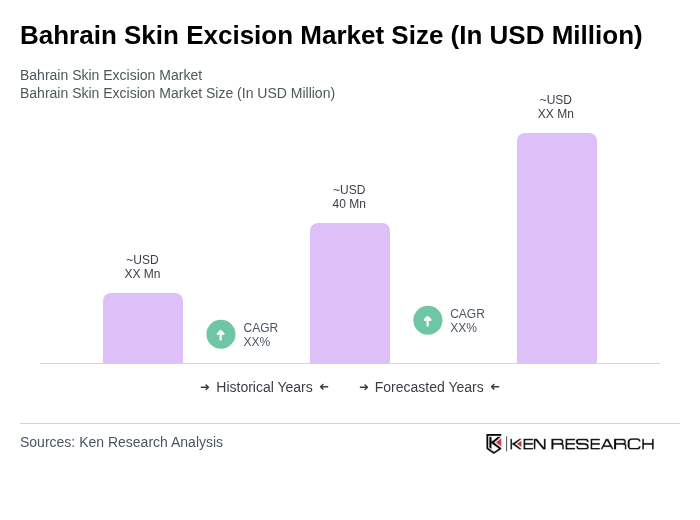
- The Bahrain Skin Excision Market is valued at USD 40 million, based on a five-year historical analysis and extrapolation from the Middle East and Africa skin excision market size and Bahrain’s share of regional healthcare and aesthetic procedure spending. This growth is primarily driven by the increasing prevalence of skin-related conditions, rising awareness about skin health, and advancements in surgical techniques. The demand for skin excision procedures has also been supported by a growing population with high healthcare coverage, strong outpatient specialist access, and the expansion of dermatology and plastic surgery services in both public and private hospitals in Bahrain.
- Key cities such as Manama and Muharraq dominate the market due to their concentration of tertiary hospitals, private specialty hospitals, and dedicated dermatology and plastic surgery clinics. The urban population in these areas has a higher demand for skin excision procedures, driven by lifestyle factors, higher disposable income, and increased access to advanced aesthetic and oncologic dermatology services. Additionally, the presence of expatriates seeking quality medical care and cosmetic procedures within Bahrain, alongside residents who travel abroad for cosmetic surgery and may require follow?up care locally, contributes to the market’s growth in these regions.
- Regulation of skin excision procedures in Bahrain is embedded within the national framework for healthcare facility licensing and professional practice. The National Health Regulatory Authority (NHRA) sets and enforces standards requiring that surgical and invasive dermatologic procedures be conducted in licensed facilities that meet specific infrastructure, equipment, and staffing criteria, and that practitioners hold appropriate specialty licensure. In particular, requirements issued under the National Health Regulatory Authority regulations on healthcare facility licensing and the Professional Licensing Standards of the NHRA (Kingdom of Bahrain, National Health Regulatory Authority) mandate that hospitals, day surgery centers, and specialized clinics performing dermatologic and plastic surgery interventions maintain accreditation?style quality systems, infection control programs, and procedure?appropriate operating room standards to ensure patient safety and continuity of care.
Bahrain Skin Excision Market Segmentation
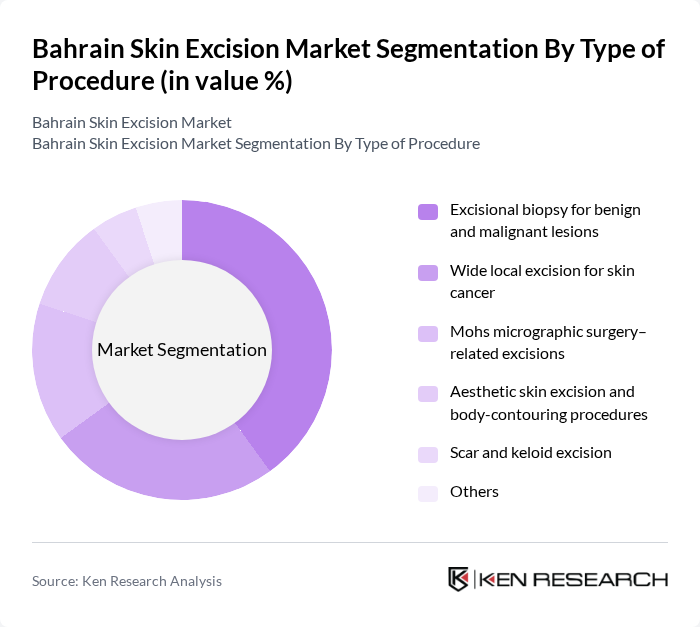
By Type of Procedure:This segmentation includes various types of skin excision procedures that cater to different medical needs. The dominant sub-segment is excisional biopsy for benign and malignant lesions, which is widely performed due to the need for accurate histopathological diagnosis of suspected skin cancers and other lesions in both hospital and clinic settings. Other notable procedures include wide local excision for skin cancer and aesthetic skin excision, reflecting the growing interest in cosmetic dermatology, body?contouring surgeries, and scar revision as documented in global and regional skin excision and cosmetic surgery trends.
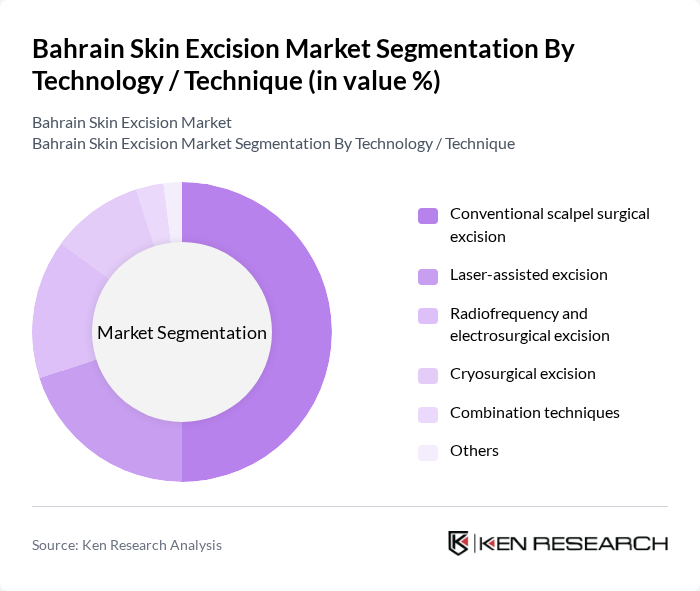
By Technology / Technique:This segmentation highlights the various technologies and techniques used in skin excision procedures. The leading sub-segment is conventional scalpel surgical excision, which remains the standard method due to its effectiveness, ability to obtain full?thickness specimens, and familiarity among surgeons worldwide. However, laser-assisted excision is gaining traction due to its minimally invasive nature, improved hemostasis, and reduced recovery times, aligning with broader trends toward energy?based and combination techniques in aesthetic and dermatologic surgery.
Bahrain Skin Excision Market Competitive Landscape
The Bahrain Skin Excision Market is characterized by a dynamic mix of regional and international players. Leading participants such as Salmaniya Medical Complex (Dermatology & Plastic Surgery Units), King Hamad University Hospital, Bahrain Defence Force (BDF) Royal Medical Services Hospital, Bahrain Specialist Hospital, Royal Bahrain Hospital, American Mission Hospital, KIMSHEALTH Hospital Bahrain (KIMS Bahrain Medical Centre), Middle East Hospital & Medical Centres, Al Hilal Hospital & Medical Centers, Al Salam Specialist Hospital, Dr. Tariq Hospital, Dr. Abdulrahman Tareq Derma Clinic, German Medical Centre Bahrain (Dermatology & Aesthetics), DermaOne Clinic, Kaya Skin Clinic Bahrain contribute to innovation, geographic expansion, and service delivery in this space.
Bahrain Skin Excision Market Industry Analysis
Growth Drivers
- Increasing Prevalence of Skin Disorders:The prevalence of skin disorders in Bahrain is rising, with dermatological consultations increasing by 15% annually. According to the Bahrain Ministry of Health, over 32,000 cases of skin conditions were reported recently. This surge is attributed to factors such as urbanization and lifestyle changes, leading to a greater demand for skin excision procedures. The growing patient base is expected to drive market growth significantly in the coming years.
- Rising Awareness About Skin Health:Public awareness campaigns in Bahrain have led to a 22% increase in skin health awareness among the population. The Ministry of Health reported that educational initiatives have resulted in more individuals seeking early treatment for skin disorders. This heightened awareness is fostering a proactive approach to skin health, thereby increasing the demand for skin excision procedures as patients are more informed about their treatment options.
- Advancements in Surgical Techniques:The introduction of innovative surgical techniques, such as laser excision and minimally invasive methods, has transformed the skin excision landscape in Bahrain. A report from the Bahrain Medical Society indicates that these advancements have improved patient outcomes, reducing recovery times by 28%. As healthcare providers adopt these technologies, the efficiency and effectiveness of skin excision procedures are expected to enhance, driving market growth.
Market Challenges
- High Cost of Advanced Procedures:The cost of advanced skin excision procedures in Bahrain can be prohibitive, with prices ranging from BHD 550 to BHD 1,600 depending on the complexity. This financial barrier limits access for many patients, particularly those without insurance coverage. The high costs associated with state-of-the-art technologies and skilled practitioners pose a significant challenge to market growth, as affordability remains a critical concern for potential patients.
- Limited Access to Specialized Care:Access to specialized dermatological care in Bahrain is uneven, with most specialists concentrated in urban areas. According to the Bahrain Medical Council, only 16 dermatologists serve the entire population of over 1.6 million. This shortage results in long wait times and limited availability of skin excision services, particularly in rural regions. Consequently, patients may delay seeking treatment, hindering market expansion and patient outcomes.
Bahrain Skin Excision Market Future Outlook
The Bahrain skin excision market is poised for significant transformation, driven by technological advancements and evolving patient preferences. The integration of telemedicine is expected to enhance access to specialized care, allowing patients to consult with experts remotely. Additionally, the growing trend towards outpatient procedures will likely reshape the surgical landscape, making treatments more accessible and convenient. As healthcare providers adapt to these changes, the market is set to experience robust growth, catering to the increasing demand for effective skin excision solutions.
Market Opportunities
- Expansion of Telemedicine Services:The rise of telemedicine in Bahrain presents a unique opportunity for the skin excision market. With a projected increase in telehealth consultations by 42% in the near future, patients can access dermatological advice without geographical constraints. This shift can lead to earlier diagnosis and treatment, ultimately increasing the demand for skin excision procedures.
- Increasing Demand for Minimally Invasive Procedures:There is a growing preference for minimally invasive skin excision techniques among patients, driven by their benefits such as reduced recovery time and lower complication rates. The Bahrain Medical Society reports a 27% increase in such procedures over the past year. This trend indicates a significant market opportunity for healthcare providers to invest in and promote these advanced surgical options.
Scope of the Report
| Segment | Sub-Segments |
|---|---|
| By Type of Procedure | Excisional biopsy for benign and malignant lesions Wide local excision for skin cancer Mohs micrographic surgery–related excisions Aesthetic skin excision and body-contouring procedures Scar and keloid excision Others |
| By Technology / Technique | Conventional scalpel surgical excision Laser-assisted excision Radiofrequency and electrosurgical excision Cryosurgical excision Combination techniques Others |
| By Indication | Non-melanoma skin cancer (basal cell, squamous cell) Melanoma and high?risk pigmented lesions Benign tumors, nevi and cysts Post?bariatric and post?pregnancy excess skin Traumatic and surgical scar revision Cosmetic and aesthetic indications Others |
| By End-User | Tertiary care hospitals Specialized dermatology and plastic surgery centers Day-care and ambulatory surgery centers Multispecialty private clinics Others |
| By Patient Profile | Local residents – Bahraini nationals Expatriate population Inbound medical tourists Age groups (pediatric, adult, geriatric) Gender Others |
| By Setting of Care | Inpatient procedures Outpatient / office?based procedures Emergency procedures Others |
| By Payer Type | Government and public schemes Private medical insurance Self?pay and out?of?pocket Corporate / employer?sponsored plans Others |
Key Target Audience
Investors and Venture Capitalist Firms
Government and Regulatory Bodies (e.g., Ministry of Health, Bahrain Food and Drug Authority)
Manufacturers and Producers of Surgical Instruments
Distributors and Retailers of Medical Supplies
Healthcare Providers and Hospitals
Medical Device Regulatory Consultants
Pharmaceutical Companies involved in Skin Treatments
Health Insurance Companies
Players Mentioned in the Report:
Salmaniya Medical Complex (Dermatology & Plastic Surgery Units)
King Hamad University Hospital
Bahrain Defence Force (BDF) Royal Medical Services Hospital
Bahrain Specialist Hospital
Royal Bahrain Hospital
American Mission Hospital
KIMSHEALTH Hospital Bahrain (KIMS Bahrain Medical Centre)
Middle East Hospital & Medical Centres
Al Hilal Hospital & Medical Centers
Al Salam Specialist Hospital
Dr. Tariq Hospital
Dr. Abdulrahman Tareq Derma Clinic
German Medical Centre Bahrain (Dermatology & Aesthetics)
DermaOne Clinic
Kaya Skin Clinic Bahrain
Table of Contents
Market Assessment Phase
1. Executive Summary and Approach
2. Bahrain Skin Excision Market Overview
2.1 Key Insights and Strategic Recommendations
2.2 Bahrain Skin Excision Market Overview
2.3 Definition and Scope
2.4 Evolution of Market Ecosystem
2.5 Timeline of Key Regulatory Milestones
2.6 Value Chain & Stakeholder Mapping
2.7 Business Cycle Analysis
2.8 Policy & Incentive Landscape
3. Bahrain Skin Excision Market Analysis
3.1 Growth Drivers
3.1.1 Increasing prevalence of skin disorders
3.1.2 Rising awareness about skin health
3.1.3 Advancements in surgical techniques
3.1.4 Growth in healthcare infrastructure
3.2 Market Challenges
3.2.1 High cost of advanced procedures
3.2.2 Limited access to specialized care
3.2.3 Regulatory hurdles
3.2.4 Competition from alternative treatments
3.3 Market Opportunities
3.3.1 Expansion of telemedicine services
3.3.2 Increasing demand for minimally invasive procedures
3.3.3 Collaborations with international healthcare providers
3.3.4 Growth in medical tourism
3.4 Market Trends
3.4.1 Shift towards outpatient procedures
3.4.2 Integration of technology in surgical practices
3.4.3 Focus on patient-centered care
3.4.4 Rise in cosmetic skin excision procedures
3.5 Government Regulation
3.5.1 Licensing requirements for practitioners
3.5.2 Standards for surgical facilities
3.5.3 Patient safety regulations
3.5.4 Insurance coverage policies
4. SWOT Analysis
5. Stakeholder Analysis
6. Porter's Five Forces Analysis
7. Bahrain Skin Excision Market Market Size, 2019-2024
7.1 By Value
7.2 By Volume
7.3 By Average Selling Price
8. Bahrain Skin Excision Market Segmentation
8.1 By Type of Procedure
8.1.1 Excisional biopsy for benign and malignant lesions
8.1.2 Wide local excision for skin cancer
8.1.3 Mohs micrographic surgery–related excisions
8.1.4 Aesthetic skin excision and body-contouring procedures
8.1.5 Scar and keloid excision
8.1.6 Others
8.2 By Technology / Technique
8.2.1 Conventional scalpel surgical excision
8.2.2 Laser-assisted excision
8.2.3 Radiofrequency and electrosurgical excision
8.2.4 Cryosurgical excision
8.2.5 Combination techniques
8.2.6 Others
8.3 By Indication
8.3.1 Non-melanoma skin cancer (basal cell, squamous cell)
8.3.2 Melanoma and high?risk pigmented lesions
8.3.3 Benign tumors, nevi and cysts
8.3.4 Post?bariatric and post?pregnancy excess skin
8.3.5 Traumatic and surgical scar revision
8.3.6 Cosmetic and aesthetic indications
8.3.7 Others
8.4 By End-User
8.4.1 Tertiary care hospitals
8.4.2 Specialized dermatology and plastic surgery centers
8.4.3 Day-care and ambulatory surgery centers
8.4.4 Multispecialty private clinics
8.4.5 Others
8.5 By Patient Profile
8.5.1 Local residents – Bahraini nationals
8.5.2 Expatriate population
8.5.3 Inbound medical tourists
8.5.4 Age groups (pediatric, adult, geriatric)
8.5.5 Gender
8.5.6 Others
8.6 By Setting of Care
8.6.1 Inpatient procedures
8.6.2 Outpatient / office?based procedures
8.6.3 Emergency procedures
8.6.4 Others
8.7 By Payer Type
8.7.1 Government and public schemes
8.7.2 Private medical insurance
8.7.3 Self?pay and out?of?pocket
8.7.4 Corporate / employer?sponsored plans
8.7.5 Others
9. Bahrain Skin Excision Market Competitive Analysis
9.1 Market Share of Key Players
9.2 Cross Comparison of Key Players
9.2.1 Presence of board?certified dermatologists and plastic surgeons
9.2.2 Annual volume of skin excision procedures performed
9.2.3 Share of complex oncologic vs. cosmetic excisions
9.2.4 Average revenue from skin excision services
9.2.5 Year?on?year revenue growth from skin excision
9.2.6 Market penetration within Bahrain (number of branches / catchment area)
9.2.7 Average skin excision procedure cost by indication
9.2.8 Case?mix adjusted complication and revision rates
9.2.9 Patient satisfaction and PROMs (patient?reported outcome measures)
9.2.10 Average waiting time and length of stay for excision procedures
9.2.11 Investment in new excision technologies (laser, radiofrequency, Mohs capacity)
9.2.12 Proportion of medical tourist patients in total excision volume
9.3 SWOT Analysis of Top Players
9.4 Pricing Analysis
9.5 Detailed Profile of Major Companies
9.5.1 Salmaniya Medical Complex (Dermatology & Plastic Surgery Units)
9.5.2 King Hamad University Hospital
9.5.3 Bahrain Defence Force (BDF) Royal Medical Services Hospital
9.5.4 Bahrain Specialist Hospital
9.5.5 Royal Bahrain Hospital
9.5.6 American Mission Hospital
9.5.7 KIMSHEALTH Hospital Bahrain (KIMS Bahrain Medical Centre)
9.5.8 Middle East Hospital & Medical Centres
9.5.9 Al Hilal Hospital & Medical Centers
9.5.10 Al Salam Specialist Hospital
9.5.11 Dr. Tariq Hospital
9.5.12 Dr. Abdulrahman Tareq Derma Clinic
9.5.13 German Medical Centre Bahrain (Dermatology & Aesthetics)
9.5.14 DermaOne Clinic
9.5.15 Kaya Skin Clinic Bahrain
10. Bahrain Skin Excision Market End-User Analysis
10.1 Procurement Behavior of Key Ministries
10.1.1 Budget allocation for skin excision procedures
10.1.2 Decision-making processes
10.1.3 Preferred suppliers
10.1.4 Compliance with regulations
10.2 Corporate Spend on Infrastructure & Energy
10.2.1 Investment in healthcare facilities
10.2.2 Funding for advanced medical equipment
10.2.3 Partnerships with private sectors
10.2.4 Others
10.3 Pain Point Analysis by End-User Category
10.3.1 Access to specialized care
10.3.2 Affordability of procedures
10.3.3 Quality of care
10.3.4 Others
10.4 User Readiness for Adoption
10.4.1 Awareness of skin excision options
10.4.2 Willingness to undergo procedures
10.4.3 Availability of information
10.4.4 Others
10.5 Post-Deployment ROI and Use Case Expansion
10.5.1 Evaluation of treatment outcomes
10.5.2 Patient follow-up rates
10.5.3 Expansion into new procedures
10.5.4 Others
11. Bahrain Skin Excision Market Future Size, 2025-2030
11.1 By Value
11.2 By Volume
11.3 By Average Selling Price
Go-To-Market Strategy Phase
1. Whitespace Analysis + Business Model Canvas
1.1 Market gaps identification
1.2 Value proposition development
1.3 Revenue model exploration
1.4 Customer segmentation analysis
1.5 Competitive landscape overview
1.6 Key partnerships identification
1.7 Risk assessment
2. Marketing and Positioning Recommendations
2.1 Branding strategies
2.2 Product USPs
2.3 Target audience identification
2.4 Communication strategies
2.5 Digital marketing approaches
2.6 Customer engagement tactics
2.7 Performance metrics
3. Distribution Plan
3.1 Urban retail vs rural NGO tie-ups
3.2 Distribution channel selection
3.3 Logistics and supply chain management
3.4 Partnership opportunities
3.5 Inventory management strategies
3.6 Sales force deployment
3.7 Performance tracking
4. Channel & Pricing Gaps
4.1 Underserved routes
4.2 Pricing bands
4.3 Competitor pricing analysis
4.4 Customer willingness to pay
4.5 Value-based pricing strategies
4.6 Discounting strategies
4.7 Price elasticity assessment
5. Unmet Demand & Latent Needs
5.1 Category gaps
5.2 Consumer segments
5.3 Emerging trends analysis
5.4 Customer feedback incorporation
5.5 Market research insights
5.6 Innovation opportunities
5.7 Future demand forecasting
6. Customer Relationship
6.1 Loyalty programs
6.2 After-sales service
6.3 Customer feedback mechanisms
6.4 Relationship management strategies
6.5 Community engagement initiatives
6.6 Customer education programs
6.7 Performance evaluation
7. Value Proposition
7.1 Sustainability
7.2 Integrated supply chains
7.3 Unique selling points
7.4 Customer-centric approaches
7.5 Competitive advantages
7.6 Market differentiation strategies
7.7 Value delivery mechanisms
8. Key Activities
8.1 Regulatory compliance
8.2 Branding
8.3 Distribution setup
8.4 Training and development
8.5 Quality assurance processes
8.6 Performance monitoring
8.7 Stakeholder engagement
9. Entry Strategy Evaluation
9.1 Domestic Market Entry Strategy
9.1.1 Product mix
9.1.2 Pricing band
9.1.3 Packaging
9.2 Export Entry Strategy
9.2.1 Target countries
9.2.2 Compliance roadmap
10. Entry Mode Assessment
10.1 JV
10.2 Greenfield
10.3 M&A
10.4 Distributor Model
11. Capital and Timeline Estimation
11.1 Capital requirements
11.2 Timelines
12. Control vs Risk Trade-Off
12.1 Ownership vs Partnerships
13. Profitability Outlook
13.1 Breakeven analysis
13.2 Long-term sustainability
14. Potential Partner List
14.1 Distributors
14.2 JVs
14.3 Acquisition targets
15. Execution Roadmap
15.1 Phased Plan for Market Entry
15.1.1 Market Setup
15.1.2 Market Entry
15.1.3 Growth Acceleration
15.1.4 Scale & Stabilize
15.2 Key Activities and Milestones
15.2.1 Activity timelines
15.2.2 Milestone tracking
Research Methodology
Phase 1: Approach1
Desk Research
- Analysis of healthcare expenditure reports from the Bahrain Ministry of Health
- Review of published market studies and white papers on dermatological procedures
- Examination of demographic and health statistics from the Bahrain National Statistics Bureau
Primary Research
- Interviews with dermatologists and plastic surgeons practicing in Bahrain
- Surveys with hospital administrators regarding skin excision procedure volumes
- Focus groups with patients who have undergone skin excision procedures
Validation & Triangulation
- Cross-validation of findings with regional healthcare market reports
- Triangulation of data from healthcare providers, patient feedback, and industry experts
- Sanity checks through expert panel discussions with medical professionals
Phase 2: Market Size Estimation1
Top-down Assessment
- Estimation of total healthcare spending in Bahrain as a basis for market size
- Segmentation of skin excision procedures by type and demographic factors
- Incorporation of trends in cosmetic and reconstructive surgery demand
Bottom-up Modeling
- Collection of procedure volume data from leading hospitals and clinics
- Cost analysis based on average pricing for skin excision procedures
- Calculation of market size using volume x average cost methodology
Forecasting & Scenario Analysis
- Multi-variable regression analysis incorporating population growth and aging demographics
- Scenario modeling based on potential changes in healthcare policy and insurance coverage
- Development of baseline, optimistic, and pessimistic market growth projections through 2030
Phase 3: CATI Sample Composition1
| Scope Item/Segment | Sample Size | Target Respondent Profiles |
|---|---|---|
| Dermatology Clinics | 60 | Dermatologists, Clinic Managers |
| Plastic Surgery Centers | 50 | Plastic Surgeons, Administrative Staff |
| Hospitals with Surgical Departments | 70 | Surgeons, Hospital Administrators |
| Patient Feedback on Procedures | 120 | Patients who have undergone skin excision |
| Health Insurance Providers | 40 | Insurance Analysts, Claims Managers |
Frequently Asked Questions
What is the current value of the Bahrain Skin Excision Market?
The Bahrain Skin Excision Market is valued at approximately USD 40 million, reflecting a five-year historical analysis and regional healthcare spending trends. This valuation indicates significant growth driven by increasing skin-related conditions and advancements in surgical techniques.
What factors are driving the growth of the Bahrain Skin Excision Market?
Which cities in Bahrain are leading in skin excision procedures?
What types of skin excision procedures are most common in Bahrain?
Other Regional/Country Reports
Indonesia Skin Excision Market
Malaysia Skin Excision Market
KSA Skin Excision Market
APAC Skin Excision Market
SEA Skin Excision Market
Vietnam Skin Excision Market
Other Adjacent Reports
Oman Dermatology Services Market
UAE Cosmetic Surgery Market
Brazil Skin Cancer Treatment Market
Middle East aesthetic devices market report size, share, growth drivers, trends, opportunities & forecast 2025–2030Malaysia Wound Care Management Market
Indonesia Surgical Instruments Market
Mexico Laser Therapy Market
UAE Biopsy Devices MarketIndonesia Plastic Surgery Market
Bahrain medical aesthetics market Size, Share, Growth Drivers, Trends, Opportunities & Forecast 2025–2030Why Buy From Us?

What makes us stand out is that our consultants follow Robust, Refine and Result (RRR) methodology. Robust for clear definitions, approaches and sanity checking, Refine for differentiating respondents' facts and opinions, and Result for presenting data with story.

We have set a benchmark in the industry by offering our clients with syndicated and customized market research reports featuring coverage of entire market as well as meticulous research and analyst insights.

While we don't replace traditional research, we flip the method upside down. Our dual approach of Top Bottom & Bottom Top ensures quality deliverable by not just verifying company fundamentals but also looking at the sector and macroeconomic factors.

With one step in the future, our research team constantly tries to show you the bigger picture. We help with some of the tough questions you may encounter along the way: How is the industry positioned? Best marketing channel? KPI's of competitors? By aligning every element, we help maximize success.

Our report gives you instant access to the answers and sources that other companies might choose to hide. We elaborate each steps of research methodology we have used and showcase you the sample size to earn your trust.

If you need any support, we are here! We pride ourselves on universe strength, data quality, and quick, friendly, and professional service.