About the Report
Base Year 2024Brazil Real Estate and PropTech Development Market Overview
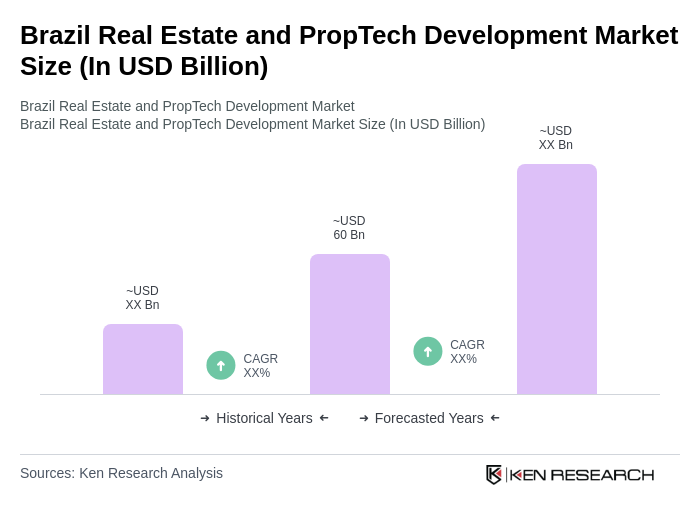
- The Brazil Real Estate and PropTech Development Market is valued at approximately USD 60 billion, based on a five-year historical analysis of the residential sector and supported by robust growth in commercial, industrial, and PropTech segments . This expansion is driven by rapid urbanization, strong demand for housing, active construction, and increased adoption of technology in property management and transactions. Notably, PropTech investment is accelerating digital transformation, with platforms for property search, transaction automation, and smart building solutions gaining traction .
- Key cities such as São Paulo, Rio de Janeiro, and Brasília continue to dominate the market due to their economic significance, population density, and infrastructure development. São Paulo, as the financial hub, is experiencing record residential sales and launches, while Rio de Janeiro benefits from tourism and cultural appeal, and Brasília maintains steady demand for commercial and residential properties . Regional price growth and foreign investment interest further reinforce the prominence of these cities.
- The “Minha Casa, Minha Vida” Program (Law No. 14,620/2023) issued by the Brazilian Federal Government in 2023 expanded affordable housing initiatives, allocating a budget of USD 1 billion to support low-income housing projects. The program provides direct subsidies, tax incentives, and financing for private sector participation, with operational requirements for eligibility, income thresholds, and compliance monitoring by Caixa Econômica Federal .
Brazil Real Estate and PropTech Development Market Segmentation
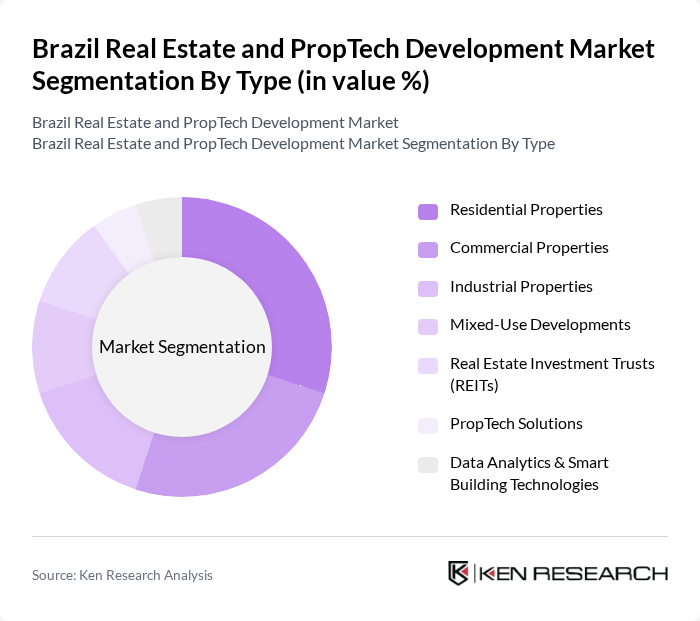
By Type:The market is segmented into Residential Properties, Commercial Properties, Industrial Properties, Mixed-Use Developments, Real Estate Investment Trusts (REITs), PropTech Solutions, and Data Analytics & Smart Building Technologies. Residential properties remain the largest segment, driven by urban migration and affordability programs. Commercial properties are supported by business expansion and retail growth in major cities. Industrial properties benefit from logistics and e-commerce demand. Mixed-use developments integrate residential, commercial, and leisure spaces, reflecting urban planning trends. REITs offer institutional investment opportunities, while PropTech and smart building technologies enable digitalization, automation, and energy efficiency in property management .
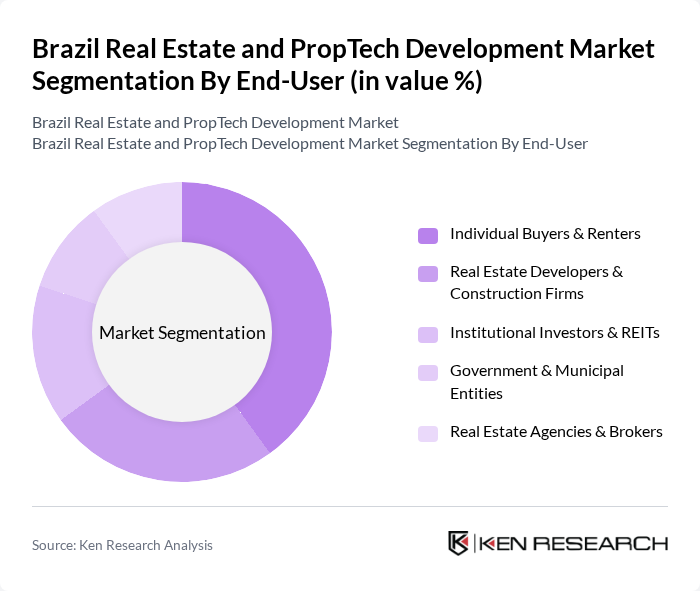
By End-User:The end-user segmentation includes Individual Buyers & Renters, Real Estate Developers & Construction Firms, Institutional Investors & REITs, Government & Municipal Entities, and Real Estate Agencies & Brokers. Individual buyers and renters represent the largest share, reflecting strong demand for homeownership and rental housing. Developers and construction firms drive supply through new projects and urban renewal. Institutional investors and REITs focus on portfolio diversification and yield generation. Government entities play a key role in affordable housing and regulatory oversight. Agencies and brokers facilitate transactions and market access .
Brazil Real Estate and PropTech Development Market Competitive Landscape
The Brazil Real Estate and PropTech Development Market is characterized by a dynamic mix of regional and international players. Leading participants such as MRV Engenharia, Cyrela Brazil Realty, Gafisa S.A., Even Construtora e Incorporadora S.A., JHSF Participações S.A., Tecnisa S.A., Brookfield Incorporações, Grupo Viver, EmCasa, Loft, QuintoAndar, Housi, Date A Home, Homelend Tecnologia, MySide contribute to innovation, geographic expansion, and service delivery in this space.
Brazil Real Estate and PropTech Development Market Industry Analysis
Growth Drivers
- Urbanization and Population Growth:Brazil's urban population is projected to reach approximately 87% in future, up from about 86% in recent years, according to the World Bank. This rapid urbanization drives demand for housing, with an estimated 1.5 million new homes needed annually to accommodate the growing population. The urban migration trend is particularly strong in cities like São Paulo and Rio de Janeiro, where the influx of residents increases the need for residential and commercial real estate developments.
- Increased Investment in Infrastructure:The Brazilian government allocated approximately BRL 100 billion (USD 19 billion) for infrastructure projects in future, focusing on transportation and utilities. This investment is expected to enhance connectivity and accessibility, making previously underdeveloped areas more attractive for real estate investment. Improved infrastructure not only supports residential growth but also stimulates commercial real estate, particularly in logistics and retail sectors.
- Technological Advancements in Real Estate:The PropTech sector in Brazil is experiencing significant growth, with investments reaching BRL 1.2 billion (USD 230 million) in recent periods. Technologies such as virtual reality, blockchain, and AI are transforming property management and sales processes. These advancements enhance efficiency and transparency, attracting both domestic and foreign investors, and are expected to continue driving innovation in the real estate market in future.
Market Challenges
- Economic Instability:Brazil's economy is projected to grow by approximately 2% in future, according to the IMF, reflecting ongoing challenges such as inflation and political uncertainty. This economic environment can deter investment in real estate, as potential buyers and investors may hesitate to commit to large financial decisions amid fluctuating market conditions. Economic instability can lead to decreased consumer confidence, impacting housing demand significantly.
- Regulatory Hurdles:The Brazilian real estate market faces complex regulatory frameworks that can delay project approvals. In major cities, it is estimated that the average time for obtaining construction permits is around 12 months, according to the World Bank. These regulatory challenges can increase costs and discourage developers from pursuing new projects, ultimately limiting market growth and innovation in the sector.
Brazil Real Estate and PropTech Development Market Future Outlook
The Brazilian real estate market is poised for transformation as urbanization continues to accelerate and technological innovations reshape the landscape. In future, the integration of smart technologies and sustainable practices is expected to become standard in new developments. Additionally, the demand for rental properties is likely to rise, driven by changing demographics and lifestyle preferences. As the government implements supportive policies, the market is anticipated to adapt and thrive, despite existing challenges, fostering a more resilient real estate environment.
Market Opportunities
- Growth of Smart Cities:The Brazilian government is investing in smart city initiatives, with over BRL 30 billion (USD 5.7 billion) allocated for technology-driven urban development in future. This focus on smart infrastructure presents opportunities for real estate developers to create innovative, tech-enabled living spaces that cater to modern urban lifestyles, enhancing property values and attracting tech-savvy residents.
- Rise of Co-Living Spaces:The co-living trend is gaining traction in Brazil, particularly among millennials and young professionals. With an estimated increase in demand for shared living arrangements in future, developers can capitalize on this opportunity by creating affordable, community-oriented housing solutions. This trend not only addresses housing shortages but also fosters social interaction and collaboration among residents.
Scope of the Report
| Segment | Sub-Segments |
|---|---|
| By Type | Residential Properties Commercial Properties Industrial Properties Mixed-Use Developments Real Estate Investment Trusts (REITs) PropTech Solutions Data Analytics & Smart Building Technologies |
| By End-User | Individual Buyers & Renters Real Estate Developers & Construction Firms Institutional Investors & REITs Government & Municipal Entities Real Estate Agencies & Brokers |
| By Region | Southeast Brazil South Brazil Northeast Brazil Central-West Brazil North Brazil |
| By Application | Residential Development Commercial Leasing & Office Space Property Management & Facility Services Real Estate Financing & Mortgage Tech Smart Home & IoT Applications |
| By Investment Source | Domestic Investments Foreign Direct Investment (FDI) Public-Private Partnerships (PPP) Government Grants and Subsidies |
| By Policy Support | Tax Incentives Subsidies for Affordable Housing Regulatory Support for Green Buildings Digitalization Initiatives Others |
| By Sales Channel | Direct Sales Online Platforms & Marketplaces Real Estate Agencies & Brokers Auctions & Alternative Channels |
Key Target Audience
Investors and Venture Capitalist Firms
Government and Regulatory Bodies (e.g., Ministério das Cidades, Agência Nacional de Vigilância Sanitária)
Real Estate Developers
Property Management Companies
Construction Firms
Technology Providers
Real Estate Investment Trusts (REITs)
Financial Institutions
Players Mentioned in the Report:
MRV Engenharia
Cyrela Brazil Realty
Gafisa S.A.
Even Construtora e Incorporadora S.A.
JHSF Participacoes S.A.
Tecnisa S.A.
Brookfield Incorporacoes
Grupo Viver
EmCasa
Loft
QuintoAndar
Housi
Date A Home
Homelend Tecnologia
MySide
Table of Contents
Market Assessment Phase
1. Executive Summary and Approach
2. Brazil Real Estate and PropTech Development Market Overview
2.1 Key Insights and Strategic Recommendations
2.2 Brazil Real Estate and PropTech Development Market Overview
2.3 Definition and Scope
2.4 Evolution of Market Ecosystem
2.5 Timeline of Key Regulatory Milestones
2.6 Value Chain & Stakeholder Mapping
2.7 Business Cycle Analysis
2.8 Policy & Incentive Landscape
3. Brazil Real Estate and PropTech Development Market Analysis
3.1 Growth Drivers
3.1.1 Urbanization and Population Growth
3.1.2 Increased Investment in Infrastructure
3.1.3 Technological Advancements in Real Estate
3.1.4 Government Initiatives to Promote Housing
3.2 Market Challenges
3.2.1 Economic Instability
3.2.2 Regulatory Hurdles
3.2.3 High Interest Rates
3.2.4 Limited Access to Financing
3.3 Market Opportunities
3.3.1 Growth of Smart Cities
3.3.2 Rise of Co-Living Spaces
3.3.3 Expansion of E-commerce and Logistics Real Estate
3.3.4 Adoption of Sustainable Building Practices
3.4 Market Trends
3.4.1 Digital Transformation in Real Estate
3.4.2 Increased Demand for Rental Properties
3.4.3 Integration of AI and Big Data
3.4.4 Focus on Customer Experience
3.5 Government Regulation
3.5.1 Zoning Laws and Land Use Regulations
3.5.2 Tax Incentives for Real Estate Development
3.5.3 Environmental Regulations
3.5.4 Building Codes and Safety Standards
4. SWOT Analysis
5. Stakeholder Analysis
6. Porter's Five Forces Analysis
7. Brazil Real Estate and PropTech Development Market Market Size, 2019-2024
7.1 By Value
7.2 By Volume
7.3 By Average Selling Price
8. Brazil Real Estate and PropTech Development Market Segmentation
8.1 By Type
8.1.1 Residential Properties
8.1.2 Commercial Properties
8.1.3 Industrial Properties
8.1.4 Mixed-Use Developments
8.1.5 Real Estate Investment Trusts (REITs)
8.1.6 PropTech Solutions
8.1.7 Data Analytics & Smart Building Technologies
8.2 By End-User
8.2.1 Individual Buyers & Renters
8.2.2 Real Estate Developers & Construction Firms
8.2.3 Institutional Investors & REITs
8.2.4 Government & Municipal Entities
8.2.5 Real Estate Agencies & Brokers
8.3 By Region
8.3.1 Southeast Brazil
8.3.2 South Brazil
8.3.3 Northeast Brazil
8.3.4 Central-West Brazil
8.3.5 North Brazil
8.4 By Application
8.4.1 Residential Development
8.4.2 Commercial Leasing & Office Space
8.4.3 Property Management & Facility Services
8.4.4 Real Estate Financing & Mortgage Tech
8.4.5 Smart Home & IoT Applications
8.5 By Investment Source
8.5.1 Domestic Investments
8.5.2 Foreign Direct Investment (FDI)
8.5.3 Public-Private Partnerships (PPP)
8.5.4 Government Grants and Subsidies
8.6 By Policy Support
8.6.1 Tax Incentives
8.6.2 Subsidies for Affordable Housing
8.6.3 Regulatory Support for Green Buildings
8.6.4 Digitalization Initiatives
8.6.5 Others
8.7 By Sales Channel
8.7.1 Direct Sales
8.7.2 Online Platforms & Marketplaces
8.7.3 Real Estate Agencies & Brokers
8.7.4 Auctions & Alternative Channels
9. Brazil Real Estate and PropTech Development Market Competitive Analysis
9.1 Market Share of Key Players(Micro, Small, Medium, Large Enterprises)
9.2 Cross Comparison of Key Players
9.2.1 Company Name
9.2.2 Group Size (Large, Medium, or Small as per industry convention)
9.2.3 Revenue Growth Rate (YoY %)
9.2.4 Market Penetration Rate (by region, segment, or digital adoption)
9.2.5 Customer Acquisition Cost (CAC)
9.2.6 Customer Retention Rate (%)
9.2.7 Average Deal Size (BRL or USD)
9.2.8 Pricing Strategy (subscription, transaction-based, commission, etc.)
9.2.9 Return on Investment (ROI)
9.2.10 Net Promoter Score (NPS)
9.2.11 Digital Platform Adoption Rate (%)
9.2.12 Number of Active Listings/Transactions
9.2.13 Technology Investment as % of Revenue
9.2.14 ESG (Environmental, Social, Governance) Ratings/Initiatives
9.3 SWOT Analysis of Top Players
9.4 Pricing Analysis(By Class and Payload)
9.5 Detailed Profile of Major Companies
9.5.1 MRV Engenharia
9.5.2 Cyrela Brazil Realty
9.5.3 Gafisa S.A.
9.5.4 Even Construtora e Incorporadora S.A.
9.5.5 JHSF Participações S.A.
9.5.6 Tecnisa S.A.
9.5.7 Brookfield Incorporações
9.5.8 Grupo Viver
9.5.9 EmCasa
9.5.10 Loft
9.5.11 QuintoAndar
9.5.12 Housi
9.5.13 Date A Home
9.5.14 Homelend Tecnologia
9.5.15 MySide
10. Brazil Real Estate and PropTech Development Market End-User Analysis
10.1 Procurement Behavior of Key Ministries
10.1.1 Ministry of Cities
10.1.2 Ministry of Finance
10.1.3 Ministry of Regional Development
10.2 Corporate Spend on Infrastructure & Energy
10.2.1 Corporate Investments in Real Estate
10.2.2 Budget Allocations for Urban Development
10.2.3 Expenditure on Sustainable Projects
10.3 Pain Point Analysis by End-User Category
10.3.1 Residential Buyers
10.3.2 Commercial Tenants
10.3.3 Real Estate Developers
10.4 User Readiness for Adoption
10.4.1 Awareness of PropTech Solutions
10.4.2 Willingness to Invest in Technology
10.4.3 Training and Support Needs
10.5 Post-Deployment ROI and Use Case Expansion
10.5.1 Measurement of ROI
10.5.2 Expansion into New Use Cases
10.5.3 Long-term Value Creation
11. Brazil Real Estate and PropTech Development Market Future Size, 2025-2030
11.1 By Value
11.2 By Volume
11.3 By Average Selling Price
Go-To-Market Strategy Phase
1. Whitespace Analysis + Business Model Canvas
1.1 Market Gaps Identification
1.2 Business Model Framework
2. Marketing and Positioning Recommendations(Branding strategies, Product USPs)
2.1 Branding Strategies
2.2 Product USPs
3. Distribution Plan(Urban retail vs rural NGO tie-ups)
3.1 Distribution Channels
4. Channel & Pricing Gaps(Underserved routes, Pricing bands)
4.1 Pricing Strategies
5. Unmet Demand & Latent Needs(Category gaps, Consumer segments)
5.1 Consumer Segment Analysis
6. Customer Relationship(Loyalty programs, After-sales service)
6.1 Customer Engagement Strategies
7. Value Proposition(Sustainability, Integrated supply chains)
7.1 Value Creation Strategies
8. Key Activities(Regulatory compliance, Branding, Distribution setup)
8.1 Key Operational Activities
9. Entry Strategy Evaluation
9.1 Domestic Market Entry Strategy(Product mix, Pricing band, Packaging)
9.1.1 Product Mix Considerations
9.1.2 Pricing Band Strategy
9.1.3 Packaging Options
9.2 Export Entry Strategy(Target countries, Compliance roadmap)
9.2.1 Target Countries for Expansion
9.2.2 Compliance Requirements
10. Entry Mode Assessment(JV, Greenfield, M&A, Distributor Model)
10.1 Entry Mode Options
11. Capital and Timeline Estimation (Capital requirements, Timelines)
11.1 Capital Requirements
11.2 Project Timelines
12. Control vs Risk Trade-Off (Ownership vs Partnerships)
12.1 Ownership Considerations
13. Profitability Outlook (Breakeven analysis, Long-term sustainability)
13.1 Profitability Metrics
14. Potential Partner List (Distributors, JVs, Acquisition targets)
14.1 Potential Partners
15. Execution Roadmap
15.1 Phased Plan for Market Entry (Market Setup ? Market Entry ? Growth Acceleration ? Scale & Stabilize)
15.1.1 Market Setup Activities
15.1.2 Market Entry Strategies
15.1.3 Growth Acceleration Tactics
15.1.4 Scale & Stabilize Actions
15.2 Key Activities and Milestones
15.2.1 Milestone Planning
15.2.2 Activity Tracking
Research Methodology
Phase 1: Approach1
Desk Research
- Analysis of real estate market reports from Brazilian government agencies and industry associations
- Review of PropTech investment trends through venture capital databases and financial news outlets
- Examination of regulatory frameworks affecting real estate and technology sectors in Brazil
Primary Research
- Interviews with real estate developers and PropTech entrepreneurs to gather insights on market dynamics
- Surveys targeting real estate agents and brokers to understand technology adoption rates
- Focus groups with end-users of PropTech solutions to assess user experience and satisfaction
Validation & Triangulation
- Cross-validation of findings through multiple data sources, including market reports and expert opinions
- Triangulation of qualitative insights from interviews with quantitative data from surveys
- Sanity checks conducted through expert panel reviews to ensure data reliability
Phase 2: Market Size Estimation1
Top-down Assessment
- Estimation of the overall real estate market size in Brazil, segmented by residential, commercial, and industrial sectors
- Analysis of PropTech market size based on investment trends and technology adoption rates
- Incorporation of macroeconomic indicators such as GDP growth and urbanization rates
Bottom-up Modeling
- Collection of firm-level data from leading real estate companies and PropTech startups
- Operational cost analysis based on service pricing models in the PropTech sector
- Volume and revenue estimates derived from user adoption rates and market penetration
Forecasting & Scenario Analysis
- Multi-factor regression analysis incorporating economic indicators, technology trends, and consumer behavior
- Scenario modeling based on potential regulatory changes and market disruptions
- Development of baseline, optimistic, and pessimistic forecasts through 2030
Phase 3: CATI Sample Composition1
| Scope Item/Segment | Sample Size | Target Respondent Profiles |
|---|---|---|
| Residential Real Estate Developers | 60 | Project Managers, Business Development Executives |
| Commercial Property Managers | 50 | Operations Managers, Asset Managers |
| PropTech Startups | 40 | Founders, Product Managers |
| Real Estate Agents and Brokers | 70 | Sales Agents, Regional Managers |
| End-users of PropTech Solutions | 50 | Homebuyers, Commercial Tenants |
Frequently Asked Questions
What is the current value of the Brazil Real Estate and PropTech Development Market?
The Brazil Real Estate and PropTech Development Market is valued at approximately USD 60 billion, driven by growth in residential, commercial, industrial, and PropTech segments, reflecting strong demand for housing and technological advancements in property management.
Which cities are the main hubs for real estate in Brazil?
What is the Minha Casa, Minha Vida Program?
How is urbanization affecting the real estate market in Brazil?
Other Regional/Country Reports
Indonesia Real Estate and PropTech Development Market
Malaysia Real Estate and PropTech Development Market
KSA Real Estate and PropTech Development Market
APAC Real Estate and PropTech Development Market
SEA Real Estate and PropTech Development Market
Vietnam Real Estate and PropTech Development Market
Other Adjacent Reports
Indonesia Architectural Design Services Market
Global Property Management Software Market Size, Share & Forecast, By Solution Type, Deployment Model, End-Use Industry & Enterprise Size, 2026-2031Thailand Mortgage Financing Market
Singapore Urban Development Planning Market
Philippines Smart Building Technologies Market
Brazil Real Estate Investment Trusts Market
Qatar Facilities Management Services Market
Philippines Sustainable Architecture Market
Qatar Digital Property Transaction Platforms Market
Why Buy From Us?

What makes us stand out is that our consultants follow Robust, Refine and Result (RRR) methodology. Robust for clear definitions, approaches and sanity checking, Refine for differentiating respondents' facts and opinions, and Result for presenting data with story.

We have set a benchmark in the industry by offering our clients with syndicated and customized market research reports featuring coverage of entire market as well as meticulous research and analyst insights.

While we don't replace traditional research, we flip the method upside down. Our dual approach of Top Bottom & Bottom Top ensures quality deliverable by not just verifying company fundamentals but also looking at the sector and macroeconomic factors.

With one step in the future, our research team constantly tries to show you the bigger picture. We help with some of the tough questions you may encounter along the way: How is the industry positioned? Best marketing channel? KPI's of competitors? By aligning every element, we help maximize success.

Our report gives you instant access to the answers and sources that other companies might choose to hide. We elaborate each steps of research methodology we have used and showcase you the sample size to earn your trust.

If you need any support, we are here! We pride ourselves on universe strength, data quality, and quick, friendly, and professional service.