Canada Smart Agriculture Robotics Market

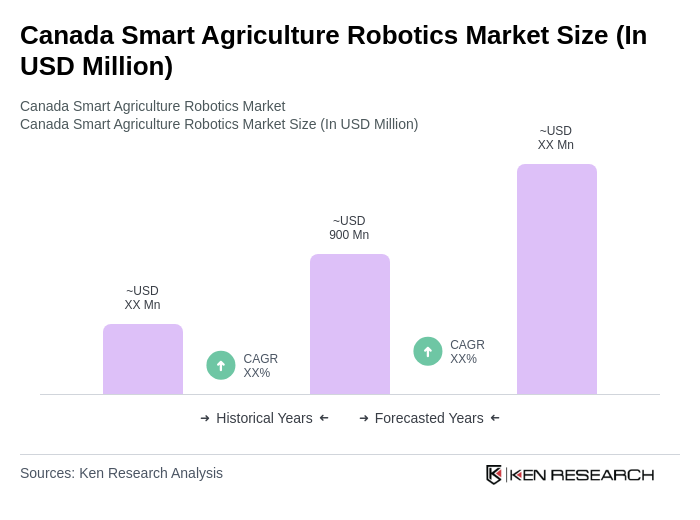
Canada Smart Agriculture Robotics Market is worth USD 900 Mn, fueled by robotics advancements, precision farming, and labor shortage solutions for enhanced productivity.

Region:North America

Author(s):Geetanshi

Product Code:KRAB3414

Pages:92

Published On:October 2025
About the Report

Base Year 2024

Canada Smart Agriculture Robotics Market Overview

  • The Canada Smart Agriculture Robotics Market is valued at USD 900 million, based on a five-year historical analysis. This growth is primarily driven by advancements in robotics, artificial intelligence, and sensor technologies, the increasing demand for automation in agriculture, and the need for sustainable farming practices. The integration of robotics in agriculture enhances productivity and efficiency, addresses labor shortages, and improves crop yields by enabling precision farming and resource optimization .
  • Key provinces in this market include Ontario, Quebec, and Alberta, which lead due to their robust agricultural sectors and significant investment in agri-tech infrastructure. Ontario, with its diverse agricultural landscape and strong research ecosystem, is at the forefront of smart farming technology adoption, while Quebec and Alberta benefit from targeted government support and a growing focus on innovation in agriculture .
  • The Canadian government’s "Agricultural Clean Technology Program" (Agriculture and Agri-Food Canada, 2021) allocates substantial funding to support the development and adoption of agricultural robotics and automation. This program provides grants and contributions to encourage farmers to integrate advanced technologies, aiming to enhance productivity, sustainability, and competitiveness in the agricultural sector. The program covers investments in precision agriculture, energy efficiency, and automation, with compliance requirements for reporting outcomes and environmental impacts .
Canada Smart Agriculture Robotics Market Size

Canada Smart Agriculture Robotics Market Segmentation

By Type:The market is segmented into various types of smart agriculture robotics, including Autonomous Tractors, Drones & UAVs, Robotic Harvesters & Fruit Pickers, Soil Monitoring Robots & Sensors, Irrigation & Crop Spraying Robots, Livestock Monitoring & Milking Robots, Greenhouse Automation Robots, and Others. Each of these sub-segments plays a crucial role in enhancing agricultural efficiency and productivity by automating repetitive tasks, improving data-driven decision-making, and reducing resource wastage .
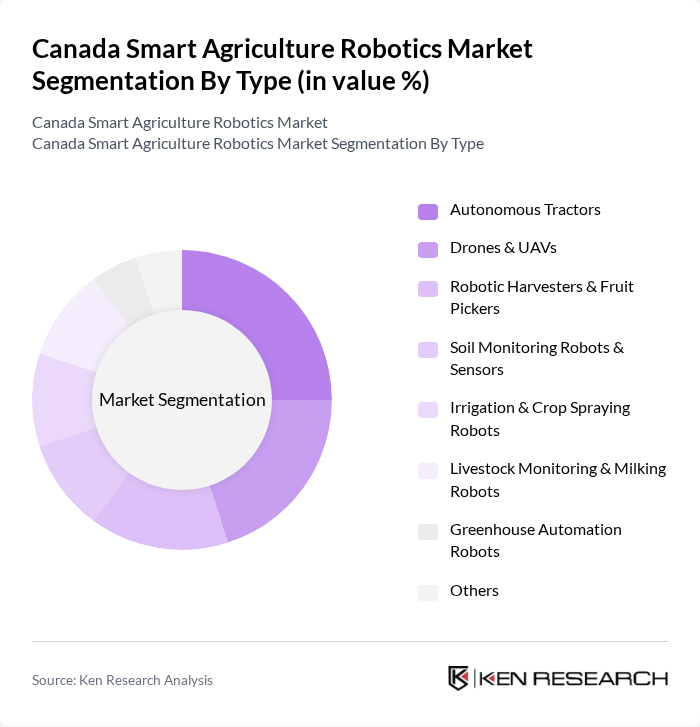
Canada Smart Agriculture Robotics Market segmentation by Type.

By End-User:The end-user segmentation includes Crop Farmers, Livestock Farmers, Greenhouse Growers, Agricultural Cooperatives, Research Institutions, Government Agencies, and Others. Each end-user category has unique needs and applications for smart agriculture robotics, such as precision planting, automated livestock management, and advanced greenhouse controls, all contributing to the overall market growth and digital transformation of Canadian agriculture .
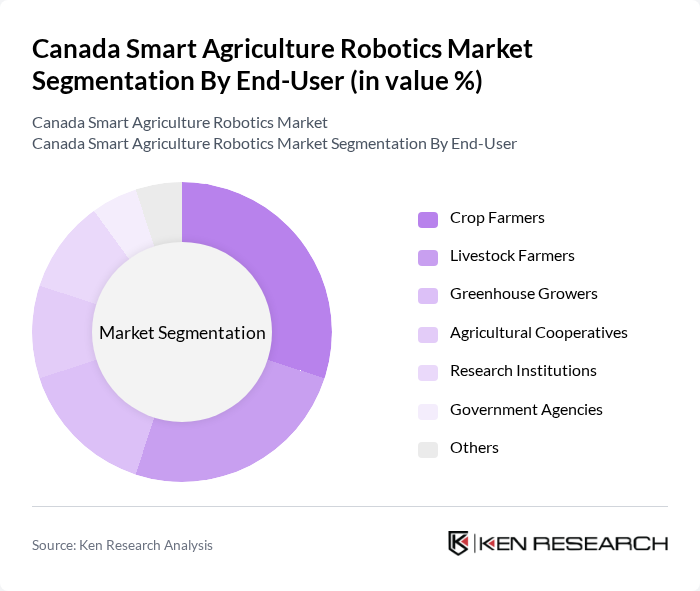
Canada Smart Agriculture Robotics Market segmentation by End-User.

Canada Smart Agriculture Robotics Market Competitive Landscape

The Canada Smart Agriculture Robotics Market is characterized by a dynamic mix of regional and international players. Leading participants such as John Deere, Trimble Inc., CNH Industrial, AG Leader Technology, Raven Industries, Clearpath Robotics, Solinftec, DeLaval, BouMatic Robotics, EcoRobotix, Naïo Technologies, AgEagle Aerial Systems, DJI Technology, FarmBot, Lely, GEA Group, Topcon Corporation, CropX, Argus Controls, Autonomous Solutions Inc., Blue River Technology, Harvest Automation, Taranis contribute to innovation, geographic expansion, and service delivery in this space.

John Deere

1837

Moline, Illinois, USA

Trimble Inc.

1978

Westminster, Colorado, USA

CNH Industrial

2013

London, UK

AG Leader Technology

1992

Ames, Iowa, USA

Raven Industries

1956

Sioux Falls, South Dakota, USA

Company

Establishment Year

Headquarters

Group Size (Large, Medium, or Small as per industry convention)

Revenue Growth Rate (Canada segment)

Market Penetration Rate (Canada smart ag robotics)

Installed Base (Number of units deployed in Canada)

Customer Retention Rate

Pricing Strategy (per robot/unit/service)

Canada Smart Agriculture Robotics Market Industry Analysis

Growth Drivers

  • Increasing Demand for Precision Agriculture:The Canadian agriculture sector is increasingly adopting precision agriculture techniques, with the market for precision farming technologies projected to reach CAD 1.5 billion in future. This growth is driven by the need for improved crop yields and resource efficiency, as farmers seek to optimize inputs like water and fertilizers. The integration of smart agriculture robotics plays a crucial role in achieving these goals, enhancing productivity and sustainability in farming practices.
  • Technological Advancements in Robotics:The Canadian smart agriculture robotics market is benefiting from significant technological advancements, with investments in robotics expected to exceed CAD 500 million in future. Innovations such as autonomous drones and robotic harvesters are enhancing operational efficiency. These technologies enable farmers to monitor crops in real-time, automate labor-intensive tasks, and reduce operational costs, thereby driving the adoption of smart agricultural solutions across the country.
  • Government Support and Funding:The Canadian government has committed over CAD 200 million in funding for agricultural innovation and technology adoption through various programs in future. This support aims to enhance the competitiveness of the agricultural sector by promoting the use of smart technologies. Such initiatives not only facilitate the development of smart agriculture robotics but also encourage farmers to invest in these technologies, fostering a more sustainable agricultural landscape.

Market Challenges

  • High Initial Investment Costs:One of the significant barriers to the adoption of smart agriculture robotics in Canada is the high initial investment required, which can range from CAD 50,000 to CAD 200,000 per unit. Many farmers, particularly small-scale operators, struggle to justify these costs, especially in a market where profit margins are often tight. This financial hurdle can delay the transition to more advanced agricultural practices, limiting overall market growth.
  • Limited Awareness Among Farmers:A considerable challenge facing the smart agriculture robotics market is the limited awareness and understanding of these technologies among Canadian farmers. Approximately 40% of farmers report being unaware of the benefits and functionalities of smart robotics. This lack of knowledge can hinder adoption rates, as farmers may be reluctant to invest in technologies they do not fully understand or trust, impacting market penetration.

Canada Smart Agriculture Robotics Market Future Outlook

The future of the smart agriculture robotics market in Canada appears promising, driven by ongoing technological advancements and increasing government support. As farmers become more aware of the benefits of automation and precision agriculture, adoption rates are expected to rise. Additionally, the focus on sustainability and environmental stewardship will likely propel the development of innovative robotic solutions tailored to meet the unique challenges of Canadian agriculture, ensuring a more efficient and productive farming landscape.

Market Opportunities

  • Expansion into Remote Farming Areas:There is a significant opportunity for smart agriculture robotics to expand into remote farming areas in Canada, where traditional farming methods are often less efficient. By providing automated solutions tailored to these regions, companies can enhance productivity and resource management, addressing the unique challenges faced by farmers in isolated locations.
  • Development of New Robotic Applications:The continuous development of new robotic applications presents a lucrative opportunity for the market. Innovations such as robotic weeders and automated planting systems can address specific agricultural challenges, improving efficiency and reducing labor costs. This diversification of applications will likely attract more farmers to invest in smart agriculture technologies, further driving market growth.

Scope of the Report

SegmentSub-Segments
By Type

Autonomous Tractors

Drones & UAVs

Robotic Harvesters & Fruit Pickers

Soil Monitoring Robots & Sensors

Irrigation & Crop Spraying Robots

Livestock Monitoring & Milking Robots

Greenhouse Automation Robots

Others

By End-User

Crop Farmers

Livestock Farmers

Greenhouse Growers

Agricultural Cooperatives

Research Institutions

Government Agencies

Others

By Application

Crop Monitoring & Scouting

Pest & Weed Control

Soil & Environmental Analysis

Harvesting & Fruit Picking

Irrigation & Nutrient Management

Livestock Health & Milking Automation

Greenhouse Automation

Others

By Distribution Channel

Direct Sales

Online Sales

Distributors

Retailers

Others

By Region

Ontario

Quebec

British Columbia

Alberta

Saskatchewan

Manitoba

Others

By Investment Source

Private Investments

Government Grants

Venture Capital

Crowdfunding

Others

By Policy Support

Subsidies

Tax Incentives

Research Grants

Training Programs

Others

Key Target Audience

Investors and Venture Capitalist Firms

Government and Regulatory Bodies (e.g., Agriculture and Agri-Food Canada, Canadian Food Inspection Agency)

Manufacturers and Producers of Agricultural Robotics

Distributors and Retailers of Agricultural Technology

Agri-tech Startups

Industry Associations (e.g., Canadian Agricultural Innovation and Research Network)

Financial Institutions and Banks with Agri-focused Investment Divisions

Farm Management Software Providers

Players Mentioned in the Report:

John Deere

Trimble Inc.

CNH Industrial

AG Leader Technology

Raven Industries

Clearpath Robotics

Solinftec

DeLaval

BouMatic Robotics

EcoRobotix

Naio Technologies

AgEagle Aerial Systems

DJI Technology

FarmBot

Lely

GEA Group

Topcon Corporation

CropX

Argus Controls

Autonomous Solutions Inc.

Blue River Technology

Harvest Automation

Taranis

Table of Contents

Market Assessment Phase

1. Executive Summary and Approach


2. Canada Smart Agriculture Robotics Market Overview

2.1 Key Insights and Strategic Recommendations

2.2 Canada Smart Agriculture Robotics Market Overview

2.3 Definition and Scope

2.4 Evolution of Market Ecosystem

2.5 Timeline of Key Regulatory Milestones

2.6 Value Chain & Stakeholder Mapping

2.7 Business Cycle Analysis

2.8 Policy & Incentive Landscape


3. Canada Smart Agriculture Robotics Market Analysis

3.1 Growth Drivers

3.1.1 Increasing demand for precision agriculture
3.1.2 Technological advancements in robotics
3.1.3 Government support and funding
3.1.4 Rising labor costs in agriculture

3.2 Market Challenges

3.2.1 High initial investment costs
3.2.2 Limited awareness among farmers
3.2.3 Integration with existing systems
3.2.4 Regulatory hurdles

3.3 Market Opportunities

3.3.1 Expansion into remote farming areas
3.3.2 Development of new robotic applications
3.3.3 Collaborations with tech companies
3.3.4 Increasing focus on sustainability

3.4 Market Trends

3.4.1 Adoption of AI and machine learning
3.4.2 Growth of autonomous farming equipment
3.4.3 Rise of data-driven farming practices
3.4.4 Increased investment in R&D

3.5 Government Regulation

3.5.1 Safety standards for agricultural robots
3.5.2 Environmental regulations
3.5.3 Subsidies for technology adoption
3.5.4 Data privacy laws affecting agricultural data

4. SWOT Analysis


5. Stakeholder Analysis


6. Porter's Five Forces Analysis


7. Canada Smart Agriculture Robotics Market Market Size, 2019-2024

7.1 By Value

7.2 By Volume

7.3 By Average Selling Price


8. Canada Smart Agriculture Robotics Market Segmentation

8.1 By Type

8.1.1 Autonomous Tractors
8.1.2 Drones & UAVs
8.1.3 Robotic Harvesters & Fruit Pickers
8.1.4 Soil Monitoring Robots & Sensors
8.1.5 Irrigation & Crop Spraying Robots
8.1.6 Livestock Monitoring & Milking Robots
8.1.7 Greenhouse Automation Robots
8.1.8 Others

8.2 By End-User

8.2.1 Crop Farmers
8.2.2 Livestock Farmers
8.2.3 Greenhouse Growers
8.2.4 Agricultural Cooperatives
8.2.5 Research Institutions
8.2.6 Government Agencies
8.2.7 Others

8.3 By Application

8.3.1 Crop Monitoring & Scouting
8.3.2 Pest & Weed Control
8.3.3 Soil & Environmental Analysis
8.3.4 Harvesting & Fruit Picking
8.3.5 Irrigation & Nutrient Management
8.3.6 Livestock Health & Milking Automation
8.3.7 Greenhouse Automation
8.3.8 Others

8.4 By Distribution Channel

8.4.1 Direct Sales
8.4.2 Online Sales
8.4.3 Distributors
8.4.4 Retailers
8.4.5 Others

8.5 By Region

8.5.1 Ontario
8.5.2 Quebec
8.5.3 British Columbia
8.5.4 Alberta
8.5.5 Saskatchewan
8.5.6 Manitoba
8.5.7 Others

8.6 By Investment Source

8.6.1 Private Investments
8.6.2 Government Grants
8.6.3 Venture Capital
8.6.4 Crowdfunding
8.6.5 Others

8.7 By Policy Support

8.7.1 Subsidies
8.7.2 Tax Incentives
8.7.3 Research Grants
8.7.4 Training Programs
8.7.5 Others

9. Canada Smart Agriculture Robotics Market Competitive Analysis

9.1 Market Share of Key Players

9.2 Cross Comparison of Key Players

9.2.1 Company Name
9.2.2 Group Size (Large, Medium, or Small as per industry convention)
9.2.3 Revenue Growth Rate (Canada segment)
9.2.4 Market Penetration Rate (Canada smart ag robotics)
9.2.5 Installed Base (Number of units deployed in Canada)
9.2.6 Customer Retention Rate
9.2.7 Pricing Strategy (per robot/unit/service)
9.2.8 Product Development Cycle Time
9.2.9 Average Deal Size (Canada market)
9.2.10 Customer Acquisition Cost
9.2.11 Return on Investment (ROI)
9.2.12 R&D Intensity (% of revenue spent on R&D)
9.2.13 After-Sales Service Coverage (Canada)

9.3 SWOT Analysis of Top Players

9.4 Pricing Analysis

9.5 Detailed Profile of Major Companies

9.5.1 John Deere
9.5.2 Trimble Inc.
9.5.3 CNH Industrial
9.5.4 AG Leader Technology
9.5.5 Raven Industries
9.5.6 Clearpath Robotics
9.5.7 Solinftec
9.5.8 DeLaval
9.5.9 BouMatic Robotics
9.5.10 EcoRobotix
9.5.11 Naïo Technologies
9.5.12 AgEagle Aerial Systems
9.5.13 DJI Technology
9.5.14 FarmBot
9.5.15 Lely
9.5.16 GEA Group
9.5.17 Topcon Corporation
9.5.18 CropX
9.5.19 Argus Controls
9.5.20 Autonomous Solutions Inc.
9.5.21 Blue River Technology
9.5.22 Harvest Automation
9.5.23 Taranis

10. Canada Smart Agriculture Robotics Market End-User Analysis

10.1 Procurement Behavior of Key Ministries

10.1.1 Ministry of Agriculture
10.1.2 Ministry of Environment
10.1.3 Ministry of Innovation
10.1.4 Ministry of Finance

10.2 Corporate Spend on Infrastructure & Energy

10.2.1 Investment in Smart Technologies
10.2.2 Budget Allocation for R&D
10.2.3 Expenditure on Training Programs

10.3 Pain Point Analysis by End-User Category

10.3.1 Crop Farmers
10.3.2 Livestock Farmers
10.3.3 Agricultural Cooperatives

10.4 User Readiness for Adoption

10.4.1 Awareness Levels
10.4.2 Training Needs
10.4.3 Financial Readiness

10.5 Post-Deployment ROI and Use Case Expansion

10.5.1 Performance Metrics
10.5.2 Case Studies
10.5.3 Future Use Cases

11. Canada Smart Agriculture Robotics Market Future Size, 2025-2030

11.1 By Value

11.2 By Volume

11.3 By Average Selling Price


Go-To-Market Strategy Phase

1. Whitespace Analysis + Business Model Canvas

1.1 Market Gaps Identification

1.2 Business Model Options

1.3 Value Proposition Development

1.4 Revenue Streams

1.5 Cost Structure Analysis

1.6 Key Partnerships

1.7 Customer Segments


2. Marketing and Positioning Recommendations

2.1 Branding Strategies

2.2 Product USPs

2.3 Target Market Segmentation

2.4 Communication Strategies

2.5 Digital Marketing Approaches


3. Distribution Plan

3.1 Urban Retail Strategies

3.2 Rural NGO Tie-ups

3.3 E-commerce Platforms

3.4 Direct Sales Channels


4. Channel & Pricing Gaps

4.1 Underserved Routes

4.2 Pricing Bands

4.3 Competitive Pricing Analysis


5. Unmet Demand & Latent Needs

5.1 Category Gaps

5.2 Consumer Segments

5.3 Emerging Trends


6. Customer Relationship

6.1 Loyalty Programs

6.2 After-sales Service

6.3 Customer Feedback Mechanisms


7. Value Proposition

7.1 Sustainability Initiatives

7.2 Integrated Supply Chains

7.3 Customer-Centric Innovations


8. Key Activities

8.1 Regulatory Compliance

8.2 Branding Efforts

8.3 Distribution Setup


9. Entry Strategy Evaluation

9.1 Domestic Market Entry Strategy

9.1.1 Product Mix
9.1.2 Pricing Band
9.1.3 Packaging

9.2 Export Entry Strategy

9.2.1 Target Countries
9.2.2 Compliance Roadmap

10. Entry Mode Assessment

10.1 Joint Ventures

10.2 Greenfield Investments

10.3 Mergers & Acquisitions

10.4 Distributor Model


11. Capital and Timeline Estimation

11.1 Capital Requirements

11.2 Timelines


12. Control vs Risk Trade-Off

12.1 Ownership vs Partnerships


13. Profitability Outlook

13.1 Breakeven Analysis

13.2 Long-term Sustainability


14. Potential Partner List

14.1 Distributors

14.2 Joint Ventures

14.3 Acquisition Targets


15. Execution Roadmap

15.1 Phased Plan for Market Entry

15.1.1 Market Setup
15.1.2 Market Entry
15.1.3 Growth Acceleration
15.1.4 Scale & Stabilize

15.2 Key Activities and Milestones

15.2.1 Milestone Planning
15.2.2 Activity Tracking

Research Methodology

ApproachModellingSample

Phase 1: Approach1

Desk Research

  • Analysis of industry reports from Canadian agricultural associations and government publications
  • Review of academic journals focusing on robotics applications in agriculture
  • Examination of market trends and forecasts from agricultural technology think tanks

Primary Research

  • Interviews with agricultural technology developers and robotics engineers
  • Surveys with farmers and agricultural producers utilizing smart robotics
  • Focus groups with agricultural consultants and industry experts

Validation & Triangulation

  • Cross-validation of findings through multiple data sources including trade publications and expert opinions
  • Triangulation of market data with insights from industry conferences and workshops
  • Sanity checks through peer reviews and expert panel discussions

Phase 2: Market Size Estimation1

Top-down Assessment

  • Estimation of market size based on national agricultural output and technology adoption rates
  • Segmentation by crop type and robotic application (e.g., planting, harvesting, monitoring)
  • Incorporation of government initiatives promoting smart agriculture technologies

Bottom-up Modeling

  • Data collection from leading robotics manufacturers on sales volumes and pricing
  • Estimation of market penetration rates among different agricultural sectors
  • Calculation of total addressable market based on unit economics and operational efficiencies

Forecasting & Scenario Analysis

  • Multi-variable forecasting using trends in agricultural productivity and labor costs
  • Scenario modeling based on technological advancements and regulatory impacts
  • Development of baseline, optimistic, and pessimistic market growth projections through 2030

Phase 3: CATI Sample Composition1

Scope Item/SegmentSample SizeTarget Respondent Profiles
Crop Monitoring Robotics60Agronomists, Farm Managers
Automated Harvesting Solutions50Farm Owners, Agricultural Engineers
Precision Agriculture Technologies40Data Analysts, Crop Scientists
Livestock Management Robotics40Livestock Farmers, Veterinary Technicians
Agri-tech Startups and Innovators40Startup Founders, Technology Developers

Frequently Asked Questions

What is the current value of the Canada Smart Agriculture Robotics Market?

The Canada Smart Agriculture Robotics Market is valued at approximately USD 900 million, driven by advancements in robotics, artificial intelligence, and sensor technologies, alongside the increasing demand for automation and sustainable farming practices.

Which provinces are leading in the Canada Smart Agriculture Robotics Market?

What government initiatives support smart agriculture robotics in Canada?

What types of smart agriculture robotics are available in Canada?

Other Regional/Country Reports

Indonesia Smart Agriculture Robotics Market

Malaysia Smart Agriculture Robotics Market

KSA Smart Agriculture Robotics Market

APAC Smart Agriculture Robotics Market

SEA Smart Agriculture Robotics Market

Vietnam Smart Agriculture Robotics Market

Why Buy From Us?

Refine Robust Result (RRR) Framework

What makes us stand out is that our consultants follow Robust, Refine and Result (RRR) methodology. Robust for clear definitions, approaches and sanity checking, Refine for differentiating respondents' facts and opinions, and Result for presenting data with story.

Our Reach Is Unmatched

We have set a benchmark in the industry by offering our clients with syndicated and customized market research reports featuring coverage of entire market as well as meticulous research and analyst insights.

Shifting the Research Paradigm

While we don't replace traditional research, we flip the method upside down. Our dual approach of Top Bottom & Bottom Top ensures quality deliverable by not just verifying company fundamentals but also looking at the sector and macroeconomic factors.

More Insights-Better Decisions

With one step in the future, our research team constantly tries to show you the bigger picture. We help with some of the tough questions you may encounter along the way: How is the industry positioned? Best marketing channel? KPI's of competitors? By aligning every element, we help maximize success.

Transparency and Trust

Our report gives you instant access to the answers and sources that other companies might choose to hide. We elaborate each steps of research methodology we have used and showcase you the sample size to earn your trust.

Round the Clock Support

If you need any support, we are here! We pride ourselves on universe strength, data quality, and quick, friendly, and professional service.

Why Clients Choose Us?

400000+
Reports in repository
150+
Consulting projects a year
100+
Analysts
8000+
Client Queries in 2022








