China Indoor Led Lighting Market

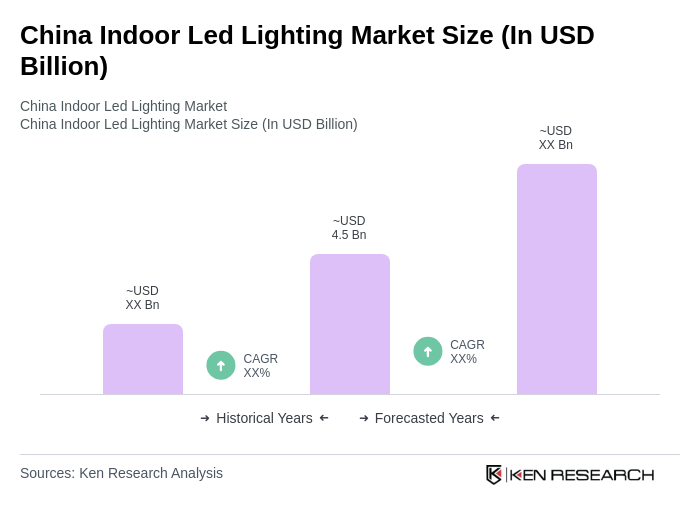
China Indoor LED Lighting Market, valued at USD 4.5 Bn, is driven by demand for energy-efficient solutions, urbanization, and smart lighting trends, with strong growth projected to 2030.

Region:Asia

Author(s):Dev

Product Code:KRAC0384

Pages:85

Published On:August 2025
About the Report

Base Year 2024

China Indoor Led Lighting Market Overview

  • The China Indoor LED Lighting Market is valued at USD 4.5 billion, based on a five-year historical analysis. This value aligns with recent industry assessments of the indoor segment within China’s LED market and reflects consolidation toward mature replacement demand and industrial applications.
  • Growth is primarily driven by increasing demand for energy?efficient lighting solutions, ongoing urbanization, and sustained policy support favoring LEDs over legacy lighting. China’s transition toward LEDs has been propelled by advantages such as long lifespan and lower energy consumption, alongside national initiatives that accelerated LED adoption across sectors.
  • Key cities such as Beijing, Shanghai, and Shenzhen lead demand due to high population density, large commercial real estate footprints, and heavy infrastructure investment that boost indoor installations in offices, retail, hospitality, healthcare, education, and logistics facilities.
  • In 2023, China continued enforcing energy-efficiency policies that prioritize LEDs through long?standing measures banning low?efficiency incandescent lamps and public?sector efficiency programs; policy direction remains aligned with reducing building energy use and supporting high?efficiency lighting adoption. While a single nationwide 2023 regulation mandating LEDs in all new public buildings and residences is not specifically evidenced, China’s prior bans on incandescent bulbs and government efficiency mandates underpin ongoing LED penetration.
China Indoor Led Lighting Market Size

China Indoor Led Lighting Market Segmentation

By Type:The market comprises LED bulbs, panels, downlights, strips/linear, luminaires/fixtures, tubes, and smart connected LEDs. Each serves distinct applications across residential, commercial, and industrial settings. Demand for smart and connected LED solutions is rising with home and building automation (Zigbee, Wi?Fi, Bluetooth Mesh) and energy management use cases in offices, retail, and warehouses.
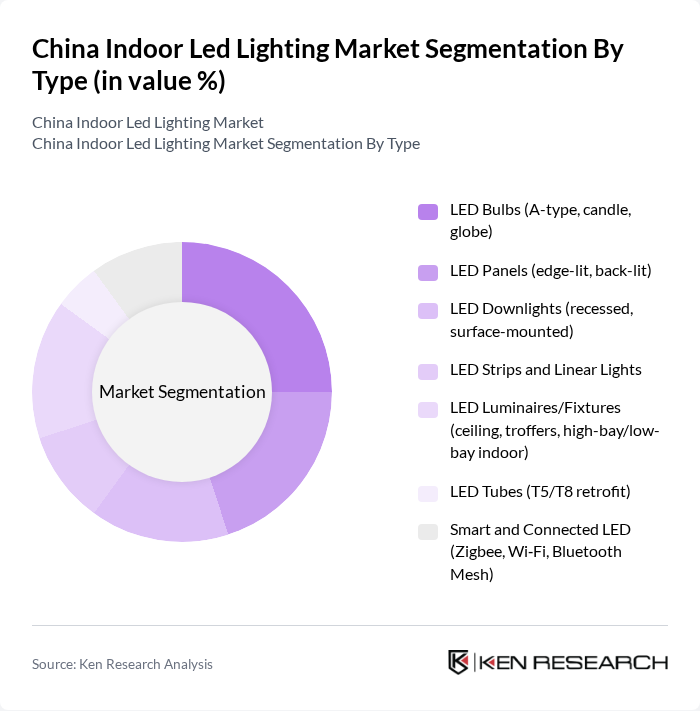
China Indoor Led Lighting Market segmentation by Type.

By End-User:The end-user segmentation includes residential, commercial, industrial, government, and agricultural sectors. Each segment has unique lighting requirements, with commercial and residential sectors leading the demand due to ongoing urban development and the growing trend of smart homes. The industrial sector is also witnessing increased adoption of LED lighting for energy efficiency and cost savings.
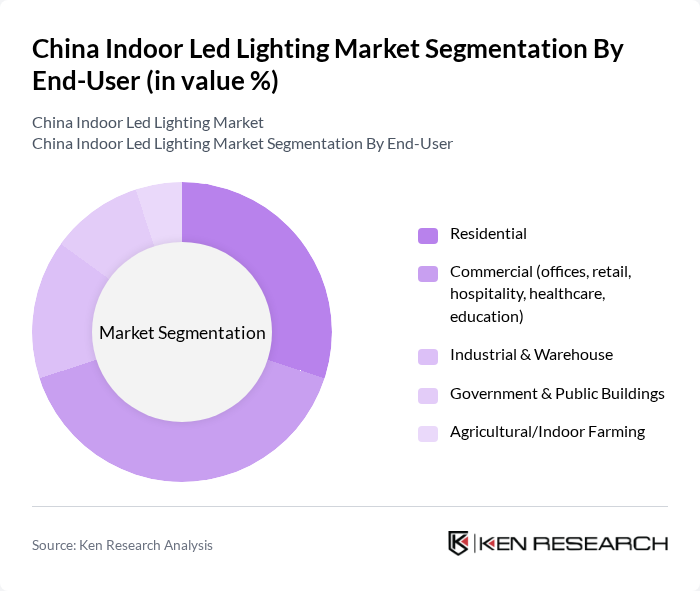
China Indoor Led Lighting Market segmentation by End-User.

China Indoor Led Lighting Market Competitive Landscape

The China Indoor Led Lighting Market features a mix of international and Chinese vendors shaping product innovation, channels, and service models. Leading participants include Signify N.V. (Philips Lighting), OSRAM GmbH (ams OSRAM), Cree Lighting (IDEAL INDUSTRIES, Inc.), GE Lighting, a Savant company, Acuity Brands, Inc., Eaton Corporation (Cooper Lighting Solutions), Panasonic Corporation, Toshiba Corporation, Samsung Electronics Co., Ltd., LG Electronics Inc., Opple Lighting Co., Ltd. (????), NVC Lighting Technology Corporation (????), Foshan Electrical and Lighting Co., Ltd. (FSL, ????), Yankon Group Co., Ltd. (Zhejiang Yankon, ????), TCL Zhongshan Huayi Lighting Co., Ltd. (????) contribute to innovation, geographic expansion, and service delivery in this space.

Signify N.V. (Philips Lighting)

1891

Amsterdam, Netherlands

OSRAM GmbH

1919

Munich, Germany

Cree Lighting

1987

Durham, North Carolina, USA

GE Lighting

1892

Cleveland, Ohio, USA

Acuity Brands, Inc.

2001

Atlanta, Georgia, USA

Company

Establishment Year

Headquarters

Group Size (Large, Medium, Small)

China Indoor LED Revenue (USD, latest FY)

China Indoor LED Revenue Growth Rate (YoY, %)

Indoor Market Share in China (%)

Installed Base Added (mn units, latest FY)

ASP for Key Indoor Products (USD/unit)

China Indoor Led Lighting Market Industry Analysis

Growth Drivers

  • Increasing Energy Efficiency Demand:The demand for energy-efficient lighting solutions in China is surging, driven by the country's commitment to reducing energy consumption. In future, China's energy consumption is projected to reach approximately 7,000 terawatt-hours (TWh), with a significant portion attributed to lighting. The shift towards LED technology, which consumes up to 80% less energy than traditional incandescent bulbs, is expected to contribute to a reduction of 1,400 TWh in energy usage, aligning with national energy efficiency goals.
  • Government Initiatives for Green Lighting:The Chinese government has implemented various initiatives to promote green lighting solutions, including subsidies and tax incentives. In future, the government plans to allocate around 20 billion yuan (approximately $3.1 billion) to support the adoption of LED lighting in public infrastructure. This funding is part of a broader strategy to achieve a 30% reduction in carbon emissions by 2030, fostering a favorable environment for LED market growth.
  • Rising Urbanization and Infrastructure Development:Urbanization in China is accelerating, with the urban population expected to reach 1.2 billion in future. This rapid urban growth necessitates significant infrastructure development, including residential and commercial buildings. The construction of approximately 12 million new housing units in urban areas will drive the demand for indoor LED lighting solutions, estimated to require around 600 million LED units, further propelling market expansion.

Market Challenges

  • High Initial Investment Costs:Despite the long-term savings associated with LED lighting, the high initial investment costs remain a significant barrier for many consumers and businesses. The average cost of installing LED lighting in commercial spaces can exceed 1.2 million yuan (approximately $180,000), which deters adoption. This challenge is particularly pronounced in smaller enterprises, where budget constraints limit the ability to invest in energy-efficient technologies.
  • Intense Competition Among Manufacturers:The Chinese indoor LED lighting market is characterized by intense competition, with over 1,200 manufacturers vying for market share. This saturation leads to price wars, driving down profit margins. In future, the average selling price of LED lighting products is expected to decrease by 12%, further complicating the landscape for manufacturers. Companies must innovate continuously to differentiate their products and maintain profitability in this competitive environment.

China Indoor Led Lighting Market Future Outlook

The future of the China indoor LED lighting market appears promising, driven by technological advancements and increasing consumer awareness of energy efficiency. As smart home technologies gain traction, the integration of LED lighting with IoT devices is expected to enhance user experience and convenience. Additionally, the growing emphasis on sustainability will likely lead to further innovations in eco-friendly lighting solutions, positioning the market for robust growth in the coming years.

Market Opportunities

  • Expansion into Rural Markets:With approximately 700 million people living in rural areas, there is a significant opportunity for LED lighting manufacturers to penetrate these markets. The government’s rural electrification initiatives, which aim to provide electricity to 40 million households in future, will create demand for affordable and energy-efficient lighting solutions, presenting a lucrative opportunity for growth.
  • Development of Smart Lighting Solutions:The increasing adoption of smart home technologies presents a unique opportunity for the LED lighting market. In future, it is estimated that smart lighting solutions will account for 30% of the total LED market. Manufacturers can capitalize on this trend by developing products that integrate seamlessly with smart home systems, enhancing user convenience and energy management.

Scope of the Report

SegmentSub-Segments
By Type

LED Bulbs (A-type, candle, globe)

LED Panels (edge-lit, back-lit)

LED Downlights (recessed, surface-mounted)

LED Strips and Linear Lights

LED Luminaires/Fixtures (ceiling, troffers, high-bay/low-bay indoor)

LED Tubes (T5/T8 retrofit)

Smart and Connected LED (Zigbee, Wi?Fi, Bluetooth Mesh)

By End-User

Residential

Commercial (offices, retail, hospitality, healthcare, education)

Industrial & Warehouse

Government & Public Buildings

Agricultural/Indoor Farming

By Application

Ambient/General Lighting

Task Lighting

Decorative/Accent Lighting

Horticulture Grow Lighting (indoor)

By Distribution Channel

Online (e-commerce, brand stores)

Offline (distributors, electrical wholesalers, modern retail)

Direct/Project Sales (B2B, EPC/contractors)

By Price Range

Budget

Mid-Range

Premium/Professional

By Brand

Domestic Brands

Private Labels

International Brands

By Policy Support

Subsidies & Retrofit Programs

Tax Incentives

Standards & Regulatory Compliance Support

Key Target Audience

Investors and Venture Capitalist Firms

Government and Regulatory Bodies (e.g., Ministry of Industry and Information Technology, National Development and Reform Commission)

Manufacturers and Producers

Distributors and Retailers

Lighting Design Firms

Energy Efficiency Organizations

Construction and Real Estate Developers

Utility Companies and Energy Providers

Players Mentioned in the Report:

Signify N.V. (Philips Lighting)

OSRAM GmbH (ams OSRAM)

Cree Lighting (IDEAL INDUSTRIES, Inc.)

GE Lighting, a Savant company

Acuity Brands, Inc.

Eaton Corporation (Cooper Lighting Solutions)

Panasonic Corporation

Toshiba Corporation

Samsung Electronics Co., Ltd.

LG Electronics Inc.

Opple Lighting Co., Ltd. ()

NVC Lighting Technology Corporation ()

Foshan Electrical and Lighting Co., Ltd. (FSL, )

Yankon Group Co., Ltd. (Zhejiang Yankon, )

TCL Zhongshan Huayi Lighting Co., Ltd. ()

Table of Contents

Market Assessment Phase

1. Executive Summary and Approach


2. China Indoor Led Lighting Market Overview

2.1 Key Insights and Strategic Recommendations

2.2 China Indoor Led Lighting Market Overview

2.3 Definition and Scope

2.4 Evolution of Market Ecosystem

2.5 Timeline of Key Regulatory Milestones

2.6 Value Chain & Stakeholder Mapping

2.7 Business Cycle Analysis

2.8 Policy & Incentive Landscape


3. China Indoor Led Lighting Market Analysis

3.1 Growth Drivers

3.1.1 Increasing Energy Efficiency Demand
3.1.2 Government Initiatives for Green Lighting
3.1.3 Rising Urbanization and Infrastructure Development
3.1.4 Technological Advancements in LED Technology

3.2 Market Challenges

3.2.1 High Initial Investment Costs
3.2.2 Intense Competition Among Manufacturers
3.2.3 Regulatory Compliance and Standards
3.2.4 Market Saturation in Urban Areas

3.3 Market Opportunities

3.3.1 Expansion into Rural Markets
3.3.2 Development of Smart Lighting Solutions
3.3.3 Integration with Renewable Energy Sources
3.3.4 Growing Demand for Customizable Lighting Solutions

3.4 Market Trends

3.4.1 Shift Towards Smart Home Integration
3.4.2 Increasing Adoption of IoT in Lighting
3.4.3 Focus on Sustainable and Eco-Friendly Products
3.4.4 Rise of Online Sales Channels

3.5 Government Regulation

3.5.1 Energy Efficiency Standards
3.5.2 Subsidies for LED Adoption
3.5.3 Environmental Protection Regulations
3.5.4 Import Tariffs on Lighting Products

4. SWOT Analysis


5. Stakeholder Analysis


6. Porter's Five Forces Analysis


7. China Indoor Led Lighting Market Market Size, 2019-2024

7.1 By Value

7.2 By Volume

7.3 By Average Selling Price


8. China Indoor Led Lighting Market Segmentation

8.1 By Type

8.1.1 LED Bulbs (A-type, candle, globe)
8.1.2 LED Panels (edge-lit, back-lit)
8.1.3 LED Downlights (recessed, surface-mounted)
8.1.4 LED Strips and Linear Lights
8.1.5 LED Luminaires/Fixtures (ceiling, troffers, high-bay/low-bay indoor)
8.1.6 LED Tubes (T5/T8 retrofit)
8.1.7 Smart and Connected LED (Zigbee, Wi?Fi, Bluetooth Mesh)

8.2 By End-User

8.2.1 Residential
8.2.2 Commercial (offices, retail, hospitality, healthcare, education)
8.2.3 Industrial & Warehouse
8.2.4 Government & Public Buildings
8.2.5 Agricultural/Indoor Farming

8.3 By Application

8.3.1 Ambient/General Lighting
8.3.2 Task Lighting
8.3.3 Decorative/Accent Lighting
8.3.4 Horticulture Grow Lighting (indoor)

8.4 By Distribution Channel

8.4.1 Online (e-commerce, brand stores)
8.4.2 Offline (distributors, electrical wholesalers, modern retail)
8.4.3 Direct/Project Sales (B2B, EPC/contractors)

8.5 By Price Range

8.5.1 Budget
8.5.2 Mid-Range
8.5.3 Premium/Professional

8.6 By Brand

8.6.1 Domestic Brands
8.6.2 Private Labels
8.6.3 International Brands

8.7 By Policy Support

8.7.1 Subsidies & Retrofit Programs
8.7.2 Tax Incentives
8.7.3 Standards & Regulatory Compliance Support

9. China Indoor Led Lighting Market Competitive Analysis

9.1 Market Share of Key Players

9.2 KPIs for Cross Comparison of Key Players

9.2.1 Company Name
9.2.2 Group Size (Large, Medium, Small)
9.2.3 China Indoor LED Revenue (USD, latest FY)
9.2.4 China Indoor LED Revenue Growth Rate (YoY, %)
9.2.5 Indoor Market Share in China (%)
9.2.6 Installed Base Added (mn units, latest FY)
9.2.7 ASP for Key Indoor Products (USD/unit)
9.2.8 Gross Margin (%) on Indoor Portfolio
9.2.9 R&D Intensity (% of revenue)
9.2.10 New Product Launches (count, last 12 months)
9.2.11 Smart/Connected Mix (% of indoor sales)
9.2.12 Channel Mix (% online, % offline distribution, % direct/project)
9.2.13 Project Win Rate in B2B Tenders (%)
9.2.14 On-time Delivery Rate (%)
9.2.15 Warranty Claim Rate (% of shipped units)
9.2.16 Customer Satisfaction (NPS/CSAT)
9.2.17 Geographic Coverage (provinces/cities served)
9.2.18 ESG/Energy Efficiency Certifications (count of SKUs meeting GB/CCC, DLC equivalent)

9.3 SWOT Analysis of Top Players

9.4 Pricing Analysis

9.5 Detailed Profile of Major Companies

9.5.1 Signify N.V. (Philips Lighting)
9.5.2 OSRAM GmbH (ams OSRAM)
9.5.3 Cree Lighting (IDEAL INDUSTRIES, Inc.)
9.5.4 GE Lighting, a Savant company
9.5.5 Acuity Brands, Inc.
9.5.6 Eaton Corporation (Cooper Lighting Solutions)
9.5.7 Panasonic Corporation
9.5.8 Toshiba Corporation
9.5.9 Samsung Electronics Co., Ltd.
9.5.10 LG Electronics Inc.
9.5.11 Opple Lighting Co., Ltd. (????)
9.5.12 NVC Lighting Technology Corporation (????)
9.5.13 Foshan Electrical and Lighting Co., Ltd. (FSL, ????)
9.5.14 Yankon Group Co., Ltd. (Zhejiang Yankon, ????)
9.5.15 TCL Zhongshan Huayi Lighting Co., Ltd. (????)

10. China Indoor Led Lighting Market End-User Analysis

10.1 Procurement Behavior of Key Ministries

10.1.1 Government Procurement Policies
10.1.2 Budget Allocation Trends
10.1.3 Decision-Making Processes

10.2 Corporate Spend on Infrastructure & Energy

10.2.1 Investment Trends in Energy Efficiency
10.2.2 Budgeting for Lighting Solutions
10.2.3 Long-term Infrastructure Planning

10.3 Pain Point Analysis by End-User Category

10.3.1 Cost Management Issues
10.3.2 Quality and Reliability Concerns
10.3.3 Integration Challenges with Existing Systems

10.4 User Readiness for Adoption

10.4.1 Awareness of LED Benefits
10.4.2 Training and Support Needs
10.4.3 Adoption Barriers

10.5 Post-Deployment ROI and Use Case Expansion

10.5.1 Measurement of Energy Savings
10.5.2 User Feedback and Improvement Areas
10.5.3 Potential for Upgrades and Add-ons

11. China Indoor Led Lighting Market Future Size, 2025-2030

11.1 By Value

11.2 By Volume

11.3 By Average Selling Price


Go-To-Market Strategy Phase

1. Whitespace Analysis + Business Model Canvas

1.1 Market Gaps Identification

1.2 Business Model Development


2. Marketing and Positioning Recommendations

2.1 Branding Strategies

2.2 Product USPs


3. Distribution Plan

3.1 Urban Retail Strategies

3.2 Rural NGO Tie-ups


4. Channel & Pricing Gaps

4.1 Underserved Routes

4.2 Pricing Bands Analysis


5. Unmet Demand & Latent Needs

5.1 Category Gaps

5.2 Consumer Segments


6. Customer Relationship

6.1 Loyalty Programs

6.2 After-sales Service


7. Value Proposition

7.1 Sustainability Initiatives

7.2 Integrated Supply Chains


8. Key Activities

8.1 Regulatory Compliance

8.2 Branding Efforts

8.3 Distribution Setup


9. Entry Strategy Evaluation

9.1 Domestic Market Entry Strategy

9.1.1 Product Mix Considerations
9.1.2 Pricing Band Strategy
9.1.3 Packaging Solutions

9.2 Export Entry Strategy

9.2.1 Target Countries
9.2.2 Compliance Roadmap

10. Entry Mode Assessment

10.1 Joint Ventures

10.2 Greenfield Investments

10.3 Mergers & Acquisitions

10.4 Distributor Model


11. Capital and Timeline Estimation

11.1 Capital Requirements

11.2 Timelines for Implementation


12. Control vs Risk Trade-Off

12.1 Ownership Considerations

12.2 Partnerships Evaluation


13. Profitability Outlook

13.1 Breakeven Analysis

13.2 Long-term Sustainability Strategies


14. Potential Partner List

14.1 Distributors

14.2 Joint Ventures

14.3 Acquisition Targets


15. Execution Roadmap

15.1 Phased Plan for Market Entry

15.1.1 Market Setup
15.1.2 Market Entry
15.1.3 Growth Acceleration
15.1.4 Scale & Stabilize

15.2 Key Activities and Milestones

15.2.1 Activity Planning
15.2.2 Milestone Tracking

Research Methodology

ApproachModellingSample

Phase 1: Approach1

Desk Research

  • Analysis of market reports from industry associations such as the China Lighting Association
  • Review of government publications and energy efficiency regulations impacting LED lighting
  • Examination of trade statistics and import/export data related to LED lighting products

Primary Research

  • Interviews with key stakeholders in the LED lighting supply chain, including manufacturers and distributors
  • Surveys targeting end-users in commercial and residential sectors to gauge adoption rates and preferences
  • Focus group discussions with lighting designers and architects to understand market trends and innovations

Validation & Triangulation

  • Cross-validation of findings through multiple data sources, including sales data and market forecasts
  • Triangulation of insights from primary interviews with secondary research findings
  • Sanity checks conducted through expert panel reviews comprising industry veterans and market analysts

Phase 2: Market Size Estimation1

Top-down Assessment

  • Estimation of the overall market size based on national energy consumption statistics and LED penetration rates
  • Segmentation of the market by application areas such as commercial, industrial, and residential lighting
  • Incorporation of growth projections from government initiatives promoting energy-efficient lighting solutions

Bottom-up Modeling

  • Collection of sales data from leading LED manufacturers and distributors in China
  • Estimation of average selling prices (ASPs) across different LED product categories
  • Calculation of market size based on unit sales multiplied by ASPs for each segment

Forecasting & Scenario Analysis

  • Development of forecasting models using historical sales data and market growth trends
  • Scenario analysis based on potential regulatory changes and technological advancements in LED lighting
  • Creation of multiple growth scenarios (baseline, optimistic, and pessimistic) through 2030

Phase 3: CATI Sample Composition1

Scope Item/SegmentSample SizeTarget Respondent Profiles
Commercial Lighting Solutions120Facility Managers, Procurement Officers
Residential LED Adoption100Homeowners, Interior Designers
Industrial LED Applications90Operations Managers, Safety Officers
Smart Lighting Technologies70Technology Officers, Product Managers
Energy Efficiency Programs80Energy Auditors, Sustainability Consultants

Frequently Asked Questions

What is the current value of the China Indoor LED Lighting Market?

The China Indoor LED Lighting Market is valued at approximately USD 4.5 billion, reflecting a five-year historical analysis. This valuation indicates a strong demand for energy-efficient lighting solutions and aligns with industry assessments of the indoor segment within China's LED market.

What factors are driving the growth of the China Indoor LED Lighting Market?

Which cities in China lead the demand for indoor LED lighting?

What government initiatives support the adoption of LED lighting in China?

Other Regional/Country Reports

Indonesia Indoor Led Lighting Market

Malaysia Indoor Led Lighting Market

KSA Indoor Led Lighting Market

APAC Indoor Led Lighting Market

SEA Indoor Led Lighting Market

Vietnam Indoor Led Lighting Market

Why Buy From Us?

Refine Robust Result (RRR) Framework

What makes us stand out is that our consultants follow Robust, Refine and Result (RRR) methodology. Robust for clear definitions, approaches and sanity checking, Refine for differentiating respondents' facts and opinions, and Result for presenting data with story.

Our Reach Is Unmatched

We have set a benchmark in the industry by offering our clients with syndicated and customized market research reports featuring coverage of entire market as well as meticulous research and analyst insights.

Shifting the Research Paradigm

While we don't replace traditional research, we flip the method upside down. Our dual approach of Top Bottom & Bottom Top ensures quality deliverable by not just verifying company fundamentals but also looking at the sector and macroeconomic factors.

More Insights-Better Decisions

With one step in the future, our research team constantly tries to show you the bigger picture. We help with some of the tough questions you may encounter along the way: How is the industry positioned? Best marketing channel? KPI's of competitors? By aligning every element, we help maximize success.

Transparency and Trust

Our report gives you instant access to the answers and sources that other companies might choose to hide. We elaborate each steps of research methodology we have used and showcase you the sample size to earn your trust.

Round the Clock Support

If you need any support, we are here! We pride ourselves on universe strength, data quality, and quick, friendly, and professional service.

Why Clients Choose Us?

400000+
Reports in repository
150+
Consulting projects a year
100+
Analysts
8000+
Client Queries in 2022








