About the Report
Base Year 2024China Kiosk Market Overview
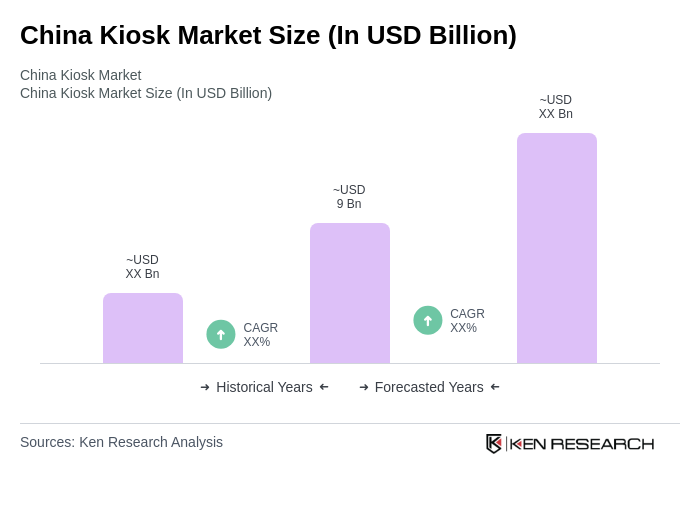
- The China Kiosk Market is valued at USD 9 billion, based on a five-year historical analysis. This growth is primarily driven by the increasing demand for self-service solutions across various sectors, including retail, healthcare, and transportation. The rise in consumer preference for contactless transactions, the proliferation of digital payment users, and the expansion of smart city initiatives have significantly contributed to the market's expansion. Notably, consumer expenditure on automated services has surged, and kiosk installations have increased substantially in recent years .
- Key cities such as Beijing, Shanghai, and Shenzhen continue to dominate the market due to their high population density, rapid urbanization, and status as technological hubs. These cities foster innovation and adoption of advanced kiosk solutions, supported by robust digital infrastructure and the presence of major corporations. However, rapid economic growth and government investment are also driving significant expansion in tier 2 and tier 3 cities, where smart city projects and digital public services are accelerating kiosk adoption .
- Recent government initiatives under the Digital China policy and the 14th Five-Year Plan have promoted the use of self-service kiosks in public spaces, aiming to enhance operational efficiency and reduce wait times in sectors such as transportation and healthcare. These policies have led to a notable increase in smart service points and digital infrastructure, further streamlining service delivery across urban and less urbanized regions .
China Kiosk Market Segmentation
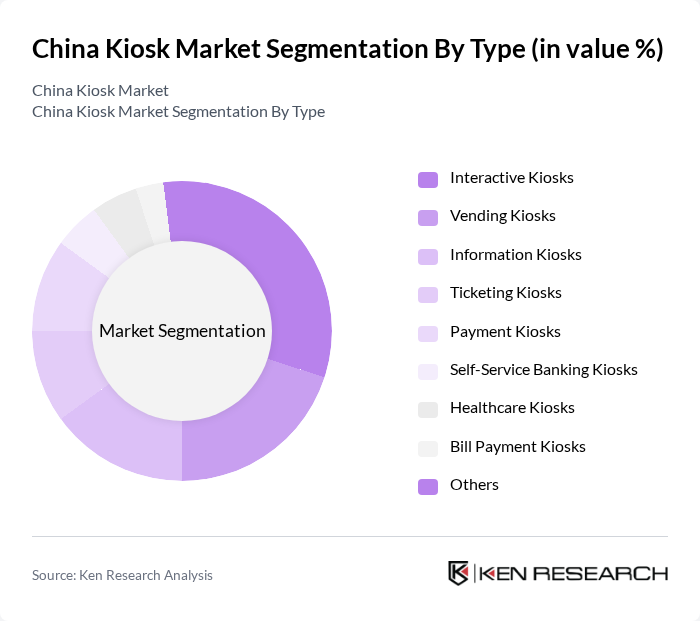
By Type:The kiosk market is segmented into Interactive Kiosks, Vending Kiosks, Information Kiosks, Ticketing Kiosks, Payment Kiosks, Self-Service Banking Kiosks, Healthcare Kiosks, Bill Payment Kiosks, and Others. Among these,Interactive Kioskslead the market due to their versatility and high user engagement. They are extensively deployed in retail and hospitality sectors, offering personalized experiences, digital product catalogs, and streamlined check-in/check-out processes. Vending Kiosks are also gaining traction, especially in urban and transit environments, due to the increasing demand for automated retail and food services .
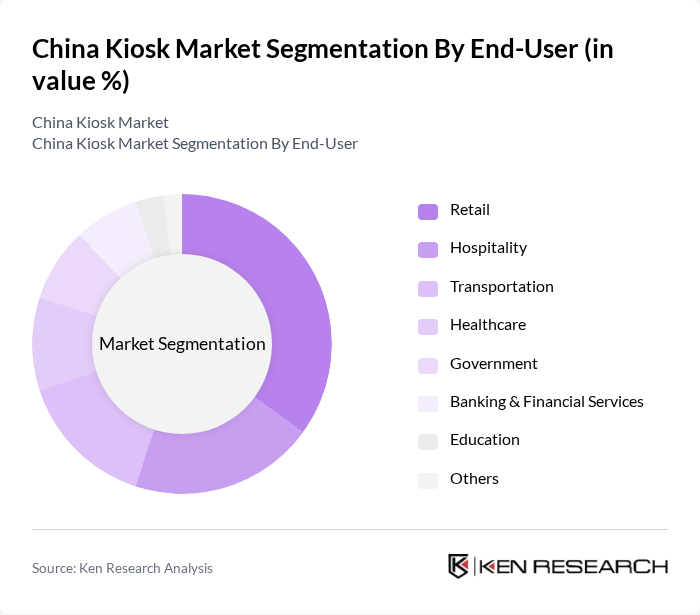
By End-User:The end-user segmentation includes Retail, Hospitality, Transportation, Healthcare, Government, Banking & Financial Services, Education, and Others. TheRetail sectorremains the largest end-user of kiosks, driven by the need for enhanced customer service, omnichannel engagement, and operational efficiency. Retailers are increasingly adopting kiosks for self-service checkout, digital product browsing, and loyalty program management. The Hospitality and Transportation sectors are also witnessing rapid kiosk adoption for automated check-in, ticketing, and information services .
China Kiosk Market Competitive Landscape
The China Kiosk Market is characterized by a dynamic mix of regional and international players. Leading participants such as GRG Banking Equipment Co., Ltd., Shanghai Sunmi Technology Co., Ltd., Shenzhen Justtide Tech Co., Ltd., Beijing KEMAS Technology Co., Ltd., Guangzhou Liandong Intelligent Information Technology Co., Ltd. (Laud Intelligent), Shenzhen Yihua Computer Co., Ltd., Diebold Nixdorf, NCR Corporation, Fujitsu (China) Holdings Co., Ltd., Hitachi Terminal Solutions (China) Co., Ltd., Advantech Co., Ltd., Beijing Sunyard System Engineering Co., Ltd., Shenzhen Zhengtong Electronics Co., Ltd., Eastcompeace Technology Co., Ltd., Shanghai HiStone Information Technology Co., Ltd. contribute to innovation, geographic expansion, and service delivery in this space.
China Kiosk Market Industry Analysis
Growth Drivers
- Increasing Demand for Self-Service Solutions:The demand for self-service kiosks in China is projected to rise significantly, driven by a growing consumer preference for convenience. In future, the retail sector is expected to reach approximately CNY 46 trillion, with self-service solutions capturing a notable share. This shift is supported by a 16% increase in consumer spending on digital services, highlighting the trend towards automation and self-service in various industries, including retail and hospitality.
- Expansion of Retail and Hospitality Sectors:China's retail and hospitality sectors are experiencing robust growth, with retail sales expected to exceed CNY 46 trillion in future. This expansion is accompanied by a projected 11% increase in the number of retail outlets and hotels, creating a favorable environment for kiosk deployment. The hospitality sector alone is anticipated to grow by 9%, further driving the need for efficient self-service solutions to enhance customer experience and operational efficiency.
- Technological Advancements in Kiosk Solutions:The kiosk market is benefiting from rapid technological advancements, particularly in AI and machine learning. In future, the integration of advanced technologies is expected to enhance kiosk functionalities, with an estimated 22% of kiosks incorporating AI-driven features. This trend is supported by a 13% increase in R&D spending in the tech sector, fostering innovation and improving user interaction, thereby driving market growth.
Market Challenges
- High Initial Investment Costs:One of the significant challenges facing the kiosk market in China is the high initial investment required for deployment. The average cost of a kiosk can range from CNY 32,000 to CNY 102,000, depending on the technology and features. This financial barrier can deter small and medium-sized enterprises from adopting kiosk solutions, limiting market penetration and growth potential in various sectors.
- Regulatory Compliance Issues:Navigating regulatory compliance poses a challenge for kiosk operators in China. With stringent data privacy laws and health regulations, companies must invest considerable resources to ensure compliance. In future, the cost of compliance is projected to increase by 16%, impacting operational budgets. Failure to adhere to these regulations can result in significant fines and reputational damage, further complicating market entry for new players.
China Kiosk Market Future Outlook
The future of the kiosk market in China appears promising, driven by technological advancements and increasing consumer acceptance of self-service solutions. As the retail and hospitality sectors continue to expand, the integration of AI and machine learning will enhance user experiences, making kiosks more efficient and appealing. Additionally, the push for digitalization by the government will likely create a conducive environment for kiosk adoption, fostering innovation and growth in this sector.
Market Opportunities
- Growth in E-commerce and Online Services:The surge in e-commerce, projected to reach CNY 22 trillion in future, presents a significant opportunity for kiosks. Retailers can leverage kiosks to facilitate online order pickups and returns, enhancing customer convenience and driving foot traffic to physical stores.
- Partnerships with Technology Providers:Collaborating with technology providers can unlock new capabilities for kiosk operators. By integrating cutting-edge technologies, such as contactless payment systems and advanced analytics, kiosks can offer enhanced services, improving customer engagement and operational efficiency, thus capturing a larger market share.
Scope of the Report
| Segment | Sub-Segments |
|---|---|
| By Type | Interactive Kiosks Vending Kiosks Information Kiosks Ticketing Kiosks Payment Kiosks Self-Service Banking Kiosks Healthcare Kiosks Bill Payment Kiosks Others |
| By End-User | Retail Hospitality Transportation Healthcare Government Banking & Financial Services Education Others |
| By Application | Customer Service Information Dissemination Payment Processing Ticketing and Reservations Product Dispensing Account Opening & Card Issuance Others |
| By Deployment Location | Indoor Kiosks Outdoor Kiosks Others |
| By Distribution Channel | Online Sales Direct Sales Retail Partnerships Distributors Others |
| By Price Range | Low-End Kiosks Mid-Range Kiosks High-End Kiosks Others |
| By Technology | Touchscreen Technology Non-Touch Technology Cloud-Based Solutions AI Integration IoT-Enabled Kiosks Others |
| By User Interface | Multilingual Interfaces Voice-Activated Interfaces Visual Recognition Interfaces Others |
Key Target Audience
Investors and Venture Capitalist Firms
Government and Regulatory Bodies (e.g., Ministry of Industry and Information Technology, National Development and Reform Commission)
Manufacturers and Producers
Distributors and Retailers
Technology Providers
Industry Associations (e.g., China Electronic Chamber of Commerce)
Financial Institutions
Advertising and Marketing Agencies
Players Mentioned in the Report:
GRG Banking Equipment Co., Ltd.
Shanghai Sunmi Technology Co., Ltd.
Shenzhen Justtide Tech Co., Ltd.
Beijing KEMAS Technology Co., Ltd.
Guangzhou Liandong Intelligent Information Technology Co., Ltd. (Laud Intelligent)
Shenzhen Yihua Computer Co., Ltd.
Diebold Nixdorf
NCR Corporation
Fujitsu (China) Holdings Co., Ltd.
Hitachi Terminal Solutions (China) Co., Ltd.
Advantech Co., Ltd.
Beijing Sunyard System Engineering Co., Ltd.
Shenzhen Zhengtong Electronics Co., Ltd.
Eastcompeace Technology Co., Ltd.
Shanghai HiStone Information Technology Co., Ltd.
Table of Contents
Market Assessment Phase
1. Executive Summary and Approach
2. China Kiosk Market Overview
2.1 Key Insights and Strategic Recommendations
2.2 China Kiosk Market Overview
2.3 Definition and Scope
2.4 Evolution of Market Ecosystem
2.5 Timeline of Key Regulatory Milestones
2.6 Value Chain & Stakeholder Mapping
2.7 Business Cycle Analysis
2.8 Policy & Incentive Landscape
3. China Kiosk Market Analysis
3.1 Growth Drivers
3.1.1 Increasing Demand for Self-Service Solutions
3.1.2 Expansion of Retail and Hospitality Sectors
3.1.3 Technological Advancements in Kiosk Solutions
3.1.4 Government Initiatives Promoting Digitalization
3.2 Market Challenges
3.2.1 High Initial Investment Costs
3.2.2 Regulatory Compliance Issues
3.2.3 Limited Consumer Awareness
3.2.4 Competition from Traditional Service Channels
3.3 Market Opportunities
3.3.1 Growth in E-commerce and Online Services
3.3.2 Integration of AI and Machine Learning
3.3.3 Expansion into Untapped Markets
3.3.4 Partnerships with Technology Providers
3.4 Market Trends
3.4.1 Rise of Contactless Payment Solutions
3.4.2 Customization and Personalization of Kiosks
3.4.3 Increased Focus on User Experience
3.4.4 Sustainability and Eco-Friendly Kiosk Solutions
3.5 Government Regulation
3.5.1 Data Privacy Regulations
3.5.2 Health and Safety Standards
3.5.3 Digital Payment Regulations
3.5.4 Accessibility Compliance
4. SWOT Analysis
5. Stakeholder Analysis
6. Porter's Five Forces Analysis
7. China Kiosk Market Market Size, 2019-2024
7.1 By Value
7.2 By Volume
7.3 By Average Selling Price
8. China Kiosk Market Segmentation
8.1 By Type
8.1.1 Interactive Kiosks
8.1.2 Vending Kiosks
8.1.3 Information Kiosks
8.1.4 Ticketing Kiosks
8.1.5 Payment Kiosks
8.1.6 Self-Service Banking Kiosks
8.1.7 Healthcare Kiosks
8.1.8 Bill Payment Kiosks
8.1.9 Others
8.2 By End-User
8.2.1 Retail
8.2.2 Hospitality
8.2.3 Transportation
8.2.4 Healthcare
8.2.5 Government
8.2.6 Banking & Financial Services
8.2.7 Education
8.2.8 Others
8.3 By Application
8.3.1 Customer Service
8.3.2 Information Dissemination
8.3.3 Payment Processing
8.3.4 Ticketing and Reservations
8.3.5 Product Dispensing
8.3.6 Account Opening & Card Issuance
8.3.7 Others
8.4 By Deployment Location
8.4.1 Indoor Kiosks
8.4.2 Outdoor Kiosks
8.4.3 Others
8.5 By Distribution Channel
8.5.1 Online Sales
8.5.2 Direct Sales
8.5.3 Retail Partnerships
8.5.4 Distributors
8.5.5 Others
8.6 By Price Range
8.6.1 Low-End Kiosks
8.6.2 Mid-Range Kiosks
8.6.3 High-End Kiosks
8.6.4 Others
8.7 By Technology
8.7.1 Touchscreen Technology
8.7.2 Non-Touch Technology
8.7.3 Cloud-Based Solutions
8.7.4 AI Integration
8.7.5 IoT-Enabled Kiosks
8.7.6 Others
8.8 By User Interface
8.8.1 Multilingual Interfaces
8.8.2 Voice-Activated Interfaces
8.8.3 Visual Recognition Interfaces
8.8.4 Others
9. China Kiosk Market Competitive Analysis
9.1 Market Share of Key Players
9.2 Cross Comparison of Key Players
9.2.1 Company Name
9.2.2 Group Size (Large, Medium, or Small as per industry convention)
9.2.3 Revenue (RMB/Year)
9.2.4 Revenue Growth Rate (%)
9.2.5 Market Share (%)
9.2.6 Installed Base (Units in China)
9.2.7 Market Penetration Rate (%)
9.2.8 Customer Retention Rate (%)
9.2.9 Average Deal Size (RMB)
9.2.10 Pricing Strategy (Premium/Value/Cost Leadership)
9.2.11 Product Innovation Rate (New Models/Year)
9.2.12 R&D Spend (% of Revenue)
9.2.13 Operational Efficiency (Units/Employee)
9.2.14 Customer Satisfaction Score (NPS or Equivalent)
9.2.15 Brand Recognition (Survey/Ranking)
9.3 SWOT Analysis of Top Players
9.4 Pricing Analysis
9.5 Detailed Profile of Major Companies
9.5.1 GRG Banking Equipment Co., Ltd.
9.5.2 Shanghai Sunmi Technology Co., Ltd.
9.5.3 Shenzhen Justtide Tech Co., Ltd.
9.5.4 Beijing KEMAS Technology Co., Ltd.
9.5.5 Guangzhou Liandong Intelligent Information Technology Co., Ltd. (Laud Intelligent)
9.5.6 Shenzhen Yihua Computer Co., Ltd.
9.5.7 Diebold Nixdorf
9.5.8 NCR Corporation
9.5.9 Fujitsu (China) Holdings Co., Ltd.
9.5.10 Hitachi Terminal Solutions (China) Co., Ltd.
9.5.11 Advantech Co., Ltd.
9.5.12 Beijing Sunyard System Engineering Co., Ltd.
9.5.13 Shenzhen Zhengtong Electronics Co., Ltd.
9.5.14 Eastcompeace Technology Co., Ltd.
9.5.15 Shanghai HiStone Information Technology Co., Ltd.
10. China Kiosk Market End-User Analysis
10.1 Procurement Behavior of Key Ministries
10.1.1 Budget Allocation Trends
10.1.2 Decision-Making Processes
10.1.3 Preferred Vendors
10.1.4 Procurement Timelines
10.2 Corporate Spend on Infrastructure & Energy
10.2.1 Investment Priorities
10.2.2 Spending Patterns
10.2.3 Budget Constraints
10.3 Pain Point Analysis by End-User Category
10.3.1 Common Challenges Faced
10.3.2 Service Gaps
10.3.3 Technology Adoption Barriers
10.4 User Readiness for Adoption
10.4.1 Training Requirements
10.4.2 User Feedback Mechanisms
10.4.3 Adoption Rates
10.5 Post-Deployment ROI and Use Case Expansion
10.5.1 ROI Measurement Techniques
10.5.2 Use Case Success Stories
10.5.3 Future Expansion Plans
11. China Kiosk Market Future Size, 2025-2030
11.1 By Value
11.2 By Volume
11.3 By Average Selling Price
Go-To-Market Strategy Phase
1. Whitespace Analysis + Business Model Canvas
1.1 Market Gaps Identification
1.2 Business Model Framework
2. Marketing and Positioning Recommendations
2.1 Branding Strategies
2.2 Product USPs
3. Distribution Plan
3.1 Urban Retail Strategies
3.2 Rural NGO Tie-Ups
4. Channel & Pricing Gaps
4.1 Underserved Routes
4.2 Pricing Bands
5. Unmet Demand & Latent Needs
5.1 Category Gaps
5.2 Consumer Segments
6. Customer Relationship
6.1 Loyalty Programs
6.2 After-Sales Service
7. Value Proposition
7.1 Sustainability Initiatives
7.2 Integrated Supply Chains
8. Key Activities
8.1 Regulatory Compliance
8.2 Branding Efforts
8.3 Distribution Setup
9. Entry Strategy Evaluation
9.1 Domestic Market Entry Strategy
9.1.1 Product Mix Considerations
9.1.2 Pricing Band Strategies
9.1.3 Packaging Approaches
9.2 Export Entry Strategy
9.2.1 Target Countries
9.2.2 Compliance Roadmap
10. Entry Mode Assessment
10.1 Joint Ventures
10.2 Greenfield Investments
10.3 Mergers & Acquisitions
10.4 Distributor Model
11. Capital and Timeline Estimation
11.1 Capital Requirements
11.2 Timelines for Implementation
12. Control vs Risk Trade-Off
12.1 Ownership Considerations
12.2 Partnerships Evaluation
13. Profitability Outlook
13.1 Breakeven Analysis
13.2 Long-Term Sustainability
14. Potential Partner List
14.1 Distributors
14.2 Joint Ventures
14.3 Acquisition Targets
15. Execution Roadmap
15.1 Phased Plan for Market Entry
15.1.1 Market Setup
15.1.2 Market Entry
15.1.3 Growth Acceleration
15.1.4 Scale & Stabilize
15.2 Key Activities and Milestones
15.2.1 Milestone Planning
15.2.2 Activity Tracking
Research Methodology
Phase 1: Approach1
Desk Research
- Analysis of industry reports from government agencies and market research firms
- Review of academic journals and publications focusing on kiosk technology and consumer behavior in China
- Examination of trade publications and news articles related to the kiosk market trends and innovations
Primary Research
- Interviews with key stakeholders in the kiosk manufacturing sector, including product managers and engineers
- Surveys conducted with end-users in retail and hospitality sectors to gauge user experience and preferences
- Focus groups with consumers to understand attitudes towards kiosk usage and technology adoption
Validation & Triangulation
- Cross-validation of findings through comparison with existing market data and forecasts
- Triangulation of insights from primary interviews with secondary data sources to ensure consistency
- Sanity checks through expert panel discussions to validate assumptions and findings
Phase 2: Market Size Estimation1
Top-down Assessment
- Estimation of total kiosk market size based on national retail and service sector revenues
- Segmentation of market size by kiosk type (e.g., information, payment, and interactive kiosks)
- Incorporation of growth rates from related sectors such as e-commerce and digital payments
Bottom-up Modeling
- Collection of sales data from leading kiosk manufacturers and service providers
- Estimation of average revenue per kiosk based on deployment in various sectors
- Analysis of installation and maintenance costs to derive profitability metrics
Forecasting & Scenario Analysis
- Development of growth scenarios based on technological advancements and consumer adoption rates
- Scenario modeling considering regulatory impacts and economic conditions in China
- Projections of market growth through 2030 under different market conditions
Phase 3: CATI Sample Composition1
| Scope Item/Segment | Sample Size | Target Respondent Profiles |
|---|---|---|
| Retail Kiosk Deployment | 120 | Store Managers, Retail Operations Directors |
| Hospitality Kiosk Usage | 90 | Hotel Managers, Guest Experience Coordinators |
| Healthcare Kiosk Implementation | 60 | Healthcare Administrators, IT Managers |
| Public Information Kiosks | 50 | City Planners, Public Relations Officers |
| Transportation Kiosk Services | 70 | Transport Managers, Customer Service Representatives |
Frequently Asked Questions
What is the current value of the China Kiosk Market?
The China Kiosk Market is valued at approximately USD 9 billion, reflecting significant growth driven by the increasing demand for self-service solutions across various sectors, including retail, healthcare, and transportation.
What factors are driving the growth of the China Kiosk Market?
Which cities are leading in kiosk adoption in China?
What types of kiosks are most popular in the China Kiosk Market?
Other Regional/Country Reports
Indonesia Kiosk Market
Malaysia Kiosk Market
KSA Kiosk Market
APAC Kiosk Market
SEA Kiosk Market
Why Buy From Us?

What makes us stand out is that our consultants follow Robust, Refine and Result (RRR) methodology. Robust for clear definitions, approaches and sanity checking, Refine for differentiating respondents' facts and opinions, and Result for presenting data with story.

We have set a benchmark in the industry by offering our clients with syndicated and customized market research reports featuring coverage of entire market as well as meticulous research and analyst insights.

While we don't replace traditional research, we flip the method upside down. Our dual approach of Top Bottom & Bottom Top ensures quality deliverable by not just verifying company fundamentals but also looking at the sector and macroeconomic factors.

With one step in the future, our research team constantly tries to show you the bigger picture. We help with some of the tough questions you may encounter along the way: How is the industry positioned? Best marketing channel? KPI's of competitors? By aligning every element, we help maximize success.

Our report gives you instant access to the answers and sources that other companies might choose to hide. We elaborate each steps of research methodology we have used and showcase you the sample size to earn your trust.

If you need any support, we are here! We pride ourselves on universe strength, data quality, and quick, friendly, and professional service.