About the Report
Base Year 2024Europe Confectionery Packaging Market Overview
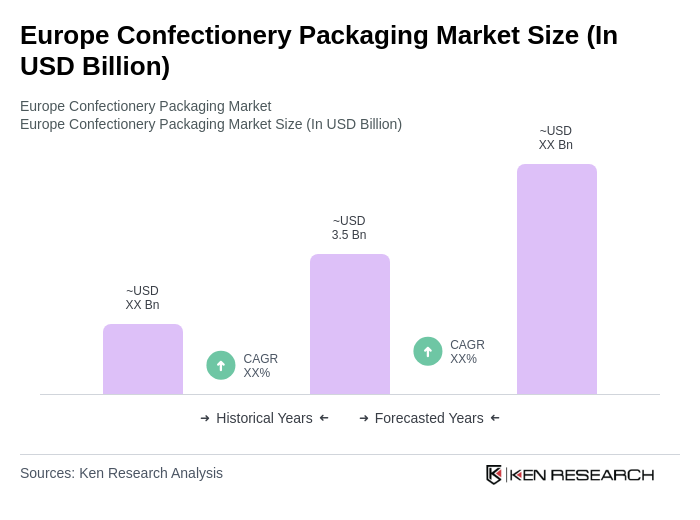
- The Europe Confectionery Packaging Market is valued at USD 3.5 billion, based on a five-year historical analysis. This growth is primarily driven by the increasing demand for convenience foods, rising disposable incomes, a growing trend of gifting confectionery products, and the expansion of online retail channels. The market is also influenced by innovations in packaging technology that enhance product shelf life, visual appeal, and sustainability, such as improved barrier properties, tamper-evident features, and eco-friendly materials .
- Key players in this market include Germany, the UK, and France, which dominate due to their strong confectionery manufacturing bases and high consumer spending on sweets and snacks. These countries benefit from advanced logistics and distribution networks, enabling efficient supply chains that cater to both local and international markets. Germany leads in chocolate and confectionery consumption, while the UK and France have robust manufacturing and export capabilities .
- In 2023, the European Union implemented the Packaging and Packaging Waste Directive (Directive (EU) 2018/852, as amended), issued by the European Parliament and the Council. This directive mandates that all packaging placed on the EU market must be reusable or recyclable by 2030. The regulation aims to reduce environmental impact and promote sustainable practices within the confectionery packaging sector, encouraging manufacturers to innovate in eco-friendly materials and designs. Compliance requires manufacturers to ensure packaging meets recyclability criteria, utilize recycled content, and report annually on packaging waste management .
Europe Confectionery Packaging Market Segmentation
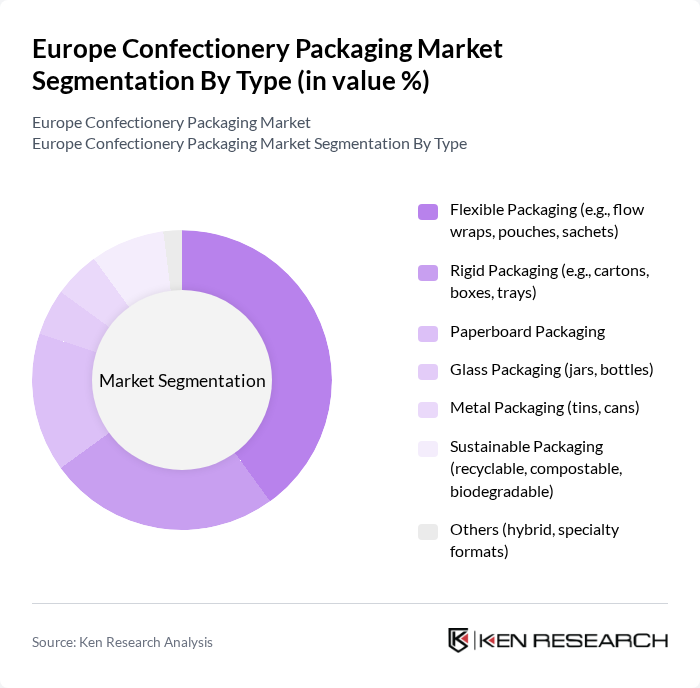
By Type:The market is segmented into various types of packaging, including flexible packaging, rigid packaging, paperboard packaging, glass packaging, metal packaging, sustainable packaging, and others. Among these, flexible packaging is gaining significant traction due to its lightweight nature, cost-effectiveness, and ability to preserve product freshness. Rigid packaging, while traditionally popular for premium and gift items, is facing competition from innovative flexible solutions that better cater to consumer preferences for convenience, portability, and sustainability. Paperboard and sustainable packaging formats are also rising in demand, driven by regulatory pressures and consumer environmental awareness .
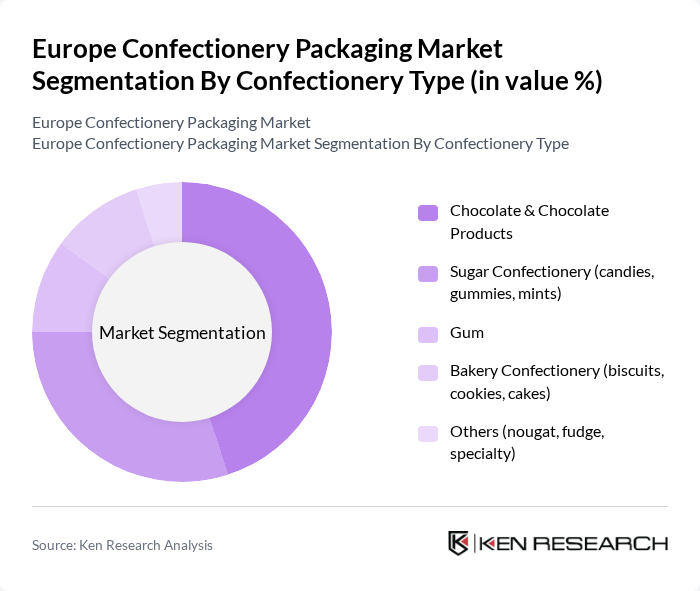
By Confectionery Type:The confectionery packaging market is further segmented into chocolate & chocolate products, sugar confectionery, gum, bakery confectionery, and others. Chocolate products dominate this segment due to their high demand across various demographics, driven by gifting trends, premiumization, and seasonal purchases. Sugar confectionery follows closely, benefiting from impulse buying behavior and a wide range of product innovations in retail environments. Gum and bakery confectionery maintain steady shares, supported by convenience packaging and evolving consumer preferences .
Europe Confectionery Packaging Market Competitive Landscape
The Europe Confectionery Packaging Market is characterized by a dynamic mix of regional and international players. Leading participants such as Amcor plc, Mondi Group, Sealed Air Corporation, Berry Global, Inc., Smurfit Kappa Group plc, Huhtamaki Oyj, Constantia Flexibles Group GmbH, WestRock Company, DS Smith Plc, Tetra Pak International S.A., Graphic Packaging Holding Company, Clondalkin Group Holdings B.V., ProAmpac LLC, Winpak Ltd., Coveris Holdings S.A. contribute to innovation, geographic expansion, and service delivery in this space.
Europe Confectionery Packaging Market Industry Analysis
Growth Drivers
- Increasing Demand for Sustainable Packaging Solutions:The European confectionery packaging market is witnessing a significant shift towards sustainable solutions, driven by consumer awareness and regulatory pressures. In future, the European Union aims to reduce plastic waste by 30%, impacting packaging choices. The market for sustainable packaging is projected to reach €250 billion in future, with 60% of consumers willing to pay more for eco-friendly options, highlighting a robust demand for sustainable materials in confectionery packaging.
- Growth in the Confectionery Industry:The European confectionery industry is projected to generate €40 billion in revenue in future, reflecting a steady growth trajectory. This growth is fueled by rising disposable incomes and changing consumer preferences towards premium and artisanal products. As confectionery sales increase, the demand for innovative and attractive packaging solutions is expected to rise, with manufacturers focusing on enhancing product visibility and shelf appeal to capture consumer interest effectively.
- Innovations in Packaging Technology:Technological advancements in packaging are transforming the confectionery sector, with innovations such as smart packaging and active packaging gaining traction. In future, the smart packaging market is anticipated to reach €10 billion in Europe, driven by the integration of QR codes and NFC technology. These innovations not only enhance product safety and freshness but also provide consumers with interactive experiences, thereby increasing the overall appeal of confectionery products.
Market Challenges
- Fluctuating Raw Material Prices:The confectionery packaging industry faces significant challenges due to volatile raw material prices, particularly for plastics and paper. In future, the price of polyethylene is expected to rise by 15% due to supply chain constraints and increased demand. This fluctuation can lead to higher production costs for manufacturers, impacting profit margins and potentially leading to increased prices for consumers, which may affect overall market growth.
- Stringent Regulatory Requirements:Compliance with stringent EU regulations on packaging waste and food safety presents a challenge for manufacturers. In future, the EU's Packaging and Packaging Waste Directive mandates that 70% of packaging waste must be recycled. This regulatory landscape requires significant investment in compliance measures and sustainable practices, which can strain resources for smaller manufacturers, potentially limiting their competitiveness in the market.
Europe Confectionery Packaging Market Future Outlook
The future of the Europe confectionery packaging market is poised for transformation, driven by sustainability and technological advancements. As consumer preferences shift towards eco-friendly and innovative packaging solutions, manufacturers will need to adapt quickly. The integration of smart technologies and sustainable materials will likely dominate the landscape, enhancing product appeal and safety. Additionally, the rise of e-commerce will necessitate packaging that meets both aesthetic and functional demands, ensuring products remain competitive in a rapidly evolving market.
Market Opportunities
- Development of Biodegradable Packaging Options:The increasing regulatory focus on reducing plastic waste presents a significant opportunity for biodegradable packaging solutions. By future, the biodegradable packaging market is expected to grow to €5 billion in Europe, driven by consumer demand for environmentally friendly options. Companies investing in this area can differentiate themselves and capture a growing segment of eco-conscious consumers.
- Collaborations with E-commerce Platforms:The growth of online sales channels offers a unique opportunity for confectionery packaging innovation. In future, e-commerce sales in the confectionery sector are projected to reach €15 billion. Collaborating with e-commerce platforms to develop packaging that enhances the unboxing experience can significantly boost brand visibility and customer satisfaction, driving sales and market share.
Scope of the Report
| Segment | Sub-Segments |
|---|---|
| By Type | Flexible Packaging (e.g., flow wraps, pouches, sachets) Rigid Packaging (e.g., cartons, boxes, trays) Paperboard Packaging Glass Packaging (jars, bottles) Metal Packaging (tins, cans) Sustainable Packaging (recyclable, compostable, biodegradable) Others (hybrid, specialty formats) |
| By Confectionery Type | Chocolate & Chocolate Products Sugar Confectionery (candies, gummies, mints) Gum Bakery Confectionery (biscuits, cookies, cakes) Others (nougat, fudge, specialty) |
| By Material | Plastic (PET, PP, PE, etc.) Paper & Paperboard Metal (aluminum, tinplate) Glass Others (biopolymers, laminates) |
| By Distribution Channel | Online Retail Supermarkets/Hypermarkets Convenience Stores Specialty Stores Others (wholesale, direct-to-consumer) |
| By Region | Western Europe (Germany, UK, France, Benelux) Eastern Europe (Poland, Hungary, Czech Republic, others) Northern Europe (Nordic countries) Southern Europe (Italy, Spain, Portugal, Greece) Others |
| By Price Range | Premium Mid-Range Economy |
| By Packaging Feature | Resealable Packaging Tamper-Evident Packaging Portion-Controlled Packaging Smart Packaging (track & trace, QR codes) Others |
Key Target Audience
Investors and Venture Capitalist Firms
Government and Regulatory Bodies (e.g., European Food Safety Authority, Food Standards Agency)
Manufacturers and Producers
Distributors and Retailers
Packaging Material Suppliers
Logistics and Supply Chain Companies
Industry Associations (e.g., European Confectionery Association)
Financial Institutions
Players Mentioned in the Report:
Amcor plc
Mondi Group
Sealed Air Corporation
Berry Global, Inc.
Smurfit Kappa Group plc
Huhtamaki Oyj
Constantia Flexibles Group GmbH
WestRock Company
DS Smith Plc
Tetra Pak International S.A.
Graphic Packaging Holding Company
Clondalkin Group Holdings B.V.
ProAmpac LLC
Winpak Ltd.
Coveris Holdings S.A.
Table of Contents
Market Assessment Phase
1. Executive Summary and Approach
2. Europe Confectionery Packaging Market Overview
2.1 Key Insights and Strategic Recommendations
2.2 Europe Confectionery Packaging Market Overview
2.3 Definition and Scope
2.4 Evolution of Market Ecosystem
2.5 Timeline of Key Regulatory Milestones
2.6 Value Chain & Stakeholder Mapping
2.7 Business Cycle Analysis
2.8 Policy & Incentive Landscape
3. Europe Confectionery Packaging Market Analysis
3.1 Growth Drivers
3.1.1 Increasing demand for sustainable packaging solutions
3.1.2 Growth in the confectionery industry
3.1.3 Innovations in packaging technology
3.1.4 Rising consumer preference for convenience packaging
3.2 Market Challenges
3.2.1 Fluctuating raw material prices
3.2.2 Stringent regulatory requirements
3.2.3 Competition from alternative packaging materials
3.2.4 Supply chain disruptions
3.3 Market Opportunities
3.3.1 Expansion into emerging markets
3.3.2 Development of biodegradable packaging options
3.3.3 Customization and personalization of packaging
3.3.4 Collaborations with e-commerce platforms
3.4 Market Trends
3.4.1 Shift towards eco-friendly packaging
3.4.2 Increased use of smart packaging technologies
3.4.3 Growth of online sales channels
3.4.4 Focus on minimalistic packaging designs
3.5 Government Regulation
3.5.1 EU regulations on plastic waste
3.5.2 Compliance with food safety standards
3.5.3 Packaging waste management directives
3.5.4 Restrictions on single-use plastics
4. SWOT Analysis
5. Stakeholder Analysis
6. Porter's Five Forces Analysis
7. Europe Confectionery Packaging Market Market Size, 2019-2024
7.1 By Value
7.2 By Volume
7.3 By Average Selling Price
8. Europe Confectionery Packaging Market Segmentation
8.1 By Type
8.1.1 Flexible Packaging (e.g., flow wraps, pouches, sachets)
8.1.2 Rigid Packaging (e.g., cartons, boxes, trays)
8.1.3 Paperboard Packaging
8.1.4 Glass Packaging (jars, bottles)
8.1.5 Metal Packaging (tins, cans)
8.1.6 Sustainable Packaging (recyclable, compostable, biodegradable)
8.1.7 Others (hybrid, specialty formats)
8.2 By Confectionery Type
8.2.1 Chocolate & Chocolate Products
8.2.2 Sugar Confectionery (candies, gummies, mints)
8.2.3 Gum
8.2.4 Bakery Confectionery (biscuits, cookies, cakes)
8.2.5 Others (nougat, fudge, specialty)
8.3 By Material
8.3.1 Plastic (PET, PP, PE, etc.)
8.3.2 Paper & Paperboard
8.3.3 Metal (aluminum, tinplate)
8.3.4 Glass
8.3.5 Others (biopolymers, laminates)
8.4 By Distribution Channel
8.4.1 Online Retail
8.4.2 Supermarkets/Hypermarkets
8.4.3 Convenience Stores
8.4.4 Specialty Stores
8.4.5 Others (wholesale, direct-to-consumer)
8.5 By Region
8.5.1 Western Europe (Germany, UK, France, Benelux)
8.5.2 Eastern Europe (Poland, Hungary, Czech Republic, others)
8.5.3 Northern Europe (Nordic countries)
8.5.4 Southern Europe (Italy, Spain, Portugal, Greece)
8.5.5 Others
8.6 By Price Range
8.6.1 Premium
8.6.2 Mid-Range
8.6.3 Economy
8.7 By Packaging Feature
8.7.1 Resealable Packaging
8.7.2 Tamper-Evident Packaging
8.7.3 Portion-Controlled Packaging
8.7.4 Smart Packaging (track & trace, QR codes)
8.7.5 Others
9. Europe Confectionery Packaging Market Competitive Analysis
9.1 Market Share of Key Players
9.2 KPIs for Cross Comparison of Key Players
9.2.1 Company Name
9.2.2 Group Size (Large, Medium, or Small as per industry convention)
9.2.3 Revenue Growth Rate (YoY % specific to confectionery packaging)
9.2.4 Market Share in Europe Confectionery Packaging (%)
9.2.5 Geographic Footprint (number of European countries served)
9.2.6 Product Portfolio Breadth (number of packaging formats offered)
9.2.7 Sustainability Index (share of eco-friendly packaging in portfolio)
9.2.8 Innovation Score (number of new product launches, patents)
9.2.9 Supply Chain Efficiency (lead time, on-time delivery %)
9.2.10 Customer Retention Rate (repeat business %)
9.2.11 Brand Equity Score (market surveys, awards)
9.2.12 Pricing Strategy (premium, value, mid-tier)
9.3 SWOT Analysis of Top Players
9.4 Pricing Analysis
9.5 List of Major Companies
9.5.1 Amcor plc
9.5.2 Mondi Group
9.5.3 Sealed Air Corporation
9.5.4 Berry Global, Inc.
9.5.5 Smurfit Kappa Group plc
9.5.6 Huhtamaki Oyj
9.5.7 Constantia Flexibles Group GmbH
9.5.8 WestRock Company
9.5.9 DS Smith Plc
9.5.10 Tetra Pak International S.A.
9.5.11 Graphic Packaging Holding Company
9.5.12 Clondalkin Group Holdings B.V.
9.5.13 ProAmpac LLC
9.5.14 Winpak Ltd.
9.5.15 Coveris Holdings S.A.
10. Europe Confectionery Packaging Market End-User Analysis
10.1 Procurement Behavior of Key Ministries
10.1.1 Government procurement policies
10.1.2 Budget allocation for confectionery packaging
10.1.3 Supplier selection criteria
10.1.4 Sustainability considerations in procurement
10.2 Corporate Spend on Infrastructure & Energy
10.2.1 Investment in packaging technology
10.2.2 Budget for sustainable packaging initiatives
10.2.3 Expenditure on supply chain improvements
10.3 Pain Point Analysis by End-User Category
10.3.1 Quality assurance challenges
10.3.2 Cost management issues
10.3.3 Compliance with regulations
10.4 User Readiness for Adoption
10.4.1 Awareness of sustainable packaging options
10.4.2 Willingness to invest in new technologies
10.4.3 Training and support needs
10.5 Post-Deployment ROI and Use Case Expansion
10.5.1 Measurement of packaging effectiveness
10.5.2 Long-term cost savings analysis
10.5.3 Opportunities for product line expansion
11. Europe Confectionery Packaging Market Future Size, 2025-2030
11.1 By Value
11.2 By Volume
11.3 By Average Selling Price
Go-To-Market Strategy Phase
1. Whitespace Analysis + Business Model Canvas
1.1 Market gaps identification
1.2 Value proposition development
1.3 Revenue model exploration
1.4 Customer segmentation analysis
1.5 Competitive landscape assessment
1.6 Key partnerships identification
1.7 Risk assessment and mitigation
2. Marketing and Positioning Recommendations
2.1 Branding strategies
2.2 Product USPs
2.3 Target audience definition
2.4 Marketing channels selection
2.5 Messaging and communication strategy
3. Distribution Plan
3.1 Urban retail strategies
3.2 Rural NGO tie-ups
3.3 E-commerce integration
3.4 Logistics and supply chain management
4. Channel & Pricing Gaps
4.1 Underserved routes
4.2 Pricing bands analysis
4.3 Competitor pricing strategies
4.4 Consumer price sensitivity
5. Unmet Demand & Latent Needs
5.1 Category gaps identification
5.2 Consumer segments analysis
5.3 Emerging trends exploration
6. Customer Relationship
6.1 Loyalty programs development
6.2 After-sales service enhancement
6.3 Customer feedback mechanisms
7. Value Proposition
7.1 Sustainability initiatives
7.2 Integrated supply chains
7.3 Innovation in product offerings
8. Key Activities
8.1 Regulatory compliance
8.2 Branding efforts
8.3 Distribution setup
9. Entry Strategy Evaluation
9.1 Domestic Market Entry Strategy
9.1.1 Product mix considerations
9.1.2 Pricing band strategy
9.1.3 Packaging innovations
9.2 Export Entry Strategy
9.2.1 Target countries selection
9.2.2 Compliance roadmap development
10. Entry Mode Assessment
10.1 Joint Ventures
10.2 Greenfield investments
10.3 Mergers & Acquisitions
10.4 Distributor Model evaluation
11. Capital and Timeline Estimation
11.1 Capital requirements analysis
11.2 Timelines for market entry
12. Control vs Risk Trade-Off
12.1 Ownership considerations
12.2 Partnerships evaluation
13. Profitability Outlook
13.1 Breakeven analysis
13.2 Long-term sustainability strategies
14. Potential Partner List
14.1 Distributors identification
14.2 Joint Ventures exploration
14.3 Acquisition targets
15. Execution Roadmap
15.1 Phased Plan for Market Entry
15.1.1 Market Setup
15.1.2 Market Entry
15.1.3 Growth Acceleration
15.1.4 Scale & Stabilize
15.2 Key Activities and Milestones
15.2.1 Milestone tracking
15.2.2 Activity scheduling
Research Methodology
Phase 1: Approach1
Desk Research
- Analysis of industry reports from trade associations and market research firms
- Review of published articles and white papers on confectionery packaging trends
- Examination of regulatory frameworks and sustainability initiatives in Europe
Primary Research
- Interviews with packaging engineers and product managers in confectionery firms
- Surveys with retailers and distributors to understand packaging preferences
- Focus groups with consumers to gauge perceptions of packaging sustainability
Validation & Triangulation
- Cross-validation of findings through multiple data sources including sales data and market trends
- Triangulation of insights from primary interviews with secondary research findings
- Sanity checks conducted through expert panel discussions and feedback sessions
Phase 2: Market Size Estimation1
Top-down Assessment
- Estimation of market size based on overall confectionery sales in Europe
- Segmentation of packaging types (e.g., flexible, rigid, and sustainable options)
- Incorporation of growth rates from historical data and market forecasts
Bottom-up Modeling
- Collection of data on packaging volumes from leading confectionery manufacturers
- Cost analysis of packaging materials and production processes
- Estimation of market share based on sales figures and packaging type distribution
Forecasting & Scenario Analysis
- Utilization of time series analysis to project future market trends
- Scenario modeling based on consumer behavior shifts towards sustainable packaging
- Development of baseline, optimistic, and pessimistic forecasts through 2030
Phase 3: CATI Sample Composition1
| Scope Item/Segment | Sample Size | Target Respondent Profiles |
|---|---|---|
| Confectionery Manufacturers | 100 | Product Development Managers, Packaging Engineers |
| Retailers of Confectionery Products | 70 | Category Managers, Purchasing Agents |
| Packaging Suppliers | 50 | Sales Directors, Product Managers |
| Consumers of Confectionery Products | 120 | General Consumers, Eco-conscious Shoppers |
| Regulatory Bodies and Industry Experts | 40 | Policy Makers, Sustainability Consultants |
Frequently Asked Questions
What is the current value of the Europe Confectionery Packaging Market?
The Europe Confectionery Packaging Market is valued at approximately USD 3.5 billion, driven by increasing demand for convenience foods, rising disposable incomes, and innovations in packaging technology that enhance product shelf life and sustainability.
Which countries dominate the Europe Confectionery Packaging Market?
What are the key drivers of growth in the Europe Confectionery Packaging Market?
What challenges does the Europe Confectionery Packaging Market face?
Other Regional/Country Reports
Indonesia Confectionery Packaging Market
Malaysia Confectionery Packaging Market
KSA Confectionery Packaging Market
APAC Confectionery Packaging Market
SEA Confectionery Packaging Market
Vietnam Confectionery Packaging Market
Why Buy From Us?

What makes us stand out is that our consultants follow Robust, Refine and Result (RRR) methodology. Robust for clear definitions, approaches and sanity checking, Refine for differentiating respondents' facts and opinions, and Result for presenting data with story.

We have set a benchmark in the industry by offering our clients with syndicated and customized market research reports featuring coverage of entire market as well as meticulous research and analyst insights.

While we don't replace traditional research, we flip the method upside down. Our dual approach of Top Bottom & Bottom Top ensures quality deliverable by not just verifying company fundamentals but also looking at the sector and macroeconomic factors.

With one step in the future, our research team constantly tries to show you the bigger picture. We help with some of the tough questions you may encounter along the way: How is the industry positioned? Best marketing channel? KPI's of competitors? By aligning every element, we help maximize success.

Our report gives you instant access to the answers and sources that other companies might choose to hide. We elaborate each steps of research methodology we have used and showcase you the sample size to earn your trust.

If you need any support, we are here! We pride ourselves on universe strength, data quality, and quick, friendly, and professional service.