About the Report
Base Year 2024Europe Floating Offshore Wind Power Market Overview
- The Europe Floating Offshore Wind Power Market is valued at USD 5 billion, based on a five-year historical analysis. This valuation aligns with global floating wind market assessments and Europe’s leadership position in floating wind deployment and pipeline within the broader offshore wind build-out supported by EU industrial policy and national auctions .
- Countries such as the United Kingdom, Norway, and France dominate activity due to suitable deep-water sites, robust wind resources, and policy support through seabed leasing and auctions. The UK leads Europe’s offshore wind investment and policy framework; France and Norway have active floating programs tied to national targets and auction rounds, reinforcing their role in floating wind development .
- In 2023, the European Union updated its Renewable Energy Directive (RED III), raising the binding renewables target to at least 42.5% by 2030, with an additional 2.5% indicative objective; this strengthens investment signals for offshore wind, including floating projects, alongside the EU’s Net Zero Industry Act measures to scale clean-tech manufacturing .

Europe Floating Offshore Wind Power Market Segmentation
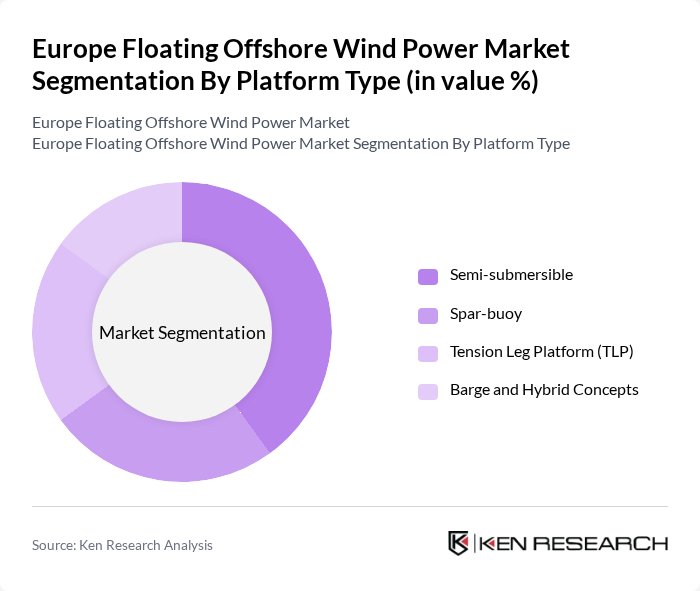
By Platform Type:The platform type segmentation includes various designs that support floating wind turbines. The primary subsegments are Semi-submersible, Spar-buoy, Tension Leg Platform (TLP), and Barge and Hybrid Concepts. Each platform type has unique characteristics that cater to different water depths and environmental conditions, influencing their adoption in various projects. Semi-submersibles and spars are the most commercially proven concepts to date in Europe’s pilots and early arrays, with TLP and barge/hybrid concepts progressing through demonstrations and pre-commercial phases .
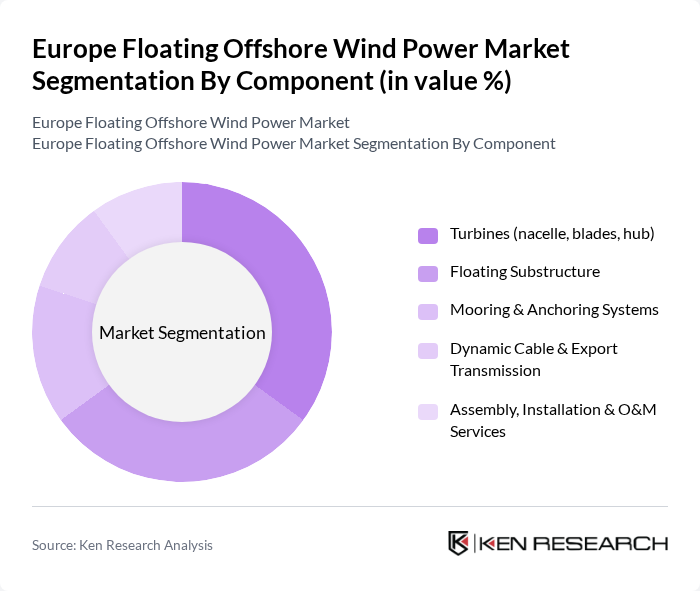
By Component:The component segmentation encompasses the essential parts required for floating offshore wind power systems. This includes Turbines (nacelle, blades, hub), Floating Substructure, Mooring & Anchoring Systems, Dynamic Cable & Export Transmission, and Assembly, Installation & O&M Services. Each component plays a critical role in the overall efficiency and reliability of floating wind farms. European floating wind cost structure is typically led by the floating substructure, turbines, and mooring/cabling, with logistics and assembly strategies (e.g., quayside fabrication and tow-to-port maintenance) key to reducing costs at scale under EU industrial policy initiatives .
Europe Floating Offshore Wind Power Market Competitive Landscape
The Europe Floating Offshore Wind Power Market is characterized by a dynamic mix of regional and international players. Leading participants such as Equinor ASA, Ocean Winds (EDP Renewables & ENGIE JV), RWE AG, Iberdrola S.A., Ørsted A/S, Vestas Wind Systems A/S, Siemens Gamesa Renewable Energy S.A., GE Vernova, BW Ideol SA, Principle Power, Inc., Aker Solutions ASA, Technip Energies N.V., Hexicon AB, Copenhagen Infrastructure Partners (CIP), TotalEnergies SE contribute to innovation, geographic expansion, and service delivery in this space. The UK and EU auction frameworks and project pipelines position these companies to scale from demonstrators to commercial arrays in deeper waters across the North Sea, Celtic Sea, Atlantic, and Mediterranean basins .
Europe Floating Offshore Wind Power Market Industry Analysis
Growth Drivers
- Increasing Demand for Renewable Energy:The European Union aims to achieve a 55% reduction in greenhouse gas emissions by 2030, driving a surge in renewable energy demand. In future, renewable energy sources are projected to account for 50% of the EU's electricity generation, up from 38% in 2020. This shift is supported by the EU's commitment to invest €1 trillion in green energy initiatives, fostering a favorable environment for floating offshore wind power development.
- Technological Advancements in Turbine Design:Innovations in turbine technology are enhancing the efficiency and capacity of floating offshore wind farms. For instance, the latest floating turbine designs can generate up to 18 MW of power, significantly higher than previous models. The European market is expected to see a 20% increase in turbine efficiency in future, driven by advancements in materials and engineering, which will lower the cost of energy production and improve project viability.
- Government Support and Incentives:European governments are increasingly providing financial incentives to promote floating offshore wind projects. In future, the EU plans to allocate €30 billion for renewable energy subsidies, including feed-in tariffs and grants. Countries like France and the UK are implementing favorable regulatory frameworks, which are expected to facilitate the installation of over 10 GW of new floating wind capacity in future, further stimulating market growth.
Market Challenges
- High Initial Capital Investment:The capital required to develop floating offshore wind farms is substantial, often exceeding €3 million per MW installed. This high upfront cost poses a significant barrier to entry for new projects. In future, the total investment needed for floating wind projects in Europe is estimated to reach €25 billion, which may deter smaller companies from entering the market and limit competition.
- Regulatory and Permitting Hurdles:Navigating the complex regulatory landscape can delay project timelines and increase costs. In future, it is anticipated that the average permitting process for floating offshore wind projects will take over 3 years, with some projects facing even longer delays. This regulatory uncertainty can hinder investment and slow the deployment of new technologies, impacting overall market growth.
Europe Floating Offshore Wind Power Market Future Outlook
The future of the floating offshore wind power market in Europe appears promising, driven by increasing investments and technological advancements. In future, the market is expected to witness a significant rise in floating wind capacity, with over 20 GW projected to be operational. The integration of energy storage solutions and smart grid technologies will enhance grid stability and efficiency, while partnerships with local governments will facilitate smoother project execution, ensuring a sustainable energy transition across the region.
Market Opportunities
- Expansion into Emerging Markets:Emerging markets in Asia and Africa present significant opportunities for floating offshore wind technology. With countries like Vietnam and South Africa setting ambitious renewable energy targets, European companies can leverage their expertise to establish projects, potentially generating revenues exceeding €5 billion in future.
- Development of Hybrid Energy Systems:The integration of floating offshore wind with other renewable sources, such as solar and energy storage, offers a unique opportunity. In future, hybrid systems are expected to enhance energy reliability and reduce costs, with potential savings of up to €1 billion annually across Europe, making them an attractive investment for energy developers.
Scope of the Report
| Segment | Sub-Segments |
|---|---|
| By Platform Type | Semi-submersible Spar-buoy Tension Leg Platform (TLP) Barge and Hybrid Concepts |
| By Component | Turbines (nacelle, blades, hub) Floating Substructure Mooring & Anchoring Systems Dynamic Cable & Export Transmission Assembly, Installation & O&M Services |
| By Water Depth | Transitional (30–60 m) Deepwater (60–200 m) Ultra-deepwater (>200 m) |
| By Project Phase | Demonstration & Pilot Pre-commercial Commercial-scale |
| By Power Rating | ?5 MW >5–10 MW >10–15 MW >15 MW |
| By Offtake Mechanism | Contracts for Difference (CfD) / Two-way CfD Corporate PPAs Merchant/Spot with Hedges |
| By Application | Grid-connected Power Offshore Oil & Gas Powering/Platform Electrification Hybrid Systems (wind-to-hydrogen, wind+storage) |
| By Sea Basin | North Sea Atlantic (Iberian, Celtic, Bay of Biscay) Mediterranean Baltic & Norwegian Sea Others (Azores/Madeira/Canary pilot zones) |
Key Target Audience
Investors and Venture Capitalist Firms
Government and Regulatory Bodies (e.g., European Commission, National Renewable Energy Agency)
Manufacturers and Producers of Wind Turbines
Energy Utility Companies
Offshore Construction and Engineering Firms
Environmental NGOs and Advocacy Groups
Energy Policy Makers
Insurance and Risk Management Firms
Players Mentioned in the Report:
Equinor ASA
Ocean Winds (EDP Renewables & ENGIE JV)
RWE AG
Iberdrola S.A.
rsted A/S
Vestas Wind Systems A/S
Siemens Gamesa Renewable Energy S.A.
GE Vernova
BW Ideol SA
Principle Power, Inc.
Aker Solutions ASA
Technip Energies N.V.
Hexicon AB
Copenhagen Infrastructure Partners (CIP)
TotalEnergies SE
Table of Contents
Market Assessment Phase
1. Executive Summary and Approach
2. Europe Floating Offshore Wind Power Market Overview
2.1 Key Insights and Strategic Recommendations
2.2 Europe Floating Offshore Wind Power Market Overview
2.3 Definition and Scope
2.4 Evolution of Market Ecosystem
2.5 Timeline of Key Regulatory Milestones
2.6 Value Chain & Stakeholder Mapping
2.7 Business Cycle Analysis
2.8 Policy & Incentive Landscape
3. Europe Floating Offshore Wind Power Market Analysis
3.1 Growth Drivers
3.1.1 Increasing Demand for Renewable Energy
3.1.2 Technological Advancements in Turbine Design
3.1.3 Government Support and Incentives
3.1.4 Rising Investment in Offshore Infrastructure
3.2 Market Challenges
3.2.1 High Initial Capital Investment
3.2.2 Regulatory and Permitting Hurdles
3.2.3 Environmental Concerns and Impact Assessments
3.2.4 Supply Chain Disruptions
3.3 Market Opportunities
3.3.1 Expansion into Emerging Markets
3.3.2 Innovations in Floating Technology
3.3.3 Partnerships with Local Governments
3.3.4 Development of Hybrid Energy Systems
3.4 Market Trends
3.4.1 Increasing Focus on Sustainability
3.4.2 Growth of Floating Wind Farms
3.4.3 Integration of Energy Storage Solutions
3.4.4 Digitalization and Smart Grid Technologies
3.5 Government Regulation
3.5.1 Renewable Energy Directives
3.5.2 Emission Reduction Targets
3.5.3 Feed-in Tariffs and Power Purchase Agreements
3.5.4 Environmental Protection Regulations
4. SWOT Analysis
5. Stakeholder Analysis
6. Porter's Five Forces Analysis
7. Europe Floating Offshore Wind Power Market Market Size, 2019-2024
7.1 By Value
7.2 By Volume
7.3 By Average Selling Price
8. Europe Floating Offshore Wind Power Market Segmentation
8.1 By Platform Type
8.1.1 Semi-submersible
8.1.2 Spar-buoy
8.1.3 Tension Leg Platform (TLP)
8.1.4 Barge and Hybrid Concepts
8.2 By Component
8.2.1 Turbines (nacelle, blades, hub)
8.2.2 Floating Substructure
8.2.3 Mooring & Anchoring Systems
8.2.4 Dynamic Cable & Export Transmission
8.2.5 Assembly, Installation & O&M Services
8.3 By Water Depth
8.3.1 Transitional (30–60 m)
8.3.2 Deepwater (60–200 m)
8.3.3 Ultra-deepwater (>200 m)
8.4 By Project Phase
8.4.1 Demonstration & Pilot
8.4.2 Pre-commercial
8.4.3 Commercial-scale
8.5 By Power Rating
8.5.1 ?5 MW
8.5.2 >5–10 MW
8.5.3 >10–15 MW
8.5.4 >15 MW
8.6 By Offtake Mechanism
8.6.1 Contracts for Difference (CfD) / Two-way CfD
8.6.2 Corporate PPAs
8.6.3 Merchant/Spot with Hedges
8.7 By Application
8.7.1 Grid-connected Power
8.7.2 Offshore Oil & Gas Powering/Platform Electrification
8.7.3 Hybrid Systems (wind-to-hydrogen, wind+storage)
8.8 By Sea Basin
8.8.1 North Sea
8.8.2 Atlantic (Iberian, Celtic, Bay of Biscay)
8.8.3 Mediterranean
8.8.4 Baltic & Norwegian Sea
8.8.5 Others (Azores/Madeira/Canary pilot zones)
9. Europe Floating Offshore Wind Power Market Competitive Analysis
9.1 Market Share of Key Players
9.2 KPIs for Cross Comparison of Key Players
9.2.1 Installed/Commissioned Floating Capacity (MW)
9.2.2 Pipeline by Stage (leased, consented, pre-FID, under construction) (MW)
9.2.3 Average Turbine Rating Deployed (MW)
9.2.4 Levelized Cost of Energy (LCOE) for Floating Projects (€/MWh)
9.2.5 Winning Auction/CfD Capacity in Europe (MW)
9.2.6 Capex per MW and Cost Reduction Trajectory
9.2.7 Load Factor/Capacity Factor on Operating Floaters (%)
9.2.8 Project Delivery Lead Time (lease-to-COD, years)
9.2.9 Platform Technology Readiness Level (TRL) and Serial Fabrication Readiness
9.2.10 Health, Safety & Environment (HSE) KPIs (TRIR, lost-time rate)
9.2.11 Supply Chain Localization (% EU content, local fabrication yards)
9.2.12 Balance Sheet Strength for Project Finance (net debt/EBITDA)
9.2.13 Strategic Partnerships & JVs Count (developers, yards, OEMs)
9.2.14 O&M Performance (availability %, unplanned outage hours/MW)
9.3 SWOT Analysis of Top Players
9.4 Pricing Analysis
9.5 Detailed Profile of Major Companies
9.5.1 Equinor ASA
9.5.2 Ocean Winds (EDP Renewables & ENGIE JV)
9.5.3 RWE AG
9.5.4 Iberdrola S.A.
9.5.5 Ørsted A/S
9.5.6 Vestas Wind Systems A/S
9.5.7 Siemens Gamesa Renewable Energy S.A.
9.5.8 GE Vernova
9.5.9 BW Ideol SA
9.5.10 Principle Power, Inc.
9.5.11 Aker Solutions ASA
9.5.12 Technip Energies N.V.
9.5.13 Hexicon AB
9.5.14 Copenhagen Infrastructure Partners (CIP)
9.5.15 TotalEnergies SE
10. Europe Floating Offshore Wind Power Market End-User Analysis
10.1 Procurement Behavior of Key Ministries
10.1.1 Government Procurement Policies
10.1.2 Budget Allocations for Renewable Projects
10.1.3 Collaboration with Private Sector
10.2 Corporate Spend on Infrastructure & Energy
10.2.1 Investment Trends in Renewable Energy
10.2.2 Corporate Sustainability Goals
10.2.3 Energy Cost Management Strategies
10.3 Pain Point Analysis by End-User Category
10.3.1 Cost of Energy Production
10.3.2 Reliability of Supply
10.3.3 Regulatory Compliance Challenges
10.4 User Readiness for Adoption
10.4.1 Awareness of Floating Offshore Wind Technology
10.4.2 Financial Readiness for Investment
10.4.3 Technical Capability for Implementation
10.5 Post-Deployment ROI and Use Case Expansion
10.5.1 Performance Metrics Evaluation
10.5.2 Scalability of Projects
10.5.3 Long-term Maintenance Considerations
11. Europe Floating Offshore Wind Power Market Future Size, 2025-2030
11.1 By Value
11.2 By Volume
11.3 By Average Selling Price
Go-To-Market Strategy Phase
1. Whitespace Analysis + Business Model Canvas
1.1 Market Gaps Identification
1.2 Value Proposition Development
1.3 Revenue Streams Analysis
1.4 Cost Structure Evaluation
1.5 Key Partnerships Exploration
1.6 Customer Segmentation
1.7 Channels of Distribution
2. Marketing and Positioning Recommendations
2.1 Branding Strategies
2.2 Product USPs
2.3 Target Audience Identification
2.4 Communication Strategies
2.5 Digital Marketing Approaches
3. Distribution Plan
3.1 Urban Retail Strategies
3.2 Rural NGO Tie-ups
3.3 Online Distribution Channels
3.4 Direct Sales Approaches
4. Channel & Pricing Gaps
4.1 Underserved Routes
4.2 Pricing Bands Analysis
4.3 Competitor Pricing Strategies
5. Unmet Demand & Latent Needs
5.1 Category Gaps Identification
5.2 Consumer Segments Analysis
5.3 Emerging Trends Exploration
6. Customer Relationship
6.1 Loyalty Programs Development
6.2 After-sales Service Strategies
6.3 Customer Feedback Mechanisms
7. Value Proposition
7.1 Sustainability Initiatives
7.2 Integrated Supply Chains
7.3 Competitive Advantages
8. Key Activities
8.1 Regulatory Compliance
8.2 Branding Initiatives
8.3 Distribution Setup
9. Entry Strategy Evaluation
9.1 Domestic Market Entry Strategy
9.1.1 Product Mix Considerations
9.1.2 Pricing Band Strategies
9.1.3 Packaging Options
9.2 Export Entry Strategy
9.2.1 Target Countries Identification
9.2.2 Compliance Roadmap Development
10. Entry Mode Assessment
10.1 Joint Ventures
10.2 Greenfield Investments
10.3 Mergers & Acquisitions
10.4 Distributor Model Evaluation
11. Capital and Timeline Estimation
11.1 Capital Requirements Analysis
11.2 Timelines for Implementation
12. Control vs Risk Trade-Off
12.1 Ownership vs Partnerships
12.2 Risk Management Strategies
13. Profitability Outlook
13.1 Breakeven Analysis
13.2 Long-term Sustainability Considerations
14. Potential Partner List
14.1 Distributors Identification
14.2 Joint Ventures Opportunities
14.3 Acquisition Targets
15. Execution Roadmap
15.1 Phased Plan for Market Entry
15.1.1 Market Setup
15.1.2 Market Entry
15.1.3 Growth Acceleration
15.1.4 Scale & Stabilize
15.2 Key Activities and Milestones
15.2.1 Milestone Planning
15.2.2 Activity Tracking
Research Methodology
Phase 1: Approach1
Desk Research
- Analysis of industry reports from European energy agencies and renewable energy associations
- Review of government publications and policy documents related to offshore wind energy
- Examination of market studies and white papers from leading consultancy firms in the renewable sector
Primary Research
- Interviews with project managers at leading floating offshore wind developers
- Surveys with regulatory bodies and environmental agencies overseeing offshore projects
- Field interviews with engineers and technical experts involved in floating wind turbine technology
Validation & Triangulation
- Cross-validation of data through multiple sources including trade publications and market forecasts
- Triangulation of insights from primary interviews with secondary data findings
- Sanity checks conducted through expert panels comprising industry veterans and academic researchers
Phase 2: Market Size Estimation1
Top-down Assessment
- Estimation of total offshore wind capacity in Europe and its projected growth
- Analysis of government incentives and funding programs for floating wind projects
- Segmentation of market size by country, technology type, and project stage
Bottom-up Modeling
- Collection of data on installed capacity and projected installations from key market players
- Cost analysis of floating wind projects including installation, maintenance, and operational expenses
- Volume x cost calculations to derive revenue estimates for the floating offshore wind market
Forecasting & Scenario Analysis
- Multi-variable forecasting models incorporating technological advancements and policy changes
- Scenario analysis based on varying levels of investment and regulatory support
- Development of baseline, optimistic, and pessimistic market projections through 2030
Phase 3: CATI Sample Composition1
| Scope Item/Segment | Sample Size | Target Respondent Profiles |
|---|---|---|
| Floating Wind Project Developers | 120 | Project Managers, Technical Directors |
| Regulatory Bodies and Policy Makers | 70 | Government Officials, Energy Policy Analysts |
| Environmental Consultants | 50 | Environmental Impact Assessors, Sustainability Experts |
| Technology Providers for Floating Wind | 80 | Product Managers, R&D Engineers |
| Investors in Renewable Energy Projects | 60 | Investment Analysts, Fund Managers |
Frequently Asked Questions
What is the current value of the Europe Floating Offshore Wind Power Market?
The Europe Floating Offshore Wind Power Market is valued at approximately USD 5 billion, reflecting a robust historical analysis and aligning with global assessments of the floating wind sector, highlighting Europe's leadership in deployment and project pipelines.
Which countries are leading in floating offshore wind power in Europe?
What are the key drivers of growth in the Europe Floating Offshore Wind Power Market?
What challenges does the Europe Floating Offshore Wind Power Market face?
Other Regional/Country Reports
Indonesia Floating Offshore Wind Power Market
Malaysia Floating Offshore Wind Power Market
KSA Floating Offshore Wind Power Market
APAC Floating Offshore Wind Power Market
SEA Floating Offshore Wind Power Market
Vietnam Floating Offshore Wind Power Market
Why Buy From Us?

What makes us stand out is that our consultants follow Robust, Refine and Result (RRR) methodology. Robust for clear definitions, approaches and sanity checking, Refine for differentiating respondents' facts and opinions, and Result for presenting data with story.

We have set a benchmark in the industry by offering our clients with syndicated and customized market research reports featuring coverage of entire market as well as meticulous research and analyst insights.

While we don't replace traditional research, we flip the method upside down. Our dual approach of Top Bottom & Bottom Top ensures quality deliverable by not just verifying company fundamentals but also looking at the sector and macroeconomic factors.

With one step in the future, our research team constantly tries to show you the bigger picture. We help with some of the tough questions you may encounter along the way: How is the industry positioned? Best marketing channel? KPI's of competitors? By aligning every element, we help maximize success.

Our report gives you instant access to the answers and sources that other companies might choose to hide. We elaborate each steps of research methodology we have used and showcase you the sample size to earn your trust.

If you need any support, we are here! We pride ourselves on universe strength, data quality, and quick, friendly, and professional service.