About the Report
Base Year 2024Europe Gas Turbine MRO Market Overview
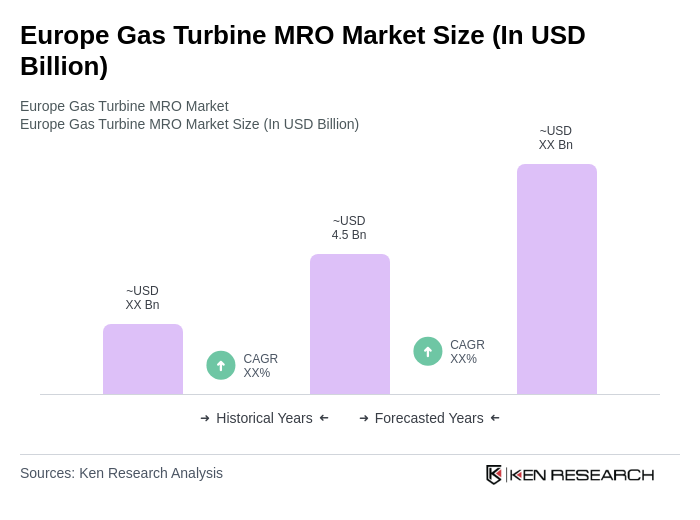
- The Europe Gas Turbine MRO Market is valued at USD 4.5 billion, based on a five-year historical analysis. This growth is primarily driven by the increasing demand for energy efficiency, the need for maintenance and repair services for aging gas turbine infrastructure, and the adoption of digital solutions enabling predictive maintenance. Advancements in technology, such as digital monitoring and analytics, are enhancing the performance and reliability of gas turbines, resulting in more frequent and efficient maintenance and repair operations .
- Countries such asGermany, the United Kingdom, and Francecontinue to dominate the Europe Gas Turbine MRO Market due to their robust industrial sectors, significant investments in energy infrastructure, and established presence of major manufacturers and service providers. These nations are leaders in gas turbine technology and maintenance services, which further accelerates market growth .
- TheClean Energy for All Europeans package(Directive (EU) 2018/2001 and Regulation (EU) 2019/631, issued by the European Parliament and the Council) sets binding targets for energy efficiency and emissions reductions, including requirements for new gas turbine installations to meet stringent emissions standards. These regulations mandate operational compliance and promote the adoption of advanced maintenance and repair practices to ensure environmental performance and regulatory adherence .
Europe Gas Turbine MRO Market Segmentation
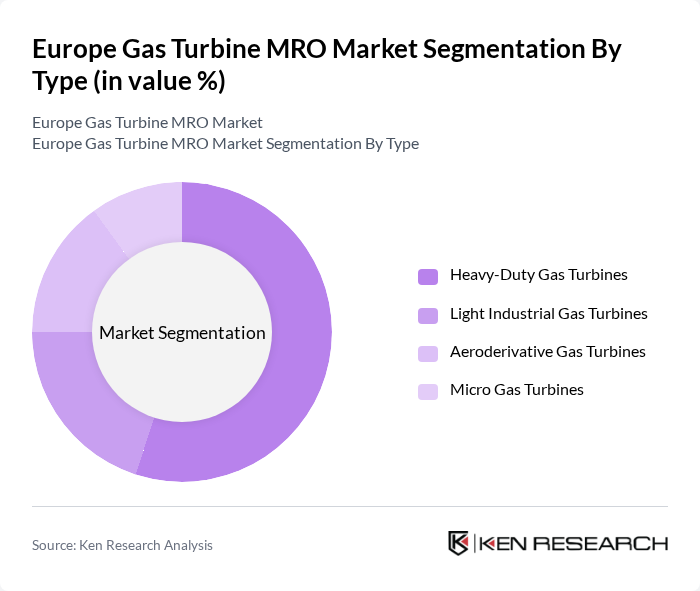
By Type:The market is segmented into four main types of gas turbines: Heavy-Duty Gas Turbines, Light Industrial Gas Turbines, Aeroderivative Gas Turbines, and Micro Gas Turbines. Among these,Heavy-Duty Gas Turbinesdominate the market due to their widespread use in power generation and industrial applications. Their robust design and high efficiency make them the preferred choice for large-scale energy production, resulting in higher demand for MRO services. The growing emphasis on energy efficiency, reliability, and digital monitoring further reinforces their market leadership .
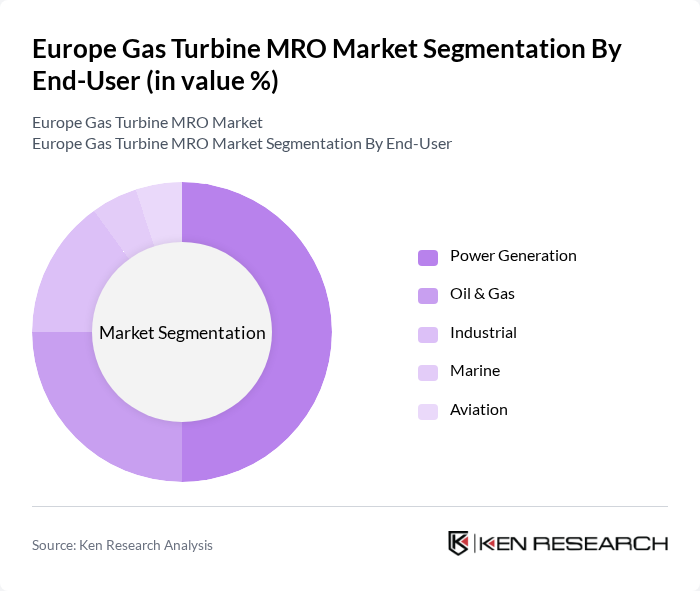
By End-User:The end-user segmentation includes Power Generation, Oil & Gas, Industrial, Marine, and Aviation sectors. ThePower Generationsegment leads the market, driven by the increasing demand for electricity, the need for reliable energy sources, and the modernization of existing power plants. The shift toward cleaner energy solutions and the expansion of gas-fired power generation are key contributors to this segment's growth. The Oil & Gas sector also plays a significant role, as gas turbines are essential for various applications in this industry .
Europe Gas Turbine MRO Market Competitive Landscape
The Europe Gas Turbine MRO Market is characterized by a dynamic mix of regional and international players. Leading participants such as General Electric Company, Siemens Energy AG, Mitsubishi Heavy Industries, Ltd., Rolls-Royce Holdings plc, Alstom S.A., John Wood Group PLC, Baker Hughes Company, MTU Aero Engines AG, Ansaldo Energia S.p.A., MAN Energy Solutions SE, Sulzer Ltd., EthosEnergy Group Limited, Wärtsilä Corporation, Aker Solutions ASA, and Babcock International Group PLC contribute to innovation, geographic expansion, and service delivery in this space.
Europe Gas Turbine MRO Market Industry Analysis
Growth Drivers
- Increasing Demand for Energy Efficiency:The European Union aims to reduce greenhouse gas emissions by at least 55% in future, driving the need for more efficient energy solutions. In future, energy efficiency investments are projected to reach €1.6 trillion, with gas turbines playing a crucial role in this transition. Enhanced efficiency not only lowers operational costs but also aligns with EU regulations, making MRO services essential for maintaining optimal performance in aging fleets.
- Aging Gas Turbine Fleet:The average age of gas turbines in Europe is approximately 20 years, with many units nearing the end of their operational lifespan. In future, it is estimated that over 45% of the fleet will require significant maintenance or upgrades. This aging infrastructure necessitates comprehensive MRO services to ensure reliability and compliance with evolving environmental standards, thus driving market growth as operators seek to extend the life of their assets.
- Technological Advancements in MRO Services:The integration of advanced technologies such as IoT and AI in MRO services is revolutionizing the industry. In future, investments in digital MRO solutions are expected to exceed €600 million, enhancing predictive maintenance capabilities. These innovations not only improve operational efficiency but also reduce downtime, making MRO services more attractive to operators looking to optimize their gas turbine performance and reduce costs.
Market Challenges
- High Maintenance Costs:The average maintenance cost for gas turbines in Europe can reach up to €1.1 million annually per unit, significantly impacting operational budgets. In future, as the demand for skilled labor increases, these costs are expected to rise further, challenging operators to balance maintenance needs with financial constraints. This situation may lead to deferred maintenance, potentially compromising turbine efficiency and reliability.
- Skilled Labor Shortage:The gas turbine MRO sector faces a critical shortage of skilled technicians, with an estimated 32% of the workforce nearing retirement in future. This gap poses a significant challenge for operators, as the demand for specialized skills in maintenance and repair continues to grow. The lack of qualified personnel can lead to increased operational risks and higher costs, as companies may need to invest in training or outsourcing services.
Europe Gas Turbine MRO Market Future Outlook
The Europe Gas Turbine MRO market is poised for significant transformation as operators increasingly adopt digital technologies and sustainable practices. In future, the focus on predictive maintenance and AI integration will enhance operational efficiency, while regulatory pressures will drive investments in cleaner technologies. As the market evolves, companies that prioritize innovation and customer-centric services will likely gain a competitive edge, positioning themselves favorably in a rapidly changing energy landscape.
Market Opportunities
- Expansion into Emerging Markets:As European companies look to diversify, emerging markets in Eastern Europe and Africa present significant opportunities. In future, these regions are expected to see a 17% increase in gas turbine installations, creating demand for MRO services. Companies that strategically enter these markets can capitalize on the growing need for maintenance and support services.
- Adoption of Predictive Maintenance Technologies:The shift towards predictive maintenance is set to revolutionize the MRO landscape. In future, the market for predictive maintenance solutions is projected to grow to €350 million. This trend offers companies the chance to enhance service offerings, reduce downtime, and improve customer satisfaction, ultimately leading to increased market share and profitability.
Scope of the Report
| Segment | Sub-Segments |
|---|---|
| By Type | Heavy-Duty Gas Turbines Light Industrial Gas Turbines Aeroderivative Gas Turbines Micro Gas Turbines |
| By End-User | Power Generation Oil & Gas Industrial Marine Aviation |
| By Component | Combustion Chamber Turbine Blades Compressor Control Systems Others |
| By Service Type | Maintenance Overhaul Services Repair Services Spare Parts Supply Field Services |
| By Sales Channel | OEM (Original Equipment Manufacturer) Independent Service Providers Distributors Online Sales |
| By Region | Western Europe Eastern Europe Northern Europe Southern Europe |
| By Policy Support | Subsidies Tax Exemptions Regulatory Credits Others |
Key Target Audience
Investors and Venture Capitalist Firms
Government and Regulatory Bodies (e.g., European Commission, National Energy Regulator)
Gas Turbine Manufacturers
Maintenance, Repair, and Overhaul Service Providers
Energy Utility Companies
Oil and Gas Exploration and Production Companies
Industry Associations (e.g., European Turbine Network)
Financial Institutions and Banks
Players Mentioned in the Report:
General Electric Company
Siemens Energy AG
Mitsubishi Heavy Industries, Ltd.
Rolls-Royce Holdings plc
Alstom S.A.
John Wood Group PLC
Baker Hughes Company
MTU Aero Engines AG
Ansaldo Energia S.p.A.
MAN Energy Solutions SE
Sulzer Ltd.
EthosEnergy Group Limited
Wartsila Corporation
Aker Solutions ASA
Babcock International Group PLC
Table of Contents
Market Assessment Phase
1. Executive Summary and Approach
2. Europe Gas Turbine MRO Market Overview
2.1 Key Insights and Strategic Recommendations
2.2 Europe Gas Turbine MRO Market Overview
2.3 Definition and Scope
2.4 Evolution of Market Ecosystem
2.5 Timeline of Key Regulatory Milestones
2.6 Value Chain & Stakeholder Mapping
2.7 Business Cycle Analysis
2.8 Policy & Incentive Landscape
3. Europe Gas Turbine MRO Market Analysis
3.1 Growth Drivers
3.1.1 Increasing Demand for Energy Efficiency
3.1.2 Aging Gas Turbine Fleet
3.1.3 Technological Advancements in MRO Services
3.1.4 Regulatory Compliance and Environmental Standards
3.2 Market Challenges
3.2.1 High Maintenance Costs
3.2.2 Skilled Labor Shortage
3.2.3 Supply Chain Disruptions
3.2.4 Competition from Alternative Energy Sources
3.3 Market Opportunities
3.3.1 Expansion into Emerging Markets
3.3.2 Adoption of Predictive Maintenance Technologies
3.3.3 Strategic Partnerships and Collaborations
3.3.4 Government Incentives for Renewable Energy Integration
3.4 Market Trends
3.4.1 Digital Transformation in MRO Services
3.4.2 Shift Towards Sustainable Practices
3.4.3 Increased Focus on Customer-Centric Services
3.4.4 Integration of AI and Machine Learning in Operations
3.5 Government Regulation
3.5.1 Emission Standards Compliance
3.5.2 Safety Regulations for Gas Turbine Operations
3.5.3 Incentives for Renewable Energy Projects
3.5.4 Maintenance and Inspection Regulations
4. SWOT Analysis
5. Stakeholder Analysis
6. Porter's Five Forces Analysis
7. Europe Gas Turbine MRO Market Market Size, 2019-2024
7.1 By Value
7.2 By Volume
7.3 By Average Selling Price
8. Europe Gas Turbine MRO Market Segmentation
8.1 By Type
8.1.1 Heavy-Duty Gas Turbines
8.1.2 Light Industrial Gas Turbines
8.1.3 Aeroderivative Gas Turbines
8.1.4 Micro Gas Turbines
8.2 By End-User
8.2.1 Power Generation
8.2.2 Oil & Gas
8.2.3 Industrial
8.2.4 Marine
8.2.5 Aviation
8.3 By Component
8.3.1 Combustion Chamber
8.3.2 Turbine Blades
8.3.3 Compressor
8.3.4 Control Systems
8.3.5 Others
8.4 By Service Type
8.4.1 Maintenance
8.4.2 Overhaul Services
8.4.3 Repair Services
8.4.4 Spare Parts Supply
8.4.5 Field Services
8.5 By Sales Channel
8.5.1 OEM (Original Equipment Manufacturer)
8.5.2 Independent Service Providers
8.5.3 Distributors
8.5.4 Online Sales
8.6 By Region
8.6.1 Western Europe
8.6.2 Eastern Europe
8.6.3 Northern Europe
8.6.4 Southern Europe
8.7 By Policy Support
8.7.1 Subsidies
8.7.2 Tax Exemptions
8.7.3 Regulatory Credits
8.7.4 Others
9. Europe Gas Turbine MRO Market Competitive Analysis
9.1 Market Share of Key Players
9.2 KPIs for Cross Comparison of Key Players
9.2.1 Company Name
9.2.2 Group Size (Large, Medium, or Small as per industry convention)
9.2.3 Revenue from Gas Turbine MRO (Europe, USD Millions)
9.2.4 Revenue Growth Rate (CAGR %)
9.2.5 Number of Gas Turbines Serviced Annually
9.2.6 Market Share (%) in Europe Gas Turbine MRO
9.2.7 Average Turnaround Time (Days)
9.2.8 Customer Retention Rate (%)
9.2.9 Service Quality Index (Independent Rating)
9.2.10 Innovation Index (Patents/Investments in Digital MRO)
9.3 SWOT Analysis of Top Players
9.4 Pricing Analysis
9.5 Detailed Profile of Major Companies
9.5.1 General Electric Company
9.5.2 Siemens Energy AG
9.5.3 Mitsubishi Heavy Industries, Ltd.
9.5.4 Rolls-Royce Holdings plc
9.5.5 Alstom S.A.
9.5.6 John Wood Group PLC
9.5.7 Baker Hughes Company
9.5.8 MTU Aero Engines AG
9.5.9 Ansaldo Energia S.p.A.
9.5.10 MAN Energy Solutions SE
9.5.11 Sulzer Ltd.
9.5.12 EthosEnergy Group Limited
9.5.13 Wärtsilä Corporation
9.5.14 Aker Solutions ASA
9.5.15 Babcock International Group PLC
10. Europe Gas Turbine MRO Market End-User Analysis
10.1 Procurement Behavior of Key Ministries
10.1.1 Government Energy Departments
10.1.2 Environmental Agencies
10.1.3 Defense Ministries
10.1.4 Others
10.2 Corporate Spend on Infrastructure & Energy
10.2.1 Energy Sector Investments
10.2.2 Infrastructure Development Budgets
10.2.3 Maintenance and Upgrades Allocations
10.2.4 Others
10.3 Pain Point Analysis by End-User Category
10.3.1 Reliability Issues
10.3.2 Cost Management Challenges
10.3.3 Compliance with Regulations
10.3.4 Others
10.4 User Readiness for Adoption
10.4.1 Technology Adoption Rates
10.4.2 Training and Skill Development Needs
10.4.3 Investment Readiness
10.4.4 Others
10.5 Post-Deployment ROI and Use Case Expansion
10.5.1 Performance Metrics Tracking
10.5.2 Cost Savings Analysis
10.5.3 Scalability of Solutions
10.5.4 Others
11. Europe Gas Turbine MRO Market Future Size, 2025-2030
11.1 By Value
11.2 By Volume
11.3 By Average Selling Price
Go-To-Market Strategy Phase
1. Whitespace Analysis + Business Model Canvas
1.1 Market Gaps Identification
1.2 Value Proposition Development
1.3 Revenue Streams Analysis
1.4 Customer Segmentation
1.5 Key Partnerships
1.6 Cost Structure Analysis
1.7 Competitive Advantage
2. Marketing and Positioning Recommendations
2.1 Branding Strategies
2.2 Product USPs
2.3 Target Market Positioning
2.4 Communication Strategies
2.5 Digital Marketing Approaches
3. Distribution Plan
3.1 Urban Retail Strategies
3.2 Rural NGO Tie-Ups
3.3 Online Distribution Channels
3.4 Direct Sales Approaches
4. Channel & Pricing Gaps
4.1 Underserved Routes
4.2 Pricing Bands Analysis
4.3 Competitor Pricing Strategies
4.4 Customer Willingness to Pay
5. Unmet Demand & Latent Needs
5.1 Category Gaps
5.2 Consumer Segments Analysis
5.3 Emerging Trends Identification
5.4 Future Needs Forecasting
6. Customer Relationship
6.1 Loyalty Programs
6.2 After-Sales Service Strategies
6.3 Customer Feedback Mechanisms
6.4 Relationship Management Tools
7. Value Proposition
7.1 Sustainability Initiatives
7.2 Integrated Supply Chains
7.3 Customer-Centric Solutions
7.4 Competitive Differentiation
8. Key Activities
8.1 Regulatory Compliance
8.2 Branding Initiatives
8.3 Distribution Setup
8.4 Training and Development
9. Entry Strategy Evaluation
9.1 Domestic Market Entry Strategy
9.1.1 Product Mix Considerations
9.1.2 Pricing Band Strategy
9.1.3 Packaging Solutions
9.2 Export Entry Strategy
9.2.1 Target Countries Identification
9.2.2 Compliance Roadmap Development
10. Entry Mode Assessment
10.1 Joint Ventures
10.2 Greenfield Investments
10.3 Mergers & Acquisitions
10.4 Distributor Model Evaluation
11. Capital and Timeline Estimation
11.1 Capital Requirements Analysis
11.2 Timelines for Implementation
12. Control vs Risk Trade-Off
12.1 Ownership vs Partnerships
12.2 Risk Management Strategies
13. Profitability Outlook
13.1 Breakeven Analysis
13.2 Long-Term Sustainability Strategies
14. Potential Partner List
14.1 Distributors
14.2 Joint Ventures
14.3 Acquisition Targets
15. Execution Roadmap
15.1 Phased Plan for Market Entry
15.1.1 Market Setup
15.1.2 Market Entry
15.1.3 Growth Acceleration
15.1.4 Scale & Stabilize
15.2 Key Activities and Milestones
15.2.1 Milestone Planning
15.2.2 Activity Tracking
Research Methodology
Phase 1: Approach1
Desk Research
- Industry reports from European energy agencies and gas turbine associations
- Market analysis publications from leading energy consultancy firms
- Regulatory frameworks and policy documents from the European Commission
Primary Research
- Interviews with maintenance managers at major gas turbine operators
- Surveys with MRO service providers and equipment manufacturers
- Field interviews with engineers and technicians involved in gas turbine maintenance
Validation & Triangulation
- Cross-validation of findings through multiple industry reports and expert opinions
- Triangulation of data from primary interviews and secondary sources
- Sanity checks through expert panel discussions and feedback sessions
Phase 2: Market Size Estimation1
Top-down Assessment
- Analysis of the overall European gas turbine market size and growth trends
- Segmentation by application areas such as power generation and industrial use
- Incorporation of government initiatives promoting renewable energy and efficiency
Bottom-up Modeling
- Estimation of MRO spending based on the installed base of gas turbines
- Operational cost analysis derived from service contracts and maintenance schedules
- Volume x cost calculations for various MRO services offered
Forecasting & Scenario Analysis
- Multi-variable regression analysis considering fuel prices, regulatory changes, and technology advancements
- Scenario modeling based on economic conditions and energy transition policies
- Baseline, optimistic, and pessimistic forecasts through 2030
Phase 3: CATI Sample Composition1
| Scope Item/Segment | Sample Size | Target Respondent Profiles |
|---|---|---|
| Power Generation MRO Services | 100 | Plant Managers, Maintenance Directors |
| Industrial Gas Turbine Maintenance | 60 | Operations Managers, Technical Supervisors |
| Gas Turbine Component Suppliers | 50 | Procurement Managers, Product Development Engineers |
| Service Providers in MRO | 40 | Business Development Managers, Service Engineers |
| Regulatory Compliance and Safety | 40 | Compliance Officers, Safety Managers |
Frequently Asked Questions
What is the current value of the Europe Gas Turbine MRO Market?
The Europe Gas Turbine MRO Market is valued at approximately USD 4.5 billion, driven by the increasing demand for energy efficiency and the need for maintenance services for aging gas turbine infrastructure.
Which countries dominate the Europe Gas Turbine MRO Market?
What are the main drivers of growth in the Europe Gas Turbine MRO Market?
What challenges does the Europe Gas Turbine MRO Market face?
Other Regional/Country Reports
Indonesia Gas Turbine MRO Market
Malaysia Gas Turbine MRO Market
Why Buy From Us?

What makes us stand out is that our consultants follow Robust, Refine and Result (RRR) methodology. Robust for clear definitions, approaches and sanity checking, Refine for differentiating respondents' facts and opinions, and Result for presenting data with story.

We have set a benchmark in the industry by offering our clients with syndicated and customized market research reports featuring coverage of entire market as well as meticulous research and analyst insights.

While we don't replace traditional research, we flip the method upside down. Our dual approach of Top Bottom & Bottom Top ensures quality deliverable by not just verifying company fundamentals but also looking at the sector and macroeconomic factors.

With one step in the future, our research team constantly tries to show you the bigger picture. We help with some of the tough questions you may encounter along the way: How is the industry positioned? Best marketing channel? KPI's of competitors? By aligning every element, we help maximize success.

Our report gives you instant access to the answers and sources that other companies might choose to hide. We elaborate each steps of research methodology we have used and showcase you the sample size to earn your trust.

If you need any support, we are here! We pride ourselves on universe strength, data quality, and quick, friendly, and professional service.