About the Report
Base Year 2024Europe Hair Colorants Market Overview
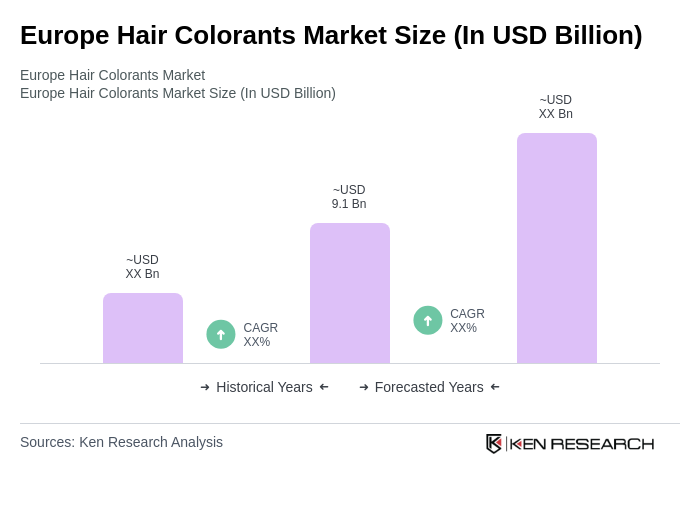
- The Europe Hair Colorants Market is valued at approximately USD 9.1 billion, based on a five-year historical analysis. This growth is primarily driven by increasing consumer demand for hair color products, influenced by fashion trends, personal grooming, and the rising popularity of at-home hair coloring solutions. The market has seen a shift towards more innovative and diverse product offerings, including ammonia-free, vegan, and natural ingredient-based formulations aligned with safety and sustainability preferences.
- Countries such as Germany, the United Kingdom, and France dominate the Europe Hair Colorants Market due to their large and premium beauty markets, high disposable incomes, and strong salon and retail infrastructures. Germany is highlighted as a leading country market within Europe with substantial share, supported by a sophisticated consumer base and robust salon segment.
- The European Union regulates hair colorants under the EU Cosmetics Regulation and REACH; authorities have tightened safety reviews and ingredient restrictions through ongoing REACH evaluations and Cosmetics Regulation updates rather than a single new 2023 regulation. Hair dyes and colorant substances require safety assessments and compliance, including restrictions for certain oxidative dye intermediates to protect consumer health and the environment.
Europe Hair Colorants Market Segmentation
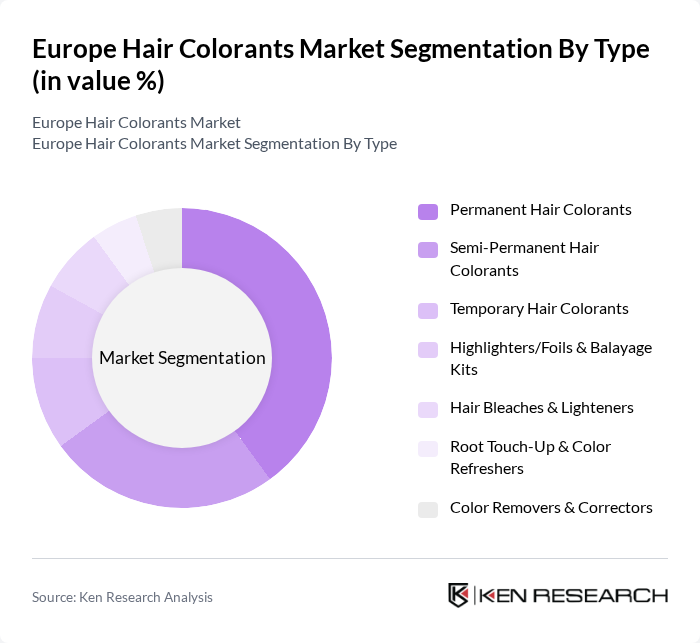
By Type:The hair colorants market is segmented into various types, including Permanent Hair Colorants, Semi-Permanent Hair Colorants, Temporary Hair Colorants, Highlighters/Foils & Balayage Kits, Hair Bleaches & Lighteners, Root Touch-Up & Color Refreshers, and Color Removers & Correctors. Among these, Permanent Hair Colorants dominate the market due to their long-lasting effects and the growing trend of consumers seeking more durable solutions for hair coloring. The increasing preference for vibrant and bold colors and innovations such as ammonia-free and fade-resistant formulas have contributed to the rise in demand for high-quality permanent colorants.
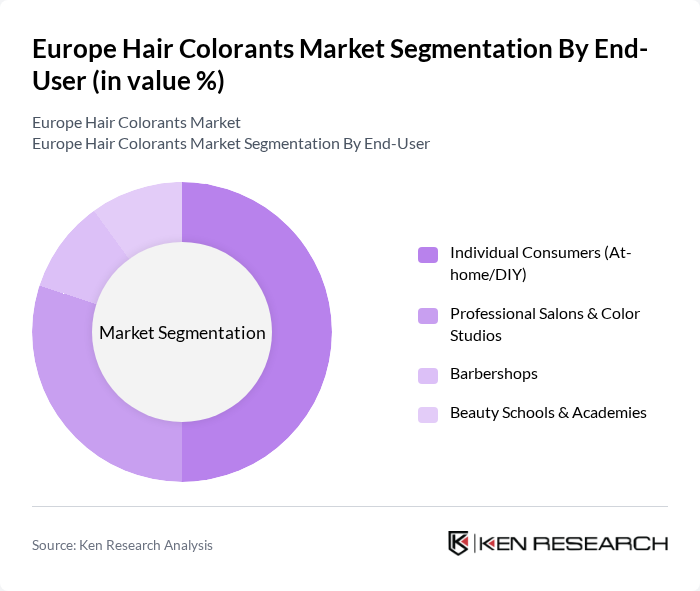
By End-User:The market is segmented by end-users, including Individual Consumers (At-home/DIY), Professional Salons & Color Studios, Barbershops, and Beauty Schools & Academies. The Individual Consumers segment is the leading end-user category, driven by the increasing trend of DIY hair coloring among consumers seeking convenience and cost-effectiveness, supported by broad availability in supermarkets/hypermarkets and e-commerce. Social media and influencer-led tutorials further encourage at-home experimentation, while professional salons remain significant for advanced services and premium formulations.
Europe Hair Colorants Market Competitive Landscape
The Europe Hair Colorants Market is characterized by a dynamic mix of regional and international players. Leading participants such as L'Oréal S.A. (L'Oréal Paris, Garnier, Matrix, Redken), Wella Company (Wella Professionals, Koleston Perfect, Clairol), Henkel AG & Co. KGaA (Schwarzkopf Professional, got2b, Palette), Coty Inc. (Clairol, Nice'n Easy; legacy brands), Revlon, Inc. (Revlon Colorsilk), Kao Corporation (Goldwell, John Frieda), Unilever PLC (TRESemmé, TIGI/Bed Head color lines), Estée Lauder Companies Inc. (Aveda), Shiseido Company, Limited (Japan; selective salon presence in EU), Davines S.p.A., Eugène Perma France, Alfaparf Milano, Laboratorios Phergal S.A. (Naturtint), Crazy Color Ltd. (Renbow), Umberto Giannini Hair Cosmetics Ltd contribute to innovation, geographic expansion, and service delivery in this space.
Europe Hair Colorants Market Industry Analysis
Growth Drivers
- Increasing Demand for Natural Products:The European hair colorants market is witnessing a significant shift towards natural and organic products, driven by consumer preferences for safer alternatives. In future, the market for organic hair colorants is projected to reach €1.2 billion, reflecting a 15% increase from the previous year. This trend is supported by the growing awareness of the harmful effects of synthetic chemicals, with 60% of consumers prioritizing natural ingredients in their beauty products, according to industry reports.
- Rising Fashion Consciousness:Fashion consciousness among European consumers is a key growth driver for the hair colorants market. In future, the European fashion industry is expected to generate €500 billion, with hair colorants playing a crucial role in personal expression. The increasing influence of social media and celebrity endorsements has led to a 20% rise in demand for vibrant and trendy hair colors, particularly among millennials and Gen Z, who are more willing to experiment with their looks.
- Growth of E-commerce:The e-commerce sector for beauty products is rapidly expanding, significantly impacting the hair colorants market. In future, online sales of hair colorants are projected to reach €800 million, accounting for 30% of total sales. This growth is fueled by the convenience of online shopping and the increasing number of beauty brands investing in digital marketing strategies. Additionally, 70% of consumers report purchasing beauty products online, highlighting the importance of e-commerce in reaching a broader audience.
Market Challenges
- Stringent Regulations:The hair colorants market in Europe faces significant challenges due to stringent regulations on chemical ingredients. The EU's REACH regulations require extensive testing and compliance, which can delay product launches and increase costs. In future, companies may spend up to €200 million on compliance-related activities, impacting their profitability. Additionally, the increasing scrutiny on product safety and environmental impact necessitates ongoing investment in research and development to meet regulatory standards.
- High Competition from Unbranded Products:The market is also challenged by intense competition from unbranded and low-cost alternatives. In future, unbranded hair colorants are expected to capture 25% of the market share, appealing to price-sensitive consumers. This competition pressures established brands to lower prices or enhance product offerings, which can erode profit margins. Furthermore, the lack of brand loyalty among consumers makes it difficult for companies to maintain a competitive edge in this crowded marketplace.
Europe Hair Colorants Market Future Outlook
The future of the Europe hair colorants market appears promising, driven by evolving consumer preferences and technological advancements. As the demand for sustainable and innovative products continues to rise, brands are likely to invest in eco-friendly formulations and personalized solutions. Additionally, the increasing penetration of e-commerce will facilitate greater access to diverse product offerings, enhancing consumer choice. Companies that adapt to these trends and focus on quality and sustainability are expected to thrive in this dynamic market landscape.
Market Opportunities
- Expansion into Emerging Markets:There is a significant opportunity for hair colorant brands to expand into emerging markets within Europe, such as Eastern Europe. With a projected market growth of 10% in these regions, companies can tap into a growing consumer base that is increasingly interested in beauty products, particularly as disposable incomes rise.
- Development of Personalized Solutions:The trend towards personalized hair color solutions presents a lucrative opportunity. Brands can leverage technology to offer customized color formulations based on individual preferences and hair types. This approach is expected to attract a younger demographic, with 40% of consumers expressing interest in personalized beauty products, thereby enhancing customer loyalty and engagement.
Scope of the Report
| Segment | Sub-Segments |
|---|---|
| By Type | Permanent Hair Colorants Semi-Permanent Hair Colorants Temporary Hair Colorants Highlighters/Foils & Balayage Kits Hair Bleaches & Lighteners Root Touch-Up & Color Refreshers Color Removers & Correctors |
| By End-User | Individual Consumers (At-home/DIY) Professional Salons & Color Studios Barbershops Beauty Schools & Academies |
| By Distribution Channel | Supermarkets/Hypermarkets Specialist Retailers/Beauty Stores Drugstores/Pharmacies Online Retail/E-commerce Professional Salon Supply/Distributors |
| By Price Range | Premium/Professional Mid-range/Masstige Economy/Value |
| By Brand Type | Global Established Brands Indie/Emerging Brands Private Labels/Retailer Brands |
| By Formulation | Oxidative (Ammonia/MEA-Based) Ammonia-Free Plant-Based/Herbal Vegan & Cruelty-Free PPD/PTD-Free & Hypoallergenic |
| By Geography | United Kingdom Germany France Italy Spain Russia Rest of Europe |
Key Target Audience
Investors and Venture Capitalist Firms
Government and Regulatory Bodies (e.g., European Chemicals Agency, Health and Safety Executive)
Manufacturers and Producers
Distributors and Retailers
Cosmetic and Personal Care Brands
Raw Material Suppliers
Industry Associations (e.g., Cosmetics Europe)
Financial Institutions
Players Mentioned in the Report:
L'Oreal S.A. (L'Oreal Paris, Garnier, Matrix, Redken)
Wella Company (Wella Professionals, Koleston Perfect, Clairol)
Henkel AG & Co. KGaA (Schwarzkopf Professional, got2b, Palette)
Coty Inc. (Clairol, Nice'n Easy; legacy brands)
Revlon, Inc. (Revlon Colorsilk)
Kao Corporation (Goldwell, John Frieda)
Unilever PLC (TRESemme, TIGI/Bed Head color lines)
Estee Lauder Companies Inc. (Aveda)
Shiseido Company, Limited (Japan; selective salon presence in EU)
Davines S.p.A.
Eugene Perma France
Alfaparf Milano
Laboratorios Phergal S.A. (Naturtint)
Crazy Color Ltd. (Renbow)
Umberto Giannini Hair Cosmetics Ltd
Table of Contents
Market Assessment Phase
1. Executive Summary and Approach
2. Europe Hair Colorants Market Overview
2.1 Key Insights and Strategic Recommendations
2.2 Europe Hair Colorants Market Overview
2.3 Definition and Scope
2.4 Evolution of Market Ecosystem
2.5 Timeline of Key Regulatory Milestones
2.6 Value Chain & Stakeholder Mapping
2.7 Business Cycle Analysis
2.8 Policy & Incentive Landscape
3. Europe Hair Colorants Market Analysis
3.1 Growth Drivers
3.1.1 Increasing demand for natural and organic hair colorants
3.1.2 Rising fashion consciousness among consumers
3.1.3 Growth of the e-commerce sector for beauty products
3.1.4 Innovations in hair colorant formulations
3.2 Market Challenges
3.2.1 Stringent regulations on chemical ingredients
3.2.2 High competition from unbranded products
3.2.3 Consumer sensitivity to pricing
3.2.4 Limited awareness of product benefits
3.3 Market Opportunities
3.3.1 Expansion into emerging markets within Europe
3.3.2 Development of personalized hair color solutions
3.3.3 Collaborations with salons and beauty professionals
3.3.4 Increasing online marketing and sales strategies
3.4 Market Trends
3.4.1 Shift towards vegan and cruelty-free products
3.4.2 Growth in DIY hair coloring kits
3.4.3 Rising popularity of temporary hair colorants
3.4.4 Increased focus on sustainable packaging
3.5 Government Regulation
3.5.1 EU regulations on cosmetic product safety
3.5.2 Restrictions on certain chemical ingredients
3.5.3 Labeling requirements for allergens
3.5.4 Compliance with REACH regulations
4. SWOT Analysis
5. Stakeholder Analysis
6. Porter's Five Forces Analysis
7. Europe Hair Colorants Market Market Size, 2019-2024
7.1 By Value
7.2 By Volume
7.3 By Average Selling Price
8. Europe Hair Colorants Market Segmentation
8.1 By Type
8.1.1 Permanent Hair Colorants
8.1.2 Semi-Permanent Hair Colorants
8.1.3 Temporary Hair Colorants
8.1.4 Highlighters/Foils & Balayage Kits
8.1.5 Hair Bleaches & Lighteners
8.1.6 Root Touch-Up & Color Refreshers
8.1.7 Color Removers & Correctors
8.2 By End-User
8.2.1 Individual Consumers (At-home/DIY)
8.2.2 Professional Salons & Color Studios
8.2.3 Barbershops
8.2.4 Beauty Schools & Academies
8.3 By Distribution Channel
8.3.1 Supermarkets/Hypermarkets
8.3.2 Specialist Retailers/Beauty Stores
8.3.3 Drugstores/Pharmacies
8.3.4 Online Retail/E-commerce
8.3.5 Professional Salon Supply/Distributors
8.4 By Price Range
8.4.1 Premium/Professional
8.4.2 Mid-range/Masstige
8.4.3 Economy/Value
8.5 By Brand Type
8.5.1 Global Established Brands
8.5.2 Indie/Emerging Brands
8.5.3 Private Labels/Retailer Brands
8.6 By Formulation
8.6.1 Oxidative (Ammonia/MEA-Based)
8.6.2 Ammonia-Free
8.6.3 Plant-Based/Herbal
8.6.4 Vegan & Cruelty-Free
8.6.5 PPD/PTD-Free & Hypoallergenic
8.7 By Geography
8.7.1 United Kingdom
8.7.2 Germany
8.7.3 France
8.7.4 Italy
8.7.5 Spain
8.7.6 Russia
8.7.7 Rest of Europe
9. Europe Hair Colorants Market Competitive Analysis
9.1 Market Share of Key Players
9.2 Cross Comparison of Key Players
9.2.1 Company Name
9.2.2 Group Size (Global, Regional, or Niche)
9.2.3 Europe Hair Color Revenue (latest FY, USD/EUR)
9.2.4 3-Year CAGR in Europe Hair Color
9.2.5 Market Coverage (Countries/Doors in Europe)
9.2.6 Channel Mix (% Retail, % Salon/Professional, % E-commerce)
9.2.7 SKU Breadth (Shades/SKUs in portfolio)
9.2.8 Innovation Velocity (New launches per year; % ammonia-free/PPD-free)
9.2.9 Regulatory/Claims Profile (REACH/EU cosmetic compliance; vegan/clean)
9.2.10 Pricing Positioning (Economy/Mid-range/Premium; avg. price per unit)
9.2.11 Brand Equity Indicators (awareness/share of voice/social engagement)
9.2.12 Salon Partnerships & Education Footprint (academies/artists)
9.2.13 Sustainability KPIs (% recycled packaging; refill options; Scope 1–3 targets)
9.3 SWOT Analysis of Top Players
9.4 Pricing Analysis
9.5 Detailed Profile of Major Companies
9.5.1 L'Oréal S.A. (L'Oréal Paris, Garnier, Matrix, Redken)
9.5.2 Wella Company (Wella Professionals, Koleston Perfect, Clairol)
9.5.3 Henkel AG & Co. KGaA (Schwarzkopf Professional, got2b, Palette)
9.5.4 Coty Inc. (Clairol, Nice'n Easy; legacy brands)
9.5.5 Revlon, Inc. (Revlon Colorsilk)
9.5.6 Kao Corporation (Goldwell, John Frieda)
9.5.7 Unilever PLC (TRESemmé, TIGI/Bed Head color lines)
9.5.8 Estée Lauder Companies Inc. (Aveda)
9.5.9 Shiseido Company, Limited (Japan; selective salon presence in EU)
9.5.10 Davines S.p.A.
9.5.11 Eugène Perma France
9.5.12 Alfaparf Milano
9.5.13 Laboratorios Phergal S.A. (Naturtint)
9.5.14 Crazy Color Ltd. (Renbow)
9.5.15 Umberto Giannini Hair Cosmetics Ltd
10. Europe Hair Colorants Market End-User Analysis
10.1 Procurement Behavior of Key Ministries
10.1.1 Government contracts for public health initiatives
10.1.2 Bulk purchasing for public sector salons
10.1.3 Compliance with safety standards
10.2 Corporate Spend on Infrastructure & Energy
10.2.1 Investment in sustainable product development
10.2.2 Funding for marketing campaigns
10.2.3 Expenditure on R&D for innovative formulations
10.3 Pain Point Analysis by End-User Category
10.3.1 Quality concerns with low-cost products
10.3.2 Availability of desired shades
10.3.3 Difficulty in achieving desired results
10.4 User Readiness for Adoption
10.4.1 Awareness of product benefits
10.4.2 Willingness to try new brands
10.4.3 Accessibility of products in local markets
10.5 Post-Deployment ROI and Use Case Expansion
10.5.1 Customer feedback on product performance
10.5.2 Repeat purchase rates
10.5.3 Expansion into new product lines
11. Europe Hair Colorants Market Future Size, 2025-2030
11.1 By Value
11.2 By Volume
11.3 By Average Selling Price
Go-To-Market Strategy Phase
1. Whitespace Analysis + Business Model Canvas
1.1 Market Gaps Identification
1.2 Value Proposition Development
1.3 Revenue Streams Analysis
1.4 Customer Segmentation
1.5 Key Partnerships
1.6 Cost Structure
1.7 Channels of Distribution
2. Marketing and Positioning Recommendations
2.1 Branding strategies
2.2 Product USPs
3. Distribution Plan
3.1 Urban retail vs rural NGO tie-ups
4. Channel & Pricing Gaps
4.1 Underserved routes
4.2 Pricing bands
5. Unmet Demand & Latent Needs
5.1 Category gaps
5.2 Consumer segments
6. Customer Relationship
6.1 Loyalty programs
6.2 After-sales service
7. Value Proposition
7.1 Sustainability
7.2 Integrated supply chains
8. Key Activities
8.1 Regulatory compliance
8.2 Branding
8.3 Distribution setup
9. Entry Strategy Evaluation
9.1 Domestic Market Entry Strategy
9.1.1 Product mix
9.1.2 Pricing band
9.1.3 Packaging
9.2 Export Entry Strategy
9.2.1 Target countries
9.2.2 Compliance roadmap
10. Entry Mode Assessment
10.1 JV
10.2 Greenfield
10.3 M&A
10.4 Distributor Model
11. Capital and Timeline Estimation
11.1 Capital requirements
11.2 Timelines
12. Control vs Risk Trade-Off
12.1 Ownership vs Partnerships
13. Profitability Outlook
13.1 Breakeven analysis
13.2 Long-term sustainability
14. Potential Partner List
14.1 Distributors
14.2 JVs
14.3 Acquisition targets
15. Execution Roadmap
15.1 Phased Plan for Market Entry
15.1.1 Market Setup
15.1.2 Market Entry
15.1.3 Growth Acceleration
15.1.4 Scale & Stabilize
15.2 Key Activities and Milestones
15.2.1 Activity Planning
15.2.2 Milestone Tracking
Research Methodology
Phase 1: Approach1
Desk Research
- Analysis of market reports from industry associations and trade publications
- Review of consumer behavior studies and demographic data from Eurostat
- Examination of regulatory frameworks and compliance guidelines from EU authorities
Primary Research
- Interviews with product development managers at leading hair colorant manufacturers
- Surveys with beauty salon owners and hair professionals across Europe
- Focus groups with consumers to understand preferences and trends in hair colorants
Validation & Triangulation
- Cross-validation of findings through multiple data sources including sales data and market trends
- Triangulation of insights from primary interviews with secondary research findings
- Sanity checks conducted through expert panels comprising industry veterans
Phase 2: Market Size Estimation1
Top-down Assessment
- Estimation of total market size based on historical sales data and growth rates
- Segmentation of the market by product type, distribution channel, and geography
- Incorporation of macroeconomic indicators influencing consumer spending on hair colorants
Bottom-up Modeling
- Collection of sales volume data from key players in the hair colorants market
- Estimation of average selling prices across different product categories
- Calculation of market size based on volume and price data aggregated from various sources
Forecasting & Scenario Analysis
- Utilization of time-series analysis to project future market trends through 2030
- Scenario modeling based on potential shifts in consumer preferences and regulatory changes
- Development of best-case, worst-case, and most-likely market scenarios
Phase 3: CATI Sample Composition1
| Scope Item/Segment | Sample Size | Target Respondent Profiles |
|---|---|---|
| Consumer Preferences in Hair Colorants | 150 | End Consumers, Beauty Enthusiasts |
| Professional Insights from Salons | 120 | Salon Owners, Hair Stylists |
| Retail Distribution Channels | 90 | Retail Managers, Category Buyers |
| Market Trends and Innovations | 70 | Product Development Experts, Marketing Managers |
| Regulatory Impact on Hair Colorants | 60 | Regulatory Affairs Specialists, Compliance Officers |
Frequently Asked Questions
What is the current value of the Europe Hair Colorants Market?
The Europe Hair Colorants Market is valued at approximately USD 9.1 billion, reflecting a significant growth driven by consumer demand for diverse hair color products, including innovative formulations that prioritize safety and sustainability.
Which countries dominate the Europe Hair Colorants Market?
What types of hair colorants are available in the market?
Who are the primary end-users of hair colorants in Europe?
Other Regional/Country Reports
Indonesia Hair Colorants Market
Malaysia Hair Colorants Market
KSA Hair Colorants Market
APAC Hair Colorants Market
SEA Hair Colorants Market
Vietnam Hair Colorants Market
Why Buy From Us?

What makes us stand out is that our consultants follow Robust, Refine and Result (RRR) methodology. Robust for clear definitions, approaches and sanity checking, Refine for differentiating respondents' facts and opinions, and Result for presenting data with story.

We have set a benchmark in the industry by offering our clients with syndicated and customized market research reports featuring coverage of entire market as well as meticulous research and analyst insights.

While we don't replace traditional research, we flip the method upside down. Our dual approach of Top Bottom & Bottom Top ensures quality deliverable by not just verifying company fundamentals but also looking at the sector and macroeconomic factors.

With one step in the future, our research team constantly tries to show you the bigger picture. We help with some of the tough questions you may encounter along the way: How is the industry positioned? Best marketing channel? KPI's of competitors? By aligning every element, we help maximize success.

Our report gives you instant access to the answers and sources that other companies might choose to hide. We elaborate each steps of research methodology we have used and showcase you the sample size to earn your trust.

If you need any support, we are here! We pride ourselves on universe strength, data quality, and quick, friendly, and professional service.