About the Report
Base Year 2024Europe Manufactured Homes Market Overview
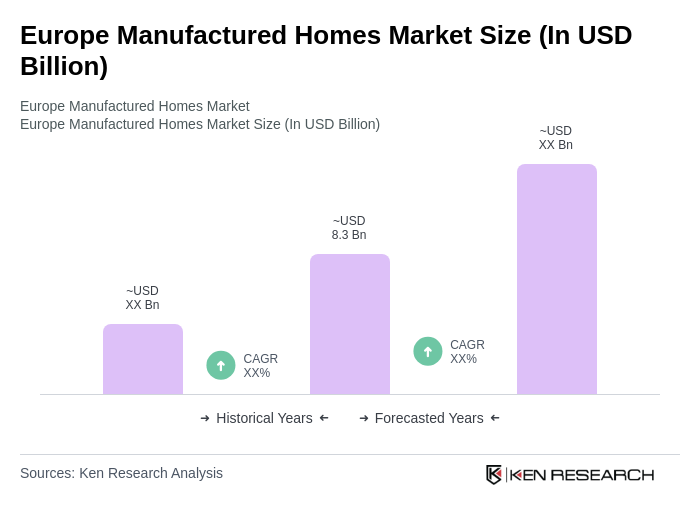
- The Europe Manufactured Homes Market is valued at approximately USD 8.3 billion, based on a five-year historical analysis. This level is consistent with recent industry valuations that place the market in the high–single-digit billions, supported by multiple analyst estimates within the 2024–2025 period . This growth is primarily driven by increasing demand for affordable housing solutions, urbanization, and a shift towards sustainable living. The market has seen a rise in consumer interest in manufactured and modular homes due to their cost-effectiveness and quicker construction timelines compared to traditional homes .
- Countries such as Germany, the United Kingdom, and France dominate the Europe Manufactured Homes Market due to their strong economies, high population density, and increasing housing shortages. These nations are frequently cited as the largest national markets in Europe for manufactured and modular homes, aided by relatively mature infrastructure and frameworks that facilitate deployment .
- In 2023, the European policy environment advanced measures aimed at promoting sustainable housing solutions, including energy-efficiency obligations for buildings and support mechanisms at national levels. The recast Energy Performance of Buildings Directive (EPBD) and related green-building initiatives reinforce higher efficiency standards that also influence prefabricated/manufactured housing supply chains and procurement by public bodies . Several countries have deployed incentives or procurement programs for low-carbon and prefabricated housing to meet climate and housing objectives .
Europe Manufactured Homes Market Segmentation
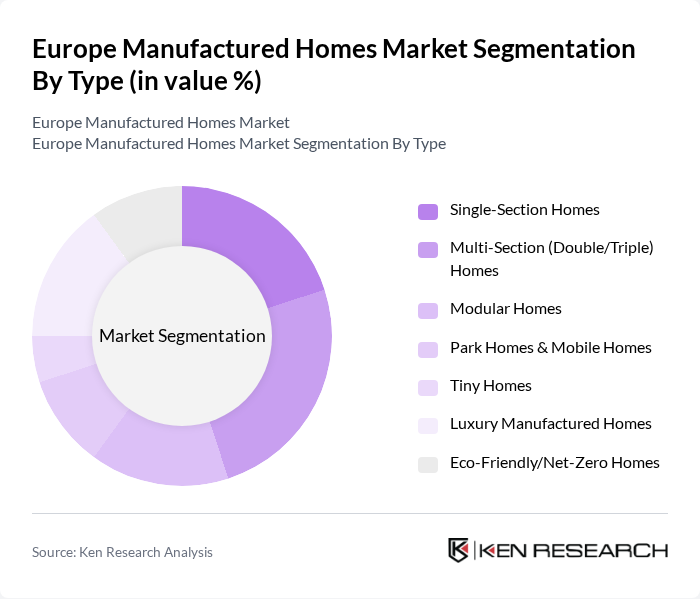
By Type:The market is segmented into various types of manufactured homes, including Single-Section Homes, Multi-Section (Double/Triple) Homes, Modular Homes, Park Homes & Mobile Homes, Tiny Homes, Luxury Manufactured Homes, and Eco-Friendly/Net-Zero Homes. Each type caters to different consumer preferences and needs, with varying levels of customization, size, and price points.
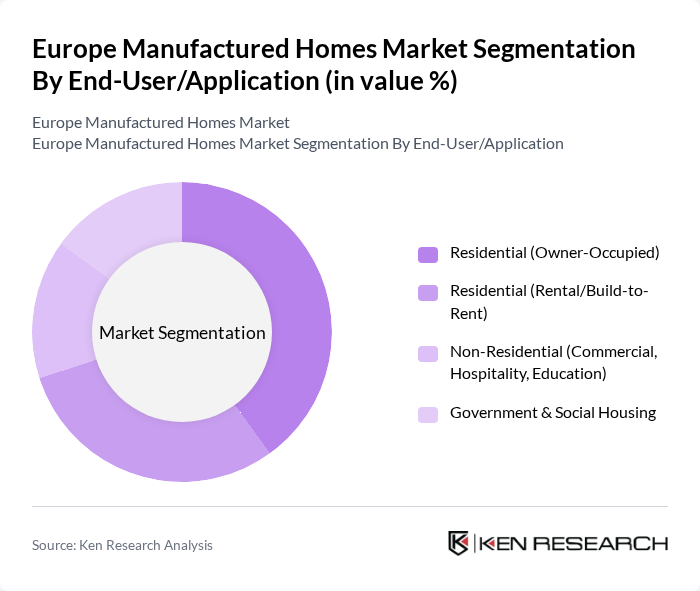
By End-User/Application:The market is further segmented by end-user applications, which include Residential (Owner-Occupied), Residential (Rental/Build-to-Rent), Non-Residential (Commercial, Hospitality, Education), and Government & Social Housing. Each application serves distinct market needs, with residential applications being the most significant segment due to the growing demand for affordable housing. Increased adoption is also visible in rental and public-sector procurement to address housing shortages and accelerate delivery timelines .
Europe Manufactured Homes Market Competitive Landscape
The Europe Manufactured Homes Market is characterized by a dynamic mix of regional and international players. Leading participants such as Nordic Homes AS, Ilke Homes Ltd, Laing O'Rourke (Explore Manufacturing), Modulaire Group, Algeco, Skanska AB, PEAB AB, Bonava AB, Katerra Europe S.L. (legacy assets), Willerby Ltd, ABI Holiday Homes, Victory Leisure Homes, Omar Park Homes Ltd, Pathfinder Homes, Tingdene Homes Ltd contribute to innovation, geographic expansion, and service delivery in this space .
Europe Manufactured Homes Market Industry Analysis
Growth Drivers
- Increasing Demand for Affordable Housing:The European housing market faces a significant affordability crisis, with over 80 million people in the EU unable to afford adequate housing. The average cost of housing has risen by 5% annually, while average incomes have only increased by 3%. This disparity drives demand for manufactured homes, which can be produced at a lower cost, with prices averaging around €120,000 compared to traditional homes that can exceed €350,000 in urban areas.
- Rising Awareness of Sustainable Living:In future, approximately 65% of European consumers prioritize sustainability in their housing choices. The demand for eco-friendly homes is reflected in the growing market for manufactured homes, which often utilize sustainable materials and energy-efficient designs. The European Commission's Green Deal aims to reduce carbon emissions by 55% by 2030, further encouraging the adoption of sustainable housing solutions, including manufactured homes.
- Technological Advancements in Construction:The manufactured homes sector is benefiting from technological innovations, such as 3D printing and modular construction techniques. In future, the adoption of these technologies is expected to reduce construction time by 30% and costs by 25%. This efficiency not only enhances the appeal of manufactured homes but also aligns with the growing trend of rapid urbanization, where demand for quick and affordable housing solutions is paramount.
Market Challenges
- Regulatory Hurdles:The manufactured homes market in Europe faces stringent regulatory frameworks that vary significantly across countries. For instance, compliance with building codes and zoning laws can add up to 20% to the overall project costs. In future, navigating these regulations remains a challenge for manufacturers, potentially delaying project timelines and increasing costs, which can deter potential buyers from considering manufactured homes.
- Perception Issues Among Consumers:Despite the advantages, manufactured homes often suffer from negative perceptions regarding quality and safety. In future, surveys indicated that 35% of potential buyers still associate manufactured homes with lower quality compared to traditional housing. This perception can hinder market growth, as consumers may be reluctant to invest in manufactured homes, fearing they may not meet their expectations for durability and aesthetics.
Europe Manufactured Homes Market Future Outlook
The future of the manufactured homes market in Europe appears promising, driven by increasing urbanization and a growing emphasis on affordable housing solutions. As governments implement policies to support sustainable living, the integration of smart technologies into manufactured homes is likely to enhance their appeal. Additionally, the trend towards customization will cater to diverse consumer preferences, making manufactured homes a more attractive option for a broader demographic, particularly millennials and first-time buyers.
Market Opportunities
- Expansion into Emerging Markets:Emerging markets in Eastern Europe present significant opportunities for manufactured homes, with housing shortages affecting over 25% of the population. In future, targeted investments in these regions could lead to a 30% increase in market penetration, addressing both affordability and availability issues.
- Integration of Smart Home Technologies:The integration of smart home technologies is becoming increasingly popular, with the smart home market projected to reach €35 billion in future in Europe. This trend offers manufactured home builders a chance to differentiate their products, appealing to tech-savvy consumers who prioritize convenience and energy efficiency in their living spaces.
Scope of the Report
| Segment | Sub-Segments |
|---|---|
| By Type | Single-Section Homes Multi-Section (Double/Triple) Homes Modular Homes Park Homes & Mobile Homes Tiny Homes Luxury Manufactured Homes Eco-Friendly/Net-Zero Homes |
| By End-User/Application | Residential (Owner-Occupied) Residential (Rental/Build-to-Rent) Non-Residential (Commercial, Hospitality, Education) Government & Social Housing |
| By Placement/Community Type | Private Property (Fee Simple) Manufactured Home Communities/Parks Temporary/Relocatable Sites |
| By Distribution Channel | Direct Sales (Manufacturer to Buyer) Authorized Dealers Online/Digital Sales Developers and Community Operators |
| By Price Range | Entry-Level Mid-Range Premium |
| By Material System | Timber/Light-Frame Wood Steel Frame Hybrid/Composite Panels Concrete/Lightweight Concrete |
| By Financing Mechanism | Mortgage Finance Chattel/Personal Property Loans Leasing & Rent-to-Buy Public Subsidies/Grants |
| By Country | Germany United Kingdom France Italy Spain Netherlands Sweden Norway Denmark Poland Rest of Europe |
Key Target Audience
Investors and Venture Capitalist Firms
Government and Regulatory Bodies (e.g., European Commission, National Housing Agencies)
Manufacturers and Producers
Distributors and Retailers
Real Estate Developers
Construction Companies
Industry Associations (e.g., European Federation of Wooden Houses)
Financial Institutions (e.g., Banks, Mortgage Lenders)
Players Mentioned in the Report:
Nordic Homes AS
Ilke Homes Ltd
Laing O'Rourke (Explore Manufacturing)
Modulaire Group
Algeco
Skanska AB
PEAB AB
Bonava AB
Katerra Europe S.L. (legacy assets)
Willerby Ltd
ABI Holiday Homes
Victory Leisure Homes
Omar Park Homes Ltd
Pathfinder Homes
Tingdene Homes Ltd
Table of Contents
Market Assessment Phase
1. Executive Summary and Approach
2. Europe Manufactured Homes Market Overview
2.1 Key Insights and Strategic Recommendations
2.2 Europe Manufactured Homes Market Overview
2.3 Definition and Scope
2.4 Evolution of Market Ecosystem
2.5 Timeline of Key Regulatory Milestones
2.6 Value Chain & Stakeholder Mapping
2.7 Business Cycle Analysis
2.8 Policy & Incentive Landscape
3. Europe Manufactured Homes Market Analysis
3.1 Growth Drivers
3.1.1 Increasing Demand for Affordable Housing
3.1.2 Rising Awareness of Sustainable Living
3.1.3 Technological Advancements in Construction
3.1.4 Government Support and Incentives
3.2 Market Challenges
3.2.1 Regulatory Hurdles
3.2.2 Perception Issues Among Consumers
3.2.3 Competition from Traditional Housing
3.2.4 Supply Chain Disruptions
3.3 Market Opportunities
3.3.1 Expansion into Emerging Markets
3.3.2 Customization and Personalization Trends
3.3.3 Integration of Smart Home Technologies
3.3.4 Partnerships with Real Estate Developers
3.4 Market Trends
3.4.1 Shift Towards Eco-Friendly Materials
3.4.2 Growth of Modular Construction Techniques
3.4.3 Increasing Popularity of Tiny Homes
3.4.4 Rise in Off-Grid Living Solutions
3.5 Government Regulation
3.5.1 Building Codes and Standards
3.5.2 Zoning Laws and Land Use Regulations
3.5.3 Environmental Impact Assessments
3.5.4 Financial Incentives for Sustainable Housing
4. SWOT Analysis
5. Stakeholder Analysis
6. Porter's Five Forces Analysis
7. Europe Manufactured Homes Market Market Size, 2019-2024
7.1 By Value
7.2 By Volume
7.3 By Average Selling Price
8. Europe Manufactured Homes Market Segmentation
8.1 By Type
8.1.1 Single-Section Homes
8.1.2 Multi-Section (Double/Triple) Homes
8.1.3 Modular Homes
8.1.4 Park Homes & Mobile Homes
8.1.5 Tiny Homes
8.1.6 Luxury Manufactured Homes
8.1.7 Eco-Friendly/Net-Zero Homes
8.2 By End-User/Application
8.2.1 Residential (Owner-Occupied)
8.2.2 Residential (Rental/Build-to-Rent)
8.2.3 Non-Residential (Commercial, Hospitality, Education)
8.2.4 Government & Social Housing
8.3 By Placement/Community Type
8.3.1 Private Property (Fee Simple)
8.3.2 Manufactured Home Communities/Parks
8.3.3 Temporary/Relocatable Sites
8.4 By Distribution Channel
8.4.1 Direct Sales (Manufacturer to Buyer)
8.4.2 Authorized Dealers
8.4.3 Online/Digital Sales
8.4.4 Developers and Community Operators
8.5 By Price Range
8.5.1 Entry-Level
8.5.2 Mid-Range
8.5.3 Premium
8.6 By Material System
8.6.1 Timber/Light-Frame Wood
8.6.2 Steel Frame
8.6.3 Hybrid/Composite Panels
8.6.4 Concrete/Lightweight Concrete
8.7 By Financing Mechanism
8.7.1 Mortgage Finance
8.7.2 Chattel/Personal Property Loans
8.7.3 Leasing & Rent-to-Buy
8.7.4 Public Subsidies/Grants
8.8 By Country
8.8.1 Germany
8.8.2 United Kingdom
8.8.3 France
8.8.4 Italy
8.8.5 Spain
8.8.6 Netherlands
8.8.7 Sweden
8.8.8 Norway
8.8.9 Denmark
8.8.10 Poland
8.8.11 Rest of Europe
9. Europe Manufactured Homes Market Competitive Analysis
9.1 Market Share of Key Players
9.2 Cross Comparison of Key Players
9.2.1 Company Name
9.2.2 Group Size (Large, Medium, or Small as per industry convention)
9.2.3 Revenue from Manufactured/Modular Housing (Europe, latest FY)
9.2.4 Installed Capacity/Annual Output (units per year)
9.2.5 Order Backlog/Book-to-Bill Ratio
9.2.6 Average Selling Price (EUR per unit)
9.2.7 Gross Margin/EBIT Margin
9.2.8 Lead Time (factory-to-site, weeks)
9.2.9 Market Coverage (countries served / distribution breadth)
9.2.10 Certifications & Compliance (EN/Eurocode, NHBC, BOPAS, etc.)
9.2.11 Energy Performance (EPC class, U-values, % NZEB/Passivhaus)
9.2.12 Warranty & After-Sales KPIs (call-out rate, defect rate per unit)
9.2.13 Customer Mix (owner-occupied vs BTR/social housing %)
9.2.14 On-time Delivery Rate
9.2.15 R&D/Innovation Intensity (% of revenue)
9.3 SWOT Analysis of Top Players
9.4 Pricing Analysis
9.5 Detailed Profile of Major Companies
9.5.1 Nordic Homes AS
9.5.2 Ilke Homes Ltd
9.5.3 Laing O'Rourke (Explore Manufacturing)
9.5.4 Modulaire Group
9.5.5 Algeco
9.5.6 Skanska AB
9.5.7 PEAB AB
9.5.8 Bonava AB
9.5.9 Katerra Europe S.L. (legacy assets)
9.5.10 Willerby Ltd
9.5.11 ABI Holiday Homes
9.5.12 Victory Leisure Homes
9.5.13 Omar Park Homes Ltd
9.5.14 Pathfinder Homes
9.5.15 Tingdene Homes Ltd
10. Europe Manufactured Homes Market End-User Analysis
10.1 Procurement Behavior of Key Ministries
10.1.1 Government Housing Initiatives
10.1.2 Budget Allocations for Affordable Housing
10.1.3 Collaboration with Private Sector
10.2 Corporate Spend on Infrastructure & Energy
10.2.1 Investment in Sustainable Housing
10.2.2 Funding for Modular Construction Projects
10.3 Pain Point Analysis by End-User Category
10.3.1 Affordability Issues
10.3.2 Quality Concerns
10.3.3 Availability of Financing
10.4 User Readiness for Adoption
10.4.1 Awareness of Manufactured Homes
10.4.2 Perceived Value vs. Traditional Homes
10.5 Post-Deployment ROI and Use Case Expansion
10.5.1 Long-Term Cost Savings
10.5.2 Potential for Resale Value Increase
11. Europe Manufactured Homes Market Future Size, 2025-2030
11.1 By Value
11.2 By Volume
11.3 By Average Selling Price
Go-To-Market Strategy Phase
1. Whitespace Analysis + Business Model Canvas
1.1 Market Gaps Identification
1.2 Business Model Framework
2. Marketing and Positioning Recommendations
2.1 Branding Strategies
2.2 Product USPs
3. Distribution Plan
3.1 Urban Retail Strategies
3.2 Rural NGO Tie-Ups
4. Channel & Pricing Gaps
4.1 Underserved Routes
4.2 Pricing Bands
5. Unmet Demand & Latent Needs
5.1 Category Gaps
5.2 Consumer Segments
6. Customer Relationship
6.1 Loyalty Programs
6.2 After-Sales Service
7. Value Proposition
7.1 Sustainability
7.2 Integrated Supply Chains
8. Key Activities
8.1 Regulatory Compliance
8.2 Branding
8.3 Distribution Setup
9. Entry Strategy Evaluation
9.1 Domestic Market Entry Strategy
9.1.1 Product Mix
9.1.2 Pricing Band
9.1.3 Packaging
9.2 Export Entry Strategy
9.2.1 Target Countries
9.2.2 Compliance Roadmap
10. Entry Mode Assessment
10.1 Joint Ventures
10.2 Greenfield Investments
10.3 Mergers & Acquisitions
10.4 Distributor Model
11. Capital and Timeline Estimation
11.1 Capital Requirements
11.2 Timelines
12. Control vs Risk Trade-Off
12.1 Ownership vs Partnerships
13. Profitability Outlook
13.1 Breakeven Analysis
13.2 Long-Term Sustainability
14. Potential Partner List
14.1 Distributors
14.2 Joint Ventures
14.3 Acquisition Targets
15. Execution Roadmap
15.1 Phased Plan for Market Entry
15.1.1 Market Setup
15.1.2 Market Entry
15.1.3 Growth Acceleration
15.1.4 Scale & Stabilize
15.2 Key Activities and Milestones
15.2.1 Activity Timeline
15.2.2 Milestone Tracking
Research Methodology
Phase 1: Approach1
Desk Research
- Analysis of industry reports from European housing associations and market research firms
- Review of government publications and housing policy documents across key European nations
- Examination of statistical data from Eurostat and national statistical offices regarding manufactured home sales
Primary Research
- Interviews with manufacturers and suppliers of manufactured homes in Europe
- Surveys conducted with real estate agents specializing in manufactured housing
- Focus groups with consumers who have purchased or are considering manufactured homes
Validation & Triangulation
- Cross-validation of findings through multiple data sources including trade publications and market surveys
- Triangulation of insights from primary interviews with secondary data trends
- Sanity checks through expert panels comprising industry veterans and market analysts
Phase 2: Market Size Estimation1
Top-down Assessment
- Estimation of market size based on overall housing market trends and manufactured home penetration rates
- Segmentation of market data by country, type of manufactured home, and consumer demographics
- Incorporation of macroeconomic indicators such as GDP growth and housing affordability metrics
Bottom-up Modeling
- Collection of sales data from leading manufacturers and distributors of manufactured homes
- Estimation of average selling prices and volume sold across different regions
- Analysis of consumer financing options and their impact on purchasing behavior
Forecasting & Scenario Analysis
- Development of forecasting models based on historical sales data and economic indicators
- Scenario analysis considering factors such as regulatory changes and shifts in consumer preferences
- Projections of market growth under various economic conditions through 2030
Phase 3: CATI Sample Composition1
| Scope Item/Segment | Sample Size | Target Respondent Profiles |
|---|---|---|
| Manufactured Home Buyers | 150 | First-time homebuyers, Retirees, Young families |
| Manufactured Home Manufacturers | 100 | Production Managers, Sales Directors, Marketing Executives |
| Real Estate Agents | 80 | Residential Real Estate Agents, Brokers specializing in manufactured homes |
| Financial Institutions | 70 | Loan Officers, Mortgage Brokers, Financial Advisors |
| Regulatory Bodies | 50 | Policy Makers, Housing Authority Representatives, Urban Planners |
Frequently Asked Questions
What is the current value of the Europe Manufactured Homes Market?
The Europe Manufactured Homes Market is valued at approximately USD 8.3 billion, reflecting a consistent trend in the high-single-digit billions, driven by increasing demand for affordable housing and sustainable living solutions.
Which countries dominate the Europe Manufactured Homes Market?
What are the main types of manufactured homes available in Europe?
What factors are driving the growth of the manufactured homes market in Europe?
Other Regional/Country Reports
Indonesia Manufactured Homes Market
Malaysia Manufactured Homes Market
Why Buy From Us?

What makes us stand out is that our consultants follow Robust, Refine and Result (RRR) methodology. Robust for clear definitions, approaches and sanity checking, Refine for differentiating respondents' facts and opinions, and Result for presenting data with story.

We have set a benchmark in the industry by offering our clients with syndicated and customized market research reports featuring coverage of entire market as well as meticulous research and analyst insights.

While we don't replace traditional research, we flip the method upside down. Our dual approach of Top Bottom & Bottom Top ensures quality deliverable by not just verifying company fundamentals but also looking at the sector and macroeconomic factors.

With one step in the future, our research team constantly tries to show you the bigger picture. We help with some of the tough questions you may encounter along the way: How is the industry positioned? Best marketing channel? KPI's of competitors? By aligning every element, we help maximize success.

Our report gives you instant access to the answers and sources that other companies might choose to hide. We elaborate each steps of research methodology we have used and showcase you the sample size to earn your trust.

If you need any support, we are here! We pride ourselves on universe strength, data quality, and quick, friendly, and professional service.