About the Report
Base Year 2024Listen to the audio summary
Europe Orange Market Overview
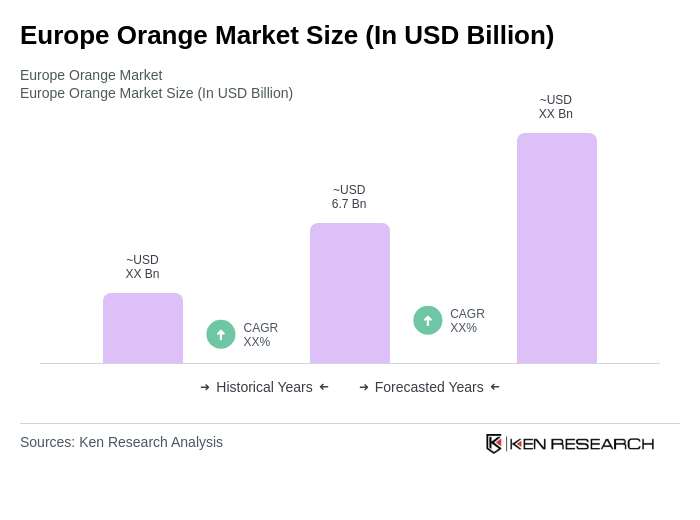
- The Europe Orange Market is valued at USD 6.7 billion, based on a five-year historical analysis. This growth is primarily driven by increasing consumer demand for fresh fruits, rising health consciousness, and the sustained popularity of orange juice as a beverage choice. The market has experienced a steady rise in production and consumption, supported by favorable climatic conditions and ongoing advancements in agricultural practices .
- Countries such as Spain and Italy dominate the Europe Orange Market due to their favorable climates for orange cultivation, advanced agricultural techniques, and strong export capabilities. Spain, in particular, is recognized for its high-quality Navel and Valencia oranges, making it a leading player in the European market. The strategic location of these countries also facilitates efficient distribution across Europe .
- In recent years, the European Union has implemented regulations aimed at promoting sustainable agricultural practices in the orange sector. These include guidelines for reducing pesticide use and enhancing organic farming methods, which are expected to improve orange quality and meet the growing consumer demand for organic products .
Europe Orange Market Segmentation
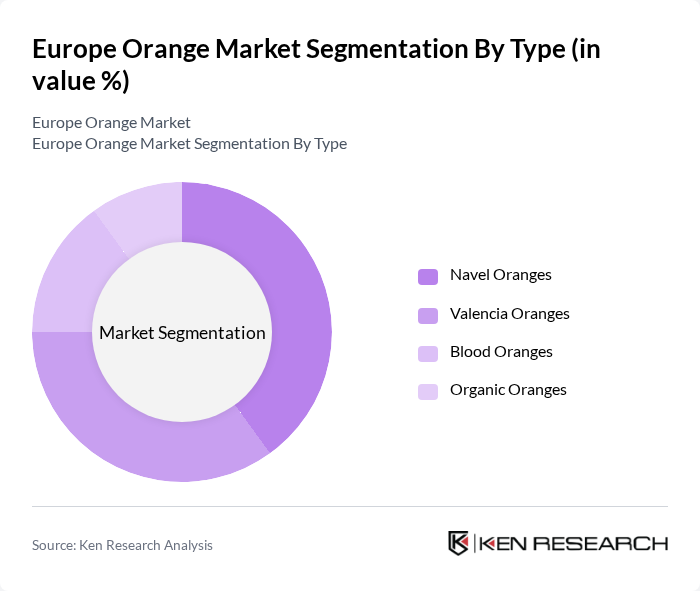
By Type:The market is segmented into various types of oranges, including Navel Oranges, Valencia Oranges, Blood Oranges, and Organic Oranges. Each type caters to different consumer preferences and market demands. Navel and Valencia oranges are especially popular for their sweetness and juiciness, while organic oranges are gaining traction due to increasing health consciousness among consumers .
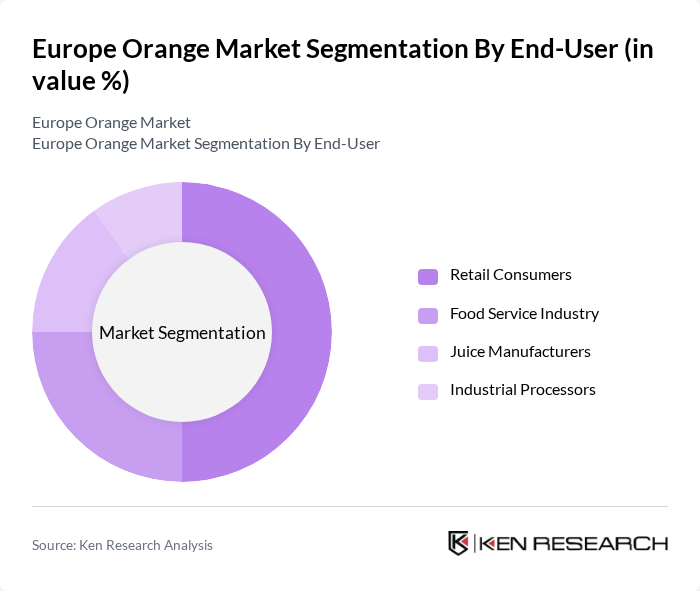
By End-User:The end-user segmentation includes Retail Consumers, Food Service Industry, Juice Manufacturers, and Industrial Processors. Retail consumers represent the largest segment, driven by the increasing demand for fresh fruits and juices in households. The food service industry also plays a significant role, as restaurants and cafes increasingly incorporate oranges into their menus .
Europe Orange Market Competitive Landscape
The Europe Orange Market is characterized by a dynamic mix of regional and international players. Leading participants such as Eckes-Granini Group GmbH, Britvic PLC, Maspex Wadowice Group, Tropicana Brands Group, Suntory Holdings Limited, The Coca-Cola Company (Minute Maid, Simply Orange), PepsiCo, Inc. (Tropicana Europe), Refresco Group B.V., Granini France SAS, Citrosuco Europe S.A., Louis Dreyfus Company B.V. (Juice Division), Grupo García Carrión S.A., Zuegg S.p.A., Valensina GmbH, Rauch Fruchtsäfte GmbH & Co OG contribute to innovation, geographic expansion, and service delivery in this space.
Europe Orange Market Industry Analysis
Growth Drivers
- Increasing Consumer Demand for Healthy Products:The European orange market is experiencing a surge in consumer demand for healthy products, with the organic food sector growing by €2.8 billion annually. In future, the organic fruit market reached €13 billion, driven by a 17% increase in health-conscious consumers seeking nutritious options. This trend is supported by the European Commission's initiatives promoting fruit consumption, which aim to increase per capita fruit intake to 110 kg, further boosting orange demand.
- Expansion of Organic Farming Practices:The area dedicated to organic orange farming in Europe has expanded significantly, with over 180,000 hectares cultivated, reflecting a 12% increase from the previous year. This growth is supported by EU policies encouraging sustainable agriculture, with €1.5 billion allocated for organic farming subsidies. As consumers increasingly prefer organic products, this expansion is expected to enhance the availability of organic oranges, meeting rising market demand.
- Technological Advancements in Agriculture:Technological innovations in agriculture, such as precision farming and smart irrigation systems, are enhancing orange production efficiency. In future, the adoption of these technologies led to a 25% increase in yield per hectare, with average yields reaching 45 tons. The European Union's investment of €600 million in agricultural technology is expected to further improve productivity and sustainability, positioning the orange market for robust growth in the coming years.
Market Challenges
- Climate Change Impact on Crop Yields:Climate change poses a significant threat to orange production in Europe, with average temperatures projected to rise by 2°C. This increase has already resulted in a 20% decline in crop yields in southern Europe due to drought conditions. The European Environment Agency reports that extreme weather events could further disrupt production, leading to potential shortages and increased prices for consumers and producers alike.
- Regulatory Compliance Costs:Compliance with stringent EU regulations on food safety and environmental standards imposes significant costs on orange producers. In future, the average compliance cost per farm was estimated at €35,000, impacting profitability. With new regulations expected, these costs may rise by 12%, straining smaller producers and potentially leading to market consolidation as larger firms absorb these expenses more easily.
Europe Orange Market Future Outlook
The future of the European orange market appears promising, driven by increasing health awareness and a shift towards organic products. As consumer preferences evolve, the demand for sustainably sourced oranges is expected to rise, supported by technological advancements in agriculture. Additionally, the expansion of e-commerce platforms for fresh produce will facilitate greater access to oranges, enhancing market reach. These trends indicate a dynamic market landscape, with opportunities for growth and innovation in the coming years.
Market Opportunities
- Growth in E-commerce for Fresh Produce:The rise of e-commerce platforms for fresh produce presents a significant opportunity for the orange market. In future, online grocery sales in Europe reached €35 billion, with fresh produce accounting for 30% of this figure. This trend is expected to continue, providing orange producers with a direct channel to consumers and enhancing market accessibility.
- Development of Sustainable Farming Techniques:The increasing focus on sustainability offers opportunities for innovation in orange farming. With €1.2 billion allocated for sustainable agriculture initiatives, producers can invest in eco-friendly practices. This shift not only meets consumer demand for sustainable products but also positions farmers to benefit from potential subsidies and grants aimed at promoting environmentally responsible farming.
Scope of the Report
| Segment | Sub-Segments |
|---|---|
| By Type | Navel Oranges Valencia Oranges Blood Oranges Organic Oranges |
| By End-User | Retail Consumers Food Service Industry Juice Manufacturers Industrial Processors |
| By Distribution Channel | Supermarkets and Hypermarkets Online Retail Farmers' Markets Foodservice Distributors |
| By Region | Western Europe Eastern Europe Southern Europe Northern Europe |
| By Packaging Type | Bulk Packaging Retail Packaging Eco-friendly Packaging |
| By Quality Grade | Premium Quality Standard Quality Industrial Grade |
| By Price Range | Low Price Mid Price High Price |
Key Target Audience
Investors and Venture Capitalist Firms
Government and Regulatory Bodies (e.g., European Commission, Food Standards Agency)
Manufacturers and Producers
Distributors and Retailers
Export and Import Agencies (e.g., UK Department for International Trade)
Food and Beverage Industry Associations
Logistics and Supply Chain Companies
Health and Nutrition Organizations
Players Mentioned in the Report:
Eckes-Granini Group GmbH
Britvic PLC
Maspex Wadowice Group
Tropicana Brands Group
Suntory Holdings Limited
The Coca-Cola Company (Minute Maid, Simply Orange)
PepsiCo, Inc. (Tropicana Europe)
Refresco Group B.V.
Granini France SAS
Citrosuco Europe S.A.
Louis Dreyfus Company B.V. (Juice Division)
Grupo Garcia Carrion S.A.
Zuegg S.p.A.
Valensina GmbH
Rauch Fruchtsafte GmbH & Co OG
Table of Contents
Market Assessment Phase
1. Executive Summary and Approach
2. Europe Orange Market Overview
2.1 Key Insights and Strategic Recommendations
2.2 Europe Orange Market Overview
2.3 Definition and Scope
2.4 Evolution of Market Ecosystem
2.5 Timeline of Key Regulatory Milestones
2.6 Value Chain & Stakeholder Mapping
2.7 Business Cycle Analysis
2.8 Policy & Incentive Landscape
3. Europe Orange Market Analysis
3.1 Growth Drivers
3.1.1 Increasing Consumer Demand for Healthy Products
3.1.2 Expansion of Organic Farming Practices
3.1.3 Technological Advancements in Agriculture
3.1.4 Rising Health Consciousness Among Consumers
3.2 Market Challenges
3.2.1 Climate Change Impact on Crop Yields
3.2.2 Regulatory Compliance Costs
3.2.3 Competition from Imported Products
3.2.4 Supply Chain Disruptions
3.3 Market Opportunities
3.3.1 Growth in E-commerce for Fresh Produce
3.3.2 Development of Sustainable Farming Techniques
3.3.3 Expansion into Emerging Markets
3.3.4 Partnerships with Health and Wellness Brands
3.4 Market Trends
3.4.1 Shift Towards Organic and Natural Products
3.4.2 Increased Use of Digital Marketing Strategies
3.4.3 Focus on Traceability and Transparency
3.4.4 Growth of Subscription-Based Delivery Services
3.5 Government Regulation
3.5.1 EU Organic Certification Standards
3.5.2 Food Safety Regulations
3.5.3 Environmental Protection Laws
3.5.4 Trade Tariffs on Imported Citrus Products
4. SWOT Analysis
5. Stakeholder Analysis
6. Porter's Five Forces Analysis
7. Europe Orange Market Market Size, 2019-2024
7.1 By Value
7.2 By Volume
7.3 By Average Selling Price
8. Europe Orange Market Segmentation
8.1 By Type
8.1.1 Navel Oranges
8.1.2 Valencia Oranges
8.1.3 Blood Oranges
8.1.4 Organic Oranges
8.2 By End-User
8.2.1 Retail Consumers
8.2.2 Food Service Industry
8.2.3 Juice Manufacturers
8.2.4 Industrial Processors
8.3 By Distribution Channel
8.3.1 Supermarkets and Hypermarkets
8.3.2 Online Retail
8.3.3 Farmers' Markets
8.3.4 Foodservice Distributors
8.4 By Region
8.4.1 Western Europe
8.4.2 Eastern Europe
8.4.3 Southern Europe
8.4.4 Northern Europe
8.5 By Packaging Type
8.5.1 Bulk Packaging
8.5.2 Retail Packaging
8.5.3 Eco-friendly Packaging
8.6 By Quality Grade
8.6.1 Premium Quality
8.6.2 Standard Quality
8.6.3 Industrial Grade
8.7 By Price Range
8.7.1 Low Price
8.7.2 Mid Price
8.7.3 High Price
9. Europe Orange Market Competitive Analysis
9.1 Market Share of Key Players
9.2 Cross Comparison of Key Players
9.2.1 Company Name
9.2.2 Group Size (Large, Medium, or Small)
9.2.3 Revenue Growth Rate (CAGR %)
9.2.4 Market Share (%)
9.2.5 Geographic Coverage (Number of European countries served)
9.2.6 Product Portfolio Breadth (Number of orange-based SKUs)
9.2.7 Distribution Channel Diversity (Retail, Foodservice, Online, etc.)
9.2.8 Brand Recognition Score (Consumer survey index)
9.2.9 Sustainability Initiatives (Eco-certifications, packaging, sourcing)
9.2.10 Innovation Rate (New product launches per year)
9.3 SWOT Analysis of Top Players
9.4 Pricing Analysis
9.5 Detailed Profile of Major Companies
9.5.1 Eckes-Granini Group GmbH
9.5.2 Britvic PLC
9.5.3 Maspex Wadowice Group
9.5.4 Tropicana Brands Group
9.5.5 Suntory Holdings Limited
9.5.6 The Coca-Cola Company (Minute Maid, Simply Orange)
9.5.7 PepsiCo, Inc. (Tropicana Europe)
9.5.8 Refresco Group B.V.
9.5.9 Granini France SAS
9.5.10 Citrosuco Europe S.A.
9.5.11 Louis Dreyfus Company B.V. (Juice Division)
9.5.12 Grupo García Carrión S.A.
9.5.13 Zuegg S.p.A.
9.5.14 Valensina GmbH
9.5.15 Rauch Fruchtsäfte GmbH & Co OG
10. Europe Orange Market End-User Analysis
10.1 Procurement Behavior of Key Ministries
10.1.1 Budget Allocation for Citrus Products
10.1.2 Sourcing Preferences
10.1.3 Compliance with Health Standards
10.2 Corporate Spend on Infrastructure & Energy
10.2.1 Investment in Sustainable Practices
10.2.2 Infrastructure Development for Distribution
10.2.3 Energy Efficiency Initiatives
10.3 Pain Point Analysis by End-User Category
10.3.1 Quality Consistency Issues
10.3.2 Supply Chain Reliability
10.3.3 Price Volatility
10.4 User Readiness for Adoption
10.4.1 Awareness of Organic Options
10.4.2 Willingness to Pay for Quality
10.4.3 Accessibility of Products
10.5 Post-Deployment ROI and Use Case Expansion
10.5.1 Measurement of Customer Satisfaction
10.5.2 Expansion into New Markets
10.5.3 Long-term Customer Engagement Strategies
11. Europe Orange Market Future Size, 2025-2030
11.1 By Value
11.2 By Volume
11.3 By Average Selling Price
Go-To-Market Strategy Phase
1. Whitespace Analysis + Business Model Canvas
1.1 Identification of Market Gaps
1.2 Value Proposition Development
1.3 Revenue Stream Analysis
1.4 Cost Structure Evaluation
1.5 Key Partnerships Identification
1.6 Customer Segmentation
1.7 Channels of Distribution
2. Marketing and Positioning Recommendations
2.1 Branding Strategies
2.2 Product USPs
2.3 Target Audience Identification
2.4 Communication Strategy
2.5 Digital Marketing Tactics
3. Distribution Plan
3.1 Urban Retail Strategies
3.2 Rural NGO Tie-ups
3.3 Logistics and Supply Chain Management
3.4 Distribution Partnerships
4. Channel & Pricing Gaps
4.1 Underserved Routes
4.2 Pricing Bands Analysis
4.3 Competitor Pricing Strategies
5. Unmet Demand & Latent Needs
5.1 Category Gaps Identification
5.2 Consumer Segments Analysis
5.3 Emerging Trends Exploration
6. Customer Relationship
6.1 Loyalty Programs
6.2 After-sales Service
6.3 Customer Feedback Mechanisms
7. Value Proposition
7.1 Sustainability Initiatives
7.2 Integrated Supply Chains
7.3 Competitive Advantages
8. Key Activities
8.1 Regulatory Compliance
8.2 Branding Efforts
8.3 Distribution Setup
9. Entry Strategy Evaluation
9.1 Domestic Market Entry Strategy
9.1.1 Product Mix Considerations
9.1.2 Pricing Band Strategy
9.1.3 Packaging Innovations
9.2 Export Entry Strategy
9.2.1 Target Countries Identification
9.2.2 Compliance Roadmap Development
10. Entry Mode Assessment
10.1 Joint Ventures
10.2 Greenfield Investments
10.3 Mergers & Acquisitions
10.4 Distributor Model Evaluation
11. Capital and Timeline Estimation
11.1 Capital Requirements Analysis
11.2 Timelines for Market Entry
12. Control vs Risk Trade-Off
12.1 Ownership vs Partnerships
13. Profitability Outlook
13.1 Breakeven Analysis
13.2 Long-term Sustainability Strategies
14. Potential Partner List
14.1 Distributors
14.2 Joint Ventures
14.3 Acquisition Targets
15. Execution Roadmap
15.1 Phased Plan for Market Entry
15.1.1 Market Setup
15.1.2 Market Entry
15.1.3 Growth Acceleration
15.1.4 Scale & Stabilize
15.2 Key Activities and Milestones
15.2.1 Milestone Planning
15.2.2 Activity Tracking
Research Methodology
Phase 1: Approach1
Desk Research
- Analysis of market reports from industry associations and trade bodies in Europe
- Review of government publications and statistical databases related to orange production and consumption
- Examination of academic journals and white papers focusing on agricultural economics and citrus markets
Primary Research
- Interviews with key stakeholders in the orange supply chain, including farmers and distributors
- Surveys targeting retailers and wholesalers to understand market dynamics and pricing strategies
- Field visits to orchards and processing facilities to gather firsthand insights on production practices
Validation & Triangulation
- Cross-validation of findings through comparison with historical market data and trends
- Triangulation of insights from primary interviews with secondary data sources
- Sanity checks conducted through expert panel discussions with agronomists and market analysts
Phase 2: Market Size Estimation1
Top-down Assessment
- Estimation of total market size based on national agricultural output and consumption statistics
- Segmentation of the market by product type, including fresh oranges, juice, and processed products
- Incorporation of import/export data to assess the impact of trade on market size
Bottom-up Modeling
- Collection of production volume data from leading orange producers across Europe
- Analysis of pricing trends based on retail and wholesale market data
- Calculation of market size using volume x price methodology for each segment
Forecasting & Scenario Analysis
- Development of forecasting models based on historical growth rates and market drivers
- Scenario analysis considering factors such as climate change impacts and consumer preferences
- Projections for market growth through 2030 under various economic conditions
Phase 3: CATI Sample Composition1
| Scope Item/Segment | Sample Size | Target Respondent Profiles |
|---|---|---|
| Fresh Orange Producers | 80 | Farm Owners, Agricultural Managers |
| Orange Juice Manufacturers | 60 | Production Managers, Quality Control Supervisors |
| Retail Market Insights | 100 | Retail Buyers, Category Managers |
| Export and Import Traders | 50 | Trade Analysts, Logistics Coordinators |
| Consumer Preferences Survey | 120 | End Consumers, Health-Conscious Shoppers |
Frequently Asked Questions
What is the current value of the Europe Orange Market?
The Europe Orange Market is valued at approximately USD 6.7 billion, reflecting a steady growth driven by increasing consumer demand for fresh fruits and health-conscious choices, particularly orange juice.
Which countries dominate the Europe Orange Market?
What types of oranges are popular in the Europe Orange Market?
How is the Europe Orange Market responding to health trends?
Other Regional/Country Reports
Indonesia Orange Market
Malaysia Orange Market
KSA Orange Market
APAC Orange Market
Why Buy From Us?

What makes us stand out is that our consultants follow Robust, Refine and Result (RRR) methodology. Robust for clear definitions, approaches and sanity checking, Refine for differentiating respondents' facts and opinions, and Result for presenting data with story.

We have set a benchmark in the industry by offering our clients with syndicated and customized market research reports featuring coverage of entire market as well as meticulous research and analyst insights.

While we don't replace traditional research, we flip the method upside down. Our dual approach of Top Bottom & Bottom Top ensures quality deliverable by not just verifying company fundamentals but also looking at the sector and macroeconomic factors.

With one step in the future, our research team constantly tries to show you the bigger picture. We help with some of the tough questions you may encounter along the way: How is the industry positioned? Best marketing channel? KPI's of competitors? By aligning every element, we help maximize success.

Our report gives you instant access to the answers and sources that other companies might choose to hide. We elaborate each steps of research methodology we have used and showcase you the sample size to earn your trust.

If you need any support, we are here! We pride ourselves on universe strength, data quality, and quick, friendly, and professional service.