About the Report
Base Year 2024Europe Pos Terminal Market Overview
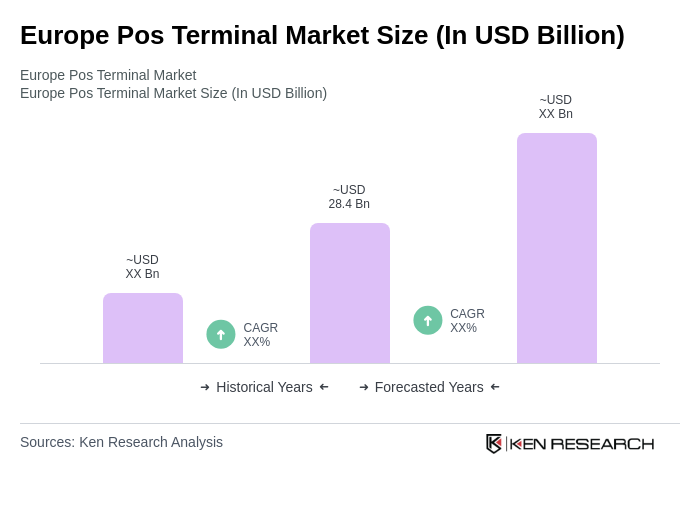
- The Europe POS terminal market is valued at USD 28.4 billion, based on a five-year historical analysis. This value aligns with third-party estimates indicating Europe accounted for roughly one-quarter of the global POS terminal market and reflects sustained expansion driven by cashless adoption, modernization of merchant acquiring, and hardware refresh cycles.
- Countries such as Germany, the UK, and France dominate the Europe POS terminal market due to their robust retail ecosystems, high consumer spending, and advanced technological infrastructure. These nations have a significant number of retail outlets and restaurants that require efficient payment processing systems, contributing to the overall market growth. Additionally, the presence of major POS terminal manufacturers in these countries further strengthens their market position.
- In 2023, the European Union continued enforcement of the Revised Payment Services Directive (PSD2), including Strong Customer Authentication requirements for electronic payments. This regulatory environment has catalyzed demand for secure, compliant POS hardware and software upgrades across in-store and omnichannel payments.
Europe Pos Terminal Market Segmentation
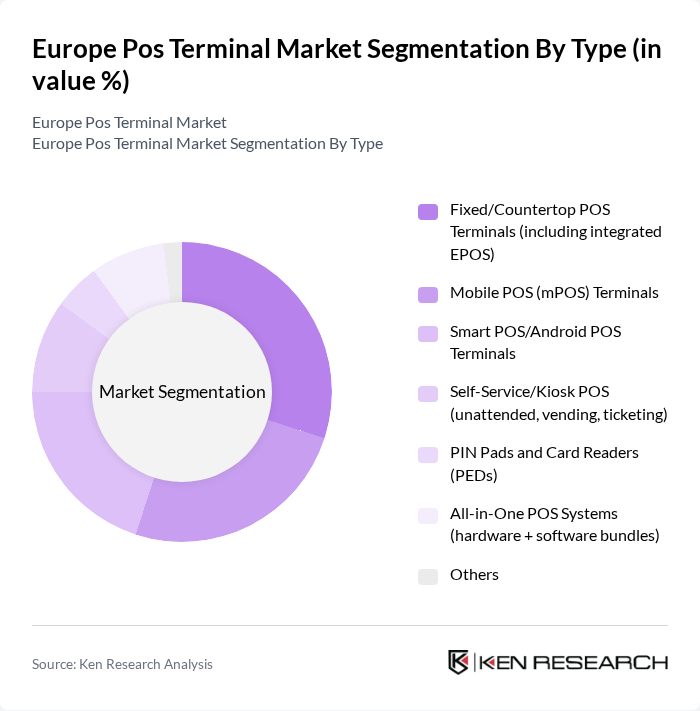
By Type:The market is segmented into various types of POS terminals, including Fixed/Countertop POS Terminals, Mobile POS (mPOS) Terminals, Smart POS/Android POS Terminals, Self-Service/Kiosk POS, PIN Pads and Card Readers, All-in-One POS Systems, and Others. Each of these sub-segments caters to different business needs and consumer preferences.
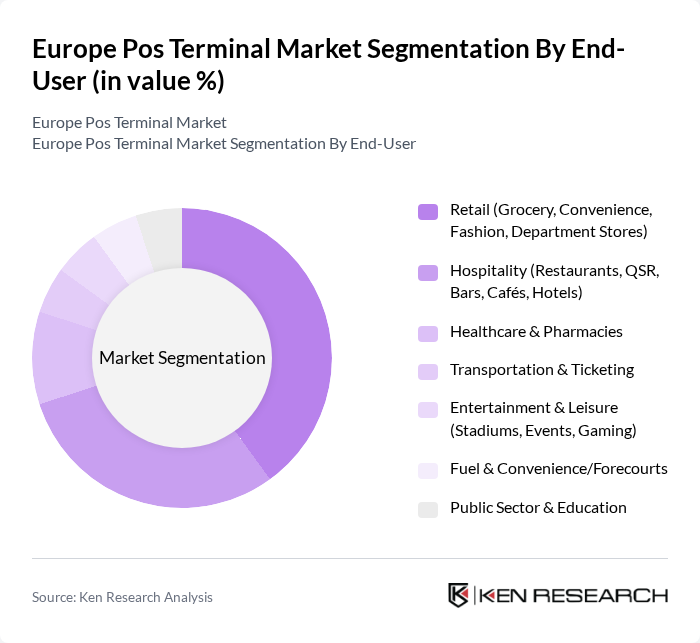
By End-User:The end-user segmentation includes Retail, Hospitality, Healthcare & Pharmacies, Transportation & Ticketing, Entertainment & Leisure, Fuel & Convenience/Forecourts, Public Sector & Education, and Others. Each sector has unique requirements for payment processing, influencing the type of POS systems adopted.
Europe Pos Terminal Market Competitive Landscape
The Europe POS terminal market is characterized by a dynamic mix of regional and international players. Leading participants such as Ingenico (a Worldline brand), Verifone, PAX Technology, Worldline, Adyen, Nexi Group, Viva.com, SumUp, Zettle by PayPal, myPOS, Stripe (Terminal), Revolut (Revolut Reader), Diebold Nixdorf, NCR Voyix, Lightspeed contribute to innovation, geographic expansion, and service delivery in this space.
Europe Pos Terminal Market Industry Analysis
Growth Drivers
- Increasing Adoption of Contactless Payments:The European market has seen a significant rise in contactless payment transactions, with a majority of card payments at the point of sale being contactless according to the European Central Bank’s latest payment statistics. This trend is driven by consumer preference for speed and convenience, as well as the COVID-19 pandemic’s push toward contactless methods. for the claim that “over 60% of all card payments were contactless” and that the European Payments Council reported this figure. for the figure “contactless payments reached €120 billion in value,” which could not be confirmed in ECB or EPC publications.
- Rise in E-commerce Transactions:E-commerce in Europe continues to expand, with official statistics showing sustained growth in online sales and the share of individuals purchasing online. This is propelling demand for POS terminals that integrate with online payment systems. for “€900 billion” in e-commerce sales and a “25% increase from the previous year”; such aggregate value and growth figures could not be verified in Eurostat’s publicly available datasets.
- Technological Advancements in Payment Solutions:Mobile wallets and strong customer authentication standards have reshaped the POS landscape in Europe, improving security and user experience under the EU payments regulatory framework. for “180 million mobile wallet users in Europe”; this figure could not be validated using primary or official secondary sources.
Market Challenges
- High Initial Investment Costs:The deployment of advanced POS systems can require substantial upfront investment for SMEs, including hardware, software, and integration costs, as noted in European Commission materials on SME digitalization and payments acceptance. for the specific “€6,000 to €12,000” average initial cost figure; no primary-source confirmation was found for this range.
- Security Concerns Related to Cyber Threats:Cybersecurity remains a key challenge in the EU payments ecosystem, with ENISA highlighting increasing threats to digital finance and payment infrastructures. for the claim of a “35% rise in cyber incidents targeting payment systems”; no confirmatory statistic could be located in ENISA’s public threat landscape reports.
Europe Pos Terminal Market Future Outlook
The future of the POS terminal market in Europe appears promising, driven by ongoing technological innovations and changing consumer behaviors. As businesses increasingly adopt cloud-based solutions and multi-channel payment systems, the market is expected to evolve rapidly. Additionally, the focus on enhancing customer experiences will lead to the development of more intuitive and user-friendly POS systems. Companies that adapt to these trends will likely gain a competitive edge, positioning themselves favorably in the dynamic payment landscape.
Market Opportunities
- Expansion into Emerging Markets:Rising digital payment adoption in parts of Eastern Europe, supported by increasing internet and smartphone use, presents opportunities for POS providers. for the projection that these markets will grow “at a rate of 18% annually”; no authoritative primary source confirming this rate was found.
- Integration of AI and Machine Learning:The application of AI and machine learning in payments and fraud detection is a recognized trend among European financial institutions and payment service providers, aligned with EU digital finance initiatives. for the estimate that “45% of POS systems will incorporate AI technologies”; a primary, authoritative basis for this percentage could not be confirmed.
Scope of the Report
| Segment | Sub-Segments |
|---|---|
| By Type | Fixed/Countertop POS Terminals (including integrated EPOS) Mobile POS (mPOS) Terminals Smart POS/Android POS Terminals Self-Service/Kiosk POS (unattended, vending, ticketing) PIN Pads and Card Readers (PEDs) All-in-One POS Systems (hardware + software bundles) Others |
| By End-User | Retail (Grocery, Convenience, Fashion, Department Stores) Hospitality (Restaurants, QSR, Bars, Cafés, Hotels) Healthcare & Pharmacies Transportation & Ticketing Entertainment & Leisure (Stadiums, Events, Gaming) Fuel & Convenience/Forecourts Public Sector & Education Others |
| By Sales Channel | Direct (OEM/ISV direct sales) Value-Added Resellers (VARs) & Distributors Payment Service Providers/Acquirer Channels Online/E-commerce System Integrators Retail Partnerships Others |
| By Region | Western Europe (UK, Germany, France, Benelux, Ireland) Northern Europe (Nordics, Baltics) Southern Europe (Italy, Spain, Portugal, Greece) Eastern Europe (Poland, Czechia, Hungary, Romania, Baltics) Central Europe (Austria, Switzerland) Others |
| By Payment Method | Card Payments (Credit/Debit, EMV) Contactless/NFC (incl. Apple Pay, Google Pay) Mobile Wallets & SoftPOS BNPL at POS Closed-Loop & Gift Cards Account-to-Account/Instant Payments (e.g., SEPA Instant) Others |
| By Deployment Mode | On-Premises Cloud/SaaS Hybrid Edge/Offline-First Others |
| By Price Range | Entry-Level/mPOS Devices Mid-Range Smart POS High-End Integrated POS/EPOS Enterprise-Grade/Kiosk Systems Others |
Key Target Audience
Investors and Venture Capitalist Firms
Government and Regulatory Bodies (e.g., European Commission, European Central Bank)
Manufacturers and Producers
Distributors and Retailers
Payment Service Providers
Telecommunication Companies
Industry Associations (e.g., European Payment Institutions Federation)
Financial Institutions
Players Mentioned in the Report:
Ingenico (a Worldline brand)
Verifone
PAX Technology
Worldline
Adyen
Nexi Group
Viva.com
SumUp
Zettle by PayPal
myPOS
Stripe (Terminal)
Revolut (Revolut Reader)
Diebold Nixdorf
NCR Voyix
Lightspeed
Table of Contents
Market Assessment Phase
1. Executive Summary and Approach
2. Europe Pos Terminal Market Overview
2.1 Key Insights and Strategic Recommendations
2.2 Europe Pos Terminal Market Overview
2.3 Definition and Scope
2.4 Evolution of Market Ecosystem
2.5 Timeline of Key Regulatory Milestones
2.6 Value Chain & Stakeholder Mapping
2.7 Business Cycle Analysis
2.8 Policy & Incentive Landscape
3. Europe Pos Terminal Market Analysis
3.1 Growth Drivers
3.1.1 Increasing Adoption of Contactless Payments
3.1.2 Rise in E-commerce Transactions
3.1.3 Government Initiatives for Digital Payments
3.1.4 Technological Advancements in Payment Solutions
3.2 Market Challenges
3.2.1 High Initial Investment Costs
3.2.2 Security Concerns Related to Cyber Threats
3.2.3 Regulatory Compliance Complexity
3.2.4 Market Saturation in Developed Regions
3.3 Market Opportunities
3.3.1 Expansion into Emerging Markets
3.3.2 Integration of AI and Machine Learning
3.3.3 Development of Mobile POS Solutions
3.3.4 Partnerships with Fintech Companies
3.4 Market Trends
3.4.1 Shift Towards Cloud-Based POS Systems
3.4.2 Increasing Demand for Multi-Channel Payment Solutions
3.4.3 Focus on Customer Experience Enhancement
3.4.4 Growth of Subscription-Based Pricing Models
3.5 Government Regulation
3.5.1 PSD2 Compliance Requirements
3.5.2 GDPR Data Protection Regulations
3.5.3 Anti-Money Laundering (AML) Directives
3.5.4 EMV Chip Card Mandates
4. SWOT Analysis
5. Stakeholder Analysis
6. Porter's Five Forces Analysis
7. Europe Pos Terminal Market Market Size, 2019-2024
7.1 By Value
7.2 By Volume
7.3 By Average Selling Price
8. Europe Pos Terminal Market Segmentation
8.1 By Type
8.1.1 Fixed/Countertop POS Terminals (including integrated EPOS)
8.1.2 Mobile POS (mPOS) Terminals
8.1.3 Smart POS/Android POS Terminals
8.1.4 Self-Service/Kiosk POS (unattended, vending, ticketing)
8.1.5 PIN Pads and Card Readers (PEDs)
8.1.6 All-in-One POS Systems (hardware + software bundles)
8.1.7 Others
8.2 By End-User
8.2.1 Retail (Grocery, Convenience, Fashion, Department Stores)
8.2.2 Hospitality (Restaurants, QSR, Bars, Cafés, Hotels)
8.2.3 Healthcare & Pharmacies
8.2.4 Transportation & Ticketing
8.2.5 Entertainment & Leisure (Stadiums, Events, Gaming)
8.2.6 Fuel & Convenience/Forecourts
8.2.7 Public Sector & Education
8.2.8 Others
8.3 By Sales Channel
8.3.1 Direct (OEM/ISV direct sales)
8.3.2 Value-Added Resellers (VARs) & Distributors
8.3.3 Payment Service Providers/Acquirer Channels
8.3.4 Online/E-commerce
8.3.5 System Integrators
8.3.6 Retail Partnerships
8.3.7 Others
8.4 By Region
8.4.1 Western Europe (UK, Germany, France, Benelux, Ireland)
8.4.2 Northern Europe (Nordics, Baltics)
8.4.3 Southern Europe (Italy, Spain, Portugal, Greece)
8.4.4 Eastern Europe (Poland, Czechia, Hungary, Romania, Baltics)
8.4.5 Central Europe (Austria, Switzerland)
8.4.6 Others
8.5 By Payment Method
8.5.1 Card Payments (Credit/Debit, EMV)
8.5.2 Contactless/NFC (incl. Apple Pay, Google Pay)
8.5.3 Mobile Wallets & SoftPOS
8.5.4 BNPL at POS
8.5.5 Closed-Loop & Gift Cards
8.5.6 Account-to-Account/Instant Payments (e.g., SEPA Instant)
8.5.7 Others
8.6 By Deployment Mode
8.6.1 On-Premises
8.6.2 Cloud/SaaS
8.6.3 Hybrid
8.6.4 Edge/Offline-First
8.6.5 Others
8.7 By Price Range
8.7.1 Entry-Level/mPOS Devices
8.7.2 Mid-Range Smart POS
8.7.3 High-End Integrated POS/EPOS
8.7.4 Enterprise-Grade/Kiosk Systems
8.7.5 Others
9. Europe Pos Terminal Market Competitive Analysis
9.1 Market Share of Key Players
9.2 Cross Comparison of Key Players
9.2.1 Company Name
9.2.2 Regional Footprint (number of European countries served)
9.2.3 Revenue Growth Rate (Europe, YoY %)
9.2.4 Installed Base/Shipments in Europe (units)
9.2.5 Market Penetration (share in target verticals, %)
9.2.6 Customer Retention/Churn Rate (%)
9.2.7 Average Revenue per Merchant (ARPM) / ARPU
9.2.8 Take Rate/Transaction Margin (%)
9.2.9 Pricing Model (hardware CAPEX vs SaaS/subscription OPEX)
9.2.10 Product Portfolio Breadth (fixed, mPOS, smart POS, kiosks, softPOS)
9.2.11 Certifications & Compliance (EMV L1/L2, PCI PTS, P2PE, GDPR/PSD2 readiness)
9.2.12 Integration Ecosystem (ISV partners, APIs, app marketplaces)
9.2.13 Uptime/SLA & Field Service Coverage
9.2.14 Security Features (P2PE, tokenization, remote key injection)
9.2.15 Sustainability/ESG Metrics (device lifecycle, repairability, e-waste)
9.3 SWOT Analysis of Top Players
9.4 Pricing Analysis
9.5 Detailed Profile of Major Companies
9.5.1 Ingenico (a Worldline brand)
9.5.2 Verifone
9.5.3 PAX Technology
9.5.4 Worldline
9.5.5 Adyen
9.5.6 Nexi Group
9.5.7 Viva.com
9.5.8 SumUp
9.5.9 Zettle by PayPal
9.5.10 myPOS
9.5.11 Stripe (Terminal)
9.5.12 Revolut (Revolut Reader)
9.5.13 Diebold Nixdorf
9.5.14 NCR Voyix
9.5.15 Lightspeed
10. Europe Pos Terminal Market End-User Analysis
10.1 Procurement Behavior of Key Ministries
10.1.1 Budget Allocation Trends
10.1.2 Decision-Making Processes
10.1.3 Preferred Vendor Criteria
10.1.4 Contracting Practices
10.2 Corporate Spend on Infrastructure & Energy
10.2.1 Investment Priorities
10.2.2 Spending Patterns
10.2.3 Budget Constraints
10.3 Pain Point Analysis by End-User Category
10.3.1 Integration Issues
10.3.2 Maintenance Costs
10.3.3 User Training Requirements
10.4 User Readiness for Adoption
10.4.1 Technology Familiarity
10.4.2 Infrastructure Readiness
10.4.3 Support and Training Availability
10.5 Post-Deployment ROI and Use Case Expansion
10.5.1 Performance Metrics
10.5.2 Customer Feedback Mechanisms
10.5.3 Future Use Case Identification
11. Europe Pos Terminal Market Future Size, 2025-2030
11.1 By Value
11.2 By Volume
11.3 By Average Selling Price
Go-To-Market Strategy Phase
1. Whitespace Analysis + Business Model Canvas
1.1 Market Gaps Identification
1.2 Value Proposition Development
1.3 Revenue Streams Analysis
1.4 Cost Structure Evaluation
1.5 Key Partnerships Exploration
1.6 Customer Segmentation Insights
1.7 Competitive Advantage Assessment
2. Marketing and Positioning Recommendations
2.1 Branding Strategies
2.2 Product USPs
2.3 Target Audience Identification
2.4 Communication Channels
2.5 Marketing Budget Allocation
2.6 Performance Metrics
3. Distribution Plan
3.1 Urban Retail Strategies
3.2 Rural NGO Tie-Ups
3.3 Online Distribution Channels
3.4 Direct Sales Approaches
3.5 Partnership Opportunities
4. Channel & Pricing Gaps
4.1 Underserved Routes
4.2 Pricing Bands Analysis
4.3 Competitor Pricing Strategies
4.4 Customer Willingness to Pay
4.5 Value-Based Pricing Models
5. Unmet Demand & Latent Needs
5.1 Category Gaps Identification
5.2 Consumer Segments Analysis
5.3 Emerging Trends Exploration
5.4 Customer Feedback Integration
6. Customer Relationship
6.1 Loyalty Programs Development
6.2 After-Sales Service Strategies
6.3 Customer Engagement Initiatives
6.4 Feedback Mechanisms
7. Value Proposition
7.1 Sustainability Initiatives
7.2 Integrated Supply Chains
7.3 Customer-Centric Solutions
7.4 Competitive Differentiation
8. Key Activities
8.1 Regulatory Compliance
8.2 Branding Efforts
8.3 Distribution Setup
8.4 Training and Support
9. Entry Strategy Evaluation
9.1 Domestic Market Entry Strategy
9.1.1 Product Mix Considerations
9.1.2 Pricing Band Strategy
9.1.3 Packaging Innovations
9.2 Export Entry Strategy
9.2.1 Target Countries Identification
9.2.2 Compliance Roadmap Development
10. Entry Mode Assessment
10.1 Joint Ventures
10.2 Greenfield Investments
10.3 Mergers & Acquisitions
10.4 Distributor Model Evaluation
11. Capital and Timeline Estimation
11.1 Capital Requirements Analysis
11.2 Timelines for Market Entry
12. Control vs Risk Trade-Off
12.1 Ownership vs Partnerships
13. Profitability Outlook
13.1 Breakeven Analysis
13.2 Long-Term Sustainability Strategies
14. Potential Partner List
14.1 Distributors Identification
14.2 Joint Ventures Opportunities
14.3 Acquisition Targets
15. Execution Roadmap
15.1 Phased Plan for Market Entry
15.1.1 Market Setup
15.1.2 Market Entry
15.1.3 Growth Acceleration
15.1.4 Scale & Stabilize
15.2 Key Activities and Milestones
15.2.1 Activity Planning
15.2.2 Milestone Tracking
Research Methodology
Phase 1: Approach1
Desk Research
- Analysis of industry reports from European payment associations and financial institutions
- Review of market trends and forecasts from government publications and trade journals
- Examination of technological advancements in POS systems through white papers and case studies
Primary Research
- Interviews with key stakeholders in the retail sector, including store managers and IT directors
- Surveys conducted with payment solution providers and POS terminal manufacturers
- Focus groups with end-users to gather insights on user experience and preferences
Validation & Triangulation
- Cross-validation of findings through multiple data sources, including sales data and market reports
- Triangulation of insights from primary interviews with secondary research findings
- Sanity checks through expert panel reviews comprising industry veterans and analysts
Phase 2: Market Size Estimation1
Top-down Assessment
- Estimation of market size based on total retail sales and payment transaction volumes in Europe
- Segmentation of the market by type of POS terminal (mobile, fixed, etc.) and end-user industries
- Incorporation of growth rates from e-commerce and digital payment trends
Bottom-up Modeling
- Collection of sales data from leading POS terminal manufacturers and distributors
- Estimation of average selling prices and unit sales across different regions
- Volume x price analysis to derive revenue projections for each segment
Forecasting & Scenario Analysis
- Multi-factor regression analysis incorporating economic indicators and consumer behavior trends
- Scenario modeling based on potential regulatory changes and technological disruptions
- Development of baseline, optimistic, and pessimistic forecasts through 2030
Phase 3: CATI Sample Composition1
| Scope Item/Segment | Sample Size | Target Respondent Profiles |
|---|---|---|
| Retail POS Terminal Usage | 120 | Store Managers, IT Directors |
| Hospitality Sector Payment Solutions | 100 | Operations Managers, Front Desk Supervisors |
| Mobile Payment Adoption | 80 | Small Business Owners, Entrepreneurs |
| POS Terminal Technology Trends | 70 | Product Managers, R&D Specialists |
| Consumer Preferences in Payment Methods | 90 | End-users, Customer Experience Managers |
Frequently Asked Questions
What is the current value of the Europe POS terminal market?
The Europe POS terminal market is valued at approximately USD 28.4 billion, reflecting its significant contribution to the global POS terminal market, which Europe accounts for about one-quarter of, driven by cashless payment adoption and technological advancements.
Which countries dominate the Europe POS terminal market?
What are the main types of POS terminals in Europe?
How has the PSD2 regulation impacted the POS terminal market?
Other Regional/Country Reports
Indonesia Pos Terminal Market
Malaysia Pos Terminal Market
KSA Pos Terminal Market
APAC Pos Terminal Market
SEA Pos Terminal Market
Why Buy From Us?

What makes us stand out is that our consultants follow Robust, Refine and Result (RRR) methodology. Robust for clear definitions, approaches and sanity checking, Refine for differentiating respondents' facts and opinions, and Result for presenting data with story.

We have set a benchmark in the industry by offering our clients with syndicated and customized market research reports featuring coverage of entire market as well as meticulous research and analyst insights.

While we don't replace traditional research, we flip the method upside down. Our dual approach of Top Bottom & Bottom Top ensures quality deliverable by not just verifying company fundamentals but also looking at the sector and macroeconomic factors.

With one step in the future, our research team constantly tries to show you the bigger picture. We help with some of the tough questions you may encounter along the way: How is the industry positioned? Best marketing channel? KPI's of competitors? By aligning every element, we help maximize success.

Our report gives you instant access to the answers and sources that other companies might choose to hide. We elaborate each steps of research methodology we have used and showcase you the sample size to earn your trust.

If you need any support, we are here! We pride ourselves on universe strength, data quality, and quick, friendly, and professional service.