About the Report
Base Year 2024Europe Smart Watches Market Overview
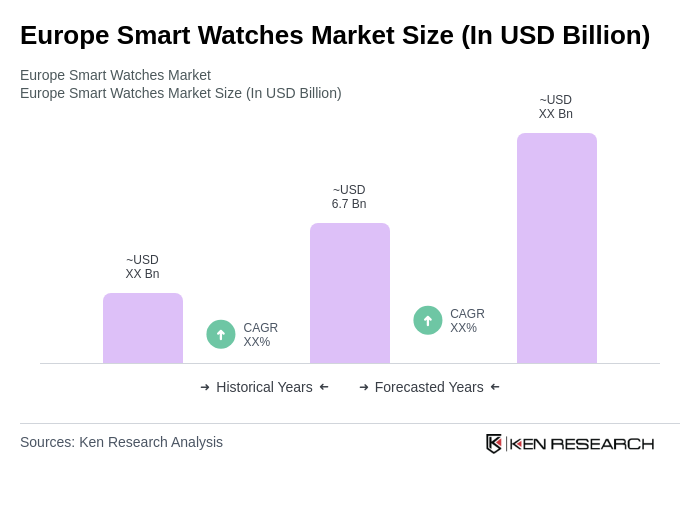
- The Europe Smart Watches Market is valued at USD 6.7 billion, based on a five-year historical analysis. This value aligns with multiple industry trackers that place the European smartwatch market in the mid–single digit billions in recent periods, driven by sustained adoption rather than one-off spikes. Growth is primarily propelled by increasing health consciousness, advancements in sensors (ECG, SpO?, temperature), NFC payments, and broader integration with smartphones and connected ecosystems. The integration of smart technology into everyday life has further accelerated adoption across demographics via improved battery life, cellular/eSIM options, and richer app ecosystems.
- Key players in this market include Germany, the United Kingdom, and France, underpinned by strong retail/carrier distribution, high disposable incomes, and robust digital infrastructure—factors associated with higher wearables penetration in Western Europe according to market coverage and vendor focus. Major analysts and vendor country breakouts consistently highlight the UK, Germany, and France as leading demand centers within Europe.
- In 2023, the European Union implemented regulations mandating that all smartwatches sold within its member states must comply with specific health and safety standards. EU product safety and radio equipment frameworks apply to smartwatches via CE marking requirements (notified under the Radio Equipment Directive and general product safety), and health-related features increasingly intersect with medical-device conformity when claims are made; these regulatory baselines strengthen consumer protection and trust.
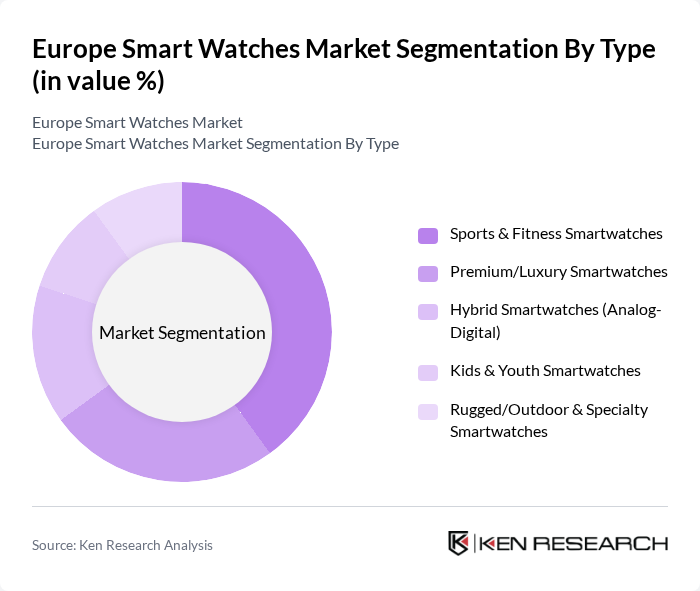
Europe Smart Watches Market Segmentation
By Type:The smartwatch market can be segmented into various types, including Sports & Fitness Smartwatches, Premium/Luxury Smartwatches, Hybrid Smartwatches (Analog-Digital), Kids & Youth Smartwatches, and Rugged/Outdoor & Specialty Smartwatches. Among these, Sports & Fitness Smartwatches are currently leading the market due to the increasing focus on health and fitness among consumers. The trend of fitness tracking and health monitoring has made these devices highly sought after, especially among fitness enthusiasts and health-conscious individuals. Continuous feature upgrades such as ECG, SpO?, sleep staging, temperature sensing, and support for LTE/eSIM and NFC payments reinforce the lead of health/fitness-centric models in Europe.
By End-User:The end-user segmentation includes Individual Consumers, Enterprise & Corporate Wellness Programs, Healthcare & Insurance Programs, and Fitness Enthusiasts & Athletes. Individual Consumers dominate this segment, driven by the growing trend of personal health management and the convenience offered by smartwatches. The increasing integration of health monitoring features has made these devices appealing to a broad audience, including those who are not professional athletes but are health-conscious. Insurer-linked wellness incentives and remote monitoring pilots further broaden usage beyond athletes to mainstream consumers in Western and Northern Europe.

Europe Smart Watches Market Competitive Landscape
The Europe Smart Watches Market is characterized by a dynamic mix of regional and international players. Leading participants such as Apple Inc., Samsung Electronics Co., Ltd., Garmin Ltd., Fitbit (Google LLC), Fossil Group, Inc., Huawei Technologies Co., Ltd., Suunto Oy, Withings S.A.S., Amazfit (Zepp Health Corporation), Mobvoi Inc. (TicWatch), Xiaomi Corporation, Polar Electro Oy, TAG Heuer (LVMH), Montblanc (Richemont), HMD Global (Nokia brand wearables ecosystem) contribute to innovation, geographic expansion, and service delivery in this space.
Europe Smart Watches Market Industry Analysis
Growth Drivers
- Increasing Health Awareness:The European population is increasingly prioritizing health, with 65% of adults engaging in regular physical activity. This trend is supported by the European Commission's report indicating that health-related expenditures reached €1.3 trillion. Smartwatches, equipped with health monitoring features, are becoming essential tools for fitness enthusiasts, driving demand. The rise in chronic diseases, affecting over 45% of the population, further emphasizes the need for health tracking solutions, propelling smartwatch adoption.
- Technological Advancements:The European smartwatches market is witnessing rapid technological innovations, with over 35 new models launched. Features such as advanced heart rate monitoring, GPS tracking, and sleep analysis are becoming standard. According to the European Telecommunications Standards Institute, the integration of 5G technology is expected to enhance connectivity and functionality, making smartwatches more appealing. This technological evolution is projected to attract a broader consumer base, particularly tech-savvy individuals seeking cutting-edge devices.
- Integration with Smart Home Devices:The growing trend of smart home technology is significantly influencing smartwatch adoption in Europe. In the future, approximately 30% of households in the EU are expected to report using smart home devices, creating a demand for interconnected ecosystems. Smartwatches that seamlessly integrate with home automation systems, such as lighting and security, are increasingly sought after. This integration not only enhances user convenience but also positions smartwatches as central hubs for managing smart home functionalities, driving market growth.
Market Challenges
- High Competition:The European smartwatches market is characterized by intense competition, with over 55 brands vying for market share. Major players like Apple, Samsung, and Garmin dominate, accounting for nearly 75% of total sales. This competitive landscape pressures smaller brands to innovate rapidly and differentiate their offerings. As a result, profit margins are shrinking, making it challenging for new entrants to establish a foothold in this saturated market.
- Data Privacy Concerns:With the increasing reliance on smartwatches for health data, privacy concerns are becoming a significant challenge. A recent survey indicated that 50% of consumers in Europe are worried about data security and unauthorized access to personal information. The implementation of GDPR regulations mandates strict compliance, which can be costly for manufacturers. This challenge may hinder consumer trust and slow down the adoption of smartwatches, impacting overall market growth.
Europe Smart Watches Market Future Outlook
The future of the European smartwatches market appears promising, driven by ongoing technological advancements and a growing emphasis on health and wellness. As consumers increasingly seek devices that offer comprehensive health monitoring and smart home integration, manufacturers are likely to focus on enhancing features and user experience. Additionally, the rise of e-commerce platforms is expected to facilitate broader market access, allowing brands to reach diverse consumer segments and adapt to changing preferences effectively.
Market Opportunities
- Expansion into Emerging Markets:The potential for growth in Eastern European countries is significant, with a projected increase in smartwatch adoption rates by 25%. As disposable incomes rise, manufacturers can tap into these markets by offering affordable yet feature-rich devices, catering to a new demographic of health-conscious consumers.
- Collaborations with Health Institutions:Partnerships with healthcare providers can enhance the credibility of smartwatches as health monitoring tools. Collaborating with hospitals and clinics to develop specialized health applications can lead to increased consumer trust and adoption. This strategy could potentially increase market penetration by 20% in the next two years, as more users seek reliable health management solutions.
Scope of the Report
| Segment | Sub-Segments |
|---|---|
| By Type | Sports & Fitness Smartwatches Premium/Luxury Smartwatches Hybrid Smartwatches (Analog-Digital) Kids & Youth Smartwatches Rugged/Outdoor & Specialty Smartwatches |
| By End-User | Individual Consumers Enterprise & Corporate Wellness Programs Healthcare & Insurance Programs Fitness Enthusiasts & Athletes |
| By Distribution Channel | Online Retail (Brand D2C, Marketplaces) Offline Retail (CE Stores, Department & Jewelry Stores) Telco Carriers & Operator Bundles Specialist & Sports Retailers |
| By Price Range | Budget (Under €150) Mid-Range (€150–€400) Premium (€400 and Above) |
| By Operating System/Compatibility | watchOS (Apple) Wear OS by Google Proprietary OS (e.g., HarmonyOS, Zepp OS, Fitbit OS) Platform-Agnostic/Hybrid |
| By Feature Set | Health Monitoring (ECG, SpO2, BP, Afib alerts) Connectivity (LTE/eSIM, 5G-ready, NFC) Battery & Power (Fast charge, multi-week life) Durability & Outdoor (GPS, GLONASS, WR ratings) |
| By Country | Germany United Kingdom France Italy Spain Nordics (Sweden, Norway, Finland, Denmark) Benelux (Netherlands, Belgium, Luxembourg) Rest of Europe |
Key Target Audience
Investors and Venture Capitalist Firms
Government and Regulatory Bodies (e.g., European Commission, European Union Agency for Cybersecurity)
Manufacturers and Producers
Distributors and Retailers
Telecommunications Companies
Health and Fitness Organizations
Wearable Technology Developers
Insurance Companies
Players Mentioned in the Report:
Apple Inc.
Samsung Electronics Co., Ltd.
Garmin Ltd.
Fitbit (Google LLC)
Fossil Group, Inc.
Huawei Technologies Co., Ltd.
Suunto Oy
Withings S.A.S.
Amazfit (Zepp Health Corporation)
Mobvoi Inc. (TicWatch)
Xiaomi Corporation
Polar Electro Oy
TAG Heuer (LVMH)
Montblanc (Richemont)
HMD Global (Nokia brand wearables ecosystem)
Table of Contents
Market Assessment Phase
1. Executive Summary and Approach
2. Europe Smart Watches Market Overview
2.1 Key Insights and Strategic Recommendations
2.2 Europe Smart Watches Market Overview
2.3 Definition and Scope
2.4 Evolution of Market Ecosystem
2.5 Timeline of Key Regulatory Milestones
2.6 Value Chain & Stakeholder Mapping
2.7 Business Cycle Analysis
2.8 Policy & Incentive Landscape
3. Europe Smart Watches Market Analysis
3.1 Growth Drivers
3.1.1 Increasing Health Awareness
3.1.2 Technological Advancements
3.1.3 Rising Demand for Fitness Tracking
3.1.4 Integration with Smart Home Devices
3.2 Market Challenges
3.2.1 High Competition
3.2.2 Price Sensitivity Among Consumers
3.2.3 Data Privacy Concerns
3.2.4 Limited Battery Life
3.3 Market Opportunities
3.3.1 Expansion into Emerging Markets
3.3.2 Collaborations with Health Institutions
3.3.3 Development of Niche Products
3.3.4 Growth in E-commerce Sales
3.4 Market Trends
3.4.1 Customization and Personalization
3.4.2 Increased Focus on Mental Health Features
3.4.3 Adoption of Wearable Payment Solutions
3.4.4 Sustainability in Manufacturing
3.5 Government Regulation
3.5.1 GDPR Compliance for Data Protection
3.5.2 Health and Safety Standards
3.5.3 Environmental Regulations
3.5.4 Import Tariffs and Trade Policies
4. SWOT Analysis
5. Stakeholder Analysis
6. Porter's Five Forces Analysis
7. Europe Smart Watches Market Market Size, 2019-2024
7.1 By Value
7.2 By Volume
7.3 By Average Selling Price
8. Europe Smart Watches Market Segmentation
8.1 By Type
8.1.1 Sports & Fitness Smartwatches
8.1.2 Premium/Luxury Smartwatches
8.1.3 Hybrid Smartwatches (Analog-Digital)
8.1.4 Kids & Youth Smartwatches
8.1.5 Rugged/Outdoor & Specialty Smartwatches
8.2 By End-User
8.2.1 Individual Consumers
8.2.2 Enterprise & Corporate Wellness Programs
8.2.3 Healthcare & Insurance Programs
8.2.4 Fitness Enthusiasts & Athletes
8.3 By Distribution Channel
8.3.1 Online Retail (Brand D2C, Marketplaces)
8.3.2 Offline Retail (CE Stores, Department & Jewelry Stores)
8.3.3 Telco Carriers & Operator Bundles
8.3.4 Specialist & Sports Retailers
8.4 By Price Range
8.4.1 Budget (Under €150)
8.4.2 Mid-Range (€150–€400)
8.4.3 Premium (€400 and Above)
8.5 By Operating System/Compatibility
8.5.1 watchOS (Apple)
8.5.2 Wear OS by Google
8.5.3 Proprietary OS (e.g., HarmonyOS, Zepp OS, Fitbit OS)
8.5.4 Platform-Agnostic/Hybrid
8.6 By Feature Set
8.6.1 Health Monitoring (ECG, SpO2, BP, Afib alerts)
8.6.2 Connectivity (LTE/eSIM, 5G-ready, NFC)
8.6.3 Battery & Power (Fast charge, multi-week life)
8.6.4 Durability & Outdoor (GPS, GLONASS, WR ratings)
8.7 By Country
8.7.1 Germany
8.7.2 United Kingdom
8.7.3 France
8.7.4 Italy
8.7.5 Spain
8.7.6 Nordics (Sweden, Norway, Finland, Denmark)
8.7.7 Benelux (Netherlands, Belgium, Luxembourg)
8.7.8 Rest of Europe
9. Europe Smart Watches Market Competitive Analysis
9.1 Market Share of Key Players
9.2 Cross Comparison of Key Players
9.2.1 Company Name
9.2.2 Europe Smartwatch Revenue/Shipments
9.2.3 CAGR in Europe (Last 3 Years)
9.2.4 Installed Base in Europe
9.2.5 Cellular Penetration (LTE/eSIM models % of mix)
9.2.6 Average Selling Price (ASP) in Europe (€)
9.2.7 Retail Coverage (Carriers vs CE/Jewelry vs Online)
9.2.8 Return/DOA Rate (%)
9.2.9 Health Certifications (ECG/Medical device approvals)
9.2.10 NPS/Customer Satisfaction (Europe)
9.2.11 R&D Intensity (% of revenue)
9.2.12 Warranty and Service Network (countries covered)
9.3 SWOT Analysis of Top Players
9.4 Pricing Analysis
9.5 Detailed Profile of Major Companies
9.5.1 Apple Inc.
9.5.2 Samsung Electronics Co., Ltd.
9.5.3 Garmin Ltd.
9.5.4 Fitbit (Google LLC)
9.5.5 Fossil Group, Inc.
9.5.6 Huawei Technologies Co., Ltd.
9.5.7 Suunto Oy
9.5.8 Withings S.A.S.
9.5.9 Amazfit (Zepp Health Corporation)
9.5.10 Mobvoi Inc. (TicWatch)
9.5.11 Xiaomi Corporation
9.5.12 Polar Electro Oy
9.5.13 TAG Heuer (LVMH)
9.5.14 Montblanc (Richemont)
9.5.15 HMD Global (Nokia brand wearables ecosystem)
10. Europe Smart Watches Market End-User Analysis
10.1 Procurement Behavior of Key Ministries
10.1.1 Government Health Initiatives
10.1.2 Public Sector Procurement Policies
10.1.3 Budget Allocations for Health Tech
10.2 Corporate Spend on Infrastructure & Energy
10.2.1 Investment in Employee Wellness Programs
10.2.2 Corporate Partnerships with Tech Firms
10.3 Pain Point Analysis by End-User Category
10.3.1 User Interface Complexity
10.3.2 Integration with Existing Systems
10.3.3 Cost of Ownership
10.4 User Readiness for Adoption
10.4.1 Awareness of Smart Watch Benefits
10.4.2 Training and Support Needs
10.5 Post-Deployment ROI and Use Case Expansion
10.5.1 Measurement of Health Outcomes
10.5.2 User Engagement Metrics
11. Europe Smart Watches Market Future Size, 2025-2030
11.1 By Value
11.2 By Volume
11.3 By Average Selling Price
Go-To-Market Strategy Phase
1. Whitespace Analysis + Business Model Canvas
1.1 Market Gaps Identification
1.2 Business Model Options
2. Marketing and Positioning Recommendations
2.1 Branding Strategies
2.2 Product USPs
3. Distribution Plan
3.1 Urban Retail Strategies
3.2 Rural NGO Tie-ups
4. Channel & Pricing Gaps
4.1 Underserved Routes
4.2 Pricing Bands
5. Unmet Demand & Latent Needs
5.1 Category Gaps
5.2 Consumer Segments
6. Customer Relationship
6.1 Loyalty Programs
6.2 After-sales Service
7. Value Proposition
7.1 Sustainability
7.2 Integrated Supply Chains
8. Key Activities
8.1 Regulatory Compliance
8.2 Branding
8.3 Distribution Setup
9. Entry Strategy Evaluation
9.1 Domestic Market Entry Strategy
9.1.1 Product Mix
9.1.2 Pricing Band
9.1.3 Packaging
9.2 Export Entry Strategy
9.2.1 Target Countries
9.2.2 Compliance Roadmap
10. Entry Mode Assessment
10.1 JV
10.2 Greenfield
10.3 M&A
10.4 Distributor Model
11. Capital and Timeline Estimation
11.1 Capital Requirements
11.2 Timelines
12. Control vs Risk Trade-Off
12.1 Ownership vs Partnerships
13. Profitability Outlook
13.1 Breakeven Analysis
13.2 Long-term Sustainability
14. Potential Partner List
14.1 Distributors
14.2 JVs
14.3 Acquisition Targets
15. Execution Roadmap
15.1 Phased Plan for Market Entry
15.1.1 Market Setup
15.1.2 Market Entry
15.1.3 Growth Acceleration
15.1.4 Scale & Stabilize
15.2 Key Activities and Milestones
15.2.1 Activity Planning
15.2.2 Milestone Tracking
Research Methodology
Phase 1: Approach1
Desk Research
- Market reports from industry associations and research firms focusing on smart wearables
- Analysis of consumer behavior studies and trends in wearable technology adoption
- Review of regulatory frameworks and standards impacting smart watch manufacturing in Europe
Primary Research
- Interviews with product managers at leading smart watch manufacturers
- Surveys targeting end-users to understand preferences and usage patterns
- Focus groups with tech enthusiasts to gauge perceptions of smart watch features
Validation & Triangulation
- Cross-validation of findings with sales data from major retailers and e-commerce platforms
- Triangulation of insights from consumer surveys and expert interviews
- Sanity checks through feedback from industry experts and analysts
Phase 2: Market Size Estimation1
Top-down Assessment
- Estimation of total addressable market based on overall wearables market growth
- Segmentation by product type, including fitness trackers and smart watches
- Incorporation of demographic data to assess potential market penetration rates
Bottom-up Modeling
- Collection of sales data from key retailers and online platforms for smart watches
- Estimation of average selling prices and unit sales across different brands
- Analysis of consumer spending patterns on wearable technology
Forecasting & Scenario Analysis
- Multi-variable forecasting using historical sales data and market trends
- Scenario analysis based on economic conditions and technological advancements
- Development of baseline, optimistic, and pessimistic market growth projections through 2030
Phase 3: CATI Sample Composition1
| Scope Item/Segment | Sample Size | Target Respondent Profiles |
|---|---|---|
| Consumer Smart Watch Usage | 150 | Smart Watch Users, Fitness Enthusiasts |
| Retail Insights on Smart Watches | 100 | Retail Managers, Sales Associates |
| Technology Adoption Trends | 80 | Technology Analysts, Market Researchers |
| Health and Fitness Tracking Preferences | 70 | Health Professionals, Fitness Trainers |
| Smart Watch Feature Evaluation | 90 | Product Managers, UX Designers |
Frequently Asked Questions
What is the current value of the Europe Smart Watches Market?
The Europe Smart Watches Market is valued at approximately USD 6.7 billion, reflecting a steady growth trend driven by increasing health consciousness and technological advancements in wearable devices.
Which countries are the leading markets for smartwatches in Europe?
What are the main drivers of growth in the European smartwatch market?
What types of smartwatches are most popular in Europe?
Other Regional/Country Reports
Indonesia Smart Watches Market
Malaysia Smart Watches Market
KSA Smart Watches Market
APAC Smart Watches Market
SEA Smart Watches Market
Vietnam Smart Watches Market
Why Buy From Us?

What makes us stand out is that our consultants follow Robust, Refine and Result (RRR) methodology. Robust for clear definitions, approaches and sanity checking, Refine for differentiating respondents' facts and opinions, and Result for presenting data with story.

We have set a benchmark in the industry by offering our clients with syndicated and customized market research reports featuring coverage of entire market as well as meticulous research and analyst insights.

While we don't replace traditional research, we flip the method upside down. Our dual approach of Top Bottom & Bottom Top ensures quality deliverable by not just verifying company fundamentals but also looking at the sector and macroeconomic factors.

With one step in the future, our research team constantly tries to show you the bigger picture. We help with some of the tough questions you may encounter along the way: How is the industry positioned? Best marketing channel? KPI's of competitors? By aligning every element, we help maximize success.

Our report gives you instant access to the answers and sources that other companies might choose to hide. We elaborate each steps of research methodology we have used and showcase you the sample size to earn your trust.

If you need any support, we are here! We pride ourselves on universe strength, data quality, and quick, friendly, and professional service.