Europe Sports Team And Club Market

Europe Sports Team and Club Market, valued at USD 35-38 billion, is driven by rising fan engagement, digital streaming, and sponsorship revenues, with professional clubs leading the segments.

Region:Europe

Author(s):Dev

Product Code:KRAA1694

Pages:91

Published On:August 2025

About the Report

Base Year 2024

Europe Sports Team And Club Market Overview

  • The Europe Sports Team and Club Market is valued at approximately USD 35–38 billion, based on a five-year analysis. This valuation reflects aggregated club revenues across top European leagues and competitions, underpinned by strong commercial income, media rights, and matchday recovery, with commercial now the largest revenue stream for leading European clubs. The market is driven by increasing fan engagement, the rise of digital platforms and streaming, and lucrative broadcasting rights, alongside robust merchandise and sponsorship growth.
  • Countries such as the United Kingdom, Germany, and Spain dominate the market due to rich sporting heritage, high-profile leagues, and substantial fan bases. These countries host Europe’s strongest football leagues and clubs, which drive significant revenues via ticket sales, media, commercial deals, and global fan engagement; the UK, Germany, France, Italy, and Spain represent the largest market clusters in Europe.
  • In 2023, European football’s governing framework shifted to new financial sustainability rules overseen by UEFA, replacing legacy Financial Fair Play with squad cost controls that aim to align spending and revenues, reduce excessive losses and debt accumulation, and promote competitive balance across European competitions.

Europe Sports Team And Club Market Segmentation

By Type:The market is segmented into various types, including professional clubs and teams, amateur and community clubs, youth and academy teams, e-sports organizations, and multi-sport clubs. Among these, professional clubs and teams dominate the market due to their established fan bases, significant media rights revenues, and commercial partnerships. The popularity of professional leagues, particularly in football, drives substantial attendance and merchandise sales, making this segment the most lucrative. E-sports organizations are also gaining traction, appealing to younger audiences and leveraging digital platforms for engagement.
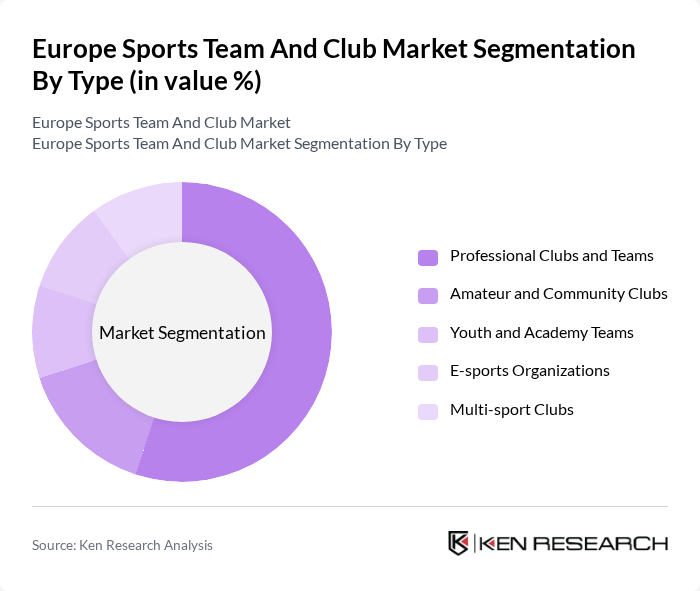
Europe Sports Team And Club Market segmentation by Type.

By End-User:This segmentation includes fans and members, corporate sponsors and partners, broadcasters and streaming platforms, and retailers and licensing partners. Fans and members represent the largest segment, driven by the passionate support for clubs and teams, which translates into ticket sales, merchandise purchases, and subscription services. Corporate sponsors are increasingly investing in sports teams to enhance brand visibility, while broadcasters and streaming platforms are capitalizing on the growing demand for live sports content, further fueling market growth.
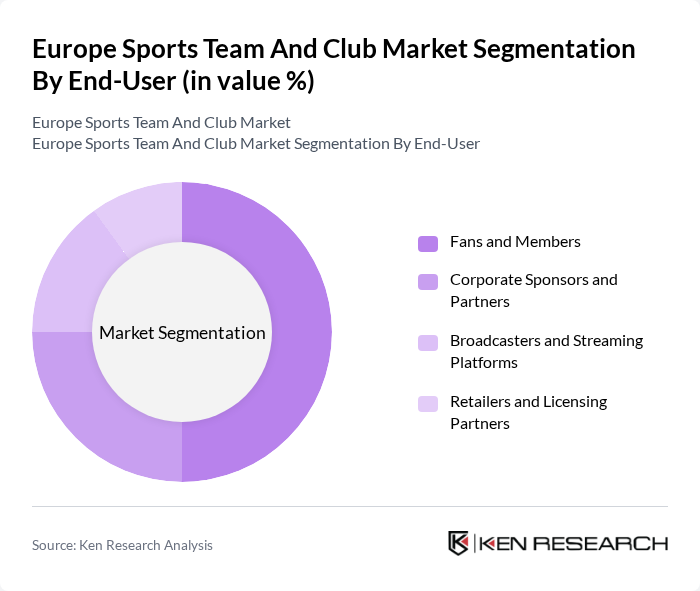
Europe Sports Team And Club Market segmentation by End-User.

Europe Sports Team And Club Market Competitive Landscape

The Europe Sports Team and Club Market is characterized by a dynamic mix of regional and international players. Leading participants such as Real Madrid CF, FC Barcelona, Manchester United FC, FC Bayern München, Paris Saint-Germain FC, Juventus FC, Liverpool FC, Arsenal FC, Chelsea FC, Borussia Dortmund, AC Milan, FC Internazionale Milano, Atlético de Madrid, Tottenham Hotspur FC, Sport Lisboa e Benfica contribute to innovation, geographic expansion, and service delivery in this space.

Real Madrid CF

1902

Madrid, Spain

FC Barcelona

1899

Barcelona, Spain

Manchester United FC

1878

Manchester, England

FC Bayern München

1900

Munich, Germany

Paris Saint-Germain FC

1970

Paris, France

Company

Establishment Year

Headquarters

Scale Tier (Elite, Major, Challenger)

Year-over-Year Revenue Growth (%)

Media Rights Revenue Share (%)

Sponsorship/Commercial Revenue (EUR, latest FY)

Matchday Metrics (Average Attendance, Stadium Utilization %)

Global Fanbase Size (Social Followers, Registered Members)

Europe Sports Team And Club Market Industry Analysis

Growth Drivers

  • Increasing Popularity of Sports:The sports sector in Europe has seen a significant rise in participation, with over 60% of the population engaging in sports activities as of the future. This trend is supported by the European Commission's report indicating that sports contribute approximately €300 billion to the EU economy annually. The growing interest in major events, such as the UEFA Champions League, which attracted over 500 million viewers in the future, further fuels this popularity, driving revenue for clubs and teams.
  • Rise in Sponsorship and Advertising Revenue:Sponsorship revenue in European sports reached €8 billion in the future, reflecting a robust growth trajectory. Major brands are increasingly investing in sports sponsorships, with the top 10 European football clubs alone generating over €1.8 billion from sponsorship deals. This influx of capital not only enhances team finances but also allows for improved facilities and player acquisitions, thereby elevating the overall market landscape.
  • Expansion of Digital Platforms:The digital transformation in sports has led to a surge in online viewership, with streaming services reporting a 35% increase in subscriptions for sports content in the future. Platforms like DAZN and ESPN+ have expanded their offerings, reaching over 20 million subscribers across Europe. This shift not only diversifies revenue streams for clubs but also enhances fan engagement through interactive content and personalized experiences, driving market growth.

Market Challenges

  • Economic Uncertainty:The European sports market faces challenges due to economic fluctuations, with GDP growth projected at only 1.5% in the future according to the IMF. This economic slowdown can lead to reduced consumer spending on sports events and merchandise, impacting club revenues. Additionally, inflation rates hovering around 4% may further strain disposable incomes, leading to decreased attendance at games and lower overall engagement.
  • Competition from Other Entertainment Options:The sports industry is increasingly competing with alternative entertainment forms, such as streaming services and e-sports, which have seen a 25% growth in viewership in the future. Traditional sports teams must innovate to retain fan interest, as younger demographics show a preference for diverse entertainment options. This shift poses a significant challenge for clubs to maintain their audience and revenue streams amidst changing consumer preferences.

Europe Sports Team And Club Market Future Outlook

The future of the European sports team and club market appears promising, driven by technological advancements and evolving consumer preferences. As clubs increasingly adopt digital solutions, fan engagement is expected to deepen, enhancing loyalty and revenue. Moreover, the integration of sustainability practices is likely to resonate with environmentally conscious fans, creating new avenues for growth. The focus on inclusivity, particularly in women's sports, will also play a crucial role in expanding market reach and participation levels across diverse demographics.

Market Opportunities

  • Development of E-Sports:The e-sports sector is projected to generate over €1.5 billion in revenue in the future, presenting a lucrative opportunity for traditional sports teams to diversify their offerings. Collaborations between traditional sports clubs and e-sports organizations can attract younger audiences, enhancing overall market engagement and revenue potential.
  • Enhanced Fan Experience through Technology:The implementation of augmented reality (AR) and virtual reality (VR) technologies is set to revolutionize fan experiences, with investments expected to exceed €600 million in the future. These technologies can create immersive experiences during live events, increasing fan satisfaction and loyalty, ultimately driving higher attendance and merchandise sales.

Scope of the Report

SegmentSub-Segments
By Type

Professional Clubs and Teams

Amateur and Community Clubs

Youth and Academy Teams

E-sports Organizations

Multi-sport Clubs

By End-User

Fans and Members

Corporate Sponsors and Partners

Broadcasters and Streaming Platforms

Retailers and Licensing Partners

By Revenue Model

Media Rights

Ticketing and Matchday

Sponsorship and Commercial

Merchandising and Licensing

By Geographic Presence

United Kingdom & Ireland

Germany, Austria & Switzerland (DACH)

France & Benelux

Italy

Spain & Portugal (Iberia)

Nordics

Central & Eastern Europe

By Sport Type

Football (Soccer)

Basketball

Rugby Union and Rugby League

Tennis Clubs

Handball, Volleyball, Ice Hockey, and Others

By Fan Engagement Method

Social Media and Creator Content

Live Events and Matchday Activations

OTT/Digital Content and Membership Apps

Community and Grassroots Programs

By Investment Source

Private Ownership and PE Investment

Public/Member-Owned Models

Sponsorship and Commercial Partnerships

Municipal and Government Funding

Key Target Audience

Investors and Venture Capitalist Firms

Government and Regulatory Bodies (e.g., European Commission, National Sports Authorities)

Sports Marketing Agencies

Media and Broadcasting Companies

Sponsorship and Advertising Firms

Sports Equipment Manufacturers

Event Management Companies

Sports Technology Startups

Players Mentioned in the Report:

Real Madrid CF

FC Barcelona

Manchester United FC

FC Bayern Munchen

Paris Saint-Germain FC

Juventus FC

Liverpool FC

Arsenal FC

Chelsea FC

Borussia Dortmund

AC Milan

FC Internazionale Milano

Atletico de Madrid

Tottenham Hotspur FC

Sport Lisboa e Benfica

Table of Contents

Market Assessment Phase

1. Executive Summary and Approach


2. Europe Sports Team And Club Market Overview

2.1 Key Insights and Strategic Recommendations

2.2 Europe Sports Team And Club Market Overview

2.3 Definition and Scope

2.4 Evolution of Market Ecosystem

2.5 Timeline of Key Regulatory Milestones

2.6 Value Chain & Stakeholder Mapping

2.7 Business Cycle Analysis

2.8 Policy & Incentive Landscape


3. Europe Sports Team And Club Market Analysis

3.1 Growth Drivers

3.1.1 Increasing Popularity of Sports
3.1.2 Rise in Sponsorship and Advertising Revenue
3.1.3 Expansion of Digital Platforms
3.1.4 Growing Investment in Youth Sports Programs

3.2 Market Challenges

3.2.1 Economic Uncertainty
3.2.2 Competition from Other Entertainment Options
3.2.3 Regulatory Compliance Issues
3.2.4 Managing Fan Engagement

3.3 Market Opportunities

3.3.1 Development of E-Sports
3.3.2 Expansion into Emerging Markets
3.3.3 Enhanced Fan Experience through Technology
3.3.4 Strategic Partnerships and Collaborations

3.4 Market Trends

3.4.1 Increased Focus on Sustainability
3.4.2 Growth of Women’s Sports
3.4.3 Integration of Augmented Reality in Fan Engagement
3.4.4 Shift Towards Subscription-Based Models

3.5 Government Regulation

3.5.1 Player Transfer Regulations
3.5.2 Financial Fair Play Regulations
3.5.3 Health and Safety Regulations
3.5.4 Broadcasting Rights Regulations

4. SWOT Analysis


5. Stakeholder Analysis


6. Porter's Five Forces Analysis


7. Europe Sports Team And Club Market Market Size, 2019-2024

7.1 By Value

7.2 By Volume

7.3 By Average Selling Price


8. Europe Sports Team And Club Market Segmentation

8.1 By Type

8.1.1 Professional Clubs and Teams
8.1.2 Amateur and Community Clubs
8.1.3 Youth and Academy Teams
8.1.4 E-sports Organizations
8.1.5 Multi-sport Clubs

8.2 By End-User

8.2.1 Fans and Members
8.2.2 Corporate Sponsors and Partners
8.2.3 Broadcasters and Streaming Platforms
8.2.4 Retailers and Licensing Partners

8.3 By Revenue Model

8.3.1 Media Rights
8.3.2 Ticketing and Matchday
8.3.3 Sponsorship and Commercial
8.3.4 Merchandising and Licensing

8.4 By Geographic Presence

8.4.1 United Kingdom & Ireland
8.4.2 Germany, Austria & Switzerland (DACH)
8.4.3 France & Benelux
8.4.4 Italy
8.4.5 Spain & Portugal (Iberia)
8.4.6 Nordics
8.4.7 Central & Eastern Europe

8.5 By Sport Type

8.5.1 Football (Soccer)
8.5.2 Basketball
8.5.3 Rugby Union and Rugby League
8.5.4 Tennis Clubs
8.5.5 Handball, Volleyball, Ice Hockey, and Others

8.6 By Fan Engagement Method

8.6.1 Social Media and Creator Content
8.6.2 Live Events and Matchday Activations
8.6.3 OTT/Digital Content and Membership Apps
8.6.4 Community and Grassroots Programs

8.7 By Investment Source

8.7.1 Private Ownership and PE Investment
8.7.2 Public/Member-Owned Models
8.7.3 Sponsorship and Commercial Partnerships
8.7.4 Municipal and Government Funding

9. Europe Sports Team And Club Market Competitive Analysis

9.1 Market Share of Key Players

9.2 Cross Comparison of Key Players

9.2.1 Entity Name (Club/Team/Ownership Group)
9.2.2 Scale Tier (Elite, Major, Challenger)
9.2.3 Year-over-Year Revenue Growth (%)
9.2.4 Media Rights Revenue Share (%)
9.2.5 Sponsorship/Commercial Revenue (EUR, latest FY)
9.2.6 Matchday Metrics (Average Attendance, Stadium Utilization %)
9.2.7 Global Fanbase Size (Social Followers, Registered Members)
9.2.8 Merchandise and Licensing Revenue Growth (%)
9.2.9 Digital Engagement (Monthly MAUs/App Subs/OTT Watch Hours)
9.2.10 Competitive Performance Index (League Position/UEFA Coefficients/Titles)

9.3 SWOT Analysis of Top Players

9.4 Pricing Analysis

9.5 Detailed Profile of Major Companies

9.5.1 Real Madrid CF
9.5.2 FC Barcelona
9.5.3 Manchester United FC
9.5.4 FC Bayern München
9.5.5 Paris Saint-Germain FC
9.5.6 Juventus FC
9.5.7 Liverpool FC
9.5.8 Arsenal FC
9.5.9 Chelsea FC
9.5.10 Borussia Dortmund
9.5.11 AC Milan
9.5.12 FC Internazionale Milano
9.5.13 Atlético de Madrid
9.5.14 Tottenham Hotspur FC
9.5.15 Sport Lisboa e Benfica

10. Europe Sports Team And Club Market End-User Analysis

10.1 Procurement Behavior of Key Ministries

10.1.1 Funding Allocation for Sports
10.1.2 Policy Development for Sports Programs
10.1.3 Collaboration with Sports Organizations

10.2 Corporate Spend on Infrastructure & Energy

10.2.1 Investment in Stadium Development
10.2.2 Sponsorship of Local Teams
10.2.3 Funding for Community Sports Initiatives

10.3 Pain Point Analysis by End-User Category

10.3.1 Accessibility to Sports Facilities
10.3.2 Affordability of Tickets
10.3.3 Quality of Fan Experience

10.4 User Readiness for Adoption

10.4.1 Engagement with Digital Platforms
10.4.2 Willingness to Attend Live Events
10.4.3 Interest in E-Sports

10.5 Post-Deployment ROI and Use Case Expansion

10.5.1 Measurement of Fan Engagement
10.5.2 Analysis of Revenue Streams
10.5.3 Expansion of Merchandise Offerings

11. Europe Sports Team And Club Market Future Size, 2025-2030

11.1 By Value

11.2 By Volume

11.3 By Average Selling Price


Go-To-Market Strategy Phase

1. Whitespace Analysis + Business Model Canvas

1.1 Market Gaps Identification

1.2 Business Model Development

1.3 Value Proposition Analysis


2. Marketing and Positioning Recommendations

2.1 Branding Strategies

2.2 Product USPs


3. Distribution Plan

3.1 Urban Retail Strategies

3.2 Rural NGO Tie-Ups


4. Channel & Pricing Gaps

4.1 Underserved Routes

4.2 Pricing Bands Analysis


5. Unmet Demand & Latent Needs

5.1 Category Gaps

5.2 Consumer Segments


6. Customer Relationship

6.1 Loyalty Programs

6.2 After-Sales Service


7. Value Proposition

7.1 Sustainability Initiatives

7.2 Integrated Supply Chains


8. Key Activities

8.1 Regulatory Compliance

8.2 Branding Efforts

8.3 Distribution Setup


9. Entry Strategy Evaluation

9.1 Domestic Market Entry Strategy

9.1.1 Product Mix Considerations
9.1.2 Pricing Band Strategy
9.1.3 Packaging Options

9.2 Export Entry Strategy

9.2.1 Target Countries
9.2.2 Compliance Roadmap

10. Entry Mode Assessment

10.1 Joint Ventures

10.2 Greenfield Investments

10.3 Mergers & Acquisitions

10.4 Distributor Model


11. Capital and Timeline Estimation

11.1 Capital Requirements

11.2 Timelines for Implementation


12. Control vs Risk Trade-Off

12.1 Ownership Considerations

12.2 Partnerships Evaluation


13. Profitability Outlook

13.1 Breakeven Analysis

13.2 Long-Term Sustainability


14. Potential Partner List

14.1 Distributors

14.2 Joint Ventures

14.3 Acquisition Targets


15. Execution Roadmap

15.1 Phased Plan for Market Entry

15.1.1 Market Setup
15.1.2 Market Entry
15.1.3 Growth Acceleration
15.1.4 Scale & Stabilize

15.2 Key Activities and Milestones

15.2.1 Milestone Planning
15.2.2 Activity Tracking

Research Methodology

ApproachModellingSample

Phase 1: Approach1

Desk Research

  • Analysis of market reports from sports industry associations and federations across Europe
  • Review of financial statements and annual reports from leading sports teams and clubs
  • Examination of demographic and economic data from Eurostat and national statistics offices

Primary Research

  • Interviews with executives from major sports clubs and teams to gather insights on operational strategies
  • Surveys targeting sports marketing professionals to understand sponsorship trends and fan engagement
  • Focus groups with sports fans to assess preferences and spending behaviors related to team merchandise

Validation & Triangulation

  • Cross-validation of findings through multiple data sources, including industry publications and expert opinions
  • Triangulation of quantitative data from surveys with qualitative insights from interviews
  • Sanity checks conducted through expert panel reviews comprising sports economists and market analysts

Phase 2: Market Size Estimation1

Top-down Assessment

  • Estimation of total market size based on revenue data from major European sports leagues
  • Segmentation of market by sport type, including football, basketball, and rugby
  • Incorporation of trends in broadcasting rights and digital media revenues

Bottom-up Modeling

  • Collection of ticket sales data from various sports events across Europe
  • Analysis of merchandise sales figures from leading sports clubs and online platforms
  • Estimation of revenue from sponsorship deals and partnerships at the club level

Forecasting & Scenario Analysis

  • Multi-factor regression analysis incorporating economic indicators and sports participation rates
  • Scenario modeling based on potential impacts of regulatory changes and economic fluctuations
  • Development of baseline, optimistic, and pessimistic forecasts through 2030

Phase 3: CATI Sample Composition1

Scope Item/SegmentSample SizeTarget Respondent Profiles
Football Club Revenue Streams140Club Executives, Financial Analysts
Basketball Team Sponsorship Insights100Marketing Directors, Sponsorship Managers
Rugby Fan Engagement Strategies80Fan Experience Managers, Community Engagement Officers
Merchandise Sales Analysis120Retail Managers, E-commerce Specialists
Broadcasting Rights Valuation90Media Rights Executives, Sports Economists

Frequently Asked Questions

What is the current valuation of the Europe Sports Team and Club Market?

The Europe Sports Team and Club Market is valued at approximately USD 3538 billion, reflecting revenues from top European leagues and competitions, driven by commercial income, media rights, and matchday recovery.

Which countries dominate the Europe Sports Team and Club Market?

What are the main revenue streams for European sports clubs?

How has UEFA's financial sustainability rules impacted European football?

Other Regional/Country Reports

India Sports Team And Club Market

Indonesia Sports Team And Club Market

Malaysia Sports Team And Club Market

KSA Sports Team And Club Market

APAC Sports Team And Club Market

SEA Sports Team And Club Market

Why Buy From Us?

Refine Robust Result (RRR) Framework

What makes us stand out is that our consultants follow Robust, Refine and Result (RRR) methodology. Robust for clear definitions, approaches and sanity checking, Refine for differentiating respondents' facts and opinions, and Result for presenting data with story.

Our Reach Is Unmatched

We have set a benchmark in the industry by offering our clients with syndicated and customized market research reports featuring coverage of entire market as well as meticulous research and analyst insights.

Shifting the Research Paradigm

While we don't replace traditional research, we flip the method upside down. Our dual approach of Top Bottom & Bottom Top ensures quality deliverable by not just verifying company fundamentals but also looking at the sector and macroeconomic factors.

More Insights-Better Decisions

With one step in the future, our research team constantly tries to show you the bigger picture. We help with some of the tough questions you may encounter along the way: How is the industry positioned? Best marketing channel? KPI's of competitors? By aligning every element, we help maximize success.

Transparency and Trust

Our report gives you instant access to the answers and sources that other companies might choose to hide. We elaborate each steps of research methodology we have used and showcase you the sample size to earn your trust.

Round the Clock Support

If you need any support, we are here! We pride ourselves on universe strength, data quality, and quick, friendly, and professional service.

Why Clients Choose Us?

400000+
Reports in repository
150+
Consulting projects a year
100+
Analysts
8000+
Client Queries in 2022








