About the Report
Base Year 2024European Household Coffee Machine Market Overview
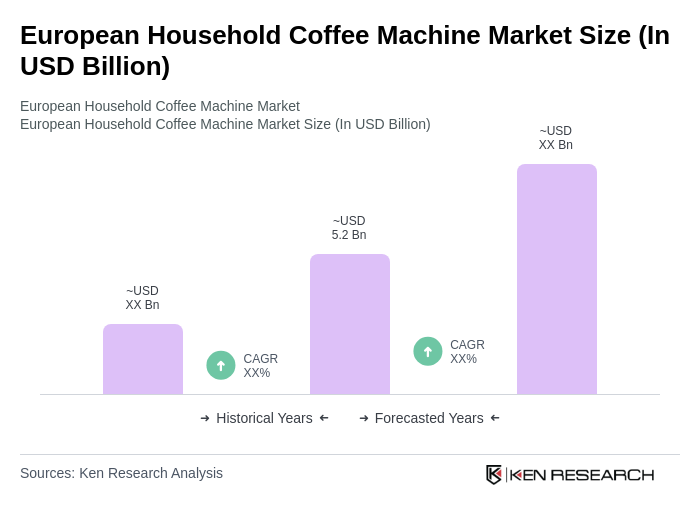
- The European Household Coffee Machine Market is valued at USD 5.2 billion, based on a five-year historical analysis. This market continues to expand, driven by the rising demand for at-home premium coffee experiences, growth in single-serve capsule systems, and the increasing adoption of smart and energy-efficient appliances. The surge in specialty coffee culture and the shift toward home brewing have further accelerated the uptake of advanced coffee machines, including bean-to-cup and connected devices.
- Key players in this market include countries like Germany, Italy, and France, which dominate due to their rich coffee culture, high per capita coffee consumption, and the strong presence of leading coffee machine manufacturers. Germany holds the largest national share, accounting for over 22% of regional revenue, and these nations have established robust markets for both traditional and innovative coffee brewing solutions.
- In 2024, the European Union introduced the Right-to-Repair Directive, issued by the European Parliament and Council, mandating that manufacturers of household appliances, including coffee machines, provide affordable repairs and spare parts for a minimum period. This regulation aims to improve energy efficiency, extend product lifecycles, and promote sustainability by reducing electronic waste and environmental impact.
European Household Coffee Machine Market Segmentation
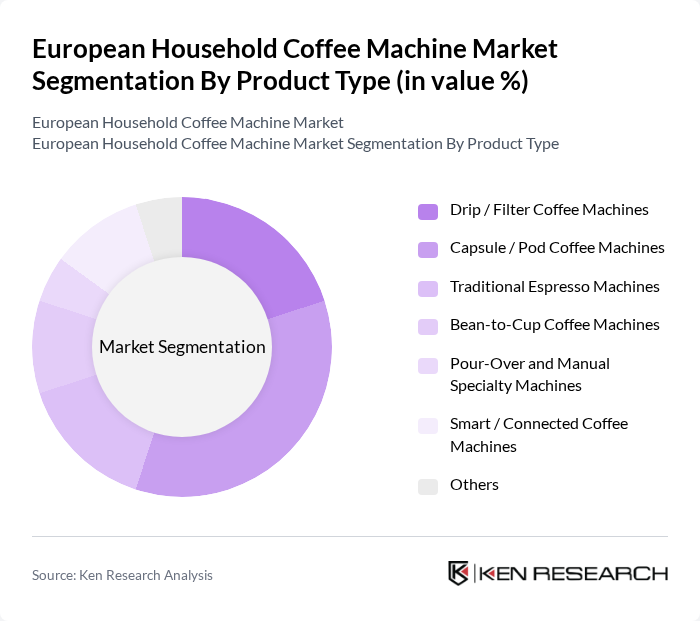
By Product Type:The product type segmentation encompasses a diverse range of coffee machines tailored to varying consumer preferences and brewing methods. Subsegments include Drip / Filter Coffee Machines, Capsule / Pod Coffee Machines, Traditional Espresso Machines, Bean-to-Cup Coffee Machines, Pour-Over and Manual Specialty Machines, Smart / Connected Coffee Machines, and Others. Capsule / Pod Coffee Machines maintain significant popularity due to their convenience, ease of use, and wide variety, particularly appealing to busy consumers seeking quick and consistent coffee solutions. Bean-to-cup systems are expanding at the fastest rate, reflecting the premiumization trend in home coffee consumption.
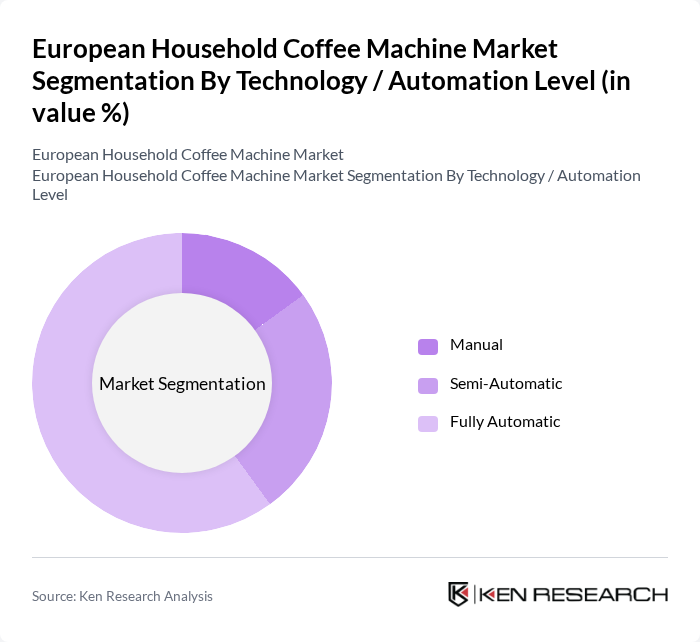
By Technology / Automation Level:This segmentation highlights the automation spectrum in coffee machines, including Manual, Semi-Automatic, and Fully Automatic models. Fully Automatic machines lead the market, reflecting consumer preferences for convenience, consistency, and advanced features such as programmable brewing and integration with smart home ecosystems. The trend toward automation underscores the growing demand for efficient, user-friendly coffee preparation at home.
European Household Coffee Machine Market Competitive Landscape
The European Household Coffee Machine Market is characterized by a dynamic mix of regional and international players. Leading participants such as De'Longhi S.p.A., Breville Group Limited, Koninklijke Philips N.V., BSH Hausgeräte GmbH (Bosch Home Appliances), Krups GmbH, Nestlé Nespresso S.A., Cuisinart (Conair Corporation), Hamilton Beach Brands Holding Company, Gaggia S.p.A., Smeg S.p.A., Miele & Cie. KG, Jura Elektroapparate AG, Rancilio Group S.p.A., La Marzocco S.r.l., Tchibo GmbH, Illycaffè S.p.A., Dualit Limited, AB Electrolux, and Schaerer AG contribute to innovation, geographic expansion, and service delivery in this space.
European Household Coffee Machine Market Industry Analysis
Growth Drivers
- Increasing Consumer Demand for Specialty Coffee:The European coffee market is witnessing a significant shift, with specialty coffee consumption rising to approximately 45% of total coffee sales in future. This trend is driven by consumers' willingness to pay more for high-quality, unique coffee experiences. The European Specialty Coffee Association reported that the specialty coffee segment grew by €1.8 billion in future, indicating a robust demand for premium coffee products, which directly influences the household coffee machine market.
- Rise in Home Brewing Trends:The COVID-19 pandemic has accelerated the trend of home brewing, with a reported 70% increase in coffee machine sales in future compared to pre-pandemic levels. According to the International Coffee Organization, 75% of European consumers now prefer brewing coffee at home, leading to a surge in demand for advanced coffee machines. This shift is supported by a growing interest in coffee culture and the desire for convenience, driving innovation in household coffee machines.
- Technological Advancements in Coffee Machines:The integration of smart technology in coffee machines is revolutionizing the market. In future, over 30% of coffee machines sold in Europe featured IoT capabilities, allowing users to control brewing remotely. The European market for smart appliances is projected to reach €18 billion by future, with coffee machines being a significant contributor. These advancements enhance user experience and cater to tech-savvy consumers, further propelling market growth.
Market Challenges
- High Competition Among Established Brands:The European household coffee machine market is characterized by intense competition, with major players like De'Longhi, Breville, and Philips dominating the landscape. In future, these brands accounted for over 65% of market share, making it challenging for new entrants to gain traction. The competitive pressure leads to price wars and increased marketing costs, which can hinder profitability for smaller companies trying to establish their presence.
- Fluctuating Coffee Bean Prices:The volatility in coffee bean prices poses a significant challenge for manufacturers. In future, the price of Arabica coffee beans surged by 25% due to adverse weather conditions in key producing countries. This fluctuation impacts production costs for coffee machines, as manufacturers may face increased expenses that could be passed on to consumers. Such price instability can lead to reduced consumer spending on premium coffee machines, affecting overall market growth.
European Household Coffee Machine Market Future Outlook
The European household coffee machine market is poised for continued growth, driven by evolving consumer preferences and technological innovations. As more consumers seek personalized coffee experiences, manufacturers are likely to invest in customizable features and smart technologies. Additionally, the increasing focus on sustainability will push brands to develop eco-friendly products. The rise of e-commerce will further facilitate market expansion, allowing consumers easier access to a wider range of coffee machines and related products.
Market Opportunities
- Expansion into Emerging Markets:Emerging markets in Eastern Europe and Asia present significant growth opportunities for coffee machine manufacturers. With rising disposable incomes and a growing coffee culture, these regions are expected to see a 20% increase in coffee machine sales in future. Companies can capitalize on this trend by tailoring products to local preferences and investing in targeted marketing strategies.
- Development of Smart Coffee Machines:The demand for smart coffee machines is on the rise, with an expected market value of €6 billion by future. As consumers increasingly seek convenience and connectivity, manufacturers can leverage IoT technology to create innovative products that enhance user experience. This opportunity allows brands to differentiate themselves in a competitive market while meeting the evolving needs of tech-savvy consumers.
Scope of the Report
| Segment | Sub-Segments |
|---|---|
| By Product Type | Drip / Filter Coffee Machines Capsule / Pod Coffee Machines Traditional Espresso Machines Bean-to-Cup Coffee Machines Pour-Over and Manual Specialty Machines Smart / Connected Coffee Machines Others |
| By Technology / Automation Level | Manual Semi-Automatic Fully Automatic |
| By Distribution Channel | Multi-Brand Electrical and Appliance Stores Specialty Coffee and Kitchenware Stores Online Pure-Play Retailers Direct-to-Consumer Webshops Mass Merchandisers and Hypermarkets |
| By Geography | United Kingdom Germany France Spain Italy BENELUX (Belgium, Netherlands, Luxembourg) NORDICS (Denmark, Finland, Iceland, Norway, Sweden) Rest of Europe |
| By Price Range | Budget Mid-Range Premium |
| By Features | Programmable Settings Built-in Grinder Milk Frother Smart Connectivity |
| By Material | Plastic Stainless Steel Glass Others |
Key Target Audience
Investors and Venture Capitalist Firms
Government and Regulatory Bodies (e.g., European Commission, Food Standards Agency)
Manufacturers and Producers
Distributors and Retailers
Importers and Exporters
Industry Associations (e.g., European Coffee Federation)
Financial Institutions
Market Analysts and Industry Experts
Players Mentioned in the Report:
De'Longhi S.p.A.
Breville Group Limited
Koninklijke Philips N.V.
BSH Hausgerate GmbH (Bosch Home Appliances)
Krups GmbH
Nestle Nespresso S.A.
Cuisinart (Conair Corporation)
Hamilton Beach Brands Holding Company
Gaggia S.p.A.
Smeg S.p.A.
Miele & Cie. KG
Jura Elektroapparate AG
Rancilio Group S.p.A.
La Marzocco S.r.l.
Tchibo GmbH
Illycaffe S.p.A.
Dualit Limited
AB Electrolux
Schaerer AG
Table of Contents
Market Assessment Phase
1. Executive Summary and Approach
2. European Household Coffee Machine Market Overview
2.1 Key Insights and Strategic Recommendations
2.2 European Household Coffee Machine Market Overview
2.3 Definition and Scope
2.4 Evolution of Market Ecosystem
2.5 Timeline of Key Regulatory Milestones
2.6 Value Chain & Stakeholder Mapping
2.7 Business Cycle Analysis
2.8 Policy & Incentive Landscape
3. European Household Coffee Machine Market Analysis
3.1 Growth Drivers
3.1.1 Increasing Consumer Demand for Specialty Coffee
3.1.2 Rise in Home Brewing Trends
3.1.3 Technological Advancements in Coffee Machines
3.1.4 Growing Awareness of Sustainable Coffee Practices
3.2 Market Challenges
3.2.1 High Competition Among Established Brands
3.2.2 Fluctuating Coffee Bean Prices
3.2.3 Regulatory Compliance Costs
3.2.4 Consumer Price Sensitivity
3.3 Market Opportunities
3.3.1 Expansion into Emerging Markets
3.3.2 Development of Smart Coffee Machines
3.3.3 Collaborations with Coffee Brands
3.3.4 Increasing Online Sales Channels
3.4 Market Trends
3.4.1 Growth of Subscription Services for Coffee
3.4.2 Shift Towards Eco-Friendly Products
3.4.3 Customization and Personalization in Coffee Machines
3.4.4 Integration of IoT in Coffee Brewing
3.5 Government Regulation
3.5.1 EU Energy Labeling Regulations
3.5.2 Compliance with Food Safety Standards
3.5.3 Environmental Regulations on Packaging
3.5.4 Regulations on Electrical Safety Standards
4. SWOT Analysis
5. Stakeholder Analysis
6. Porter's Five Forces Analysis
7. European Household Coffee Machine Market Market Size, 2019-2024
7.1 By Value
7.2 By Volume
7.3 By Average Selling Price
8. European Household Coffee Machine Market Segmentation
8.1 By Product Type
8.1.1 Drip / Filter Coffee Machines
8.1.2 Capsule / Pod Coffee Machines
8.1.3 Traditional Espresso Machines
8.1.4 Bean-to-Cup Coffee Machines
8.1.5 Pour-Over and Manual Specialty Machines
8.1.6 Smart / Connected Coffee Machines
8.1.7 Others
8.2 By Technology / Automation Level
8.2.1 Manual
8.2.2 Semi-Automatic
8.2.3 Fully Automatic
8.3 By Distribution Channel
8.3.1 Multi-Brand Electrical and Appliance Stores
8.3.2 Specialty Coffee and Kitchenware Stores
8.3.3 Online Pure-Play Retailers
8.3.4 Direct-to-Consumer Webshops
8.3.5 Mass Merchandisers and Hypermarkets
8.4 By Geography
8.4.1 United Kingdom
8.4.2 Germany
8.4.3 France
8.4.4 Spain
8.4.5 Italy
8.4.6 BENELUX (Belgium, Netherlands, Luxembourg)
8.4.7 NORDICS (Denmark, Finland, Iceland, Norway, Sweden)
8.4.8 Rest of Europe
8.5 By Price Range
8.5.1 Budget
8.5.2 Mid-Range
8.5.3 Premium
8.6 By Features
8.6.1 Programmable Settings
8.6.2 Built-in Grinder
8.6.3 Milk Frother
8.6.4 Smart Connectivity
8.7 By Material
8.7.1 Plastic
8.7.2 Stainless Steel
8.7.3 Glass
8.7.4 Others
9. European Household Coffee Machine Market Competitive Analysis
9.1 Market Share of Key Players
9.2 KPIs for Cross Comparison of Key Players
9.2.1 Company Name
9.2.2 Group Size (Large, Medium, or Small as per industry convention)
9.2.3 Revenue Growth Rate (Europe Household Coffee Machine Segment)
9.2.4 Market Share (Europe Household Coffee Machine Market)
9.2.5 Product Portfolio Breadth (Number of Coffee Machine Models)
9.2.6 R&D/Innovation Investment (% of Revenue)
9.2.7 Distribution Network Coverage (Countries/Channels)
9.2.8 Average Selling Price (ASP) by Product Tier
9.2.9 Brand Awareness Index (Europe)
9.2.10 Customer Satisfaction Score (NPS or Equivalent)
9.3 SWOT Analysis of Top Players
9.4 Pricing Analysis
9.5 Detailed Profile of Major Companies
9.5.1 De'Longhi S.p.A.
9.5.2 Breville Group Limited
9.5.3 Koninklijke Philips N.V.
9.5.4 BSH Hausgeräte GmbH (Bosch Home Appliances)
9.5.5 Krups GmbH
9.5.6 Nestlé Nespresso S.A.
9.5.7 Cuisinart (Conair Corporation)
9.5.8 Hamilton Beach Brands Holding Company
9.5.9 Gaggia S.p.A.
9.5.10 Smeg S.p.A.
9.5.11 Miele & Cie. KG
9.5.12 Jura Elektroapparate AG
9.5.13 Rancilio Group S.p.A.
9.5.14 La Marzocco S.r.l.
9.5.15 Tchibo GmbH
9.5.16 Illycaffè S.p.A.
9.5.17 Dualit Limited
9.5.18 AB Electrolux
9.5.19 Schaerer AG
10. European Household Coffee Machine Market End-User Analysis
10.1 Procurement Behavior of Key Ministries
10.1.1 Government Procurement Policies
10.1.2 Budget Allocations for Coffee Machines
10.1.3 Supplier Selection Criteria
10.2 Corporate Spend on Infrastructure & Energy
10.2.1 Investment in Coffee Equipment
10.2.2 Energy Efficiency Considerations
10.2.3 Maintenance and Operational Costs
10.3 Pain Point Analysis by End-User Category
10.3.1 Quality Consistency
10.3.2 Equipment Reliability
10.3.3 User-Friendliness
10.4 User Readiness for Adoption
10.4.1 Awareness of New Technologies
10.4.2 Training and Support Needs
10.5 Post-Deployment ROI and Use Case Expansion
10.5.1 Measurement of ROI
10.5.2 Expansion into New Use Cases
10.5.3 Long-term User Engagement
11. European Household Coffee Machine Market Future Size, 2025-2030
11.1 By Value
11.2 By Volume
11.3 By Average Selling Price
Go-To-Market Strategy Phase
1. Whitespace Analysis + Business Model Canvas
1.1 Market Gaps Identification
1.2 Business Model Development
2. Marketing and Positioning Recommendations
2.1 Branding Strategies
2.2 Product USPs
3. Distribution Plan
3.1 Urban Retail vs Rural NGO Tie-ups
4. Channel & Pricing Gaps
4.1 Underserved Routes
4.2 Pricing Bands
5. Unmet Demand & Latent Needs
5.1 Category Gaps
5.2 Consumer Segments
6. Customer Relationship
6.1 Loyalty Programs
6.2 After-sales Service
7. Value Proposition
7.1 Sustainability
7.2 Integrated Supply Chains
8. Key Activities
8.1 Regulatory Compliance
8.2 Branding
8.3 Distribution Setup
9. Entry Strategy Evaluation
9.1 Domestic Market Entry Strategy
9.1.1 Product Mix
9.1.2 Pricing Band
9.1.3 Packaging
9.2 Export Entry Strategy
9.2.1 Target Countries
9.2.2 Compliance Roadmap
10. Entry Mode Assessment
10.1 JV
10.2 Greenfield
10.3 M&A
10.4 Distributor Model
11. Capital and Timeline Estimation
11.1 Capital Requirements
11.2 Timelines
12. Control vs Risk Trade-Off
12.1 Ownership vs Partnerships
13. Profitability Outlook
13.1 Breakeven Analysis
13.2 Long-term Sustainability
14. Potential Partner List
14.1 Distributors
14.2 JVs
14.3 Acquisition Targets
15. Execution Roadmap
15.1 Phased Plan for Market Entry
15.1.1 Market Setup
15.1.2 Market Entry
15.1.3 Growth Acceleration
15.1.4 Scale & Stabilize
15.2 Key Activities and Milestones
15.2.1 Activity Planning
15.2.2 Milestone Tracking
Research Methodology
Phase 1: Approach1
Desk Research
- Analysis of market reports from industry associations and trade publications
- Review of consumer behavior studies and coffee consumption trends in Europe
- Examination of regulatory frameworks affecting household coffee machines in EU countries
Primary Research
- Interviews with product managers at leading coffee machine manufacturers
- Surveys targeting coffee enthusiasts and household consumers across major European markets
- Focus groups with baristas and coffee shop owners to understand market preferences
Validation & Triangulation
- Cross-validation of findings through multiple data sources, including sales data and consumer feedback
- Triangulation of insights from primary interviews with secondary research findings
- Sanity checks conducted through expert panel reviews and industry roundtables
Phase 2: Market Size Estimation1
Top-down Assessment
- Estimation of total market size based on overall coffee consumption statistics in Europe
- Segmentation of market by product type, including drip coffee makers, espresso machines, and single-serve systems
- Incorporation of growth rates from historical data and projected trends in coffee consumption
Bottom-up Modeling
- Collection of sales data from major retailers and e-commerce platforms selling coffee machines
- Estimation of average selling prices and volume sold across different product categories
- Analysis of consumer purchasing patterns and frequency of coffee machine replacements
Forecasting & Scenario Analysis
- Multi-variable forecasting using economic indicators, coffee price fluctuations, and consumer trends
- Scenario analysis based on potential impacts of sustainability initiatives and technological advancements
- Development of baseline, optimistic, and pessimistic market growth scenarios through 2030
Phase 3: CATI Sample Composition1
| Scope Item/Segment | Sample Size | Target Respondent Profiles |
|---|---|---|
| Household Coffee Machine Users | 120 | Homeowners, Coffee Enthusiasts |
| Retailers of Coffee Machines | 60 | Store Managers, Sales Representatives |
| Baristas and Coffee Shop Owners | 50 | Baristas, Café Managers |
| Industry Experts and Analysts | 40 | Market Analysts, Industry Consultants |
| Manufacturers of Coffee Machines | 45 | Product Development Managers, Marketing Directors |
Frequently Asked Questions
What is the current value of the European Household Coffee Machine Market?
The European Household Coffee Machine Market is valued at approximately USD 5.2 billion, reflecting a robust growth trajectory driven by increasing consumer demand for premium coffee experiences and advanced brewing technologies.
Which countries dominate the European Household Coffee Machine Market?
What are the key drivers of growth in the European Household Coffee Machine Market?
What types of coffee machines are popular in Europe?
Other Regional/Country Reports
Indonesia Household Coffee Machine Market
Malaysia Household Coffee Machine Market
KSA Household Coffee Machine Market
APAC Household Coffee Machine Market
SEA Household Coffee Machine Market
Vietnam Household Coffee Machine Market
Why Buy From Us?

What makes us stand out is that our consultants follow Robust, Refine and Result (RRR) methodology. Robust for clear definitions, approaches and sanity checking, Refine for differentiating respondents' facts and opinions, and Result for presenting data with story.

We have set a benchmark in the industry by offering our clients with syndicated and customized market research reports featuring coverage of entire market as well as meticulous research and analyst insights.

While we don't replace traditional research, we flip the method upside down. Our dual approach of Top Bottom & Bottom Top ensures quality deliverable by not just verifying company fundamentals but also looking at the sector and macroeconomic factors.

With one step in the future, our research team constantly tries to show you the bigger picture. We help with some of the tough questions you may encounter along the way: How is the industry positioned? Best marketing channel? KPI's of competitors? By aligning every element, we help maximize success.

Our report gives you instant access to the answers and sources that other companies might choose to hide. We elaborate each steps of research methodology we have used and showcase you the sample size to earn your trust.

If you need any support, we are here! We pride ourselves on universe strength, data quality, and quick, friendly, and professional service.