About the Report
Base Year 2024France EV Two-Wheelers and Micro-Mobility Market Overview
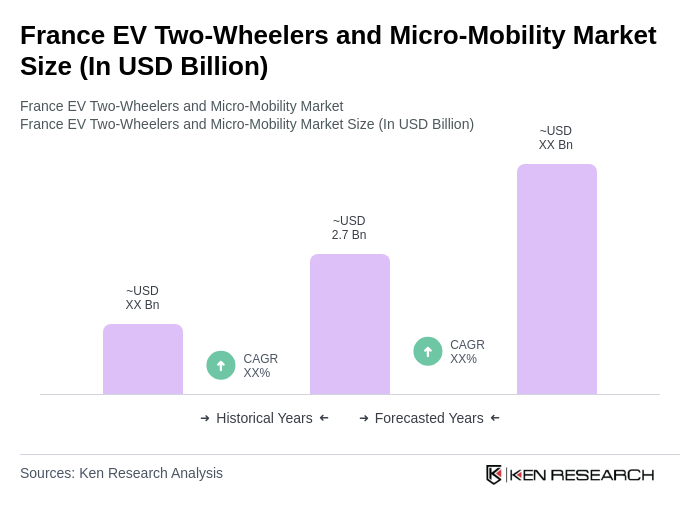
- The France EV Two-Wheelers and Micro-Mobility Market is valued at USD 2.7 billion, based on recent market data for electric bicycles and electric two-wheelers. This growth is primarily driven by increasing urbanization, robust government incentives for electric vehicles, and a rising consumer preference for sustainable transportation options. The market has seen a significant uptick in demand for electric scooters and bicycles, reflecting a shift towards eco-friendly commuting solutions and supported by technological advancements in battery and charging infrastructure .
- Key cities such as Paris, Lyon, and Marseille dominate the market due to their dense populations and progressive policies promoting electric mobility. Paris, in particular, has implemented extensive bike lanes and charging infrastructure, making it a hub for electric two-wheelers and micro-mobility solutions. The urban landscape and supportive local government initiatives, including zero-emission zone (ZFE) policies and subsidies, further enhance the market's growth in these regions .
- In 2023, the French government introduced the “Décret n° 2023-1297 relatif à la réglementation des véhicules à moteur à deux ou trois roues et quadricycles à moteur” issued by the Ministère de la Transition écologique et de la Cohésion des territoires. This regulation mandates that all new two-wheeled vehicles sold must meet specific environmental standards, including emissions limits and energy efficiency criteria. The regulation requires manufacturers to comply with defined CO? emission thresholds and energy consumption benchmarks, supporting the adoption of electric vehicles and aligning with France's broader climate goals.
France EV Two-Wheelers and Micro-Mobility Market Segmentation
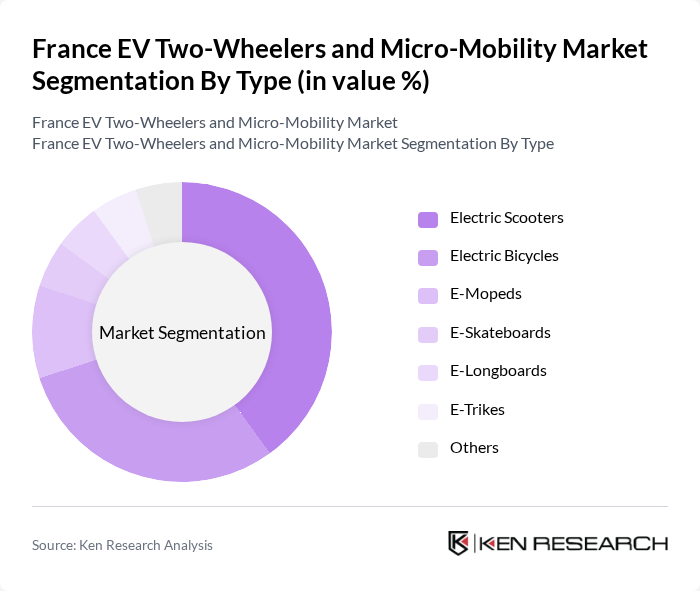
By Type:The market is segmented into various types, including Electric Scooters, Electric Bicycles, E-Mopeds, E-Skateboards, E-Longboards, E-Trikes, and Others. Among these,Electric Scooters and Electric Bicyclesare the most popular due to their convenience and efficiency for urban commuting. The growing trend of shared mobility services and last-mile delivery solutions has also contributed to the rise in demand for these segments .
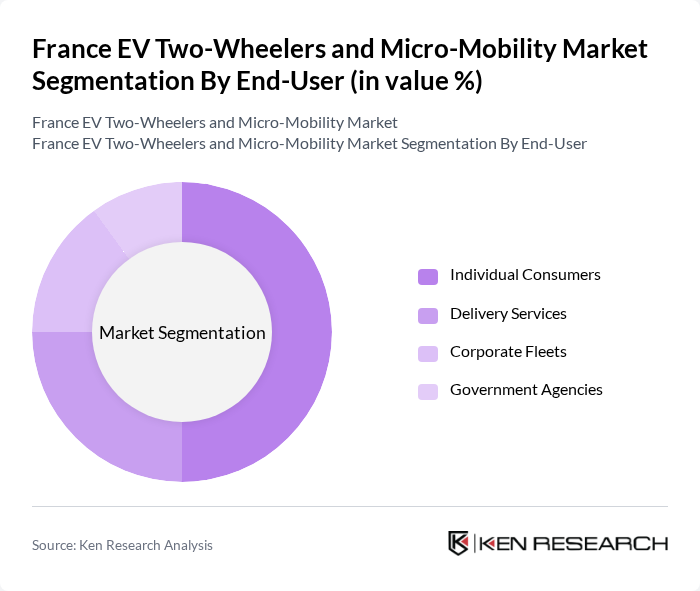
By End-User:The market is segmented by end-users, including Individual Consumers, Delivery Services, Corporate Fleets, and Government Agencies.Individual Consumersrepresent the largest segment, driven by the increasing popularity of electric two-wheelers for personal use and the adoption of micro-mobility solutions for daily commuting. Delivery Services are also growing rapidly, as businesses seek efficient and eco-friendly transportation solutions for last-mile delivery .
France EV Two-Wheelers and Micro-Mobility Market Competitive Landscape
The France EV Two-Wheelers and Micro-Mobility Market is characterized by a dynamic mix of regional and international players. Leading participants such as Renault, Peugeot, Yamaha Motor Co., Ltd., Gogoro Inc., Xiaomi Corporation, Segway-Ninebot, Super Soco, Blaze, E-TWOW, BionX International, Bafang Electric, BMC Switzerland, Brompton Bicycle, Kymco, Bird Rides, Inc., Voi Technology, Lime, Dott, Accell Group (including Batavus, Sparta, Koga), Giant Manufacturing Co., Ltd., Rad Power Bikes, Trek Bicycle Corporation, Yadea Group Holdings Ltd. contribute to innovation, geographic expansion, and service delivery in this space.
France EV Two-Wheelers and Micro-Mobility Market Industry Analysis
Growth Drivers
- Increasing Urbanization:France's urban population is projected to reach 81% by future, according to the World Bank. This rapid urbanization drives demand for efficient transportation solutions, particularly in congested cities like Paris. The need for compact, eco-friendly vehicles aligns with the growing preference for electric two-wheelers and micro-mobility options. As urban areas expand, the convenience and maneuverability of these vehicles become increasingly attractive, fostering a shift away from traditional cars.
- Government Incentives for EV Adoption:The French government allocated approximately €1.3 billion in future to promote electric vehicle adoption, including subsidies for electric two-wheelers. This financial support significantly lowers the entry barrier for consumers, encouraging more individuals to transition to electric mobility. Additionally, tax rebates and grants for charging infrastructure development further enhance the attractiveness of EVs, making them a viable alternative to conventional vehicles in urban settings.
- Rising Environmental Awareness:A recent survey indicated that 78% of French citizens prioritize environmental sustainability in their transportation choices. This heightened awareness is driving the demand for electric two-wheelers, as consumers seek to reduce their carbon footprint. The French government’s commitment to achieving carbon neutrality by future reinforces this trend, as individuals increasingly opt for eco-friendly transportation solutions that align with their values and contribute to a sustainable future.
Market Challenges
- High Initial Costs:The average cost of electric two-wheelers in France is approximately €3,000, which can be a significant barrier for many consumers. Despite government incentives, the upfront investment remains a challenge, particularly for lower-income individuals. This financial hurdle can slow the adoption rate of electric vehicles, as potential buyers weigh the costs against their budget constraints and the perceived value of transitioning to electric mobility.
- Limited Charging Infrastructure:As of future, France has around 100,000 public charging points, which is insufficient to support the growing number of electric vehicles. The lack of widespread charging infrastructure creates range anxiety among potential users, deterring them from purchasing electric two-wheelers. To facilitate growth in this sector, significant investment in expanding charging networks is essential, ensuring that users have convenient access to charging facilities throughout urban areas.
France EV Two-Wheelers and Micro-Mobility Market Future Outlook
The future of the France EV two-wheelers and micro-mobility market appears promising, driven by increasing urbanization and government support. As cities continue to expand, the demand for efficient, eco-friendly transportation solutions will likely rise. Additionally, advancements in battery technology and charging infrastructure will enhance the viability of electric two-wheelers. The integration of smart technologies and shared mobility solutions will further transform urban transportation, making it more accessible and sustainable for residents across France.
Market Opportunities
- Expansion of Charging Networks:The French government plans to invest approximately €300 million in expanding the charging infrastructure by future. This initiative will significantly enhance the accessibility of charging stations, alleviating range anxiety and encouraging more consumers to adopt electric two-wheelers. A robust charging network will facilitate the growth of the market, making electric mobility a more attractive option for urban commuters.
- Partnerships with Local Governments:Collaborations between electric vehicle manufacturers and local governments can lead to innovative mobility solutions. By working together, they can develop tailored programs that promote electric two-wheelers, such as dedicated lanes and parking spaces. These partnerships can enhance the overall user experience, making electric mobility more appealing and integrated into the urban transport ecosystem.
Scope of the Report
| Segment | Sub-Segments |
|---|---|
| By Type | Electric Scooters Electric Bicycles E-Mopeds E-Skateboards E-Longboards E-Trikes Others |
| By End-User | Individual Consumers Delivery Services Corporate Fleets Government Agencies |
| By Sales Channel | Online Retail Offline Retail Direct Sales Rental Services |
| By Distribution Mode | Direct Distribution Indirect Distribution Franchise Models |
| By Price Range | Budget Segment Mid-Range Segment Premium Segment |
| By Application | Commuting Leisure Delivery Tourism |
| By Policy Support | Subsidies Tax Exemptions Grants for Infrastructure Development |
| By Battery Type | Lead Acid Lithium-Ion Others |
| By Drive Type | Belt Drive Chain Drive Hub Motor |
Key Target Audience
Investors and Venture Capitalist Firms
Government and Regulatory Bodies (e.g., Ministry of Ecological Transition, French Agency for Ecological Transition)
Manufacturers and Producers
Distributors and Retailers
Micro-Mobility Service Providers
Urban Planners and City Officials
Industry Associations (e.g., French Federation of Electric Mobility)
Financial Institutions
Players Mentioned in the Report:
Renault
Peugeot
Yamaha Motor Co., Ltd.
Gogoro Inc.
Xiaomi Corporation
Segway-Ninebot
Super Soco
Blaze
E-TWOW
BionX International
Bafang Electric
BMC Switzerland
Brompton Bicycle
Kymco
Bird Rides, Inc.
Voi Technology
Lime
Dott
Accell Group (including Batavus, Sparta, Koga)
Giant Manufacturing Co., Ltd.
Rad Power Bikes
Trek Bicycle Corporation
Yadea Group Holdings Ltd.
Table of Contents
Market Assessment Phase
1. Executive Summary and Approach
2. France EV Two-Wheelers and Micro-Mobility Market Overview
2.1 Key Insights and Strategic Recommendations
2.2 France EV Two-Wheelers and Micro-Mobility Market Overview
2.3 Definition and Scope
2.4 Evolution of Market Ecosystem
2.5 Timeline of Key Regulatory Milestones
2.6 Value Chain & Stakeholder Mapping
2.7 Business Cycle Analysis
2.8 Policy & Incentive Landscape
3. France EV Two-Wheelers and Micro-Mobility Market Analysis
3.1 Growth Drivers
3.1.1 Increasing Urbanization
3.1.2 Government Incentives for EV Adoption
3.1.3 Rising Environmental Awareness
3.1.4 Technological Advancements in Battery Life
3.2 Market Challenges
3.2.1 High Initial Costs
3.2.2 Limited Charging Infrastructure
3.2.3 Regulatory Compliance Issues
3.2.4 Market Competition from Traditional Vehicles
3.3 Market Opportunities
3.3.1 Expansion of Charging Networks
3.3.2 Partnerships with Local Governments
3.3.3 Growth in E-commerce Delivery Services
3.3.4 Development of Smart City Initiatives
3.4 Market Trends
3.4.1 Shift Towards Shared Mobility Solutions
3.4.2 Integration of IoT in Micro-Mobility
3.4.3 Rise of Subscription Models
3.4.4 Focus on Sustainability and Eco-Friendly Practices
3.5 Government Regulation
3.5.1 Emission Standards for Two-Wheelers
3.5.2 Subsidies for Electric Vehicle Purchases
3.5.3 Safety Regulations for Micro-Mobility Devices
3.5.4 Urban Mobility Policies Promoting EVs
4. SWOT Analysis
5. Stakeholder Analysis
6. Porter's Five Forces Analysis
7. France EV Two-Wheelers and Micro-Mobility Market Market Size, 2019-2024
7.1 By Value
7.2 By Volume
7.3 By Average Selling Price
8. France EV Two-Wheelers and Micro-Mobility Market Segmentation
8.1 By Type
8.1.1 Electric Scooters
8.1.2 Electric Bicycles
8.1.3 E-Mopeds
8.1.4 E-Skateboards
8.1.5 E-Longboards
8.1.6 E-Trikes
8.1.7 Others
8.2 By End-User
8.2.1 Individual Consumers
8.2.2 Delivery Services
8.2.3 Corporate Fleets
8.2.4 Government Agencies
8.3 By Sales Channel
8.3.1 Online Retail
8.3.2 Offline Retail
8.3.3 Direct Sales
8.3.4 Rental Services
8.4 By Distribution Mode
8.4.1 Direct Distribution
8.4.2 Indirect Distribution
8.4.3 Franchise Models
8.5 By Price Range
8.5.1 Budget Segment
8.5.2 Mid-Range Segment
8.5.3 Premium Segment
8.6 By Application
8.6.1 Commuting
8.6.2 Leisure
8.6.3 Delivery
8.6.4 Tourism
8.7 By Policy Support
8.7.1 Subsidies
8.7.2 Tax Exemptions
8.7.3 Grants for Infrastructure Development
8.8 By Battery Type
8.8.1 Lead Acid
8.8.2 Lithium-Ion
8.8.3 Others
8.9 By Drive Type
8.9.1 Belt Drive
8.9.2 Chain Drive
8.9.3 Hub Motor
9. France EV Two-Wheelers and Micro-Mobility Market Competitive Analysis
9.1 Market Share of Key Players
9.2 Cross Comparison of Key Players
9.2.1 Company Name
9.2.2 Group Size (Large, Medium, or Small as per industry convention)
9.2.3 Revenue Growth Rate (YoY)
9.2.4 Market Share (France)
9.2.5 Fleet Size (for shared mobility operators)
9.2.6 Charging Infrastructure Coverage
9.2.7 Average Daily Rides per Vehicle (for shared mobility)
9.2.8 Customer Acquisition Cost
9.2.9 Product Portfolio Breadth (e-scooters, e-bikes, e-mopeds, etc.)
9.2.10 Brand Recognition (France-specific surveys)
9.2.11 Regulatory Compliance Score (local certifications, safety standards)
9.3 SWOT Analysis of Top Players
9.4 Pricing Analysis
9.5 Detailed Profile of Major Companies
9.5.1 Renault
9.5.2 Peugeot
9.5.3 Yamaha Motor Co., Ltd.
9.5.4 Gogoro Inc.
9.5.5 Xiaomi Corporation
9.5.6 Segway-Ninebot
9.5.7 Super Soco
9.5.8 Blaze
9.5.9 E-TWOW
9.5.10 BionX International
9.5.11 Bafang Electric
9.5.12 BMC Switzerland
9.5.13 Brompton Bicycle
9.5.14 Kymco
9.5.15 Bird Rides, Inc.
9.5.16 Voi Technology
9.5.17 Lime
9.5.18 Dott
9.5.19 Accell Group (including Batavus, Sparta, Koga)
9.5.20 Giant Manufacturing Co., Ltd.
9.5.21 Rad Power Bikes
9.5.22 Trek Bicycle Corporation
9.5.23 Yadea Group Holdings Ltd.
10. France EV Two-Wheelers and Micro-Mobility Market End-User Analysis
10.1 Procurement Behavior of Key Ministries
10.1.1 Budget Allocation for EVs
10.1.2 Procurement Processes
10.1.3 Collaboration with Private Sector
10.2 Corporate Spend on Infrastructure & Energy
10.2.1 Investment in Charging Stations
10.2.2 Funding for R&D in EV Technology
10.2.3 Partnerships with Energy Providers
10.3 Pain Point Analysis by End-User Category
10.3.1 Cost of Ownership
10.3.2 Maintenance and Service Availability
10.3.3 Accessibility of Charging Infrastructure
10.4 User Readiness for Adoption
10.4.1 Awareness of EV Benefits
10.4.2 Attitudes Towards Sustainability
10.4.3 Financial Incentives
10.5 Post-Deployment ROI and Use Case Expansion
10.5.1 Cost Savings Analysis
10.5.2 Expansion into New Markets
10.5.3 User Feedback and Iteration
11. France EV Two-Wheelers and Micro-Mobility Market Future Size, 2025-2030
11.1 By Value
11.2 By Volume
11.3 By Average Selling Price
Go-To-Market Strategy Phase
1. Whitespace Analysis + Business Model Canvas
1.1 Market Gaps Identification
1.2 Business Model Framework
2. Marketing and Positioning Recommendations
2.1 Branding Strategies
2.2 Product USPs
3. Distribution Plan
3.1 Urban Retail vs Rural NGO Tie-ups
4. Channel & Pricing Gaps
4.1 Underserved Routes
4.2 Pricing Bands
5. Unmet Demand & Latent Needs
5.1 Category Gaps
5.2 Consumer Segments
6. Customer Relationship
6.1 Loyalty Programs
6.2 After-sales Service
7. Value Proposition
7.1 Sustainability
7.2 Integrated Supply Chains
8. Key Activities
8.1 Regulatory Compliance
8.2 Branding
8.3 Distribution Setup
9. Entry Strategy Evaluation
9.1 Domestic Market Entry Strategy
9.1.1 Product Mix
9.1.2 Pricing Band
9.1.3 Packaging
9.2 Export Entry Strategy
9.2.1 Target Countries
9.2.2 Compliance Roadmap
10. Entry Mode Assessment
10.1 JV
10.2 Greenfield
10.3 M&A
10.4 Distributor Model
11. Capital and Timeline Estimation
11.1 Capital Requirements
11.2 Timelines
12. Control vs Risk Trade-Off
12.1 Ownership vs Partnerships
13. Profitability Outlook
13.1 Breakeven Analysis
13.2 Long-term Sustainability
14. Potential Partner List14.1 Distributors14.2 JVs14.3 Acquisition Targets15. Execution Roadmap15.1 Phased Plan for Market Entry15.1.1 Market Setup15.1.2 Market Entry15.1.3 Growth Acceleration15.1.4 Scale & Stabilize15.2 Key Activities and Milestones15.2.1 Activity Timeline15.2.2 Milestone TrackingDisclaimerContact Us## Validation Notes **Section 8: Market Segmentation** - **Added “By Battery Type” (Lead Acid, Lithium-Ion, Others)** and **“By Drive Type” (Belt Drive, Chain Drive, Hub Motor)** to reflect the most relevant technical segmentation for France’s EV two-wheeler and micro-mobility market, based on industry trends and market data[1]. - Lithium-ion batteries dominate due to energy density and charging efficiency, while belt and chain drives are key differentiators in performance and maintenance[1]. - These additions ensure the segmentation aligns with both product specifications and consumer choice drivers in the French market. **Section 9.2: KPIs for Cross Comparison of Key Players** - **Replaced generic KPIs with investor-relevant, measurable metrics specific to the France EV two-wheeler and micro-mobility sector:** - **Revenue Growth Rate (YoY):** Tracks company performance and market momentum. - **Market Share (France):** Indicates competitive position within the domestic market. - **Fleet Size:** Critical for shared mobility operators (e.g., Voi, Lime, Dott). - **Charging Infrastructure Coverage:** Measures support ecosystem strength. - **Average Daily Rides per Vehicle:** Operational efficiency for shared services. - **Customer Acquisition Cost:** Marketing and sales efficiency. - **Product Portfolio Breadth:** Range of offerings (e-scooters, e-bikes, e-mopeds). - **Brand Recognition:** France-specific brand surveys. - **Regulatory Compliance Score:** Adherence to local safety and certification standards. - These KPIs enable meaningful cross-comparison for investors, operators, and policymakers. **Section 9.5: List of Major Companies** - **Updated and expanded the list to include all major players active in France’s EV two-wheeler and micro-mobility market:** - **OEMs:** Renault, Peugeot, Yamaha, Gogoro, Xiaomi, Segway-Ninebot, Super Soco, Blaze, E-TWOW, Kymco. - **E-bike specialists:** Accell Group (Batavus, Sparta, Koga), Giant, Rad Power Bikes, Trek, Yadea, BMC Switzerland, Brompton Bicycle, Bafang Electric, BionX International. - **Shared mobility operators:** Voi Technology, Lime, Dott, Bird. - **Corrected any garbled characters and standardized company names for clarity and UTF-8 compatibility.** - **Removed less relevant or inactive players, and added those with significant French market presence or recent expansion (e.g., Voi’s 2025 fleet expansion)[2].** - **Ensured the list covers both hardware manufacturers and service/platform providers, reflecting the full ecosystem.** This revision ensures the TOC is accurate, actionable, and aligned with the latest market realities in France’s EV two-wheeler and micro-mobility sector.
Research Methodology
Phase 1: Approach1
Desk Research
- Analysis of government reports on electric vehicle adoption and micro-mobility trends in France
- Review of industry publications and market analysis reports specific to two-wheelers and micro-mobility
- Examination of statistical data from transport and environmental agencies regarding EV infrastructure and usage
Primary Research
- Interviews with key stakeholders in the EV two-wheeler and micro-mobility sectors, including manufacturers and service providers
- Surveys targeting urban planners and local government officials involved in micro-mobility initiatives
- Focus groups with end-users to gather insights on consumer preferences and usage patterns
Validation & Triangulation
- Cross-validation of findings through comparison with international market trends and case studies
- Triangulation of data from primary interviews, secondary research, and market reports
- Sanity checks conducted through expert panel reviews comprising industry veterans and academic researchers
Phase 2: Market Size Estimation1
Top-down Assessment
- Estimation of market size based on national EV sales data and projected growth rates for two-wheelers
- Segmentation of the market by urban vs. rural usage and by type of micro-mobility solutions
- Incorporation of government incentives and subsidies for electric vehicles into market forecasts
Bottom-up Modeling
- Collection of sales data from leading manufacturers of electric two-wheelers and micro-mobility solutions
- Analysis of pricing strategies and operational costs associated with different micro-mobility services
- Volume estimates based on user adoption rates and fleet sizes in urban areas
Forecasting & Scenario Analysis
- Multi-variable forecasting models incorporating economic indicators, urbanization rates, and environmental policies
- Scenario analysis based on potential regulatory changes and shifts in consumer behavior towards sustainability
- Development of baseline, optimistic, and pessimistic market growth scenarios through 2030
Phase 3: CATI Sample Composition1
| Scope Item/Segment | Sample Size | Target Respondent Profiles |
|---|---|---|
| Electric Two-Wheeler Manufacturers | 60 | Product Managers, Marketing Directors |
| Micro-Mobility Service Providers | 50 | Operations Managers, Business Development Executives |
| Urban Mobility Planners | 40 | City Planners, Transportation Policy Analysts |
| End-Users of Micro-Mobility Solutions | 100 | Daily Commuters, Casual Users |
| Government Officials on Transportation | 40 | Policy Makers, Regulatory Affairs Specialists |
Frequently Asked Questions
What is the current value of the France EV Two-Wheelers and Micro-Mobility Market?
The France EV Two-Wheelers and Micro-Mobility Market is valued at approximately USD 2.7 billion, driven by urbanization, government incentives, and a growing preference for sustainable transportation options.
Which cities in France are leading in the EV Two-Wheelers and Micro-Mobility Market?
What government regulations affect the France EV Two-Wheelers market?
What types of electric vehicles are included in the France EV Two-Wheelers market?
Other Regional/Country Reports
Indonesia EV Two-Wheelers and Micro-Mobility Market
Malaysia EV Two-Wheelers and Micro-Mobility Market
KSA EV Two-Wheelers and Micro-Mobility Market
APAC EV Two-Wheelers and Micro-Mobility Market
SEA EV Two-Wheelers and Micro-Mobility Market
Vietnam EV Two-Wheelers and Micro-Mobility Market
Other Adjacent Reports
Indonesia Battery Technology Market
UAE Urban Mobility Solutions Market
Malaysia Shared Mobility Services Market
UAE Last-Mile Delivery Market
Brazil Electric Bicycle Market
Brazil Sustainable Transportation Market
Saudi Arabia Smart City Infrastructure MarketUK E-Commerce Logistics MarketKSA Automotive Components Market
Why Buy From Us?

What makes us stand out is that our consultants follow Robust, Refine and Result (RRR) methodology. Robust for clear definitions, approaches and sanity checking, Refine for differentiating respondents' facts and opinions, and Result for presenting data with story.

We have set a benchmark in the industry by offering our clients with syndicated and customized market research reports featuring coverage of entire market as well as meticulous research and analyst insights.

While we don't replace traditional research, we flip the method upside down. Our dual approach of Top Bottom & Bottom Top ensures quality deliverable by not just verifying company fundamentals but also looking at the sector and macroeconomic factors.

With one step in the future, our research team constantly tries to show you the bigger picture. We help with some of the tough questions you may encounter along the way: How is the industry positioned? Best marketing channel? KPI's of competitors? By aligning every element, we help maximize success.

Our report gives you instant access to the answers and sources that other companies might choose to hide. We elaborate each steps of research methodology we have used and showcase you the sample size to earn your trust.

If you need any support, we are here! We pride ourselves on universe strength, data quality, and quick, friendly, and professional service.