About the Report
Base Year 2024France Sustainable Fashion and Apparel Tech Market Overview
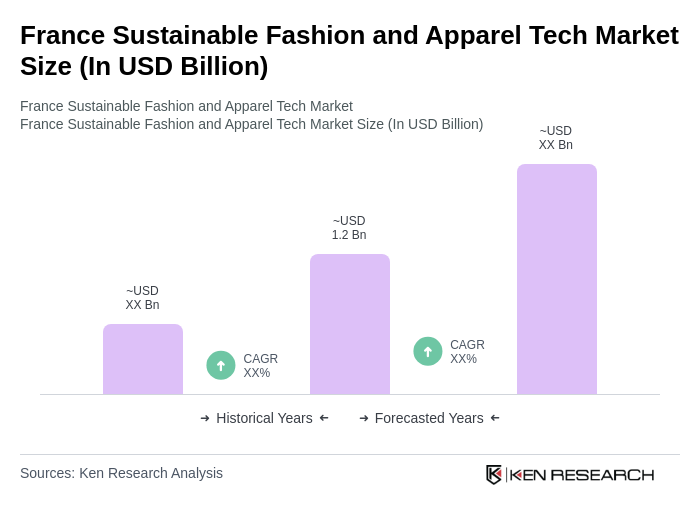
- The France Sustainable Fashion and Apparel Tech Market is valued at USD 1.2 billion, based on a five-year historical analysis. This market is driven by rising consumer demand for eco-friendly products, increased awareness of environmental impacts, and the adoption of innovative technologies such as AI-powered recycling and digital supply chain platforms. The sector is further supported by the expansion of circular economy practices, including recycling, upcycling, and extended product lifecycles, which emphasize sustainability and resource efficiency .
- Key cities such as Paris, Lyon, and Marseille remain dominant in the market due to their strong fashion heritage, vibrant cultural scenes, and the presence of numerous sustainable fashion brands. Paris, as a global fashion hub, attracts both consumers and designers focused on sustainability. The city's commitment to eco-friendly initiatives, including green manufacturing and textile recycling, further enhances its leadership in the sustainable fashion landscape .
- The "Anti-Waste Law for a Circular Economy" (Loi Anti-Gaspillage pour une Économie Circulaire, 2020) issued by the French Ministry for the Ecological Transition mandates that all textile producers ensure products are recyclable or reusable. This regulation requires extended producer responsibility, including mandatory product labeling, recycling targets, and compliance with eco-design standards, thereby promoting sustainable practices and reducing textile waste in the industry .
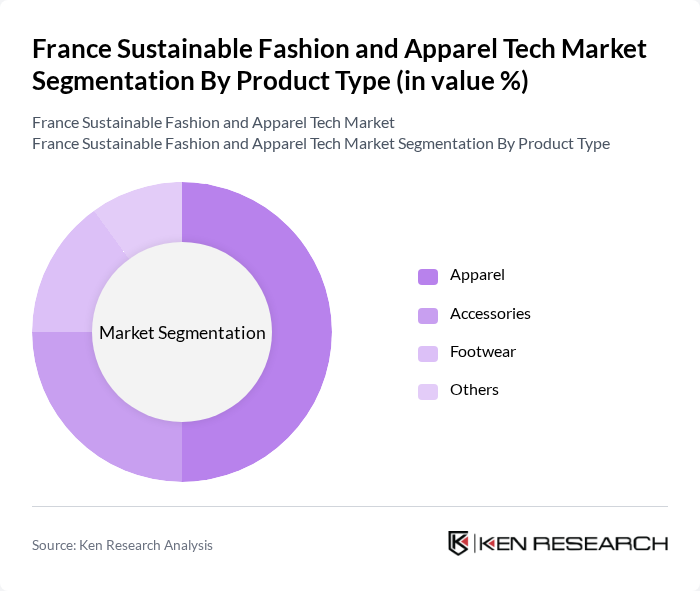
France Sustainable Fashion and Apparel Tech Market Segmentation
By Product Type:The product type segmentation includes apparel, accessories, footwear, and others. Apparel remains the leading subsegment, driven by consumer preferences for sustainable clothing and the proliferation of eco-friendly brands. Accessories and footwear also show significant growth, reflecting the broader adoption of sustainability across fashion categories and increased interest in ethically produced goods .
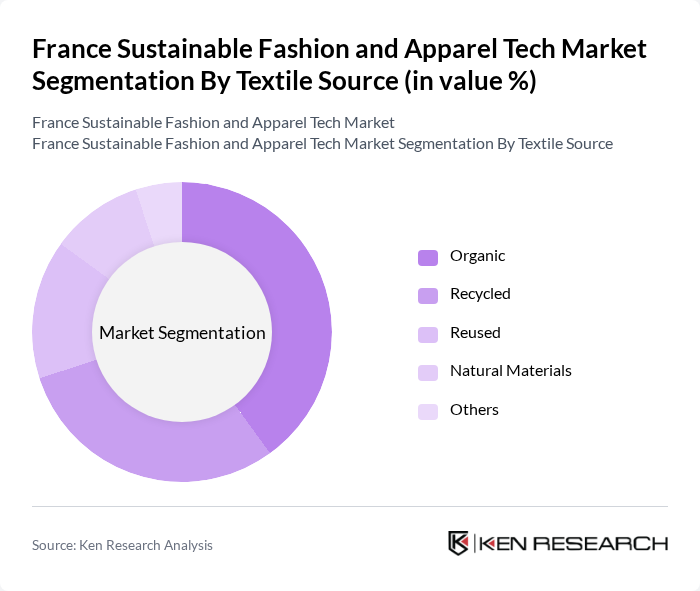
By Textile Source:This segmentation focuses on the source of textiles used in sustainable fashion, including organic, recycled, reused, natural materials, and others. Organic textiles are currently the most popular choice, supported by consumer awareness of the environmental impact of conventional textile production and the expansion of certified organic supply chains. Recycled and reused materials are gaining traction due to advances in fabric recycling technologies and the growing market for upcycled and secondhand apparel .
France Sustainable Fashion and Apparel Tech Market Competitive Landscape
The France Sustainable Fashion and Apparel Tech Market is characterized by a dynamic mix of regional and international players. Leading participants such as Stella McCartney, Veja, LVMH, Kering, Chanel, MUD Jeans, Ecoalf, People Tree, Faithfull the Brand, Amour Vert, Nudie Jeans, Reformation, Etnies, Tentree, Arket contribute to innovation, geographic expansion, and service delivery in this space.
France Sustainable Fashion and Apparel Tech Market Industry Analysis
Growth Drivers
- Increasing Consumer Demand for Sustainable Products:In France, the sustainable fashion market has seen a significant uptick, with consumer spending on eco-friendly apparel reaching approximately €8 billion in future. This figure is projected to grow as approximately 70% of French consumers express a willingness to pay more for sustainable products. The rise in awareness regarding environmental issues, coupled with a shift towards responsible consumption, is driving this demand, making sustainable fashion a priority for many shoppers.
- Government Initiatives Promoting Eco-Friendly Practices:The French government has implemented various initiatives to support sustainable fashion, including the "Anti-Waste Law" passed to reduce textile waste by 50% in future. Additionally, funding of €1.3 billion has been allocated to promote sustainable practices in the fashion industry. These policies not only encourage brands to adopt eco-friendly practices but also enhance consumer confidence in sustainable products, fostering market growth.
- Technological Advancements in Sustainable Materials:Innovations in sustainable materials are transforming the fashion landscape in France. The market for biodegradable textiles is expected to reach €1.6 billion in future, driven by advancements in technology that allow for the production of eco-friendly fabrics. Companies are increasingly investing in research and development, with over €320 million allocated in future alone, to create materials that reduce environmental impact while maintaining quality and style.
Market Challenges
- High Production Costs for Sustainable Apparel:One of the significant challenges facing the sustainable fashion market in France is the high production costs associated with eco-friendly materials and processes. For instance, the cost of organic cotton is approximately 20% higher than conventional cotton. This price disparity can deter brands from fully committing to sustainable practices, limiting the availability of affordable sustainable options for consumers and hindering market growth.
- Limited Consumer Awareness of Sustainable Options:Despite the growing interest in sustainable fashion, a considerable portion of the French population remains unaware of available sustainable options. Research indicates that only 40% of consumers can identify eco-friendly brands. This lack of awareness can impede market growth, as consumers may not actively seek out sustainable products, leading to missed opportunities for brands to engage with potential customers and expand their market share.
France Sustainable Fashion and Apparel Tech Market Future Outlook
The future of the sustainable fashion market in France appears promising, driven by increasing consumer awareness and government support. As more brands adopt sustainable practices, the market is likely to witness a surge in innovative products and eco-friendly materials. Additionally, the integration of technology in fashion, such as digital fashion and virtual try-ons, will enhance consumer engagement. This evolution will create a more transparent and responsible fashion ecosystem, aligning with the growing demand for sustainability among consumers.
Market Opportunities
- Expansion of E-commerce Platforms for Sustainable Fashion:The rise of e-commerce presents a significant opportunity for sustainable fashion brands in France. With online sales of sustainable apparel projected to reach €2.1 billion in future, brands can leverage digital platforms to reach a broader audience. This shift allows for targeted marketing strategies that highlight eco-friendly practices, appealing to the growing base of environmentally conscious consumers.
- Collaborations with Influencers and Eco-Conscious Brands:Collaborations between sustainable fashion brands and influencers can significantly enhance brand visibility and credibility. In future, partnerships with eco-conscious influencers have shown to increase brand engagement by approximately 30%. By aligning with influencers who advocate for sustainability, brands can effectively reach and educate consumers, driving sales and fostering a community around sustainable fashion.
Scope of the Report
| Segment | Sub-Segments |
|---|---|
| By Product Type | Apparel Accessories Footwear Others |
| By Textile Source | Organic Recycled Reused Natural Materials Others |
| By End-User | Women Men Kids Unisex Others |
| By Distribution Channel | Online Retail Brick-and-Mortar Stores Pop-Up Shops Wholesale Others |
| By Price Range | Budget Mid-Range Premium Luxury Others |
| By Material Source | Locally Sourced Imported Sustainable Materials Recycled Materials Others |
| By Consumer Demographics | Age Group (18-24, 25-34, 35-44, etc.) Gender Income Level Lifestyle Preferences Others |
| By Sustainability Certification | GOTS Certified OEKO-TEX Certified Fair Trade Certified Others |
Key Target Audience
Investors and Venture Capitalist Firms
Government and Regulatory Bodies (e.g., Ministry of Ecological Transition, ADEME)
Manufacturers and Producers
Distributors and Retailers
Fashion Brands and Designers
Technology Providers
Industry Associations (e.g., Fédération Française du Prêt à Porter Féminin)
Financial Institutions
Players Mentioned in the Report:
Stella McCartney
Veja
LVMH
Kering
Chanel
MUD Jeans
Ecoalf
People Tree
Faithfull the Brand
Amour Vert
Nudie Jeans
Reformation
Etnies
Tentree
Arket
Table of Contents
Market Assessment Phase
1. Executive Summary and Approach
2. France Sustainable Fashion and Apparel Tech Market Overview
2.1 Key Insights and Strategic Recommendations
2.2 France Sustainable Fashion and Apparel Tech Market Overview
2.3 Definition and Scope
2.4 Evolution of Market Ecosystem
2.5 Timeline of Key Regulatory Milestones
2.6 Value Chain & Stakeholder Mapping
2.7 Business Cycle Analysis
2.8 Policy & Incentive Landscape
3. France Sustainable Fashion and Apparel Tech Market Analysis
3.1 Growth Drivers
3.1.1 Increasing Consumer Demand for Sustainable Products
3.1.2 Government Initiatives Promoting Eco-Friendly Practices
3.1.3 Technological Advancements in Sustainable Materials
3.1.4 Rise of Ethical Consumerism
3.2 Market Challenges
3.2.1 High Production Costs for Sustainable Apparel
3.2.2 Limited Consumer Awareness of Sustainable Options
3.2.3 Competition from Fast Fashion Brands
3.2.4 Regulatory Compliance Complexity
3.3 Market Opportunities
3.3.1 Expansion of E-commerce Platforms for Sustainable Fashion
3.3.2 Collaborations with Influencers and Eco-Conscious Brands
3.3.3 Development of Circular Fashion Models
3.3.4 Investment in Sustainable Supply Chain Innovations
3.4 Market Trends
3.4.1 Growth of Second-Hand and Vintage Clothing Markets
3.4.2 Increasing Use of Biodegradable Materials
3.4.3 Adoption of Digital Fashion Technologies
3.4.4 Focus on Transparency in Supply Chains
3.5 Government Regulation
3.5.1 Extended Producer Responsibility (EPR) Policies
3.5.2 Eco-Labeling Requirements
3.5.3 Regulations on Textile Waste Management
3.5.4 Incentives for Sustainable Manufacturing Practices
4. SWOT Analysis
5. Stakeholder Analysis
6. Porter's Five Forces Analysis
7. France Sustainable Fashion and Apparel Tech Market Market Size, 2019-2024
7.1 By Value
7.2 By Volume
7.3 By Average Selling Price
8. France Sustainable Fashion and Apparel Tech Market Segmentation
8.1 By Product Type
8.1.1 Apparel
8.1.2 Accessories
8.1.3 Footwear
8.1.4 Others
8.2 By Textile Source
8.2.1 Organic
8.2.2 Recycled
8.2.3 Reused
8.2.4 Natural Materials
8.2.5 Others
8.3 By End-User
8.3.1 Women
8.3.2 Men
8.3.3 Kids
8.3.4 Unisex
8.3.5 Others
8.4 By Distribution Channel
8.4.1 Online Retail
8.4.2 Brick-and-Mortar Stores
8.4.3 Pop-Up Shops
8.4.4 Wholesale
8.4.5 Others
8.5 By Price Range
8.5.1 Budget
8.5.2 Mid-Range
8.5.3 Premium
8.5.4 Luxury
8.5.5 Others
8.6 By Material Source
8.6.1 Locally Sourced
8.6.2 Imported Sustainable Materials
8.6.3 Recycled Materials
8.6.4 Others
8.7 By Consumer Demographics
8.7.1 Age Group (18-24, 25-34, 35-44, etc.)
8.7.2 Gender
8.7.3 Income Level
8.7.4 Lifestyle Preferences
8.7.5 Others
8.8 By Sustainability Certification
8.8.1 GOTS Certified
8.8.2 OEKO-TEX Certified
8.8.3 Fair Trade Certified
8.8.4 Others
9. France Sustainable Fashion and Apparel Tech Market Competitive Analysis
9.1 Market Share of Key Players
9.2 KPIs for Cross Comparison of Key Players
9.2.1 Company Name
9.2.2 Group Size (Large, Medium, or Small as per industry convention)
9.2.3 Revenue Growth Rate (YoY %)
9.2.4 Market Penetration Rate (France-specific % share)
9.2.5 Customer Retention Rate (%)
9.2.6 Average Order Value (EUR)
9.2.7 Product Diversification Index
9.2.8 Sustainability Index (e.g., % sustainable materials used, emissions per unit)
9.2.9 Brand Equity Score (France market)
9.2.10 Supply Chain Transparency Score
9.2.11 Circularity Ratio (% of products recycled/upcycled)
9.2.12 Digital Engagement Rate (online traffic, social media metrics)
9.3 SWOT Analysis of Top Players
9.4 Pricing Analysis
9.5 List of Major Companies
9.5.1 Stella McCartney
9.5.2 Veja
9.5.3 LVMH
9.5.4 Kering
9.5.5 Chanel
9.5.6 MUD Jeans
9.5.7 Ecoalf
9.5.8 People Tree
9.5.9 Faithfull the Brand
9.5.10 Amour Vert
9.5.11 Nudie Jeans
9.5.12 Reformation
9.5.13 Etnies
9.5.14 Tentree
9.5.15 Arket
10. France Sustainable Fashion and Apparel Tech Market End-User Analysis
10.1 Procurement Behavior of Key Ministries
10.1.1 Sustainable Procurement Policies
10.1.2 Budget Allocation for Sustainable Fashion
10.1.3 Collaboration with Eco-Friendly Brands
10.2 Corporate Spend on Infrastructure & Energy
10.2.1 Investment in Sustainable Practices
10.2.2 Budget for Eco-Friendly Initiatives
10.2.3 Partnerships with Sustainable Suppliers
10.3 Pain Point Analysis by End-User Category
10.3.1 Cost of Sustainable Options
10.3.2 Availability of Eco-Friendly Products
10.3.3 Consumer Education on Sustainability
10.4 User Readiness for Adoption
10.4.1 Awareness of Sustainable Fashion
10.4.2 Willingness to Pay for Sustainability
10.4.3 Accessibility of Sustainable Options
10.5 Post-Deployment ROI and Use Case Expansion
10.5.1 Measurement of Sustainability Impact
10.5.2 Expansion of Sustainable Product Lines
10.5.3 Long-term Consumer Engagement Strategies
11. France Sustainable Fashion and Apparel Tech Market Future Size, 2025-2030
11.1 By Value
11.2 By Volume
11.3 By Average Selling Price
Go-To-Market Strategy Phase
1. Whitespace Analysis + Business Model Canvas
1.1 Market Gaps Identification
1.2 Value Proposition Development
1.3 Revenue Streams Analysis
1.4 Cost Structure Evaluation
1.5 Key Partnerships Exploration
1.6 Customer Segmentation
1.7 Channels of Distribution
2. Marketing and Positioning Recommendations
2.1 Branding Strategies
2.2 Product USPs
2.3 Target Audience Engagement
2.4 Digital Marketing Tactics
2.5 Sustainability Messaging
3. Distribution Plan
3.1 Urban Retail Strategies
3.2 Rural NGO Tie-Ups
3.3 E-commerce Integration
3.4 Logistics and Supply Chain Management
4. Channel & Pricing Gaps
4.1 Underserved Routes
4.2 Pricing Bands Analysis
4.3 Competitor Pricing Strategies
5. Unmet Demand & Latent Needs
5.1 Category Gaps Identification
5.2 Consumer Segments Analysis
5.3 Emerging Trends Exploration
6. Customer Relationship
6.1 Loyalty Programs
6.2 After-sales Service
6.3 Customer Feedback Mechanisms
7. Value Proposition
7.1 Sustainability Focus
7.2 Integrated Supply Chains
7.3 Unique Selling Points
8. Key Activities
8.1 Regulatory Compliance
8.2 Branding Initiatives
8.3 Distribution Setup
9. Entry Strategy Evaluation
9.1 Domestic Market Entry Strategy
9.1.1 Product Mix Considerations
9.1.2 Pricing Band Strategy
9.1.3 Packaging Innovations
9.2 Export Entry Strategy
9.2.1 Target Countries Identification
9.2.2 Compliance Roadmap Development
10. Entry Mode Assessment
10.1 Joint Ventures
10.2 Greenfield Investments
10.3 Mergers & Acquisitions
10.4 Distributor Model Evaluation
11. Capital and Timeline Estimation
11.1 Capital Requirements Analysis
11.2 Timelines for Market Entry
12. Control vs Risk Trade-Off
12.1 Ownership vs Partnerships
13. Profitability Outlook
13.1 Breakeven Analysis
13.2 Long-term Sustainability Strategies
14. Potential Partner List
14.1 Distributors
14.2 Joint Ventures
14.3 Acquisition Targets
15. Execution Roadmap
15.1 Phased Plan for Market Entry
15.1.1 Market Setup
15.1.2 Market Entry
15.1.3 Growth Acceleration
15.1.4 Scale & Stabilize
15.2 Key Activities and Milestones
15.2.1 Milestone Planning
15.2.2 Activity Tracking
Research Methodology
Phase 1: Approach1
Desk Research
- Analysis of industry reports from French fashion and apparel associations
- Review of government publications on sustainable fashion initiatives and regulations
- Examination of academic journals focusing on sustainability in the fashion sector
Primary Research
- Interviews with sustainability officers at leading apparel brands in France
- Surveys targeting consumers regarding their purchasing behavior towards sustainable fashion
- Focus groups with industry experts and fashion designers on technology adoption
Validation & Triangulation
- Cross-validation of findings through multiple data sources including sales data and consumer insights
- Triangulation of qualitative insights from interviews with quantitative survey results
- Sanity checks through expert panel reviews comprising industry veterans and academics
Phase 2: Market Size Estimation1
Top-down Assessment
- Estimation of market size based on national apparel market statistics and growth rates
- Segmentation of the market by sustainable apparel categories and consumer demographics
- Incorporation of trends in eco-friendly materials and technology adoption rates
Bottom-up Modeling
- Collection of sales data from key sustainable fashion retailers in France
- Estimation of average transaction values and purchase frequencies among consumers
- Analysis of production costs associated with sustainable apparel technologies
Forecasting & Scenario Analysis
- Multi-factor regression analysis incorporating consumer trends and regulatory impacts
- Scenario modeling based on varying levels of sustainability adoption and market penetration
- Development of baseline, optimistic, and pessimistic forecasts through 2030
Phase 3: CATI Sample Composition1
| Scope Item/Segment | Sample Size | Target Respondent Profiles |
|---|---|---|
| Sustainable Apparel Retailers | 80 | Retail Managers, Sustainability Coordinators |
| Consumer Insights on Sustainable Fashion | 120 | Fashion Consumers, Eco-conscious Shoppers |
| Technology Providers in Apparel | 50 | Product Managers, Technology Developers |
| Fashion Designers Focused on Sustainability | 40 | Designers, Brand Founders |
| Industry Experts and Academics | 40 | Researchers, Professors in Fashion Studies |
Frequently Asked Questions
What is the current value of the France Sustainable Fashion and Apparel Tech Market?
The France Sustainable Fashion and Apparel Tech Market is valued at approximately USD 1.2 billion, reflecting a growing consumer demand for eco-friendly products and innovative technologies in the fashion sector.
What factors are driving the growth of sustainable fashion in France?
Which cities in France are leading in sustainable fashion?
What is the "Anti-Waste Law for a Circular Economy" in France?
Other Regional/Country Reports
Indonesia Sustainable Fashion and Apparel Tech Market
Malaysia Sustainable Fashion and Apparel Tech Market
KSA Sustainable Fashion and Apparel Tech Market
APAC Sustainable Fashion and Apparel Tech Market
SEA Sustainable Fashion and Apparel Tech Market
Vietnam Sustainable Fashion and Apparel Tech Market
Other Adjacent Reports
KSA Sustainable Textile Materials Market
UAE Circular Fashion Economy Market
Japan Eco-Friendly Apparel Manufacturing Market
Japan Fashion Supply Chain Technology Market
South Korea Digital Fashion Design Market
South Korea Ethical Clothing Retail Market
Bahrain Green Fabric Recycling Market
South Africa Sustainable Footwear Production Market
Oman Apparel E-Commerce Platforms Market
Singapore Fashion Sustainability Consulting Market
Why Buy From Us?

What makes us stand out is that our consultants follow Robust, Refine and Result (RRR) methodology. Robust for clear definitions, approaches and sanity checking, Refine for differentiating respondents' facts and opinions, and Result for presenting data with story.

We have set a benchmark in the industry by offering our clients with syndicated and customized market research reports featuring coverage of entire market as well as meticulous research and analyst insights.

While we don't replace traditional research, we flip the method upside down. Our dual approach of Top Bottom & Bottom Top ensures quality deliverable by not just verifying company fundamentals but also looking at the sector and macroeconomic factors.

With one step in the future, our research team constantly tries to show you the bigger picture. We help with some of the tough questions you may encounter along the way: How is the industry positioned? Best marketing channel? KPI's of competitors? By aligning every element, we help maximize success.

Our report gives you instant access to the answers and sources that other companies might choose to hide. We elaborate each steps of research methodology we have used and showcase you the sample size to earn your trust.

If you need any support, we are here! We pride ourselves on universe strength, data quality, and quick, friendly, and professional service.