CHAPTER 1 - MARKET SUMMARY
Market Overview
The GCC Automated Parking Systems Market operates primarily through project-based procurement by real estate developers, public authorities, institutions and EPC contractors, with revenue generated from parking machinery, controls, software integration, installation and lifecycle services. Saudi Arabia had 15.8 million registered and roadworthy vehicles in 2024, up 6.9% year on year, creating substantial parking-density requirements across major cities.
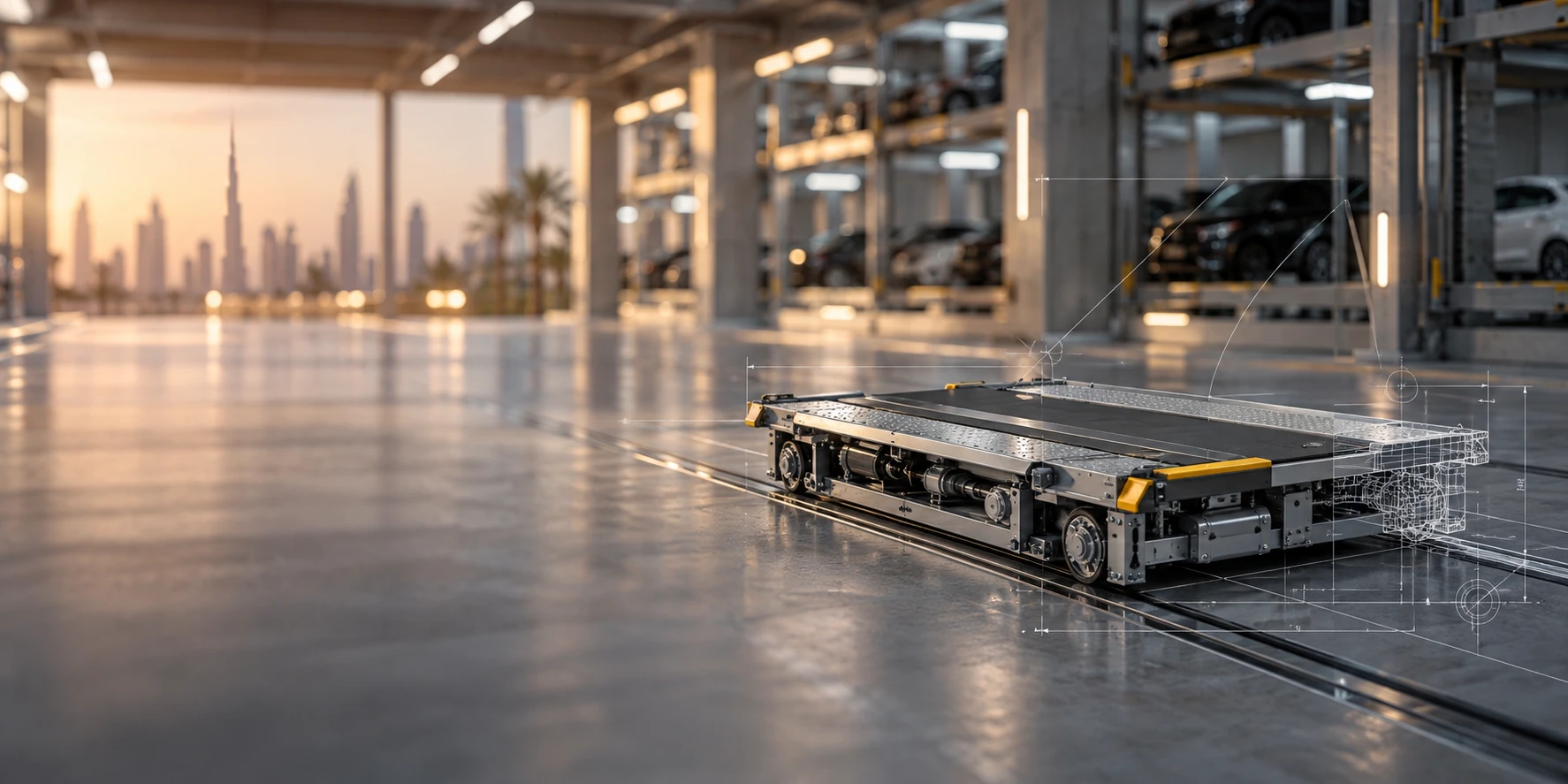
The UAE is the GCC's most mature deployment hub, particularly Dubai, where high land values and vertical real estate have supported large robotic facilities. The Conrad Dubai automated parking installation provides 1,053 spaces across 12 parking levels, while Emirates Financial Towers has a documented 1,191-space robotic facility. These projects establish commercial proof for high-density automated parking at scale.
Market Value
USD 110 million
2025
Dominant Region
UAE
Dominant Segment
Robotic AGV-Based
fastest growing
Total Number of Players
45
Future Outlook
The GCC Automated Parking Systems Market is expected to accelerate from its 2025 base as urban infill, premium real estate and government mobility programs increase the value of space-saving parking formats. The market is projected to reach USD 251 Mn in 2031 and USD 288 Mn in 2032, compared with USD 110 Mn in 2025. Historical CAGR during 2020-2025 was 11.79%, while the forecast CAGR rises to 14.74% for 2025-2032. The acceleration reflects a larger share of fully automated systems, higher controls and software content, and increasing lifecycle-service attachment to new projects.
New automated parking capacity commissioned annually is modeled to increase from approximately 4.80 thousand spaces in 2025 to 9.96 thousand spaces by 2032. At the same time, modeled supplier revenue per newly commissioned space rises as robotic handling, sensor integration and software become more prominent. Fully automated formats are expected to account for roughly 74% of new-revenue activity by 2032. UAE remains the principal commercial hub, while Saudi Arabia provides the largest incremental pipeline opportunity as Riyadh and other major cities expand parking regulation, high-density developments and smart-mobility infrastructure.
14.74%
Forecast CAGR
$288 Mn
2030 Projection
Base Year
2025
Historical Period
2020-2025
Forecast Period
2025-2032
Historical CAGR
11.79%
CHAPTER 2 - SCOPE OF REPORT
Scope of the Market
CHAPTER 3 - Key Stakeholders
Key Target Audience
Key stakeholders who can leverage from this market analysis for investment, strategy, and operational planning.
Investors
CAGR, backlog quality, capex intensity, service margins, risk
Corporates
parking yield, lifecycle cost, throughput, reliability, integration economics
Government
urban mobility, land efficiency, PPP economics, compliance, localization
Operators
uptime, retrieval speed, maintenance, occupancy, digital integration, safety
Financial institutions
project finance, backlog visibility, covenants, utilization, cash conversion
CHAPTER 4 - Market Size & Growth
Market Size, Growth Forecast and Trends
This section evaluates the historical market size, analyzes year-over-year growth dynamics, and presents forecast projections supported by market performance indicators and demand-side drivers.
Historical & Projected Market Size ($ Million)
Year-over-Year Growth Rate (%)
Market Value vs Volume Growth (%)
Historical Market Performance (2020-2025)
Historical performance strengthened progressively as high-density residential and mixed-use development shifted automated parking from a niche architectural solution toward a repeatable infrastructure category. Annual value growth reached its historical high of 14.0% in 2024, compared with a trough of 9.5% in 2021. The 2025 base-year sizing carries a modeled confidence band of USD 98-122 Mn, with the principal uncertainty driven by project commissioning timing, imported system value, local integration content and the treatment of aftermarket service revenue.
Forecast Market Outlook (2025-2032)
The forecast model indicates 14.74% CAGR through 2032, supported by expanding automated project capacity and a rising technology-content mix. New APS spaces commissioned are projected to increase from 4.80 thousand in 2025 to 9.96 thousand in 2032, while modeled revenue per newly commissioned space rises from USD 22,917 to USD 28,916. Fully automated formats increase from approximately 60% of new-revenue activity in 2025 to 74% by 2032, creating stronger profit pools in software, robotics, commissioning and lifecycle maintenance.
CHAPTER 5 - Market Data
Market Breakdown
The GCC market is moving from mechanically assisted parking toward higher-value robotic configurations as developers prioritize space yield, user experience and integrated mobility systems. For CEOs and investors, the key issue is not only space additions but the increasing revenue captured per commissioned bay through automation, software and service content.
Year | Market Size (USD Mn) | YoY Growth (%) | New APS Spaces Commissioned (000) | Avg Revenue per New APS Space (USD) | Fully Automated Share of New Revenue (%) | Period |
|---|---|---|---|---|---|---|
| 2020 | $63 Mn | +- | 3.20 | 19,688 | Forecast | |
| 2021 | $69 Mn | +9.5% | 3.43 | 20,117 | Forecast | |
| 2022 | $77 Mn | +11.6% | 3.74 | 20,588 | Forecast | |
| 2023 | $86 Mn | +11.7% | 4.07 | 21,130 | Forecast | |
| 2024 | $98 Mn | +14.0% | 4.44 | 22,072 | Forecast | |
| 2025 | $110 Mn | +12.2% | 4.80 | 22,917 | Forecast | |
| 2026 | $126 Mn | +14.5% | 5.28 | 23,864 | Forecast | |
| 2027 | $145 Mn | +15.1% | 5.86 | 24,744 | Forecast | |
| 2028 | $166 Mn | +14.5% | 6.50 | 25,538 | Forecast | |
| 2029 | $190 Mn | +14.5% | 7.23 | 26,279 | Forecast | |
| 2030 | $218 Mn | +14.7% | 8.05 | 27,081 | Forecast | |
| 2031 | $251 Mn | +15.1% | 8.95 | 28,045 | Forecast | |
| 2032 | $288 Mn | +14.7% | 9.96 | 28,916 | Forecast |
New APS Spaces Commissioned
4.80 thousand spaces, 2025, GCC. Capacity growth expands the addressable installation and service base. Kuwait's Al Jahra automated facility demonstrates regional megaproject scalability with a documented 2,314 parking spaces.
Avg Revenue per New APS Space
USD 22,917, 2025, GCC. Higher system complexity increases addressable revenue for controls, robotics and integration. Kuwait's Palace of Justice automated parking procurement carried a USD 40 million contract value, illustrating the capital intensity of large civic deployments.
Fully Automated Share of New Revenue
60%, 2025, GCC. Mix migration favors specialist robotic vendors and service-intensive integrators. Conrad Dubai's automated facility accommodates 1,053 cars across 12 levels using eight entry and exit cabins and 22 transfer cars.
CHAPTER 6 - Segmentation
Market Segmentation Framework
Comprehensive analysis across key dimensions providing insights into market structure, consumer preferences, and distribution patterns.
No of Segments
7
Dominant Segment
System Type
Fastest Growing Segment
Automation Level
System Type
Automation Level
End-Use Sector
Project Type
Ownership Model
Contracting Model
Geography
Key Segmentation Takeaways
Comprehensive analysis across all extracted segmentation dimensions providing insights into market structure, consumer preferences, and distribution patterns.
System Type
System architecture remains the primary determinant of project footprint, throughput, capex and integration complexity. Tower and AGV/robotic systems are particularly important in high-value urban plots because they maximize parking density and reduce internal circulation space. AGV/Robotic Systems increasingly capture premium projects where flexible layouts, high software content and differentiated user experience justify higher lifecycle expenditure.
Automation Level
Automation Level is the fastest-changing competitive dimension as GCC buyers move from mechanically assisted stacking toward fully automated retrieval. Robotic AGV-Based systems are positioned for the strongest expansion because they support configurable layouts, redundancy and software-led fleet coordination. Vendors able to combine robotics with local engineering, commissioning and maintenance are better positioned to capture recurring service revenue and high-specification projects.
CHAPTER 7 - Regional Analysis
Regional Analysis
The GCC market is led by the UAE, supported by an established base of high-capacity automated garages, premium real estate and mature parking digitization. Saudi Arabia ranks second but has the strongest large-country expansion potential as parking regulation and urban investment deepen across Riyadh and other cities.
Focus Country Ranking
1st, UAE
Focus Country Market Size
USD 59 Mn (2025)
UAE CAGR (2025-2032)
16.0%
Focus Country Ranking
1st, UAE
Focus Country Market Size
USD 59 Mn (2025)
UAE CAGR (2025-2032)
16.0%
Regional Analysis (Current Year)
Regional Analysis Comparison
| Metric | UAE | Saudi Arabia | Kuwait | Qatar | Oman | Bahrain |
|---|---|---|---|---|---|---|
| Market Size | USD 59 Mn | USD 27 Mn | USD 10 Mn | USD 6 Mn | USD 5 Mn | USD 3 Mn |
| CAGR (%) | 16.0% | 15.0% | 10.0% | 12.0% | 11.0% | 10.5% |
Market Position
UAE ranks first among GCC countries at an estimated USD 59 Mn in 2025, supported by proven large-scale installations including the 1,053-space Conrad Dubai automated facility.
Growth Advantage
UAE's modeled 16.0% CAGR exceeds Saudi Arabia's 15.0% and Kuwait's 10.0%, reflecting a deeper project base and mature parking ecosystem, while Saudi Arabia increasingly narrows the pipeline gap.
Competitive Strengths
UAE combines high urban concentration, established robotic-garage references and approximately 229,000 paid parking spaces at year-end 2025, providing a strong ecosystem for integrated automated-parking deployment.
CHAPTER 8 - INDUSTRY ANALYSIS
Growth Drivers, Challenges & Opportunities
Comprehensive analysis of key factors shaping the GCC Automated Parking Systems Market, including growth catalysts, operational challenges, and emerging opportunities across production, distribution, and consumer segments.
Growth Drivers
High Vehicle Density and Urban Land Scarcity
- Saudi Arabia's roadworthy vehicle fleet increased by 6.9% (2024, Saudi Arabia), increasing parking demand faster than many constrained central-city plots can expand horizontally and improving the economic case for vertical automated systems.
- More than 1 million newly registered vehicles (2024, Saudi Arabia) added incremental demand for residential, office and public parking, strengthening opportunities for developers and system integrators in high-density urban corridors.
- GCC urbanization is exceptionally concentrated, including 99% urban population (2024, Qatar), which channels vehicle demand into dense metropolitan areas where land-saving automated garages have stronger unit economics.
Government-Led Smart Mobility and Parking Programs
- Riyadh's first phase includes more than 24,000 paid spaces (2024, Riyadh), creating a structured parking ecosystem where data integration, enforcement and automated infrastructure can become part of wider mobility procurement.
- The program also covers more than 140,000 free residential spaces (2024, Riyadh), demonstrating the scale at which curbside and off-street parking policy is being coordinated and influencing future developer parking requirements.
- A 10-year PPP term (2024, Riyadh) supports long-duration operating and technology contracts, expanding the addressable profit pool beyond equipment sales into software, monitoring, maintenance and performance-linked service.
High-Density Real Estate and Megaproject Procurement
- The Conrad Dubai facility spans 12 parking levels (Dubai), demonstrating how automated systems replace circulation-intensive ramps with high-density storage, increasing usable development area on premium urban plots.
- Emirates Financial Towers incorporates 1,191 automated spaces (Dubai), providing a large commercial reference that reduces technology adoption risk for new office, residential and mixed-use developers.
- Kuwait's Al Jahra facility reached 2,314 automated spaces (Kuwait), proving that government-backed projects can support very large robotic systems and creating reference value for future civic procurement.
Market Challenges
High Upfront Capital and Long Procurement Cycles
- The Palace of Justice award originated in 2019 (Kuwait), while phased execution extended into subsequent years, showing how design coordination, civil works and commissioning can create lengthy cash-conversion cycles for suppliers.
- The project's first phase was completed in 2022 (Kuwait), highlighting schedule exposure between contract award and revenue recognition that requires working-capital capacity from OEMs and integrators.
- The second phase was scheduled to begin in 2025 (Kuwait), reinforcing that large public installations can span multiple budget cycles and making milestone-based contracting and local project management critical to margin control.
Reliability, Throughput and Lifecycle Service Requirements
- The Conrad system includes 8 entry and exit cabins (Dubai); simultaneous peak-demand management therefore depends on control logic, redundancy and disciplined preventive maintenance rather than storage capacity alone.
- Its 1,053-space capacity (Dubai) concentrates a large share of building parking operations into one automated system, increasing the commercial value of uptime guarantees, spare-parts inventory and rapid-response service.
- Large-scale Kuwait references exceed 2,300 spaces (Kuwait), making lifecycle engineering a material operating requirement and favoring suppliers with local technical teams rather than equipment-only distribution models.
Imported Technology Dependence and Fragmented Approval Standards
- Regional integrators must adapt imported architectures to local building and service requirements; Gitech recorded four automated system sales in 2018 (UAE), illustrating the role of local installation specialists in market access.
- iPark Global reports a 15-year operating history (GCC) and manufacturing capability in Oman, showing why localization of engineering and fabrication can reduce lead-time and imported-service dependence.
- KTC Saudi was established in 2019 (Saudi Arabia), illustrating the emergence of domestic integration capability as localization and project-specific engineering become more important in Saudi procurement.
Market Opportunities
Retrofit and Infill Automation for Mature Urban Assets
- Retrofit applications monetize existing basements and surface parking without full property redevelopment; the 8-space Dubai reference demonstrates that the opportunity extends below megaproject scale into smaller premium assets.
- Prime Technologies cites a 900-space automated project (Burj Daman, Dubai), indicating substantial demand potential inside developed business districts where existing plot constraints increase the value of compact parking.
- Capturing retrofit demand requires suppliers to minimize structural modifications and downtime; projects ranging from 8 to 900 spaces (Dubai references) support differentiated solutions for boutique and large institutional assets.
EV-Ready and Autonomous-Compatible Automated Garages
- Dubai initiated additional autonomous-vehicle pilot activity in 2025 (Dubai), increasing strategic value for parking systems capable of digital vehicle identification, automated handover and software-defined access.
- Commercial fully driverless services were targeted for 2026 (Dubai), creating a technology window for automated garages to integrate charging, reservation, robotic handling and fleet-oriented retrieval processes.
- Parking payment technology was deployed across 150+ locations in early 2026 (UAE), demonstrating rapid digitalization of parking interfaces and supporting future integration between automated garages and mobility-payment platforms.
Local Manufacturing, Integration and Long-Term O&M
- Local fabrication can shorten logistics cycles and capture more project value; iPark's documented manufacturing presence in 1 GCC country, Oman, creates a platform for serving all six GCC markets.
- Local service networks create recurring revenue after installation; Gitech has operated since 2009 (UAE) across lift and automated parking activities, illustrating the strategic importance of installed-base maintenance capability.
- Saudi localization is emerging through companies such as KTC Saudi, established in 2019 (Saudi Arabia), allowing international OEMs to pursue project execution through domestic engineering, integration and after-sales partnerships.
CHAPTER 9 - Competitive Landscape
Competitive Landscape Overview
Competition combines established global automated-parking OEMs with GCC-based integrators and service specialists. Entry barriers center on engineering references, reliability, local approvals, project execution capability and long-duration aftermarket support.
Market Share Distribution
Top 5 Players
Market Dynamics
8 new entrants in the past 5 years, indicating strong market attractiveness and growth potential.
Company Name | Market Share | Headquarters | Founding Year | Core Market Focus |
|---|---|---|---|---|
Robotic Parking Systems, Inc. | - | Clearwater, Florida, USA | 1994 | High-capacity robotic garages for public, commercial and mixed-use projects |
WÖHR Autoparksysteme GmbH | - | Friolzheim, Germany | 1902 | Mechanical and fully automated multiparking systems |
KLAUS Multiparking GmbH | - | Aitrach, Germany | 1907 | Mechanical, semi-automated and automated parking systems |
Sotefin SA | - | Stabio, Switzerland | 1956 | Fully automated robotic parking and vehicle storage solutions |
Lödige Industries GmbH | - | Warburg, Germany | 1948 | Automated car parks, vehicle lifts and material-handling technology |
Westfalia Technologies, Inc. | - | York, Pennsylvania, USA | 1992 | AS/RS-based robotic parking and automated storage systems |
iPark Global | - | Muscat, Oman / Dubai, UAE | - | GCC parking-system design, manufacturing, installation and service |
Gitech Lifts & Escalators LLC | - | Abu Dhabi, UAE | 2009 | Automated parking import, installation, integration and maintenance |
KTC Saudi | - | Riyadh, Saudi Arabia | 2019 | Robotic parking, parking management and ITS integration |
Prime Technologies LLC | - | Dubai, UAE | - | Automated parking distribution, integration and installation |
Cross Comparison Parameters
The report provides detailed cross-comparison of key players across 10 performance parameters to identify competitive strengths and weaknesses.
Project Throughput Capacity
Installed Parking Capacity
GCC Sector Revenue Growth
Lifecycle Service Margin
Analysis Covered
Market Share Analysis:
Benchmarks supplier positioning across addressable GCC automated parking revenue pools
Cross Comparison Matrix:
Compares operating scale, technology depth, project references and economics
SWOT Analysis:
Evaluates competitive strengths, vulnerabilities, expansion options and execution risks
Pricing Strategy Analysis:
Assesses system configuration, project pricing and lifecycle monetization approaches
Company Profiles:
Profiles corporate background, GCC footprint, technology and project capabilities
CHAPTER 10 - REPORT TOC
Table of Contents
Market Assessment Phase
Supply-side and competitive intelligence covering market sizing, segmentation, competitive dynamics, regulatory landscape, and future forecasts.
Go-To-Market Strategy Phase
15 chapters
Entry strategy evaluation, execution roadmap, partner recommendations, and profitability outlook.
Survey Phase
8 chapters
Demand-side primary research conducted through structured interviews and online surveys with end users across priority metros and Tier 2/3 cities to capture consumption behavior, unmet needs, and purchase drivers.
Complete Report Coverage
201+ detailed sections covering every aspect of the market
143
Assessment Sections
58
Strategy Sections
CHAPTER 11 - Our Approach
Research Methodology
Desk Research
- Mapped GCC automated parking project pipeline
- Reviewed municipal parking modernization programs
- Benchmarked robotic parking system capacities
- Tracked OEM and integrator footprints
Primary Research
- Interviewed regional parking sales directors
- Engaged automated parking systems engineers
- Consulted real estate development directors
- Interviewed municipal mobility program managers
Validation and Triangulation
- Validated assumptions across 280 respondents
- Reconciled OEM and developer estimates
- Cross-checked project capacity and pricing
- Tested deployment schedules against pipelines
CHAPTER 12 - FAQ
FAQs
Still have questions?
Our research team is here to help you find the right solution
CHAPTER 13 - Related Research
Explore Related Reports
Expand your market intelligence with complementary research across regions and adjacent markets.
Regional/Country ReportsRelated market analysis across key regions
Related market analysis across key regions
- Indonesia Automated Parking Systems Market
- Vietnam Automated Parking Systems Market
- Thailand Automated Parking Systems Market
- Malaysia Automated Parking Systems Market
- Philippines Automated Parking Systems Market
Adjacent ReportsRelated markets and complementary research
Related markets and complementary research
- Egypt Automated Vehicle Management Systems Market
- Saudi Arabia Smart City Infrastructure Market
- Brazil Robotic Delivery Systems Market
- Bahrain Mobility-as-a-Service Solutions Market
- South Africa Parking Management Software Market
500+
Market Research Reports
50+
Countries Covered
15+
Industry Verticals