














Region:Middle East
Author(s):Rebecca
Product Code:KRAD4976
Pages:94
Published On:December 2025
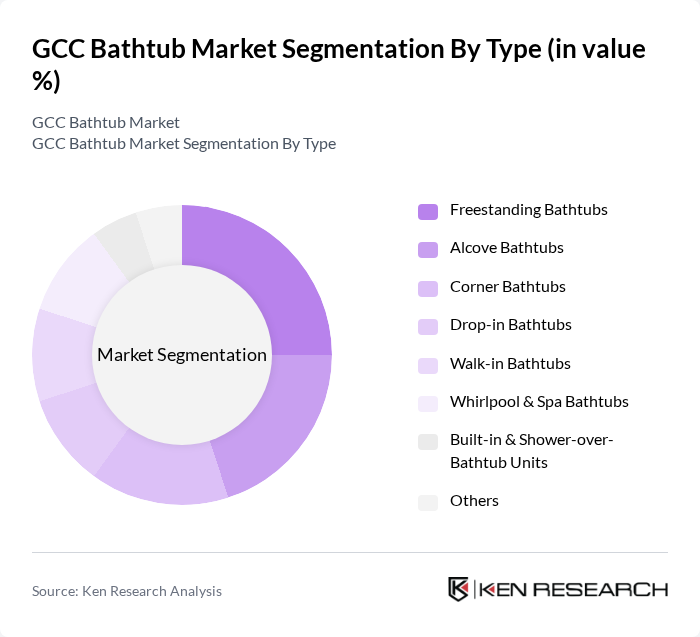
By Type:The bathtub market can be segmented into various types, including Freestanding Bathtubs, Alcove Bathtubs, Corner Bathtubs, Drop-in Bathtubs, Walk-in Bathtubs, Whirlpool & Spa Bathtubs, Built-in & Shower-over-Bathtub Units, and Others. Each type caters to different consumer preferences and installation requirements, influencing market dynamics. Freestanding and whirlpool/spa bathtubs are particularly popular in premium residential and hospitality projects, driven by the global trend towards spa-like bathrooms and higher spending on bathroom aesthetics.
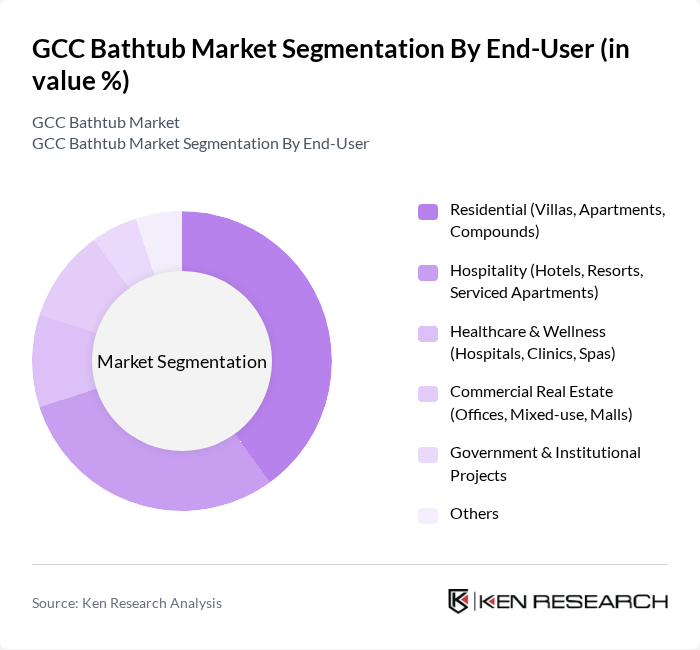
By End-User:The market is segmented based on end-users, including Residential (Villas, Apartments, Compounds), Hospitality (Hotels, Resorts, Serviced Apartments), Healthcare & Wellness (Hospitals, Clinics, Spas), Commercial Real Estate (Offices, Mixed-use, Malls), Government & Institutional Projects, and Others. Each segment reflects distinct consumer needs and purchasing behaviors. Residential and hospitality applications constitute the dominant share of bathtub installations worldwide, driven by renovation cycles, luxury housing demand, and hotel room pipelines, trends that are also evident in GCC markets.
The GCC Bathtub Market is characterized by a dynamic mix of regional and international players. Leading participants such as Roca Sanitario, S.A., TOTO Ltd., LIXIL Group Corporation (INAX, GROHE, American Standard), Duravit AG, Villeroy & Boch AG, Geberit AG, Ideal Standard International NV, Jaquar Group, Kohler Co., Rak Ceramics PJSC, Grohe Middle East (LIXIL Group), Hansgrohe SE, Sanitec / Sphinx (part of Geberit Group), local GCC players and distributors (e.g., Sanipex Group, Al-Majid Jawad Trading, Al-Futtaim Engineering & Technologies), Other Regional Importers & Private Labels Active in GCC Bathtub Segment contribute to innovation, geographic expansion, and service delivery in this space.
The GCC bathtub market is poised for significant transformation, driven by evolving consumer preferences and technological advancements. As the trend towards sustainable living gains momentum, manufacturers are likely to focus on eco-friendly materials and water-efficient designs. Additionally, the integration of smart technology in bathtubs, such as temperature control and hydrotherapy features, is expected to enhance user experience. The expansion of e-commerce platforms will also facilitate greater accessibility to a wider range of products, further stimulating market growth.
| Segment | Sub-Segments |
|---|---|
| By Type | Freestanding Bathtubs Alcove Bathtubs Corner Bathtubs Drop-in Bathtubs Walk-in Bathtubs Whirlpool & Spa Bathtubs Built-in & Shower-over-Bathtub Units Others |
| By End-User | Residential (Villas, Apartments, Compounds) Hospitality (Hotels, Resorts, Serviced Apartments) Healthcare & Wellness (Hospitals, Clinics, Spas) Commercial Real Estate (Offices, Mixed-use, Malls) Government & Institutional Projects Others |
| By Material | Acrylic Cast Iron Fiberglass / FRP Solid Surface / Artificial Stone Steel & Enamelled Steel Natural Stone & Marble Others |
| By Installation Style | Built-in / Recessed Freestanding Drop-in & Under-mount Corner Walk-in & Accessibility-focused Others |
| By Size | Compact (? 1500 mm) Standard (1501–1700 mm) Large (1701–1900 mm) Extra-Large & Custom Sizes (? 1901 mm) Others |
| By Price Range | Economy Mid-range Premium Luxury Project / Contract-Specific Pricing |
| By Distribution Channel | Specialized Sanitaryware & Bathroom Showrooms Building Material & DIY Hypermarkets Project Sales via Developers & Contractors Online Retail & Marketplaces Direct Sales from Manufacturers / Importers Others |
| Scope Item/Segment | Sample Size | Target Respondent Profiles |
|---|---|---|
| Residential Bathtub Purchases | 150 | Homeowners, Interior Designers |
| Commercial Bathtub Installations | 120 | Contractors, Project Managers |
| Retail Market Insights | 80 | Store Managers, Sales Representatives |
| Consumer Preferences and Trends | 140 | End-users, Market Researchers |
| Hospitality Sector Bathtub Usage | 70 | Hotel Managers, Facility Managers |
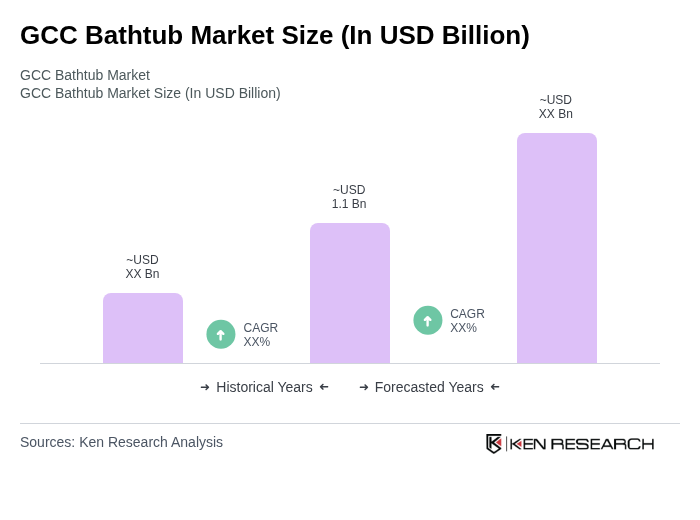
The GCC Bathtub Market is valued at approximately USD 1.1 billion, reflecting its share within the global bathtub market, which is estimated to be between USD 9.9 billion and USD 10.7 billion. This valuation is based on a five-year historical analysis.

What makes us stand out is that our consultants follow Robust, Refine and Result (RRR) methodology. Robust for clear definitions, approaches and sanity checking, Refine for differentiating respondents' facts and opinions, and Result for presenting data with story.

We have set a benchmark in the industry by offering our clients with syndicated and customized market research reports featuring coverage of entire market as well as meticulous research and analyst insights.

While we don't replace traditional research, we flip the method upside down. Our dual approach of Top Bottom & Bottom Top ensures quality deliverable by not just verifying company fundamentals but also looking at the sector and macroeconomic factors.

With one step in the future, our research team constantly tries to show you the bigger picture. We help with some of the tough questions you may encounter along the way: How is the industry positioned? Best marketing channel? KPI's of competitors? By aligning every element, we help maximize success.

Our report gives you instant access to the answers and sources that other companies might choose to hide. We elaborate each steps of research methodology we have used and showcase you the sample size to earn your trust.

If you need any support, we are here! We pride ourselves on universe strength, data quality, and quick, friendly, and professional service.