GCC emulsifiers personal care market report Size, Share, Growth Drivers, Trends, Opportunities & Forecast 2025–2030

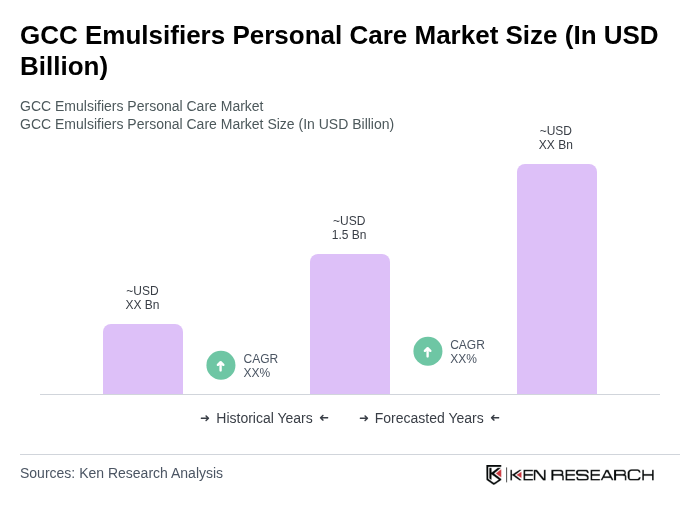
GCC Emulsifiers Personal Care Market, valued at USD 1.5 Bn, grows due to rising demand for sustainable, natural formulations in skincare and haircare products across Saudi Arabia and UAE.

Region:Middle East

Author(s):Geetanshi

Product Code:KRAC8238

Pages:89

Published On:November 2025
About the Report

Base Year 2024

GCC Emulsifiers Personal Care Market Overview

  • The GCC Emulsifiers Personal Care Market is valued at USD 1.5 billion, based on a five-year historical analysis. This growth is primarily driven by the increasing demand for personal care products, particularly in skincare and haircare, as consumers become more aware of the benefits of emulsifiers in enhancing product texture and stability. The market is further supported by rising consumer preference for clean-label and sustainable formulations, with a significant shift toward naturally derived emulsifiers, particularly polyglyceryl-based and amino acid-based variants.
  • Key players in this market include Saudi Arabia and the United Arab Emirates, which dominate due to their robust manufacturing capabilities and high consumer spending on personal care products. The presence of major international brands and a growing trend towards natural and organic products further bolster their market position. The increased awareness of skin compatibility and sensitivity is prompting formulators to replace harsh synthetic emulsifiers with mild, green alternatives, with green emulsifiers projected to represent approximately 72% of the emulsifiers in the personal care market, underscoring the industry's transformation toward eco-efficient and naturally-derived ingredients.
  • The GCC regulatory framework for personal care products includes mandatory safety and efficacy standards for emulsifiers. The Personal Care Products Regulation, issued by the GCC Standardization Organization, establishes comprehensive compliance requirements including mandatory testing and certification processes for new emulsifiers, quality assurance standards, and labeling requirements, aimed at protecting consumer health and promoting sustainable practices within the industry.
GCC Emulsifiers Personal Care Market Size

GCC Emulsifiers Personal Care Market Segmentation

By Chemistry Type:The chemistry type segmentation includes various emulsifiers that are crucial for formulating personal care products. The subsegments are Polyglyceryl Esters, Oil-in-Water (O/W) Emulsifiers, Water-in-Oil (W/O) Emulsifiers, Bio-based Emulsifiers (Lecithin, Glyceryl Stearate, Sucrose Esters), and Synthetic Emulsifiers. Among these, Oil-in-Water (O/W) Emulsifiers are leading the market due to their widespread use in skincare products, which require a lighter texture and better absorption. The trend towards lightweight formulations and the increasing preference for water-based products are driving the demand for O/W emulsifiers.
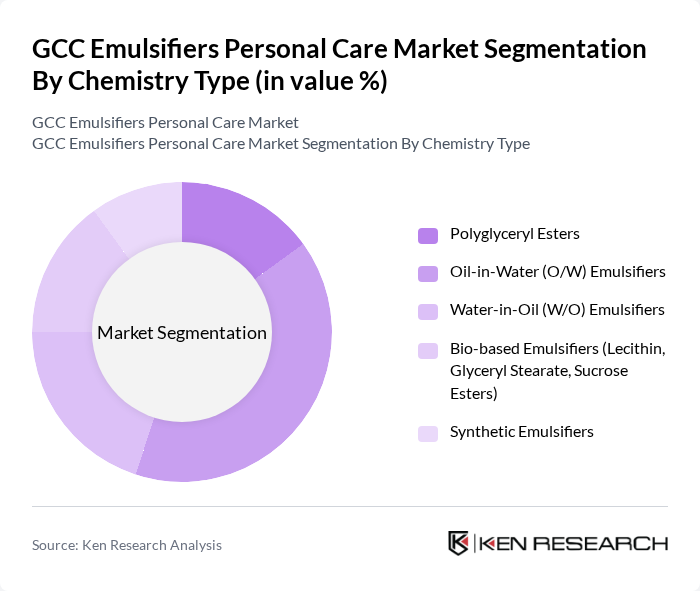
GCC Emulsifiers Personal Care Market segmentation by Chemistry Type.

By Application:The application segmentation encompasses various personal care products, including Skincare Creams & Lotions, Hair Conditioners, Sun Care Products, Color Cosmetics, Serums & Gels, and Others. Skincare Creams & Lotions dominate this segment, driven by the rising consumer focus on skincare routines and the demand for effective moisturizing products. The increasing awareness of skin health and the growing trend of personalized skincare solutions are further propelling the growth of this application segment.
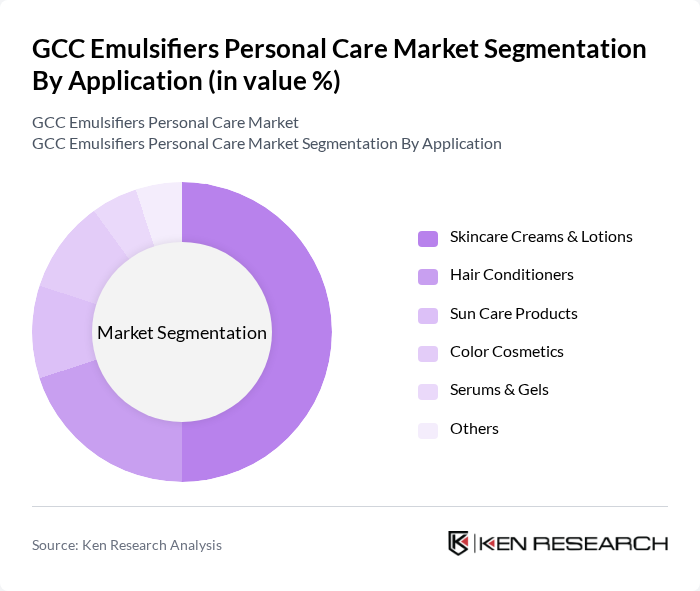
GCC Emulsifiers Personal Care Market segmentation by Application.

GCC Emulsifiers Personal Care Market Competitive Landscape

The GCC Emulsifiers Personal Care Market is characterized by a dynamic mix of regional and international players. Leading participants such as BASF SE, Croda International Plc, Evonik Industries AG, Dow Inc., Ashland Inc., Solvay S.A., Clariant AG, Innospec Inc., Stepan Company, Lubrizol Corporation, Galaxy Surfactants Ltd., Kao Corporation, Lonza Group AG, Nouryon (Akzo Nobel), Cargill Incorporated contribute to innovation, geographic expansion, and service delivery in this space.

BASF SE

1865

Ludwigshafen, Germany

Croda International Plc

1925

Goole, United Kingdom

Evonik Industries AG

2007

Essen, Germany

Dow Inc.

1897

Midland, Michigan, USA

Ashland Inc.

1924

Covington, Kentucky, USA

Company

Establishment Year

Headquarters

Company Size Classification (Large, Medium, Small)

Revenue Growth Rate (YoY %)

Market Share in GCC Region (%)

Product Portfolio Breadth (Bio-based vs. Synthetic)

R&D Investment & Innovation Pipeline

Distribution Network Reach (Countries/Channels)

GCC Emulsifiers Personal Care Market Industry Analysis

Growth Drivers

  • Increasing Demand for Natural Ingredients:The GCC region has witnessed a significant shift towards natural ingredients in personal care products, with a reported 30% increase in consumer preference for such products from 2020 to 2023. This trend is driven by heightened awareness of the benefits of natural formulations, which are perceived as safer and more effective. The market for natural personal care products in the GCC is projected to reach $1.8 billion in future, reflecting a robust demand for emulsifiers derived from natural sources.
  • Rising Consumer Awareness of Skin Care:The personal care sector in the GCC is experiencing a surge in consumer awareness regarding skin health, with 70% of consumers actively seeking products that cater to specific skin concerns. This growing knowledge is leading to increased sales of specialized emulsifiers that enhance product efficacy. The skin care market in the GCC is expected to grow to $3.5 billion in future, indicating a strong correlation between consumer education and product demand.
  • Growth of E-commerce Platforms:E-commerce has become a vital channel for personal care products in the GCC, with online sales projected to account for 30% of total sales in future. The convenience of online shopping and the rise of digital marketing strategies have significantly boosted the visibility of emulsifiers in personal care. In the previous year, e-commerce sales in the personal care sector reached $1 billion, highlighting the importance of this channel in driving market growth and consumer engagement.

Market Challenges

  • Regulatory Compliance Issues:The GCC personal care market faces stringent regulatory compliance challenges, particularly concerning ingredient safety and labeling. In the previous year, over 45% of brands reported difficulties in meeting the evolving regulations set by local authorities. This has resulted in increased operational costs, with compliance expenditures averaging $250,000 per brand annually. Such challenges can hinder market entry for new players and slow down innovation in product development.
  • High Competition Among Brands:The GCC emulsifiers personal care market is characterized by intense competition, with over 160 brands vying for market share. This saturation has led to aggressive pricing strategies, with some brands reducing prices by up to 20% to attract consumers. The competitive landscape is further complicated by the rapid introduction of new products, making it challenging for brands to differentiate themselves and maintain profitability in a crowded market.

GCC Emulsifiers Personal Care Market Future Outlook

The GCC emulsifiers personal care market is poised for significant transformation, driven by evolving consumer preferences and technological advancements. As sustainability becomes a core value, brands are increasingly focusing on eco-friendly formulations and packaging solutions. Additionally, the rise of digital platforms will facilitate greater consumer engagement and personalized marketing strategies. By 2024, the market is expected to embrace innovative product formulations that cater to diverse consumer needs, enhancing overall market dynamism and growth potential.

Market Opportunities

  • Development of Eco-friendly Products:There is a growing opportunity for brands to develop eco-friendly emulsifiers that align with consumer demand for sustainable products. The GCC market is witnessing a 25% increase in sales of eco-friendly personal care items, indicating a strong market potential for environmentally conscious formulations that appeal to eco-aware consumers.
  • Expansion into Emerging Markets:The GCC personal care market has significant potential for expansion into emerging markets within the region. With a projected 20% annual growth rate in neighboring markets, brands can leverage this opportunity to introduce their emulsifiers and capitalize on the increasing demand for personal care products in these developing areas.

Scope of the Report

SegmentSub-Segments
By Chemistry Type

Polyglyceryl Esters

Oil-in-Water (O/W) Emulsifiers

Water-in-Oil (W/O) Emulsifiers

Bio-based Emulsifiers (Lecithin, Glyceryl Stearate, Sucrose Esters)

Synthetic Emulsifiers

By Application

Skincare Creams & Lotions

Hair Conditioners

Sun Care Products

Color Cosmetics

Serums & Gels

Others

By Distribution Channel

Online Retail & E-commerce

Supermarkets/Hypermarkets

Specialty Beauty Stores

Pharmacies & Drugstores

Department Stores

Direct Sales

By GCC Country

Saudi Arabia

United Arab Emirates (UAE)

Qatar

Kuwait

Bahrain

Oman

By Physical Form

Liquid Emulsifiers

Powder Emulsifiers

Pellet Emulsifiers

By Delivery System

Free Form

Pre-blended

Encapsulated

By Price Segment

Premium

Mid-range

Economy

Key Target Audience

Investors and Venture Capitalist Firms

Government and Regulatory Bodies (e.g., Gulf Cooperation Council, Saudi Food and Drug Authority)

Manufacturers and Producers

Distributors and Retailers

Raw Material Suppliers

Brand Owners and Private Label Companies

Industry Associations (e.g., Personal Care Products Council)

Financial Institutions

Players Mentioned in the Report:

BASF SE

Croda International Plc

Evonik Industries AG

Dow Inc.

Ashland Inc.

Solvay S.A.

Clariant AG

Innospec Inc.

Stepan Company

Lubrizol Corporation

Galaxy Surfactants Ltd.

Kao Corporation

Lonza Group AG

Nouryon (Akzo Nobel)

Cargill Incorporated

Table of Contents

Market Assessment Phase

1. Executive Summary and Approach


2. GCC Emulsifiers Personal Care Market Overview

2.1 Key Insights and Strategic Recommendations

2.2 GCC Emulsifiers Personal Care Market Overview

2.3 Definition and Scope

2.4 Evolution of Market Ecosystem

2.5 Timeline of Key Regulatory Milestones

2.6 Value Chain & Stakeholder Mapping

2.7 Business Cycle Analysis

2.8 Policy & Incentive Landscape


3. GCC Emulsifiers Personal Care Market Analysis

3.1 Growth Drivers

3.1.1 Increasing Demand for Natural Ingredients
3.1.2 Rising Consumer Awareness of Skin Care
3.1.3 Growth of E-commerce Platforms
3.1.4 Expansion of Personal Care Product Lines

3.2 Market Challenges

3.2.1 Regulatory Compliance Issues
3.2.2 High Competition Among Brands
3.2.3 Fluctuating Raw Material Prices
3.2.4 Consumer Sensitivity to Pricing

3.3 Market Opportunities

3.3.1 Development of Eco-friendly Products
3.3.2 Expansion into Emerging Markets
3.3.3 Collaborations with Influencers
3.3.4 Innovations in Product Formulations

3.4 Market Trends

3.4.1 Shift Towards Sustainable Packaging
3.4.2 Increasing Popularity of DIY Personal Care Products
3.4.3 Growth in Male Grooming Products
3.4.4 Rise of Clean Beauty Movement

3.5 Government Regulation

3.5.1 Stricter Safety Standards for Ingredients
3.5.2 Labeling Requirements for Natural Products
3.5.3 Import Regulations on Cosmetic Ingredients
3.5.4 Environmental Regulations on Packaging

4. SWOT Analysis


5. Stakeholder Analysis


6. Porter's Five Forces Analysis


7. GCC Emulsifiers Personal Care Market Size, 2019-2024

7.1 By Value

7.2 By Volume

7.3 By Average Selling Price


8. GCC Emulsifiers Personal Care Market Segmentation

8.1 By Chemistry Type

8.1.1 Polyglyceryl Esters
8.1.2 Oil-in-Water (O/W) Emulsifiers
8.1.3 Water-in-Oil (W/O) Emulsifiers
8.1.4 Bio-based Emulsifiers (Lecithin, Glyceryl Stearate, Sucrose Esters)
8.1.5 Synthetic Emulsifiers

8.2 By Application

8.2.1 Skincare Creams & Lotions
8.2.2 Hair Conditioners
8.2.3 Sun Care Products
8.2.4 Color Cosmetics
8.2.5 Serums & Gels
8.2.6 Others

8.3 By Distribution Channel

8.3.1 Online Retail & E-commerce
8.3.2 Supermarkets/Hypermarkets
8.3.3 Specialty Beauty Stores
8.3.4 Pharmacies & Drugstores
8.3.5 Department Stores
8.3.6 Direct Sales

8.4 By GCC Country

8.4.1 Saudi Arabia
8.4.2 United Arab Emirates (UAE)
8.4.3 Qatar
8.4.4 Kuwait
8.4.5 Bahrain
8.4.6 Oman

8.5 By Physical Form

8.5.1 Liquid Emulsifiers
8.5.2 Powder Emulsifiers
8.5.3 Pellet Emulsifiers

8.6 By Delivery System

8.6.1 Free Form
8.6.2 Pre-blended
8.6.3 Encapsulated

8.7 By Price Segment

8.7.1 Premium
8.7.2 Mid-range
8.7.3 Economy

9. GCC Emulsifiers Personal Care Market Competitive Analysis

9.1 Market Share of Key Players

9.2 Cross Comparison of Key Players

9.2.1 Company Name
9.2.2 Company Size Classification (Large, Medium, Small)
9.2.3 Revenue Growth Rate (YoY %)
9.2.4 Market Share in GCC Region (%)
9.2.5 Product Portfolio Breadth (Bio-based vs. Synthetic)
9.2.6 R&D Investment & Innovation Pipeline
9.2.7 Distribution Network Reach (Countries/Channels)
9.2.8 Pricing Strategy (Premium/Mid-tier/Value)
9.2.9 Brand Recognition & Market Positioning
9.2.10 Regulatory Certifications (ISO, Halal, Organic)

9.3 SWOT Analysis of Top Players

9.4 Pricing Analysis

9.5 Detailed Profile of Major Companies

9.5.1 BASF SE
9.5.2 Croda International Plc
9.5.3 Evonik Industries AG
9.5.4 Dow Inc.
9.5.5 Ashland Inc.
9.5.6 Solvay S.A.
9.5.7 Clariant AG
9.5.8 Innospec Inc.
9.5.9 Stepan Company
9.5.10 Lubrizol Corporation
9.5.11 Galaxy Surfactants Ltd.
9.5.12 Kao Corporation
9.5.13 Lonza Group AG
9.5.14 Nouryon (Akzo Nobel)
9.5.15 Cargill Incorporated

10. GCC Emulsifiers Personal Care Market End-User Analysis

10.1 Procurement Behavior of Key Ministries

10.1.1 Government Contracts and Tenders
10.1.2 Budget Allocations for Personal Care Products
10.1.3 Supplier Selection Criteria
10.1.4 Compliance with Local Regulations

10.2 Corporate Spend on Infrastructure & Energy

10.2.1 Investment in Sustainable Practices
10.2.2 Budget for R&D in Personal Care
10.2.3 Expenditure on Marketing and Branding
10.2.4 Partnerships with Local Manufacturers

10.3 Pain Point Analysis by End-User Category

10.3.1 Quality Assurance Issues
10.3.2 Supply Chain Disruptions
10.3.3 Price Sensitivity Among Consumers
10.3.4 Demand for Customization

10.4 User Readiness for Adoption

10.4.1 Awareness of Product Benefits
10.4.2 Availability of Products in Market
10.4.3 Consumer Education Initiatives
10.4.4 Feedback Mechanisms for Improvement

10.5 Post-Deployment ROI and Use Case Expansion

10.5.1 Measurement of Customer Satisfaction
10.5.2 Analysis of Repeat Purchase Rates
10.5.3 Evaluation of Market Penetration
10.5.4 Identification of New Use Cases

11. GCC Emulsifiers Personal Care Market Future Size, 2025-2030

11.1 By Value

11.2 By Volume

11.3 By Average Selling Price


Go-To-Market Strategy Phase

1. Whitespace Analysis + Business Model Canvas

1.1 Market Gaps Identification

1.2 Value Proposition Development

1.3 Revenue Streams Analysis

1.4 Cost Structure Evaluation

1.5 Key Partnerships Exploration

1.6 Customer Segmentation

1.7 Channels of Distribution


2. Marketing and Positioning Recommendations

2.1 Branding Strategies

2.2 Product USPs

2.3 Target Audience Identification

2.4 Communication Strategy

2.5 Digital Marketing Tactics


3. Distribution Plan

3.1 Urban Retail Strategies

3.2 Rural NGO Tie-ups

3.3 E-commerce Integration

3.4 Logistics and Supply Chain Management


4. Channel & Pricing Gaps

4.1 Underserved Routes

4.2 Pricing Bands Analysis

4.3 Competitor Pricing Strategies


5. Unmet Demand & Latent Needs

5.1 Category Gaps Identification

5.2 Consumer Segments Analysis

5.3 Product Development Opportunities


6. Customer Relationship

6.1 Loyalty Programs

6.2 After-sales Service

6.3 Customer Feedback Mechanisms


7. Value Proposition

7.1 Sustainability Initiatives

7.2 Integrated Supply Chains

7.3 Competitive Advantages


8. Key Activities

8.1 Regulatory Compliance

8.2 Branding Efforts

8.3 Distribution Setup


9. Entry Strategy Evaluation

9.1 Domestic Market Entry Strategy

9.1.1 Product Mix Considerations
9.1.2 Pricing Band Strategy
9.1.3 Packaging Innovations

9.2 Export Entry Strategy

9.2.1 Target Countries Analysis
9.2.2 Compliance Roadmap Development

10. Entry Mode Assessment

10.1 Joint Ventures

10.2 Greenfield Investments

10.3 Mergers & Acquisitions

10.4 Distributor Model Evaluation


11. Capital and Timeline Estimation

11.1 Capital Requirements

11.2 Timelines for Implementation


12. Control vs Risk Trade-Off


Research Methodology

ApproachModellingSample

Phase 1: Approach1

Desk Research

  • Industry reports from market research firms focusing on the GCC personal care sector
  • Analysis of trade publications and journals related to emulsifiers and personal care products
  • Regulatory documents and guidelines from GCC health and safety authorities

Primary Research

  • Interviews with product development managers at leading personal care brands
  • Surveys with formulators and chemists specializing in emulsifier applications
  • Focus groups with consumers to understand preferences and trends in personal care products

Validation & Triangulation

  • Cross-validation of data from multiple sources including trade associations and market reports
  • Triangulation of insights from primary interviews with secondary data findings
  • Sanity checks through expert panels comprising industry veterans and academic researchers

Phase 2: Market Size Estimation1

Top-down Assessment

  • Analysis of overall personal care market size in the GCC and its growth trajectory
  • Segmentation of the market by product type, including creams, lotions, and hair care products
  • Incorporation of demographic trends and consumer spending patterns in the GCC region

Bottom-up Modeling

  • Estimation of emulsifier usage rates based on product formulations across various personal care categories
  • Collection of sales data from key manufacturers and distributors in the GCC market
  • Cost analysis of emulsifiers to determine pricing strategies and market penetration

Forecasting & Scenario Analysis

  • Multi-variable forecasting models considering economic indicators and consumer behavior shifts
  • Scenario planning based on potential regulatory changes and sustainability trends
  • Development of baseline, optimistic, and pessimistic market growth scenarios through 2030

Phase 3: CATI Sample Composition1

Scope Item/SegmentSample SizeTarget Respondent Profiles
Personal Care Product Manufacturers45Product Managers, R&D Directors
Emulsifier Suppliers38Sales Managers, Technical Support Specialists
Retailers of Personal Care Products42Category Managers, Purchasing Agents
Consumer Insights and Market Research Firms35Market Analysts, Consumer Behavior Researchers
Regulatory Bodies and Industry Associations28Compliance Officers, Standards Development Specialists

Frequently Asked Questions

What is the current value of the GCC Emulsifiers Personal Care Market?

The GCC Emulsifiers Personal Care Market is valued at approximately USD 1.5 billion, reflecting a significant growth trend driven by increasing consumer demand for personal care products, particularly in skincare and haircare sectors.

What factors are driving the growth of the GCC Emulsifiers Personal Care Market?

Which countries dominate the GCC Emulsifiers Personal Care Market?

What types of emulsifiers are most commonly used in personal care products?

Other Regional/Country Reports

Indonesia Emulsifiers Personal Care Market

Malaysia Emulsifiers Personal Care Market

KSA Emulsifiers Personal Care Market

APAC Emulsifiers Personal Care Market

SEA Emulsifiers Personal Care Market

Vietnam Emulsifiers Personal Care Market

Other Adjacent Reports

Thailand Personal Care Surfactants Market

Germany Personal Care Preservatives Market

South Korea Personal Care Thickeners Market

Egypt Personal Care Stabilizers Market

South Korea Personal Care Fragrances Market

Kuwait Personal Care Colorants Market

Belgium Personal Care UV Filters Market

South Africa Personal Care Antioxidants Market

Japan Personal Care Humectants Market

UAE Personal Care Active Ingredients Market

Why Buy From Us?

Refine Robust Result (RRR) Framework

What makes us stand out is that our consultants follow Robust, Refine and Result (RRR) methodology. Robust for clear definitions, approaches and sanity checking, Refine for differentiating respondents' facts and opinions, and Result for presenting data with story.

Our Reach Is Unmatched

We have set a benchmark in the industry by offering our clients with syndicated and customized market research reports featuring coverage of entire market as well as meticulous research and analyst insights.

Shifting the Research Paradigm

While we don't replace traditional research, we flip the method upside down. Our dual approach of Top Bottom & Bottom Top ensures quality deliverable by not just verifying company fundamentals but also looking at the sector and macroeconomic factors.

More Insights-Better Decisions

With one step in the future, our research team constantly tries to show you the bigger picture. We help with some of the tough questions you may encounter along the way: How is the industry positioned? Best marketing channel? KPI's of competitors? By aligning every element, we help maximize success.

Transparency and Trust

Our report gives you instant access to the answers and sources that other companies might choose to hide. We elaborate each steps of research methodology we have used and showcase you the sample size to earn your trust.

Round the Clock Support

If you need any support, we are here! We pride ourselves on universe strength, data quality, and quick, friendly, and professional service.

Why Clients Choose Us?

400000+
Reports in repository
150+
Consulting projects a year
100+
Analysts
8000+
Client Queries in 2022








