GCC Energy Based Hair Removal Devices Market Report Size Share Growth Drivers Trends Opportunities & Forecast 2025–2030

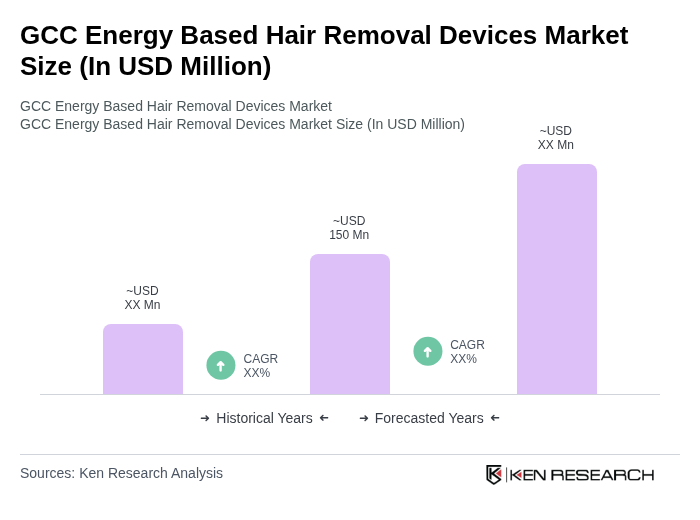
The GCC Energy Based Hair Removal Devices Market, valued at USD 150 million, is growing due to increased awareness of personal grooming and adoption of laser and IPL devices in clinics and homes.

Region:Middle East

Author(s):Dev

Product Code:KRAB1714

Pages:82

Published On:January 2026
About the Report

Base Year 2024

GCC Energy Based Hair Removal Devices Market Overview

  • The GCC Energy Based Hair Removal Devices Market is valued at USD 150 million, based on a five-year historical analysis that reconciles regional aesthetic device revenues with the share attributable to hair removal platforms in the Middle East and Africa. This growth is primarily driven by increasing consumer awareness regarding personal grooming and aesthetic enhancement, rapid penetration of social media and beauty influencers, and strong demand for non-invasive, long-lasting hair reduction solutions across both female and male demographics. The market has seen a notable uptick in the adoption of energy-based laser and IPL devices in dermatology clinics, medical spas, and premium beauty salons, supported by improvements in treatment speed, comfort (advanced cooling), and safety across a wider range of skin phototypes common in GCC populations.
  • Key countries in this market include the United Arab Emirates and Saudi Arabia, which account for a substantial share of GCC demand due to high disposable incomes, strong beauty and wellness culture, medical tourism, and a growing base of chain dermatology clinics and medspas. The UAE has a particularly vibrant aesthetic ecosystem with a dense concentration of laser clinics in Dubai and Abu Dhabi and active expansion by global energy-based device brands through distributors and regional hubs, while Saudi Arabia’s expanding private healthcare sector and modernization of cosmetic dermatology services in Riyadh, Jeddah, and Dammam are driving increased procurement of professional hair removal platforms.
  • In Saudi Arabia, energy-based hair removal devices are regulated as medical devices under the Medical Devices Interim Regulation issued by the Saudi Food and Drug Authority (SFDA) in 2008, together with its Implementing Rules and related guidance on aesthetic laser and IPL systems. These instruments require SFDA marketing authorization, conformity assessment to applicable standards (including documentation of safety and performance), and registration of manufacturers and local authorized representatives before devices can be placed on the market or used in clinical practice, with clinics also subject to facility licensing and inspection to ensure safe operation and trained personnel for laser-based aesthetic procedures.
GCC Energy Based Hair Removal Devices Market Size

GCC Energy Based Hair Removal Devices Market Segmentation

By Device Type:The market is segmented into various device types, including Laser Hair Removal Devices, Intense Pulsed Light (IPL) Devices, Diode / Diode-Hybrid Devices, and Other Energy-Based Devices (e.g., RF, HPL). This structure aligns with global segmentation where diode and multi-wavelength lasers, IPL platforms, and other light/energy modalities are the primary technologies used for long-term hair reduction. Among these, Laser Hair Removal Devices are leading in GCC due to strong penetration in dermatology clinics and medspas, faster procedures with high-power diode and alexandrite systems, and the ability to customize wavelengths for darker skin tones common in the region. IPL Devices are also gaining traction, particularly for personal use and in beauty salons, as they offer a relatively more affordable entry point, multi-application capability (hair removal plus skin rejuvenation), and wide availability through e-commerce and retail channels.
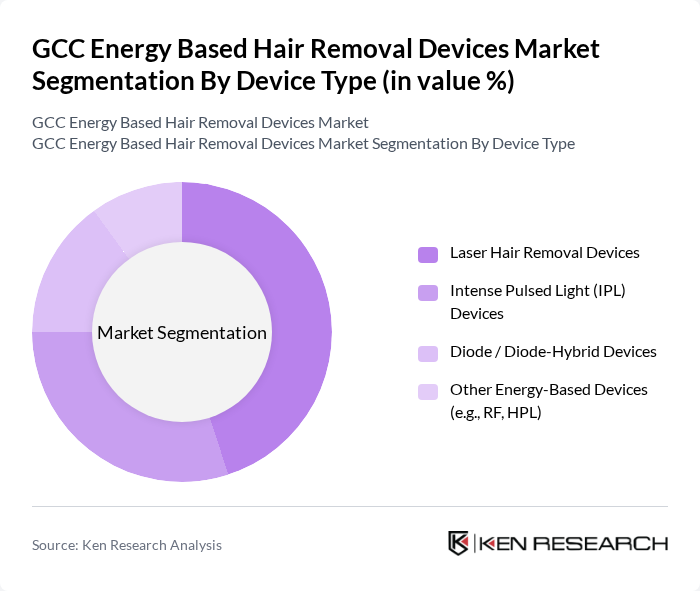
GCC Energy Based Hair Removal Devices Market segmentation by Device Type.

By Usage Setting:The market is categorized into Professional Use (Dermatology Clinics & MedSpas), Beauty Salons, At-home / Personal Use Devices, and Others. This categorization is consistent with global end-use splits, where MedSpas, dermatology clinics, and beauty salons represent the primary professional channels and at-home devices form a fast-growing consumer segment. Professional Use is the dominant segment, driven by the increasing number of specialized clinics in GCC malls and medical centers, consumer preference for physician- or therapist-supervised treatments, and the availability of multi-application workstations that combine hair removal with other aesthetic functions. At-home devices are also gaining popularity due to their convenience, declining price points, and improved safety features (skin-tone sensors, lower fluence presets), appealing to tech-savvy consumers who use them to maintain results between in-clinic sessions.
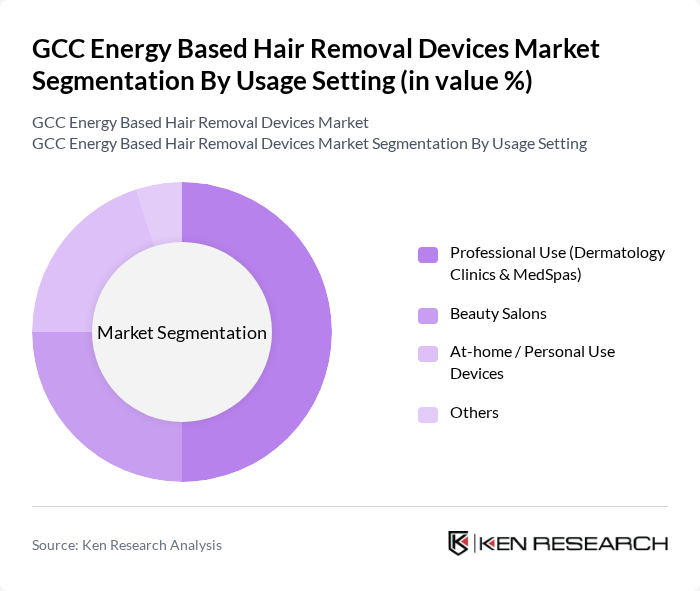
GCC Energy Based Hair Removal Devices Market segmentation by Usage Setting.

GCC Energy Based Hair Removal Devices Market Competitive Landscape

The GCC Energy Based Hair Removal Devices Market is characterized by a dynamic mix of regional and international players. Leading participants such as Candela (Syneron Candela), Cynosure, Alma Lasers (Sisram Medical), Lumenis, Cutera, InMode, Philips, Braun, Tria Beauty, Remington, DEESS, Silk'n (Home Skinovations), Beurer, Panasonic, and other emerging GCC-focused brands contribute to innovation, geographic expansion, and service delivery in this space, mirroring the global competitive set of energy-based hair removal and aesthetic device manufacturers expanding into the Middle East.

Candela (Syneron Candela)

1970

Marlborough, Massachusetts, USA

Cynosure

1991

Westford, Massachusetts, USA

Alma Lasers (Sisram Medical)

1999

Caesarea, Israel

Lumenis

1991

Yokneam, Israel

Cutera

1998

Brisbane, California, USA

Company

Establishment Year

Headquarters

Revenue in GCC (USD Mn)

3-year Revenue CAGR in GCC (%)

Installed Base in GCC (Number of Devices)

Average Selling Price by Key Product Line

Gross Margin (%)

R&D Spend as % of Revenue

GCC Energy Based Hair Removal Devices Market Industry Analysis

Growth Drivers

  • Increasing Demand for Non-Invasive Beauty Treatments:The GCC region has witnessed a significant rise in the demand for non-invasive beauty treatments, with the market for such services projected to reach approximately $1.8 billion in future. This growth is driven by a cultural shift towards aesthetic enhancement without the need for surgical procedures. The increasing disposable income of consumers, which is expected to rise by 4.2% annually, further supports this trend, making energy-based hair removal devices more accessible to a broader audience.
  • Rising Awareness About Personal Grooming:The personal grooming market in the GCC is anticipated to grow to $5.1 billion in future, reflecting a growing awareness among consumers about the importance of personal appearance. This trend is particularly pronounced among younger demographics, with 70% of individuals aged 18-34 actively seeking advanced grooming solutions. The increasing influence of social media and beauty influencers is also contributing to this heightened awareness, driving demand for effective hair removal solutions.
  • Technological Advancements in Hair Removal Devices:The GCC energy-based hair removal devices market is benefiting from rapid technological advancements, with innovations such as laser and IPL technologies enhancing efficacy and safety. The introduction of devices with improved user interfaces and features is expected to increase consumer adoption rates. In future, the market for advanced hair removal technologies is projected to grow by 22%, driven by consumer preference for high-quality, efficient solutions that deliver long-lasting results.

Market Challenges

  • High Initial Investment Costs:One of the significant challenges facing the GCC energy-based hair removal devices market is the high initial investment required for both consumers and service providers. The average cost of advanced hair removal devices can exceed $6,000, which may deter potential buyers. Additionally, beauty salons and clinics face substantial costs in acquiring and maintaining these devices, which can limit their ability to offer competitive pricing and services to consumers.
  • Regulatory Hurdles and Compliance Issues:The regulatory landscape for energy-based hair removal devices in the GCC is complex, with varying standards across different countries. Compliance with safety standards and licensing requirements can be cumbersome for manufacturers and service providers. For instance, obtaining necessary certifications can take up to eight months, delaying market entry and increasing operational costs. This regulatory uncertainty can hinder innovation and slow down market growth.

GCC Energy Based Hair Removal Devices Market Future Outlook

The future of the GCC energy-based hair removal devices market appears promising, driven by ongoing technological advancements and a growing consumer base seeking non-invasive beauty solutions. As the beauty and wellness industry continues to expand, the integration of smart technology into devices is expected to enhance user experience and efficacy. Additionally, the rise of e-commerce platforms will facilitate easier access to these products, further propelling market growth and consumer engagement in the coming years.

Market Opportunities

  • Expansion into Emerging Markets Within the GCC:Emerging markets within the GCC, such as Oman and Bahrain, present significant growth opportunities for energy-based hair removal devices. With increasing disposable incomes and a growing middle class, these regions are expected to see a surge in demand for advanced beauty treatments, potentially increasing market penetration by 18% in future.
  • Development of Innovative and User-Friendly Devices:There is a substantial opportunity for manufacturers to develop innovative, user-friendly hair removal devices that cater to the needs of consumers. By focusing on features such as portability and ease of use, companies can tap into the growing trend of at-home beauty treatments, which is projected to increase by 30% in the next two years, enhancing overall market appeal.

Scope of the Report

SegmentSub-Segments
By Device Type

Laser Hair Removal Devices

Intense Pulsed Light (IPL) Devices

Diode / Diode-Hybrid Devices

Other Energy-Based Devices (e.g., RF, HPL)

By Usage Setting

Professional Use (Dermatology Clinics & MedSpas)

Beauty Salons

At-home / Personal Use Devices

Others

By Gender

Female

Male

By Age Group

25 Years

35 Years

50 Years

Years and Above

By Distribution Channel

E-commerce / Online Retail

Specialty Stores & Pharmacies

Direct / Institutional Sales

Others

By Price Range (At-home Devices)

Budget

Mid-Range

Premium

By GCC Country

Saudi Arabia

United Arab Emirates

Qatar

Kuwait

Oman

Bahrain

Key Target Audience

Investors and Venture Capitalist Firms

Government and Regulatory Bodies (e.g., Ministry of Health, Ministry of Commerce)

Manufacturers and Producers

Distributors and Retailers

Beauty and Personal Care Clinics

Health and Wellness Centers

Industry Associations (e.g., Gulf Cooperation Council Beauty Association)

Financial Institutions

Players Mentioned in the Report:

Candela (Syneron Candela)

Cynosure

Alma Lasers (Sisram Medical)

Lumenis

Cutera

InMode

Philips

Braun

Tria Beauty

Remington

DEESS

Silk'n (Home Skinovations)

Beurer

Panasonic

Other Emerging GCC-focused Brands

Table of Contents

Market Assessment Phase

1. Executive Summary and Approach


2. GCC Energy Based Hair Removal Devices Market Overview

2.1 Key Insights and Strategic Recommendations

2.2 GCC Energy Based Hair Removal Devices Market Overview

2.3 Definition and Scope

2.4 Evolution of Market Ecosystem

2.5 Timeline of Key Regulatory Milestones

2.6 Value Chain & Stakeholder Mapping

2.7 Business Cycle Analysis

2.8 Policy & Incentive Landscape


3. GCC Energy Based Hair Removal Devices Market Analysis

3.1 Growth Drivers

3.1.1 Increasing demand for non-invasive beauty treatments
3.1.2 Rising awareness about personal grooming
3.1.3 Technological advancements in hair removal devices
3.1.4 Growth of the beauty and wellness industry

3.2 Market Challenges

3.2.1 High initial investment costs
3.2.2 Regulatory hurdles and compliance issues
3.2.3 Competition from traditional hair removal methods
3.2.4 Consumer skepticism regarding efficacy and safety

3.3 Market Opportunities

3.3.1 Expansion into emerging markets within the GCC
3.3.2 Development of innovative and user-friendly devices
3.3.3 Strategic partnerships with beauty salons and clinics
3.3.4 Increasing online sales channels and e-commerce growth

3.4 Market Trends

3.4.1 Shift towards eco-friendly and sustainable products
3.4.2 Personalization and customization in beauty treatments
3.4.3 Integration of smart technology in devices
3.4.4 Rise of at-home beauty treatments

3.5 Government Regulation

3.5.1 Safety standards for energy-based devices
3.5.2 Licensing requirements for practitioners
3.5.3 Import regulations for beauty devices
3.5.4 Consumer protection laws related to beauty services

4. SWOT Analysis


5. Stakeholder Analysis


6. Porter's Five Forces Analysis


7. GCC Energy Based Hair Removal Devices Market Size, 2019-2024

7.1 By Value

7.2 By Volume

7.3 By Average Selling Price


8. GCC Energy Based Hair Removal Devices Market Segmentation

8.1 By Device Type

8.1.1 Laser Hair Removal Devices
8.1.2 Intense Pulsed Light (IPL) Devices
8.1.3 Diode / Diode-Hybrid Devices
8.1.4 Other Energy-Based Devices (e.g., RF, HPL)

8.2 By Usage Setting

8.2.1 Professional Use (Dermatology Clinics & MedSpas)
8.2.2 Beauty Salons
8.2.3 At-home / Personal Use Devices
8.2.4 Others

8.3 By Gender

8.3.1 Female
8.3.2 Male

8.4 By Age Group

8.4.1 18-25 Years
8.4.2 26-35 Years
8.4.3 36-50 Years
8.4.4 51 Years and Above

8.5 By Distribution Channel

8.5.1 E-commerce / Online Retail
8.5.2 Specialty Stores & Pharmacies
8.5.3 Direct / Institutional Sales
8.5.4 Others

8.6 By Price Range (At-home Devices)

8.6.1 Budget
8.6.2 Mid-Range
8.6.3 Premium

8.7 By GCC Country

8.7.1 Saudi Arabia
8.7.2 United Arab Emirates
8.7.3 Qatar
8.7.4 Kuwait
8.7.5 Oman
8.7.6 Bahrain

9. GCC Energy Based Hair Removal Devices Market Competitive Analysis

9.1 Market Share of Key Players

9.2 Cross Comparison of Key Players

9.2.1 Company Name
9.2.2 Revenue in GCC (USD Mn)
9.2.3 3-year Revenue CAGR in GCC (%)
9.2.4 Installed Base in GCC (Number of Devices)
9.2.5 Average Selling Price by Key Product Line
9.2.6 Gross Margin (%)
9.2.7 R&D Spend as % of Revenue
9.2.8 EBITDA Margin (%)
9.2.9 Market Share by Country (Top GCC Markets)
9.2.10 Share of Recurring / Service Revenue (%)

9.3 SWOT Analysis of Top Players

9.4 Pricing Analysis

9.5 Detailed Profile of Major Companies

9.5.1 Candela (Syneron Candela)
9.5.2 Cynosure
9.5.3 Alma Lasers (Sisram Medical)
9.5.4 Lumenis
9.5.5 Cutera
9.5.6 InMode
9.5.7 Philips
9.5.8 Braun
9.5.9 Tria Beauty
9.5.10 Remington
9.5.11 DEESS
9.5.12 Silk'n (Home Skinovations)
9.5.13 Beurer
9.5.14 Panasonic
9.5.15 Other Emerging GCC-focused Brands

10. GCC Energy Based Hair Removal Devices Market End-User Analysis

10.1 Procurement Behavior of Key Ministries

10.1.1 Budget Allocation for Beauty and Wellness
10.1.2 Decision-Making Process
10.1.3 Preferred Suppliers
10.1.4 Compliance Requirements

10.2 Corporate Spend on Infrastructure & Energy

10.2.1 Investment in Beauty Technology
10.2.2 Trends in Corporate Wellness Programs
10.2.3 Partnerships with Beauty Providers
10.2.4 Budgeting for Employee Benefits

10.3 Pain Point Analysis by End-User Category

10.3.1 Common Issues Faced by Residential Users
10.3.2 Challenges for Beauty Salons
10.3.3 Concerns of Medical Clinics
10.3.4 Others

10.4 User Readiness for Adoption

10.4.1 Awareness Levels
10.4.2 Perceived Value of Devices
10.4.3 Barriers to Adoption
10.4.4 Others

10.5 Post-Deployment ROI and Use Case Expansion

10.5.1 Measurement of Effectiveness
10.5.2 Customer Feedback and Satisfaction
10.5.3 Opportunities for Upselling
10.5.4 Others

11. GCC Energy Based Hair Removal Devices Market Future Size, 2025-2030

11.1 By Value

11.2 By Volume

11.3 By Average Selling Price


Go-To-Market Strategy Phase

1. Whitespace Analysis + Business Model Canvas

1.1 Market Gaps Identification

1.2 Value Proposition Development

1.3 Revenue Streams

1.4 Key Partnerships

1.5 Cost Structure

1.6 Customer Segments

1.7 Channels


2. Marketing and Positioning Recommendations

2.1 Branding Strategies

2.2 Product USPs

2.3 Target Audience Engagement

2.4 Digital Marketing Strategies

2.5 Offline Marketing Strategies


3. Distribution Plan

3.1 Urban Retail Strategies

3.2 Rural NGO Tie-ups

3.3 E-commerce Strategies

3.4 Direct Sales Approaches


4. Channel & Pricing Gaps

4.1 Underserved Routes

4.2 Pricing Bands Analysis

4.3 Competitor Pricing Comparison


5. Unmet Demand & Latent Needs

5.1 Category Gaps

5.2 Consumer Segments Analysis

5.3 Emerging Trends


6. Customer Relationship

6.1 Loyalty Programs

6.2 After-sales Service

6.3 Customer Feedback Mechanisms


7. Value Proposition

7.1 Sustainability Initiatives

7.2 Integrated Supply Chains

7.3 Customer-Centric Innovations


8. Key Activities

8.1 Regulatory Compliance

8.2 Branding Initiatives

8.3 Distribution Setup


9. Entry Strategy Evaluation

9.1 Domestic Market Entry Strategy

9.1.1 Product Mix Considerations
9.1.2 Pricing Band Strategy
9.1.3 Packaging Innovations

9.2 Export Entry Strategy

9.2.1 Target Countries Identification
9.2.2 Compliance Roadmap Development

10. Entry Mode Assessment

10.1 Joint Ventures

10.2 Greenfield Investments

10.3 Mergers & Acquisitions

10.4 Distributor Model Evaluation


11. Capital and Timeline Estimation

11.1 Capital Requirements

11.2 Timelines for Implementation


12. Control vs Risk Trade-Off

12.1 Ownership Considerations

12.2 Partnerships Evaluation


13. Profitability Outlook

13.1 Breakeven Analysis

13.2 Long-term Sustainability Strategies


14. Potential Partner List

14.1 Distributors

14.2 Joint Ventures

14.3 Acquisition Targets


15. Execution Roadmap

15.1 Phased Plan for Market Entry

15.1.1 Market Setup
15.1.2 Market Entry
15.1.3 Growth Acceleration
15.1.4 Scale & Stabilize

15.2 Key Activities and Milestones

15.2.1 Milestone Planning
15.2.2 Activity Tracking

Research Methodology

ApproachModellingSample

Phase 1: Approach1

Desk Research

  • Industry reports from market research firms focusing on GCC beauty and personal care sectors
  • Government publications and statistics on consumer electronics and personal care device sales
  • Academic journals and articles discussing technological advancements in hair removal devices

Primary Research

  • Interviews with dermatologists and beauty professionals to understand consumer preferences
  • Surveys conducted with end-users of hair removal devices to gather insights on usage patterns
  • Focus group discussions with potential buyers to assess market trends and product features

Validation & Triangulation

  • Cross-validation of findings through multiple data sources including sales data and consumer feedback
  • Triangulation of insights from primary interviews with secondary research findings
  • Sanity checks through expert panels comprising industry veterans and market analysts

Phase 2: Market Size Estimation1

Top-down Assessment

  • Analysis of overall GCC beauty and personal care market size to estimate the share of energy-based hair removal devices
  • Segmentation of the market by device type, including laser and IPL technologies
  • Incorporation of demographic data to assess potential market growth among different consumer segments

Bottom-up Modeling

  • Estimation of sales volume based on unit sales data from leading manufacturers in the GCC region
  • Cost analysis of devices to determine average selling prices and revenue generation
  • Assessment of distribution channels and their impact on market penetration rates

Forecasting & Scenario Analysis

  • Multi-variable forecasting models incorporating economic indicators and consumer spending trends
  • Scenario analysis based on potential regulatory changes affecting the beauty and personal care industry
  • Development of optimistic, pessimistic, and realistic market growth scenarios through 2030

Phase 3: CATI Sample Composition1

Scope Item/SegmentSample SizeTarget Respondent Profiles
Consumer Insights on Hair Removal Devices150End-users, Beauty Enthusiasts
Professional Insights from Dermatologists60Dermatologists, Aesthetic Practitioners
Retail Sector Feedback120Retail Managers, Beauty Product Buyers
Market Trends from Industry Experts40Market Analysts, Industry Consultants
Technological Insights from Manufacturers50Product Development Managers, Engineers

Frequently Asked Questions

What is the current value of the GCC Energy Based Hair Removal Devices Market?

The GCC Energy Based Hair Removal Devices Market is valued at approximately USD 150 million, reflecting a significant growth driven by increasing consumer awareness and demand for non-invasive hair removal solutions across various demographics in the region.

What factors are driving the growth of the GCC Energy Based Hair Removal Devices Market?

Which countries are the largest markets for energy-based hair removal devices in the GCC?

What types of devices are included in the GCC Energy Based Hair Removal Devices Market?

Other Regional/Country Reports

Indonesia Energy Based Hair Removal Devices Market

Malaysia Energy Based Hair Removal Devices Market

KSA Energy Based Hair Removal Devices Market

APAC Energy Based Hair Removal Devices Market

SEA Energy Based Hair Removal Devices Market

Vietnam Energy Based Hair Removal Devices Market

Other Adjacent Reports

Bahrain energy based aesthetic devices market report size, share, growth drivers, trends, opportunities & forecast 2025–2030

Kuwait Skin Rejuvenation Devices Market

Vietnam Body Contouring Devices Market

KSA Laser Treatment Devices Market

Japan Intense Pulsed Light Devices Market

Belgium Dermatology Equipment Market

South Africa Radiofrequency Aesthetic Devices Market

South Korea Ultrasound Beauty Devices Market

Oman At-Home Aesthetic Devices Market

Indonesia Cosmetic Laser Equipment Market

Why Buy From Us?

Refine Robust Result (RRR) Framework

What makes us stand out is that our consultants follow Robust, Refine and Result (RRR) methodology. Robust for clear definitions, approaches and sanity checking, Refine for differentiating respondents' facts and opinions, and Result for presenting data with story.

Our Reach Is Unmatched

We have set a benchmark in the industry by offering our clients with syndicated and customized market research reports featuring coverage of entire market as well as meticulous research and analyst insights.

Shifting the Research Paradigm

While we don't replace traditional research, we flip the method upside down. Our dual approach of Top Bottom & Bottom Top ensures quality deliverable by not just verifying company fundamentals but also looking at the sector and macroeconomic factors.

More Insights-Better Decisions

With one step in the future, our research team constantly tries to show you the bigger picture. We help with some of the tough questions you may encounter along the way: How is the industry positioned? Best marketing channel? KPI's of competitors? By aligning every element, we help maximize success.

Transparency and Trust

Our report gives you instant access to the answers and sources that other companies might choose to hide. We elaborate each steps of research methodology we have used and showcase you the sample size to earn your trust.

Round the Clock Support

If you need any support, we are here! We pride ourselves on universe strength, data quality, and quick, friendly, and professional service.

Why Clients Choose Us?

400000+
Reports in repository
150+
Consulting projects a year
100+
Analysts
8000+
Client Queries in 2022








