Ken Research Logo

GCC Fruits And Vegetables Market

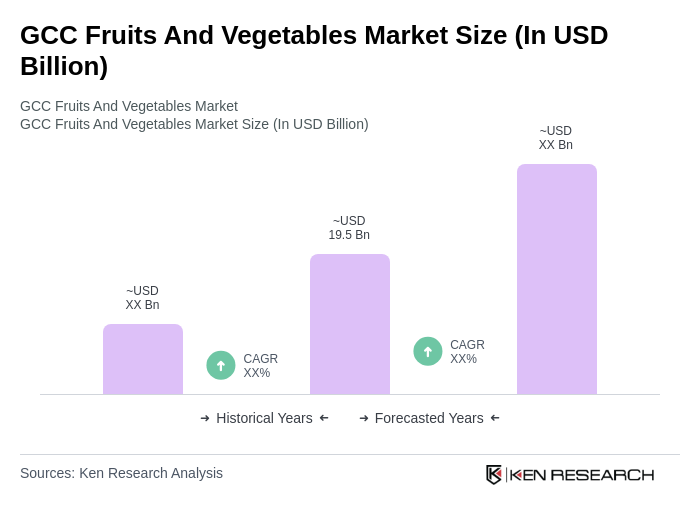
The GCC Fruits and Vegetables Market, valued at USD 19.5 billion, is growing due to rising health awareness, urbanization, and government food security initiatives, with strong demand for organic and frozen options.

Region:Middle East

Author(s):Shubham

Product Code:KRAD0649

Pages:80

Published On:August 2025
About the Report

Base Year 2024

GCC Fruits And Vegetables Market Overview

  • The GCC Fruits and Vegetables Market is valued at USD 19.5 billion, based on a five-year historical analysis. Growth is primarily driven by increasing health consciousness, rising disposable incomes, population growth, and strong expansion of organized retail and e-grocery that improves access to fresh produce. The market is also seeing greater demand for convenience formats (fresh-cut, frozen) alongside a shift toward organic and locally grown produce, enabled by cold chain investments and modern farming systems.
  • Key players in this market include the United Arab Emirates and Saudi Arabia, which dominate due to strategic locations, robust logistics, and significant investments in agricultural technology and controlled-environment agriculture. The UAE’s food security strategy and Saudi Arabia’s initiatives in greenhouse, hydroponics, and vertical farming bolster their positions, with Saudi Arabia holding the largest country share in the region.
  • In 2023, GCC governments advanced regulations and programs to promote sustainable agriculture and food safety, including incentives for local/organic production, vertical farming, hydroponics, and improvements in trade logistics and distribution networks across the bloc. These measures align with broader goals of food security, reduced pesticide use, and import reliance mitigation while supporting efficient cold-chain and re-export capabilities.
GCC Fruits And Vegetables Market Size

GCC Fruits And Vegetables Market Segmentation

By Type:The market is segmented into various types, including Fresh Fruits, Fresh Vegetables, Frozen Fruits & Vegetables, Processed (Canned, Dried, Juices, Purees), Organic Produce, Hydroponic/Greenhouse-grown Produce, and Exotic & Specialty (Berries, Avocado, Kiwi, Dragon Fruit). Among these, Fresh Fruits and Fresh Vegetables are the leading subsegments, supported by strong household consumption and organized retail availability. Demand for Frozen Fruits & Vegetables continues to grow due to convenience, off-season availability, and improved insulated packaging that preserves quality. The trend toward Organic and Greenhouse-grown produce is gaining traction, driven by food safety, sustainability, and water-efficiency priorities across the region.
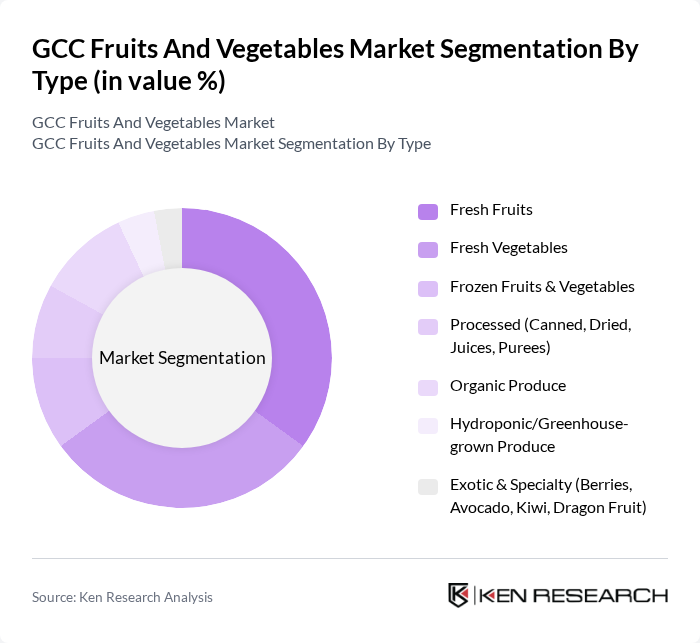
GCC Fruits And Vegetables Market segmentation by Type.

By End-User:The market is segmented by end-users, including Household/Retail Consumers, HoReCa (Hotels, Restaurants, Catering), Food Processing Companies (Juice, Fresh-cut, Ready Meals), and Institutional Buyers (Airlines, Schools, Hospitals). Household/Retail Consumers remain the largest due to daily consumption patterns and the rise of e-grocery and modern trade. HoReCa demand is supported by tourism and foodservice expansion, while processors increasingly source for juices, fresh-cut, and ready-meal applications.
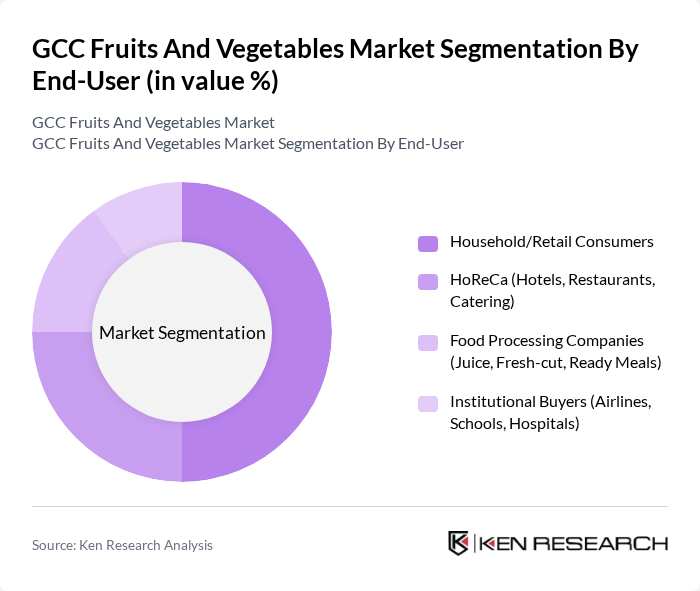
GCC Fruits And Vegetables Market segmentation by End-User.

GCC Fruits And Vegetables Market Competitive Landscape

The GCC Fruits And Vegetables Market is characterized by a dynamic mix of regional and international players. Leading participants such as Del Monte Foods (UAE) / Fresh Del Monte, Barakat Group (Barakat Quality Plus), NRTC Group (Nassar Al Refaee Trading Company), Kibsons International LLC, Al Foah (Agthia Group) – Dates & Produce, Al Dahra Holding, Lulu Group International (Fresh Produce), Spinneys (UAE) / Spinneys House of Produce, Carrefour (Majid Al Futtaim Retail), Saudi Marketing Company (Farm Superstores), Al Watania Agriculture, Nadec – National Agricultural Development Company, Hassad Food (Qatar), Silal (Abu Dhabi), Pure Harvest Smart Farms contribute to innovation, geographic expansion, and service delivery in this space.

Del Monte Foods

1886

Dubai, UAE

Barakat Group

1976

Dubai, UAE

NRTC Group

1973

Dubai, UAE

Kibsons International LLC

1980

Dubai, UAE

Al Foah (Agthia Group)

2005

Abu Dhabi, UAE

Company

Establishment Year

Headquarters

Scale Tier (Global, Regional, Local)

GCC Produce Revenue (USD, latest FY)

3-year Revenue CAGR (%)

Market Coverage (No. of GCC Countries Served)

Channel Mix (% Retail, % HoReCa, % Processing)

Import vs Local Sourcing Mix (%)

GCC Fruits And Vegetables Market Industry Analysis

Growth Drivers

  • Increasing Health Consciousness:The GCC region has seen a significant rise in health awareness, with 65% of consumers prioritizing fresh fruits and vegetables in their diets. This shift is driven by rising obesity rates, which reached 30% in the future, prompting governments to promote healthier eating habits. The World Health Organization reports that increased fruit and vegetable consumption can reduce chronic diseases, further fueling demand. Consequently, the market for fresh produce is expected to expand as consumers seek nutritious options.
  • Rising Population and Urbanization:The GCC's population is projected to reach 65 million in the future, with urbanization rates exceeding 90%. This demographic shift leads to increased demand for fresh produce, as urban dwellers typically consume more fruits and vegetables. The United Nations estimates that urban populations consume 25% more fresh produce than rural counterparts. As cities expand, the need for efficient supply chains and local sourcing becomes critical, driving growth in the fruits and vegetables market.
  • Government Initiatives for Food Security:GCC governments are investing heavily in food security, with budgets exceeding $12 billion in the future. Initiatives include subsidies for local farmers and investments in agricultural technology to enhance production. The UAE's National Food Security Strategy aims to increase local food production by 35% in the future. These efforts not only bolster domestic supply but also reduce reliance on imports, fostering a more resilient fruits and vegetables market in the region.

Market Challenges

  • Supply Chain Disruptions:The GCC fruits and vegetables market faces significant supply chain challenges, exacerbated by geopolitical tensions and global logistics issues. In the future, shipping delays increased by 30%, impacting the timely delivery of fresh produce. Additionally, the COVID-19 pandemic highlighted vulnerabilities in supply chains, leading to increased costs and reduced availability. These disruptions hinder market growth and create uncertainty for retailers and consumers alike.
  • High Import Dependency:The GCC region relies heavily on imports for its fruits and vegetables, with over 85% of produce sourced from abroad. This dependency exposes the market to fluctuations in global supply and pricing. In the future, import costs surged by 20% due to rising freight charges and supply chain constraints. Such volatility can lead to increased prices for consumers and challenges for local retailers, impacting overall market stability.

GCC Fruits And Vegetables Market Future Outlook

The GCC fruits and vegetables market is poised for transformation, driven by evolving consumer preferences and technological advancements. As health consciousness continues to rise, demand for organic and locally sourced produce is expected to increase. Additionally, the integration of digital technologies in supply chains will enhance efficiency and transparency. These trends, coupled with government support for local agriculture, will create a more sustainable and resilient market landscape, fostering growth and innovation in the sector.

Market Opportunities

  • Growth in Organic Produce Demand:The demand for organic fruits and vegetables is surging, with sales projected to reach $2 billion in the future. This trend is driven by consumer preferences for healthier, chemical-free options. Retailers are increasingly expanding their organic offerings, creating opportunities for local farmers to meet this growing demand and enhance their market presence.
  • Technological Advancements in Agriculture:Innovations such as vertical farming and precision agriculture are gaining traction in the GCC. Investments in these technologies are expected to exceed $600 million in the future, enhancing crop yields and reducing resource consumption. This shift presents opportunities for local producers to increase efficiency and sustainability, ultimately benefiting the fruits and vegetables market.

Scope of the Report

SegmentSub-Segments
By Type

Fresh Fruits

Fresh Vegetables

Frozen Fruits & Vegetables

Processed (Canned, Dried, Juices, Purees)

Organic Produce

Hydroponic/Greenhouse-grown Produce

Exotic & Specialty (Berries, Avocado, Kiwi, Dragon Fruit)

By End-User

Household/Retail Consumers

HoReCa (Hotels, Restaurants, Catering)

Food Processing Companies (Juice, Fresh-cut, Ready Meals)

Institutional Buyers (Airlines, Schools, Hospitals)

By Sales Channel

Supermarkets & Hypermarkets

Online Grocery & Quick Commerce

Traditional Grocers & Wet Markets

Specialty & Organic Stores

By Distribution Mode

Direct Sourcing (Farms-to-Retail/Foodservice)

Importers & Wholesalers

Cold Chain Logistics (Reefer Transport & Cold Storage)

By Price Range

Premium

Mid-Range

Budget

By Packaging Type

Bulk & Foodservice Packs

Retail Packs (Clamshells, Punnets, Nets)

Eco-Friendly & Recyclable Packaging

By Quality Grade

Export Grade/Grade A

Grade B (Value/Processing)

Grade C (Processing/Industry)

Key Target Audience

Investors and Venture Capitalist Firms

Government and Regulatory Bodies (e.g., Ministry of Climate Change and Environment, Food Security Office)

Manufacturers and Producers

Distributors and Retailers

Food Importers and Exporters

Logistics and Supply Chain Companies

Industry Associations (e.g., GCC Agricultural Association)

Financial Institutions

Players Mentioned in the Report:

Del Monte Foods (UAE) / Fresh Del Monte

Barakat Group (Barakat Quality Plus)

NRTC Group (Nassar Al Refaee Trading Company)

Kibsons International LLC

Al Foah (Agthia Group) Dates & Produce

Al Dahra Holding

Lulu Group International (Fresh Produce)

Spinneys (UAE) / Spinneys House of Produce

Carrefour (Majid Al Futtaim Retail)

Saudi Marketing Company (Farm Superstores)

Al Watania Agriculture

Nadec National Agricultural Development Company

Hassad Food (Qatar)

Silal (Abu Dhabi)

Pure Harvest Smart Farms

Table of Contents

Market Assessment Phase

1. Executive Summary and Approach


2. GCC Fruits And Vegetables Market Overview

2.1 Key Insights and Strategic Recommendations

2.2 GCC Fruits And Vegetables Market Overview

2.3 Definition and Scope

2.4 Evolution of Market Ecosystem

2.5 Timeline of Key Regulatory Milestones

2.6 Value Chain & Stakeholder Mapping

2.7 Business Cycle Analysis

2.8 Policy & Incentive Landscape


3. GCC Fruits And Vegetables Market Analysis

3.1 Growth Drivers

3.1.1 Increasing Health Consciousness
3.1.2 Rising Population and Urbanization
3.1.3 Government Initiatives for Food Security
3.1.4 Expansion of Retail Channels

3.2 Market Challenges

3.2.1 Supply Chain Disruptions
3.2.2 High Import Dependency
3.2.3 Seasonal Variability in Production
3.2.4 Regulatory Compliance Issues

3.3 Market Opportunities

3.3.1 Growth in Organic Produce Demand
3.3.2 Technological Advancements in Agriculture
3.3.3 E-commerce Growth for Fresh Produce
3.3.4 Investment in Local Farming Initiatives

3.4 Market Trends

3.4.1 Increasing Preference for Local Sourcing
3.4.2 Rise of Plant-Based Diets
3.4.3 Sustainable Packaging Solutions
3.4.4 Digital Transformation in Supply Chains

3.5 Government Regulation

3.5.1 Food Safety Standards
3.5.2 Import Tariffs and Quotas
3.5.3 Agricultural Subsidies
3.5.4 Environmental Regulations

4. SWOT Analysis


5. Stakeholder Analysis


6. Porter's Five Forces Analysis


7. GCC Fruits And Vegetables Market Market Size, 2019-2024

7.1 By Value

7.2 By Volume

7.3 By Average Selling Price


8. GCC Fruits And Vegetables Market Segmentation

8.1 By Type

8.1.1 Fresh Fruits
8.1.2 Fresh Vegetables
8.1.3 Frozen Fruits & Vegetables
8.1.4 Processed (Canned, Dried, Juices, Purees)
8.1.5 Organic Produce
8.1.6 Hydroponic/Greenhouse-grown Produce
8.1.7 Exotic & Specialty (Berries, Avocado, Kiwi, Dragon Fruit)

8.2 By End-User

8.2.1 Household/Retail Consumers
8.2.2 HoReCa (Hotels, Restaurants, Catering)
8.2.3 Food Processing Companies (Juice, Fresh-cut, Ready Meals)
8.2.4 Institutional Buyers (Airlines, Schools, Hospitals)

8.3 By Sales Channel

8.3.1 Supermarkets & Hypermarkets
8.3.2 Online Grocery & Quick Commerce
8.3.3 Traditional Grocers & Wet Markets
8.3.4 Specialty & Organic Stores

8.4 By Distribution Mode

8.4.1 Direct Sourcing (Farms-to-Retail/Foodservice)
8.4.2 Importers & Wholesalers
8.4.3 Cold Chain Logistics (Reefer Transport & Cold Storage)

8.5 By Price Range

8.5.1 Premium
8.5.2 Mid-Range
8.5.3 Budget

8.6 By Packaging Type

8.6.1 Bulk & Foodservice Packs
8.6.2 Retail Packs (Clamshells, Punnets, Nets)
8.6.3 Eco-Friendly & Recyclable Packaging

8.7 By Quality Grade

8.7.1 Export Grade/Grade A
8.7.2 Grade B (Value/Processing)
8.7.3 Grade C (Processing/Industry)

9. GCC Fruits And Vegetables Market Competitive Analysis

9.1 Market Share of Key Players

9.2 Cross Comparison of Key Players

9.2.1 Company Name
9.2.2 Scale Tier (Global, Regional, Local)
9.2.3 GCC Produce Revenue (USD, latest FY)
9.2.4 3-year Revenue CAGR (%)
9.2.5 Market Coverage (No. of GCC Countries Served)
9.2.6 Channel Mix (% Retail, % HoReCa, % Processing)
9.2.7 Import vs Local Sourcing Mix (%)
9.2.8 Cold Chain Capacity (Pallet positions/MT; No. of DCs)
9.2.9 SKU Breadth (No. of SKUs; share of premium/organic/exotic)
9.2.10 On-time Fill Rate (% OTIF)
9.2.11 Private Label Penetration (% of sales)
9.2.12 Food Safety & Certifications (HACCP, ISO 22000, GlobalG.A.P.)
9.2.13 Sustainability KPIs (Food waste %, water use/L per kg, renewable energy %)

9.3 SWOT Analysis of Top Players

9.4 Pricing Analysis

9.5 Detailed Profile of Major Companies

9.5.1 Del Monte Foods (UAE) / Fresh Del Monte
9.5.2 Barakat Group (Barakat Quality Plus)
9.5.3 NRTC Group (Nassar Al Refaee Trading Company)
9.5.4 Kibsons International LLC
9.5.5 Al Foah (Agthia Group) – Dates & Produce
9.5.6 Al Dahra Holding
9.5.7 Lulu Group International (Fresh Produce)
9.5.8 Spinneys (UAE) / Spinneys House of Produce
9.5.9 Carrefour (Majid Al Futtaim Retail)
9.5.10 Saudi Marketing Company (Farm Superstores)
9.5.11 Al Watania Agriculture
9.5.12 Nadec – National Agricultural Development Company
9.5.13 Hassad Food (Qatar)
9.5.14 Silal (Abu Dhabi)
9.5.15 Pure Harvest Smart Farms

10. GCC Fruits And Vegetables Market End-User Analysis

10.1 Procurement Behavior of Key Ministries

10.1.1 Ministry of Agriculture
10.1.2 Ministry of Health
10.1.3 Ministry of Commerce

10.2 Corporate Spend on Infrastructure & Energy

10.2.1 Investment in Cold Storage Facilities
10.2.2 Funding for Transportation Logistics
10.2.3 Budget for Quality Control Systems

10.3 Pain Point Analysis by End-User Category

10.3.1 Supply Chain Inefficiencies
10.3.2 Quality Assurance Challenges
10.3.3 Price Volatility

10.4 User Readiness for Adoption

10.4.1 Awareness of Organic Products
10.4.2 Acceptance of E-commerce Solutions
10.4.3 Readiness for Sustainable Practices

10.5 Post-Deployment ROI and Use Case Expansion

10.5.1 Increased Sales through E-commerce
10.5.2 Enhanced Customer Loyalty Programs
10.5.3 Expansion into New Markets

11. GCC Fruits And Vegetables Market Future Size, 2025-2030

11.1 By Value

11.2 By Volume

11.3 By Average Selling Price


Go-To-Market Strategy Phase

1. Whitespace Analysis + Business Model Canvas

1.1 Market Gaps Identification

1.2 Value Proposition Development

1.3 Revenue Streams Analysis

1.4 Cost Structure Evaluation

1.5 Key Partnerships Exploration

1.6 Customer Segmentation

1.7 Channels of Distribution


2. Marketing and Positioning Recommendations

2.1 Branding Strategies

2.2 Product USPs


3. Distribution Plan

3.1 Urban Retail vs Rural NGO Tie-ups


4. Channel & Pricing Gaps

4.1 Underserved Routes

4.2 Pricing Bands


5. Unmet Demand & Latent Needs

5.1 Category Gaps

5.2 Consumer Segments


6. Customer Relationship

6.1 Loyalty Programs

6.2 After-sales Service


7. Value Proposition

7.1 Sustainability

7.2 Integrated Supply Chains


8. Key Activities

8.1 Regulatory Compliance

8.2 Branding

8.3 Distribution Setup


9. Entry Strategy Evaluation

9.1 Domestic Market Entry Strategy

9.1.1 Product Mix
9.1.2 Pricing Band
9.1.3 Packaging

9.2 Export Entry Strategy

9.2.1 Target Countries
9.2.2 Compliance Roadmap

10. Entry Mode Assessment

10.1 JV

10.2 Greenfield

10.3 M&A

10.4 Distributor Model


11. Capital and Timeline Estimation

11.1 Capital Requirements

11.2 Timelines


12. Control vs Risk Trade-Off

12.1 Ownership vs Partnerships


13. Profitability Outlook

13.1 Breakeven Analysis

13.2 Long-term Sustainability


14. Potential Partner List

14.1 Distributors

14.2 JVs

14.3 Acquisition Targets


15. Execution Roadmap

15.1 Phased Plan for Market Entry

15.1.1 Market Setup
15.1.2 Market Entry
15.1.3 Growth Acceleration
15.1.4 Scale & Stabilize

15.2 Key Activities and Milestones

15.2.1 Activity Planning
15.2.2 Milestone Tracking

Research Methodology

ApproachModellingSample

Phase 1: Approach1

Desk Research

  • Analysis of trade statistics from the Gulf Cooperation Council (GCC) agricultural departments
  • Review of market reports from regional agricultural organizations and trade associations
  • Examination of government publications on agricultural policies and import/export regulations

Primary Research

  • Interviews with key stakeholders in the fruits and vegetables supply chain, including farmers and distributors
  • Surveys conducted with retailers and wholesalers to gather insights on purchasing trends
  • Field visits to local markets and farms to observe practices and gather qualitative data

Validation & Triangulation

  • Cross-validation of findings through multiple data sources, including trade data and expert opinions
  • Triangulation of market insights from primary interviews with secondary research findings
  • Sanity checks through expert panel discussions to ensure data reliability

Phase 2: Market Size Estimation1

Top-down Assessment

  • Estimation of market size based on national consumption data and import statistics
  • Segmentation of the market by product type (fruits vs. vegetables) and distribution channel
  • Incorporation of demographic trends and consumer preferences in the GCC region

Bottom-up Modeling

  • Collection of sales data from major retailers and wholesalers in the GCC fruits and vegetables market
  • Estimation of average purchase volumes and prices across different market segments
  • Calculation of market size based on aggregated data from local producers and importers

Forecasting & Scenario Analysis

  • Utilization of time-series analysis to project future market growth based on historical data
  • Scenario modeling based on potential changes in consumer behavior and economic conditions
  • Development of baseline, optimistic, and pessimistic forecasts through 2030

Phase 3: CATI Sample Composition1

Scope Item/SegmentSample SizeTarget Respondent Profiles
Retail Fruit Sales120Store Managers, Category Buyers
Wholesale Vegetable Distribution100Wholesale Distributors, Supply Chain Managers
Local Farm Production80Farm Owners, Agricultural Managers
Import/Export Operations70Logistics Coordinators, Trade Compliance Officers
Consumer Purchasing Behavior140End Consumers, Household Decision Makers

Frequently Asked Questions

What is the current value of the GCC Fruits and Vegetables Market?

The GCC Fruits and Vegetables Market is valued at approximately USD 19.5 billion, reflecting a robust growth driven by health consciousness, rising disposable incomes, and the expansion of organized retail and e-grocery services.

What factors are driving growth in the GCC Fruits and Vegetables Market?

Which countries dominate the GCC Fruits and Vegetables Market?

What types of products are included in the GCC Fruits and Vegetables Market?

Other Regional/Country Reports

Indonesia GCC Fruits And Vegetables Market

Malaysia GCC Fruits And Vegetables Market

KSA GCC Fruits And Vegetables Market

APAC GCC Fruits And Vegetables Market

SEA GCC Fruits And Vegetables Market

Vietnam GCC Fruits And Vegetables Market

Why Buy From Us?

Refine Robust Result (RRR) Framework

What makes us stand out is that our consultants follow Robust, Refine and Result (RRR) methodology. Robust for clear definitions, approaches and sanity checking, Refine for differentiating respondents' facts and opinions, and Result for presenting data with story.

Our Reach Is Unmatched

We have set a benchmark in the industry by offering our clients with syndicated and customized market research reports featuring coverage of entire market as well as meticulous research and analyst insights.

Shifting the Research Paradigm

While we don't replace traditional research, we flip the method upside down. Our dual approach of Top Bottom & Bottom Top ensures quality deliverable by not just verifying company fundamentals but also looking at the sector and macroeconomic factors.

More Insights-Better Decisions

With one step in the future, our research team constantly tries to show you the bigger picture. We help with some of the tough questions you may encounter along the way: How is the industry positioned? Best marketing channel? KPI's of competitors? By aligning every element, we help maximize success.

Transparency and Trust

Our report gives you instant access to the answers and sources that other companies might choose to hide. We elaborate each steps of research methodology we have used and showcase you the sample size to earn your trust.

Round the Clock Support

If you need any support, we are here! We pride ourselves on universe strength, data quality, and quick, friendly, and professional service.

Why Clients Choose Us?

400000+
Reports in repository
150+
Consulting projects a year
100+
Analysts
8000+
Client Queries in 2022








