About the Report
Base Year 2024GCC In Vitro Fertilization Market Overview
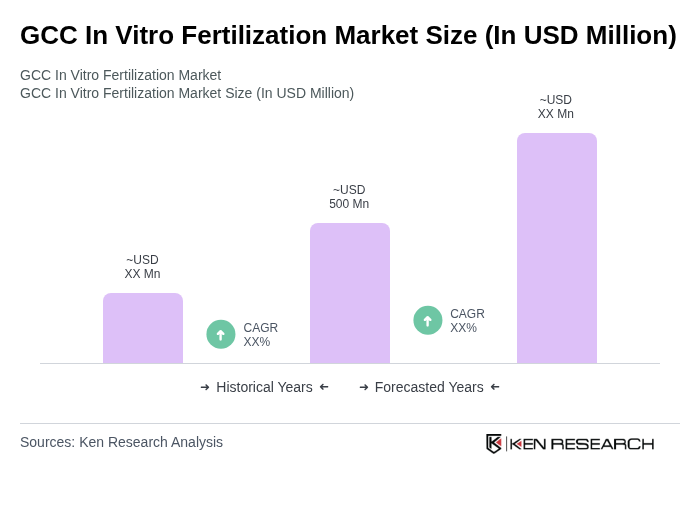
- The GCC In Vitro Fertilization Market is valued at USD 500 million, based on a five-year historical analysis. This growth is primarily driven by increasing infertility rates, rising awareness about assisted reproductive technologies, and advancements in IVF techniques. The market is also supported by the growing number of fertility clinics and the availability of government funding for reproductive health services.
- The United Arab Emirates and Saudi Arabia dominate the market due to their advanced healthcare infrastructure, high disposable incomes, and a growing population seeking fertility treatments. Additionally, these countries have established numerous fertility clinics and centers of excellence, making them attractive destinations for patients seeking IVF services.
- The Federal Decree-Law No. 4 of 2016 on Medical Liability, issued by the UAE Ministry of Health and Prevention, governs IVF services by requiring fertility clinics to obtain licensing, adhere to standardized protocols for embryo handling and genetic screening, maintain success rate reporting above 30% thresholds for licensed operations, and ensure compliance with ethical standards for gamete donation and storage.
GCC In Vitro Fertilization Market Segmentation
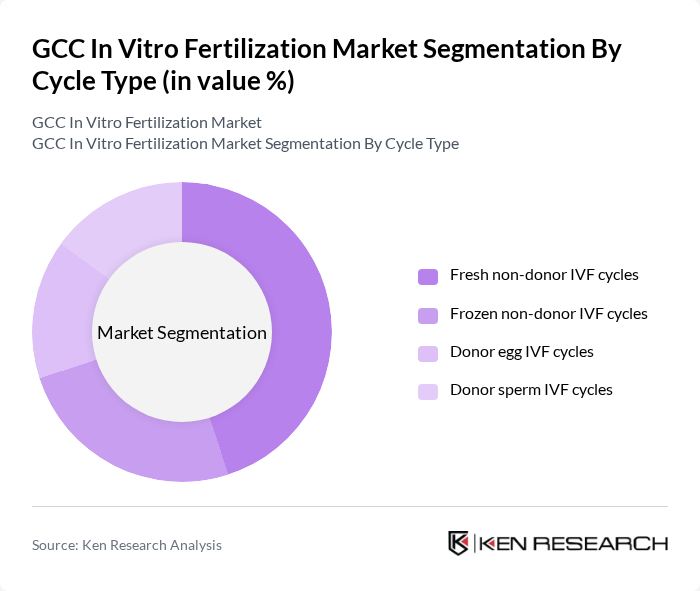
By Cycle Type:The cycle type segmentation includes various methods of IVF procedures, which are crucial for addressing different patient needs. The subsegments include Fresh non-donor IVF cycles, Frozen non-donor IVF cycles, Donor egg IVF cycles, and Donor sperm IVF cycles. Among these, Fresh non-donor IVF cycles are currently the most popular due to their higher success rates and the preference of patients for using their own eggs and sperm. The increasing awareness and acceptance of IVF treatments have led to a significant rise in the number of fresh cycles performed.
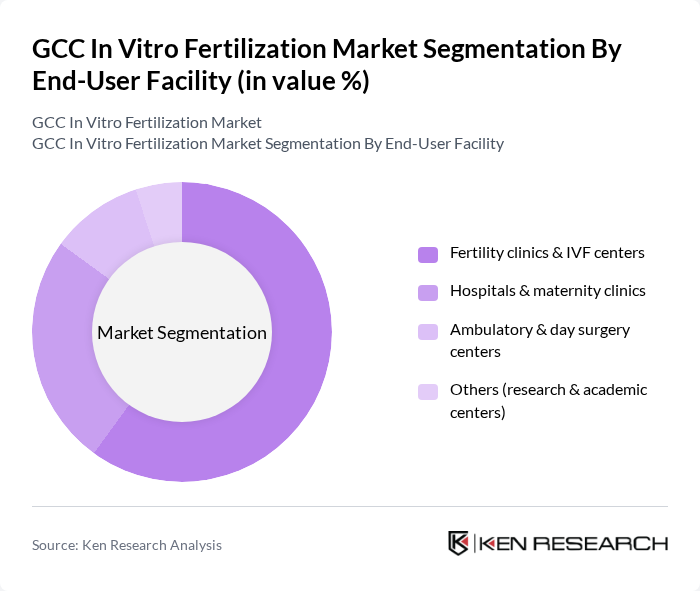
By End-User Facility:The end-user facility segmentation encompasses various healthcare settings where IVF procedures are performed. This includes Fertility clinics & IVF centers, Hospitals & maternity clinics, Ambulatory & day surgery centers, and Others (research & academic centers). Fertility clinics & IVF centers dominate this segment due to their specialized services and focus on reproductive health, which cater specifically to patients seeking IVF treatments. The increasing number of such clinics in the GCC region has further solidified their leading position in the market.
GCC In Vitro Fertilization Market Competitive Landscape
The GCC In Vitro Fertilization Market is characterized by a dynamic mix of regional and international players. Leading participants such as Dubai Fertility Centre (UAE), HealthPlus Fertility Center (Abu Dhabi, UAE), Bourn Hall Fertility Centre (Dubai & Abu Dhabi, UAE), Fakih IVF Fertility Center (UAE & Oman), Orchid Fertility Clinic (Dubai, UAE), Medcare Fertility Centre, Medcare Women & Children Hospital (Dubai, UAE), Conceive – The Gynaecology & Fertility Hospital (Sharjah, UAE), King Faisal Specialist Hospital & Research Centre – IVF Unit (Riyadh, Saudi Arabia), Dr. Sulaiman Al Habib Medical Group – IVF & Fertility Centers (Saudi Arabia), Dallah Hospital – IVF & Reproductive Medicine Center (Riyadh, Saudi Arabia), Sidra Medicine – Reproductive Medicine & IVF (Doha, Qatar), Qatar Center for Reproductive Medicine / Qatar Fertility Center (Doha, Qatar), New Hope IVF Gynaecology & Fertility Hospital (Sharjah, UAE), Bahrain Defence Force Hospital – IVF & Fertility Center (Bahrain), Royal Hospital – IVF & Fertility Services (Muscat, Oman) contribute to innovation, geographic expansion, and service delivery in this space.
GCC In Vitro Fertilization Market Industry Analysis
Growth Drivers
- Increasing Infertility Rates:The GCC region has witnessed a significant rise in infertility rates, with estimates indicating that approximately 15% of couples face challenges in conceiving. Factors contributing to this trend include lifestyle changes, delayed marriages, and increased prevalence of conditions such as polycystic ovary syndrome (PCOS). According to the World Health Organization, the number of couples seeking fertility treatments is projected to reach 1.5 million in future, driving demand for in vitro fertilization (IVF) services across the region.
- Rising Awareness and Acceptance of IVF:Public awareness regarding IVF has surged, with educational campaigns and media coverage playing pivotal roles. In future, surveys indicated that 70% of the population in the GCC is aware of IVF as a viable option for infertility. This growing acceptance is further supported by cultural shifts towards family planning and reproductive health, leading to an increase in consultations and treatments. As a result, the number of IVF cycles performed annually is expected to exceed 200,000 in future.
- Government Support and Funding for Fertility Treatments:Governments in the GCC are increasingly recognizing the importance of addressing infertility issues, leading to enhanced funding and support for fertility treatments. For instance, the UAE government allocated $50 million in future to subsidize IVF treatments for couples in need. Additionally, initiatives aimed at improving healthcare infrastructure and access to fertility clinics are expected to bolster the IVF market, making treatments more accessible to a broader demographic.
Market Challenges
- High Treatment Costs:One of the primary challenges facing the GCC IVF market is the high cost of treatment, which can range from $5,000 to $15,000 per cycle. This financial burden often deters couples from pursuing IVF, particularly in lower-income brackets. The average annual income in the GCC is approximately $30,000, making IVF unaffordable for many. As a result, only about 20% of couples who require IVF actually proceed with treatment, limiting market growth potential.
- Limited Insurance Coverage:Insurance coverage for IVF treatments remains limited across the GCC, with only 30% of health insurance plans offering any form of fertility treatment coverage. This lack of support exacerbates the financial challenges faced by couples seeking IVF. In many cases, patients must pay out-of-pocket, which can lead to significant financial strain. The disparity in coverage across different countries in the region further complicates access to necessary treatments, hindering overall market expansion.
GCC In Vitro Fertilization Market Future Outlook
The future of the GCC IVF market appears promising, driven by increasing investments in healthcare infrastructure and advancements in reproductive technologies. As telemedicine becomes more integrated into fertility treatments, patients will benefit from remote consultations and follow-ups, enhancing accessibility. Additionally, the integration of artificial intelligence in IVF processes is expected to improve success rates and patient experiences. These trends indicate a robust growth trajectory for the IVF market, with a focus on patient-centered care and innovative solutions.
Market Opportunities
- Expansion of Fertility Clinics:The establishment of new fertility clinics across the GCC presents a significant opportunity for market growth. With an estimated 50 new clinics projected to open in future, increased access to services will cater to the rising demand for IVF treatments. This expansion will not only enhance competition but also improve service quality and patient outcomes in the region.
- Development of Personalized Medicine:The shift towards personalized medicine in reproductive health offers a unique opportunity for innovation in IVF treatments. By leveraging genetic testing and tailored treatment plans, clinics can enhance success rates and patient satisfaction. This approach is expected to attract more couples seeking effective and customized fertility solutions, further driving market growth in the coming years.
Scope of the Report
| Segment | Sub-Segments |
|---|---|
| By Cycle Type | Fresh non-donor IVF cycles Frozen non-donor IVF cycles Donor egg IVF cycles Donor sperm IVF cycles |
| By End-User Facility | Fertility clinics & IVF centers Hospitals & maternity clinics Ambulatory & day surgery centers Others (research & academic centers) |
| By Patient Profile (Age Group) | Under 30 years –34 years –39 years years & above |
| By Procedure Type | Conventional IVF IVF with ICSI (Intracytoplasmic Sperm Injection) IUI (Intrauterine Insemination) IVF with donor gametes and surrogacy programs |
| By Technology | Conventional stimulation protocols Minimal stimulation & natural cycle IVF Assisted hatching, PGT/PGS and genetic testing Cryopreservation (oocyte, sperm & embryo freezing) |
| By Country | United Arab Emirates Saudi Arabia Qatar Kuwait Oman Bahrain |
| By Service Offering | Diagnostic & consultation services Ovarian stimulation & monitoring Laboratory & embryology services Counseling, follow?up & support services |
Key Target Audience
Investors and Venture Capitalist Firms
Government and Regulatory Bodies (e.g., Ministry of Health, Health Authority Abu Dhabi)
Manufacturers and Producers of IVF Equipment
Fertility Clinics and IVF Centers
Pharmaceutical Companies specializing in Reproductive Health
Health Insurance Providers
Biotechnology Firms focused on Reproductive Technologies
Medical Device Suppliers
Players Mentioned in the Report:
Dubai Fertility Centre (UAE)
HealthPlus Fertility Center (Abu Dhabi, UAE)
Bourn Hall Fertility Centre (Dubai & Abu Dhabi, UAE)
Fakih IVF Fertility Center (UAE & Oman)
Orchid Fertility Clinic (Dubai, UAE)
Medcare Fertility Centre, Medcare Women & Children Hospital (Dubai, UAE)
Conceive The Gynaecology & Fertility Hospital (Sharjah, UAE)
King Faisal Specialist Hospital & Research Centre IVF Unit (Riyadh, Saudi Arabia)
Dr. Sulaiman Al Habib Medical Group IVF & Fertility Centers (Saudi Arabia)
Dallah Hospital IVF & Reproductive Medicine Center (Riyadh, Saudi Arabia)
Sidra Medicine Reproductive Medicine & IVF (Doha, Qatar)
Qatar Center for Reproductive Medicine / Qatar Fertility Center (Doha, Qatar)
New Hope IVF Gynaecology & Fertility Hospital (Sharjah, UAE)
Bahrain Defence Force Hospital IVF & Fertility Center (Bahrain)
Royal Hospital IVF & Fertility Services (Muscat, Oman)
Table of Contents
Market Assessment Phase
1. Executive Summary and Approach
2. GCC In Vitro Fertilization Market Overview
2.1 Key Insights and Strategic Recommendations
2.2 GCC In Vitro Fertilization Market Overview
2.3 Definition and Scope
2.4 Evolution of Market Ecosystem
2.5 Timeline of Key Regulatory Milestones
2.6 Value Chain & Stakeholder Mapping
2.7 Business Cycle Analysis
2.8 Policy & Incentive Landscape
3. GCC In Vitro Fertilization Market Analysis
3.1 Growth Drivers
3.1.1 Increasing infertility rates
3.1.3 Rising awareness and acceptance of IVF
3.1.4 Government support and funding for fertility treatments
3.2 Market Challenges
3.2.1 High treatment costs
3.2.2 Limited insurance coverage
3.2.3 Ethical and legal concerns
3.2.4 Variability in success rates
3.3 Market Opportunities
3.3.1 Expansion of fertility clinics
3.3.2 Development of personalized medicine
3.3.3 Collaborations with healthcare providers
3.3.4 Increasing demand for egg freezing services
3.4 Market Trends
3.4.1 Growth of telemedicine in fertility treatments
3.4.2 Integration of AI in IVF processes
3.4.3 Rise in fertility preservation techniques
3.4.4 Focus on holistic and wellness approaches
3.5 Government Regulation
3.5.1 Licensing requirements for fertility clinics
3.5.2 Regulations on embryo storage and disposal
3.5.3 Guidelines for donor anonymity
3.5.4 Ethical standards for IVF practices
4. SWOT Analysis
5. Stakeholder Analysis
6. Porter's Five Forces Analysis
7. GCC In Vitro Fertilization Market Market Size, 2019-2024
7.1 By Value
7.2 By Volume
7.3 By Average Selling Price
8. GCC In Vitro Fertilization Market Segmentation
8.1 By Cycle Type
8.1.1 Fresh non-donor IVF cycles
8.1.2 Frozen non-donor IVF cycles
8.1.3 Donor egg IVF cycles
8.1.4 Donor sperm IVF cycles
8.2 By End-User Facility
8.2.1 Fertility clinics & IVF centers
8.2.2 Hospitals & maternity clinics
8.2.3 Ambulatory & day surgery centers
8.2.4 Others (research & academic centers)
8.3 By Patient Profile (Age Group)
8.3.1 Under 30 years
8.3.2 30–34 years
8.3.3 35–39 years
8.3.4 40 years & above
8.4 By Procedure Type
8.4.1 Conventional IVF
8.4.2 IVF with ICSI (Intracytoplasmic Sperm Injection)
8.4.3 IUI (Intrauterine Insemination)
8.4.4 IVF with donor gametes and surrogacy programs
8.5 By Technology
8.5.1 Conventional stimulation protocols
8.5.2 Minimal stimulation & natural cycle IVF
8.5.3 Assisted hatching, PGT/PGS and genetic testing
8.5.4 Cryopreservation (oocyte, sperm & embryo freezing)
8.6 By Country
8.6.1 United Arab Emirates
8.6.2 Saudi Arabia
8.6.3 Qatar
8.6.4 Kuwait
8.6.5 Oman
8.6.6 Bahrain
8.7 By Service Offering
8.7.1 Diagnostic & consultation services
8.7.2 Ovarian stimulation & monitoring
8.7.3 Laboratory & embryology services
8.7.4 Counseling, follow?up & support services
9. GCC In Vitro Fertilization Market Competitive Analysis
9.1 Market Share of Key Players
9.2 Cross Comparison of Key Players
9.2.1 Company name
9.2.2 Scale of operations (single?center vs multi?center network)
9.2.3 Annual IVF cycles performed (procedure volume)
9.2.4 Clinical pregnancy and live birth success rates
9.2.5 Geographic coverage across GCC countries
9.2.6 Average treatment cost per IVF cycle
9.2.7 Revenue and revenue growth rate from IVF services
9.2.8 Case mix (share of ICSI, donor programs, PGT, freezing)
9.2.9 Time to pregnancy / number of cycles per successful outcome
9.2.10 Patient satisfaction / Net Promoter Score (NPS)
9.3 SWOT Analysis of Top Players
9.4 Pricing Analysis
9.5 Detailed Profile of Major Companies
9.5.1 Dubai Fertility Centre (UAE)
9.5.2 HealthPlus Fertility Center (Abu Dhabi, UAE)
9.5.3 Bourn Hall Fertility Centre (Dubai & Abu Dhabi, UAE)
9.5.4 Fakih IVF Fertility Center (UAE & Oman)
9.5.5 Orchid Fertility Clinic (Dubai, UAE)
9.5.6 Medcare Fertility Centre, Medcare Women & Children Hospital (Dubai, UAE)
9.5.7 Conceive – The Gynaecology & Fertility Hospital (Sharjah, UAE)
9.5.8 King Faisal Specialist Hospital & Research Centre – IVF Unit (Riyadh, Saudi Arabia)
9.5.9 Dr. Sulaiman Al Habib Medical Group – IVF & Fertility Centers (Saudi Arabia)
9.5.10 Dallah Hospital – IVF & Reproductive Medicine Center (Riyadh, Saudi Arabia)
9.5.11 Sidra Medicine – Reproductive Medicine & IVF (Doha, Qatar)
9.5.12 Qatar Center for Reproductive Medicine / Qatar Fertility Center (Doha, Qatar)
9.5.13 New Hope IVF Gynaecology & Fertility Hospital (Sharjah, UAE)
9.5.14 Bahrain Defence Force Hospital – IVF & Fertility Center (Bahrain)
9.5.15 Royal Hospital – IVF & Fertility Services (Muscat, Oman)
10. GCC In Vitro Fertilization Market End-User Analysis
10.1 Procurement Behavior of Key Ministries
10.1.1 Budget allocation for fertility treatments
10.1.2 Policy frameworks for IVF funding
10.1.3 Collaboration with private clinics
10.1.4 Awareness programs for citizens
10.2 Corporate Spend on Infrastructure & Energy
10.2.1 Investment in fertility clinics
10.2.2 Funding for research and development
10.2.3 Partnerships with healthcare providers
10.2.4 Others
10.3 Pain Point Analysis by End-User Category
10.3.1 Accessibility of services
10.3.2 Affordability of treatments
10.3.3 Quality of care
10.3.4 Emotional support services
10.4 User Readiness for Adoption
10.4.1 Awareness of IVF options
10.4.2 Acceptance of assisted reproductive technologies
10.4.3 Financial preparedness
10.4.4 Others
10.5 Post-Deployment ROI and Use Case Expansion
10.5.1 Success stories and testimonials
10.5.2 Long-term health outcomes
10.5.3 Expansion of services offered
10.5.4 Others
11. GCC In Vitro Fertilization Market Future Size, 2025-2030
11.1 By Value
11.2 By Volume
11.3 By Average Selling Price
Go-To-Market Strategy Phase
1. Whitespace Analysis + Business Model Canvas
1.1 Market gaps and opportunities
1.2 Business model components
2. Marketing and Positioning Recommendations
2.1 Branding strategies
2.2 Product USPs
3. Distribution Plan
3.1 Urban retail vs rural NGO tie-ups
4. Channel & Pricing Gaps
4.1 Underserved routes
4.2 Pricing bands
5. Unmet Demand & Latent Needs
5.1 Category gaps
5.2 Consumer segments
6. Customer Relationship
6.1 Loyalty programs
6.2 After-sales service
7. Value Proposition
7.1 Sustainability
7.2 Integrated supply chains
8. Key Activities
8.1 Regulatory compliance
8.2 Branding
8.3 Distribution setup
9. Entry Strategy Evaluation
9.1 Domestic Market Entry Strategy
9.1.1 Product mix
9.1.2 Pricing band
9.1.3 Packaging
9.2 Export Entry Strategy
9.2.1 Target countries
9.2.2 Compliance roadmap
10. Entry Mode Assessment
10.1 JV
10.2 Greenfield
10.3 M&A
10.4 Distributor Model
11. Capital and Timeline Estimation
11.1 Capital requirements
11.2 Timelines
12. Control vs Risk Trade-Off
12.1 Ownership vs Partnerships
13. Profitability Outlook
13.1 Breakeven analysis
13.2 Long-term sustainability
14. Potential Partner List
14.1 Distributors
14.2 JVs
14.3 Acquisition targets
15. Execution Roadmap
15.1 Phased Plan for Market Entry
15.1.1 Market Setup
15.1.2 Market Entry
15.1.3 Growth Acceleration
15.1.4 Scale & Stabilize
15.2 Key Activities and Milestones
15.2.1 Milestone tracking
15.2.2 Activity scheduling
Research Methodology
Phase 1: Approach1
Desk Research
- Analysis of market reports from healthcare associations and fertility clinics in the GCC region
- Review of demographic and health statistics from national health ministries and WHO
- Examination of published articles and journals focusing on reproductive health and IVF trends
Primary Research
- Interviews with reproductive endocrinologists and fertility specialists across GCC countries
- Surveys with patients who have undergone IVF treatments to gather insights on experiences and outcomes
- Field interviews with clinic administrators to understand operational challenges and market dynamics
Validation & Triangulation
- Cross-validation of findings through multiple expert interviews and patient surveys
- Triangulation of data from clinical outcomes, patient demographics, and treatment costs
- Sanity checks through expert panel reviews comprising healthcare professionals and market analysts
Phase 2: Market Size Estimation1
Top-down Assessment
- Estimation of the total addressable market based on population fertility rates and IVF adoption rates
- Segmentation of the market by country, treatment type, and patient demographics
- Incorporation of government health initiatives and funding for fertility treatments
Bottom-up Modeling
- Collection of data on the number of IVF cycles performed by leading clinics in the GCC
- Operational cost analysis based on treatment pricing and service offerings
- Volume x cost calculations to derive revenue estimates for the IVF market
Forecasting & Scenario Analysis
- Multi-factor regression analysis considering factors such as healthcare access, insurance coverage, and societal attitudes towards IVF
- Scenario modeling based on potential changes in regulations and advancements in reproductive technologies
- Development of baseline, optimistic, and pessimistic forecasts through 2030
Phase 3: CATI Sample Composition1
| Scope Item/Segment | Sample Size | Target Respondent Profiles |
|---|---|---|
| Fertility Clinics in UAE | 80 | Clinic Directors, IVF Coordinators |
| Patient Experience Surveys | 120 | IVF Patients, Fertility Treatment Seekers |
| Healthcare Policy Makers | 40 | Health Ministry Officials, Regulatory Bodies |
| Reproductive Health Specialists | 90 | Gynecologists, Reproductive Endocrinologists |
| Insurance Providers | 60 | Health Insurance Analysts, Policy Underwriters |
Frequently Asked Questions
What is the current value of the GCC In Vitro Fertilization Market?
The GCC In Vitro Fertilization Market is valued at approximately USD 500 million, driven by increasing infertility rates, advancements in IVF techniques, and growing awareness of assisted reproductive technologies.
Which countries dominate the GCC In Vitro Fertilization Market?
What are the main types of IVF cycles in the GCC market?
What regulatory framework governs IVF services in the UAE?
Other Regional/Country Reports
Indonesia In Vitro Fertilization Market
Other Adjacent Reports
South Korea Reproductive Health Services Market
South Korea Fertility Drugs Market
Indonesia Genetic Testing Market
Mexico Assisted Reproductive Technology Market
Kuwait Cryopreservation Services Market
Japan Womens Health Pharmaceuticals Market
Qatar Medical Tourism Market
South Africa Embryology Equipment Market
Indonesia Healthcare Infrastructure Development Market
Bahrain Personalized Medicine Market
Why Buy From Us?

What makes us stand out is that our consultants follow Robust, Refine and Result (RRR) methodology. Robust for clear definitions, approaches and sanity checking, Refine for differentiating respondents' facts and opinions, and Result for presenting data with story.

We have set a benchmark in the industry by offering our clients with syndicated and customized market research reports featuring coverage of entire market as well as meticulous research and analyst insights.

While we don't replace traditional research, we flip the method upside down. Our dual approach of Top Bottom & Bottom Top ensures quality deliverable by not just verifying company fundamentals but also looking at the sector and macroeconomic factors.

With one step in the future, our research team constantly tries to show you the bigger picture. We help with some of the tough questions you may encounter along the way: How is the industry positioned? Best marketing channel? KPI's of competitors? By aligning every element, we help maximize success.

Our report gives you instant access to the answers and sources that other companies might choose to hide. We elaborate each steps of research methodology we have used and showcase you the sample size to earn your trust.

If you need any support, we are here! We pride ourselves on universe strength, data quality, and quick, friendly, and professional service.