About the Report
Base Year 2024GCC Middle East Refinery Catalysts Market Overview
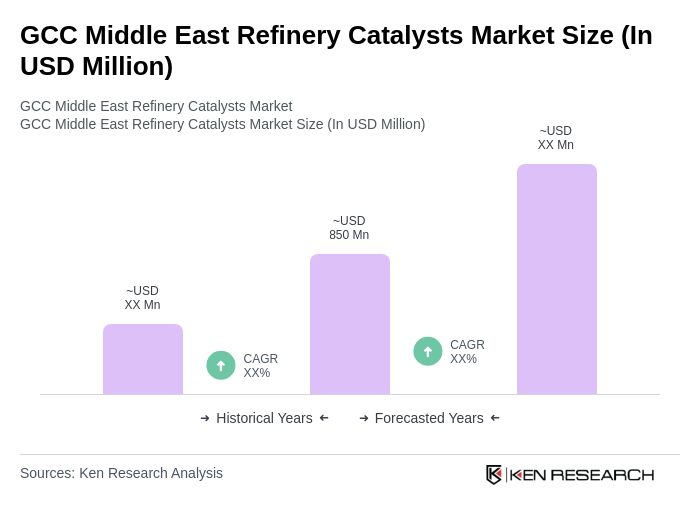
- The GCC Middle East Refinery Catalysts Market is valued at USD 850 million, based on a five-year historical analysis. This growth is primarily driven by the increasing demand for refined petroleum products, ongoing refinery capacity expansions, and the adoption of advanced catalyst technologies to meet stricter environmental standards and improve process efficiency. Key trends include the shift toward cleaner fuels and the integration of renewable feedstocks in refining operations, which further stimulate catalyst demand .
- Key players in this market include Saudi Arabia, the UAE, and Qatar. These countries dominate due to their substantial oil reserves, advanced refining infrastructure, and ongoing investments in technology to improve refining processes, making them pivotal in the global refinery catalysts landscape .
- In 2023, the GCC governments implemented regulations mandating the reduction of sulfur content in fuels to below 10 ppm. This requirement is enforced under the “GCC Standardization Organization Regulation for Motor Gasoline and Diesel Fuel Quality, GSO 42:2015,” issued by the Gulf Standardization Organization, which sets operational thresholds for sulfur content and mandates compliance for all refineries operating within GCC member states. The regulation aims to enhance air quality and reduce environmental impact, driving the demand for advanced hydrotreating catalysts in the refining sector .
GCC Middle East Refinery Catalysts Market Segmentation
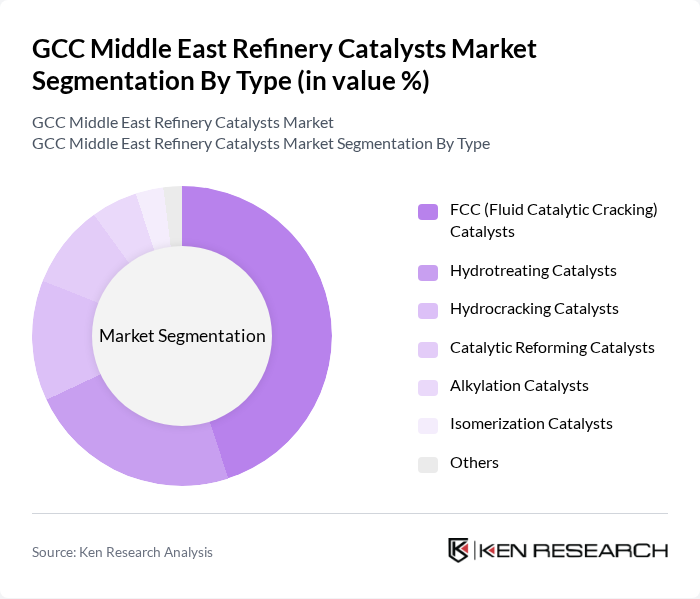
By Type:The market can be segmented into various types of catalysts, including FCC (Fluid Catalytic Cracking) Catalysts, Hydrotreating Catalysts, Hydrocracking Catalysts, Catalytic Reforming Catalysts, Alkylation Catalysts, Isomerization Catalysts, and Others. FCC Catalysts are the most widely used due to their efficiency in converting heavy crude oil into valuable gasoline and diesel products. The increasing complexity of crude oil and the need for higher yields in refining processes have further solidified the dominance of FCC Catalysts in the market .
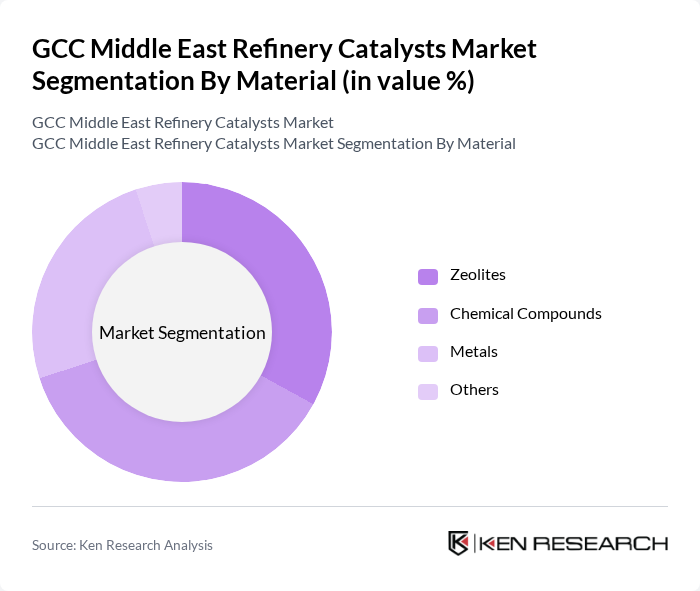
By Material:The market is also segmented by material types, including Zeolites, Chemical Compounds, Metals, and Others. Zeolites are the leading material used in refinery catalysts due to their unique porous structure, which enhances catalytic activity and selectivity. The demand for zeolite-based catalysts is driven by their effectiveness in various refining processes, including cracking and hydrotreating, making them essential for meeting regulatory standards and improving fuel quality .
GCC Middle East Refinery Catalysts Market Competitive Landscape
The GCC Middle East Refinery Catalysts Market is characterized by a dynamic mix of regional and international players. Leading participants such as BASF SE, Shell Catalysts & Technologies, Albemarle Corporation, Honeywell UOP, Clariant AG, W.R. Grace & Co., Haldor Topsøe A/S, Johnson Matthey PLC, Axens S.A., Criterion Catalysts & Technologies (Shell), JGC Holdings Corporation, KNT Group, Sinopec Catalyst Company, China Petroleum & Chemical Corporation (Sinopec), Advanced Refining Technologies (ART) contribute to innovation, geographic expansion, and service delivery in this space.
GCC Middle East Refinery Catalysts Market Industry Analysis
Growth Drivers
- Increasing Demand for Cleaner Fuels:The GCC region is witnessing a significant rise in the demand for cleaner fuels, driven by a projected increase in fuel consumption by approximately 2 million barrels per day in future. This demand is largely influenced by the region's commitment to reducing carbon emissions, with countries like Saudi Arabia aiming for a substantial reduction in future. The shift towards cleaner fuels is expected to enhance the adoption of advanced refinery catalysts, which are essential for producing low-sulfur fuels.
- Technological Advancements in Refining Processes:The GCC refining sector is increasingly adopting advanced technologies, with estimated investments in digital transformation initiatives reaching USD 10 billion in future. Innovations such as artificial intelligence and machine learning are enhancing operational efficiencies and optimizing catalyst performance. These advancements are crucial for meeting the growing demand for high-quality fuels and are expected to drive the market for refinery catalysts significantly in the coming years.
- Expansion of Refinery Capacities in the GCC Region:The GCC region is set to expand its refinery capacities, with new projects expected to add over 1 million barrels per day in future. This expansion is driven by the need to meet both domestic and international fuel demands. Countries like the UAE and Kuwait are investing heavily in refinery upgrades, which will increase the utilization of advanced catalysts, thereby boosting the overall market for refinery catalysts in the region.
Market Challenges
- High Cost of Catalyst Materials:The cost of catalyst materials remains a significant challenge for the GCC refinery catalysts market, with prices for key materials like platinum and palladium reaching approximately USD 1,000 and USD 2,200 per ounce, respectively, in future. These high costs can limit the adoption of advanced catalysts, particularly for smaller refineries that may struggle to invest in expensive materials, thereby hindering overall market growth.
- Fluctuating Crude Oil Prices:The volatility of crude oil prices poses a challenge for the GCC refinery catalysts market, with prices fluctuating between USD 75 and USD 85 per barrel in future. This uncertainty can impact refinery margins and investment decisions, leading to potential delays in catalyst procurement and adoption. As refineries navigate these fluctuations, the demand for catalysts may experience corresponding instability, affecting market dynamics.
GCC Middle East Refinery Catalysts Market Future Outlook
The future of the GCC refinery catalysts market appears promising, driven by a strong focus on sustainability and technological innovation. As refineries increasingly adopt digital technologies and sustainable practices, the demand for advanced catalysts is expected to rise. Additionally, the ongoing expansion of refinery capacities will create new opportunities for catalyst suppliers. The market is likely to witness a shift towards bio-based catalysts and customized solutions, aligning with global trends towards greener refining processes and enhanced operational efficiencies.
Market Opportunities
- Growth in Petrochemical Production:The GCC region is projected to increase its petrochemical production capacity by approximately 10% in future, reaching close to 90 million tons annually. This growth presents significant opportunities for refinery catalysts, as enhanced refining processes will be essential to meet the rising demand for high-quality petrochemical products, thereby driving catalyst adoption.
- Investment in Refinery Upgrades:With over USD 15 billion earmarked for refinery upgrades in the GCC in future, there is a substantial opportunity for catalyst manufacturers. These upgrades will focus on improving efficiency and reducing emissions, creating a favorable environment for the introduction of advanced catalysts that meet stringent regulatory requirements and enhance operational performance.
Scope of the Report
| Segment | Sub-Segments |
|---|---|
| By Type | FCC (Fluid Catalytic Cracking) Catalysts Hydrotreating Catalysts Hydrocracking Catalysts Catalytic Reforming Catalysts Alkylation Catalysts Isomerization Catalysts Others |
| By Material | Zeolites Chemical Compounds Metals Others |
| By Application | Desulfurization Denitrification Cracking Reforming Others |
| By End-User | Petroleum Refineries Petrochemical Plants Others |
| By Region | Saudi Arabia UAE Qatar Kuwait Oman Bahrain |
Key Target Audience
Investors and Venture Capitalist Firms
Government and Regulatory Bodies (e.g., Ministry of Energy, Ministry of Industry and Advanced Technology)
Refinery Operators and Oil Companies
Catalyst Manufacturers and Suppliers
Petrochemical Producers
Environmental Agencies (e.g., Environmental Protection Agency)
Trade Associations and Industry Groups
Financial Institutions and Banks
Players Mentioned in the Report:
BASF SE
Shell Catalysts & Technologies
Albemarle Corporation
Honeywell UOP
Clariant AG
W.R. Grace & Co.
Haldor Topse A/S
Johnson Matthey PLC
Axens S.A.
Criterion Catalysts & Technologies (Shell)
JGC Holdings Corporation
KNT Group
Sinopec Catalyst Company
China Petroleum & Chemical Corporation (Sinopec)
Advanced Refining Technologies (ART)
Table of Contents
Market Assessment Phase
1. Executive Summary and Approach
2. GCC Middle East Refinery Catalysts Market Overview
2.1 Key Insights and Strategic Recommendations
2.2 GCC Middle East Refinery Catalysts Market Overview
2.3 Definition and Scope
2.4 Evolution of Market Ecosystem
2.5 Timeline of Key Regulatory Milestones
2.6 Value Chain & Stakeholder Mapping
2.7 Business Cycle Analysis
2.8 Policy & Incentive Landscape
3. GCC Middle East Refinery Catalysts Market Analysis
3.1 Growth Drivers
3.1.1 Increasing demand for cleaner fuels
3.1.2 Technological advancements in refining processes
3.1.3 Stringent environmental regulations
3.1.4 Expansion of refinery capacities in the GCC region
3.2 Market Challenges
3.2.1 High cost of catalyst materials
3.2.2 Fluctuating crude oil prices
3.2.3 Competition from alternative energy sources
3.2.4 Regulatory compliance complexities
3.3 Market Opportunities
3.3.1 Growth in petrochemical production
3.3.2 Investment in refinery upgrades
3.3.3 Development of bio-based refinery catalysts
3.3.4 Strategic partnerships and collaborations
3.4 Market Trends
3.4.1 Shift towards sustainable refining practices
3.4.2 Increasing adoption of digital technologies
3.4.3 Focus on catalyst recycling and reusability
3.4.4 Emergence of customized catalyst solutions
3.5 Government Regulation
3.5.1 Emission reduction targets
3.5.2 Incentives for cleaner technologies
3.5.3 Safety and operational standards
3.5.4 Import/export regulations for catalyst materials
4. SWOT Analysis
5. Stakeholder Analysis
6. Porter's Five Forces Analysis
7. GCC Middle East Refinery Catalysts Market Market Size, 2019-2024
7.1 By Value
7.2 By Volume
7.3 By Average Selling Price
8. GCC Middle East Refinery Catalysts Market Segmentation
8.1 By Type
8.1.1 FCC (Fluid Catalytic Cracking) Catalysts
8.1.2 Hydrotreating Catalysts
8.1.3 Hydrocracking Catalysts
8.1.4 Catalytic Reforming Catalysts
8.1.5 Alkylation Catalysts
8.1.6 Isomerization Catalysts
8.1.7 Others
8.2 By Material
8.2.1 Zeolites
8.2.2 Chemical Compounds
8.2.3 Metals
8.2.4 Others
8.3 By Application
8.3.1 Desulfurization
8.3.2 Denitrification
8.3.3 Cracking
8.3.4 Reforming
8.3.5 Others
8.4 By End-User
8.4.1 Petroleum Refineries
8.4.2 Petrochemical Plants
8.4.3 Others
8.5 By Region
8.5.1 Saudi Arabia
8.5.2 UAE
8.5.3 Qatar
8.5.4 Kuwait
8.5.5 Oman
8.5.6 Bahrain
9. GCC Middle East Refinery Catalysts Market Competitive Analysis
9.1 Market Share of Key Players
9.2 Cross Comparison of Key Players
9.2.1 Company Name
9.2.2 Company Size (Large, Medium, or Small)
9.2.3 Annual Revenue from Refinery Catalysts
9.2.4 Market Share in GCC Region (%)
9.2.5 Product Portfolio Breadth
9.2.6 R&D Investment (% of Revenue)
9.2.7 Geographic Presence in GCC Countries
9.2.8 Strategic Partnerships and Collaborations
9.2.9 Catalyst Regeneration Services
9.2.10 Environmental Compliance Certifications
9.3 SWOT Analysis of Top Players
9.4 Pricing Analysis
9.5 Detailed Profile of Major Companies
9.5.1 BASF SE
9.5.2 Shell Catalysts & Technologies
9.5.3 Albemarle Corporation
9.5.4 Honeywell UOP
9.5.5 Clariant AG
9.5.6 W.R. Grace & Co.
9.5.7 Haldor Topsøe A/S
9.5.8 Johnson Matthey PLC
9.5.9 Axens S.A.
9.5.10 Criterion Catalysts & Technologies (Shell)
9.5.11 JGC Holdings Corporation
9.5.12 KNT Group
9.5.13 Sinopec Catalyst Company
9.5.14 China Petroleum & Chemical Corporation (Sinopec)
9.5.15 Advanced Refining Technologies (ART)
10. GCC Middle East Refinery Catalysts Market End-User Analysis
10.1 Procurement Behavior of Key Ministries
10.1.1 Budget Allocation Trends
10.1.2 Decision-Making Processes
10.1.3 Supplier Selection Criteria
10.2 Corporate Spend on Infrastructure & Energy
10.2.1 Investment Priorities
10.2.2 Spending Patterns
10.2.3 Long-term Contracts
10.3 Pain Point Analysis by End-User Category
10.3.1 Cost Management Issues
10.3.2 Quality Assurance Challenges
10.3.3 Supply Chain Disruptions
10.4 User Readiness for Adoption
10.4.1 Training and Support Needs
10.4.2 Technology Adoption Barriers
10.5 Post-Deployment ROI and Use Case Expansion
10.5.1 Performance Metrics
10.5.2 Future Investment Plans
11. GCC Middle East Refinery Catalysts Market Future Size, 2025-2030
11.1 By Value
11.2 By Volume
11.3 By Average Selling Price
Go-To-Market Strategy Phase
1. Whitespace Analysis + Business Model Canvas
1.1 Market Gaps Identification
1.2 Value Proposition Development
1.3 Revenue Streams Analysis
2. Marketing and Positioning Recommendations
2.1 Branding Strategies
2.2 Product USPs
3. Distribution Plan
3.1 Urban Retail Strategies
3.2 Rural NGO Tie-ups
4. Channel & Pricing Gaps
4.1 Underserved Routes
4.2 Pricing Bands Analysis
5. Unmet Demand & Latent Needs
5.1 Category Gaps
5.2 Consumer Segments
6. Customer Relationship
6.1 Loyalty Programs
6.2 After-sales Service
7. Value Proposition
7.1 Sustainability Initiatives
7.2 Integrated Supply Chains
8. Key Activities
8.1 Regulatory Compliance
8.2 Branding Efforts
8.3 Distribution Setup
9. Entry Strategy Evaluation
9.1 Domestic Market Entry Strategy
9.1.1 Product Mix Considerations
9.1.2 Pricing Band Strategy
9.1.3 Packaging Solutions
9.2 Export Entry Strategy
9.2.1 Target Countries
9.2.2 Compliance Roadmap
10. Entry Mode Assessment
10.1 Joint Ventures
10.2 Greenfield Investments
10.3 Mergers & Acquisitions
10.4 Distributor Model
11. Capital and Timeline Estimation
11.1 Capital Requirements
11.2 Timelines for Implementation
12. Control vs Risk Trade-Off
12.1 Ownership vs Partnerships
13. Profitability Outlook
13.1 Breakeven Analysis
13.2 Long-term Sustainability
14. Potential Partner List
14.1 Distributors
14.2 Joint Ventures
14.3 Acquisition Targets
15. Execution Roadmap
15.1 Phased Plan for Market Entry
15.1.1 Market Setup
15.1.2 Market Entry
15.1.3 Growth Acceleration
15.1.4 Scale & Stabilize
15.2 Key Activities and Milestones
15.2.1 Milestone Planning
15.2.2 Activity Tracking
Research Methodology
Phase 1: Approach1
Desk Research
- Industry reports from the Gulf Cooperation Council (GCC) and Middle Eastern energy authorities
- Market analysis publications from petrochemical associations and trade organizations
- Academic journals and white papers focusing on refinery catalysts and their applications
Primary Research
- Interviews with refinery operations managers and catalyst procurement specialists
- Surveys targeting chemical engineers and R&D heads in major refineries
- Field visits to key refinery sites for observational insights and informal discussions
Validation & Triangulation
- Cross-validation of data through multiple industry sources and expert opinions
- Triangulation of market trends with historical data and future projections
- Sanity checks conducted through expert panel reviews and feedback sessions
Phase 2: Market Size Estimation1
Top-down Assessment
- Analysis of total refinery output in the GCC region and its correlation with catalyst usage
- Segmentation of the market by catalyst type, application, and end-user industries
- Incorporation of government policies and initiatives promoting cleaner refining technologies
Bottom-up Modeling
- Volume estimates based on production capacities of major refineries in the GCC
- Cost analysis derived from supplier pricing and historical procurement data
- Estimation of catalyst consumption rates per barrel of crude processed
Forecasting & Scenario Analysis
- Multi-variable regression analysis incorporating crude oil price fluctuations and demand forecasts
- Scenario modeling based on regulatory changes and technological advancements in refining
- Development of baseline, optimistic, and pessimistic market growth projections through 2030
Phase 3: CATI Sample Composition1
| Scope Item/Segment | Sample Size | Target Respondent Profiles |
|---|---|---|
| Refinery Operations Management | 65 | Operations Managers, Process Engineers |
| Catalyst Procurement Strategies | 55 | Procurement Managers, Supply Chain Analysts |
| Research & Development Insights | 50 | R&D Directors, Chemical Engineers |
| Market Trends in Catalyst Usage | 60 | Market Analysts, Industry Consultants |
| Environmental Compliance and Regulations | 45 | Compliance Officers, Environmental Managers |
Frequently Asked Questions
What is the current value of the GCC Middle East Refinery Catalysts Market?
The GCC Middle East Refinery Catalysts Market is valued at approximately USD 850 million, driven by increasing demand for refined petroleum products and advancements in catalyst technologies to meet environmental standards.
Which countries dominate the GCC Middle East Refinery Catalysts Market?
What are the main drivers of growth in the GCC Middle East Refinery Catalysts Market?
What regulations are impacting the GCC Middle East Refinery Catalysts Market?
Other Regional/Country Reports
Indonesia Refinery Catalysts Market
Malaysia Refinery Catalysts Market
KSA Refinery Catalysts Market
APAC Refinery Catalysts Market
SEA Refinery Catalysts Market
Other Adjacent Reports
Belgium Petrochemicals Market
Mexico Oil Refining Equipment Market
Malaysia Catalyst Regeneration Services Market
Oman Emission Control Technologies Market
Indonesia Hydroprocessing Catalysts Market
Mexico Zeolite Materials Market
Belgium Refined Petroleum Products Market
Mexico Biofuel Catalysts Market
Oman Industrial Chemicals Market
UAE Energy Transition Technologies Market
Why Buy From Us?

What makes us stand out is that our consultants follow Robust, Refine and Result (RRR) methodology. Robust for clear definitions, approaches and sanity checking, Refine for differentiating respondents' facts and opinions, and Result for presenting data with story.

We have set a benchmark in the industry by offering our clients with syndicated and customized market research reports featuring coverage of entire market as well as meticulous research and analyst insights.

While we don't replace traditional research, we flip the method upside down. Our dual approach of Top Bottom & Bottom Top ensures quality deliverable by not just verifying company fundamentals but also looking at the sector and macroeconomic factors.

With one step in the future, our research team constantly tries to show you the bigger picture. We help with some of the tough questions you may encounter along the way: How is the industry positioned? Best marketing channel? KPI's of competitors? By aligning every element, we help maximize success.

Our report gives you instant access to the answers and sources that other companies might choose to hide. We elaborate each steps of research methodology we have used and showcase you the sample size to earn your trust.

If you need any support, we are here! We pride ourselves on universe strength, data quality, and quick, friendly, and professional service.