About the Report
Base Year 2024GCC Military Wearables Market Overview
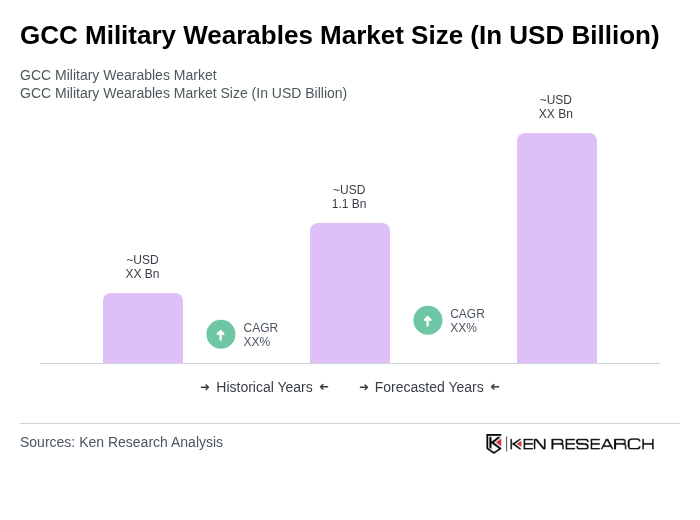
- The GCC Military Wearables Market is valued at USD 1.1 billion, based on a five-year historical analysis and benchmarked against the share of Middle East and Africa within the global military wearables market. This growth is primarily driven by increasing defense budgets across the GCC, extensive soldier modernization programs, and the rising need for enhanced soldier performance, protection, and connectivity. The integration of IoT, AI, advanced sensors, and data analytics into smart helmets, exoskeletons, health?monitoring wearables, and communication systems has further propelled demand for innovative military wearable solutions in the region.
- Key players in this market include Saudi Arabia, the UAE, and Qatar, which together account for the majority of GCC defense spending and capability development. These countries dominate the market due to their substantial and consistently growing defense budgets, strategic geopolitical positions, and ongoing military and internal security modernization programs spanning land, air, and naval forces. The focus on enhancing operational efficiency, real?time situational awareness, and soldier safety has led to increased investments in advanced wearable technologies such as tactical communication headsets, integrated vision systems, and sensor?enabled body armor.
- In the UAE, the deployment of advanced wearable technologies in military training and operations is supported by broader defense technology and AI initiatives, including mandatory standards for defense systems under the UAE Armed Forces’ procurement and modernization frameworks and the national AI and digital transformation strategies led by the Ministry of Defence and related federal entities. For example, the UAE has introduced requirements within its defence acquisition and training programs to integrate sensor?based monitoring, secure communications, and performance?analytics solutions in selected land and special?forces training environments, ensuring that military personnel benefit from real?time data analytics, health and fatigue monitoring, and enhanced safety during exercises and live operations.
GCC Military Wearables Market Segmentation
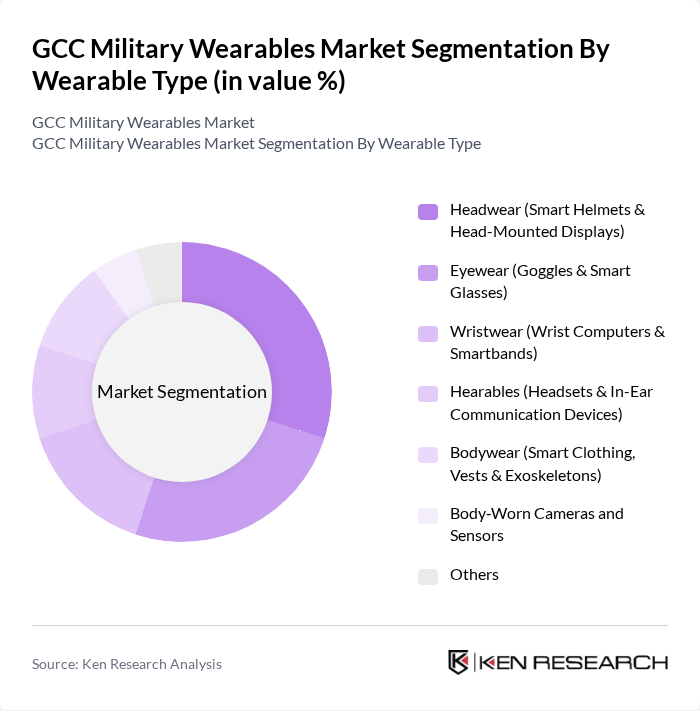
By Wearable Type:The wearable type segmentation includes various categories such as headwear, eyewear, wristwear, hearables, bodywear, body-worn cameras and sensors, and others. This structure aligns with global military wearables classifications that group products around communication, vision and surveillance, monitoring, and protection functions. Among these, headwear, particularly smart helmets and head-mounted displays, is gaining traction due to its ability to provide real-time information, integrated communications, friend?or?foe identification, and enhanced situational awareness for soldiers in combat scenarios. Eyewear, including smart glasses and augmented?reality goggles, is also witnessing significant adoption for surveillance, reconnaissance, and mission?planning overlays. The demand for body-worn cameras and sensors is increasing as they play a crucial role in data collection, mission debriefing, and health and fatigue monitoring during missions, supporting both operational analysis and training feedback loops.
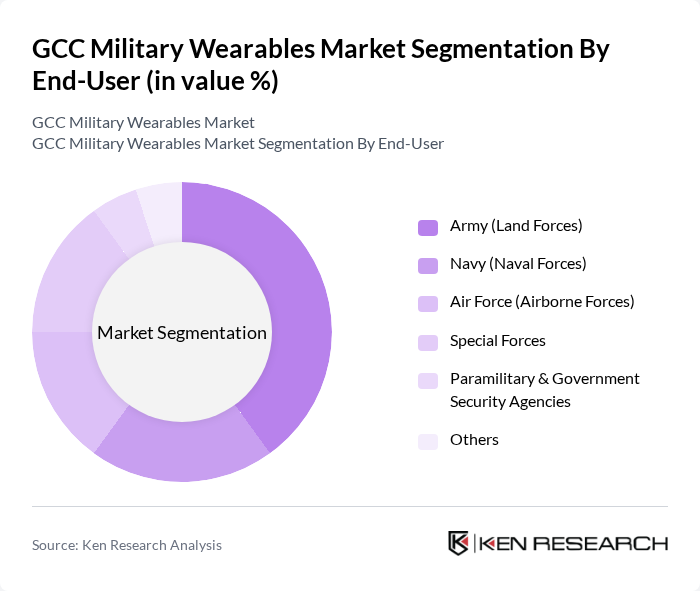
By End-User:The end-user segmentation encompasses various military branches, including the army, navy, air force, special forces, and paramilitary and government security agencies, consistent with global market breakdowns by land forces, naval forces, air forces, and other security entities. The army segment is the largest end-user of military wearables, in line with global trends where land forces account for the dominant share of demand due to the scale and intensity of ground operations and infantry?centric modernization programs. This segment is driven by the need for enhanced combat readiness, real?time communication, navigation support, and health and position monitoring of soldiers. The air force is also increasingly adopting wearables for pilot safety, situational awareness, and performance monitoring, including helmet?mounted displays and physiological sensors. Special forces require advanced wearable technologies such as lightweight tactical headsets, night?vision and augmented?reality systems, and body?worn sensors for specialized missions, leading to a growing demand in this segment, while paramilitary and government security agencies in the GCC are gradually integrating similar solutions for border security and critical?infrastructure protection.
GCC Military Wearables Market Competitive Landscape
The GCC Military Wearables Market is characterized by a dynamic mix of regional and international players. Leading participants such as Thales Group, BAE Systems plc, Elbit Systems Ltd., Northrop Grumman Corporation, Raytheon Technologies Corporation, General Dynamics Corporation, L3Harris Technologies, Inc., Leonardo S.p.A., Rheinmetall AG, Saab AB, Teledyne FLIR LLC, Collins Aerospace (RTX), Ultra Electronics Holdings plc, and Cubic Corporation contribute to innovation, geographic expansion, and service delivery in this space, with portfolios spanning vision and surveillance systems, tactical communications, soldier systems, and sensor?integrated protection solutions that are actively marketed into Middle Eastern and GCC defense programs.
GCC Military Wearables Market Industry Analysis
Growth Drivers
- Increasing Demand for Enhanced Soldier Performance:The GCC region is witnessing a significant push towards enhancing soldier performance, driven by the need for operational efficiency. In future, military expenditures in GCC countries are projected to reach approximately $80 billion, with a substantial portion allocated to advanced technologies. This investment is aimed at improving soldier capabilities through wearables that monitor health metrics and provide real-time data, thereby enhancing decision-making on the battlefield.
- Advancements in Wearable Technology:The rapid evolution of wearable technology is a key driver for the GCC military wearables market. In future, the global wearable technology market is expected to exceed $60 billion, with military applications gaining traction. Innovations such as lightweight materials, improved battery life, and enhanced connectivity are making wearables more effective for military use, allowing for better integration into existing systems and improving overall soldier performance in various environments.
- Rising Defense Budgets in GCC Countries:GCC nations are significantly increasing their defense budgets, with a collective rise of 5% expected in future, totaling around $80 billion. This increase is primarily driven by geopolitical tensions and the need for modernization. As a result, there is a growing allocation for military wearables, which are seen as essential for enhancing operational capabilities and ensuring soldier safety, thus driving market growth in the region.
Market Challenges
- High Costs of Advanced Wearable Technologies:One of the primary challenges facing the GCC military wearables market is the high cost associated with advanced technologies. In future, the average cost of military-grade wearables is estimated to be around $5,000 per unit. This high price point can limit procurement budgets, especially for smaller military units, making it difficult to achieve widespread adoption of these technologies across all branches of the military.
- Integration Issues with Existing Military Systems:The integration of new wearable technologies with existing military systems poses a significant challenge. In future, it is estimated that over 60% of military units in the GCC will face compatibility issues with legacy systems. This can lead to operational inefficiencies and increased costs, as additional resources are required to ensure seamless integration and functionality of new wearables within established military frameworks.
GCC Military Wearables Market Future Outlook
The future of the GCC military wearables market appears promising, driven by ongoing technological advancements and increased defense spending. As countries in the region prioritize military modernization, the demand for innovative wearable solutions is expected to rise. Furthermore, the integration of IoT and data analytics into military operations will enhance operational efficiency and decision-making. This trend is likely to foster collaborations between defense and technology sectors, paving the way for more sophisticated and effective military wearables in the coming years.
Market Opportunities
- Expansion of Military Modernization Programs:The GCC's focus on military modernization presents a significant opportunity for wearable technology providers. With an estimated $30 billion allocated for modernization initiatives in future, companies can capitalize on this trend by offering innovative solutions that enhance soldier capabilities and operational readiness, thereby gaining a competitive edge in the market.
- Collaborations with Tech Companies for Innovation:Collaborations between military organizations and technology firms are becoming increasingly common. In future, partnerships are expected to grow by 20%, fostering innovation in wearable technologies. These collaborations can lead to the development of cutting-edge solutions tailored to military needs, enhancing the effectiveness and functionality of wearables in the field.
Scope of the Report
| Segment | Sub-Segments |
|---|---|
| By Wearable Type | Headwear (Smart Helmets & Head-Mounted Displays) Eyewear (Goggles & Smart Glasses) Wristwear (Wrist Computers & Smartbands) Hearables (Headsets & In-Ear Communication Devices) Bodywear (Smart Clothing, Vests & Exoskeletons) Body?Worn Cameras and Sensors Others |
| By End-User | Army (Land Forces) Navy (Naval Forces) Air Force (Airborne Forces) Special Forces Paramilitary & Government Security Agencies Others |
| By Application | Combat Operations Training, Simulation & Mission Rehearsal Health & Performance Monitoring Command, Control, Communications, Computers, Intelligence, Surveillance and Reconnaissance (C4ISR) Logistics, Maintenance & Supply Chain Support Others |
| By Technology | Communication & Computing Network & Connectivity Management Navigation & Tracking Vision & Surveillance / Vision Enhancement Systems Monitoring (Health, Biometric & Environmental Sensors) Smart Textiles Exoskeleton Systems Power & Energy Management / Energy Harvesting Others |
| By Region | Saudi Arabia UAE Qatar Kuwait Oman Bahrain |
| By Procurement Type | Direct Government Procurement Procurement via Local Defense Contractors / System Integrators Public Tenders Framework Agreements & Long-Term Supply Contracts Others |
| By Funding Source | National Defense Budgets Sovereign Wealth Funds & Strategic Programs R&D Grants & Innovation Funds Public-Private Partnerships Others |
Key Target Audience
Investors and Venture Capitalist Firms
Government and Regulatory Bodies (e.g., Ministry of Defense, Ministry of Interior)
Military Procurement Agencies
Defense Contractors
Technology Providers and Developers
Logistics and Supply Chain Companies
Security and Defense Industry Associations
Financial Institutions and Investment Banks
Players Mentioned in the Report:
Thales Group
BAE Systems plc
Elbit Systems Ltd.
Northrop Grumman Corporation
Raytheon Technologies Corporation
General Dynamics Corporation
L3Harris Technologies, Inc.
Leonardo S.p.A.
Rheinmetall AG
Saab AB
Teledyne FLIR LLC
Collins Aerospace (RTX)
Ultra Electronics Holdings plc
Cubic Corporation
Regional & Local GCC Defense Electronics / Wearables OEMs
Table of Contents
Market Assessment Phase
1. Executive Summary and Approach
2. GCC Military Wearables Market Overview
2.1 Key Insights and Strategic Recommendations
2.2 GCC Military Wearables Market Overview
2.3 Definition and Scope
2.4 Evolution of Market Ecosystem
2.5 Timeline of Key Regulatory Milestones
2.6 Value Chain & Stakeholder Mapping
2.7 Business Cycle Analysis
2.8 Policy & Incentive Landscape
3. GCC Military Wearables Market Analysis
3.1 Growth Drivers
3.1.1 Increasing demand for enhanced soldier performance
3.1.2 Advancements in wearable technology
3.1.3 Rising defense budgets in GCC countries
3.1.4 Growing focus on soldier safety and health monitoring
3.2 Market Challenges
3.2.1 High costs of advanced wearable technologies
3.2.2 Integration issues with existing military systems
3.2.3 Data security and privacy concerns
3.2.4 Limited awareness and training on new technologies
3.3 Market Opportunities
3.3.1 Expansion of military modernization programs
3.3.2 Collaborations with tech companies for innovation
3.3.3 Increasing interest in dual-use technologies
3.3.4 Potential for export to allied nations
3.4 Market Trends
3.4.1 Growing adoption of IoT in military applications
3.4.2 Shift towards modular and scalable wearable solutions
3.4.3 Emphasis on data analytics for operational efficiency
3.4.4 Rising interest in augmented reality (AR) applications
3.5 Government Regulation
3.5.1 Compliance with international military standards
3.5.2 Regulations on data protection and cybersecurity
3.5.3 Export control laws for military technologies
3.5.4 Procurement policies favoring local manufacturers
4. SWOT Analysis
5. Stakeholder Analysis
6. Porter's Five Forces Analysis
7. GCC Military Wearables Market Market Size, 2019-2024
7.1 By Value
7.2 By Volume
7.3 By Average Selling Price
8. GCC Military Wearables Market Segmentation
8.1 By Wearable Type
8.1.1 Headwear (Smart Helmets & Head-Mounted Displays)
8.1.2 Eyewear (Goggles & Smart Glasses)
8.1.3 Wristwear (Wrist Computers & Smartbands)
8.1.4 Hearables (Headsets & In-Ear Communication Devices)
8.1.5 Bodywear (Smart Clothing, Vests & Exoskeletons)
8.1.6 Body?Worn Cameras and Sensors
8.1.7 Others
8.2 By End-User
8.2.1 Army (Land Forces)
8.2.2 Navy (Naval Forces)
8.2.3 Air Force (Airborne Forces)
8.2.4 Special Forces
8.2.5 Paramilitary & Government Security Agencies
8.2.6 Others
8.3 By Application
8.3.1 Combat Operations
8.3.2 Training, Simulation & Mission Rehearsal
8.3.3 Health & Performance Monitoring
8.3.4 Command, Control, Communications, Computers, Intelligence, Surveillance and Reconnaissance (C4ISR)
8.3.5 Logistics, Maintenance & Supply Chain Support
8.3.6 Others
8.4 By Technology
8.4.1 Communication & Computing
8.4.2 Network & Connectivity Management
8.4.3 Navigation & Tracking
8.4.4 Vision & Surveillance / Vision Enhancement Systems
8.4.5 Monitoring (Health, Biometric & Environmental Sensors)
8.4.6 Smart Textiles
8.4.7 Exoskeleton Systems
8.4.8 Power & Energy Management / Energy Harvesting
8.4.9 Others
8.5 By Region
8.5.1 Saudi Arabia
8.5.2 UAE
8.5.3 Qatar
8.5.4 Kuwait
8.5.5 Oman
8.5.6 Bahrain
8.6 By Procurement Type
8.6.1 Direct Government Procurement
8.6.2 Procurement via Local Defense Contractors / System Integrators
8.6.3 Public Tenders
8.6.4 Framework Agreements & Long-Term Supply Contracts
8.6.5 Others
8.7 By Funding Source
8.7.1 National Defense Budgets
8.7.2 Sovereign Wealth Funds & Strategic Programs
8.7.3 R&D Grants & Innovation Funds
8.7.4 Public-Private Partnerships
8.7.5 Others
9. GCC Military Wearables Market Competitive Analysis
9.1 Market Share of Key Players
9.2 Cross Comparison of Key Players
9.2.1 Company Name
9.2.2 Group Size (Large, Medium, or Small as per industry convention)
9.2.3 GCC Military Wearables Revenue (Latest Year, USD Mn)
9.2.4 3-Year GCC Revenue CAGR (%)
9.2.5 Share of GCC Revenue in Global Company Defense Sales (%)
9.2.6 Number of Active GCC Programs / Contracts
9.2.7 Installed Base of Deployed Wearable Systems in GCC (Units)
9.2.8 R&D Intensity in Wearables (% of Defense Revenue)
9.2.9 New Product / Upgrade Launches in Last 3 Years (Count)
9.2.10 Average Contract Value in GCC (USD Mn)
9.2.11 EBITDA Margin for GCC Defense / Wearables Business (%)
9.2.12 Win Rate in Competitive Tenders in GCC (%)
9.2.13 Strategic Partnerships / JVs Signed in GCC (Count)
9.3 SWOT Analysis of Top Players
9.4 Pricing Analysis
9.5 Detailed Profile of Major Companies
9.5.1 Thales Group
9.5.2 BAE Systems plc
9.5.3 Elbit Systems Ltd.
9.5.4 Northrop Grumman Corporation
9.5.5 Raytheon Technologies Corporation
9.5.6 General Dynamics Corporation
9.5.7 L3Harris Technologies, Inc.
9.5.8 Leonardo S.p.A.
9.5.9 Rheinmetall AG
9.5.10 Saab AB
9.5.11 Teledyne FLIR LLC
9.5.12 Collins Aerospace (RTX)
9.5.13 Ultra Electronics Holdings plc
9.5.14 Cubic Corporation
9.5.15 Regional & Local GCC Defense Electronics / Wearables OEMs
10. GCC Military Wearables Market End-User Analysis
10.1 Procurement Behavior of Key Ministries
10.1.1 Ministry of Defense
10.1.2 Ministry of Interior
10.1.3 Ministry of Health
10.1.4 Ministry of Education
10.2 Corporate Spend on Infrastructure & Energy
10.2.1 Defense Infrastructure Projects
10.2.2 Technology Upgrades
10.2.3 Training Programs
10.3 Pain Point Analysis by End-User Category
10.3.1 Budget Constraints
10.3.2 Technology Integration Issues
10.3.3 Training and Skill Gaps
10.4 User Readiness for Adoption
10.4.1 Awareness of Wearable Technologies
10.4.2 Training and Support Availability
10.5 Post-Deployment ROI and Use Case Expansion
10.5.1 Performance Metrics Evaluation
10.5.2 Feedback Mechanisms
11. GCC Military Wearables Market Future Size, 2025-2030
11.1 By Value
11.2 By Volume
11.3 By Average Selling Price
Go-To-Market Strategy Phase
1. Whitespace Analysis + Business Model Canvas
1.1 Market Gaps Identification
1.2 Value Proposition Development
1.3 Revenue Streams Analysis
1.4 Cost Structure Evaluation
1.5 Key Partnerships Exploration
1.6 Customer Segmentation
1.7 Channels of Distribution
2. Marketing and Positioning Recommendations
2.1 Branding Strategies
2.2 Product USPs
3. Distribution Plan
3.1 Urban Retail vs Rural NGO Tie-ups
4. Channel & Pricing Gaps
4.1 Underserved Routes
4.2 Pricing Bands
5. Unmet Demand & Latent Needs
5.1 Category Gaps
5.2 Consumer Segments
6. Customer Relationship
6.1 Loyalty Programs
6.2 After-sales Service
7. Value Proposition
7.1 Sustainability
7.2 Integrated Supply Chains
8. Key Activities
8.1 Regulatory Compliance
8.2 Branding
8.3 Distribution Setup
9. Entry Strategy Evaluation
9.1 Domestic Market Entry Strategy
9.1.1 Product Mix
9.1.2 Pricing Band
9.1.3 Packaging
9.2 Export Entry Strategy
9.2.1 Target Countries
9.2.2 Compliance Roadmap
10. Entry Mode Assessment
10.1 Joint Ventures
10.2 Greenfield Investments
10.3 Mergers & Acquisitions
10.4 Distributor Model
11. Capital and Timeline Estimation
11.1 Capital Requirements
11.2 Timelines
12. Control vs Risk Trade-Off
12.1 Ownership vs Partnerships
13. Profitability Outlook
13.1 Breakeven Analysis
13.2 Long-term Sustainability
14. Potential Partner List
14.1 Distributors
14.2 Joint Ventures
14.3 Acquisition Targets
15. Execution Roadmap
15.1 Phased Plan for Market Entry
15.1.1 Market Setup
15.1.2 Market Entry
15.1.3 Growth Acceleration
15.1.4 Scale & Stabilize
15.2 Key Activities and Milestones
15.2.1 Milestone Planning
15.2.2 Activity Tracking
Research Methodology
Phase 1: Approach1
Desk Research
- Analysis of market reports from defense and military technology publications
- Review of government defense budgets and procurement policies in GCC countries
- Examination of industry white papers and case studies on military wearables
Primary Research
- Interviews with military procurement officers and defense contractors
- Surveys with technology developers specializing in wearable devices for military use
- Field interviews with end-users, including soldiers and military trainers
Validation & Triangulation
- Cross-validation of findings through multiple expert interviews and focus groups
- Triangulation of data from government reports, industry publications, and expert insights
- Sanity checks through feedback from a panel of military technology experts
Phase 2: Market Size Estimation1
Top-down Assessment
- Estimation of total military expenditure in GCC countries as a basis for wearables market size
- Segmentation of military budgets by technology categories, including wearables
- Incorporation of regional defense cooperation initiatives and joint exercises
Bottom-up Modeling
- Collection of sales data from leading wearable technology manufacturers in the military sector
- Estimation of unit sales based on military contracts and procurement cycles
- Analysis of pricing strategies and cost structures of wearable devices
Forecasting & Scenario Analysis
- Multi-factor regression analysis incorporating technological advancements and defense spending trends
- Scenario modeling based on geopolitical developments and military modernization efforts
- Baseline, optimistic, and pessimistic forecasts through 2030 based on varying defense budgets
Phase 3: CATI Sample Composition1
| Scope Item/Segment | Sample Size | Target Respondent Profiles |
|---|---|---|
| Military Procurement Officers | 120 | Defense Acquisition Managers, Budget Analysts |
| Wearable Technology Developers | 90 | Product Managers, R&D Engineers |
| End-Users in Military Training | 80 | Military Trainers, Field Operators |
| Defense Contractors | 70 | Business Development Managers, Technical Sales Representatives |
| Military Technology Experts | 60 | Consultants, Analysts in Defense Technology |
Frequently Asked Questions
What is the current value of the GCC Military Wearables Market?
The GCC Military Wearables Market is valued at approximately USD 1.1 billion, driven by increasing defense budgets, soldier modernization programs, and the demand for enhanced soldier performance and connectivity through advanced wearable technologies.
What factors are driving growth in the GCC Military Wearables Market?
Which countries are the major players in the GCC Military Wearables Market?
What types of wearables are included in the GCC Military Wearables Market?
Other Regional/Country Reports
Indonesia Military Wearables Market
Malaysia Military Wearables Market
KSA Military Wearables Market
APAC Military Wearables Market
SEA Military Wearables Market
Vietnam Military Wearables Market
Other Adjacent Reports
South Africa Military Exoskeletons Market
Bahrain Tactical Communication Systems Market
Kuwait Defense Sensors Market
Global soldier systems market report Size, Share, Growth Drivers, Trends, Opportunities & Forecast 2025–2030Qatar AI in Defense Market
Kuwait IoT in Military Market
Philippines Augmented Reality Defense Market
Saudi Arabia Body Armor Market Size, Share, Growth Drivers, Trends, Opportunities & Forecast 2025–2030UAE Night Vision Devices MarketKSA Military Surveillance Systems Market
Why Buy From Us?

What makes us stand out is that our consultants follow Robust, Refine and Result (RRR) methodology. Robust for clear definitions, approaches and sanity checking, Refine for differentiating respondents' facts and opinions, and Result for presenting data with story.

We have set a benchmark in the industry by offering our clients with syndicated and customized market research reports featuring coverage of entire market as well as meticulous research and analyst insights.

While we don't replace traditional research, we flip the method upside down. Our dual approach of Top Bottom & Bottom Top ensures quality deliverable by not just verifying company fundamentals but also looking at the sector and macroeconomic factors.

With one step in the future, our research team constantly tries to show you the bigger picture. We help with some of the tough questions you may encounter along the way: How is the industry positioned? Best marketing channel? KPI's of competitors? By aligning every element, we help maximize success.

Our report gives you instant access to the answers and sources that other companies might choose to hide. We elaborate each steps of research methodology we have used and showcase you the sample size to earn your trust.

If you need any support, we are here! We pride ourselves on universe strength, data quality, and quick, friendly, and professional service.