About the Report
Base Year 2024GCC Motorcycles Market Overview
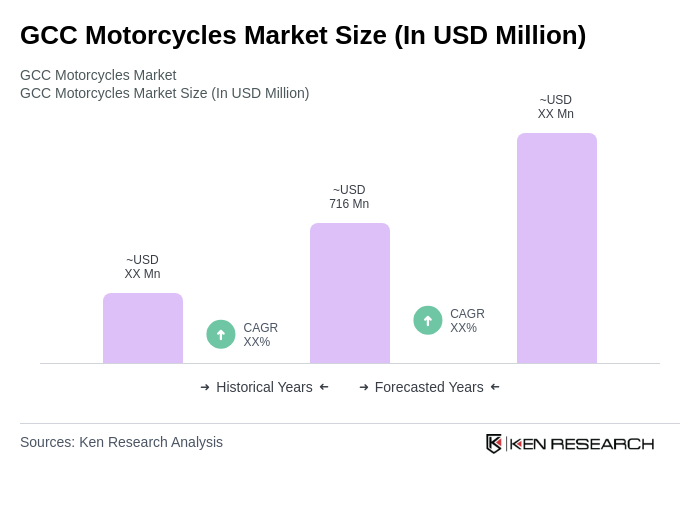
- The GCC Motorcycles Market is valued at USD 716 million, based on a five-year historical analysis. This valuation reflects the market's recent dynamics, as consumption demonstrated strong expansion over the review period before experiencing a slight contraction in 2024. The market growth is primarily driven by increasing urbanization, rising disposable incomes, and a growing interest in recreational activities among consumers. The market has seen sustained demand for motorcycles as a cost-effective and efficient mode of transportation, particularly in densely populated urban areas, with the region heavily reliant on imports of approximately 1.1 million units valued at USD 1.7 billion.
- Key consuming markets within the GCC include the United Arab Emirates, Saudi Arabia, and Qatar. The UAE leads due to its robust tourism sector and a high number of expatriates, while Saudi Arabia benefits from a large youth population and increasing motorcycle adoption for leisure and commuting. Qatar's growing infrastructure and events have also contributed to its market prominence. The Middle East region collectively, which encompasses the GCC, demonstrated market revenue of USD 2.5 billion in 2024, with Turkey, the UAE, and Saudi Arabia representing the largest consuming nations collectively accounting for 70% of total volume.
- Environmental regulations have shaped market dynamics in the GCC region. Governments have implemented emissions standards focused on promoting environmental sustainability and encouraging the adoption of cleaner technologies. The region demonstrates a significant shift towards electric motorcycles and scooters, fueled by environmental concerns and supportive government policies promoting clean energy vehicles.
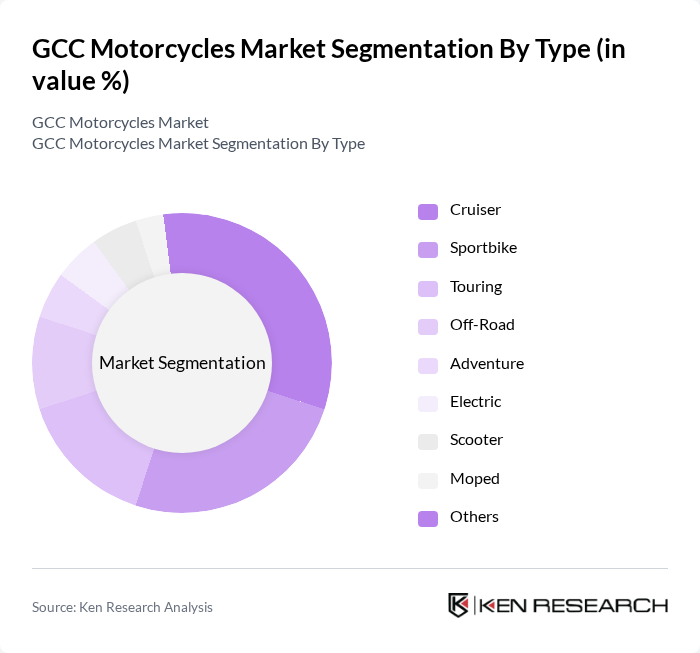
GCC Motorcycles Market Segmentation
By Type:The market is segmented into various types of motorcycles, including Cruiser, Sportbike, Touring, Off-Road, Adventure, Electric, Scooter, Moped, and Others. Among these, the Cruiser segment is particularly popular due to its comfort and style, appealing to both leisure riders and commuters. The Sportbike segment is also gaining traction, especially among younger consumers seeking performance and speed. The Electric segment is emerging as a significant player, driven by increasing environmental awareness and government incentives. Technological advancements such as connected vehicles and enhanced safety features are gaining traction, alongside the growing popularity of shared mobility services.
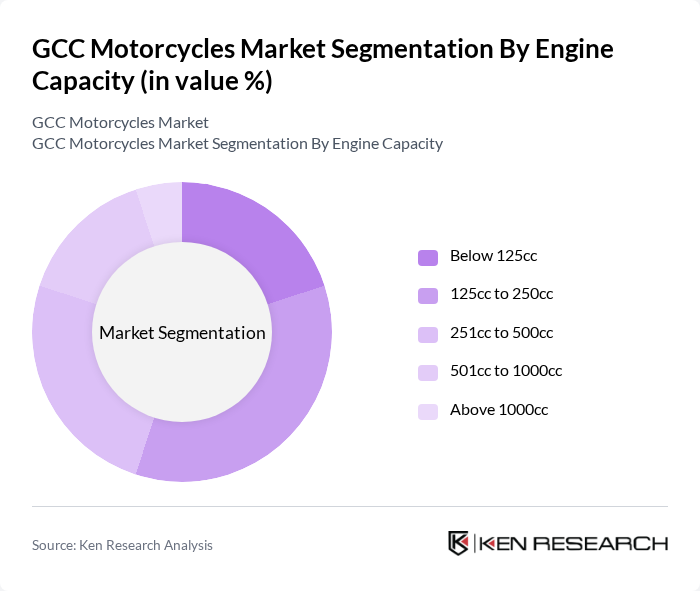
By Engine Capacity:The market is also segmented by engine capacity, including Below 125cc, 125cc to 250cc, 251cc to 500cc, 501cc to 1000cc, and Above 1000cc. The 125cc to 250cc segment is currently dominating the market, as it offers a balance between power and fuel efficiency, making it ideal for both new riders and experienced users looking for a practical option. The Below 125cc segment is also popular among urban commuters due to its affordability and ease of handling. Motorcycles with engine capacities between 50cc and 250cc dominate regional imports, constituting the majority of import volume across the Middle East.
GCC Motorcycles Market Competitive Landscape
The GCC Motorcycles Market is characterized by a dynamic mix of regional and international players. Leading participants such as Honda Motor Co., Ltd., Yamaha Motor Co., Ltd., Kawasaki Heavy Industries, Ltd., Suzuki Motor Corporation, Harley-Davidson, Inc., KTM AG, BMW Motorrad, Ducati Motor Holding S.p.A., Piaggio & C. S.p.A., Royal Enfield (Eicher Motors Ltd.), Triumph Motorcycles Ltd., Bajaj Auto Ltd., TVS Motor Company, Zero Motorcycles, Inc., Benelli Q.J., Hero MotoCorp Ltd., CFMoto, Moto Guzzi (Piaggio Group), Vespa (Piaggio Group), UM Motorcycles contribute to innovation, geographic expansion, and service delivery in this space.
GCC Motorcycles Market Industry Analysis
Growth Drivers
- Increasing Urbanization:The GCC region is experiencing rapid urbanization, with urban population growth projected to reach 90% in future. This shift is driving demand for motorcycles as a convenient mode of transport in congested cities. For instance, cities like Dubai and Riyadh are investing in motorcycle-friendly infrastructure, including dedicated lanes and parking spaces, which enhances accessibility. The urban population in the GCC is expected to exceed 54 million in future, further fueling the motorcycle market.
- Rising Disposable Incomes:The average disposable income in the GCC is projected to increase to approximately $32,000 per capita in future, up from $27,000 previously. This rise in income levels is enabling consumers to invest in motorcycles for both commuting and leisure. As more individuals can afford motorcycles, the market is likely to see a surge in sales, particularly in the mid-range and premium segments, which are expected to grow significantly due to increased purchasing power.
- Growing Interest in Recreational Riding:The GCC is witnessing a cultural shift towards recreational activities, with motorcycle riding gaining popularity as a leisure pursuit. Events such as the annual Dubai Motorcycle Festival attract thousands of enthusiasts, showcasing the growing community. The number of registered motorcycle clubs in the region has increased by 30% since previously, indicating a robust interest in recreational riding. This trend is expected to continue, further driving motorcycle sales and related services.
Market Challenges
- Regulatory Compliance Issues:The GCC motorcycle market faces significant regulatory compliance challenges, particularly concerning safety and emissions standards. For example, the UAE has implemented stringent emission regulations that require motorcycles to meet Euro 4 standards in future. Non-compliance can lead to hefty fines and restrictions on sales, creating barriers for manufacturers and importers. This regulatory landscape complicates market entry and increases operational costs for businesses.
- High Import Tariffs:Import tariffs on motorcycles in the GCC can reach as high as 20%, significantly impacting the affordability of foreign brands. This high tariff structure discourages international manufacturers from entering the market, limiting consumer choices and stifling competition. As a result, local manufacturers may struggle to compete with imported models, which can lead to higher prices and reduced market growth. The tariff situation remains a critical challenge for market expansion.
GCC Motorcycles Market Future Outlook
The GCC motorcycles market is poised for significant transformation driven by technological advancements and changing consumer preferences. The increasing adoption of electric motorcycles, supported by government initiatives for sustainable transport, is expected to reshape the market landscape. Additionally, the rise of e-commerce platforms is facilitating easier access to motorcycle sales and services, enhancing consumer engagement. As urbanization continues and disposable incomes rise, the market is likely to witness a shift towards more eco-friendly and technologically advanced models, catering to evolving consumer demands.
Market Opportunities
- Development of Electric Motorcycles:The demand for electric motorcycles is anticipated to grow, with the GCC governments investing in charging infrastructure. In future, the number of electric vehicle charging stations is expected to exceed 1,200 across the region, promoting the adoption of electric motorcycles. This shift presents a lucrative opportunity for manufacturers to innovate and capture a growing segment of environmentally conscious consumers.
- Expansion of E-commerce Platforms:The rise of e-commerce in the GCC is creating new sales channels for motorcycles and accessories. Online sales are projected to account for 35% of total motorcycle sales in future, driven by increased internet penetration and consumer preference for online shopping. This trend offers manufacturers and retailers a chance to reach a broader audience and enhance customer engagement through digital platforms.
Scope of the Report
| Segment | Sub-Segments |
|---|---|
| By Type | Cruiser Sportbike Touring Off-Road Adventure Electric Scooter Moped Others |
| By Engine Capacity | Below 125cc cc to 250cc cc to 500cc cc to 1000cc Above 1000cc |
| By End-User | Individual Consumers Commercial Users Government Agencies Rental Services |
| By Propulsion | Internal Combustion Engine (ICE) Electric |
| By Sales Channel | OEM Dealerships Independent Dealers Online Retail Auctions |
| By Distribution Mode | Urban Distribution Rural Distribution Export Distribution Others |
| By Price Range | Budget Mid-Range Premium Ultra-Premium/Luxury |
| By Brand Loyalty | Established Brands New Entrants Others |
Key Target Audience
Investors and Venture Capitalist Firms
Government and Regulatory Bodies (e.g., Ministry of Interior, Ministry of Economy)
Motorcycle Manufacturers and Producers
Distributors and Retailers
Automotive Parts Suppliers
Insurance Companies
Motorcycle Clubs and Associations
Logistics and Transportation Companies
Players Mentioned in the Report:
Honda Motor Co., Ltd.
Yamaha Motor Co., Ltd.
Kawasaki Heavy Industries, Ltd.
Suzuki Motor Corporation
Harley-Davidson, Inc.
KTM AG
BMW Motorrad
Ducati Motor Holding S.p.A.
Piaggio & C. S.p.A.
Royal Enfield (Eicher Motors Ltd.)
Triumph Motorcycles Ltd.
Bajaj Auto Ltd.
TVS Motor Company
Zero Motorcycles, Inc.
Benelli Q.J.
Hero MotoCorp Ltd.
CFMoto
Moto Guzzi (Piaggio Group)
Vespa (Piaggio Group)
UM Motorcycles
Table of Contents
Market Assessment Phase
1. Executive Summary and Approach
2. GCC Motorcycles Market Overview
2.1 Key Insights and Strategic Recommendations
2.2 GCC Motorcycles Market Overview
2.3 Definition and Scope
2.4 Evolution of Market Ecosystem
2.5 Timeline of Key Regulatory Milestones
2.6 Value Chain & Stakeholder Mapping
2.7 Business Cycle Analysis
2.8 Policy & Incentive Landscape
3. GCC Motorcycles Market Analysis
3.1 Growth Drivers
3.1.1 Increasing Urbanization
3.1.2 Rising Disposable Incomes
3.1.3 Growing Interest in Recreational Riding
3.1.4 Expansion of Motorcycle Tourism
3.2 Market Challenges
3.2.1 Regulatory Compliance Issues
3.2.2 High Import Tariffs
3.2.3 Limited Infrastructure for Motorcycles
3.2.4 Safety Concerns and Accidents
3.3 Market Opportunities
3.3.1 Development of Electric Motorcycles
3.3.2 Expansion of E-commerce Platforms
3.3.3 Increasing Demand for Customization
3.3.4 Government Initiatives for Sustainable Transport
3.4 Market Trends
3.4.1 Shift Towards Eco-Friendly Models
3.4.2 Rise of Smart Motorcycles
3.4.3 Growth of Motorcycle Clubs and Communities
3.4.4 Increasing Popularity of Adventure Riding
3.5 Government Regulation
3.5.1 Emission Standards Compliance
3.5.2 Licensing and Registration Requirements
3.5.3 Safety Gear Mandates
3.5.4 Import Regulations for Motorcycles
4. SWOT Analysis
5. Stakeholder Analysis
6. Porter's Five Forces Analysis
7. GCC Motorcycles Market Market Size, 2019-2024
7.1 By Value
7.2 By Volume
7.3 By Average Selling Price
8. GCC Motorcycles Market Segmentation
8.1 By Type
8.1.1 Cruiser
8.1.2 Sportbike
8.1.3 Touring
8.1.4 Off-Road
8.1.5 Adventure
8.1.6 Electric
8.1.7 Scooter
8.1.8 Moped
8.1.9 Others
8.2 By Engine Capacity
8.2.1 Below 125cc
8.2.2 125cc to 250cc
8.2.3 251cc to 500cc
8.2.4 501cc to 1000cc
8.2.5 Above 1000cc
8.3 By End-User
8.3.1 Individual Consumers
8.3.2 Commercial Users
8.3.3 Government Agencies
8.3.4 Rental Services
8.4 By Propulsion
8.4.1 Internal Combustion Engine (ICE)
8.4.2 Electric
8.5 By Sales Channel
8.5.1 OEM Dealerships
8.5.2 Independent Dealers
8.5.3 Online Retail
8.5.4 Auctions
8.6 By Distribution Mode
8.6.1 Urban Distribution
8.6.2 Rural Distribution
8.6.3 Export Distribution
8.6.4 Others
8.7 By Price Range
8.7.1 Budget
8.7.2 Mid-Range
8.7.3 Premium
8.7.4 Ultra-Premium/Luxury
8.8 By Brand Loyalty
8.8.1 Established Brands
8.8.2 New Entrants
8.8.3 Others
9. GCC Motorcycles Market Competitive Analysis
9.1 Market Share of Key Players
9.2 Cross Comparison of Key Players
9.2.1 Company Name
9.2.2 Group Size (Large, Medium, or Small as per industry convention)
9.2.3 Revenue (GCC Region)
9.2.4 Revenue Growth Rate (GCC Region)
9.2.5 Market Share (GCC Motorcycles Market)
9.2.6 Market Penetration Rate
9.2.7 Product Portfolio Breadth (Number of Models)
9.2.8 Product Diversification Index
9.2.9 Brand Equity Score
9.2.10 Distribution Network Coverage (Number of Dealerships/Outlets in GCC)
9.2.11 After-Sales Service Network Strength
9.2.12 Customer Satisfaction Index
9.2.13 Pricing Strategy (Positioning: Budget, Mid-Range, Premium, Luxury)
9.2.14 Innovation Index (e.g., Electric/Hybrid Offerings, Smart Features)
9.3 SWOT Analysis of Top Players
9.4 Pricing Analysis
9.5 Detailed Profile of Major Companies
9.5.1 Honda Motor Co., Ltd.
9.5.2 Yamaha Motor Co., Ltd.
9.5.3 Kawasaki Heavy Industries, Ltd.
9.5.4 Suzuki Motor Corporation
9.5.5 Harley-Davidson, Inc.
9.5.6 KTM AG
9.5.7 BMW Motorrad
9.5.8 Ducati Motor Holding S.p.A.
9.5.9 Piaggio & C. S.p.A.
9.5.10 Royal Enfield (Eicher Motors Ltd.)
9.5.11 Triumph Motorcycles Ltd.
9.5.12 Bajaj Auto Ltd.
9.5.13 TVS Motor Company
9.5.14 Zero Motorcycles, Inc.
9.5.15 Benelli Q.J.
9.5.16 Hero MotoCorp Ltd.
9.5.17 CFMoto
9.5.18 Moto Guzzi (Piaggio Group)
9.5.19 Vespa (Piaggio Group)
9.5.20 UM Motorcycles
10. GCC Motorcycles Market End-User Analysis
10.1 Procurement Behavior of Key Ministries
10.1.1 Government Procurement Policies
10.1.2 Budget Allocations for Motorcycles
10.1.3 Evaluation Criteria for Suppliers
10.2 Corporate Spend on Infrastructure & Energy
10.2.1 Investment in Motorcycle Infrastructure
10.2.2 Corporate Fleet Management
10.2.3 Partnerships with Motorcycle Manufacturers
10.3 Pain Point Analysis by End-User Category
10.3.1 Cost of Ownership
10.3.2 Maintenance Challenges
10.3.3 Safety Concerns
10.4 User Readiness for Adoption
10.4.1 Awareness of Motorcycle Benefits
10.4.2 Training and Licensing Availability
10.4.3 Financial Accessibility
10.5 Post-Deployment ROI and Use Case Expansion
10.5.1 Performance Metrics
10.5.2 User Feedback Mechanisms
10.5.3 Expansion into New Use Cases
11. GCC Motorcycles Market Future Size, 2025-2030
11.1 By Value
11.2 By Volume
11.3 By Average Selling Price
Go-To-Market Strategy Phase
1. Whitespace Analysis + Business Model Canvas
1.1 Market Gaps Identification
1.2 Business Model Framework
2. Marketing and Positioning Recommendations
2.1 Branding Strategies
2.2 Product USPs
3. Distribution Plan
3.1 Urban Retail Strategies
3.2 Rural NGO Tie-ups
4. Channel & Pricing Gaps
4.1 Underserved Routes
4.2 Pricing Bands Analysis
5. Unmet Demand & Latent Needs
5.1 Category Gaps
5.2 Consumer Segments
6. Customer Relationship
6.1 Loyalty Programs
6.2 After-sales Service
7. Value Proposition
7.1 Sustainability Initiatives
7.2 Integrated Supply Chains
8. Key Activities
8.1 Regulatory Compliance
8.2 Branding Efforts
8.3 Distribution Setup
9. Entry Strategy Evaluation
9.1 Domestic Market Entry Strategy
9.1.1 Product Mix Considerations
9.1.2 Pricing Band Strategy
9.1.3 Packaging Options
9.2 Export Entry Strategy
9.2.1 Target Countries
9.2.2 Compliance Roadmap
10. Entry Mode Assessment
10.1 Joint Ventures
10.2 Greenfield Investments
10.3 Mergers & Acquisitions
10.4 Distributor Model
11. Capital and Timeline Estimation
11.1 Capital Requirements
11.2 Timelines for Market Entry
12. Control vs Risk Trade-Off
12.1 Ownership vs Partnerships
13. Profitability Outlook
13.1 Breakeven Analysis
13.2 Long-term Sustainability
14. Potential Partner List
14.1 Distributors
14.2 Joint Ventures
14.3 Acquisition Targets
15. Execution Roadmap
15.1 Phased Plan for Market Entry
15.1.1 Market Setup
15.1.2 Market Entry
15.1.3 Growth Acceleration
15.1.4 Scale & Stabilize
15.2 Key Activities and Milestones
15.2.1 Activity Planning
15.2.2 Milestone Tracking
Research Methodology
Phase 1: Approach1
Desk Research
- Analysis of industry reports from GCC motorcycle associations and trade bodies
- Review of government publications and transportation statistics related to motorcycle registrations
- Examination of market trends through academic journals and publications focused on automotive and transportation sectors
Primary Research
- Interviews with motorcycle manufacturers and distributors operating in the GCC region
- Surveys conducted with motorcycle retailers to gather insights on consumer preferences and sales data
- Focus group discussions with motorcycle enthusiasts to understand market trends and brand perceptions
Validation & Triangulation
- Cross-validation of data from multiple sources including sales figures and registration data
- Triangulation of insights from primary interviews with secondary data findings
- Sanity checks through expert reviews from industry analysts and market consultants
Phase 2: Market Size Estimation1
Top-down Assessment
- Estimation of total market size based on national motorcycle sales and registration data
- Segmentation of the market by motorcycle type (e.g., cruisers, sport bikes, scooters)
- Incorporation of growth rates from historical data and projected economic indicators in the GCC
Bottom-up Modeling
- Collection of sales data from leading motorcycle dealerships across the GCC
- Estimation of average selling prices and volume sold per motorcycle type
- Analysis of aftermarket sales including parts, accessories, and service revenues
Forecasting & Scenario Analysis
- Development of market forecasts using time-series analysis and growth projections
- Scenario modeling based on economic conditions, regulatory changes, and consumer behavior shifts
- Creation of best-case, worst-case, and most-likely scenarios through 2030
Phase 3: CATI Sample Composition1
| Scope Item/Segment | Sample Size | Target Respondent Profiles |
|---|---|---|
| Motorcycle Retailers | 100 | Store Managers, Sales Representatives |
| Motorcycle Manufacturers | 60 | Product Managers, Marketing Directors |
| Motorcycle Enthusiasts | 50 | Club Leaders, Active Riders |
| Aftermarket Parts Suppliers | 40 | Supply Chain Managers, Product Development Heads |
| Government Regulatory Bodies | 40 | Policy Makers, Transportation Officials |
Frequently Asked Questions
What is the current value of the GCC Motorcycles Market?
The GCC Motorcycles Market is valued at approximately USD 716 million, reflecting strong growth dynamics over the past five years, despite a slight contraction expected in 2024. This valuation highlights the market's resilience and potential for future expansion.
Which countries are the key consumers in the GCC Motorcycles Market?
What factors are driving the growth of the GCC Motorcycles Market?
What are the main challenges facing the GCC Motorcycles Market?
Other Regional/Country Reports
Indonesia Motorcycles Market
Malaysia Motorcycles Market
KSA Motorcycles Market
APAC Motorcycles Market
SEA Motorcycles Market
Vietnam Motorcycles Market
Other Adjacent Reports
Vietnam Motorcycle Parts Market
Kuwait Two-Wheeler Insurance Market
Japan Electric Vehicle Charging Market
Singapore Urban Mobility Market
South Korea Recreational Vehicles Market
Saudi Arabia automotive lubricants market size, share, growth drivers, trends, opportunities & forecast 2025–2030Vietnam Tire Manufacturing Market
Belgium Protective Gear MarketMiddle East Motorcycle Rental MarketAsia Pacific E-Bike Market Outlook to 2030: Size, Share, Growth and TrendsWhy Buy From Us?

What makes us stand out is that our consultants follow Robust, Refine and Result (RRR) methodology. Robust for clear definitions, approaches and sanity checking, Refine for differentiating respondents' facts and opinions, and Result for presenting data with story.

We have set a benchmark in the industry by offering our clients with syndicated and customized market research reports featuring coverage of entire market as well as meticulous research and analyst insights.

While we don't replace traditional research, we flip the method upside down. Our dual approach of Top Bottom & Bottom Top ensures quality deliverable by not just verifying company fundamentals but also looking at the sector and macroeconomic factors.

With one step in the future, our research team constantly tries to show you the bigger picture. We help with some of the tough questions you may encounter along the way: How is the industry positioned? Best marketing channel? KPI's of competitors? By aligning every element, we help maximize success.

Our report gives you instant access to the answers and sources that other companies might choose to hide. We elaborate each steps of research methodology we have used and showcase you the sample size to earn your trust.

If you need any support, we are here! We pride ourselves on universe strength, data quality, and quick, friendly, and professional service.