Ken Research Logo

Gcc Plant Biotechnology Equipment Market Size, Share, Growth Drivers, Trends, Opportunities & Forecast 2025–2030

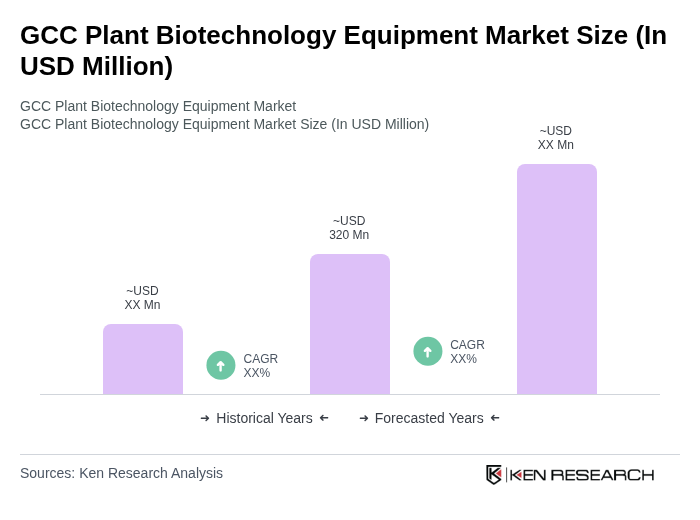
GCC Plant Biotechnology Equipment Market is worth USD 320 million, with key growth from government initiatives and demand for innovative agricultural tech in the GCC region.

Region:Middle East

Author(s):Geetanshi

Product Code:KRAD3931

Pages:89

Published On:November 2025
About the Report

Base Year 2024

GCC Plant Biotechnology Equipment Market Overview

  • The GCC Plant Biotechnology Equipment Market is valued at USD 320 million, based on a five-year historical analysis. This estimate reflects the GCC’s share of the global plant biotechnology equipment market, which is driven by increasing investments in agricultural research, advancements in biotechnology, and the rising demand for sustainable agricultural practices. The market is further supported by government initiatives aimed at enhancing food security and promoting innovative agricultural technologies .
  • Key players in this market include Saudi Arabia, the United Arab Emirates, and Qatar. These countries lead the market due to substantial investments in agricultural technology, robust research institutions, and favorable government policies that encourage biotechnology development. The presence of leading universities and research centers, such as King Abdullah University of Science and Technology (KAUST) in Saudi Arabia and the International Center for Biosaline Agriculture (ICBA) in the UAE, further enhances their competitive edge in the biotechnology sector .
  • In 2023, the GCC governments advanced regulations to promote sustainable agricultural practices, including the introduction of guidelines for the use of genetically modified organisms (GMOs). For example, the "GCC Standardization Organization Technical Regulation for Genetically Modified Foods and Feed (GSO 2141:2011)"—issued by the GCC Standardization Organization—sets requirements for the safety assessment, labeling, and traceability of GMOs, ensuring safety and environmental protection while facilitating the adoption of innovative biotechnological solutions in agriculture .
GCC Plant Biotechnology Equipment Market Size

GCC Plant Biotechnology Equipment Market Segmentation

By Type:The market is segmented into various types of equipment, including Laboratory Equipment, Greenhouse & Growth Chambers, Bioreactors & Fermenters, Imaging & Phenotyping Systems, Automated Liquid Handling & Robotics, Field Equipment, and Others. Among these, Laboratory Equipment is the most dominant segment due to its essential role in research and development activities in plant biotechnology. The increasing focus on genetic research, crop improvement, and precision agriculture drives the demand for advanced laboratory tools, such as PCR machines, sequencers, and automated sample handling systems .
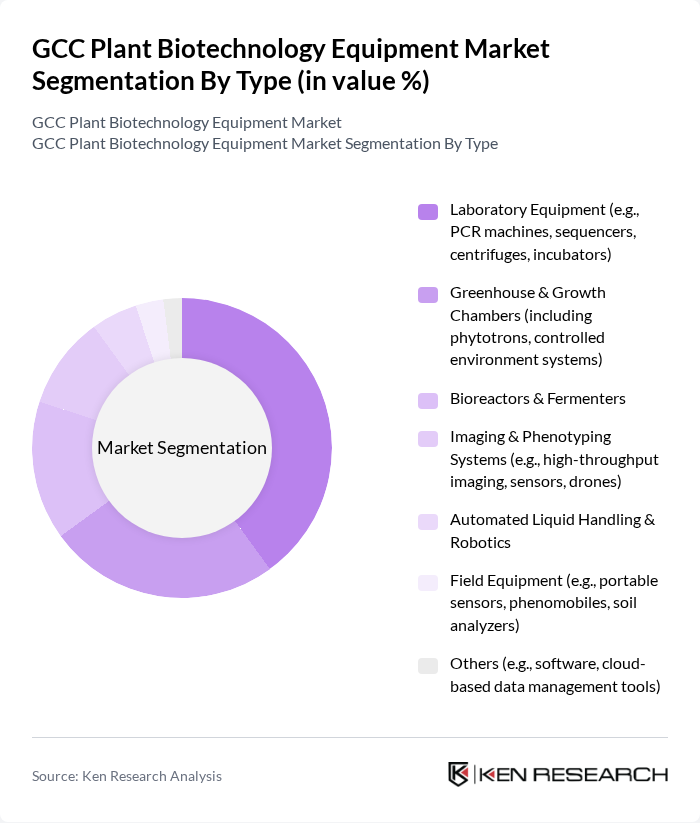
GCC Plant Biotechnology Equipment Market segmentation by Type.

By End-User:The end-user segmentation includes Research Institutions & Universities, Agricultural Corporations & Seed Companies, Government Agencies & Regulatory Bodies, Private Farms & Greenhouses, Biotechnology Startups, and Others. Research Institutions & Universities are the leading end-users, driven by the need for advanced research capabilities and the development of innovative agricultural solutions. The increasing collaboration between academia and industry, as well as the growing emphasis on precision agriculture and sustainable food production, further enhances the demand for biotechnology equipment .
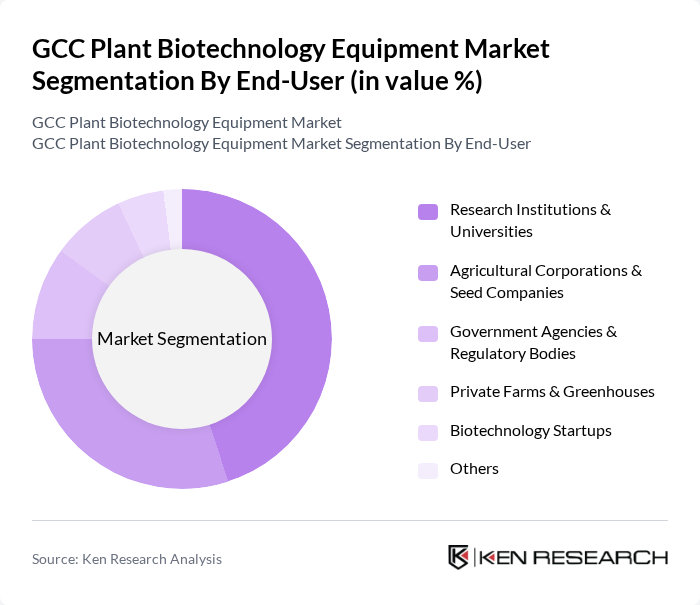
GCC Plant Biotechnology Equipment Market segmentation by End-User.

GCC Plant Biotechnology Equipment Market Competitive Landscape

The GCC Plant Biotechnology Equipment Market is characterized by a dynamic mix of regional and international players. Leading participants such as Thermo Fisher Scientific, Illumina, Agilent Technologies, Bio-Rad Laboratories, PerkinElmer, Merck KGaA, KeyGene, LemnaTec GmbH, Heinz Walz GmbH, Tecan Group Ltd., Qubit Systems Inc., LabRepCo, LGC Limited, Evogene Ltd., Photon Systems Instruments contribute to innovation, geographic expansion, and service delivery in this space.

Thermo Fisher Scientific

1956

Waltham, Massachusetts, USA

Illumina

1998

San Diego, California, USA

Agilent Technologies

1999

Santa Clara, California, USA

Bio-Rad Laboratories

1952

Hercules, California, USA

PerkinElmer

1937

Waltham, Massachusetts, USA

Company

Establishment Year

Headquarters

Group Size (Large, Medium, or Small as per industry convention)

Regional Presence (GCC, Global, Local)

Revenue Growth Rate (Plant Biotechnology Equipment Segment)

Market Penetration Rate (Share of GCC installations or customers)

R&D Investment as % of Revenue

Product Portfolio Breadth (Number of equipment types offered)

GCC Plant Biotechnology Equipment Market Industry Analysis

Growth Drivers

  • Increasing Demand for Sustainable Agricultural Practices:The GCC region is witnessing a significant shift towards sustainable agricultural practices, driven by a growing population projected to reach 60 million in the future. This demographic pressure necessitates innovative agricultural solutions. The UAE government has allocated approximately $2 billion for sustainable agriculture initiatives, reflecting a commitment to enhancing food security and reducing environmental impact. Such investments are expected to boost the adoption of plant biotechnology equipment, facilitating sustainable farming methods.
  • Advancements in Genetic Engineering Technologies:The GCC's investment in genetic engineering technologies is projected to exceed $3 billion in the future, fostering innovation in crop resilience and yield enhancement. Notable advancements include CRISPR and gene editing techniques, which are gaining traction among researchers and agricultural firms. These technologies are crucial for developing crops that can withstand harsh climatic conditions, thereby increasing agricultural productivity and ensuring food security in the region, which is vital for its economic stability.
  • Government Initiatives Promoting Biotechnology:Governments in the GCC are actively promoting biotechnology through various initiatives, with an estimated $2 billion earmarked for biotechnology research and development in the future. This includes funding for research institutions and partnerships with private sectors. Such initiatives aim to enhance agricultural productivity and sustainability, aligning with national visions like Saudi Arabia's Vision 2030, which emphasizes innovation in agriculture as a key driver for economic diversification and growth.

Market Challenges

  • High Initial Investment Costs:The high initial investment costs associated with plant biotechnology equipment can be a significant barrier for farmers and agricultural businesses in the GCC. Equipment costs can range from $150,000 to over $1.2 million, depending on the technology. This financial burden can deter small to medium-sized enterprises from adopting advanced biotechnological solutions, limiting the overall growth potential of the market in the region.
  • Regulatory Hurdles and Compliance Issues:The regulatory landscape for biotechnology in the GCC is complex, with stringent guidelines on genetically modified organisms (GMOs). Compliance with these regulations often requires extensive documentation and testing, which can take up to two years and cost upwards of $600,000. These hurdles can slow down the introduction of innovative biotechnological products, creating uncertainty for investors and stakeholders in the market.

GCC Plant Biotechnology Equipment Market Future Outlook

The future of the GCC plant biotechnology equipment market appears promising, driven by increasing investments in agricultural technology and a growing emphasis on sustainability. As governments continue to support biotechnology initiatives, the integration of advanced technologies such as AI and machine learning is expected to enhance research capabilities. Furthermore, the rising consumer demand for organic products will likely encourage the development of innovative biotechnological solutions, positioning the region as a leader in sustainable agriculture in the future.

Market Opportunities

  • Expansion of Biotechnology in Emerging Markets:The GCC's biotechnology sector is poised for expansion in emerging markets, with an estimated growth potential of $600 million in the future. This growth is driven by increasing agricultural needs and the adoption of biotechnological solutions in neighboring regions, creating opportunities for GCC companies to export their technologies and expertise.
  • Collaborations with Research Institutions:Collaborations between private companies and research institutions are expected to yield significant advancements in plant biotechnology. With over 35 research institutions focusing on agricultural biotechnology in the GCC, partnerships can facilitate knowledge transfer and innovation, potentially increasing market competitiveness and driving growth in the sector.

Scope of the Report

SegmentSub-Segments
By Type

Laboratory Equipment (e.g., PCR machines, sequencers, centrifuges, incubators)

Greenhouse & Growth Chambers (including phytotrons, controlled environment systems)

Bioreactors & Fermenters

Imaging & Phenotyping Systems (e.g., high-throughput imaging, sensors, drones)

Automated Liquid Handling & Robotics

Field Equipment (e.g., portable sensors, phenomobiles, soil analyzers)

Others (e.g., software, cloud-based data management tools)

By End-User

Research Institutions & Universities

Agricultural Corporations & Seed Companies

Government Agencies & Regulatory Bodies

Private Farms & Greenhouses

Biotechnology Startups

Others

By Application

Plant Research & Breeding

Trait Identification & Genetic Modification

High-Throughput Screening

Crop Improvement & Yield Enhancement

Disease Resistance & Stress Tolerance

Quality Assessment

Others

By Region

Saudi Arabia

United Arab Emirates (UAE)

Qatar

Kuwait

Oman

Bahrain

By Technology

CRISPR & Genome Editing Technologies

Marker-Assisted Selection

RNA Interference (RNAi)

Synthetic Biology

Tissue Culture & Micropropagation

Others

By Investment Source

Private Investments

Government Funding

International Grants & Development Agencies

Public-Private Partnerships

Others

By Policy Support

Subsidies for Research and Development

Tax Incentives for Biotechnology Firms

Grants for Sustainable Practices

Regulatory Support for New Technologies

Others

Key Target Audience

Investors and Venture Capitalist Firms

Government and Regulatory Bodies (e.g., Ministry of Environment and Water, Saudi Food and Drug Authority)

Manufacturers and Producers of Plant Biotechnology Equipment

Distributors and Retailers of Agricultural Equipment

Biotechnology Research Organizations

Industry Associations (e.g., Gulf Cooperation Council Agricultural Association)

Financial Institutions and Banks

Agri-tech Startups and Innovators

Players Mentioned in the Report:

Thermo Fisher Scientific

Illumina

Agilent Technologies

Bio-Rad Laboratories

PerkinElmer

Merck KGaA

KeyGene

LemnaTec GmbH

Heinz Walz GmbH

Tecan Group Ltd.

Qubit Systems Inc.

LabRepCo

LGC Limited

Evogene Ltd.

Photon Systems Instruments

Table of Contents

Market Assessment Phase

1. Executive Summary and Approach


2. GCC Plant Biotechnology Equipment Market Overview

2.1 Key Insights and Strategic Recommendations

2.2 GCC Plant Biotechnology Equipment Market Overview

2.3 Definition and Scope

2.4 Evolution of Market Ecosystem

2.5 Timeline of Key Regulatory Milestones

2.6 Value Chain & Stakeholder Mapping

2.7 Business Cycle Analysis

2.8 Policy & Incentive Landscape


3. GCC Plant Biotechnology Equipment Market Analysis

3.1 Growth Drivers

3.1.1 Increasing demand for sustainable agricultural practices
3.1.2 Advancements in genetic engineering technologies
3.1.3 Government initiatives promoting biotechnology
3.1.4 Rising investment in agricultural R&D

3.2 Market Challenges

3.2.1 High initial investment costs
3.2.2 Regulatory hurdles and compliance issues
3.2.3 Limited awareness among farmers
3.2.4 Competition from traditional agricultural methods

3.3 Market Opportunities

3.3.1 Expansion of biotechnology in emerging markets
3.3.2 Collaborations with research institutions
3.3.3 Development of innovative biotechnological solutions
3.3.4 Increasing consumer preference for organic products

3.4 Market Trends

3.4.1 Growing adoption of precision agriculture
3.4.2 Integration of AI and machine learning in biotechnology
3.4.3 Rise of bioinformatics in plant research
3.4.4 Shift towards sustainable and eco-friendly practices

3.5 Government Regulation

3.5.1 Strict guidelines on genetically modified organisms (GMOs)
3.5.2 Supportive policies for biotechnology research
3.5.3 Incentives for sustainable agricultural practices
3.5.4 Compliance requirements for product safety and efficacy

4. SWOT Analysis


5. Stakeholder Analysis


6. Porter's Five Forces Analysis


7. GCC Plant Biotechnology Equipment Market Size, 2019-2024

7.1 By Value

7.2 By Volume

7.3 By Average Selling Price


8. GCC Plant Biotechnology Equipment Market Segmentation

8.1 By Type

8.1.1 Laboratory Equipment (e.g., PCR machines, sequencers, centrifuges, incubators)
8.1.2 Greenhouse & Growth Chambers (including phytotrons, controlled environment systems)
8.1.3 Bioreactors & Fermenters
8.1.4 Imaging & Phenotyping Systems (e.g., high-throughput imaging, sensors, drones)
8.1.5 Automated Liquid Handling & Robotics
8.1.6 Field Equipment (e.g., portable sensors, phenomobiles, soil analyzers)
8.1.7 Others (e.g., software, cloud-based data management tools)

8.2 By End-User

8.2.1 Research Institutions & Universities
8.2.2 Agricultural Corporations & Seed Companies
8.2.3 Government Agencies & Regulatory Bodies
8.2.4 Private Farms & Greenhouses
8.2.5 Biotechnology Startups
8.2.6 Others

8.3 By Application

8.3.1 Plant Research & Breeding
8.3.2 Trait Identification & Genetic Modification
8.3.3 High-Throughput Screening
8.3.4 Crop Improvement & Yield Enhancement
8.3.5 Disease Resistance & Stress Tolerance
8.3.6 Quality Assessment
8.3.7 Others

8.4 By Region

8.4.1 Saudi Arabia
8.4.2 United Arab Emirates (UAE)
8.4.3 Qatar
8.4.4 Kuwait
8.4.5 Oman
8.4.6 Bahrain

8.5 By Technology

8.5.1 CRISPR & Genome Editing Technologies
8.5.2 Marker-Assisted Selection
8.5.3 RNA Interference (RNAi)
8.5.4 Synthetic Biology
8.5.5 Tissue Culture & Micropropagation
8.5.6 Others

8.6 By Investment Source

8.6.1 Private Investments
8.6.2 Government Funding
8.6.3 International Grants & Development Agencies
8.6.4 Public-Private Partnerships
8.6.5 Others

8.7 By Policy Support

8.7.1 Subsidies for Research and Development
8.7.2 Tax Incentives for Biotechnology Firms
8.7.3 Grants for Sustainable Practices
8.7.4 Regulatory Support for New Technologies
8.7.5 Others

9. GCC Plant Biotechnology Equipment Market Competitive Analysis

9.1 Market Share of Key Players

9.2 Cross Comparison of Key Players

9.2.1 Company Name
9.2.2 Group Size (Large, Medium, or Small as per industry convention)
9.2.3 Regional Presence (GCC, Global, Local)
9.2.4 Revenue Growth Rate (Plant Biotechnology Equipment Segment)
9.2.5 Market Penetration Rate (Share of GCC installations or customers)
9.2.6 R&D Investment as % of Revenue
9.2.7 Product Portfolio Breadth (Number of equipment types offered)
9.2.8 Technology Innovation Index (Patents, proprietary tech, AI/automation integration)
9.2.9 After-Sales Service Coverage (GCC support infrastructure)
9.2.10 Key Partnerships & Collaborations (with GCC research institutes, universities, etc.)
9.2.11 Customer Satisfaction Score

9.3 SWOT Analysis of Top Players

9.4 Pricing Analysis

9.5 Detailed Profile of Major Companies

9.5.1 Thermo Fisher Scientific
9.5.2 Illumina
9.5.3 Agilent Technologies
9.5.4 Bio-Rad Laboratories
9.5.5 PerkinElmer
9.5.6 Merck KGaA
9.5.7 KeyGene
9.5.8 LemnaTec GmbH
9.5.9 Heinz Walz GmbH
9.5.10 Tecan Group Ltd.
9.5.11 Qubit Systems Inc.
9.5.12 LabRepCo
9.5.13 LGC Limited
9.5.14 Evogene Ltd.
9.5.15 Photon Systems Instruments

10. GCC Plant Biotechnology Equipment Market End-User Analysis

10.1 Procurement Behavior of Key Ministries

10.1.1 Budget Allocation Trends
10.1.2 Decision-Making Processes
10.1.3 Preferred Suppliers
10.1.4 Evaluation Criteria

10.2 Corporate Spend on Infrastructure & Energy

10.2.1 Investment Priorities
10.2.2 Spending Patterns
10.2.3 Impact of Economic Conditions

10.3 Pain Point Analysis by End-User Category

10.3.1 Challenges Faced by Research Institutions
10.3.2 Issues in Agricultural Companies
10.3.3 Government Agency Constraints

10.4 User Readiness for Adoption

10.4.1 Awareness Levels
10.4.2 Training Needs
10.4.3 Technology Acceptance

10.5 Post-Deployment ROI and Use Case Expansion

10.5.1 Measurement of Success
10.5.2 Future Use Cases
10.5.3 Feedback Mechanisms

11. GCC Plant Biotechnology Equipment Market Future Size, 2025-2030

11.1 By Value

11.2 By Volume

11.3 By Average Selling Price


Go-To-Market Strategy Phase

1. Whitespace Analysis + Business Model Canvas

1.1 Market Gaps Identification

1.2 Business Model Development


2. Marketing and Positioning Recommendations

2.1 Branding Strategies

2.2 Product USPs


3. Distribution Plan

3.1 Urban Retail Strategies

3.2 Rural NGO Tie-ups


4. Channel & Pricing Gaps

4.1 Underserved Routes

4.2 Pricing Bands


5. Unmet Demand & Latent Needs

5.1 Category Gaps

5.2 Consumer Segments


6. Customer Relationship

6.1 Loyalty Programs

6.2 After-sales Service


7. Value Proposition

7.1 Sustainability Initiatives

7.2 Integrated Supply Chains


8. Key Activities

8.1 Regulatory Compliance

8.2 Branding Efforts

8.3 Distribution Setup


9. Entry Strategy Evaluation

9.1 Domestic Market Entry Strategy

9.1.1 Product Mix
9.1.2 Pricing Band
9.1.3 Packaging Considerations

9.2 Export Entry Strategy

9.2.1 Target Countries
9.2.2 Compliance Roadmap

10. Entry Mode Assessment

10.1 Joint Ventures

10.2 Greenfield Investments

10.3 Mergers & Acquisitions

10.4 Distributor Model


11. Capital and Timeline Estimation

11.1 Capital Requirements

11.2 Timelines for Implementation


12. Control vs Risk Trade-Off

12.1 Ownership Considerations

12.2 Partnerships Evaluation


13. Profitability Outlook

13.1 Breakeven Analysis

13.2 Long-term Sustainability


14. Potential Partner List

14.1 Distributors

14.2 Joint Ventures

14.3 Acquisition Targets


15. Execution Roadmap

15.1 Phased Plan for Market Entry

15.1.1 Market Setup
15.1.2 Market Entry
15.1.3 Growth Acceleration
15.1.4 Scale & Stabilize

15.2 Key Activities and Milestones

15.2.1 Milestone Planning
15.2.2 Activity Tracking

Research Methodology

ApproachModellingSample

Phase 1: Approach1

Desk Research

  • Industry reports from regional agricultural biotechnology associations
  • Market analysis publications from government agricultural departments
  • Academic journals focusing on plant biotechnology advancements and equipment

Primary Research

  • Interviews with laboratory managers in biotechnology firms across the GCC
  • Surveys with equipment suppliers and distributors in the plant biotechnology sector
  • Field visits to research institutions and universities engaged in plant biotechnology

Validation & Triangulation

  • Cross-validation of data from multiple industry sources and expert opinions
  • Triangulation of market trends with historical data and future projections
  • Sanity checks through feedback from industry experts and stakeholders

Phase 2: Market Size Estimation1

Top-down Assessment

  • Analysis of total agricultural spending in the GCC region
  • Segmentation of the market by equipment type and application area
  • Incorporation of government initiatives promoting biotechnology in agriculture

Bottom-up Modeling

  • Estimation of equipment sales based on historical purchase data from key players
  • Operational cost analysis derived from supplier pricing and market demand
  • Volume estimates based on projected growth rates in the biotechnology sector

Forecasting & Scenario Analysis

  • Multi-variable regression analysis considering factors like investment in R&D and crop yield improvements
  • Scenario modeling based on potential regulatory changes and technological advancements
  • Development of baseline, optimistic, and pessimistic forecasts through 2030

Phase 3: CATI Sample Composition1

Scope Item/SegmentSample SizeTarget Respondent Profiles
Biotechnology Equipment Suppliers60Sales Managers, Product Development Leads
Research Institutions in Plant Biotechnology50Research Scientists, Lab Technicians
Agricultural Biotechnology Firms55Operations Managers, R&D Directors
Government Agricultural Departments40Policy Makers, Agricultural Advisors
Universities with Biotechnology Programs45Faculty Members, Program Coordinators

Frequently Asked Questions

What is the current value of the GCC Plant Biotechnology Equipment Market?

The GCC Plant Biotechnology Equipment Market is valued at approximately USD 320 million, reflecting the region's share of the global market driven by investments in agricultural research and advancements in biotechnology.

Which countries are the key players in the GCC Plant Biotechnology Equipment Market?

What types of equipment are included in the GCC Plant Biotechnology Equipment Market?

Who are the primary end-users of plant biotechnology equipment in the GCC?

Other Regional/Country Reports

Indonesia Plant Biotechnology Equipment Market

Malaysia Plant Biotechnology Equipment Market

KSA Plant Biotechnology Equipment Market

APAC Plant Biotechnology Equipment Market

SEA Plant Biotechnology Equipment Market

Vietnam Plant Biotechnology Equipment Market

Other Adjacent Reports

Mexico Plant Genomics Market

Kuwait Agricultural Biotechnology Market Size, Share, Growth Drivers, Trends, Opportunities & Forecast 2025–2030

Singapore Plant Tissue Culture Market

Kuwait Genetic Engineering Equipment Market

Bahrain Precision Agriculture Technology Market

Qatar Bioreactors and Fermenters Market

Egypt Greenhouse and Growth Chambers Market

Brazil Crop Phenotyping Systems Market

South Africa Bioinformatics Software Market

Mexico Sustainable Farming Solutions Market

Why Buy From Us?

Refine Robust Result (RRR) Framework

What makes us stand out is that our consultants follow Robust, Refine and Result (RRR) methodology. Robust for clear definitions, approaches and sanity checking, Refine for differentiating respondents' facts and opinions, and Result for presenting data with story.

Our Reach Is Unmatched

We have set a benchmark in the industry by offering our clients with syndicated and customized market research reports featuring coverage of entire market as well as meticulous research and analyst insights.

Shifting the Research Paradigm

While we don't replace traditional research, we flip the method upside down. Our dual approach of Top Bottom & Bottom Top ensures quality deliverable by not just verifying company fundamentals but also looking at the sector and macroeconomic factors.

More Insights-Better Decisions

With one step in the future, our research team constantly tries to show you the bigger picture. We help with some of the tough questions you may encounter along the way: How is the industry positioned? Best marketing channel? KPI's of competitors? By aligning every element, we help maximize success.

Transparency and Trust

Our report gives you instant access to the answers and sources that other companies might choose to hide. We elaborate each steps of research methodology we have used and showcase you the sample size to earn your trust.

Round the Clock Support

If you need any support, we are here! We pride ourselves on universe strength, data quality, and quick, friendly, and professional service.

Why Clients Choose Us?

400000+
Reports in repository
150+
Consulting projects a year
100+
Analysts
8000+
Client Queries in 2022








