Region:Middle East
Author(s):Shubham
Product Code:KRAD0757
Pages:85
Published On:August 2025
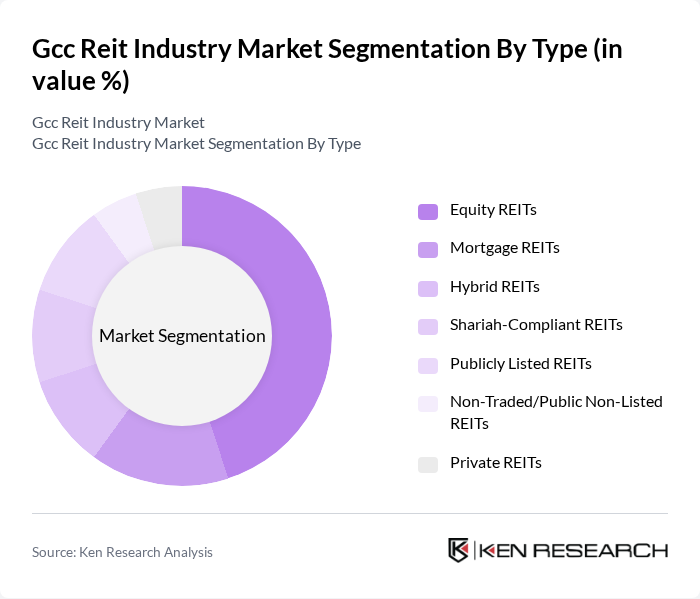
By Type:The market is segmented into various types of REITs, including Equity REITs, Mortgage REITs, Hybrid REITs, Shariah-Compliant REITs, Publicly Listed REITs, Non-Traded/Public Non-Listed REITs, and Private REITs. Among these, Equity REITs dominate the market due to their focus on income-generating properties and their ability to provide investors with regular dividends. The increasing preference for income stability and capital appreciation has led to a surge in investments in Equity REITs.
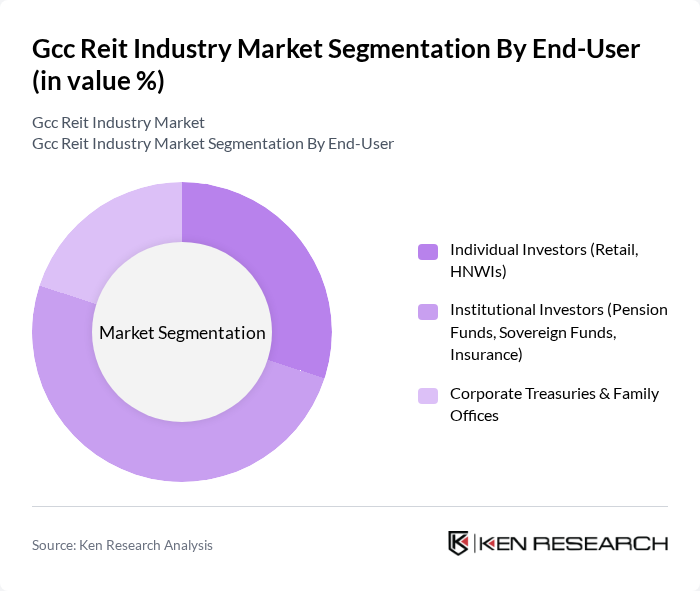
By End-User:The end-user segmentation includes Individual Investors (Retail, HNWIs), Institutional Investors (Pension Funds, Sovereign Funds, Insurance), and Corporate Treasuries & Family Offices. Institutional Investors are the leading segment, driven by their need for stable income and long-term capital appreciation. The growing trend of institutional investment in real estate assets has significantly influenced the market dynamics.
The GCC REIT industry market is characterized by a dynamic mix of regional and international players. Leading participants such as Emirates REIT (Dubai), ENBD REIT (Emirates NBD Asset Management), Al Dar Properties PJSC – ADREIT/Al Dar Investment Management, Saudi Real Estate Refinance Company (SRC) – REIT-linked investments, Jadwa REIT Saudi, Riyad REIT, Al Rajhi REIT, Derayah REIT, Sedco Capital REIT, Alinma Hospitality REIT, Alkhabeer REIT, Bonyan REIT, Al Ma’ather REIT, SNB Capital REIT, Al Rajhi Capital – logistics and diversified REIT mandates contribute to innovation, geographic expansion, and service delivery in this space.
The GCC REIT market is poised for significant transformation, driven by technological advancements and a growing emphasis on sustainability. As smart city initiatives gain momentum, REITs will increasingly integrate technology into property management, enhancing operational efficiency. Additionally, the rising demand for green buildings is expected to reshape investment strategies, with more funds allocated to eco-friendly developments. This shift will not only attract environmentally conscious investors but also align with global sustainability goals, fostering long-term growth in the sector.
| Segment | Sub-Segments |
|---|---|
| By Type | Equity REITs Mortgage REITs Hybrid REITs Shariah-Compliant REITs Publicly Listed REITs Non-Traded/Public Non-Listed REITs Private REITs |
| By End-User | Individual Investors (Retail, HNWIs) Institutional Investors (Pension Funds, Sovereign Funds, Insurance) Corporate Treasuries & Family Offices |
| By Investment Strategy | Core (Stabilized, Income-Focused) Core-Plus (Light Value Enhancement) Value-Added (Repositioning/Capex) Opportunistic (Development/Turnaround) |
| By Geographic Focus | United Arab Emirates Saudi Arabia Qatar Kuwait Bahrain Oman |
| By Asset Class | Retail (Malls, Community Centers) Office Industrial & Logistics (Warehouses, Last-Mile) Residential (Apartments, Staff Accommodation) Hospitality (Hotels, Serviced Apartments) Healthcare (Hospitals, Clinics) Data Centers & Digital Infrastructure Mixed-Use Developments |
| By Fund Structure | Single-Sponsor REITs Multi-Sponsor/Externally Managed REITs Internally Managed REITs Cross-Listed/Foreign Ownership-Eligible REITs |
| By Policy Support | Tax Treatment & Withholding Rules Foreign Ownership Limits Listing & Free Float Requirements Shariah Governance & Compliance |
| Scope Item/Segment | Sample Size | Target Respondent Profiles |
|---|---|---|
| Commercial REITs | 120 | Portfolio Managers, Investment Analysts |
| Residential REITs | 100 | Real Estate Developers, Asset Managers |
| Industrial REITs | 90 | Supply Chain Executives, Operations Managers |
| Healthcare REITs | 70 | Healthcare Facility Managers, Financial Analysts |
| Hospitality REITs | 60 | Hotel Managers, Revenue Management Directors |
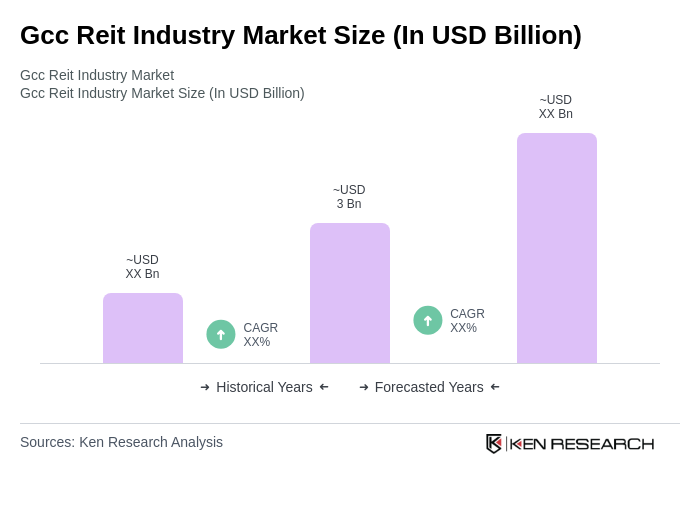
The GCC REIT industry market is valued at approximately USD 3 billion, driven by factors such as urbanization, population growth, and the demand for diversified real estate investment options. This valuation is based on a five-year historical analysis.

What makes us stand out is that our consultants follow Robust, Refine and Result (RRR) methodology. Robust for clear definitions, approaches and sanity checking, Refine for differentiating respondents' facts and opinions, and Result for presenting data with story.

We have set a benchmark in the industry by offering our clients with syndicated and customized market research reports featuring coverage of entire market as well as meticulous research and analyst insights.

While we don't replace traditional research, we flip the method upside down. Our dual approach of Top Bottom & Bottom Top ensures quality deliverable by not just verifying company fundamentals but also looking at the sector and macroeconomic factors.

With one step in the future, our research team constantly tries to show you the bigger picture. We help with some of the tough questions you may encounter along the way: How is the industry positioned? Best marketing channel? KPI's of competitors? By aligning every element, we help maximize success.

Our report gives you instant access to the answers and sources that other companies might choose to hide. We elaborate each steps of research methodology we have used and showcase you the sample size to earn your trust.

If you need any support, we are here! We pride ourselves on universe strength, data quality, and quick, friendly, and professional service.













