Region:Middle East
Author(s):Geetanshi
Product Code:KRAA8985
Pages:87
Published On:November 2025
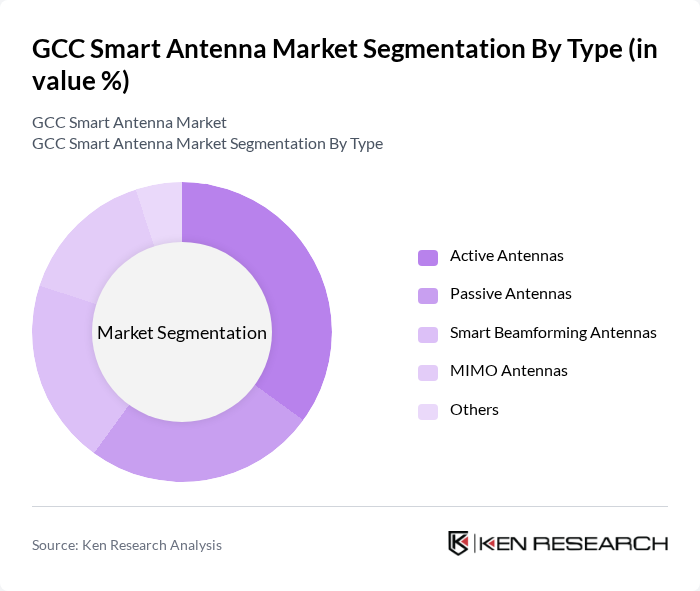
By Type:The market is segmented into Active Antennas, Passive Antennas, Smart Beamforming Antennas, MIMO Antennas, and Others. Active Antennas are gaining traction due to their ability to amplify signals and support dynamic network environments, while Passive Antennas are preferred for their cost-effectiveness and reliability in basic applications. Smart Beamforming Antennas are increasingly used in advanced communication systems for targeted signal delivery, and MIMO Antennas are essential for enhancing data throughput and supporting multiple device connections in wireless networks .
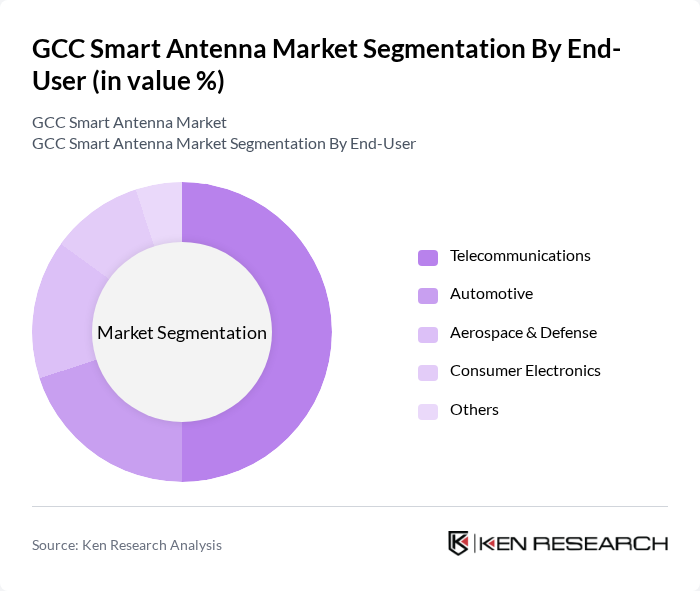
By End-User:The end-user segmentation includes Telecommunications, Automotive, Aerospace & Defense, Consumer Electronics, and Others. The Telecommunications sector is the largest consumer of smart antennas, driven by the need for enhanced network performance, 5G rollout, and increased mobile data traffic. The Automotive sector is also emerging, with the rise of connected vehicles and autonomous driving technologies requiring advanced communication systems. Aerospace & Defense and Consumer Electronics segments are adopting smart antennas for improved connectivity and operational efficiency .
The GCC Smart Antenna Market is characterized by a dynamic mix of regional and international players. Leading participants such as Huawei Technologies Co., Ltd., Qualcomm Technologies, Inc., Ericsson, Nokia Corporation, ZTE Corporation, Samsung Electronics Co., Ltd., CommScope Holding Company, Inc., Laird Connectivity, Anokiwave, Inc., Cobham Wireless, Airgain, Inc., PCTEL, Inc., Antenna Products Corporation, RF Solutions, Amphenol Corporation contribute to innovation, geographic expansion, and service delivery in this space.
The future of the GCC smart antenna market appears promising, driven by technological advancements and increasing investments in telecommunications infrastructure. As 5G networks expand, the demand for innovative antenna solutions will rise, facilitating enhanced connectivity. Furthermore, the growing emphasis on energy-efficient designs and integrated solutions will likely shape market dynamics, encouraging manufacturers to innovate. The focus on cybersecurity will also become crucial, ensuring that smart antenna systems are resilient against emerging threats, thereby fostering consumer confidence and market growth.
| Segment | Sub-Segments |
|---|---|
| By Type | Active Antennas Passive Antennas Smart Beamforming Antennas MIMO Antennas Others |
| By End-User | Telecommunications Automotive Aerospace & Defense Consumer Electronics Others |
| By Application | Wireless Communication Satellite Communication Broadcasting Navigation Systems Others |
| By Frequency Band | Low Frequency Medium Frequency High Frequency Ultra High Frequency Others |
| By Region | Saudi Arabia UAE Qatar Kuwait Oman |
| By Technology | Analog Technology Digital Technology Hybrid Technology Others |
| By Market Segment | Commercial Residential Industrial Government Others |
| Scope Item/Segment | Sample Size | Target Respondent Profiles |
|---|---|---|
| Telecommunications Network Providers | 120 | Network Engineers, Technical Directors |
| Smart City Project Managers | 90 | Urban Planners, Project Managers |
| IoT Solution Developers | 60 | Product Managers, Software Engineers |
| Research and Development Teams | 50 | R&D Managers, Innovation Leads |
| Government Regulatory Bodies | 40 | Policy Makers, Regulatory Affairs Specialists |
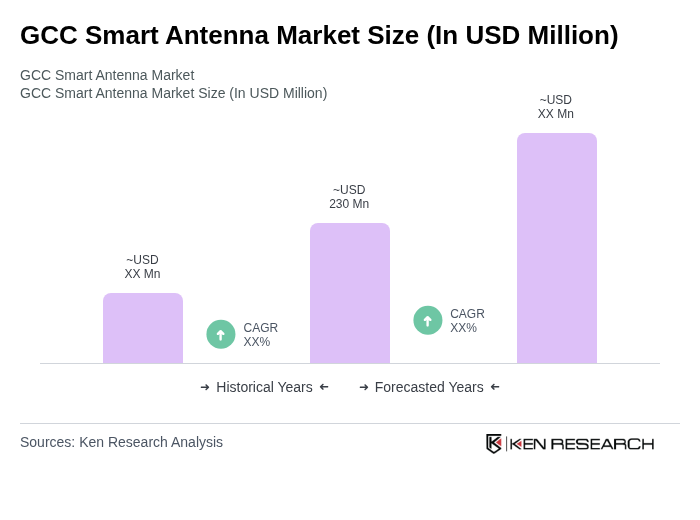
The GCC Smart Antenna Market is valued at approximately USD 230 million, driven by the increasing demand for high-speed wireless communication, the rapid deployment of 5G networks, and the integration of IoT technologies across the region.

What makes us stand out is that our consultants follow Robust, Refine and Result (RRR) methodology. Robust for clear definitions, approaches and sanity checking, Refine for differentiating respondents' facts and opinions, and Result for presenting data with story.

We have set a benchmark in the industry by offering our clients with syndicated and customized market research reports featuring coverage of entire market as well as meticulous research and analyst insights.

While we don't replace traditional research, we flip the method upside down. Our dual approach of Top Bottom & Bottom Top ensures quality deliverable by not just verifying company fundamentals but also looking at the sector and macroeconomic factors.

With one step in the future, our research team constantly tries to show you the bigger picture. We help with some of the tough questions you may encounter along the way: How is the industry positioned? Best marketing channel? KPI's of competitors? By aligning every element, we help maximize success.

Our report gives you instant access to the answers and sources that other companies might choose to hide. We elaborate each steps of research methodology we have used and showcase you the sample size to earn your trust.

If you need any support, we are here! We pride ourselves on universe strength, data quality, and quick, friendly, and professional service.













