About the Report
Base Year 2024Listen to the audio summary
GCC Smart Pet Feeder Market Overview
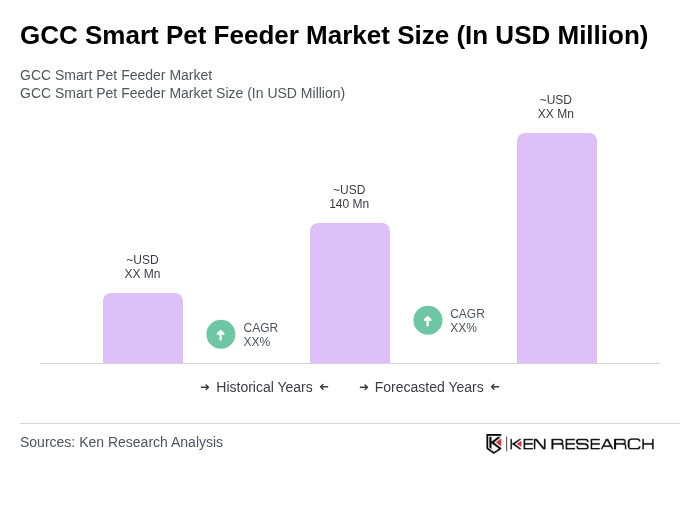
- The GCC Smart Pet Feeder Market is valued at USD 140 million, based on a five-year historical analysis. This sizing is directionally consistent with the global smart pet feeder market, which is estimated at around USD 1.5 billion, with the Middle East and Africa representing a mid?single?digit share of global revenues. This growth is primarily driven by increasing pet ownership rates, rising disposable incomes, and the growing trend of pet humanization, where pets are treated as family members, trends that are well documented in the global automatic and smart pet feeder and pet tech markets. The demand for smart pet feeders is also fueled by technological advancements such as IoT?enabled devices, app?based control, and integration with smart home ecosystems, which enhance convenience and enable more precise pet care.
- The United Arab Emirates and Saudi Arabia dominate the GCC Smart Pet Feeder Market due to their relatively high pet ownership within the region, strong expatriate populations, and an affluent consumer base that actively purchases premium pet products. Urbanization and a growing trend towards smart home technologies further contribute to the market's expansion in these countries, in line with broader Middle East adoption of connected devices and pet tech solutions. Additionally, the increasing availability of regional and cross?border e?commerce platforms, including marketplaces that carry brands such as Xiaomi, PETKIT and PetSafe, facilitates easy access to smart pet feeding solutions for GCC consumers.
- In 2023, the UAE government implemented regulations to promote pet welfare, which includes guidelines for pet care products. One of the key instruments is Federal Law No. 16 of 2007 on Animal Welfare and its implementing regulations, enforced by the Ministry of Climate Change and Environment (MOCCAE), which set requirements for the safety, quality, and humane use of equipment and products used for animals, including feeding devices. In addition, the UAE’s technical regulation for electrical equipment and appliances, administered by the Emirates Authority for Standardization and Metrology (ESMA, now part of the Ministry of Industry and Advanced Technology), requires that electrically powered consumer products comply with safety, electromagnetic compatibility, and environmental standards before being sold in the market, which applies to smart pet feeders with electrical and electronic components. These measures collectively ensure that smart pet feeders placed on the UAE market meet defined safety and quality benchmarks, supporting consumer confidence and responsible pet ownership.
GCC Smart Pet Feeder Market Segmentation
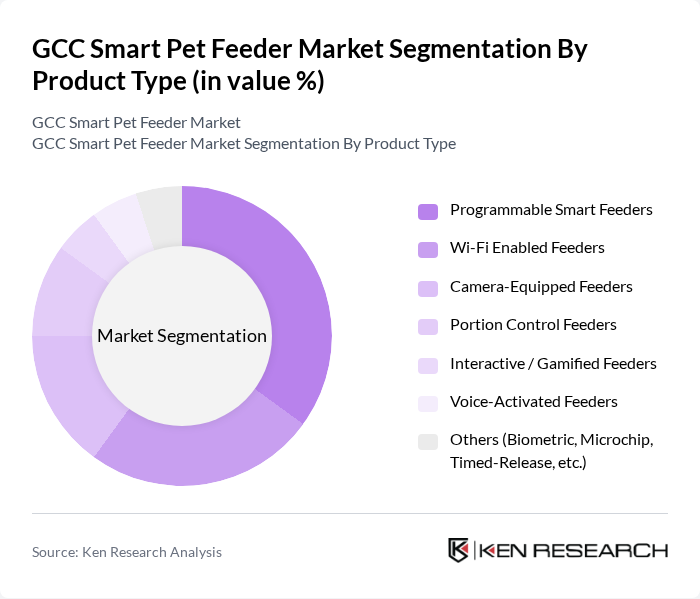
By Product Type:The product type segmentation includes various categories such as Programmable Smart Feeders, Wi-Fi Enabled Feeders, Camera-Equipped Feeders, Portion Control Feeders, Interactive / Gamified Feeders, Voice-Activated Feeders, and Others (Biometric, Microchip, Timed-Release, etc.). This structure is consistent with global product categorization, where automatic programmable units, connectivity?enhanced feeders, and camera?integrated models form the core of the market. Among these, Programmable Smart Feeders are leading the market due to their convenience and ability to schedule feeding times, which appeals especially to busy pet owners and dual?income households. The trend towards automation in pet care is driving the demand for these feeders, as they allow for better management of pet diets and feeding schedules, a behavior that mirrors broader global adoption of automatic and smart feeders featuring portion control and time?based dispensing.
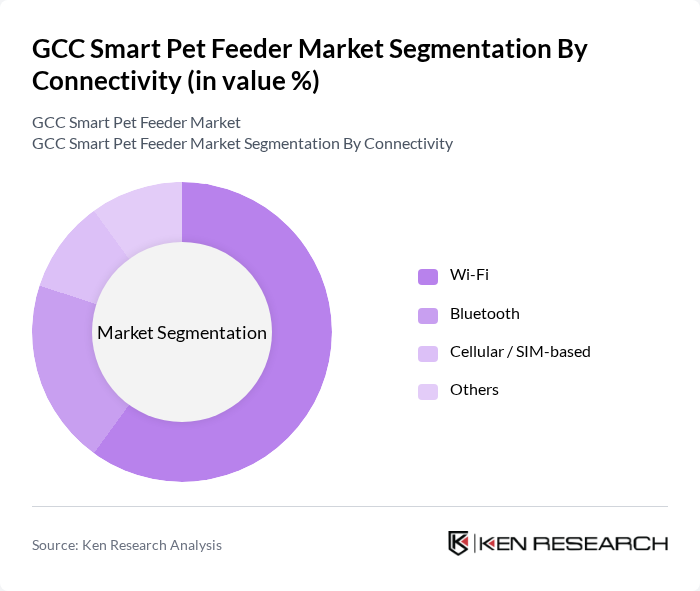
By Connectivity:The connectivity segmentation includes Wi-Fi, Bluetooth, Cellular / SIM-based, and Others. Wi-Fi enabled feeders dominate this segment due to their ability to connect to home networks, allowing pet owners to control feeding schedules remotely via smartphone applications, a feature highlighted as a key differentiator in global smart pet feeder offerings. The increasing penetration of smart home devices and the growing trend of IoT in pet care are driving the demand for Wi-Fi enabled feeders, making them the preferred choice among consumers in technologically advanced urban markets such as the GCC.
GCC Smart Pet Feeder Market Competitive Landscape
The GCC Smart Pet Feeder Market is characterized by a dynamic mix of regional and international players. Leading participants such as Dogness Group, PETKIT, Sure Petcare (Allflex Group), Xiaomi, TESLA Smart, PetSafe, WOpet, Petnet, Catspad, Arf Pets, PetFusion, Petkit Australia, Skymee, Aqara (Lumi United Technology), Pet Marvel Ltd. contribute to innovation, geographic expansion, and service delivery in this space, in line with the global competitive landscape where brands like PetSafe, PETKIT, Xiaomi and others are cited among the major manufacturers of automatic and smart pet feeders.
GCC Smart Pet Feeder Market Industry Analysis
Growth Drivers
- Increasing Pet Ownership:The GCC region has witnessed a rise in pet ownership, with over 30% of households owning pets. This trend is supported by a growing population of approximately 60 million people, with pet ownership rates expected to increase by 5% annually. The rise in pet ownership correlates with a heightened demand for innovative pet care solutions, including smart feeders, which cater to the needs of busy pet owners seeking convenience and efficiency in pet care.
- Technological Advancements in Pet Care:The integration of advanced technologies in pet care is driving the smart pet feeder market. In future, the GCC is projected to invest overin pet technology, including IoT and AI applications. These advancements enhance user experience by providing features such as remote feeding and health monitoring, appealing to tech-savvy pet owners. As technology continues to evolve, the demand for smart pet feeders that incorporate these innovations is expected to grow significantly.
- Rising Disposable Income:The GCC countries are experiencing a steady increase in disposable income, with an average growth rate of 4.5% projected. This economic growth translates to higher spending on pet care products, including smart feeders. In future, the average disposable income per capita in the UAE has been reported at approximately, enabling pet owners to invest in premium pet care solutions. This trend is expected to continue, further driving the demand for smart pet feeders in the region.
Market Challenges
- High Initial Investment Costs:One of the significant barriers to the adoption of smart pet feeders in the GCC is the high initial investment required. Prices for advanced smart feeders can range from, which may deter budget-conscious consumers. With the average household expenditure on pet care in the GCC estimated at, the upfront cost of smart feeders can be a substantial financial commitment, limiting market penetration among lower-income households.
- Limited Consumer Awareness:Despite the growing market, consumer awareness regarding smart pet feeders remains limited. A survey conducted in future indicated that onlyof pet owners in the GCC were familiar with smart feeding solutions. This lack of awareness can hinder market growth, as potential customers may not recognize the benefits of these products. Educational initiatives and marketing strategies are essential to increase consumer knowledge and drive adoption in the region.
GCC Smart Pet Feeder Market Future Outlook
The future of the GCC smart pet feeder market appears promising, driven by technological advancements and increasing pet ownership. As more consumers seek convenience and automation in pet care, the demand for smart feeders is expected to rise. Additionally, the integration of health monitoring features and AI technologies will likely enhance product appeal. Companies that focus on educating consumers about the benefits of smart feeders and invest in innovative features will be well-positioned to capture market share in the coming years.
Market Opportunities
- Expansion into Emerging Markets:There is a significant opportunity for smart pet feeder manufacturers to expand into emerging markets within the GCC. Countries like Oman and Bahrain are experiencing rising pet ownership rates, with a projected increase of. Targeting these markets can lead to substantial growth and increased brand recognition.
- Development of Smart Features:The demand for innovative features such as health monitoring and automated feeding schedules presents a lucrative opportunity. By incorporating AI and IoT technologies, companies can create products that cater to health-conscious pet owners. This trend is expected to attract a broader customer base, enhancing market competitiveness and driving sales.
Scope of the Report
| Segment | Sub-Segments |
|---|---|
| By Product Type | Programmable Smart Feeders Wi-Fi Enabled Feeders Camera-Equipped Feeders Portion Control Feeders Interactive / Gamified Feeders Voice-Activated Feeders Others (Biometric, Microchip, Timed-Release, etc.) |
| By Connectivity | Wi-Fi Bluetooth Cellular / SIM-based Others |
| By End-Use | Household / Residential Commercial Pet Care Facilities Veterinary Clinics & Pet Hospitals Pet Boarding & Daycare Centers Others |
| By Pet Type | Dogs Cats Other Small Pets |
| By Distribution Channel | Online Retailers & E-commerce Platforms Pet Specialty Stores Mass Merchandisers & Electronics Retail Veterinary Clinics & Pet Supply Chains Others |
| By Price Range | Low-cost / Budget Mid-range High-end / Premium |
| By Country | United Arab Emirates Saudi Arabia Qatar Kuwait Oman Bahrain Rest of GCC |
Key Target Audience
Investors and Venture Capitalist Firms
Government and Regulatory Bodies (e.g., Ministry of Climate Change and Environment, Saudi Food and Drug Authority)
Manufacturers and Producers
Distributors and Retailers
Pet Care Product Wholesalers
Technology Providers
Pet Industry Associations
Financial Institutions
Players Mentioned in the Report:
Dogness Group
PETKIT
Sure Petcare (Allflex Group)
Xiaomi
TESLA Smart
PetSafe
WOpet
Petnet
Catspad
Arf Pets
PetFusion
Petkit Australia
Skymee
Aqara (Lumi United Technology)
Pet Marvel Ltd.
Table of Contents
Market Assessment Phase
1. Executive Summary and Approach
2. GCC Smart Pet Feeder Market Overview
2.1 Key Insights and Strategic Recommendations
2.2 GCC Smart Pet Feeder Market Overview
2.3 Definition and Scope
2.4 Evolution of Market Ecosystem
2.5 Timeline of Key Regulatory Milestones
2.6 Value Chain & Stakeholder Mapping
2.7 Business Cycle Analysis
2.8 Policy & Incentive Landscape
3. GCC Smart Pet Feeder Market Analysis
3.1 Growth Drivers
3.1.1 Increasing Pet Ownership
3.1.2 Technological Advancements in Pet Care
3.1.3 Rising Disposable Income
3.1.4 Demand for Convenience and Automation
3.2 Market Challenges
3.2.1 High Initial Investment Costs
3.2.2 Limited Consumer Awareness
3.2.3 Competition from Traditional Feeding Solutions
3.2.4 Regulatory Compliance Issues
3.3 Market Opportunities
3.3.1 Expansion into Emerging Markets
3.3.2 Development of Smart Features
3.3.3 Partnerships with Pet Care Services
3.3.4 Customization and Personalization Trends
3.4 Market Trends
3.4.1 Growth of E-commerce Platforms
3.4.2 Integration of AI and IoT Technologies
3.4.3 Focus on Sustainability
3.4.4 Increasing Demand for Health Monitoring Features
3.5 Government Regulation
3.5.1 Safety Standards for Pet Products
3.5.2 Import Regulations for Smart Devices
3.5.3 Environmental Regulations on Materials Used
3.5.4 Consumer Protection Laws
4. SWOT Analysis
5. Stakeholder Analysis
6. Porter's Five Forces Analysis
7. GCC Smart Pet Feeder Market Market Size, 2019-2024
7.1 By Value
7.2 By Volume
7.3 By Average Selling Price
8. GCC Smart Pet Feeder Market Segmentation
8.1 By Product Type
8.1.1 Programmable Smart Feeders
8.1.2 Wi-Fi Enabled Feeders
8.1.3 Camera-Equipped Feeders
8.1.4 Portion Control Feeders
8.1.5 Interactive / Gamified Feeders
8.1.6 Voice-Activated Feeders
8.1.7 Others (Biometric, Microchip, Timed-Release, etc.)
8.2 By Connectivity
8.2.1 Wi-Fi
8.2.2 Bluetooth
8.2.3 Cellular / SIM-based
8.2.4 Others
8.3 By End-Use
8.3.1 Household / Residential
8.3.2 Commercial Pet Care Facilities
8.3.3 Veterinary Clinics & Pet Hospitals
8.3.4 Pet Boarding & Daycare Centers
8.3.5 Others
8.4 By Pet Type
8.4.1 Dogs
8.4.2 Cats
8.4.3 Other Small Pets
8.5 By Distribution Channel
8.5.1 Online Retailers & E-commerce Platforms
8.5.2 Pet Specialty Stores
8.5.3 Mass Merchandisers & Electronics Retail
8.5.4 Veterinary Clinics & Pet Supply Chains
8.5.5 Others
8.6 By Price Range
8.6.1 Low-cost / Budget
8.6.2 Mid-range
8.6.3 High-end / Premium
8.7 By Country
8.7.1 United Arab Emirates
8.7.2 Saudi Arabia
8.7.3 Qatar
8.7.4 Kuwait
8.7.5 Oman
8.7.6 Bahrain
8.7.7 Rest of GCC
9. GCC Smart Pet Feeder Market Competitive Analysis
9.1 Market Share of Key Players
9.2 Cross Comparison of Key Players
9.2.1 Company Name
9.2.2 Group Size (Large, Medium, or Small as per industry convention)
9.2.3 GCC Smart Pet Feeder Revenue (USD million)
9.2.4 GCC Smart Pet Feeder Revenue Growth Rate (% CAGR, 2019-2024)
9.2.5 GCC Market Share (%)
9.2.6 Average Selling Price Index vs Market
9.2.7 R&D Spend on Smart Pet Products (% of Revenue)
9.2.8 Product Launches in GCC (Number per Year)
9.2.9 Active GCC Distribution / Retail Partners (Number)
9.2.10 Online Sales Share in GCC Revenue (%)
9.2.11 Customer Retention / Repeat Purchase Rate (%)
9.2.12 Net Promoter Score (NPS)
9.3 SWOT Analysis of Top Players
9.4 Pricing Analysis
9.5 Detailed Profile of Major Companies
9.5.1 Dogness Group
9.5.2 PETKIT
9.5.3 Sure Petcare (Allflex Group)
9.5.4 Xiaomi
9.5.5 TESLA Smart
9.5.6 PetSafe
9.5.7 WOpet
9.5.8 Petnet
9.5.9 Catspad
9.5.10 Arf Pets
9.5.11 PetFusion
9.5.12 Petkit Australia
9.5.13 Skymee
9.5.14 Aqara (Lumi United Technology)
9.5.15 Pet Marvel Ltd.
10. GCC Smart Pet Feeder Market End-User Analysis
10.1 Procurement Behavior of Key Ministries
10.1.1 Budget Allocation for Pet Care
10.1.2 Decision-Making Process
10.1.3 Supplier Selection Criteria
10.1.4 Contract Management Practices
10.2 Corporate Spend on Infrastructure & Energy
10.2.1 Investment in Smart Technologies
10.2.2 Budgeting for Pet Care Solutions
10.2.3 Trends in Corporate Pet Care Spending
10.3 Pain Point Analysis by End-User Category
10.3.1 Challenges Faced by Pet Owners
10.3.2 Issues in Pet Boarding Facilities
10.3.3 Concerns of Veterinary Clinics
10.4 User Readiness for Adoption
10.4.1 Awareness of Smart Pet Feeders
10.4.2 Willingness to Invest
10.4.3 Perceived Benefits
10.5 Post-Deployment ROI and Use Case Expansion
10.5.1 Measurement of ROI
10.5.2 Expansion into New Use Cases
10.5.3 Long-term Benefits Analysis
11. GCC Smart Pet Feeder Market Future Size, 2025-2030
11.1 By Value
11.2 By Volume
11.3 By Average Selling Price
Go-To-Market Strategy Phase
1. Whitespace Analysis + Business Model Canvas
1.1 Market Gaps Identification
1.2 Business Model Development
2. Marketing and Positioning Recommendations
2.1 Branding Strategies
2.2 Product USPs
3. Distribution Plan
3.1 Urban Retail vs Rural NGO Tie-ups
4. Channel & Pricing Gaps
4.1 Underserved Routes
4.2 Pricing Bands
5. Unmet Demand & Latent Needs
5.1 Category Gaps
5.2 Consumer Segments
6. Customer Relationship
6.1 Loyalty Programs
6.2 After-sales Service
7. Value Proposition
7.1 Sustainability
7.2 Integrated Supply Chains
8. Key Activities
8.1 Regulatory Compliance
8.2 Branding
8.3 Distribution Setup
9. Entry Strategy Evaluation
9.1 Domestic Market Entry Strategy
9.1.1 Product Mix
9.1.2 Pricing Band
9.1.3 Packaging
9.2 Export Entry Strategy
9.2.1 Target Countries
9.2.2 Compliance Roadmap
10. Entry Mode Assessment
10.1 JV
10.2 Greenfield
10.3 M&A
10.4 Distributor Model
11. Capital and Timeline Estimation
11.1 Capital Requirements
11.2 Timelines
12. Control vs Risk Trade-Off
12.1 Ownership vs Partnerships
13. Profitability Outlook
13.1 Breakeven Analysis
13.2 Long-term Sustainability
14. Potential Partner List
14.1 Distributors
14.2 JVs
14.3 Acquisition Targets
15. Execution Roadmap
15.1 Phased Plan for Market Entry
15.1.1 Market Setup
15.1.2 Market Entry
15.1.3 Growth Acceleration
15.1.4 Scale & Stabilize
15.2 Key Activities and Milestones
15.2.1 Milestone Planning
15.2.2 Activity Tracking
Research Methodology
Phase 1: Approach1
Desk Research
- Market reports from industry associations and trade publications focused on smart pet technology
- Analysis of consumer behavior studies related to pet ownership and feeding habits in the GCC region
- Review of regulatory frameworks and standards impacting smart pet feeder products in GCC countries
Primary Research
- Interviews with product managers from leading smart pet feeder manufacturers
- Surveys targeting pet owners to understand preferences and purchasing behavior
- Focus groups with veterinarians and pet care professionals to gather insights on pet health and feeding trends
Validation & Triangulation
- Cross-validation of findings through multiple data sources, including sales data and consumer feedback
- Triangulation of insights from primary interviews with secondary data trends
- Sanity checks conducted through expert panel reviews comprising industry veterans and market analysts
Phase 2: Market Size Estimation1
Top-down Assessment
- Estimation of total addressable market based on pet ownership statistics in the GCC
- Segmentation of market size by product type, including automatic feeders, smart bowls, and related accessories
- Incorporation of growth rates from related technology sectors, such as IoT and smart home devices
Bottom-up Modeling
- Collection of sales data from key retailers and e-commerce platforms selling smart pet feeders
- Estimation of average selling prices and volume sold across different product categories
- Analysis of distribution channels and their impact on market penetration rates
Forecasting & Scenario Analysis
- Multi-factor regression analysis incorporating pet ownership growth, disposable income trends, and technology adoption rates
- Scenario modeling based on economic conditions, consumer spending patterns, and technological advancements
- Development of baseline, optimistic, and pessimistic forecasts through 2030
Phase 3: CATI Sample Composition1
| Scope Item/Segment | Sample Size | Target Respondent Profiles |
|---|---|---|
| Pet Owner Insights | 140 | Pet Owners, Pet Enthusiasts |
| Retailer Feedback | 90 | Retail Managers, E-commerce Executives |
| Veterinary Perspectives | 80 | Veterinarians, Animal Nutritionists |
| Technology Adoption Trends | 70 | Tech-savvy Pet Owners, Smart Home Users |
| Market Distribution Channels | 60 | Distributors, Supply Chain Managers |
Frequently Asked Questions
What is the current value of the GCC Smart Pet Feeder Market?
The GCC Smart Pet Feeder Market is valued at approximately USD 140 million, reflecting a growing trend in pet ownership and the demand for innovative pet care solutions in the region.
Which countries dominate the GCC Smart Pet Feeder Market?
What factors are driving the growth of the GCC Smart Pet Feeder Market?
What types of smart pet feeders are available in the GCC market?
Other Regional/Country Reports
Indonesia Smart Pet Feeder Market
Malaysia Smart Pet Feeder Market
KSA Smart Pet Feeder Market
APAC Smart Pet Feeder Market
SEA Smart Pet Feeder Market
Other Adjacent Reports
Philippines Pet Tech Market
Singapore Smart Home Devices Market
Asia Pacific Pet Food Market Size, Share & Forecast, By Product Type, Pet Type & Distribution Channel, 2025–2032Oman pet accessories market report size, share, growth drivers, trends, opportunities & forecast 2025–2030UAE Iot Devices MarketMalaysia Pet Health Monitoring Market
Global Pet Wearables Market Size, Share & Forecast, By Product Type, Technology & Application, 2025-2032Belgium Automatic Pet Waterer Market
Kuwait Pet Tracking Device Market
Bahrain Smart Pet Toy Market
Why Buy From Us?

What makes us stand out is that our consultants follow Robust, Refine and Result (RRR) methodology. Robust for clear definitions, approaches and sanity checking, Refine for differentiating respondents' facts and opinions, and Result for presenting data with story.

We have set a benchmark in the industry by offering our clients with syndicated and customized market research reports featuring coverage of entire market as well as meticulous research and analyst insights.

While we don't replace traditional research, we flip the method upside down. Our dual approach of Top Bottom & Bottom Top ensures quality deliverable by not just verifying company fundamentals but also looking at the sector and macroeconomic factors.

With one step in the future, our research team constantly tries to show you the bigger picture. We help with some of the tough questions you may encounter along the way: How is the industry positioned? Best marketing channel? KPI's of competitors? By aligning every element, we help maximize success.

Our report gives you instant access to the answers and sources that other companies might choose to hide. We elaborate each steps of research methodology we have used and showcase you the sample size to earn your trust.

If you need any support, we are here! We pride ourselves on universe strength, data quality, and quick, friendly, and professional service.