About the Report
Base Year 2024Germany Catering and Corporate Kitchens Market Overview
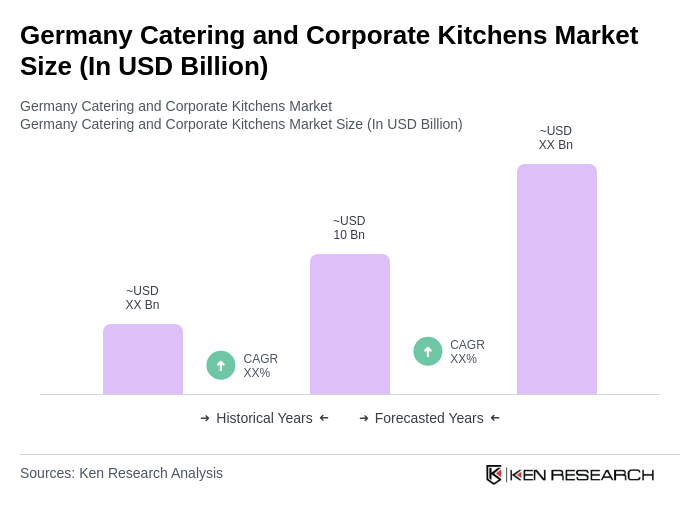
- The Germany Catering and Corporate Kitchens Market is valued at USD 10 billion, based on a five-year historical analysis. This growth is primarily driven by the increasing demand for corporate catering services, a rise in the number of corporate events, and a growing trend towards outsourcing food services by businesses. The market has seen a significant shift towards healthier and more diverse food options, catering to the evolving preferences of consumers.
- Key cities such as Berlin, Munich, and Frankfurt dominate the market due to their robust corporate sectors and high concentration of events and conferences. These cities are hubs for international business, attracting a diverse clientele that demands high-quality catering services. The presence of numerous multinational corporations and a vibrant startup ecosystem further fuels the demand for catering services in these urban centers.
- In 2023, the German government implemented regulations aimed at enhancing food safety standards in the catering industry. This includes stricter guidelines for food handling, preparation, and storage, ensuring that catering services comply with health and safety protocols. The initiative is designed to protect consumers and improve the overall quality of food services across the country.
Germany Catering and Corporate Kitchens Market Segmentation
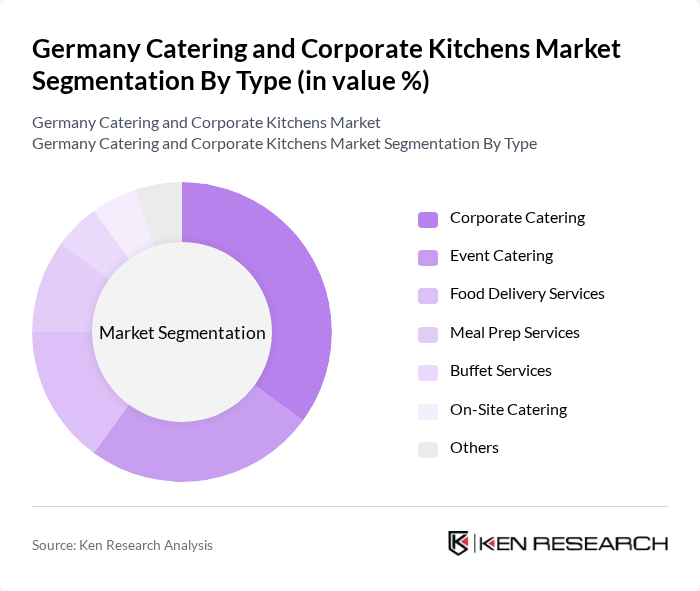
By Type:The market is segmented into various types of catering services, including Corporate Catering, Event Catering, Food Delivery Services, Meal Prep Services, Buffet Services, On-Site Catering, and Others. Among these, Corporate Catering is the leading segment, driven by the increasing number of businesses opting for outsourced food services to enhance employee satisfaction and productivity. Event Catering also holds a significant share, fueled by the rise in corporate events and social gatherings.
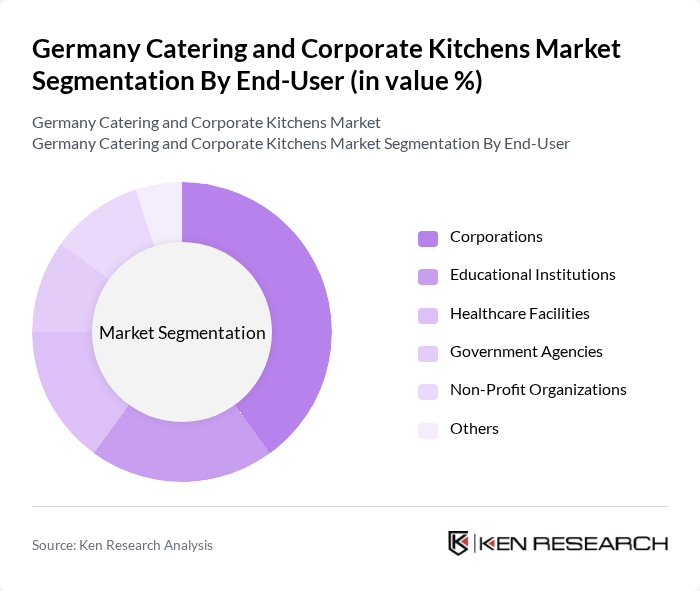
By End-User:The end-user segmentation includes Corporations, Educational Institutions, Healthcare Facilities, Government Agencies, Non-Profit Organizations, and Others. Corporations are the dominant end-user segment, as they frequently require catering services for meetings, conferences, and employee events. Educational institutions also contribute significantly, particularly for events and daily meal services, while healthcare facilities focus on specialized dietary needs.
Germany Catering and Corporate Kitchens Market Competitive Landscape
The Germany Catering and Corporate Kitchens Market is characterized by a dynamic mix of regional and international players. Leading participants such as Compass Group PLC, Sodexo S.A., Aramark Corporation, Elior Group, apetito AG, Dussmann Group, Kofler & Kompanie GmbH, LSG Group, Gategroup Holding AG, B & B Catering GmbH, Culinaria Catering GmbH, Viant Catering, Bistronauten GmbH, Food & Friends GmbH, M&M Catering contribute to innovation, geographic expansion, and service delivery in this space.
Germany Catering and Corporate Kitchens Market Industry Analysis
Growth Drivers
- Increasing Demand for Healthy Meal Options:The German catering market is witnessing a significant shift towards healthy meal options, driven by a growing health-conscious population. In future, the organic food market in Germany is projected to reach €15 billion, reflecting a 10% increase from the previous year. This trend is supported by the German Federal Ministry of Food and Agriculture, which reported that 60% of consumers prioritize health when choosing meals. Catering services that offer nutritious, locally sourced meals are likely to thrive in this environment.
- Rise in Corporate Events and Functions:The corporate sector in Germany is experiencing a resurgence in events, with an estimated 30% increase in corporate functions planned for future compared to the previous year. According to the German Convention Bureau, the number of business events is expected to exceed 1.5 million, creating a robust demand for catering services. This growth is fueled by companies investing in employee engagement and networking opportunities, thereby driving the need for professional catering solutions tailored to corporate clients.
- Technological Advancements in Food Preparation:The integration of technology in food preparation and service is revolutionizing the catering industry in Germany. In future, the market for kitchen automation technologies is projected to grow by 12%, reaching €1.2 billion. Innovations such as smart kitchen appliances and online ordering systems enhance efficiency and customer satisfaction. Catering companies adopting these technologies can streamline operations, reduce waste, and offer personalized services, positioning themselves competitively in the market.
Market Challenges
- High Competition Among Catering Services:The German catering market is characterized by intense competition, with over 20,000 registered catering businesses as of the previous year. This saturation leads to price wars and challenges in maintaining profit margins. According to industry reports, profit margins in the catering sector have declined to an average of 5% due to competitive pricing strategies. Companies must differentiate themselves through quality, service, and unique offerings to survive in this crowded marketplace.
- Fluctuating Food Prices:The catering industry in Germany faces significant challenges due to fluctuating food prices, which can impact profitability. In future, food inflation is projected to rise by 4%, driven by supply chain disruptions and increased demand. The German Federal Statistical Office reported that food prices have increased by 8% over the past year, affecting the cost structure for catering services. Companies must implement effective cost management strategies to mitigate the impact of these fluctuations on their operations.
Germany Catering and Corporate Kitchens Market Future Outlook
The future of the Germany catering and corporate kitchens market appears promising, driven by evolving consumer preferences and technological advancements. As sustainability becomes a priority, catering services that adopt eco-friendly practices are likely to gain a competitive edge. Additionally, the integration of digital solutions for order management and customer engagement will enhance operational efficiency. Companies that focus on customization and health-conscious offerings will be well-positioned to capture the growing demand from corporate clients seeking innovative catering solutions.
Market Opportunities
- Expansion of Online Catering Services:The shift towards online platforms presents a significant opportunity for catering services. With e-commerce in the food sector projected to grow by 15% in future, companies can leverage digital channels to reach a broader audience. This trend allows for streamlined ordering processes and enhanced customer engagement, ultimately driving sales and customer loyalty.
- Growth in Sustainable and Eco-Friendly Catering Options:As consumers increasingly prioritize sustainability, catering services that offer eco-friendly options are likely to thrive. The market for sustainable food products in Germany is expected to reach €10 billion in future, indicating a strong demand for organic and locally sourced ingredients. Catering companies that align their offerings with these values can attract environmentally conscious clients and enhance their brand reputation.
Scope of the Report
| Segment | Sub-Segments |
|---|---|
| By Type | Corporate Catering Event Catering Food Delivery Services Meal Prep Services Buffet Services On-Site Catering Others |
| By End-User | Corporations Educational Institutions Healthcare Facilities Government Agencies Non-Profit Organizations Others |
| By Service Model | Full-Service Catering Drop-Off Catering Food Truck Catering Self-Service Catering Others |
| By Cuisine Type | Traditional German Cuisine International Cuisine Vegetarian/Vegan Cuisine Gluten-Free Options Others |
| By Pricing Model | Fixed Pricing Per-Head Pricing Package Deals Custom Pricing Others |
| By Delivery Method | Direct Delivery Third-Party Delivery Services Pickup Options Others |
| By Customer Segment | Small Businesses Large Enterprises Startups Others |
Key Target Audience
Investors and Venture Capitalist Firms
Government and Regulatory Bodies (e.g., Federal Ministry of Food and Agriculture, Federal Office of Consumer Protection and Food Safety)
Food Service Management Companies
Corporate Event Planners
Hospitality and Catering Associations
Commercial Kitchen Equipment Suppliers
Food Safety and Quality Assurance Organizations
Logistics and Supply Chain Companies
Players Mentioned in the Report:
Compass Group PLC
Sodexo S.A.
Aramark Corporation
Elior Group
apetito AG
Dussmann Group
Kofler & Kompanie GmbH
LSG Group
Gategroup Holding AG
B & B Catering GmbH
Culinaria Catering GmbH
Viant Catering
Bistronauten GmbH
Food & Friends GmbH
M&M Catering
Table of Contents
Market Assessment Phase
1. Executive Summary and Approach
2. Germany Catering and Corporate Kitchens Market Overview
2.1 Key Insights and Strategic Recommendations
2.2 Germany Catering and Corporate Kitchens Market Overview
2.3 Definition and Scope
2.4 Evolution of Market Ecosystem
2.5 Timeline of Key Regulatory Milestones
2.6 Value Chain & Stakeholder Mapping
2.7 Business Cycle Analysis
2.8 Policy & Incentive Landscape
3. Germany Catering and Corporate Kitchens Market Analysis
3.1 Growth Drivers
3.1.1 Increasing demand for healthy meal options
3.1.2 Rise in corporate events and functions
3.1.3 Growth of remote working and corporate catering
3.1.4 Technological advancements in food preparation
3.2 Market Challenges
3.2.1 High competition among catering services
3.2.2 Fluctuating food prices
3.2.3 Regulatory compliance and food safety standards
3.2.4 Seasonal demand fluctuations
3.3 Market Opportunities
3.3.1 Expansion of online catering services
3.3.2 Partnerships with local farms for fresh produce
3.3.3 Customization of catering services for corporate clients
3.3.4 Growth in sustainable and eco-friendly catering options
3.4 Market Trends
3.4.1 Increasing focus on sustainability in catering
3.4.2 Adoption of technology for order management
3.4.3 Rise of plant-based menu options
3.4.4 Integration of delivery services in catering
3.5 Government Regulation
3.5.1 Food safety regulations compliance
3.5.2 Labor laws affecting catering staff
3.5.3 Environmental regulations for waste management
3.5.4 Health regulations for food preparation and service
4. SWOT Analysis
5. Stakeholder Analysis
6. Porter's Five Forces Analysis
7. Germany Catering and Corporate Kitchens Market Market Size, 2019-2024
7.1 By Value
7.2 By Volume
7.3 By Average Selling Price
8. Germany Catering and Corporate Kitchens Market Segmentation
8.1 By Type
8.1.1 Corporate Catering
8.1.2 Event Catering
8.1.3 Food Delivery Services
8.1.4 Meal Prep Services
8.1.5 Buffet Services
8.1.6 On-Site Catering
8.1.7 Others
8.2 By End-User
8.2.1 Corporations
8.2.2 Educational Institutions
8.2.3 Healthcare Facilities
8.2.4 Government Agencies
8.2.5 Non-Profit Organizations
8.2.6 Others
8.3 By Service Model
8.3.1 Full-Service Catering
8.3.2 Drop-Off Catering
8.3.3 Food Truck Catering
8.3.4 Self-Service Catering
8.3.5 Others
8.4 By Cuisine Type
8.4.1 Traditional German Cuisine
8.4.2 International Cuisine
8.4.3 Vegetarian/Vegan Cuisine
8.4.4 Gluten-Free Options
8.4.5 Others
8.5 By Pricing Model
8.5.1 Fixed Pricing
8.5.2 Per-Head Pricing
8.5.3 Package Deals
8.5.4 Custom Pricing
8.5.5 Others
8.6 By Delivery Method
8.6.1 Direct Delivery
8.6.2 Third-Party Delivery Services
8.6.3 Pickup Options
8.6.4 Others
8.7 By Customer Segment
8.7.1 Small Businesses
8.7.2 Large Enterprises
8.7.3 Startups
8.7.4 Others
9. Germany Catering and Corporate Kitchens Market Competitive Analysis
9.1 Market Share of Key Players
9.2 Cross Comparison of Key Players
9.2.1 Company Name
9.2.2 Group Size (Large, Medium, or Small as per industry convention)
9.2.3 Revenue Growth Rate
9.2.4 Customer Retention Rate
9.2.5 Average Order Value
9.2.6 Market Penetration Rate
9.2.7 Pricing Strategy
9.2.8 Service Quality Rating
9.2.9 Brand Recognition Score
9.2.10 Operational Efficiency Ratio
9.3 SWOT Analysis of Top Players
9.4 Pricing Analysis
9.5 Detailed Profile of Major Companies
9.5.1 Compass Group PLC
9.5.2 Sodexo S.A.
9.5.3 Aramark Corporation
9.5.4 Elior Group
9.5.5 apetito AG
9.5.6 Dussmann Group
9.5.7 Kofler & Kompanie GmbH
9.5.8 LSG Group
9.5.9 Gategroup Holding AG
9.5.10 B & B Catering GmbH
9.5.11 Culinaria Catering GmbH
9.5.12 Viant Catering
9.5.13 Bistronauten GmbH
9.5.14 Food & Friends GmbH
9.5.15 M&M Catering
10. Germany Catering and Corporate Kitchens Market End-User Analysis
10.1 Procurement Behavior of Key Ministries
10.1.1 Budget Allocation Trends
10.1.2 Preferred Service Providers
10.1.3 Contract Duration Preferences
10.1.4 Evaluation Criteria for Bids
10.2 Corporate Spend on Infrastructure & Energy
10.2.1 Investment in Catering Facilities
10.2.2 Budget for Corporate Events
10.2.3 Spending on Employee Wellness Programs
10.3 Pain Point Analysis by End-User Category
10.3.1 Quality of Food
10.3.2 Timeliness of Service
10.3.3 Variety of Menu Options
10.4 User Readiness for Adoption
10.4.1 Awareness of Catering Services
10.4.2 Willingness to Switch Providers
10.4.3 Feedback Mechanisms
10.5 Post-Deployment ROI and Use Case Expansion
10.5.1 Measurement of Satisfaction Levels
10.5.2 Analysis of Cost Savings
10.5.3 Opportunities for Upselling
11. Germany Catering and Corporate Kitchens Market Future Size, 2025-2030
11.1 By Value
11.2 By Volume
11.3 By Average Selling Price
Go-To-Market Strategy Phase
1. Whitespace Analysis + Business Model Canvas
1.1 Market Gaps Identification
1.2 Value Proposition Development
1.3 Revenue Streams Analysis
1.4 Customer Segmentation
1.5 Key Partnerships
1.6 Cost Structure
1.7 Channels of Distribution
2. Marketing and Positioning Recommendations
2.1 Branding Strategies
2.2 Product USPs
3. Distribution Plan
3.1 Urban Retail vs Rural NGO Tie-Ups
4. Channel & Pricing Gaps
4.1 Underserved Routes
4.2 Pricing Bands
5. Unmet Demand & Latent Needs
5.1 Category Gaps
5.2 Consumer Segments
6. Customer Relationship
6.1 Loyalty Programs
6.2 After-Sales Service
7. Value Proposition
7.1 Sustainability
7.2 Integrated Supply Chains
8. Key Activities
8.1 Regulatory Compliance
8.2 Branding
8.3 Distribution Setup
9. Entry Strategy Evaluation
9.1 Domestic Market Entry Strategy
9.1.1 Product Mix
9.1.2 Pricing Band
9.1.3 Packaging
9.2 Export Entry Strategy
9.2.1 Target Countries
9.2.2 Compliance Roadmap
10. Entry Mode Assessment
10.1 JV
10.2 Greenfield
10.3 M&A
10.4 Distributor Model
11. Capital and Timeline Estimation
11.1 Capital Requirements
11.2 Timelines
12. Control vs Risk Trade-Off
12.1 Ownership vs Partnerships
13. Profitability Outlook
13.1 Breakeven Analysis
13.2 Long-Term Sustainability
14. Potential Partner List
14.1 Distributors
14.2 JVs
14.3 Acquisition Targets
15. Execution Roadmap
15.1 Phased Plan for Market Entry
15.1.1 Market Setup
15.1.2 Market Entry
15.1.3 Growth Acceleration
15.1.4 Scale & Stabilize
15.2 Key Activities and Milestones
15.2.1 Milestone Planning
15.2.2 Activity Tracking
Research Methodology
Phase 1: Approach1
Desk Research
- Industry reports from German catering associations and culinary institutes
- Market analysis from government publications and trade journals
- Statistical data from Eurostat and national economic databases
Primary Research
- Interviews with executive chefs and kitchen managers in corporate settings
- Surveys targeting procurement officers in large catering firms
- Field visits to corporate kitchens to observe operational practices
Validation & Triangulation
- Cross-validation of findings with industry expert panels
- Triangulation of data from primary interviews and secondary sources
- Sanity checks through comparison with historical market trends
Phase 2: Market Size Estimation1
Top-down Assessment
- Analysis of total food service market size in Germany
- Segmentation by corporate catering and event catering services
- Incorporation of growth rates from related sectors such as hospitality
Bottom-up Modeling
- Estimation of average spend per corporate client based on survey data
- Volume estimates based on number of corporate events and employee headcounts
- Cost analysis of catering services including food, labor, and logistics
Forecasting & Scenario Analysis
- Multi-variable forecasting using economic indicators and employment rates
- Scenario analysis based on potential shifts in corporate dining trends
- Baseline, optimistic, and pessimistic projections through 2030
Phase 3: CATI Sample Composition1
| Scope Item/Segment | Sample Size | Target Respondent Profiles |
|---|---|---|
| Corporate Catering Services | 150 | Catering Managers, Corporate Event Planners |
| Corporate Kitchen Operations | 100 | Head Chefs, Kitchen Supervisors |
| Food Procurement Strategies | 80 | Procurement Managers, Supply Chain Analysts |
| Employee Dining Preferences | 120 | HR Managers, Employee Engagement Officers |
| Event Catering Trends | 90 | Event Coordinators, Marketing Managers |
Frequently Asked Questions
What is the current value of the Germany Catering and Corporate Kitchens Market?
The Germany Catering and Corporate Kitchens Market is valued at approximately USD 10 billion, reflecting a significant growth driven by increased demand for corporate catering services and a rise in corporate events, alongside a trend towards outsourcing food services by businesses.
Which cities are the main hubs for catering services in Germany?
What are the main types of catering services offered in Germany?
Who are the primary end-users of catering services in Germany?
Other Regional/Country Reports
Indonesia Catering and Corporate Kitchens Market
Malaysia Catering and Corporate Kitchens Market
KSA Catering and Corporate Kitchens Market
APAC Catering and Corporate Kitchens Market
SEA Catering and Corporate Kitchens Market
Vietnam Catering and Corporate Kitchens Market
Other Adjacent Reports
South Korea Commercial Kitchen Equipment Market
Mexico Food Delivery Services Market
Belgium Event Planning Services Market
Oman Corporate Event Management Market
Egypt Meal Preparation Services Market
Philippines Hospitality Management Software Market
Qatar Sustainable Food Packaging Market
Mexico Food Supply Chain Management Market
South Korea Nutrition Consulting Services Market
Kuwait Food Safety Testing Market
Why Buy From Us?

What makes us stand out is that our consultants follow Robust, Refine and Result (RRR) methodology. Robust for clear definitions, approaches and sanity checking, Refine for differentiating respondents' facts and opinions, and Result for presenting data with story.

We have set a benchmark in the industry by offering our clients with syndicated and customized market research reports featuring coverage of entire market as well as meticulous research and analyst insights.

While we don't replace traditional research, we flip the method upside down. Our dual approach of Top Bottom & Bottom Top ensures quality deliverable by not just verifying company fundamentals but also looking at the sector and macroeconomic factors.

With one step in the future, our research team constantly tries to show you the bigger picture. We help with some of the tough questions you may encounter along the way: How is the industry positioned? Best marketing channel? KPI's of competitors? By aligning every element, we help maximize success.

Our report gives you instant access to the answers and sources that other companies might choose to hide. We elaborate each steps of research methodology we have used and showcase you the sample size to earn your trust.

If you need any support, we are here! We pride ourselves on universe strength, data quality, and quick, friendly, and professional service.