About the Report
Base Year 2024Germany Quantum Computing Services Market Overview
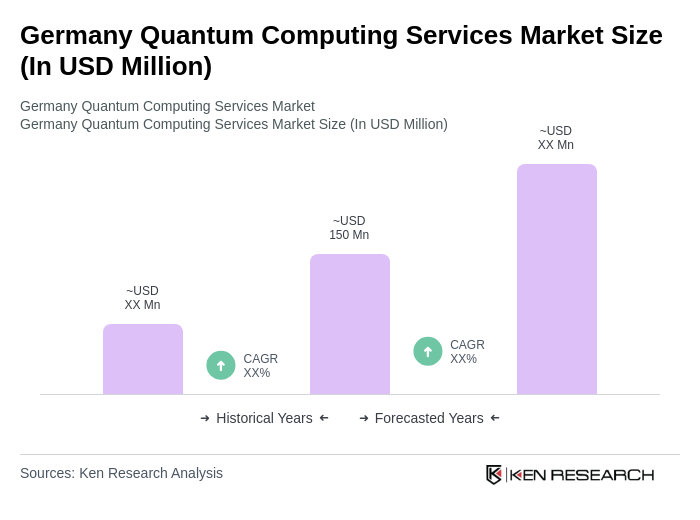
- The Germany Quantum Computing Services Market is valued at USD 150 million, based on a five-year historical analysis. This growth is primarily driven by advancements in quantum technologies, increasing investments from both public and private sectors, and a growing demand for high-performance computing solutions across various industries. Recent trends highlight Germany’s leadership in Europe, with the country accounting for over ten percent of the global quantum computing market and hosting major deployments from international technology leaders .
- Key cities such asBerlin, Munich, and Stuttgartdominate the market due to their robust technology ecosystems, presence of leading research institutions, and a concentration of startups and established companies focusing on quantum computing innovations. These cities serve as hubs for collaboration between academia and industry, fostering rapid advancements in quantum technologies. Notably, Stuttgart is home to IBM’s European quantum data center, which began operations with two utility-scale quantum computers .
- TheQuantum Technologies Action Plan(2023) issued by the Federal Government of Germany allocates EUR 2 billion to support research and development in quantum technologies. This binding instrument sets a political framework for quantum technology, prioritizing industrial adoption, scientific collaboration, and commercialization. The plan requires coordinated efforts between universities, research institutions, and private sector partners to accelerate innovation and deployment of quantum computing solutions .
Germany Quantum Computing Services Market Segmentation
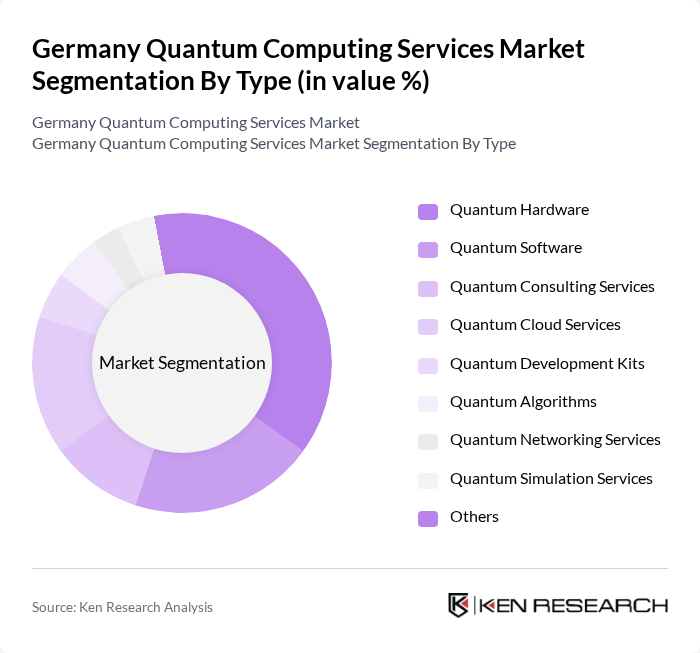
By Type:The market is segmented into various types, including Quantum Hardware, Quantum Software, Quantum Consulting Services, Quantum Cloud Services, Quantum Development Kits, Quantum Algorithms, Quantum Networking Services, Quantum Simulation Services, and Others. Among these,Quantum Hardwareis currently the leading segment due to the increasing demand for advanced computing capabilities and the development of quantum processors. The growth in this segment is fueled by significant investments in research and development, as well as the rising need for efficient data processing solutions across industries. The “system” category, which includes hardware, accounted for nearly three-quarters of market revenue in the most recent period .
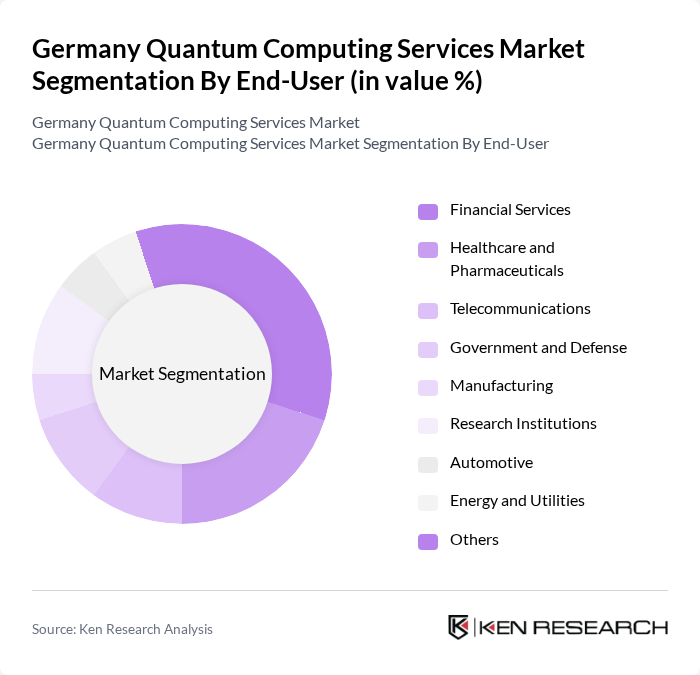
By End-User:The end-user segmentation includes Financial Services, Healthcare and Pharmaceuticals, Telecommunications, Government and Defense, Manufacturing, Research Institutions, Automotive, Energy and Utilities, and Others. TheFinancial Servicessector is the dominant segment, driven by the need for advanced algorithms to optimize trading strategies and risk management. The increasing complexity of financial models and the demand for real-time data processing are propelling the adoption of quantum computing solutions in this sector. Other sectors such as healthcare, energy, and manufacturing are also rapidly adopting quantum technologies for simulation, optimization, and secure communications .
Germany Quantum Computing Services Market Competitive Landscape
The Germany Quantum Computing Services Market is characterized by a dynamic mix of regional and international players. Leading participants such as IBM Quantum, D-Wave Quantum Inc., Rigetti Computing, Google Quantum AI, Microsoft Azure Quantum, IonQ, Xanadu Quantum Technologies, Atos SE, Quantum Computing Inc. (QCI), Quantum Motion Technologies, ColdQuanta (now Infleqtion), PsiQuantum, Zapata Computing, Qiskit (IBM open-source framework), Quantum Machines, Fraunhofer-Gesellschaft, HQS Quantum Simulations, PlanQK (Platform for Quantum Computing, Germany), QuTech (TU Delft, partner in EU quantum projects), and Alpine Quantum Technologies GmbH (AQT) contribute to innovation, geographic expansion, and service delivery in this space. The competitive landscape is further strengthened by Germany’s strong research infrastructure and public-private partnerships, supporting both domestic startups and global technology leaders .
Germany Quantum Computing Services Market Industry Analysis
Growth Drivers
- Increasing Demand for High-Performance Computing:The demand for high-performance computing (HPC) in Germany is projected to reach €3.5 billion in the future, driven by sectors such as automotive, aerospace, and energy. This surge is fueled by the need for advanced simulations and data analysis, which quantum computing can significantly enhance. As industries increasingly adopt data-driven decision-making, the reliance on HPC solutions is expected to grow, positioning quantum computing as a vital technology for future innovations.
- Advancements in Quantum Algorithms:Significant progress in quantum algorithms has been made, with over 200 new algorithms developed in the last two years alone. These advancements are crucial for solving complex problems in optimization, cryptography, and material science. The German research community, supported by institutions like the Max Planck Society, is at the forefront of these developments, which are expected to unlock new applications and drive the adoption of quantum computing technologies across various sectors.
- Government Funding and Support for Quantum Initiatives:The German government has allocated €2 billion for quantum technology initiatives as part of its National Quantum Strategy. This funding aims to foster research, development, and commercialization of quantum technologies. With a focus on creating a robust ecosystem, the government is encouraging public-private partnerships, which are essential for accelerating innovation and ensuring that Germany remains competitive in the global quantum computing landscape.
Market Challenges
- High Costs of Quantum Computing Technology:The initial investment required for quantum computing technology can exceed €10 million for enterprises, making it a significant barrier for many organizations. This high cost includes not only the hardware but also the necessary infrastructure and maintenance. As a result, many potential users are hesitant to adopt quantum solutions, limiting the market's growth potential and delaying the transition from classical to quantum computing.
- Limited Availability of Skilled Workforce:The shortage of skilled professionals in quantum computing is a pressing challenge, with estimates indicating a gap of over 5,000 qualified experts in Germany in the future. This scarcity hampers the ability of companies to develop and implement quantum solutions effectively. Educational institutions are struggling to keep pace with the rapid advancements in the field, which further exacerbates the workforce issue and slows down market growth.
Germany Quantum Computing Services Market Future Outlook
The future of the Germany quantum computing services market appears promising, driven by increasing investments in research and development, which are expected to exceed €1 billion annually in the future. The emergence of quantum-as-a-service models will democratize access to quantum technologies, allowing smaller enterprises to leverage these advancements. Additionally, the integration of artificial intelligence with quantum computing is anticipated to create innovative solutions, enhancing efficiency and opening new avenues for growth across various industries.
Market Opportunities
- Expansion into New Industry Verticals:There is a significant opportunity for quantum computing services to penetrate industries such as logistics and supply chain management, which are projected to be worth €1.2 trillion in the future. By optimizing complex logistical challenges, quantum solutions can enhance operational efficiency and reduce costs, making them attractive to businesses seeking competitive advantages.
- Growth in Cloud-Based Quantum Computing Services:The cloud-based quantum computing market is expected to grow to €500 million in the future, driven by the increasing demand for scalable and flexible computing resources. This model allows organizations to access quantum capabilities without substantial upfront investments, facilitating broader adoption and innovation in quantum applications across various sectors.
Scope of the Report
| Segment | Sub-Segments |
|---|---|
| By Type | Quantum Hardware Quantum Software Quantum Consulting Services Quantum Cloud Services Quantum Development Kits Quantum Algorithms Quantum Networking Services Quantum Simulation Services Others |
| By End-User | Financial Services Healthcare and Pharmaceuticals Telecommunications Government and Defense Manufacturing Research Institutions Automotive Energy and Utilities Others |
| By Application | Optimization Problems Cryptography Drug Discovery Financial Modeling Machine Learning Simulation & Material Science Others |
| By Deployment Model | On-Premises Cloud-Based Hybrid |
| By Service Model | Quantum as a Service (QaaS) Managed Services Professional Services |
| By Industry Vertical | Aerospace and Defense Automotive Energy and Utilities Retail Chemicals Transportation & Logistics Academia Others |
| By Pricing Model | Subscription-Based Pay-As-You-Go Tiered Pricing Custom Enterprise Pricing Others |
Key Target Audience
Investors and Venture Capitalist Firms
Government and Regulatory Bodies (e.g., Federal Ministry of Education and Research, Federal Ministry for Economic Affairs and Energy)
Technology Providers
Telecommunications Companies
Aerospace and Defense Contractors
Pharmaceutical and Biotechnology Firms
Energy Sector Companies
Financial Services Firms
Players Mentioned in the Report:
IBM Quantum
D-Wave Quantum Inc.
Rigetti Computing
Google Quantum AI
Microsoft Azure Quantum
IonQ
Xanadu Quantum Technologies
Atos SE
Quantum Computing Inc. (QCI)
Quantum Motion Technologies
ColdQuanta (now Infleqtion)
PsiQuantum
Zapata Computing
Qiskit (IBM open-source framework)
Quantum Machines
Fraunhofer-Gesellschaft
HQS Quantum Simulations
PlanQK (Platform for Quantum Computing, Germany)
QuTech (TU Delft, partner in EU quantum projects)
Alpine Quantum Technologies GmbH (AQT)
Table of Contents
Market Assessment Phase
1. Executive Summary and Approach
2. Germany Quantum Computing Services Market Overview
2.1 Key Insights and Strategic Recommendations
2.2 Germany Quantum Computing Services Market Overview
2.3 Definition and Scope
2.4 Evolution of Market Ecosystem
2.5 Timeline of Key Regulatory Milestones
2.6 Value Chain & Stakeholder Mapping
2.7 Business Cycle Analysis
2.8 Policy & Incentive Landscape
3. Germany Quantum Computing Services Market Analysis
3.1 Growth Drivers
3.1.1 Increasing demand for high-performance computing
3.1.2 Advancements in quantum algorithms
3.1.3 Government funding and support for quantum initiatives
3.1.4 Rising interest from industries such as finance and pharmaceuticals
3.2 Market Challenges
3.2.1 High costs of quantum computing technology
3.2.2 Limited availability of skilled workforce
3.2.3 Regulatory hurdles and compliance issues
3.2.4 Competition from classical computing solutions
3.3 Market Opportunities
3.3.1 Expansion into new industry verticals
3.3.2 Development of hybrid quantum-classical systems
3.3.3 Collaborations with academic institutions
3.3.4 Growth in cloud-based quantum computing services
3.4 Market Trends
3.4.1 Increasing investment in quantum research and development
3.4.2 Emergence of quantum-as-a-service models
3.4.3 Focus on quantum cybersecurity solutions
3.4.4 Integration of AI with quantum computing
3.5 Government Regulation
3.5.1 National Quantum Strategy initiatives
3.5.2 Data protection regulations impacting quantum services
3.5.3 Funding programs for quantum technology startups
3.5.4 Compliance requirements for quantum computing applications
4. SWOT Analysis
5. Stakeholder Analysis
6. Porter's Five Forces Analysis
7. Germany Quantum Computing Services Market Market Size, 2019-2024
7.1 By Value
7.2 By Volume
7.3 By Average Selling Price
8. Germany Quantum Computing Services Market Segmentation
8.1 By Type
8.1.1 Quantum Hardware
8.1.2 Quantum Software
8.1.3 Quantum Consulting Services
8.1.4 Quantum Cloud Services
8.1.5 Quantum Development Kits
8.1.6 Quantum Algorithms
8.1.7 Quantum Networking Services
8.1.8 Quantum Simulation Services
8.1.9 Others
8.2 By End-User
8.2.1 Financial Services
8.2.2 Healthcare and Pharmaceuticals
8.2.3 Telecommunications
8.2.4 Government and Defense
8.2.5 Manufacturing
8.2.6 Research Institutions
8.2.7 Automotive
8.2.8 Energy and Utilities
8.2.9 Others
8.3 By Application
8.3.1 Optimization Problems
8.3.2 Cryptography
8.3.3 Drug Discovery
8.3.4 Financial Modeling
8.3.5 Machine Learning
8.3.6 Simulation & Material Science
8.3.7 Others
8.4 By Deployment Model
8.4.1 On-Premises
8.4.2 Cloud-Based
8.4.3 Hybrid
8.5 By Service Model
8.5.1 Quantum as a Service (QaaS)
8.5.2 Managed Services
8.5.3 Professional Services
8.6 By Industry Vertical
8.6.1 Aerospace and Defense
8.6.2 Automotive
8.6.3 Energy and Utilities
8.6.4 Retail
8.6.5 Chemicals
8.6.6 Transportation & Logistics
8.6.7 Academia
8.6.8 Others
8.7 By Pricing Model
8.7.1 Subscription-Based
8.7.2 Pay-As-You-Go
8.7.3 Tiered Pricing
8.7.4 Custom Enterprise Pricing
8.7.5 Others
9. Germany Quantum Computing Services Market Competitive Analysis
9.1 Market Share of Key Players
9.2 Cross Comparison of Key Players
9.2.1 Company Name
9.2.2 Company Headquarters Location
9.2.3 Group Size (Large, Medium, or Small as per industry convention)
9.2.4 Revenue from Quantum Services (Germany, latest year, USD million)
9.2.5 Revenue Growth Rate (YoY %)
9.2.6 Number of Quantum Computing Patents (Germany/Europe)
9.2.7 Number of Enterprise Customers (Germany)
9.2.8 Market Penetration Rate (Germany, % of addressable market)
9.2.9 Customer Retention Rate (%)
9.2.10 Average Deal Size (USD)
9.2.11 Service Delivery Time (Average project duration, weeks)
9.2.12 Customer Satisfaction Score (CSAT/NPS)
9.2.13 R&D Expenditure (% of revenue)
9.2.14 Strategic Partnerships (number, Germany/Europe)
9.2.15 Pricing Strategy
9.2.16 Others (e.g., ESG Score, if available)
9.3 SWOT Analysis of Top Players
9.4 Pricing Analysis
9.5 Detailed Profile of Major Companies
9.5.1 IBM Quantum
9.5.2 D-Wave Quantum Inc.
9.5.3 Rigetti Computing
9.5.4 Google Quantum AI
9.5.5 Microsoft Azure Quantum
9.5.6 IonQ
9.5.7 Xanadu Quantum Technologies
9.5.8 Atos SE
9.5.9 Quantum Computing Inc. (QCI)
9.5.10 Quantum Motion Technologies
9.5.11 ColdQuanta (now Infleqtion)
9.5.12 PsiQuantum
9.5.13 Zapata Computing
9.5.14 Qiskit (IBM open-source framework)
9.5.15 Quantum Machines
9.5.16 Fraunhofer-Gesellschaft
9.5.17 HQS Quantum Simulations
9.5.18 PlanQK (Platform for Quantum Computing, Germany)
9.5.19 QuTech (TU Delft, partner in EU quantum projects)
9.5.20 Alpine Quantum Technologies GmbH (AQT)
10. Germany Quantum Computing Services Market End-User Analysis
10.1 Procurement Behavior of Key Ministries
10.1.1 Budget Allocation for Quantum Initiatives
10.1.2 Decision-Making Processes
10.1.3 Collaboration with Private Sector
10.2 Corporate Spend on Infrastructure & Energy
10.2.1 Investment Trends in Quantum Technologies
10.2.2 Budgeting for R&D in Quantum Computing
10.2.3 Spending on Training and Development
10.3 Pain Point Analysis by End-User Category
10.3.1 Technical Limitations of Current Solutions
10.3.2 Integration Challenges with Existing Systems
10.3.3 Cost Concerns
10.4 User Readiness for Adoption
10.4.1 Awareness of Quantum Computing Benefits
10.4.2 Training Needs for End-Users
10.4.3 Infrastructure Readiness
10.5 Post-Deployment ROI and Use Case Expansion
10.5.1 Measurement of ROI in Quantum Projects
10.5.2 Case Studies of Successful Implementations
10.5.3 Future Use Case Development
11. Germany Quantum Computing Services Market Future Size, 2025-2030
11.1 By Value
11.2 By Volume
11.3 By Average Selling Price
Go-To-Market Strategy Phase
1. Whitespace Analysis + Business Model Canvas
1.1 Market Gaps Identification
1.2 Value Proposition Development
1.3 Revenue Streams Analysis
1.4 Key Partnerships
1.5 Customer Segmentation
1.6 Cost Structure
1.7 Channels of Distribution
2. Marketing and Positioning Recommendations
2.1 Branding Strategies
2.2 Product USPs
3. Distribution Plan
3.1 Urban Retail vs Rural NGO Tie-Ups
4. Channel & Pricing Gaps
4.1 Underserved Routes
4.2 Pricing Bands
5. Unmet Demand & Latent Needs
5.1 Category Gaps
5.2 Consumer Segments
6. Customer Relationship
6.1 Loyalty Programs
6.2 After-Sales Service
7. Value Proposition
7.1 Sustainability
7.2 Integrated Supply Chains
8. Key Activities
8.1 Regulatory Compliance
8.2 Branding
8.3 Distribution Setup
9. Entry Strategy Evaluation
9.1 Domestic Market Entry Strategy
9.1.1 Product Mix
9.1.2 Pricing Band
9.1.3 Packaging
9.2 Export Entry Strategy
9.2.1 Target Countries
9.2.2 Compliance Roadmap
10. Entry Mode Assessment
10.1 JV
10.2 Greenfield
10.3 M&A
10.4 Distributor Model
11. Capital and Timeline Estimation
11.1 Capital Requirements
11.2 Timelines
12. Control vs Risk Trade-Off
12.1 Ownership vs Partnerships
13. Profitability Outlook
13.1 Breakeven Analysis
13.2 Long-Term Sustainability
14. Potential Partner List
14.1 Distributors
14.2 JVs
14.3 Acquisition Targets
15. Execution Roadmap
15.1 Phased Plan for Market Entry
15.1.1 Market Setup
15.1.2 Market Entry
15.1.3 Growth Acceleration
15.1.4 Scale & Stabilize
15.2 Key Activities and Milestones
15.2.1 Milestone Planning
15.2.2 Activity Tracking
Research Methodology
Phase 1: Approach1
Desk Research
- Analysis of industry reports from leading quantum computing research organizations
- Review of government publications and white papers on quantum technology initiatives in Germany
- Examination of academic journals and conference proceedings related to quantum computing advancements
Primary Research
- Interviews with executives from quantum computing service providers and technology firms
- Surveys targeting R&D managers in industries adopting quantum computing solutions
- Focus groups with academic researchers specializing in quantum algorithms and applications
Validation & Triangulation
- Cross-validation of findings through multiple data sources, including market reports and expert opinions
- Triangulation of quantitative data with qualitative insights from industry experts
- Sanity checks conducted through peer reviews and expert panel discussions
Phase 2: Market Size Estimation1
Top-down Assessment
- Estimation of market size based on national technology spending and investment trends in quantum computing
- Segmentation of the market by application areas such as finance, pharmaceuticals, and logistics
- Incorporation of government funding and support initiatives for quantum technology development
Bottom-up Modeling
- Collection of data on service pricing and adoption rates from leading quantum computing firms
- Estimation of market potential based on the number of active projects and collaborations in the sector
- Volume x cost analysis for various quantum computing services offered in the market
Forecasting & Scenario Analysis
- Multi-factor regression analysis incorporating technological advancements and market adoption rates
- Scenario modeling based on potential regulatory changes and funding availability
- Development of baseline, optimistic, and pessimistic forecasts through 2030
Phase 3: CATI Sample Composition1
| Scope Item/Segment | Sample Size | Target Respondent Profiles |
|---|---|---|
| Quantum Computing Service Providers | 60 | CEOs, CTOs, Business Development Managers |
| Industry Adoption in Finance | 50 | Risk Analysts, IT Managers, Innovation Officers |
| Healthcare Applications of Quantum Computing | 40 | Pharmaceutical Researchers, Data Scientists |
| Logistics and Supply Chain Optimization | 40 | Supply Chain Analysts, Operations Managers |
| Academic Research in Quantum Algorithms | 40 | University Professors, Research Scientists |
Frequently Asked Questions
What is the current value of the Germany Quantum Computing Services Market?
The Germany Quantum Computing Services Market is valued at approximately USD 150 million, reflecting significant growth driven by advancements in quantum technologies and increasing investments from both public and private sectors.
Which cities in Germany are leading in quantum computing services?
What is the Quantum Technologies Action Plan?
What are the main segments of the Germany Quantum Computing Services Market?
Other Regional/Country Reports
Indonesia Quantum Computing Services Market
Malaysia Quantum Computing Services Market
KSA Quantum Computing Services Market
APAC Quantum Computing Services Market
SEA Quantum Computing Services Market
Vietnam Quantum Computing Services Market
Other Adjacent Reports
Belgium High-Performance Computing Market
UAE Nordics Cybersecurity MarketVietnam Cloud Computing Market Outlook to 2030: Size, Share, Growth and TrendsThailand Big Data Analytics Market
UAE Semiconductor Market Outlook to 2030UAE Quantum Sensors MarketOman Quantum Cryptography Market Report Size, Share, Growth Drivers, Trends, Opportunities & Forecast 2025–2030GCC machine learning market Size, Share, Growth Drivers, Trends, Opportunities & Forecast 2025–2030KSA Blockchain Market outlook to 2030Why Buy From Us?

What makes us stand out is that our consultants follow Robust, Refine and Result (RRR) methodology. Robust for clear definitions, approaches and sanity checking, Refine for differentiating respondents' facts and opinions, and Result for presenting data with story.

We have set a benchmark in the industry by offering our clients with syndicated and customized market research reports featuring coverage of entire market as well as meticulous research and analyst insights.

While we don't replace traditional research, we flip the method upside down. Our dual approach of Top Bottom & Bottom Top ensures quality deliverable by not just verifying company fundamentals but also looking at the sector and macroeconomic factors.

With one step in the future, our research team constantly tries to show you the bigger picture. We help with some of the tough questions you may encounter along the way: How is the industry positioned? Best marketing channel? KPI's of competitors? By aligning every element, we help maximize success.

Our report gives you instant access to the answers and sources that other companies might choose to hide. We elaborate each steps of research methodology we have used and showcase you the sample size to earn your trust.

If you need any support, we are here! We pride ourselves on universe strength, data quality, and quick, friendly, and professional service.