About the Report
Base Year 2024Global 3d Motion Capture Market Overview
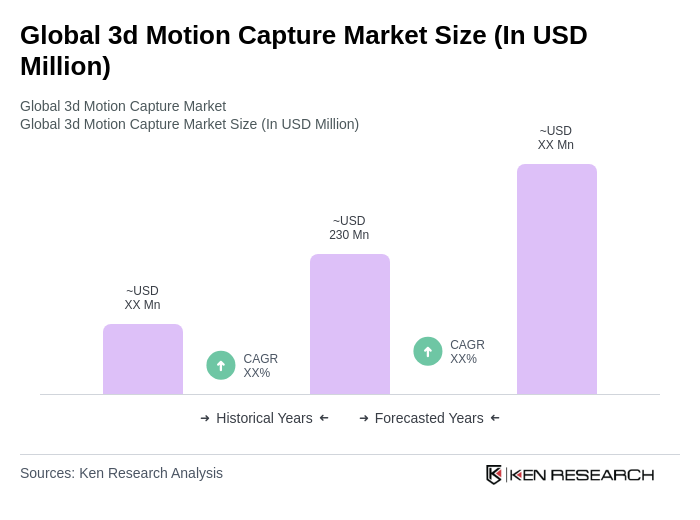
- The Global 3D Motion Capture Market is valued at USD 230 million, based on a five-year historical analysis. This growth is primarily driven by advancements in capture hardware and software, broader adoption across media and entertainment, sports and biomechanics, and healthcare, and the integration of artificial intelligence for real-time tracking, cleanup, and animation retargeting. Increasing use with virtual and augmented reality, real-time engines, and user-friendly, portable inertial systems is further expanding use cases beyond studios to field and clinical settings.
- Key players in this market include the United States, Canada, the United Kingdom, Germany, and Japan. The dominance of these countries can be attributed to their strong media and gaming industries, significant investments in research and development, and a robust technological infrastructure. Additionally, the presence of leading motion capture companies and studios in these regions fosters innovation and growth in the market.
- There is no EU regulation that specifically “standardizes motion capture technologies”; however, motion capture systems operating in the EU must comply with existing data protection frameworks, notably GDPR, which imposes strict requirements on personal data processing, privacy-by-design, and security—policies that vendors have aligned with across deployments.
Global 3d Motion Capture Market Segmentation
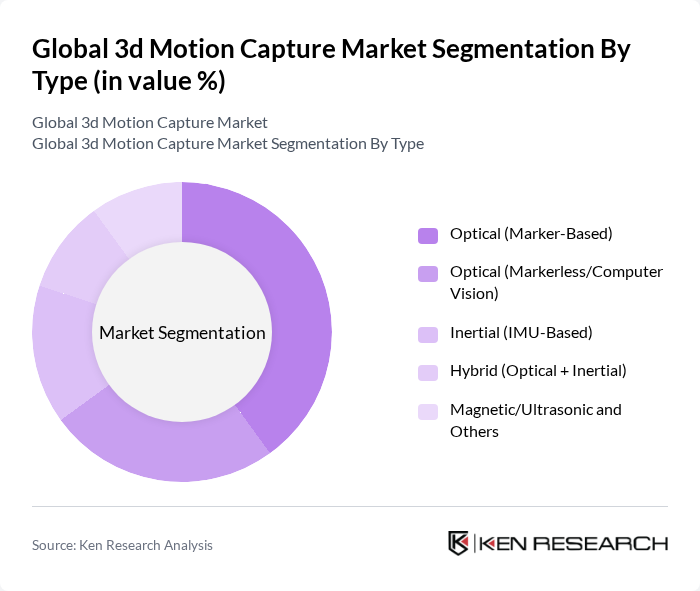
By Type:The 3D motion capture market is segmented into various types, including Optical (Marker-Based), Optical (Markerless/Computer Vision), Inertial (IMU-Based), Hybrid (Optical + Inertial), and Magnetic/Ultrasonic and Others. Optical (Marker-Based) systems remain the preferred choice in high-end film, TV, and AAA game pipelines due to their superior spatial accuracy, low latency, and established workflows, while markerless/computer vision methods and inertial suits are gaining traction for faster setup and portability.
By End-User:The market is also segmented by end-user, which includes Film, TV, and VFX Studios, Gaming and Interactive Media, Sports, Biomechanics, and Performance Labs, Healthcare and Rehabilitation, Industrial, Robotics, and Research Institutes, and Education and Training. Film, TV, and VFX Studios lead due to sustained demand for photoreal animation and real-time performance capture, while gaming and interactive media show strong use tied to real-time engines and VR/AR deployments; sports and healthcare use cases continue to expand for performance analysis and clinical assessment.

Global 3d Motion Capture Market Competitive Landscape
The Global 3D Motion Capture Market is characterized by a dynamic mix of regional and international players. Leading participants such as Vicon Motion Systems Ltd., OptiTrack (a division of Movella Inc.), Motion Analysis Corporation, Xsens Technologies B.V. (a Movella company), Qualisys AB, Noitom Ltd. (Perception Neuron), Rokoko, Faceware Technologies, Inc., iPi Soft LLC, Reallusion Inc., Dynamixyz (a Discord company), Perception Neuron Studio by Noitom, Shadow by Manus (Manus BV), StretchSense Limited, Qualibyte (Cascadeur by Nekki) and RADiCAL Solutions contribute to innovation, geographic expansion, and service delivery in this space.
Global 3d Motion Capture Market Industry Analysis
Growth Drivers
- Increasing Demand for Animation and Gaming:The global gaming audience is estimated at over3 billion players, indicating broad demand for realistic animations and immersive experiences that rely on advanced 3D motion capture technologies. This growth is supported by the increasing investment in game development, which was estimated at $18 billion in future, highlighting the critical role of motion capture in enhancing user engagement and experience.
- Advancements in Technology:Motion capture adoption is facilitated by improvements insensor accuracy,computer vision, andreal?time processingdocumented by research institutions and standards bodies, expanding use across film, healthcare, and sports. In future, the global spending on motion capture technology is expected to exceed $1.5 billion, driven by innovations in real-time data processing and cloud computing. These advancements enable more accurate and efficient motion capture solutions, making them accessible to a broader range of industries, including film, healthcare, and sports.
- Rising Adoption in Healthcare and Sports:Clinical motion analysis is an established tool in rehabilitation and gait assessment in healthcare, and biomechanical motion analysis is used in elite sports for performance and injury prevention. Additionally, sports organizations are adopting these technologies for performance analysis and injury prevention, with an estimated investment of $500 million in motion capture systems. This trend underscores the growing recognition of motion capture's value in enhancing athletic performance and patient outcomes.
Market Challenges
- High Initial Investment Costs:Professional optical motion capture systems with multi?camera arrays and dedicated studio setups can require substantial capital expenditure, which can limit adoption by smaller organizations. The average setup cost for a professional motion capture studio can exceed $250,000, which limits accessibility for smaller companies and startups. This financial hurdle can slow down the adoption of motion capture technologies, particularly in emerging markets where budgets are constrained.
- Technical Complexity and Skill Gap:Operating and interpreting data from advanced motion capture and biomechanical analysis systems typically requires specialized technical skills spanning sensors, kinematics, and data processing. In future, it is estimated that over 60% of companies in the motion capture industry will face challenges in finding qualified personnel. This skill gap can hinder the effective implementation and utilization of motion capture technologies, impacting overall productivity and innovation within the sector.
Global 3d Motion Capture Market Future Outlook
The future of the 3D motion capture market appears promising, driven by continuous technological advancements and increasing applications across various sectors. As industries increasingly recognize the value of immersive experiences, the integration of AI and machine learning will enhance motion capture capabilities, leading to more efficient data processing. Furthermore, the expansion into emerging markets will provide new growth avenues, fostering innovation and collaboration across entertainment, healthcare, and sports sectors.
Market Opportunities
- Expansion in Emerging Markets:Broaderdigital adoptionand increasinginternet and smartphone penetrationin emerging economies support adoption of advanced content creation tools, including motion capture, as part of creative and digital industries growth. This expansion can lead to enhanced local content creation and innovation, driving demand for motion capture solutions.
- Integration with AI and Machine Learning:Advances in AI?based pose estimation and computer vision are enabling markerless motion capture and real?time analytics that can broaden applications in gaming, healthcare, and sports analytics. By future, the market for AI-driven motion capture solutions is expected to grow significantly, with investments exceeding $200 million. This integration will enhance data accuracy and processing speed, enabling real-time applications in various fields, including gaming, healthcare, and sports analytics.
Scope of the Report
| Segment | Sub-Segments |
|---|---|
| By Type | Optical (Marker-Based) Optical (Markerless/Computer Vision) Inertial (IMU-Based) Hybrid (Optical + Inertial) Magnetic/Ultrasonic and Others |
| By End-User | Film, TV, and VFX Studios Gaming and Interactive Media Sports, Biomechanics, and Performance Labs Healthcare and Rehabilitation Industrial, Robotics, and Research Institutes Education and Training |
| By Application | Character Animation and Previsualization Virtual Production and Digital Humans VR/AR/MR and Metaverse Avatars Sports Analytics and Athlete Performance Clinical Gait Analysis and Ergonomics Robotics Control and Human–Robot Interaction |
| By Component | Hardware (Cameras/Sensors, Suits, Markers, Accessories) Software (Tracking, Solvers, Retargeting, Plugins) Services (Installation, Training, Maintenance, Managed Mocap) |
| By Distribution Channel | Direct (OEM and Enterprise Sales) Online (Official Stores and Marketplaces) Authorized Distributors/Resellers |
| By Region | North America Europe Asia-Pacific Latin America Middle East & Africa |
| By Price Range | Entry-Level (Creator/Indie) Mid-Range (Studio/Pro) High-End (Enterprise/Elite) |
Key Target Audience
Investors and Venture Capitalist Firms
Government and Regulatory Bodies (e.g., National Aeronautics and Space Administration, Federal Aviation Administration)
Manufacturers and Producers
Distributors and Retailers
Film and Animation Studios
Video Game Developers
Healthcare and Rehabilitation Facilities
Sports Organizations and Teams
Players Mentioned in the Report:
Vicon Motion Systems Ltd.
OptiTrack (a division of Movella Inc.)
Motion Analysis Corporation
Xsens Technologies B.V. (a Movella company)
Qualisys AB
Noitom Ltd. (Perception Neuron)
Rokoko
Faceware Technologies, Inc.
iPi Soft LLC
Reallusion Inc.
Dynamixyz (a Discord company)
Perception Neuron Studio by Noitom
Shadow by Manus (Manus BV)
StretchSense Limited
Qualibyte (Cascadeur by Nekki) and RADiCAL Solutions
Table of Contents
Market Assessment Phase
1. Executive Summary and Approach
2. Global 3d Motion Capture Market Overview
2.1 Key Insights and Strategic Recommendations
2.2 Global 3d Motion Capture Market Overview
2.3 Definition and Scope
2.4 Evolution of Market Ecosystem
2.5 Timeline of Key Regulatory Milestones
2.6 Value Chain & Stakeholder Mapping
2.7 Business Cycle Analysis
2.8 Policy & Incentive Landscape
3. Global 3d Motion Capture Market Analysis
3.1 Growth Drivers
3.1.1 Increasing Demand for Animation and Gaming
3.1.2 Advancements in Technology
3.1.3 Rising Adoption in Healthcare and Sports
3.1.4 Growth of Virtual Reality and Augmented Reality
3.2 Market Challenges
3.2.1 High Initial Investment Costs
3.2.2 Technical Complexity and Skill Gap
3.2.3 Data Privacy and Security Concerns
3.2.4 Limited Awareness in Emerging Markets
3.3 Market Opportunities
3.3.1 Expansion in Emerging Markets
3.3.2 Integration with AI and Machine Learning
3.3.3 Development of Cost-Effective Solutions
3.3.4 Collaborations with Entertainment Industries
3.4 Market Trends
3.4.1 Increasing Use of Cloud-Based Solutions
3.4.2 Growth of Mobile Motion Capture Solutions
3.4.3 Rising Popularity of Real-Time Motion Capture
3.4.4 Enhanced Focus on User Experience
3.5 Government Regulation
3.5.1 Data Protection Regulations
3.5.2 Industry Standards for Motion Capture
3.5.3 Intellectual Property Rights Enforcement
3.5.4 Support for Research and Development
4. SWOT Analysis
5. Stakeholder Analysis
6. Porter's Five Forces Analysis
7. Global 3d Motion Capture Market Market Size, 2019-2024
7.1 By Value
7.2 By Volume
7.3 By Average Selling Price
8. Global 3d Motion Capture Market Segmentation
8.1 By Type
8.1.1 Optical (Marker-Based)
8.1.2 Optical (Markerless/Computer Vision)
8.1.3 Inertial (IMU-Based)
8.1.4 Hybrid (Optical + Inertial)
8.1.5 Magnetic/Ultrasonic and Others
8.2 By End-User
8.2.1 Film, TV, and VFX Studios
8.2.2 Gaming and Interactive Media
8.2.3 Sports, Biomechanics, and Performance Labs
8.2.4 Healthcare and Rehabilitation
8.2.5 Industrial, Robotics, and Research Institutes
8.2.6 Education and Training
8.3 By Application
8.3.1 Character Animation and Previsualization
8.3.2 Virtual Production and Digital Humans
8.3.3 VR/AR/MR and Metaverse Avatars
8.3.4 Sports Analytics and Athlete Performance
8.3.5 Clinical Gait Analysis and Ergonomics
8.3.6 Robotics Control and Human–Robot Interaction
8.4 By Component
8.4.1 Hardware (Cameras/Sensors, Suits, Markers, Accessories)
8.4.2 Software (Tracking, Solvers, Retargeting, Plugins)
8.4.3 Services (Installation, Training, Maintenance, Managed Mocap)
8.5 By Distribution Channel
8.5.1 Direct (OEM and Enterprise Sales)
8.5.2 Online (Official Stores and Marketplaces)
8.5.3 Authorized Distributors/Resellers
8.6 By Region
8.6.1 North America
8.6.2 Europe
8.6.3 Asia-Pacific
8.6.4 Latin America
8.6.5 Middle East & Africa
8.7 By Price Range
8.7.1 Entry-Level (Creator/Indie)
8.7.2 Mid-Range (Studio/Pro)
8.7.3 High-End (Enterprise/Elite)
9. Global 3d Motion Capture Market Competitive Analysis
9.1 Market Share of Key Players
9.2 Cross Comparison of Key Players
9.2.1 Company Name
9.2.2 Installed Base (Active Systems/Studios)
9.2.3 Revenue Growth Rate (YoY)
9.2.4 Geographic Footprint (Regions/Countries Served)
9.2.5 Vertical Mix (% Revenue by Media, Sports, Healthcare, Industrial)
9.2.6 R&D Intensity (% Revenue Spent on R&D)
9.2.7 Product Portfolio Breadth (Optical, Inertial, Markerless, Hybrid)
9.2.8 Real-Time Performance (Latency ms, Max FPS, Tracking Accuracy mm)
9.2.9 Software Ecosystem (Native Tools, SDKs, Engine Integrations)
9.2.10 Services Depth (Installation, Managed Capture, Training SLAs)
9.2.11 Pricing Bands (Entry/Mid/Enterprise SKU Coverage)
9.2.12 Strategic Partnerships (Studios, Sports Teams, Hospitals, OEMs)
9.2.13 IP/Patents and Proprietary Algorithms
9.2.14 Customer Satisfaction (NPS/Review Scores)
9.3 SWOT Analysis of Top Players
9.4 Pricing Analysis
9.5 Detailed Profile of Major Companies
9.5.1 Vicon Motion Systems Ltd.
9.5.2 OptiTrack (a division of Movella Inc.)
9.5.3 Motion Analysis Corporation
9.5.4 Xsens Technologies B.V. (a Movella company)
9.5.5 Qualisys AB
9.5.6 Noitom Ltd. (Perception Neuron)
9.5.7 Rokoko
9.5.8 Faceware Technologies, Inc.
9.5.9 iPi Soft LLC
9.5.10 Reallusion Inc.
9.5.11 Dynamixyz (a Discord company)
9.5.12 Perception Neuron Studio by Noitom
9.5.13 Shadow by Manus (Manus BV)
9.5.14 StretchSense Limited
9.5.15 Qualibyte (Cascadeur by Nekki) and RADiCAL Solutions
10. Global 3d Motion Capture Market End-User Analysis
10.1 Procurement Behavior of Key Ministries
10.1.1 Government Contracts for Film Production
10.1.2 Funding for Healthcare Research
10.1.3 Grants for Sports Technology Development
10.2 Corporate Spend on Infrastructure & Energy
10.2.1 Investment in Motion Capture Facilities
10.2.2 Budget Allocation for R&D
10.2.3 Expenditure on Training and Development
10.3 Pain Point Analysis by End-User Category
10.3.1 High Costs of Implementation
10.3.2 Lack of Skilled Professionals
10.3.3 Integration with Existing Systems
10.4 User Readiness for Adoption
10.4.1 Awareness of Technology Benefits
10.4.2 Training Needs Assessment
10.4.3 Infrastructure Readiness
10.5 Post-Deployment ROI and Use Case Expansion
10.5.1 Measurement of Performance Improvements
10.5.2 Expansion into New Applications
10.5.3 Long-Term Cost Savings Analysis
11. Global 3d Motion Capture Market Future Size, 2025-2030
11.1 By Value
11.2 By Volume
11.3 By Average Selling Price
Go-To-Market Strategy Phase
1. Whitespace Analysis + Business Model Canvas
1.1 Market Gaps Identification
1.2 Value Proposition Development
1.3 Revenue Streams Analysis
1.4 Cost Structure Evaluation
1.5 Key Partnerships Exploration
1.6 Customer Segmentation
1.7 Channels of Distribution
2. Marketing and Positioning Recommendations
2.1 Branding Strategies
2.2 Product USPs
2.3 Target Audience Identification
2.4 Marketing Channels Selection
2.5 Campaign Effectiveness Metrics
3. Distribution Plan
3.1 Urban Retail Strategies
3.2 Rural NGO Tie-Ups
3.3 Online Distribution Channels
3.4 Partnerships with Distributors
4. Channel & Pricing Gaps
4.1 Underserved Routes
4.2 Pricing Bands Analysis
4.3 Competitor Pricing Comparison
5. Unmet Demand & Latent Needs
5.1 Category Gaps Identification
5.2 Consumer Segments Analysis
5.3 Emerging Trends Exploration
6. Customer Relationship
6.1 Loyalty Programs Development
6.2 After-Sales Service Strategies
6.3 Customer Feedback Mechanisms
7. Value Proposition
7.1 Sustainability Initiatives
7.2 Integrated Supply Chains
7.3 Unique Selling Points
8. Key Activities
8.1 Regulatory Compliance
8.2 Branding Initiatives
8.3 Distribution Setup
9. Entry Strategy Evaluation
9.1 Domestic Market Entry Strategy
9.1.1 Product Mix Considerations
9.1.2 Pricing Band Strategy
9.1.3 Packaging Solutions
9.2 Export Entry Strategy
9.2.1 Target Countries Identification
9.2.2 Compliance Roadmap Development
10. Entry Mode Assessment
10.1 Joint Ventures
10.2 Greenfield Investments
10.3 Mergers & Acquisitions
10.4 Distributor Model Evaluation
11. Capital and Timeline Estimation
11.1 Capital Requirements Analysis
11.2 Timelines for Implementation
12. Control vs Risk Trade-Off
12.1 Ownership vs Partnerships
13. Profitability Outlook
13.1 Breakeven Analysis
13.2 Long-Term Sustainability Assessment
14. Potential Partner List
14.1 Distributors Identification
14.2 Joint Ventures Opportunities
14.3 Acquisition Targets
15. Execution Roadmap
15.1 Phased Plan for Market Entry
15.1.1 Market Setup
15.1.2 Market Entry
15.1.3 Growth Acceleration
15.1.4 Scale & Stabilize
15.2 Key Activities and Milestones
15.2.1 Milestone Planning
15.2.2 Activity Tracking
Research Methodology
Phase 1: Approach1
Desk Research
- Industry reports from market research firms focusing on 3D motion capture technologies
- Academic publications and white papers on advancements in motion capture systems
- Market analysis from trade associations and industry journals related to entertainment and gaming sectors
Primary Research
- Interviews with technology developers and engineers in the motion capture industry
- Surveys with end-users in film, gaming, and sports sectors to understand usage patterns
- Field interviews with studio managers and production teams utilizing motion capture technology
Validation & Triangulation
- Cross-validation of data from multiple sources including industry reports and expert interviews
- Triangulation of market trends with sales data from leading motion capture equipment suppliers
- Sanity checks through expert panel reviews comprising industry veterans and analysts
Phase 2: Market Size Estimation1
Top-down Assessment
- Analysis of global entertainment and gaming market size to estimate motion capture segment
- Breakdown of market size by application areas such as film, gaming, and sports
- Incorporation of growth trends in virtual reality and augmented reality applications
Bottom-up Modeling
- Volume estimates based on sales data from leading motion capture hardware and software providers
- Operational cost analysis for motion capture studios and production houses
- Revenue projections based on pricing models for equipment rental and service contracts
Forecasting & Scenario Analysis
- Multi-factor regression analysis incorporating technological advancements and market adoption rates
- Scenario modeling based on potential shifts in consumer preferences and industry regulations
- Baseline, optimistic, and pessimistic forecasts through 2030 based on market dynamics
Phase 3: CATI Sample Composition1
| Scope Item/Segment | Sample Size | Target Respondent Profiles |
|---|---|---|
| Film Production Studios | 120 | Production Managers, Technical Directors |
| Video Game Development Companies | 90 | Game Designers, Animation Leads |
| Sports Analytics Firms | 60 | Data Analysts, Sports Technologists |
| Virtual Reality Content Creators | 70 | VR Developers, Creative Directors |
| Academic Research Institutions | 50 | Research Scientists, Motion Capture Specialists |
Frequently Asked Questions
What is the current value of the Global 3D Motion Capture Market?
The Global 3D Motion Capture Market is valued at approximately USD 230 million, driven by advancements in capture hardware and software, and increasing adoption across various sectors such as media, entertainment, sports, and healthcare.
What are the main drivers of growth in the 3D Motion Capture Market?
Which countries are leading in the 3D Motion Capture Market?
What types of motion capture systems are available in the market?
Other Regional/Country Reports
Indonesia 3d Motion Capture Market
Malaysia 3d Motion Capture Market
APAC 3d Motion Capture Market
Why Buy From Us?

What makes us stand out is that our consultants follow Robust, Refine and Result (RRR) methodology. Robust for clear definitions, approaches and sanity checking, Refine for differentiating respondents' facts and opinions, and Result for presenting data with story.

We have set a benchmark in the industry by offering our clients with syndicated and customized market research reports featuring coverage of entire market as well as meticulous research and analyst insights.

While we don't replace traditional research, we flip the method upside down. Our dual approach of Top Bottom & Bottom Top ensures quality deliverable by not just verifying company fundamentals but also looking at the sector and macroeconomic factors.

With one step in the future, our research team constantly tries to show you the bigger picture. We help with some of the tough questions you may encounter along the way: How is the industry positioned? Best marketing channel? KPI's of competitors? By aligning every element, we help maximize success.

Our report gives you instant access to the answers and sources that other companies might choose to hide. We elaborate each steps of research methodology we have used and showcase you the sample size to earn your trust.

If you need any support, we are here! We pride ourselves on universe strength, data quality, and quick, friendly, and professional service.