About the Report
Base Year 2024Global 3d Printing Filament Market Overview
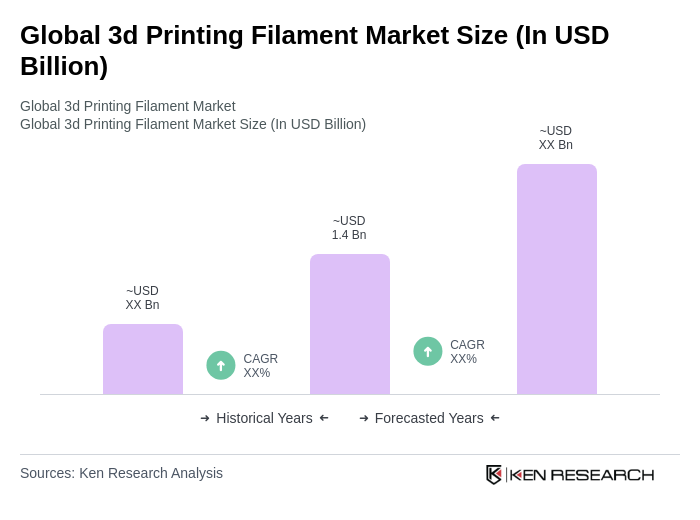
- The Global 3D Printing Filament Market is valued at USD 1.4 billion, based on a five?year historical analysis. This growth is primarily driven by increasing adoption of fused filament fabrication (FFF/FDM) for prototyping and end-use parts in aerospace, automotive, healthcare, and consumer goods; the availability of engineering- and high-performance polymers (e.g., PEEK/PEKK, PA12, PC blends); and broader access to affordable desktop and professional printers that support open materials.
- Countries such as the United States, Germany, and China lead the 3D printing filament ecosystem due to strong manufacturing bases, installed AM user communities, and sustained R&D and industrial policy support for additive manufacturing; these countries host major OEMs and materials suppliers active in filaments, including Stratasys, 3D Systems, BASF Forward AM, Evonik, Arkema, and others.
- The European Union has advanced policies promoting sustainable plastics and circularity that directly influence filament development and purchasing, including mandates and guidance under the European Green Deal and Circular Economy Action Plan encouraging bio?based and recycled polymers; these frameworks are pushing adoption of PLA and recycled PETG/ABS grades within AM material portfolios.
Global 3d Printing Filament Market Segmentation
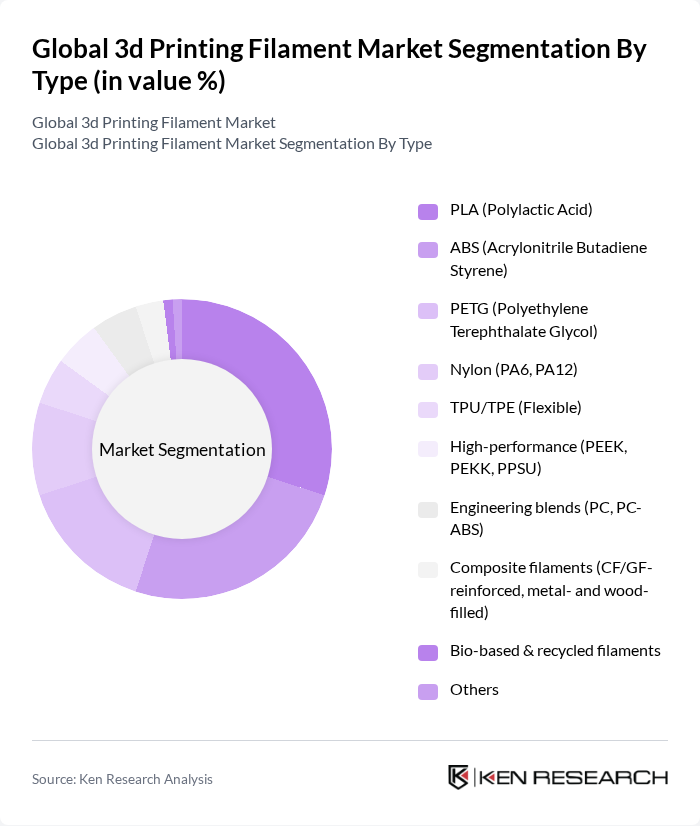
By Type:The 3D printing filament market is segmented into various types, including PLA (Polylactic Acid), ABS (Acrylonitrile Butadiene Styrene), PETG (Polyethylene Terephthalate Glycol), Nylon (PA6, PA12), TPU/TPE (Flexible), High-performance (PEEK, PEKK, PPSU), Engineering blends (PC, PC-ABS), Composite filaments (CF/GF-reinforced, metal- and wood-filled), Bio-based & recycled filaments, and Others. Among these, PLA is the most widely used filament due to its ease of printing, low warp, and bio?based origin, making it popular for education, prototyping, and consumer use; PETG and ABS follow for functional parts needing toughness and temperature resistance.
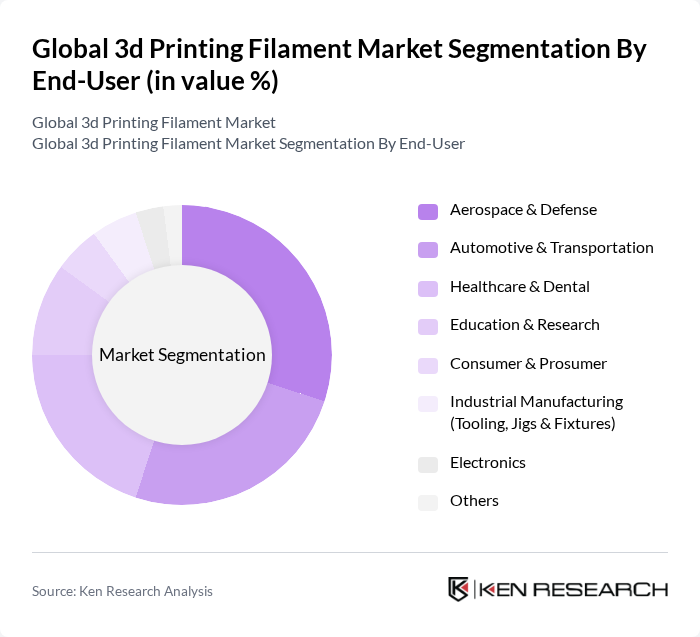
By End-User:The end-user segmentation of the 3D printing filament market includes Aerospace & Defense, Automotive & Transportation, Healthcare & Dental, Education & Research, Consumer & Prosumer, Industrial Manufacturing (Tooling, Jigs & Fixtures), Electronics, and Others. The aerospace and automotive sectors are significant users for rapid prototyping, lightweighting, and tooling; healthcare and dental use biocompatible and sterilizable polymers for models, guides, and certain patient-specific devices; education and prosumer segments accelerate unit volumes due to widespread desktop printer adoption.
Global 3d Printing Filament Market Competitive Landscape
The Global 3D Printing Filament Market is characterized by a dynamic mix of regional and international players. Leading participants such as Stratasys Ltd., 3D Systems Corporation, Filamentive, Prusa Research a.s. (Prusament), MatterHackers, Inc., colorFabb B.V., HATCHBOX (KIWI3D, LLC), Ultimaker B.V. (UltiMaker), Raise3D Technologies, Inc., eSUN (Shenzhen eSUN Industrial Co., Ltd.), Formfutura B.V., Polymaker (PolyMaker LLC), 3D-Fuel (3DomFuel, LLC), BASF Forward AM (Ultrafuse), DSM Additive Manufacturing (Novamid/Arnite, legacy), Evonik Industries AG (INFINAM), Arkema S.A. (Kepstan PEEK, Rilsan PA11), Mitsubishi Chemical Group (Verbatim/Kaiteki), Covestro (Addigy, legacy with materials now under Evonik/Sabic), SABIC (LEXAN/ULTEM filaments) contribute to innovation, geographic expansion, and service delivery in this space.
Global 3d Printing Filament Market Industry Analysis
Growth Drivers
- Increasing Demand for Customization:The customization trend is significantly driving the 3D printing filament market, with the global personalized products market projected to reach $31 billion in future. This surge is fueled by consumer preferences for unique, tailored products across sectors such as fashion, healthcare, and consumer electronics. As businesses increasingly adopt 3D printing technologies to meet these demands, the need for diverse filament options is expected to rise, enhancing market growth.
- Advancements in 3D Printing Technology:Technological advancements in 3D printing are pivotal for market growth, with the global 3D printing technology market expected to reach $35 billion in future. Innovations such as improved printing speeds, enhanced resolution, and multi-material capabilities are making 3D printing more accessible and efficient. These advancements are encouraging industries to adopt 3D printing for prototyping and production, thereby increasing the demand for high-quality filaments.
- Expanding Applications Across Industries:The application of 3D printing is expanding across various industries, including aerospace, automotive, and healthcare. For instance, the aerospace sector is projected to invest $3.5 billion in additive manufacturing technologies in future. This diversification is driving the demand for specialized filaments tailored to specific applications, such as high-temperature resistance and lightweight materials, further propelling market growth.
Market Challenges
- High Initial Investment Costs:One of the significant challenges facing the 3D printing filament market is the high initial investment required for advanced 3D printing equipment. The average cost of industrial-grade 3D printers can exceed $100,000, which poses a barrier for small and medium-sized enterprises. This financial hurdle limits the adoption of 3D printing technologies, thereby affecting the overall growth of the filament market.
- Limited Material Options:The limited variety of materials available for 3D printing is another challenge impacting the market. Currently, only a handful of materials, such as PLA, ABS, and PETG, dominate the market, which restricts the potential applications of 3D printing. As industries seek more specialized materials for specific applications, the lack of diverse filament options can hinder market expansion and innovation.
Global 3d Printing Filament Market Future Outlook
The future of the 3D printing filament market appears promising, driven by ongoing technological advancements and increasing adoption across various sectors. As industries continue to explore innovative applications, the demand for specialized filaments is expected to rise. Furthermore, the integration of sustainable practices and eco-friendly materials will likely shape the market landscape, encouraging manufacturers to develop biodegradable and recyclable filament options, thus enhancing environmental responsibility in production processes.
Market Opportunities
- Growth in Aerospace and Automotive Sectors:The aerospace and automotive sectors present significant opportunities for the 3D printing filament market, with investments projected to reach $5 billion in future. These industries are increasingly utilizing 3D printing for lightweight components and rapid prototyping, driving demand for high-performance filaments tailored to withstand extreme conditions.
- Rise of Biodegradable Filaments:The growing emphasis on sustainability is creating opportunities for biodegradable filaments, with the market for eco-friendly materials expected to reach $1.2 billion in future. As consumers and businesses prioritize environmentally responsible practices, the demand for biodegradable options will likely increase, encouraging manufacturers to innovate and expand their product offerings.
Scope of the Report
| Segment | Sub-Segments |
|---|---|
| By Type | PLA (Polylactic Acid) ABS (Acrylonitrile Butadiene Styrene) PETG (Polyethylene Terephthalate Glycol) Nylon (PA6, PA12) TPU/TPE (Flexible) High?performance (PEEK, PEKK, PPSU) Engineering blends (PC, PC?ABS) Composite filaments (CF/GF?reinforced, metal? and wood?filled) Bio?based & recycled filaments Others |
| By End-User | Aerospace & Defense Automotive & Transportation Healthcare & Dental Education & Research Consumer & Prosumer Industrial Manufacturing (Tooling, Jigs & Fixtures) Electronics Others |
| By Application | Prototyping Tooling & Manufacturing Aids End?use/Production Parts Dental & Medical Models/Devices Design, Art & Architecture Packaging & Consumer Goods Others |
| By Sales Channel | Direct/Enterprise Sales E?commerce (Brand Webstores, Marketplaces) Distributors/Resellers Retail Stores Others |
| By Distribution Mode | B2B B2C C2C Others |
| By Price Range | Economy (entry?level) Mid?Range Premium/Industrial?grade Others |
| By Material Properties | Strength & Stiffness Flexibility & Impact Resistance Heat & Chemical Resistance Biodegradability/Recyclability Electrical/ESD?safe Food?contact/Medical?grade Others |
Key Target Audience
Investors and Venture Capitalist Firms
Government and Regulatory Bodies (e.g., U.S. Department of Commerce, European Commission)
Manufacturers and Producers
Distributors and Retailers
3D Printing Technology Developers
Material Suppliers
Industry Associations (e.g., Additive Manufacturing Users Group)
Financial Institutions
Players Mentioned in the Report:
Stratasys Ltd.
3D Systems Corporation
Filamentive
Prusa Research a.s. (Prusament)
MatterHackers, Inc.
colorFabb B.V.
HATCHBOX (KIWI3D, LLC)
Ultimaker B.V. (UltiMaker)
Raise3D Technologies, Inc.
eSUN (Shenzhen eSUN Industrial Co., Ltd.)
Formfutura B.V.
Polymaker (PolyMaker LLC)
3D-Fuel (3DomFuel, LLC)
BASF Forward AM (Ultrafuse)
DSM Additive Manufacturing (Novamid/Arnite, legacy)
Evonik Industries AG (INFINAM)
Arkema S.A. (Kepstan PEEK, Rilsan PA11)
Mitsubishi Chemical Group (Verbatim/Kaiteki)
Covestro (Addigy, legacy with materials now under Evonik/Sabic)
SABIC (LEXAN/ULTEM filaments)
Table of Contents
Market Assessment Phase
1. Executive Summary and Approach
2. Global 3d Printing Filament Market Overview
2.1 Key Insights and Strategic Recommendations
2.2 Global 3d Printing Filament Market Overview
2.3 Definition and Scope
2.4 Evolution of Market Ecosystem
2.5 Timeline of Key Regulatory Milestones
2.6 Value Chain & Stakeholder Mapping
2.7 Business Cycle Analysis
2.8 Policy & Incentive Landscape
3. Global 3d Printing Filament Market Analysis
3.1 Growth Drivers
3.1.1 Increasing Demand for Customization
3.1.2 Advancements in 3D Printing Technology
3.1.3 Expanding Applications Across Industries
3.1.4 Cost Reduction in Manufacturing Processes
3.2 Market Challenges
3.2.1 High Initial Investment Costs
3.2.2 Limited Material Options
3.2.3 Regulatory Compliance Issues
3.2.4 Quality Control and Standardization
3.3 Market Opportunities
3.3.1 Growth in Aerospace and Automotive Sectors
3.3.2 Rise of Biodegradable Filaments
3.3.3 Expansion in Educational Institutions
3.3.4 Development of New Composite Materials
3.4 Market Trends
3.4.1 Increasing Adoption of Eco-Friendly Materials
3.4.2 Integration of AI in 3D Printing Processes
3.4.3 Customization and Personalization Trends
3.4.4 Growth of On-Demand Manufacturing
3.5 Government Regulation
3.5.1 Standards for Material Safety
3.5.2 Environmental Regulations on Filament Production
3.5.3 Incentives for Sustainable Practices
3.5.4 Compliance with Intellectual Property Laws
4. SWOT Analysis
5. Stakeholder Analysis
6. Porter's Five Forces Analysis
7. Global 3d Printing Filament Market Market Size, 2019-2024
7.1 By Value
7.2 By Volume
7.3 By Average Selling Price
8. Global 3d Printing Filament Market Segmentation
8.1 By Type
8.1.1 PLA (Polylactic Acid)
8.1.2 ABS (Acrylonitrile Butadiene Styrene)
8.1.3 PETG (Polyethylene Terephthalate Glycol)
8.1.4 Nylon (PA6, PA12)
8.1.5 TPU/TPE (Flexible)
8.1.6 High?performance (PEEK, PEKK, PPSU)
8.1.7 Engineering blends (PC, PC?ABS)
8.1.8 Composite filaments (CF/GF?reinforced, metal? and wood?filled)
8.1.9 Bio?based & recycled filaments
8.1.10 Others
8.2 By End-User
8.2.1 Aerospace & Defense
8.2.2 Automotive & Transportation
8.2.3 Healthcare & Dental
8.2.4 Education & Research
8.2.5 Consumer & Prosumer
8.2.6 Industrial Manufacturing (Tooling, Jigs & Fixtures)
8.2.7 Electronics
8.2.8 Others
8.3 By Application
8.3.1 Prototyping
8.3.2 Tooling & Manufacturing Aids
8.3.3 End?use/Production Parts
8.3.4 Dental & Medical Models/Devices
8.3.5 Design, Art & Architecture
8.3.6 Packaging & Consumer Goods
8.3.7 Others
8.4 By Sales Channel
8.4.1 Direct/Enterprise Sales
8.4.2 E?commerce (Brand Webstores, Marketplaces)
8.4.3 Distributors/Resellers
8.4.4 Retail Stores
8.4.5 Others
8.5 By Distribution Mode
8.5.1 B2B
8.5.2 B2C
8.5.3 C2C
8.5.4 Others
8.6 By Price Range
8.6.1 Economy (entry?level)
8.6.2 Mid?Range
8.6.3 Premium/Industrial?grade
8.6.4 Others
8.7 By Material Properties
8.7.1 Strength & Stiffness
8.7.2 Flexibility & Impact Resistance
8.7.3 Heat & Chemical Resistance
8.7.4 Biodegradability/Recyclability
8.7.5 Electrical/ESD?safe
8.7.6 Food?contact/Medical?grade
8.7.7 Others
9. Global 3d Printing Filament Market Competitive Analysis
9.1 Market Share of Key Players
9.2 Cross Comparison of Key Players
9.2.1 Company Name
9.2.2 Primary Filament Portfolio Breadth (no. of SKUs/material families)
9.2.3 Industrial vs Consumer Revenue Mix (%)
9.2.4 Geographic Footprint (regions served/warehouses)
9.2.5 Annual Filament Revenue (latest FY, USD)
9.2.6 YoY Revenue Growth in Filaments (%)
9.2.7 Average Selling Price by Material Tier (PLA/ABS; engineering; high?performance)
9.2.8 Certified Grades Offered (UL94, FDA/food?contact, medical, ESD)
9.2.9 Innovation Velocity (new SKUs launched per year/patents)
9.2.10 Quality & Consistency Metrics (diameter tolerance, lot rejection rate, moisture control)
9.2.11 Distribution Reach (direct, reseller count, major marketplaces)
9.2.12 Sustainability Metrics (recycled content %, bio?based share, take?back programs)
9.2.13 Key Partnerships/OEM Qualifications (printer certifications, aerospace/auto approvals)
9.2.14 On?time Delivery/Lead Time (days) and Fill Rate (%)
9.2.15 Customer Ratings/Net Promoter Score
9.3 SWOT Analysis of Top Players
9.4 Pricing Analysis
9.5 Detailed Profile of Major Companies
9.5.1 Stratasys Ltd.
9.5.2 3D Systems Corporation
9.5.3 Filamentive
9.5.4 Prusa Research a.s. (Prusament)
9.5.5 MatterHackers, Inc.
9.5.6 colorFabb B.V.
9.5.7 HATCHBOX (KIWI3D, LLC)
9.5.8 Ultimaker B.V. (UltiMaker)
9.5.9 Raise3D Technologies, Inc.
9.5.10 eSUN (Shenzhen eSUN Industrial Co., Ltd.)
9.5.11 Formfutura B.V.
9.5.12 Polymaker (PolyMaker LLC)
9.5.13 3D-Fuel (3DomFuel, LLC)
9.5.14 BASF Forward AM (Ultrafuse)
9.5.15 DSM Additive Manufacturing (Novamid/Arnite, legacy)
9.5.16 Evonik Industries AG (INFINAM)
9.5.17 Arkema S.A. (Kepstan PEEK, Rilsan PA11)
9.5.18 Mitsubishi Chemical Group (Verbatim/Kaiteki)
9.5.19 Covestro (Addigy, legacy with materials now under Evonik/Sabic)
9.5.20 SABIC (LEXAN/ULTEM filaments)
10. Global 3d Printing Filament Market End-User Analysis
10.1 Procurement Behavior of Key Ministries
10.1.1 Budget Allocation Trends
10.1.2 Preferred Filament Types
10.1.3 Decision-Making Processes
10.1.4 Supplier Selection Criteria
10.2 Corporate Spend on Infrastructure & Energy
10.2.1 Investment in 3D Printing Technology
10.2.2 Budget for R&D
10.2.3 Expenditure on Training and Development
10.3 Pain Point Analysis by End-User Category
10.3.1 Material Availability
10.3.2 Cost Constraints
10.3.3 Technical Support Needs
10.4 User Readiness for Adoption
10.4.1 Awareness Levels
10.4.2 Training Requirements
10.4.3 Infrastructure Readiness
10.5 Post-Deployment ROI and Use Case Expansion
10.5.1 Measurement of ROI
10.5.2 Case Studies of Successful Implementations
10.5.3 Future Use Case Potential
11. Global 3d Printing Filament Market Future Size, 2025-2030
11.1 By Value
11.2 By Volume
11.3 By Average Selling Price
Go-To-Market Strategy Phase
1. Whitespace Analysis + Business Model Canvas
1.1 Market Gaps Identification
1.2 Value Proposition Development
1.3 Revenue Streams Analysis
1.4 Cost Structure Evaluation
1.5 Key Partnerships Exploration
1.6 Customer Segments Definition
1.7 Channels Strategy
2. Marketing and Positioning Recommendations
2.1 Branding Strategies
2.2 Product USPs
2.3 Target Audience Identification
2.4 Communication Strategy
2.5 Digital Marketing Tactics
3. Distribution Plan
3.1 Urban Retail Strategies
3.2 Rural NGO Tie-Ups
3.3 E-commerce Integration
3.4 Logistics and Supply Chain Management
4. Channel & Pricing Gaps
4.1 Underserved Routes
4.2 Pricing Bands Analysis
4.3 Competitor Pricing Comparison
5. Unmet Demand & Latent Needs
5.1 Category Gaps Identification
5.2 Consumer Segments Analysis
5.3 Emerging Trends Exploration
6. Customer Relationship
6.1 Loyalty Programs Development
6.2 After-sales Service Strategies
6.3 Customer Feedback Mechanisms
7. Value Proposition
7.1 Sustainability Initiatives
7.2 Integrated Supply Chains
7.3 Competitive Advantage Analysis
8. Key Activities
8.1 Regulatory Compliance
8.2 Branding Efforts
8.3 Distribution Setup
9. Entry Strategy Evaluation
9.1 Domestic Market Entry Strategy
9.1.1 Product Mix Considerations
9.1.2 Pricing Band Strategy
9.1.3 Packaging Solutions
9.2 Export Entry Strategy
9.2.1 Target Countries Identification
9.2.2 Compliance Roadmap Development
10. Entry Mode Assessment
10.1 Joint Ventures
10.2 Greenfield Investments
10.3 Mergers & Acquisitions
10.4 Distributor Model Evaluation
11. Capital and Timeline Estimation
11.1 Capital Requirements Analysis
11.2 Timelines for Implementation
12. Control vs Risk Trade-Off
12.1 Ownership vs Partnerships
12.2 Risk Management Strategies
13. Profitability Outlook
13.1 Breakeven Analysis
13.2 Long-term Sustainability Strategies
14. Potential Partner List
14.1 Distributors Identification
14.2 Joint Ventures Opportunities
14.3 Acquisition Targets
15. Execution Roadmap
15.1 Phased Plan for Market Entry
15.1.1 Market Setup
15.1.2 Market Entry
15.1.3 Growth Acceleration
15.1.4 Scale & Stabilize
15.2 Key Activities and Milestones
15.2.1 Milestone Planning
15.2.2 Activity Tracking
Research Methodology
Phase 1: Approach1
Desk Research
- Industry reports from 3D printing associations and market research firms
- Analysis of trade publications and journals focusing on additive manufacturing
- Review of patents and technological advancements in 3D printing filament materials
Primary Research
- Interviews with R&D heads at leading 3D printing filament manufacturers
- Surveys with end-users in sectors such as aerospace, automotive, and healthcare
- Focus groups with designers and engineers utilizing 3D printing technologies
Validation & Triangulation
- Cross-validation of findings through multiple industry expert interviews
- Triangulation of data from market reports, sales figures, and user feedback
- Sanity checks through peer reviews and expert panels in the 3D printing field
Phase 2: Market Size Estimation1
Top-down Assessment
- Analysis of global 3D printing market size and growth trends
- Segmentation by filament type, including PLA, ABS, PETG, and specialty filaments
- Incorporation of regional market dynamics and demand forecasts
Bottom-up Modeling
- Volume estimates based on production capacities of major filament manufacturers
- Cost analysis of raw materials and production processes for different filament types
- Sales data from distributors and retailers in the 3D printing supply chain
Forecasting & Scenario Analysis
- Multi-variable forecasting using trends in manufacturing and consumer adoption
- Scenario modeling based on technological advancements and regulatory impacts
- Baseline, optimistic, and pessimistic projections through 2030
Phase 3: CATI Sample Composition1
| Scope Item/Segment | Sample Size | Target Respondent Profiles |
|---|---|---|
| Industrial Filament Users | 120 | Manufacturing Engineers, Production Managers |
| Educational Institutions | 90 | Academic Researchers, Lab Technicians |
| Consumer Market Segment | 80 | Hobbyists, DIY Enthusiasts |
| Healthcare Applications | 70 | Medical Device Developers, Biomedical Engineers |
| Aerospace and Automotive Sectors | 90 | Design Engineers, Product Development Managers |
Frequently Asked Questions
What is the current value of the Global 3D Printing Filament Market?
The Global 3D Printing Filament Market is valued at approximately USD 1.4 billion, driven by the increasing adoption of fused filament fabrication (FFF/FDM) technologies across various industries, including aerospace, automotive, and healthcare.
Which countries are leading in the 3D printing filament ecosystem?
What types of filaments are commonly used in 3D printing?
What are the primary end-user segments for 3D printing filaments?
Other Regional/Country Reports
Indonesia 3d Printing Filament Market
Malaysia 3d Printing Filament Market
APAC 3d Printing Filament Market
Why Buy From Us?

What makes us stand out is that our consultants follow Robust, Refine and Result (RRR) methodology. Robust for clear definitions, approaches and sanity checking, Refine for differentiating respondents' facts and opinions, and Result for presenting data with story.

We have set a benchmark in the industry by offering our clients with syndicated and customized market research reports featuring coverage of entire market as well as meticulous research and analyst insights.

While we don't replace traditional research, we flip the method upside down. Our dual approach of Top Bottom & Bottom Top ensures quality deliverable by not just verifying company fundamentals but also looking at the sector and macroeconomic factors.

With one step in the future, our research team constantly tries to show you the bigger picture. We help with some of the tough questions you may encounter along the way: How is the industry positioned? Best marketing channel? KPI's of competitors? By aligning every element, we help maximize success.

Our report gives you instant access to the answers and sources that other companies might choose to hide. We elaborate each steps of research methodology we have used and showcase you the sample size to earn your trust.

If you need any support, we are here! We pride ourselves on universe strength, data quality, and quick, friendly, and professional service.