About the Report
Base Year 2024Global 3D Scanners Market Overview
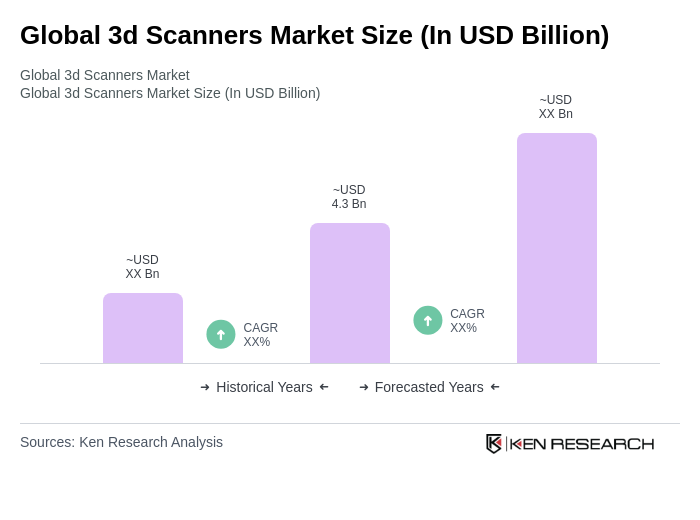
- The Global 3D Scanners Market is valued at USD 4.3 billion, based on a five-year historical analysis. This growth is primarily driven by advancements in laser and structured-light technologies, integration of scanners with software platforms, and rising adoption in manufacturing quality control, reverse engineering, and healthcare imaging workflows.
- Key players in this market include the United States, Germany, and China, supported by strong industrial bases, precision manufacturing capabilities, and sustained investments in automation, metrology, and R&D North America and Europe remain significant demand centers, while China leads in cost-competitive production and rapid adoption across automotive and electronics.
- In 2023, the European Union implemented regulations aimed at enhancing the safety and performance standards of 3D scanning devices. This regulation mandates that all 3D scanners sold within the EU must comply with specific safety and environmental standards, ensuring that products are not only effective but also safe for users and the environment.
Global 3D Scanners Market Segmentation
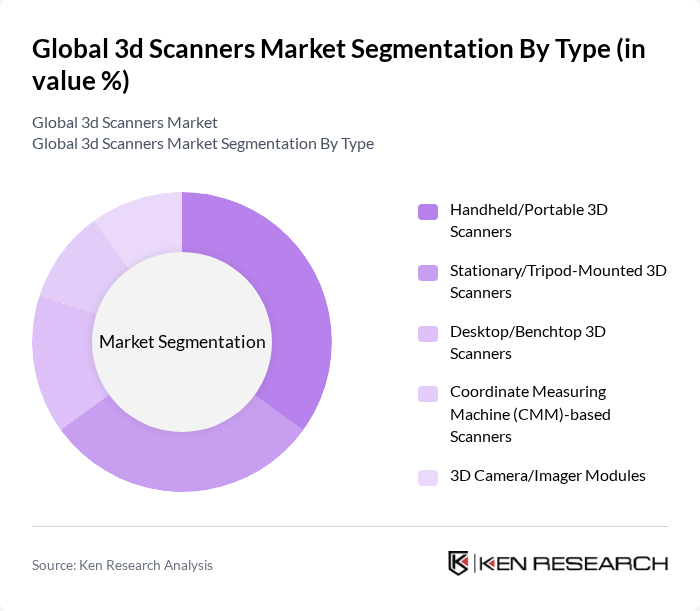
By Type:The 3D scanners market is segmented into various types, including handheld/portable scanners, stationary/tripod-mounted scanners, desktop/benchtop scanners, coordinate measuring machine (CMM)-based scanners, and 3D camera/imager modules. Among these, handheld/portable scanners are gaining traction due to their versatility and ease of use, making them popular in various applications such as field surveys and inspections. Stationary scanners, on the other hand, are preferred for high-precision tasks in controlled environments.
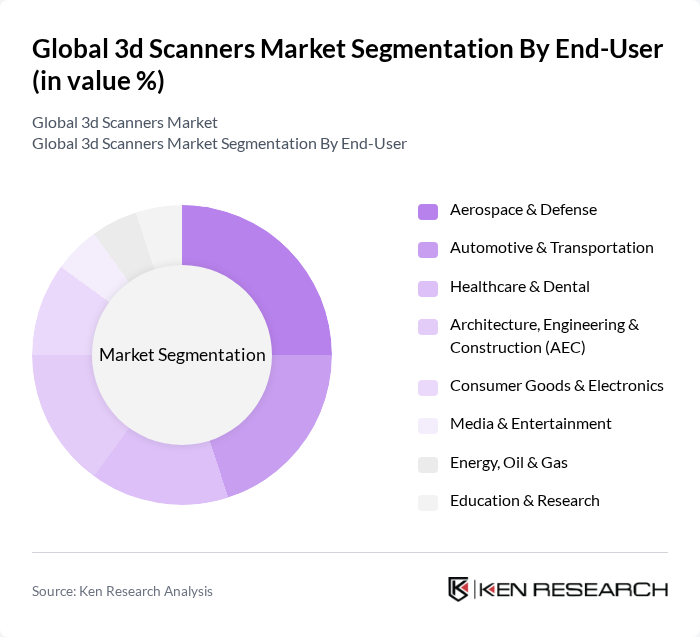
By End-User:The end-user segmentation of the 3D scanners market includes aerospace & defense, automotive & transportation, healthcare & dental, architecture, engineering & construction (AEC), consumer goods & electronics, media & entertainment, energy, oil & gas, and education & research. The aerospace & defense sector is a significant contributor to the market, driven by the need for precision and accuracy in manufacturing and maintenance processes. The automotive industry also plays a crucial role, utilizing 3D scanning for design and prototyping.
Global 3D Scanners Market Competitive Landscape
The Global 3D Scanners Market is characterized by a dynamic mix of regional and international players. Leading participants such as FARO Technologies, Inc., Hexagon AB (Leica Geosystems, Hexagon Manufacturing Intelligence), 3D Systems Corporation, Nikon Metrology NV (Nikon Corporation), Creaform Inc. (AMETEK Inc.), Artec 3D, Zoller + Fröhlich GmbH, Trimble Inc., Autodesk, Inc. (Reality Capture Software), SHINING 3D Tech Co., Ltd., GOM GmbH (ZEISS Group), Carl Zeiss Industrial Metrology (ZEISS), Peel 3D (Creaform), Scantech (Hangzhou) Co., Ltd., Polyga Inc., Revopoint 3D Technologies Inc., TOPCON Corporation (LiDAR/Imaging for AEC), Surphaser (Basis Software Inc.), Maptek Pty Ltd, Capture 3D, Inc. (ZEISS Industrial Quality Solutions) contribute to innovation, geographic expansion, and service delivery in this space.
Global 3d Scanners Market Industry Analysis
Growth Drivers
- Increasing Demand for 3D Modeling:The demand for 3D modeling across industries such as architecture, gaming, and manufacturing is rising, with the global 3D modeling market projected to reach $6.8 billion in future. This growth is driven by the need for enhanced visualization and design accuracy, as companies increasingly rely on 3D models for product development. The construction sector alone is expected to contribute approximately $1.3 billion to this growth, reflecting a robust trend towards digital transformation.
- Advancements in Scanning Technology:Technological innovations in 3D scanning, such as improved laser scanning and photogrammetry techniques, are enhancing accuracy and efficiency. For instance, the introduction of high-resolution scanners has increased scanning precision to within 0.05 mm, significantly benefiting industries like aerospace and automotive. The global investment in R&D for scanning technologies is projected to exceed $600 million in future, indicating a strong commitment to advancing these capabilities.
- Rising Adoption of 3D Printing:The integration of 3D scanning with 3D printing technologies is fostering a symbiotic relationship that drives market growth. The global 3D printing market is expected to reach $25 billion in future, with 3D scanning playing a crucial role in creating accurate prototypes. This synergy is particularly evident in the healthcare sector, where 3D-printed prosthetics and implants are projected to grow by 18% annually, highlighting the importance of precise scanning in custom manufacturing.
Market Challenges
- High Initial Investment Costs:The high upfront costs associated with acquiring advanced 3D scanning equipment pose a significant barrier to entry for many businesses. For instance, high-end 3D scanners can range from $12,000 to over $120,000, making them inaccessible for small and medium enterprises. This financial hurdle is compounded by the need for ongoing maintenance and software updates, which can further strain budgets, particularly in emerging markets.
- Lack of Skilled Professionals:The shortage of skilled professionals proficient in 3D scanning technology is a critical challenge facing the industry. According to the World Economic Forum, approximately 90 million jobs may be displaced in future due to a skills gap, particularly in technical fields. This shortage limits the effective implementation of 3D scanning solutions, hindering productivity and innovation across sectors that rely on these technologies for competitive advantage.
Global 3d Scanners Market Future Outlook
The future of the 3D scanners market appears promising, driven by continuous technological advancements and increasing applications across various sectors. As industries embrace digital transformation, the integration of AI and machine learning with 3D scanning is expected to enhance data analysis and operational efficiency. Furthermore, the growing emphasis on sustainability will likely propel the development of eco-friendly scanning solutions, aligning with global environmental goals and fostering innovation in the market.
Market Opportunities
- Expansion in Emerging Markets:Emerging markets, particularly in Asia-Pacific and Latin America, present significant growth opportunities for 3D scanners. With increasing investments in infrastructure and manufacturing, the demand for advanced scanning technologies is expected to rise. For example, the Asia-Pacific region is projected to account for over 35% of the global market in future, driven by rapid urbanization and industrialization.
- Development of Portable and User-Friendly Devices:The trend towards portable and user-friendly 3D scanning devices is creating new market opportunities. As technology advances, manufacturers are focusing on creating lightweight, easy-to-use scanners that cater to non-expert users. This shift is expected to broaden the customer base, particularly in sectors like education and small-scale manufacturing, where accessibility and ease of use are paramount.
Scope of the Report
| Segment | Sub-Segments |
|---|---|
| By Type | Handheld/Portable 3D Scanners Stationary/Tripod-Mounted 3D Scanners Desktop/Benchtop 3D Scanners Coordinate Measuring Machine (CMM)-based Scanners D Camera/Imager Modules |
| By End-User | Aerospace & Defense Automotive & Transportation Healthcare & Dental Architecture, Engineering & Construction (AEC) Consumer Goods & Electronics Media & Entertainment Energy, Oil & Gas Education & Research |
| By Application | Reverse Engineering & CAD Modeling Quality Inspection & Metrology Product Design & Prototyping Medical Imaging, Orthotics & Prosthetics BIM, Surveying & As-Built Documentation Cultural Heritage & Museum Preservation AR/VR Content Creation |
| By Distribution Channel | Direct Sales (Manufacturer) Value-Added Resellers (VARs) & Systems Integrators Online/eCommerce Distributors OEM Partnerships |
| By Region | North America Europe Asia-Pacific Latin America Middle East and Africa |
| By Price Range | Entry-Level (< USD 5,000) Mid-Range (USD 5,000–USD 25,000) Professional/Industrial (USD 25,000–USD 100,000) High-End/Metrology-Grade (> USD 100,000) |
| By Technology | Laser Triangulation Structured Light Time-of-Flight (ToF)/LiDAR Photogrammetry White/Blue Light Scanning |
Key Target Audience
Investors and Venture Capitalist Firms
Government and Regulatory Bodies (e.g., National Institute of Standards and Technology, Federal Aviation Administration)
Manufacturers and Producers
Distributors and Retailers
Construction and Engineering Firms
Aerospace and Defense Contractors
Healthcare and Medical Device Companies
Architectural and Design Firms
Players Mentioned in the Report:
FARO Technologies, Inc.
Hexagon AB (Leica Geosystems, Hexagon Manufacturing Intelligence)
3D Systems Corporation
Nikon Metrology NV (Nikon Corporation)
Creaform Inc. (AMETEK Inc.)
Artec 3D
Zoller + Frohlich GmbH
Trimble Inc.
Autodesk, Inc. (Reality Capture Software)
SHINING 3D Tech Co., Ltd.
GOM GmbH (ZEISS Group)
Carl Zeiss Industrial Metrology (ZEISS)
Peel 3d (Creaform)
Scantech (Hangzhou) Co., Ltd.
Polyga Inc.
Revopoint 3D Technologies Inc.
TOPCON Corporation (LiDAR/Imaging for AEC)
Surphaser (Basis Software Inc.)
Maptek Pty Ltd
Capture 3D, Inc. (ZEISS Industrial Quality Solutions)
Table of Contents
Market Assessment Phase
1. Executive Summary and Approach
2. Global 3d Scanners Market Overview
2.1 Key Insights and Strategic Recommendations
2.2 Global 3d Scanners Market Overview
2.3 Definition and Scope
2.4 Evolution of Market Ecosystem
2.5 Timeline of Key Regulatory Milestones
2.6 Value Chain & Stakeholder Mapping
2.7 Business Cycle Analysis
2.8 Policy & Incentive Landscape
3. Global 3d Scanners Market Analysis
3.1 Growth Drivers
3.1.1 Increasing demand for 3D modeling in various industries
3.1.2 Advancements in scanning technology
3.1.3 Rising adoption of 3D printing
3.1.4 Growing applications in healthcare and manufacturing
3.2 Market Challenges
3.2.1 High initial investment costs
3.2.2 Lack of skilled professionals
3.2.3 Data management and integration issues
3.2.4 Competition from alternative technologies
3.3 Market Opportunities
3.3.1 Expansion in emerging markets
3.3.2 Development of portable and user-friendly devices
3.3.3 Integration with AI and machine learning
3.3.4 Increasing demand in the automotive sector
3.4 Market Trends
3.4.1 Growing use of handheld 3D scanners
3.4.2 Shift towards cloud-based solutions
3.4.3 Rising focus on sustainability and eco-friendly practices
3.4.4 Increasing collaboration between industries
3.5 Government Regulation
3.5.1 Standards for 3D scanning accuracy
3.5.2 Regulations on data privacy and security
3.5.3 Compliance with industry-specific guidelines
3.5.4 Incentives for technology adoption in manufacturing
4. SWOT Analysis
5. Stakeholder Analysis
6. Porter's Five Forces Analysis
7. Global 3d Scanners Market Market Size, 2019-2024
7.1 By Value
7.2 By Volume
7.3 By Average Selling Price
8. Global 3d Scanners Market Segmentation
8.1 By Type
8.1.1 Handheld/Portable 3D Scanners
8.1.2 Stationary/Tripod-Mounted 3D Scanners
8.1.3 Desktop/Benchtop 3D Scanners
8.1.4 Coordinate Measuring Machine (CMM)-based Scanners
8.1.5 3D Camera/Imager Modules
8.2 By End-User
8.2.1 Aerospace & Defense
8.2.2 Automotive & Transportation
8.2.3 Healthcare & Dental
8.2.4 Architecture, Engineering & Construction (AEC)
8.2.5 Consumer Goods & Electronics
8.2.6 Media & Entertainment
8.2.7 Energy, Oil & Gas
8.2.8 Education & Research
8.3 By Application
8.3.1 Reverse Engineering & CAD Modeling
8.3.2 Quality Inspection & Metrology
8.3.3 Product Design & Prototyping
8.3.4 Medical Imaging, Orthotics & Prosthetics
8.3.5 BIM, Surveying & As-Built Documentation
8.3.6 Cultural Heritage & Museum Preservation
8.3.7 AR/VR Content Creation
8.4 By Distribution Channel
8.4.1 Direct Sales (Manufacturer)
8.4.2 Value-Added Resellers (VARs) & Systems Integrators
8.4.3 Online/eCommerce
8.4.4 Distributors
8.4.5 OEM Partnerships
8.5 By Region
8.5.1 North America
8.5.2 Europe
8.5.3 Asia-Pacific
8.5.4 Latin America
8.5.5 Middle East and Africa
8.6 By Price Range
8.6.1 Entry-Level (< USD 5,000)
8.6.2 Mid-Range (USD 5,000–USD 25,000)
8.6.3 Professional/Industrial (USD 25,000–USD 100,000)
8.6.4 High-End/Metrology-Grade (> USD 100,000)
8.7 By Technology
8.7.1 Laser Triangulation
8.7.2 Structured Light
8.7.3 Time-of-Flight (ToF)/LiDAR
8.7.4 Photogrammetry
8.7.5 White/Blue Light Scanning
9. Global 3d Scanners Market Competitive Analysis
9.1 Market Share of Key Players
9.2 Cross Comparison of Key Players
9.2.1 Company Name
9.2.2 Company Scale (Global, Regional, Niche)
9.2.3 3D Scanning Segment Revenue (Latest FY)
9.2.4 YoY Revenue Growth (3D Scanners/Metrology)
9.2.5 Installed Base/Units Shipped (Cumulative/Annual)
9.2.6 Geographic Penetration (No. of Countries/Regions Served)
9.2.7 Product Portfolio Breadth (Handheld, Stationary, CMM, LiDAR, Software)
9.2.8 Accuracy & Resolution Benchmarks (e.g., ?m accuracy at working distance)
9.2.9 Key Certifications & Compliance (ISO 17025, VDI/VDE, FDA/CE for medical)
9.2.10 R&D Intensity (% of Revenue, Patents Filed)
9.2.11 Channel Strength (Direct vs VAR mix, Key Integrator Alliances)
9.2.12 Service & Software Attach Rate (Maintenance, Suite Licenses)
9.2.13 Average Selling Price (by Product Class)
9.2.14 Win Rates in Target Verticals (Auto, Aero, Healthcare, AEC)
9.2.15 Customer Satisfaction/NPS (Enterprise Accounts)
9.3 SWOT Analysis of Top Players
9.4 Pricing Analysis
9.5 Detailed Profile of Major Companies
9.5.1 FARO Technologies, Inc.
9.5.2 Hexagon AB (Leica Geosystems, Hexagon Manufacturing Intelligence)
9.5.3 3D Systems Corporation
9.5.4 Nikon Metrology NV (Nikon Corporation)
9.5.5 Creaform Inc. (AMETEK Inc.)
9.5.6 Artec 3D
9.5.7 Zoller + Fröhlich GmbH
9.5.8 Trimble Inc.
9.5.9 Autodesk, Inc. (Reality Capture Software)
9.5.10 SHINING 3D Tech Co., Ltd.
9.5.11 GOM GmbH (ZEISS Group)
9.5.12 Carl Zeiss Industrial Metrology (ZEISS)
9.5.13 Peel 3d (Creaform)
9.5.14 Scantech (Hangzhou) Co., Ltd.
9.5.15 Polyga Inc.
9.5.16 Revopoint 3D Technologies Inc.
9.5.17 TOPCON Corporation (LiDAR/Imaging for AEC)
9.5.18 Surphaser (Basis Software Inc.)
9.5.19 Maptek Pty Ltd
9.5.20 Capture 3D, Inc. (ZEISS Industrial Quality Solutions)
10. Global 3d Scanners Market End-User Analysis
10.1 Procurement Behavior of Key Ministries
10.1.1 Government contracts for infrastructure projects
10.1.2 Budget allocation for technology upgrades
10.1.3 Collaboration with private sectors for innovation
10.2 Corporate Spend on Infrastructure & Energy
10.2.1 Investment in digital transformation
10.2.2 Funding for R&D in 3D technologies
10.2.3 Expenditure on training and development
10.3 Pain Point Analysis by End-User Category
10.3.1 High costs of implementation
10.3.2 Integration with existing systems
10.3.3 Need for ongoing support and maintenance
10.4 User Readiness for Adoption
10.4.1 Awareness of 3D scanning benefits
10.4.2 Availability of training resources
10.4.3 Perceived ROI from technology adoption
10.5 Post-Deployment ROI and Use Case Expansion
10.5.1 Measurement of efficiency gains
10.5.2 Expansion into new applications
10.5.3 Long-term cost savings analysis
11. Global 3d Scanners Market Future Size, 2025-2030
11.1 By Value
11.2 By Volume
11.3 By Average Selling Price
Go-To-Market Strategy Phase
1. Whitespace Analysis + Business Model Canvas
1.1 Market gaps and opportunities
2. Marketing and Positioning Recommendations
2.1 Branding strategies and Product USPs
3. Distribution Plan
3.1 Urban retail vs rural NGO tie-ups
4. Channel & Pricing Gaps
4.1 Underserved routes and Pricing bands
5. Unmet Demand & Latent Needs
5.1 Category gaps and Consumer segments
6. Customer Relationship
6.1 Loyalty programs and After-sales service
7. Value Proposition
7.1 Sustainability and Integrated supply chains
8. Key Activities
8.1 Regulatory compliance, Branding, Distribution setup
9. Entry Strategy Evaluation
9.1 Domestic Market Entry Strategy
9.1.1 Product mix, Pricing band, Packaging
9.2 Export Entry Strategy
9.2.1 Target countries, Compliance roadmap
10. Entry Mode Assessment
10.1 JV, Greenfield, M&A, Distributor Model
11. Capital and Timeline Estimation
11.1 Capital requirements, Timelines
12. Control vs Risk Trade-Off
12.1 Ownership vs Partnerships
13. Profitability Outlook
13.1 Breakeven analysis, Long-term sustainability
14. Potential Partner List
14.1 Distributors, JVs, Acquisition targets
15. Execution Roadmap
15.1 Phased Plan for Market Entry
15.1.1 Market Setup ? Market Entry ? Growth Acceleration ? Scale & Stabilize
15.2 Key Activities and Milestones
15.2.1 Milestones for successful execution
Research Methodology
Phase 1: Approach1
Desk Research
- Industry reports from market research firms focusing on 3D scanning technologies
- Published articles and white papers from leading 3D scanner manufacturers
- Market analysis from trade associations and technology journals
Primary Research
- Interviews with product managers at key 3D scanner companies
- Surveys with end-users across various sectors such as manufacturing, healthcare, and architecture
- Field interviews with industry experts and consultants specializing in 3D scanning applications
Validation & Triangulation
- Cross-validation of data from multiple sources including sales figures and market trends
- Triangulation of insights from primary interviews and secondary data sources
- Sanity checks through expert panel reviews to ensure data accuracy
Phase 2: Market Size Estimation1
Top-down Assessment
- Analysis of global 3D scanner market size based on revenue from major regions
- Segmentation by application areas such as industrial, medical, and entertainment
- Incorporation of growth trends influenced by technological advancements and market demand
Bottom-up Modeling
- Estimation of unit sales based on historical data from leading manufacturers
- Cost analysis of 3D scanning solutions across different market segments
- Volume x price modeling to derive revenue projections for each segment
Forecasting & Scenario Analysis
- Multi-factor regression analysis considering factors like technological adoption and market penetration
- Scenario planning based on potential regulatory changes and economic conditions
- Development of baseline, optimistic, and pessimistic forecasts through 2030
Phase 3: CATI Sample Composition1
| Scope Item/Segment | Sample Size | Target Respondent Profiles |
|---|---|---|
| Manufacturing Sector Applications | 150 | Production Managers, Quality Control Engineers |
| Healthcare Imaging Solutions | 100 | Radiologists, Medical Device Engineers |
| Architectural and Construction Uses | 80 | Architects, Project Managers |
| Entertainment and Gaming Industry | 70 | Game Developers, Visual Effects Supervisors |
| Research and Development in Academia | 60 | Research Scientists, University Professors |
Frequently Asked Questions
What is the current value of the Global 3D Scanners Market?
The Global 3D Scanners Market is valued at approximately USD 4.3 billion, driven by advancements in scanning technologies and increasing adoption across various industries such as manufacturing, healthcare, and automotive.
What are the main types of 3D scanners available in the market?
Which industries are the largest users of 3D scanning technology?
What are the growth drivers for the 3D scanners market?
Other Regional/Country Reports
Indonesia 3d Scanners Market
Malaysia 3d Scanners Market
APAC 3d Scanners Market
SEA 3d Scanners Market
Why Buy From Us?

What makes us stand out is that our consultants follow Robust, Refine and Result (RRR) methodology. Robust for clear definitions, approaches and sanity checking, Refine for differentiating respondents' facts and opinions, and Result for presenting data with story.

We have set a benchmark in the industry by offering our clients with syndicated and customized market research reports featuring coverage of entire market as well as meticulous research and analyst insights.

While we don't replace traditional research, we flip the method upside down. Our dual approach of Top Bottom & Bottom Top ensures quality deliverable by not just verifying company fundamentals but also looking at the sector and macroeconomic factors.

With one step in the future, our research team constantly tries to show you the bigger picture. We help with some of the tough questions you may encounter along the way: How is the industry positioned? Best marketing channel? KPI's of competitors? By aligning every element, we help maximize success.

Our report gives you instant access to the answers and sources that other companies might choose to hide. We elaborate each steps of research methodology we have used and showcase you the sample size to earn your trust.

If you need any support, we are here! We pride ourselves on universe strength, data quality, and quick, friendly, and professional service.