About the Report
Base Year 2024Global Acrylate Monomers Market Overview
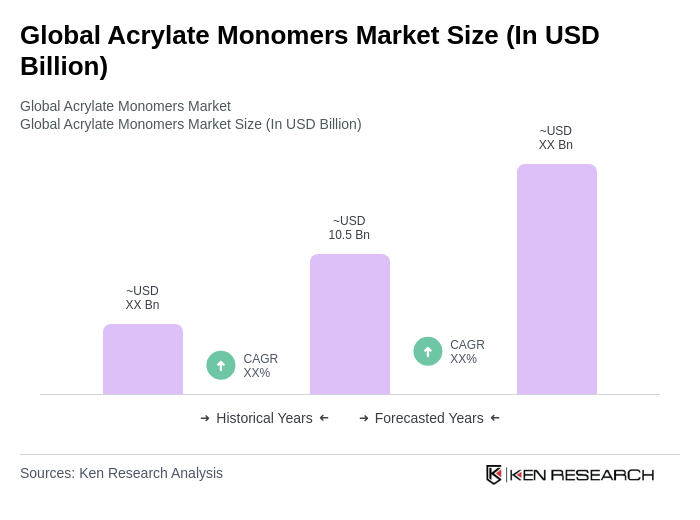
- The Global Acrylate Monomers Market is valued at approximately USD 10.5 billion, based on a five?year historical analysis. This value is supported by documented demand in paints and coatings, adhesives and sealants, plastics/synthetic resins, and inks, underpinned by construction, automotive, packaging, and electronics end-markets .
- Key producing and consuming regions include the United States, Germany, and China, reflecting large downstream coatings and adhesives industries, established chemical clusters, and strong R&D and supply chains, with Asia-Pacific holding the largest regional share by production and demand .
- The European Union maintains stringent VOC frameworks affecting coatings, adhesives, and related chemical products that use acrylate monomers (e.g., the VOC Solvents Directive 1999/13/EC replaced by Industrial Emissions Directive and national transpositions; plus product-specific VOC limits in coatings and construction products), which drive low-VOC and waterborne technology adoption across the value chain .
Global Acrylate Monomers Market Segmentation
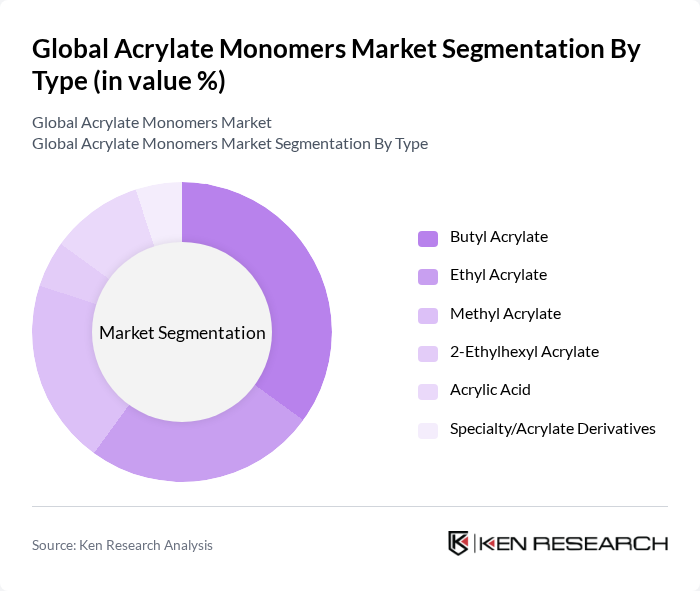
By Type:The acrylate monomers market commonly includes Butyl Acrylate, Ethyl Acrylate, Methyl Acrylate, 2?Ethylhexyl Acrylate, Acrylic Acid and derivatives, and specialty acrylates. Butyl Acrylate is widely used in waterborne and solvent-borne adhesives and architectural/industrial coatings; Ethyl Acrylate and Methyl Acrylate are important for plastics, resins, and paints; 2?Ethylhexyl Acrylate is a key soft monomer for pressure-sensitive adhesives; Acrylic Acid is fundamental for downstream esters and superabsorbent polymers .
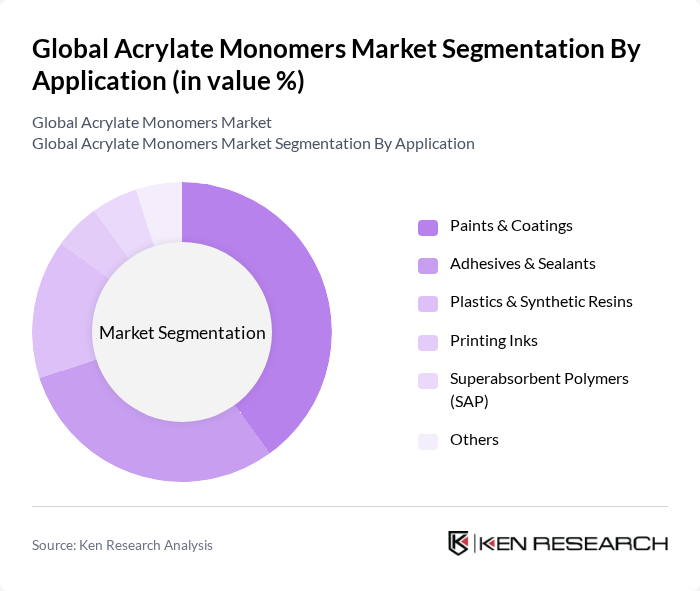
By Application:Major applications include Paints & Coatings, Adhesives & Sealants, Plastics & Synthetic Resins, Printing Inks, Superabsorbent Polymers (SAP), and others. Paints & Coatings remain the largest outlet due to architectural and industrial demand; Adhesives & Sealants are supported by packaging, tapes/labels, woodworking, and transportation; SAP consumes acrylic acid derivatives for hygiene applications .
Global Acrylate Monomers Market Competitive Landscape
The Global Acrylate Monomers Market is characterized by a dynamic mix of regional and international players. Leading participants such as BASF SE, Dow Inc., Arkema S.A., Evonik Industries AG, LG Chem Ltd., Nippon Shokubai Co., Ltd., Mitsubishi Chemical Group Corporation, Wanhua Chemical Group Co., Ltd., Formosa Plastics Corporation, Sasol Limited, Hexion Inc., Shanghai Huayi Acrylic Monomer Co., Ltd. (Shenyang Chemical), LyondellBasell Industries N.V., Sinopec (China Petroleum & Chemical Corporation), Eastman Chemical Company contribute to innovation, geographic expansion, and service delivery in this space .
- Enhancements to growth drivers and trends:Increased adoption of waterborne, low-VOC, and high-solids formulations in architectural/industrial coatings and packaging adhesives; growth in pressure-sensitive adhesives for e-commerce logistics; resilient demand from construction refurbishments; and steady SAP consumption in hygiene products. Producers are also emphasizing bio-based acrylates and circular feedstocks, aligned with regulatory and customer sustainability targets .
Global Acrylate Monomers Market Industry Analysis
Growth Drivers
- Increasing Demand from Adhesives and Sealants:The global adhesives and sealants market is projected to reach $70 billion in future, driven by the construction and automotive sectors. This growth is fueled by the increasing need for durable and high-performance bonding solutions. In future, the demand for acrylate monomers in adhesives was approximately 1.8 million tons, reflecting a robust growth trajectory as industries seek efficient and reliable materials for various applications.
- Expanding Applications in Coatings:The coatings industry is expected to grow to $200 billion in future, with acrylate monomers playing a crucial role in formulating high-performance coatings. The shift towards water-based and eco-friendly coatings is driving demand, as these products accounted for 50% of the market in future. This trend is supported by increasing regulations on solvent-based products, pushing manufacturers to adopt acrylate-based solutions for better environmental compliance.
- Growth in the Construction Industry:The global construction market is anticipated to reach $20 trillion in future, with acrylate monomers being integral to various construction materials. In future, the demand for acrylate-based products in construction applications was around 1.5 million tons. This growth is attributed to the rising investments in infrastructure development and the increasing use of advanced materials that enhance durability and performance in construction projects.
Market Challenges
- Volatility in Raw Material Prices:The prices of key raw materials for acrylate monomers, such as propylene and ethylene, have experienced fluctuations, with a 25% increase noted in future. This volatility poses a significant challenge for manufacturers, impacting production costs and profit margins. The uncertainty in raw material supply chains, exacerbated by geopolitical tensions, further complicates the pricing landscape, making it difficult for companies to maintain stable pricing strategies.
- Stringent Environmental Regulations:Regulatory frameworks, particularly in Europe and North America, are becoming increasingly stringent regarding VOC emissions and chemical safety. Compliance with regulations such as REACH and VOC standards requires significant investment in R&D and production processes. In future, over 35% of manufacturers reported increased costs due to compliance measures, which can hinder competitiveness and innovation in the acrylate monomers market.
Global Acrylate Monomers Market Future Outlook
The future of the acrylate monomers market appears promising, driven by technological advancements and a growing emphasis on sustainability. Innovations in production processes are expected to enhance efficiency and reduce environmental impact. Additionally, the increasing demand for eco-friendly products will likely spur the development of bio-based acrylate monomers. As industries adapt to changing consumer preferences, the market is poised for significant transformation, with a focus on sustainable practices and product customization to meet specific application needs.
Market Opportunities
- Innovations in Product Development:The ongoing research in developing high-performance, eco-friendly acrylate monomers presents a significant opportunity. Companies investing in R&D can create products that meet stringent environmental standards, potentially capturing a larger market share. In future, investments in sustainable product development increased by 20%, indicating a strong trend towards innovation in this sector.
- Expansion in Emerging Markets:Emerging markets, particularly in Asia-Pacific and Latin America, are witnessing rapid industrialization and urbanization. This growth is expected to drive demand for acrylate monomers in various applications, including construction and automotive. In future, the Asia-Pacific region accounted for 45% of global consumption, highlighting the potential for expansion and increased market penetration in these regions.
Scope of the Report
| Segment | Sub-Segments |
|---|---|
| By Type | Butyl Acrylate Ethyl Acrylate Methyl Acrylate Ethylhexyl Acrylate Acrylic Acid Specialty/Acrylate Derivatives (e.g., Polyfunctional, Fluorinated, UV-curable) |
| By Application | Paints & Coatings Adhesives & Sealants Plastics & Synthetic Resins Printing Inks Superabsorbent Polymers (SAP) Others |
| By End-User | Building & Construction Automotive & Transportation Packaging Textiles & Nonwovens Electronics Others |
| By Distribution Channel | Direct (Producer to End-User) Distributors/Traders Online/B2B Platforms Others |
| By Region | North America Europe Asia-Pacific Latin America Middle East & Africa |
| By Production Process | Direct Esterification Olefin Oxidation Others |
| By Product Form | Liquid Solid Emulsion/Suspension |
Key Target Audience
Investors and Venture Capitalist Firms
Government and Regulatory Bodies (e.g., Environmental Protection Agency, Occupational Safety and Health Administration)
Manufacturers and Producers
Distributors and Retailers
Raw Material Suppliers
Industry Associations (e.g., American Chemistry Council)
Financial Institutions
Trade Organizations
Players Mentioned in the Report:
BASF SE
Dow Inc.
Arkema S.A.
Evonik Industries AG
LG Chem Ltd.
Nippon Shokubai Co., Ltd.
Mitsubishi Chemical Group Corporation
Wanhua Chemical Group Co., Ltd.
Formosa Plastics Corporation
Sasol Limited
Hexion Inc.
Shanghai Huayi Acrylic Monomer Co., Ltd. (Shenyang Chemical)
LyondellBasell Industries N.V.
Sinopec (China Petroleum & Chemical Corporation)
Eastman Chemical Company
Table of Contents
Market Assessment Phase
1. Executive Summary and Approach
2. Global Acrylate Monomers Market Overview
2.1 Key Insights and Strategic Recommendations
2.2 Global Acrylate Monomers Market Overview
2.3 Definition and Scope
2.4 Evolution of Market Ecosystem
2.5 Timeline of Key Regulatory Milestones
2.6 Value Chain & Stakeholder Mapping
2.7 Business Cycle Analysis
2.8 Policy & Incentive Landscape
3. Global Acrylate Monomers Market Analysis
3.1 Growth Drivers
3.1.1 Increasing Demand from Adhesives and Sealants
3.1.2 Expanding Applications in Coatings
3.1.3 Rising Use in Textiles and Fibers
3.1.4 Growth in the Construction Industry
3.2 Market Challenges
3.2.1 Volatility in Raw Material Prices
3.2.2 Stringent Environmental Regulations
3.2.3 Competition from Alternative Materials
3.2.4 Supply Chain Disruptions
3.3 Market Opportunities
3.3.1 Innovations in Product Development
3.3.2 Expansion in Emerging Markets
3.3.3 Increasing Demand for Eco-friendly Products
3.3.4 Strategic Partnerships and Collaborations
3.4 Market Trends
3.4.1 Shift Towards Sustainable Manufacturing
3.4.2 Growth of E-commerce in Chemical Sales
3.4.3 Technological Advancements in Production
3.4.4 Customization of Products for Specific Applications
3.5 Government Regulation
3.5.1 REACH Compliance in Europe
3.5.2 VOC Emission Standards
3.5.3 Safety Data Sheet Requirements
3.5.4 Trade Tariffs and Import Regulations
4. SWOT Analysis
5. Stakeholder Analysis
6. Porter's Five Forces Analysis
7. Global Acrylate Monomers Market Market Size, 2019-2024
7.1 By Value
7.2 By Volume
7.3 By Average Selling Price
8. Global Acrylate Monomers Market Segmentation
8.1 By Type
8.1.1 Butyl Acrylate
8.1.2 Ethyl Acrylate
8.1.3 Methyl Acrylate
8.1.4 2-Ethylhexyl Acrylate
8.1.5 Acrylic Acid
8.1.6 Specialty/Acrylate Derivatives (e.g., Polyfunctional, Fluorinated, UV-curable)
8.2 By Application
8.2.1 Paints & Coatings
8.2.2 Adhesives & Sealants
8.2.3 Plastics & Synthetic Resins
8.2.4 Printing Inks
8.2.5 Superabsorbent Polymers (SAP)
8.2.6 Others
8.3 By End-User
8.3.1 Building & Construction
8.3.2 Automotive & Transportation
8.3.3 Packaging
8.3.4 Textiles & Nonwovens
8.3.5 Electronics
8.3.6 Others
8.4 By Distribution Channel
8.4.1 Direct (Producer to End-User)
8.4.2 Distributors/Traders
8.4.3 Online/B2B Platforms
8.4.4 Others
8.5 By Region
8.5.1 North America
8.5.2 Europe
8.5.3 Asia-Pacific
8.5.4 Latin America
8.5.5 Middle East & Africa
8.6 By Production Process
8.6.1 Direct Esterification
8.6.2 Olefin Oxidation
8.6.3 Others
8.7 By Product Form
8.7.1 Liquid
8.7.2 Solid
8.7.3 Emulsion/Suspension
9. Global Acrylate Monomers Market Competitive Analysis
9.1 Market Share of Key Players
9.2 Cross Comparison of Key Players
9.2.1 Company Name
9.2.2 Group Size (Large, Medium, or Small as per industry convention)
9.2.3 Acrylate Monomers Revenue (USD) and Share of Company Revenue
9.2.4 Capacity (ktpa) and Utilization Rate
9.2.5 Geographic Footprint (Production Sites by Region)
9.2.6 Application Mix (Coatings, Adhesives, Plastics, SAP, Inks)
9.2.7 Integration Level (Backward integration to acrylic acid/propylene)
9.2.8 R&D Intensity (% of sales) and Patent Filings
9.2.9 Contracting Structure (Spot vs Long-term Offtake)
9.2.10 Sustainability KPIs (VOC-free/low-VOC portfolio, Scope 1&2 intensity)
9.2.11 Pricing Realization vs Feedstock Index (Propylene/Acrylic Acid)
9.2.12 Supply Reliability (On-time delivery, logistics redundancy)
9.3 SWOT Analysis of Top Players
9.4 Pricing Analysis
9.5 Detailed Profile of Major Companies
9.5.1 BASF SE
9.5.2 Dow Inc.
9.5.3 Arkema S.A.
9.5.4 Evonik Industries AG
9.5.5 LG Chem Ltd.
9.5.6 Nippon Shokubai Co., Ltd.
9.5.7 Mitsubishi Chemical Group Corporation
9.5.8 Wanhua Chemical Group Co., Ltd.
9.5.9 Formosa Plastics Corporation
9.5.10 Sasol Limited
9.5.11 Hexion Inc.
9.5.12 Shanghai Huayi Acrylic Monomer Co., Ltd. (Shenyang Chemical)
9.5.13 LyondellBasell Industries N.V.
9.5.14 Sinopec (China Petroleum & Chemical Corporation)
9.5.15 Eastman Chemical Company
10. Global Acrylate Monomers Market End-User Analysis
10.1 Procurement Behavior of Key Ministries
10.1.1 Government Procurement Policies
10.1.2 Budget Allocations for Chemical Products
10.1.3 Supplier Selection Criteria
10.1.4 Contract Management Practices
10.2 Corporate Spend on Infrastructure & Energy
10.2.1 Investment Trends in Infrastructure
10.2.2 Energy Consumption Patterns
10.2.3 Budgeting for Chemical Inputs
10.3 Pain Point Analysis by End-User Category
10.3.1 Quality Assurance Issues
10.3.2 Supply Chain Reliability
10.3.3 Cost Management Challenges
10.4 User Readiness for Adoption
10.4.1 Awareness of Acrylate Products
10.4.2 Training and Support Needs
10.4.3 Adoption Barriers
10.5 Post-Deployment ROI and Use Case Expansion
10.5.1 Measurement of ROI
10.5.2 Case Studies of Successful Implementations
10.5.3 Future Use Case Opportunities
11. Global Acrylate Monomers Market Future Size, 2025-2030
11.1 By Value
11.2 By Volume
11.3 By Average Selling Price
Go-To-Market Strategy Phase
1. Whitespace Analysis + Business Model Canvas
1.1 Market Gaps Identification
1.2 Value Proposition Development
1.3 Revenue Streams Analysis
1.4 Customer Segmentation
1.5 Key Partnerships
1.6 Cost Structure Analysis
1.7 Channels of Distribution
2. Marketing and Positioning RecommendationsMarket Assessment Phase1. Executive Summary and Approach2. Global Acrylate Monomers Market Overview2.1 Key Insights and Strategic Recommendations2.2 Global Acrylate Monomers Market Overview2.3 Definition and Scope2.4 Evolution of Market Ecosystem2.5 Timeline of Key Regulatory Milestones2.6 Value Chain & Stakeholder Mapping2.7 Business Cycle Analysis2.8 Policy & Incentive Landscape3. Global Acrylate Monomers Market Analysis3.1 Growth Drivers3.1.1 Increasing Demand from Adhesives and Sealants3.1.2 Expanding Applications in Coatings3.1.3 Rising Use in Textiles and Fibers3.1.4 Growth in the Construction Industry3.2 Market Challenges3.2.1 Volatility in Raw Material Prices3.2.2 Stringent Environmental Regulations3.2.3 Competition from Alternative Materials3.2.4 Supply Chain Disruptions3.3 Market Opportunities3.3.1 Innovations in Product Development3.3.2 Expansion in Emerging Markets3.3.3 Increasing Demand for Eco-friendly Products3.3.4 Strategic Partnerships and Collaborations3.4 Market Trends3.4.1 Shift Towards Sustainable Manufacturing3.4.2 Growth of E-commerce in Chemical Sales3.4.3 Technological Advancements in Production3.4.4 Customization of Products for Specific Applications3.5 Government Regulation3.5.1 REACH Compliance in Europe3.5.2 VOC Emission Standards3.5.3 Safety Data Sheet Requirements3.5.4 Trade Tariffs and Import Regulations4. SWOT Analysis5. Stakeholder Analysis6. Porter's Five Forces Analysis7. Global Acrylate Monomers Market Market Size, 2019-20247.1 By Value7.2 By Volume7.3 By Average Selling Price8. Global Acrylate Monomers Market Segmentation8.1 By Type8.1.1 Butyl Acrylate8.1.2 Ethyl Acrylate8.1.3 Methyl Acrylate8.1.4 2-Ethylhexyl Acrylate8.1.5 Acrylic Acid8.1.6 Specialty/Acrylate Derivatives (Polyfunctional, Fluorinated, UV-curable)[3][4]8.2 By Application8.2.1 Paints & Coatings[4]8.2.2 Adhesives & Sealants[4]8.2.3 Plastics & Synthetic Resins[1][3]8.2.4 Printing Inks[4]8.2.5 Superabsorbent Polymers (SAP)[2][3]8.2.6 Others8.3 By End-User8.3.1 Building & Construction[3][4]8.3.2 Automotive & Transportation[3][4]8.3.3 Packaging[3]8.3.4 Textiles & Nonwovens[4]8.3.5 Electronics8.3.6 Others8.4 By Distribution Channel8.4.1 Direct (Producer to End-User)8.4.2 Distributors/Traders8.4.3 Online/B2B Platforms8.4.4 Others8.5 By Region8.5.1 North America8.5.2 Europe8.5.3 Asia-Pacific[4][5]8.5.4 Latin America8.5.5 Middle East & Africa8.6 By Production Process8.6.1 Direct Esterification[3]8.6.2 Olefin Oxidation[3]8.6.3 Others8.7 By Product Form8.7.1 Liquid8.7.2 Solid8.7.3 Emulsion/Suspension9. Global Acrylate Monomers Market Competitive Analysis9.1 Market Share of Key Players9.2 Cross Comparison of Key Players9.2.1 Company Name9.2.2 Group Size (Large, Medium, or Small as per industry convention)9.2.
Research Methodology
Phase 1: Approach1
Desk Research
- Analysis of industry reports from chemical associations and market research firms
- Review of academic journals and publications on acrylate monomers and their applications
- Examination of trade statistics and import-export data from government databases
Primary Research
- Interviews with product managers at leading acrylate monomer manufacturers
- Surveys with end-users in industries such as coatings, adhesives, and plastics
- Field interviews with technical experts and researchers in polymer chemistry
Validation & Triangulation
- Cross-validation of findings through multiple data sources including trade publications and expert opinions
- Triangulation of market trends using historical data and current market dynamics
- Sanity checks through feedback from industry panels and advisory boards
Phase 2: Market Size Estimation1
Top-down Assessment
- Estimation of market size based on global demand for acrylate monomers across various applications
- Segmentation of market data by region, application, and product type
- Incorporation of macroeconomic indicators and industry growth forecasts
Bottom-up Modeling
- Collection of production capacity data from key manufacturers in the acrylate monomer sector
- Estimation of market share based on sales volume and revenue from major players
- Analysis of pricing trends and cost structures for different types of acrylate monomers
Forecasting & Scenario Analysis
- Development of predictive models using historical growth rates and market drivers
- Scenario analysis based on potential regulatory changes and technological advancements
- Creation of baseline, optimistic, and pessimistic forecasts through 2030
Phase 3: CATI Sample Composition1
| Scope Item/Segment | Sample Size | Target Respondent Profiles |
|---|---|---|
| Coatings Industry | 110 | Product Development Managers, Technical Directors |
| Adhesives and Sealants | 80 | Procurement Managers, R&D Specialists |
| Plastics Manufacturing | 90 | Operations Managers, Quality Control Analysts |
| Textile Applications | 70 | Product Managers, Sustainability Coordinators |
| Construction Chemicals | 60 | Sales Managers, Market Analysts |
Frequently Asked Questions
What is the current value of the Global Acrylate Monomers Market?
The Global Acrylate Monomers Market is valued at approximately USD 10.5 billion, based on a five-year historical analysis. This valuation is supported by demand across various sectors, including paints, coatings, adhesives, and plastics.
Which regions are the largest producers and consumers of acrylate monomers?
What are the main applications of acrylate monomers?
What types of acrylate monomers are commonly used?
Other Regional/Country Reports
Indonesia Acrylate Monomers Market
Malaysia Acrylate Monomers Market
APAC Acrylate Monomers Market
SEA Acrylate Monomers Market
Why Buy From Us?

What makes us stand out is that our consultants follow Robust, Refine and Result (RRR) methodology. Robust for clear definitions, approaches and sanity checking, Refine for differentiating respondents' facts and opinions, and Result for presenting data with story.

We have set a benchmark in the industry by offering our clients with syndicated and customized market research reports featuring coverage of entire market as well as meticulous research and analyst insights.

While we don't replace traditional research, we flip the method upside down. Our dual approach of Top Bottom & Bottom Top ensures quality deliverable by not just verifying company fundamentals but also looking at the sector and macroeconomic factors.

With one step in the future, our research team constantly tries to show you the bigger picture. We help with some of the tough questions you may encounter along the way: How is the industry positioned? Best marketing channel? KPI's of competitors? By aligning every element, we help maximize success.

Our report gives you instant access to the answers and sources that other companies might choose to hide. We elaborate each steps of research methodology we have used and showcase you the sample size to earn your trust.

If you need any support, we are here! We pride ourselves on universe strength, data quality, and quick, friendly, and professional service.