About the Report
Base Year 2024Listen to the audio summary
Global Adaptive Cruise Control Acc And Blind Spot Detection Bsd Market Overview
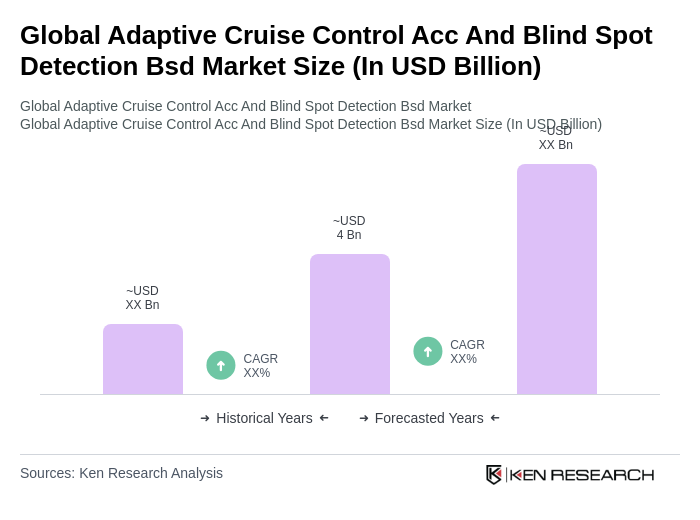
- The Global Adaptive Cruise Control (ACC) and Blind Spot Detection (BSD) market is valued at approximately USD 4 billion, based on a five-year historical analysis, aligning with multiple recent industry estimates that place the combined ACC+BSD market in the low?single?digit billions globally. This growth is primarily driven by the increasing demand for advanced driver-assistance systems (ADAS) in vehicles, which enhance safety and convenience for drivers. The rising awareness of road safety and the integration of smart technologies in automobiles are significant factors contributing to this market's expansion.
- Key players in this market are predominantly located in North America, Europe, and Asia-Pacific. Countries like the United States, Germany, and Japan lead the market due to their strong automotive industries, technological advancements, and high consumer demand for safety features. The presence of major automotive manufacturers and suppliers in these regions further solidifies their dominance in the ACC and BSD market.
- In 2023, the European Union implemented stringent regulations mandating the inclusion of advanced safety features in new vehicles; the EU General Safety Regulation requires a broad set of ADAS features to be fitted to new models and new registrations in phased timelines, which has accelerated adoption of systems such as intelligent speed assistance, lane-keeping, and blind spot-related functions across segments. While ACC is not universally mandated as a standalone feature, the regulation’s ADAS package requirements and Euro NCAP protocols have effectively increased fitment of ACC and BSD across new vehicles in Europe.
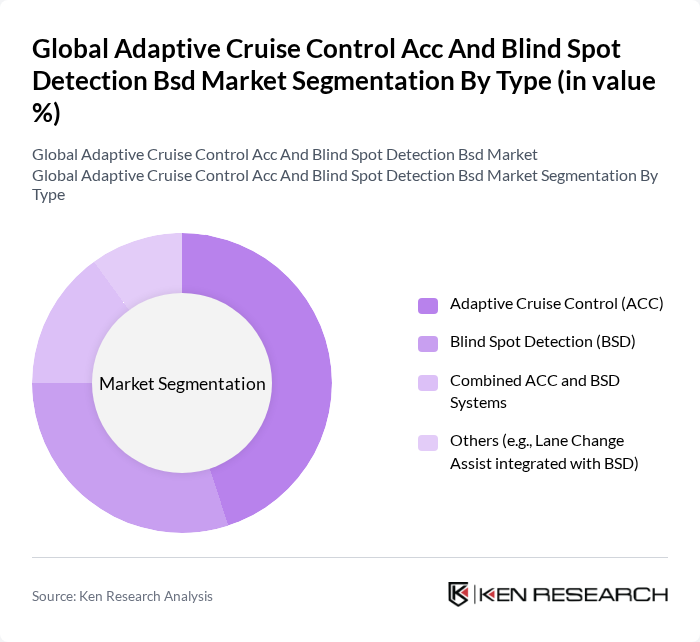
Global Adaptive Cruise Control Acc And Blind Spot Detection Bsd Market Segmentation
By Type:The market is segmented into four main types: Adaptive Cruise Control (ACC), Blind Spot Detection (BSD), Combined ACC and BSD Systems, and Others (e.g., Lane Change Assist integrated with BSD). Among these, Adaptive Cruise Control (ACC) is the leading sub-segment, driven by its growing popularity in passenger vehicles and the increasing focus on enhancing driving comfort and safety. The demand for ACC systems is fueled by consumer preferences for automated driving features, increasing OEM fitment rates, and integration with multi-sensor ADAS suites.
By End-User:The market is categorized into Passenger Vehicles, Commercial Vehicles (LCV and HCV), Fleet Operators and Mobility Services, and Others. The Passenger Vehicles segment dominates the market, driven by the increasing consumer demand for safety features and the growing trend of integrating advanced technologies in personal vehicles. As consumers become more safety-conscious, the adoption of ACC and BSD systems in passenger vehicles is expected to continue to rise, supported by OEM standardization in higher trims and regional safety regulations.

Global Adaptive Cruise Control Acc And Blind Spot Detection Bsd Market Competitive Landscape
The Global Adaptive Cruise Control Acc And Blind Spot Detection Bsd Market is characterized by a dynamic mix of regional and international players. Leading participants such as Robert Bosch GmbH, Continental AG, DENSO Corporation, ZF Friedrichshafen AG, Valeo SA, Aptiv PLC, NXP Semiconductors N.V., Mobileye Global Inc., Magna International Inc., Hyundai Mobis Co., Ltd., Panasonic Holdings Corporation, Texas Instruments Incorporated, Infineon Technologies AG, STMicroelectronics N.V., Toshiba Electronic Devices & Storage Corporation, Hella GmbH & Co. KGaA (FORVIA HELLA), Autoliv, Inc., Veoneer AB, Renesas Electronics Corporation, ON Semiconductor Corporation (onsemi) contribute to innovation, geographic expansion, and service delivery in this space.
Global Adaptive Cruise Control Acc And Blind Spot Detection Bsd Market Industry Analysis
Growth Drivers
- Increasing Demand for Vehicle Safety Features:The global automotive safety market is projected to reach $130 billion in future, driven by heightened consumer demand for advanced safety features. In future, 80% of consumers indicated that safety features significantly influence their vehicle purchasing decisions. This trend is further supported by a 20% increase in insurance premiums for vehicles lacking advanced safety systems, highlighting the economic incentive for manufacturers to integrate adaptive cruise control and blind spot detection technologies.
- Technological Advancements in Automotive Systems:The automotive industry is experiencing rapid technological advancements, with investments in R&D reaching $110 billion in future. Innovations in sensor technology and AI are enhancing the capabilities of adaptive cruise control and blind spot detection systems. For instance, the introduction of LIDAR technology has improved detection accuracy by 35%, making these systems more reliable and appealing to consumers, thereby driving market growth.
- Government Regulations Promoting Advanced Driver-Assistance Systems:In future, over 25 countries are expected to implement regulations mandating advanced driver-assistance systems (ADAS) in new vehicles. The European Union's General Safety Regulation, effective from 2022, requires features like blind spot detection in all new models. This regulatory push is projected to increase the adoption rate of adaptive cruise control systems by 45% in the next two years, significantly impacting market dynamics.
Market Challenges
- High Costs Associated with Advanced Systems:The integration of adaptive cruise control and blind spot detection systems can increase vehicle costs by approximately $1,600 to $3,200. This price sensitivity is particularly pronounced in emerging markets, where the average vehicle price is around $16,000. Consequently, manufacturers face challenges in justifying these costs to price-sensitive consumers, potentially hindering market penetration.
- Consumer Skepticism Towards Automated Systems:Despite advancements, consumer skepticism remains a significant barrier, with 65% of potential buyers expressing concerns about the reliability of automated systems. This skepticism is exacerbated by high-profile accidents involving autonomous vehicles, leading to a cautious approach among consumers. Addressing these concerns through education and transparent communication is essential for increasing acceptance and driving market growth.
Global Adaptive Cruise Control Acc And Blind Spot Detection Bsd Market Future Outlook
The future of the adaptive cruise control and blind spot detection market appears promising, driven by ongoing technological innovations and increasing regulatory support. As manufacturers invest in AI and machine learning, the integration of these systems into vehicles will become more seamless and efficient. Additionally, the growing trend towards electric and autonomous vehicles will further accelerate the adoption of advanced safety features, creating a robust market environment that prioritizes safety and connectivity.
Market Opportunities
- Expansion in Emerging Markets:Emerging markets, particularly in Asia-Pacific, are witnessing a surge in vehicle sales, projected to reach 60 million units in future. This growth presents significant opportunities for manufacturers to introduce adaptive cruise control and blind spot detection systems, catering to a growing middle class increasingly prioritizing safety features in their vehicle purchases.
- Development of Cost-Effective Solutions:The demand for cost-effective safety solutions is rising, with manufacturers focusing on reducing production costs by 25% through innovative materials and manufacturing processes. This shift will enable broader market access, allowing more consumers to benefit from advanced safety technologies, thereby expanding the overall market reach and enhancing competitive positioning.
Scope of the Report
| Segment | Sub-Segments |
|---|---|
| By Type | Adaptive Cruise Control (ACC) Blind Spot Detection (BSD) Combined ACC and BSD Systems Others (e.g., Lane Change Assist integrated with BSD) |
| By End-User | Passenger Vehicles Commercial Vehicles (LCV and HCV) Fleet Operators and Mobility Services Others |
| By Vehicle Type | Sedans SUVs and Crossovers Trucks and Buses Others |
| By Sales Channel | OEMs Aftermarket Online Sales (e-commerce and OEM portals) Others |
| By Technology/Sensor | RADAR-based Systems Camera/Vision-based Systems LiDAR-based Systems Ultrasonic and Sensor Fusion |
| By Autonomy/Operation Mode | Normal ACC (standalone) Connected/Cooperative ACC (C-ACC/V2X-enabled) Adaptive Lane Change & Blind Spot Assist Packages |
| By Price Range | Entry/Mid (mass-market trims) Premium (advanced sensor suites) Luxury (integrated ADAS stacks) |
| By Region | North America Europe Asia Pacific Latin America Middle East & Africa |
Key Target Audience
Investors and Venture Capitalist Firms
Government and Regulatory Bodies (e.g., National Highway Traffic Safety Administration, European Commission)
Automotive Manufacturers
Tier 1 Suppliers
Insurance Companies
Automotive Technology Developers
Fleet Management Companies
Automotive Aftermarket Service Providers
Players Mentioned in the Report:
Robert Bosch GmbH
Continental AG
DENSO Corporation
ZF Friedrichshafen AG
Valeo SA
Aptiv PLC
NXP Semiconductors N.V.
Mobileye Global Inc.
Magna International Inc.
Hyundai Mobis Co., Ltd.
Panasonic Holdings Corporation
Texas Instruments Incorporated
Infineon Technologies AG
STMicroelectronics N.V.
Toshiba Electronic Devices & Storage Corporation
Hella GmbH & Co. KGaA (FORVIA HELLA)
Autoliv, Inc.
Veoneer AB
Renesas Electronics Corporation
ON Semiconductor Corporation (onsemi)
Table of Contents
Market Assessment Phase
1. Executive Summary and Approach
2. Global Adaptive Cruise Control Acc And Blind Spot Detection Bsd Market Overview
2.1 Key Insights and Strategic Recommendations
2.2 Global Adaptive Cruise Control Acc And Blind Spot Detection Bsd Market Overview
2.3 Definition and Scope
2.4 Evolution of Market Ecosystem
2.5 Timeline of Key Regulatory Milestones
2.6 Value Chain & Stakeholder Mapping
2.7 Business Cycle Analysis
2.8 Policy & Incentive Landscape
3. Global Adaptive Cruise Control Acc And Blind Spot Detection Bsd Market Analysis
3.1 Growth Drivers
3.1.1 Increasing demand for vehicle safety features
3.1.2 Technological advancements in automotive systems
3.1.3 Rising consumer awareness regarding road safety
3.1.4 Government regulations promoting advanced driver-assistance systems
3.2 Market Challenges
3.2.1 High costs associated with advanced systems
3.2.2 Integration complexities with existing vehicle models
3.2.3 Consumer skepticism towards automated systems
3.2.4 Regulatory hurdles in different regions
3.3 Market Opportunities
3.3.1 Expansion in emerging markets
3.3.2 Development of cost-effective solutions
3.3.3 Partnerships with technology firms
3.3.4 Increasing demand for electric and autonomous vehicles
3.4 Market Trends
3.4.1 Growing adoption of AI in automotive safety
3.4.2 Shift towards integrated vehicle systems
3.4.3 Rise in consumer preference for connected vehicles
3.4.4 Focus on sustainability and eco-friendly technologies
3.5 Government Regulation
3.5.1 Mandates for safety features in new vehicles
3.5.2 Incentives for manufacturers adopting advanced technologies
3.5.3 Standards for performance and reliability of systems
3.5.4 Regulations on data privacy and cybersecurity in vehicles
4. SWOT Analysis
5. Stakeholder Analysis
6. Porter's Five Forces Analysis
7. Global Adaptive Cruise Control Acc And Blind Spot Detection Bsd Market Market Size, 2019-2024
7.1 By Value
7.2 By Volume
7.3 By Average Selling Price
8. Global Adaptive Cruise Control Acc And Blind Spot Detection Bsd Market Segmentation
8.1 By Type
8.1.1 Adaptive Cruise Control (ACC)
8.1.2 Blind Spot Detection (BSD)
8.1.3 Combined ACC and BSD Systems
8.1.4 Others (e.g., Lane Change Assist integrated with BSD)
8.2 By End-User
8.2.1 Passenger Vehicles
8.2.2 Commercial Vehicles (LCV and HCV)
8.2.3 Fleet Operators and Mobility Services
8.2.4 Others
8.3 By Vehicle Type
8.3.1 Sedans
8.3.2 SUVs and Crossovers
8.3.3 Trucks and Buses
8.3.4 Others
8.4 By Sales Channel
8.4.1 OEMs
8.4.2 Aftermarket
8.4.3 Online Sales (e-commerce and OEM portals)
8.4.4 Others
8.5 By Technology/Sensor
8.5.1 RADAR-based Systems
8.5.2 Camera/Vision-based Systems
8.5.3 LiDAR-based Systems
8.5.4 Ultrasonic and Sensor Fusion
8.6 By Autonomy/Operation Mode
8.6.1 Normal ACC (standalone)
8.6.2 Connected/Cooperative ACC (C-ACC/V2X-enabled)
8.6.3 Adaptive Lane Change & Blind Spot Assist Packages
8.7 By Price Range
8.7.1 Entry/Mid (mass-market trims)
8.7.2 Premium (advanced sensor suites)
8.7.3 Luxury (integrated ADAS stacks)
8.8 By Region
8.8.1 North America
8.8.2 Europe
8.8.3 Asia Pacific
8.8.4 Latin America
8.8.5 Middle East & Africa
9. Global Adaptive Cruise Control Acc And Blind Spot Detection Bsd Market Competitive Analysis
9.1 Market Share of Key Players
9.2 Cross Comparison of Key Players
9.2.1 Company Name
9.2.2 Group Size (Large, Medium, or Small as per industry convention)
9.2.3 ADAS Segment Revenue (USD) and Growth Rate
9.2.4 ACC/BSD Program Wins with Global OEMs (count)
9.2.5 ACC Take-Rate in OEM Programs (%)
9.2.6 Average System ASP (ACC/BSD module, USD)
9.2.7 Sensor Mix Share (% RADAR / Camera / LiDAR)
9.2.8 Patent Portfolio Strength (ACC/BSD-related, active families)
9.2.9 Geographic Revenue Mix (% by region)
9.2.10 Quality/Reliability KPIs (PPM defect rate, warranty claims)
9.2.11 Production Capacity/Shipments (units of ACC/BSD annually)
9.2.12 R&D Intensity (% of revenue)
9.3 SWOT Analysis of Top Players
9.4 Pricing Analysis
9.5 Detailed Profile of Major Companies
9.5.1 Robert Bosch GmbH
9.5.2 Continental AG
9.5.3 DENSO Corporation
9.5.4 ZF Friedrichshafen AG
9.5.5 Valeo SA
9.5.6 Aptiv PLC
9.5.7 NXP Semiconductors N.V.
9.5.8 Mobileye Global Inc.
9.5.9 Magna International Inc.
9.5.10 Hyundai Mobis Co., Ltd.
9.5.11 Panasonic Holdings Corporation
9.5.12 Texas Instruments Incorporated
9.5.13 Infineon Technologies AG
9.5.14 STMicroelectronics N.V.
9.5.15 Toshiba Electronic Devices & Storage Corporation
9.5.16 Hella GmbH & Co. KGaA (FORVIA HELLA)
9.5.17 Autoliv, Inc.
9.5.18 Veoneer AB
9.5.19 Renesas Electronics Corporation
9.5.20 ON Semiconductor Corporation (onsemi)
10. Global Adaptive Cruise Control Acc And Blind Spot Detection Bsd Market End-User Analysis
10.1 Procurement Behavior of Key Ministries
10.1.1 Government Fleet Purchases
10.1.2 Safety Standards Compliance
10.1.3 Budget Allocation for Vehicle Safety
10.2 Corporate Spend on Infrastructure & Energy
10.2.1 Investment in Fleet Upgrades
10.2.2 Budget for Safety Features
10.2.3 Expenditure on Training and Development
10.3 Pain Point Analysis by End-User Category
10.3.1 Cost of Implementation
10.3.2 Reliability Concerns
10.3.3 Integration with Existing Systems
10.4 User Readiness for Adoption
10.4.1 Awareness of Benefits
10.4.2 Training Needs
10.4.3 Perceived Value of Technology
10.5 Post-Deployment ROI and Use Case Expansion
10.5.1 Measurement of Safety Improvements
10.5.2 Cost Savings Analysis
10.5.3 Expansion into New Use Cases
11. Global Adaptive Cruise Control Acc And Blind Spot Detection Bsd Market Future Size, 2025-2030
11.1 By Value
11.2 By Volume
11.3 By Average Selling Price
Go-To-Market Strategy Phase
1. Whitespace Analysis + Business Model Canvas
1.1 Market Gaps Identification
1.2 Business Model Framework
2. Marketing and Positioning Recommendations
2.1 Branding Strategies
2.2 Product USPs
3. Distribution Plan
3.1 Urban Retail Strategies
3.2 Rural NGO Tie-ups
4. Channel & Pricing Gaps
4.1 Underserved Routes
4.2 Pricing Bands Analysis
5. Unmet Demand & Latent Needs
5.1 Category Gaps
5.2 Consumer Segments
6. Customer Relationship
6.1 Loyalty Programs
6.2 After-sales Service
7. Value Proposition
7.1 Sustainability Initiatives
7.2 Integrated Supply Chains
8. Key Activities
8.1 Regulatory Compliance
8.2 Branding Efforts
8.3 Distribution Setup
9. Entry Strategy Evaluation
9.1 Domestic Market Entry Strategy
9.1.1 Product Mix Considerations
9.1.2 Pricing Band Strategy
9.1.3 Packaging Options
9.2 Export Entry Strategy
9.2.1 Target Countries
9.2.2 Compliance Roadmap
10. Entry Mode Assessment
10.1 Joint Ventures
10.2 Greenfield Investments
10.3 Mergers & Acquisitions
10.4 Distributor Model
11. Capital and Timeline Estimation
11.1 Capital Requirements
11.2 Timelines for Implementation
12. Control vs Risk Trade-Off
12.1 Ownership Considerations
12.2 Partnerships Evaluation
13. Profitability Outlook
13.1 Breakeven Analysis
13.2 Long-term Sustainability Strategies
14. Potential Partner List
14.1 Distributors
14.2 Joint Ventures
14.3 Acquisition Targets
15. Execution Roadmap
15.1 Phased Plan for Market Entry
15.1.1 Market Setup
15.1.2 Market Entry
15.1.3 Growth Acceleration
15.1.4 Scale & Stabilize
15.2 Key Activities and Milestones
15.2.1 Milestone Planning
15.2.2 Activity Tracking
Research Methodology
Phase 1: Approach1
Desk Research
- Industry reports from automotive safety organizations and market research firms
- Government publications on vehicle safety regulations and standards
- Academic journals and white papers on adaptive cruise control and blind spot detection technologies
Primary Research
- Interviews with automotive engineers specializing in driver assistance systems
- Surveys with fleet managers regarding the adoption of ACC and BSD technologies
- Focus groups with consumers to gauge perceptions and acceptance of these technologies
Validation & Triangulation
- Cross-validation of findings with industry expert opinions and market trends
- Triangulation of data from sales figures, regulatory changes, and technological advancements
- Sanity checks through feedback from a panel of automotive industry experts
Phase 2: Market Size Estimation1
Top-down Assessment
- Analysis of global automotive sales data to estimate market penetration of ACC and BSD
- Segmentation of the market by vehicle type, region, and technology adoption rates
- Incorporation of trends in consumer preferences towards advanced driver-assistance systems (ADAS)
Bottom-up Modeling
- Estimation of unit sales based on OEM production data and aftermarket installations
- Cost analysis of ACC and BSD systems to determine pricing strategies
- Volume x price calculations to derive revenue projections for the market
Forecasting & Scenario Analysis
- Multi-variable forecasting using historical growth rates and technological advancements
- Scenario analysis based on regulatory impacts and shifts in consumer behavior
- Development of baseline, optimistic, and pessimistic market growth scenarios through 2030
Phase 3: CATI Sample Composition1
| Scope Item/Segment | Sample Size | Target Respondent Profiles |
|---|---|---|
| Automotive OEMs | 120 | Product Development Managers, Safety Compliance Officers |
| Aftermarket Suppliers | 90 | Sales Directors, Technical Support Managers |
| Fleet Management Companies | 80 | Fleet Operations Managers, Safety Directors |
| Consumer Focus Groups | 60 | General Consumers, Early Adopters of Automotive Technology |
| Automotive Safety Regulators | 50 | Policy Makers, Regulatory Affairs Specialists |
Frequently Asked Questions
What is the current value of the Global Adaptive Cruise Control (ACC) and Blind Spot Detection (BSD) market?
The Global Adaptive Cruise Control (ACC) and Blind Spot Detection (BSD) market is valued at approximately USD 4 billion, driven by the increasing demand for advanced driver-assistance systems (ADAS) that enhance vehicle safety and convenience.
What factors are driving the growth of the ACC and BSD market?
Which regions are leading in the ACC and BSD market?
What are the main types of systems in the ACC and BSD market?
Other Regional/Country Reports
Indonesia Adaptive Cruise Control Acc And Blind Spot Detection Bsd Market
Malaysia Adaptive Cruise Control Acc And Blind Spot Detection Bsd Market
APAC Adaptive Cruise Control Acc And Blind Spot Detection Bsd Market
SEA Adaptive Cruise Control Acc And Blind Spot Detection Bsd Market
Why Buy From Us?

What makes us stand out is that our consultants follow Robust, Refine and Result (RRR) methodology. Robust for clear definitions, approaches and sanity checking, Refine for differentiating respondents' facts and opinions, and Result for presenting data with story.

We have set a benchmark in the industry by offering our clients with syndicated and customized market research reports featuring coverage of entire market as well as meticulous research and analyst insights.

While we don't replace traditional research, we flip the method upside down. Our dual approach of Top Bottom & Bottom Top ensures quality deliverable by not just verifying company fundamentals but also looking at the sector and macroeconomic factors.

With one step in the future, our research team constantly tries to show you the bigger picture. We help with some of the tough questions you may encounter along the way: How is the industry positioned? Best marketing channel? KPI's of competitors? By aligning every element, we help maximize success.

Our report gives you instant access to the answers and sources that other companies might choose to hide. We elaborate each steps of research methodology we have used and showcase you the sample size to earn your trust.

If you need any support, we are here! We pride ourselves on universe strength, data quality, and quick, friendly, and professional service.